A network portal of Wine Idea. Discover the world of Wine idea

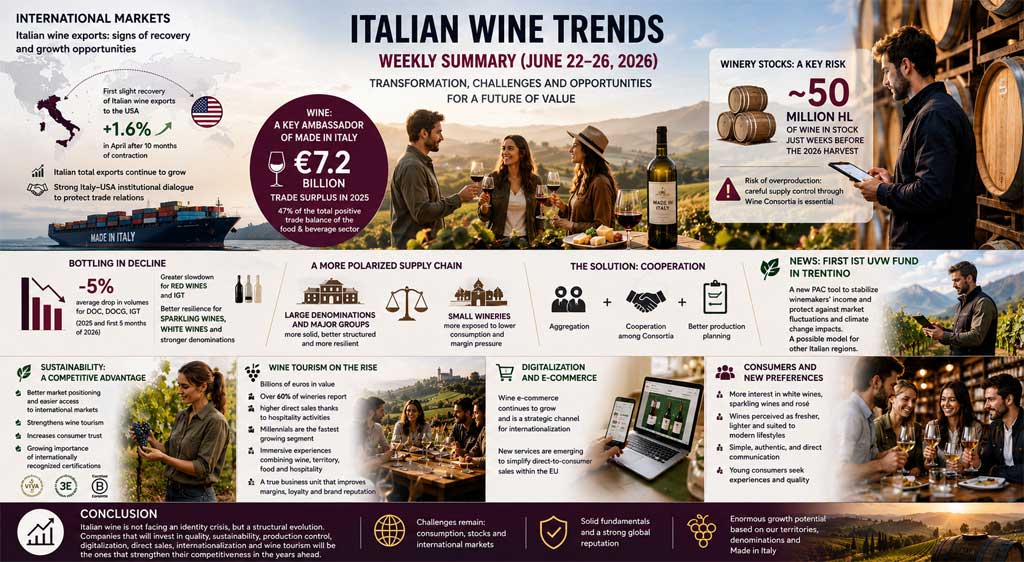
Wine Trends in Italy – Weekly Summary June 22–26 -2026

The Italian wine sector is undergoing a phase of profound transformation.

This week’s data confirms a more complex market than in previous years, but also one rich in opportunities for companies that can adapt to new scenarios.
On the international front, some encouraging signs are emerging. Exports of Made in Italy products continue to represent one of the main strengths of the national economy, and the United States remains the most important strategic market. After ten months of contraction, April saw the first slight recovery in Italian wine exports to the US (1.6%), although the first quarterly balance remains negative. At the same time, overall Italian exports continue to grow, and institutional dialogue between Italy and the United States remains solid, a key element for preserving trade relations.

Wine confirms its central role in the Italian economy. In 2025, it generated a positive trade balance of approximately €7.2 billion, representing nearly 47% of the entire positive balance of the food and beverage sector. This confirms that wine continues to be one of the main ambassadors of Made in Italy around the world.

However, structural challenges remain. Bottling volumes are expected to decline both in 2025 and in the first five months of 2026. DOC, DOCG, and IGT denominations are recording an average decline in volumes of around 5%, which is still considered manageable but indicative of weaker international demand. Red wines and IGTs are suffering the most, while sparkling wines, white wines, and some stronger denominations are holding up better.

Another area requiring attention concerns cellar inventories. In Italy, there are nearly 50 million hectoliters of wine in stock just weeks before the 2026 harvest, a situation that increases the risk of overproduction and makes it increasingly necessary to carefully monitor supply through the protection consortia.

Valoritalia’s analyses also highlight an increasingly polarized supply chain: on the one hand, large denominations and groups capable of better addressing market challenges are growing, while on the other, small companies are more exposed to declining consumption and pressure on margins. Aggregation, cooperation between consortia, and improved production planning are therefore becoming strategic.

Among the most important developments of the week is the launch of the first IST Grape Fund in Trentino, a new instrument provided by the CAP to stabilize the income of wineries and protect them from market fluctuations and the effects of climate change. It could become a model for other Italian regions as well.

Sustainability remains one of the key competitive factors of the future. It is no longer considered merely an environmental value, but a tool capable of improving commercial positioning, facilitating access to international markets, strengthening wine tourism, and increasing consumer confidence. The importance of internationally recognized certifications is also growing.

Wine tourism continues to represent one of the most interesting drivers of growth. Winery visits now generate billions of euros in value, and over 60% of companies report an increase in direct sales thanks to hospitality activities. Millennials are the fastest-growing segment, and demand is increasingly shifting toward immersive experiences that integrate wine, local produce, food, and hospitality. For many companies, wine tourism is no longer an ancillary activity but a true business unit capable of improving margins, loyalty, and brand awareness.

Digital commerce also continues to grow. Wine e-commerce continues to be a strategic channel for internationalization, and new services are emerging to simplify direct sales within the European Union.

From a consumer perspective, changing preferences continue. Interest in white, sparkling, and rosé wines is growing, perceived as fresher, lighter, and more suited to new consumption styles. Younger consumers are demanding simpler, more direct, and less technical communication, prioritizing authenticity, experiences, and quality over traditional messaging.

Conclusion

Italian wine is not experiencing an identity crisis but rather a phase of structural evolution. Companies that invest in quality, sustainability, production control, digitalization, direct sales, internationalization, and wine tourism in the coming years will be the ones that consolidate their competitiveness. Critical issues related to consumption, inventory, and international markets remain, but the sector maintains solid economic fundamentals, a strong global reputation, and enormous growth potential based on the value of its territories, appellations, and Made in Italy.
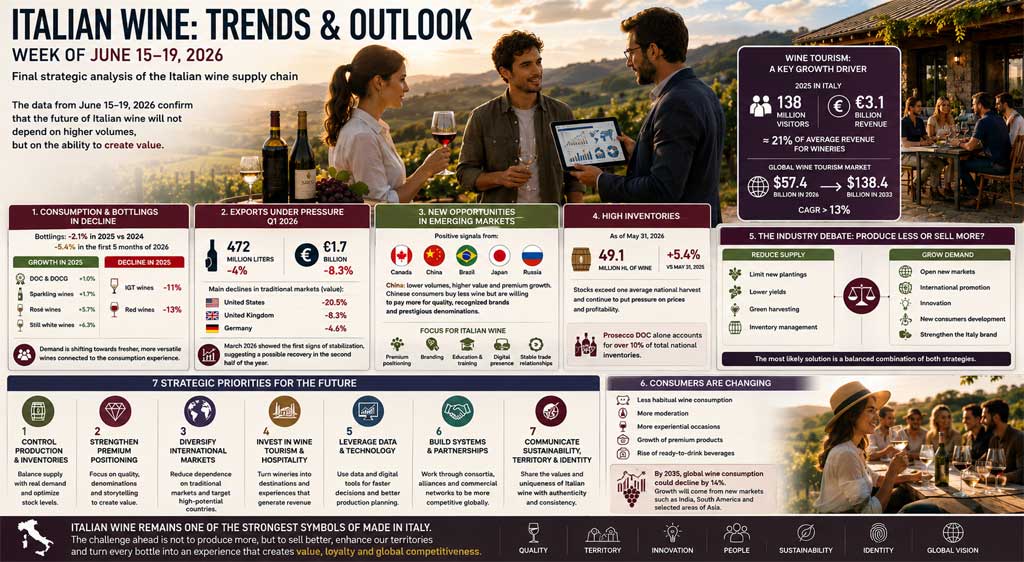
Wine Trends and Performance in Italy – Week of June 15-19 – 2026

A final, concise and strategic analysis of the Italian wine industry.
The Italian wine sector continues to experience a phase of profound transformation.
The data released during the week of June 15-19, 2026, confirm that the market is not experiencing a temporary crisis, but rather a structural change affecting consumption, exports, production, and business models.

Consumption and bottling in decline

After the growth recorded in the years following the pandemic, 2025 saw a 2.1% reduction in bottlings, followed by a further 5.4% decline in the first five months of 2026.

Consumers are changing their habits and the market is increasingly rewarding products with high added value:

DOC and DOCG: 1%
Sparkling wines: 1.7%
Rosé: 5.7%
Still whites: 6.3%

In difficulty instead:

IGT wines: -11%
Red wines: -13%

Demand is shifting towards fresher, more versatile wines that are more closely linked to the drinking experience.

Exports still under pressure

In the first quarter of 2026, Italian wine exports stood at:

472 million liters (-4%)
1.7 billion euros (-8.3%)

The biggest difficulties come from traditional markets:

United States: -20.5% in value
United Kingdom: -8.3%
Germany: -4.6%

The combined effect of tariffs, inflation, geopolitical tensions, and the economic slowdown continues to weigh on Italian exports.

However, March 2026 showed the first signs of stabilization, suggesting a possible trend reversal in the second half of the year.

Markets that offer new opportunities

Not all markets are slowing down.

The most interesting signals come from:

Canada
China
Brazil
Japan
Russia

China is particularly significant, where volumes are declining but the premium segment is growing. Chinese consumers are buying less wine but are willing to spend more for quality products, recognizable brands, and prestigious denominations.

For Italian wine this means focusing more on:

premium positioning;
branding;
training;
digital presence;
stable trade relations.

Stocks still high

Italian wine inventories remain above normal levels.

As of May 31, 2026, the following are present:

49.1 million hectoliters of wine
5.4% compared to 2025

Inventories still represent more than the national average harvest and continue to put pressure on prices and the profitability of the supply chain.

Prosecco DOC alone represents over 10% of national supplies.

The supply chain debate: produce less or sell more?

The comparison between trade organizations, consortia, and institutions revolves around two main strategies:

Reduce the offer

limitation of new installations;
reduction of yields;
green harvest;
inventory management.

Increase demand

opening of new markets;
international promotion;
innovation;
development of new consumers;
enhancement of the Italian brand.

The most likely solution will be a balanced combination of the two strategies.

Wine tourism: the real driver of growth

While wine slows down, wine tourism continues to grow.

In 2025 in Italy it generated:

138 million visitors
3.1 billion euros in turnover

equal to approximately 21% of the average turnover of the companies involved.

Globally, wine tourism should reach:

$57.4 billion in 2026
$138.4 billion in 2033

with an average annual growth of more than 13%.

For many wineries, wine tourism is becoming a strategic source of income, complementary to wine sales.

Consumers are changing

International research confirms a now consolidated trend:

decreases habitual wine consumption;
moderation is growing;
experiential consumption opportunities are increasing;
premium products are growing;
ready-to-drink beverages are increasing.

By 2035, global wine consumption could decline by 14%, while growth will shift to new markets such as India, South America and some areas of Asia.

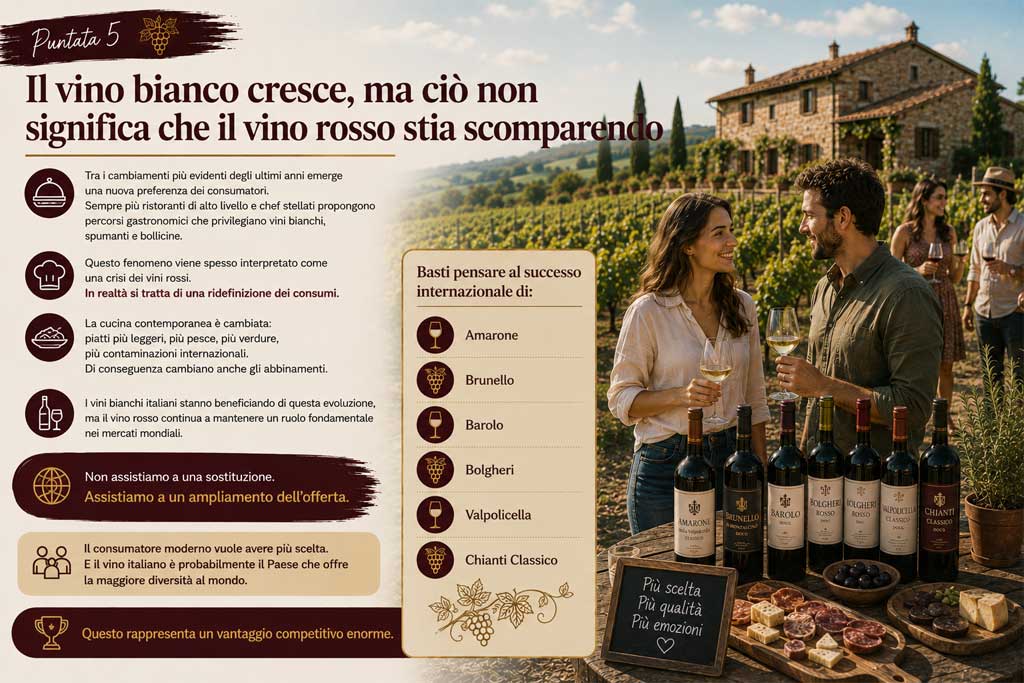
Episode 5 – Wine is not in crisis.

White wine is growing, but that doesn’t mean red wine is disappearing.
Among the most evident changes in recent years is a new consumer preference.
More and more high-end restaurants and starred chefs are offering gastronomic itineraries that emphasize white, sparkling, and bubbly wines.

This phenomenon is often interpreted as a red wine crisis.

In reality, it is a redefinition of consumption.

Contemporary cuisine has changed: lighter dishes, more fish, more vegetables, more international influences.

As a result, the pairings also change.

Italian white wines are benefiting from this evolution, but red wine continues to play a fundamental role in world markets.

Just think of the international success of:

Amarone
Brunello
Barolo
Bolgheri
Valpolicella
Chianti Classico

We are not witnessing a substitution.

We are witnessing an expansion of the offer.

The modern consumer wants more choice.

And Italian wine is probably the country that offers the greatest diversity in the world.

This represents a huge competitive advantage.

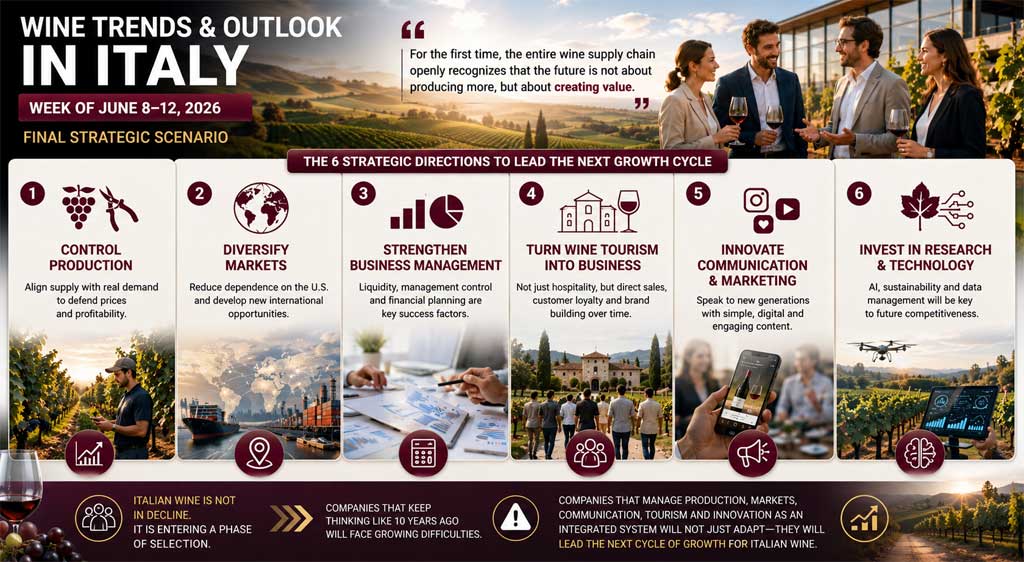
Wine Trends and Performance in Italy – Week of June 8-12 – 2026

Final strategic scenario for wineries, entrepreneurs, and investors.
The week of June 8-12, 2026, confirms a structural change in the Italian wine sector.
We are not facing a crisis in wine as a product, but a profound transformation of the entire economic, production, and commercial model that has supported the sector’s growth over the last twenty years.

The signals are coming from the entire supply chain:

increase in stocks in cellars;
slowdown in global consumption;
contraction of exports to some historical markets;
pressure on bulk prices;
growing financial difficulties for many companies;
need to reduce production to restore the balance between supply and demand.

At the same time, new opportunities are emerging related to emerging markets, wine tourism, innovation, research, and new communication models.

1. The sector chooses production containment

The biggest news of the week is the green light from the National Council of the Italian Wine Union (Unione Italiana Vini) for the national production containment plan.

The main measures envisaged are:

temporary halt to new vineyard plantings;
reduction in production yields;
revision of the specifications;
greater control over reclassifications;
strengthening of sanctioning systems;
5-10 year national strategic plan.

The decision stems from numbers that can no longer be ignored:

7.6% of stocks in Italian cellars;
-7% prices of bulk DOP and IGP wines;
-11% extra-EU exports in the first quarter of 2026;
approximately 57 million hectolitres present in the cellars.

The message is clear:

Today the problem is not to produce more, but to produce better and sell better.

2. Wine is not in crisis: the old model is in crisis

One of the most interesting reflections of recent years emerges from the Envisioning 2035 summit:

“It’s not wine itself that’s in crisis, but the old way of thinking about it, selling it, and talking about it.”

Businesses that continue to rely exclusively on:

traditional fairs;
historical distributors;
domestic market;
notoriety of the denomination;

are encountering increasing difficulties.

Consumers are changing faster than businesses.

Today wine competes not only with other wines but with:

cocktail;
premium spirits;
craft beers;
ready-to-drink beverages;
new opportunities for socialising.

For this reason the following become fundamental:

digital communication;
community;
e-commerce;
storytelling;
simple and understandable content;
immersive experiences.

3. Wine tourism: from hospitality to profitability driver

One of the most interesting data concerns wine tourism.

The sector now generates over 3.1 billion euros for Italian wineries.

However, simply opening the cellar to visitors is no longer enough.

Wine tourism must become:

customer acquisition;
loyalty;
direct sales;
brand building;
continuous experience over time.

Companies that can transform visitors into repeat customers will have a significant competitive advantage.

4. Exports: slowing but Made in Italy remains very strong

Export data continue to show difficulties.

The slowdown in the United States was particularly severe:

Italian wine: -38%;
spirits: -55%;
vinegars: -35%.

However, a very encouraging fact emerges.

In the United States:

59% of consumers consider Made in Italy to be the best among foreign products;
39% consider Italian alcoholic drinks to be the best in terms of quality;
over 90% continue to purchase Italian products despite the tariffs.

This means that the current problem is not the reputation of Italian wine.

The problem is geopolitical, logistical and commercial.

5. Emerging markets increasingly strategic

In recent years, the weight of emerging markets on Italian exports has increased:

from 15.1% to 19.5%.

Among the areas that are growing:

South Korea;
Thailand;
Romania;
Colombia;
Peru;
United Arab Emirates;
Kazakhstan;
Poland.

For many companies, the future will not be to replace the United States but to reduce their dependence on it.

6. The strongest companies are the best organized ones

One of the strongest findings of the week concerns corporate management.

Analyses of the main Italian wineries show that:

over 50% of companies are experiencing reductions in revenues and margins;
financial difficulties increase;
the importance of cash management is growing.

The companies that resist best are those that have:

structured governance;
management control;
financial planning;
diversified exports;
organized sales force.

Real estate assets or the value of vineyards are no longer enough.

The ability to generate liquidity is increasingly important.

7. Innovation, research and artificial intelligence

One of the most positive pieces of news comes from the Wine Research Team.

Research projects worth approximately 27 million euros have been activated, dedicated to:

sustainability;
production efficiency;
data management;
artificial intelligence;
new technologies applied to the vineyard and the cellar.

AI is not seen as a replacement for humans but as a decision support.

Companies that invest in data management will have significant advantages in terms of:

efficiency;
sustainability;
cost reduction;
competitiveness.

8. Wine remains the leader in Italian agri-food

Despite the slowdown, wine remains the leading sector of Italian agri-food exports.

In 2025:

wine district exports: 6.4 billion euros;
absolute leadership among all Italian agri-food sectors.

Some territories still show excellent performances:

Friuli: 7%;
Bolzano: 1.9%;
Bresciano: 27.9%.

A sign that the market continues to reward areas capable of innovating and differentiating themselves.

Style Selector
Select the layout
Choose the theme
Preset colors
No Preset
Select the pattern