

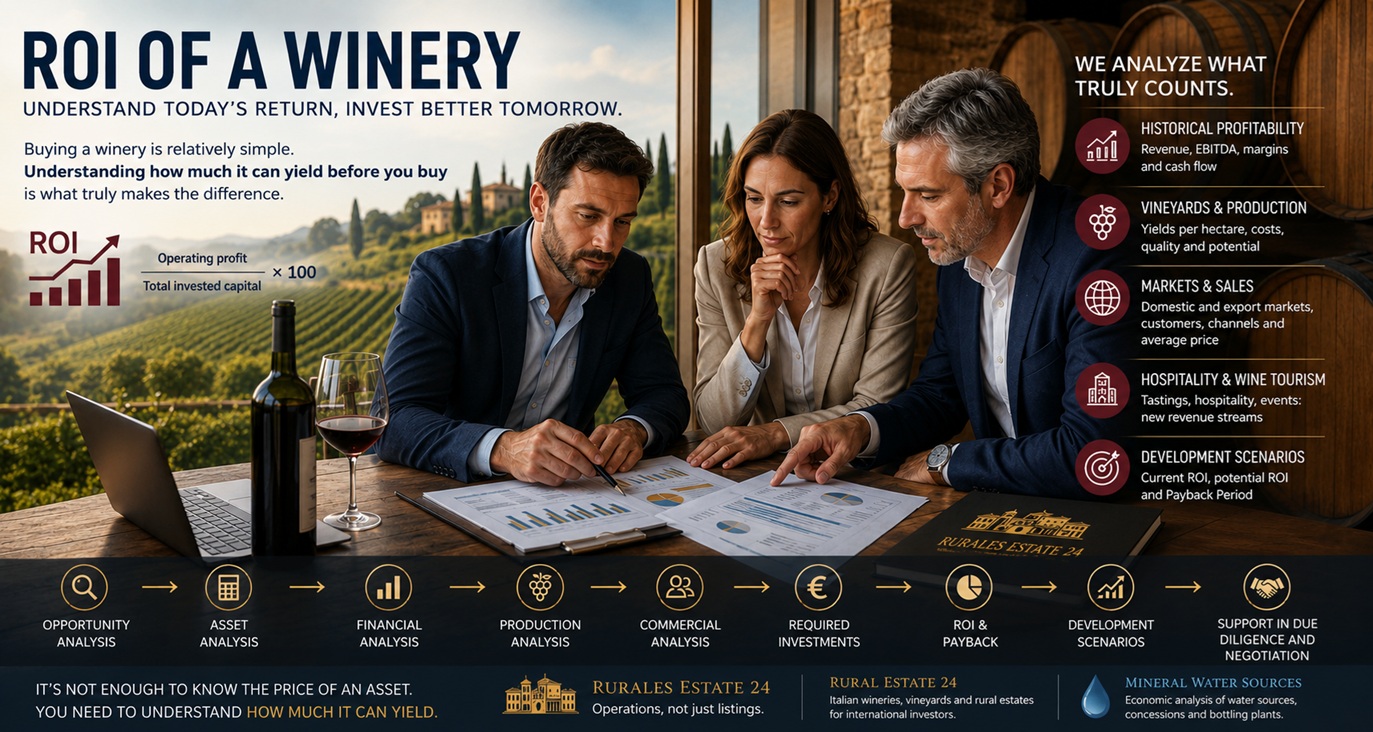
ROI OF A WINERY
How much can an investment in a winery or wine business really return?
Buying a winery is relatively straightforward. Understanding how much it can realistically return before acquiring it is far more important.
The value of a wine business is not determined solely by vineyard acreage, buildings, winery facilities, equipment or the number of bottles produced.
For an entrepreneur, wine group, investor or family office, the key question is different:
How much capital will I need to invest, and what economic return can I realistically expect from the transaction?
The “Winery ROI” service was created to answer precisely this question.
Rural Estate 24 supports investors, entrepreneurs and industry operators in the economic, financial, asset, production and commercial analysis of wineries and wine estates, with one clear objective: to assess the potential return on the investment before proceeding with an acquisition.
What is the ROI of a winery?
ROI – Return on Investment measures the return generated in relation to the capital invested.
The basic formula is simple:
ROI = Operating Return on Investment / Total Capital Invested × 100
Applying it correctly to a winery, however, is far more complex.
A wine business is simultaneously:
- an agricultural business;
- a production operation;
- a commercial enterprise;
- a real estate asset;
- a portfolio of vineyards;
- a collection of brands and products;
- a distribution and sales network;
- potentially, a hospitality and wine tourism business.
This is why two wineries acquired for the same price can generate completely different returns.
We do not simply analyse what a winery is worth. We analyse what it can return.
When assessing a wine investment, we start from one fundamental distinction:
Asset value and income-generating capacity are not the same thing.
An estate may own prestigious vineyards and valuable buildings while generating insufficient profitability.
Conversely, a relatively small winery may have strong brands, attractive margins, international distribution and significant growth potential.
An investor needs to understand both dimensions.
This is why our analysis is developed across several levels.
1. Capital required for the acquisition
We analyse the actual cost of the transaction, including:
- asking price;
- value of land and vineyards;
- buildings and real estate;
- winery facilities;
- production plants;
- machinery;
- equipment;
- inventory;
- wine stocks;
- brands and trademarks;
- equity interests;
- any existing financial debt.
The objective is to determine the real amount of capital required to acquire the business, rather than focusing only on the advertised asking price.
2. Investments required after the acquisition
This is one of the most frequently underestimated aspects of a winery acquisition.
Buying a winery for €5 million does not necessarily mean that the total investment will be €5 million.
Additional capital may be required for:
- plant and equipment upgrades;
- new vineyards or vineyard replanting;
- winery expansion;
- bottling lines;
- energy efficiency improvements;
- warehousing;
- commercial development;
- export development;
- marketing;
- brand repositioning;
- hospitality;
- wine tourism;
- working capital.
We therefore calculate the Total Investment: the capital actually required to acquire, reposition and develop the business.
3. Historical profitability analysis
We normally examine the latest available financial years to understand the company’s actual ability to generate earnings.
Key indicators include:
Revenue
EBITDA
EBIT
Net profit
Margins
Financial debt
Cash flow
Working capital
Historical investments
Personnel costs
Raw material costs
Average cost per bottle
Average revenue per bottle
We are not interested only in how much wine a winery sells.
We want to understand how much it earns from what it sells.
4. How much does each bottle generate?
A winery generating €5 million in revenue is not necessarily a better investment than one generating €3 million.
What matters is profitability.
We therefore analyse:
Bottles produced → bottles sold → average selling price → margin per bottle → EBITDA generated
This analysis quickly highlights one of the most common problems in the wine industry:
high revenue but insufficient margins.
5. How much does each hectare of vineyard generate?
When the transaction includes vineyards, we also analyse the economic productivity of the agricultural assets.
We consider:
- total hectares;
- vineyard hectares;
- DOCG, DOC and IGT appellations;
- yield per hectare;
- grape value;
- vineyard management costs;
- age of the vineyards;
- replanting requirements;
- water and irrigation availability;
- mechanisation;
- profitability per hectare.
This makes it possible to distinguish between the real estate value of a vineyard and its actual income-generating capacity.
6. Commercial analysis
A winery may own outstanding vineyards and produce excellent wines, but without an effective commercial structure, the capital invested may generate disappointing returns.
We therefore analyse:
- domestic sales vs exports;
- Ho.Re.Ca.;
- large-scale retail;
- distributors;
- importers;
- direct-to-consumer sales;
- e-commerce;
- wine clubs;
- private labels;
- key customers;
- revenue concentration;
- geographic markets;
- average selling price;
- international market potential.
The objective is to determine how much of the current revenue is sustainable and how much additional revenue can realistically be developed.
7. Brand value and market positioning
Not every bottle has the same economic value.
Two wineries may produce similar wines within the same appellation yet sell them at significantly different prices.
We therefore analyse:
Terroir + Appellation + Reputation + Brand + Distribution + Positioning + Average Price
A commercially underdeveloped brand can represent one of the most valuable hidden opportunities within an acquisition.
8. Wine tourism and hospitality
Increasingly, wine estates should not be viewed exclusively as wine-producing businesses.
Agritourism, resorts, restaurants, tastings, events, wine experiences and direct sales can become important sources of additional profitability.
We therefore assess the potential for:
- wine resorts;
- agritourism;
- restaurants;
- tastings;
- winery tours;
- events;
- weddings;
- direct sales;
- wine clubs;
- premium experiences.
The objective is to determine whether the property can develop additional revenue streams beyond traditional wine production.
9. Current ROI and Potential ROI
Our analysis distinguishes between two fundamental indicators.
Current ROI
The return generated by the business under its current operating conditions.
Potential ROI
The return the business could potentially generate after realistic operational, commercial and strategic improvements.
We can therefore develop different scenarios.
Conservative Scenario
Business continuity with limited improvements.
Growth Scenario
Commercial expansion, improved margins, export development and stronger direct-to-consumer sales.
Strategic Scenario
Brand repositioning, international expansion, hospitality and wine tourism development, complementary acquisitions or integration with other wine businesses.
10. Payback Period: how long will it take to recover the investment?
ROI alone is not enough.
An investor also wants to know:
“How many years will it take to recover the capital invested?”
We therefore calculate the Payback Period, comparing the total investment with the prospective ability of the business to generate cash.
A winery requiring a €10 million investment and generating €300,000 per year represents a completely different investment proposition from a business capable of generating €1.5 million with the same amount of invested capital.
The acquisition price alone tells us very little.
It is the relationship between price, total capital required and income-generating capacity that determines the quality of the investment.
11. Potential value of the business after repositioning
The analysis can also be extended to the potential future value of the investment.
If an industrial and commercial strategy can:
- increase revenue;
- increase EBITDA;
- improve the average selling price;
- expand exports;
- strengthen the brand;
- increase direct sales;
- develop hospitality and wine tourism;
the result is not simply higher annual profitability.
The overall value of the company may also increase.
Whenever appropriate, we therefore assess a potential Exit Value, particularly relevant for professional investors, holding companies and family offices.
OUR METHOD
From business analysis to investment decision
The service can be structured through a progressive process:
1. Opportunity Analysis↓2. Asset Analysis↓3. Economic and Financial Analysis↓4. Production Analysis↓5. Commercial Analysis↓6. Analysis of Required Investments↓7. ROI and Payback Calculation↓8. Development of Growth Scenarios↓9. Assessment of Potential Future Value↓10. Support in Investment Decision and Negotiation
One simple question: would we buy this winery under these conditions?
At the end of the analysis, we need to be able to answer some very specific questions:
Is the asking price justified?
How much capital will actually be required?
What is the current profitability?
What level of profitability can realistically be achieved?
How much working capital will be required?
Which investments are essential?
How much can revenue grow?
How much can EBITDA improve?
How many years will it take to recover the investment?
What could the company be worth in 5 or 10 years?
And, above all:
Does the risk/return profile justify the investment?
A simplified example
Imagine a winery offered at:
Acquisition Price: €6,000,000
Additional investments:
- €500,000 for production improvements;
- €300,000 for commercial development and marketing;
- €700,000 in working capital.
Total Investment: €7,500,000
Suppose the business could achieve, following implementation of the development plan:
Normalised EBITDA: €900,000
The relationship between invested capital and operating profitability immediately becomes much clearer.
But this is only the starting point.
The sustainability of EBITDA, taxation, depreciation and amortisation, debt, future CAPEX, changes in working capital and the company’s actual cash-generation capacity must all be assessed.
Our role is to turn the winery’s numbers into a clear and informed investment decision.
WINERY ROI FOR BUYERS
The service is designed for:
- entrepreneurs;
- wineries and wine groups;
- beverage companies;
- private investors;
- family offices;
- holding companies;
- investment funds;
- international investors;
- operators seeking to create wine groups or investment platforms.
It can be used before submitting an Expression of Interest, LOI or acquisition offer.
WINERY ROI FOR SELLERS
The analysis can also be highly valuable for an owner considering the sale of a winery.
Before approaching investors, it is important to understand:
- which elements create value;
- which weaknesses reduce the valuation;
- what level of normalised profitability can be presented;
- which actions could increase value before the sale;
- which type of investor may attribute the greatest value to the business.
Preparing a winery properly for sale can have a significant impact on the final outcome of the transaction.
NOT ONLY WINERIES
The same methodology for agricultural estates and mineral water sources
The methodology can also be applied to other real and productive assets.
ROI of an Agricultural Estate
For an agricultural estate, we analyse:
- land value;
- crops;
- profitability per hectare;
- buildings;
- agricultural operations;
- agritourism;
- hospitality;
- renewable energy;
- required investments;
- development potential.
ROI of a Mineral Water Source
For a mineral water source or bottling facility, the analysis considers:
- concession rights;
- available water flow;
- bottling capacity;
- utilised production capacity;
- bottling facility;
- PET and glass bottling lines;
- industrial production costs;
- logistics;
- number of bottles produced and sold;
- revenue;
- margin per litre/bottle;
- brands;
- distribution;
- required CAPEX;
- working capital;
- commercial potential;
- EBITDA;
- cash flow;
- Payback Period;
- potential ROI.
In this sector, the difference between theoretical plant capacity and actual volumes sold can be decisive.
THREE ASSETS. ONE QUESTION.
WINERIES
What return can the capital invested in wine generate?
AGRICULTURAL ESTATES
What return can land + agricultural operations + hospitality realistically generate?
MINERAL WATER SOURCES
What return can a water resource generate when transformed into an industrial and commercial business?
The principle remains the same:
KNOWING THE PRICE OF AN ASSET IS NOT ENOUGH. YOU NEED TO UNDERSTAND HOW MUCH IT CAN RETURN.
RURAL ESTATE 24
Analysis, acquisition and value creation for Italian wineries, vineyards and rural estates
Rural Estate 24 operates in the agricultural and wine estate market with an approach that goes beyond traditional real estate brokerage.
We support entrepreneurs and investors throughout the key stages of the transaction:
Search → Analysis → Valuation → ROI → Negotiation → Acquisition → Development
Our objective is not simply to find a property.
It is to identify an investment with a sound industrial, financial and asset-based rationale.
RURAL ESTATE 24
Italian wineries, vineyards and rural estates for international investors
For the international market, Rural Estate 24 presents selected Italian opportunities to:
International Investors – Family Offices – Wine Groups – Entrepreneurs – Investment Companies – Strategic Buyers
ROI analysis transforms an Italian property from a simple real estate opportunity into a genuine investment opportunity, highlighting:
Assets + Business + Cash Flow + Growth Potential + Exit Value
MINERAL WATER SOURCES
Economic analysis of water sources, concessions and bottling facilities
A mineral water source cannot be valued solely on the basis of its buildings or production facilities.
Its value derives from the integration of:
Water Resource + Concession + Production Capacity + Facilities + Brand + Market + Distribution + Profitability
ROI analysis helps determine whether the industrial and commercial investment required is consistent with the asset’s ability to generate sustainable returns.
WHY WORK WITH US
Our approach is based on direct experience in transactions involving:
Wineries – Wine Businesses – Vineyards – Agricultural Estates – Mineral Water Sources – Bottling Facilities
We do not analyse a business solely through a spreadsheet.
We assess it simultaneously as a business, asset, product, market proposition and investment opportunity.
Because in these sectors, numbers tell only part of the story.
You also need to understand the territory, production facilities, products, customers, distribution channels and, above all, the company’s untapped potential.
ARE YOU CONSIDERING BUYING A WINERY?
Before discussing the price, determine how much it can realistically return.
Request an Investment ROI Analysis
We can analyse a specific winery, wine business, agricultural estate or mineral water source and develop different economic and investment scenarios.
We analyse today’s value to understand tomorrow’s return and future value.
RURAL ESTATE 24
Transactions, not simply listings.
FAQ – Winery ROI
How is the ROI of a winery calculated?
ROI compares the return generated by an investment with the total capital invested. For a winery, however, the calculation must include not only the acquisition price but also CAPEX, working capital and the investments required after the acquisition.
What is a good ROI for a winery?
There is no universally applicable percentage. Returns must be assessed in relation to risk, location, appellation, asset structure, debt, margins, commercial prospects, required investments and potential asset appreciation.
How can you determine whether buying a winery is a good investment?
The assessment should combine asset valuation, normalised EBITDA, cash flow, debt, future investments, vineyards, production capacity, brands, distribution, exports and commercial growth potential.
Can the ROI of a vineyard be calculated?
Yes. The analysis should consider the purchase price or value of the land, vineyard yields, appellation, grape prices, management costs, remaining productive life of the vineyard, replanting requirements and profitability per hectare.
How is the ROI of a mineral water source calculated?
The analysis considers invested capital, concession rights, water availability and flow rate, production capacity, plant utilisation, bottles sold, average selling price, margins, logistics, required investments and potential cash flow.
Why analyse ROI before acquiring a winery?
Because a prestigious asset is not automatically a good investment. ROI analysis helps determine in advance the capital required, expected profitability, risks, investment recovery period and potential for future value creation.