

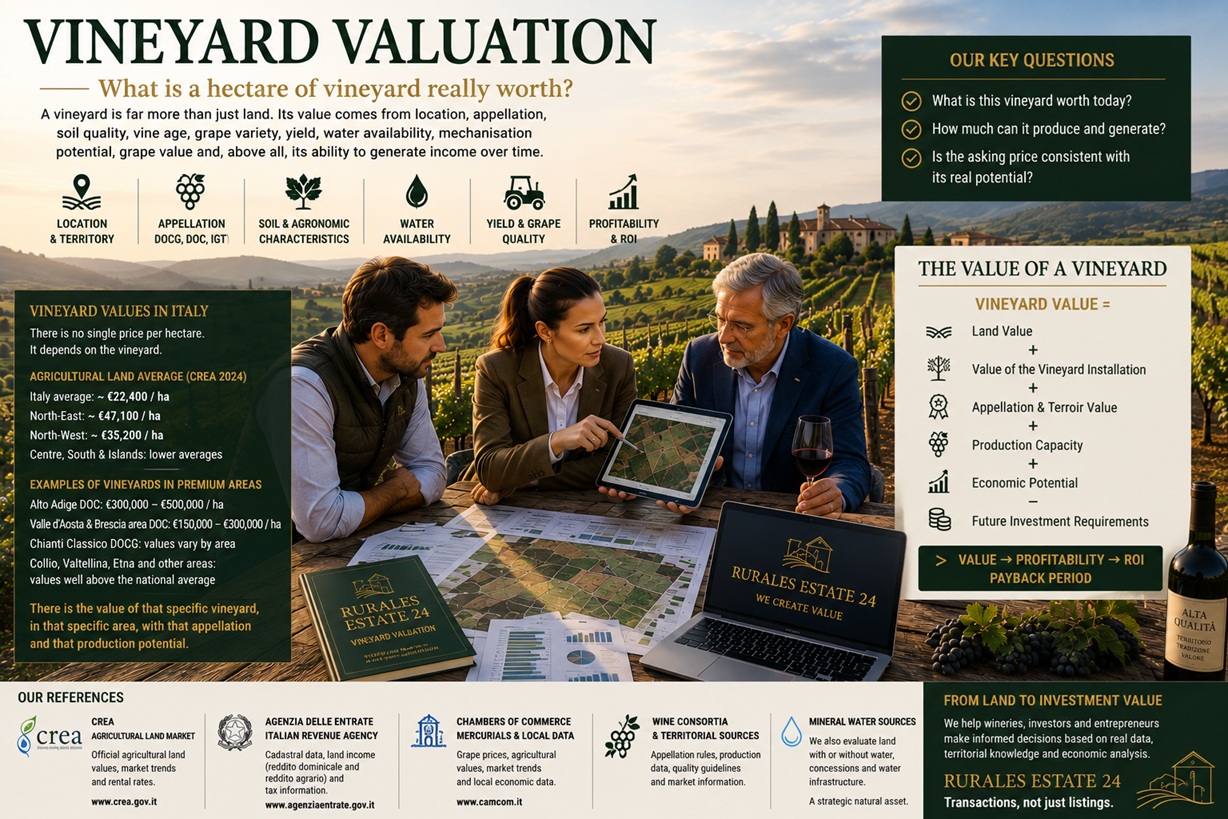
VINEYARD VALUATION
What is a vineyard really worth? And how much can it generate?
A vineyard is not simply agricultural land planted with vines.
It is simultaneously:
land + productive asset + terroir + appellation + grape-producing capacity + economic potential + capital asset.
This is why knowing the average vineyard price per hectare in a province or appellation is not enough to determine the value of a specific property.
Two vineyards located only a few kilometres apart can have significantly different values.
What may differ includes:
- location;
- appellation;
- exposure;
- soil characteristics;
- grape variety;
- age of the vines;
- yield;
- water availability;
- mechanisation potential;
- management costs;
- grape value;
- profitability;
- expansion potential;
- market demand.
The Vineyard Valuation service developed by Rural Estate 24 is designed to go beyond the simple logic of “price per hectare”.
The objective is to answer four key questions:
What is this vineyard worth today?
Why is it worth this amount?
How much income can it generate?
At the asking price, is it a good investment?
THE VALUE OF A VINEYARD
A first valuation framework can be expressed as:
VINEYARD VALUE =
Land Value
Residual Value of the Vineyard Installation
Value of the Appellation and Terroir
Production Capacity
Strategic Value
−
Future Investment Requirements
For an investor, however, this first analysis must be extended to:
VALUE → PROFITABILITY → ROI → PAYBACK PERIOD
Because knowing that a vineyard is worth €150,000 per hectare is important.
Understanding how much return that invested capital can generate is even more important.
HOW MUCH IS ONE HECTARE OF VINEYARD WORTH IN ITALY?
The correct answer is: it depends on the vineyard
There is no single national price that can be applied indiscriminately.
CREA reports an average value for Italian agricultural land of approximately €22,400 per hectare in 2024, rising to around €47,100/ha in North-Eastern Italy and approximately €35,200/ha in North-Western Italy.
These are general agricultural land values, not vineyard-specific quotations.
When we move into specialised wine-growing areas, the situation can be completely different.
The CREA land-market database provides minimum and maximum values, historical regional and provincial series, and examples relating to specific types of agricultural property.
These figures should therefore be used as market benchmarks rather than automatic valuations of a specific vineyard.
This leads to one fundamental principle:
THERE IS NO SINGLE “PRICE OF A VINEYARD”.
There is the value of that specific vineyard, in that specific location, within that specific appellation, in its current condition and with its specific income-generating capacity.
1. TERROIR AND LOCATION
In wine, location is part of the asset value
The first element to analyse is location.
A vineyard situated in a generic agricultural area cannot be directly compared with a vineyard located within areas such as:
Barolo – Barbaresco – Brunello di Montalcino – Bolgheri – Chianti Classico – Valpolicella – Conegliano Valdobbiadene Prosecco Superiore DOCG – Franciacorta – Trentodoc – Collio – Alto Adige – Etna.
In these areas, investors are not simply acquiring hectares.
They are also acquiring access to a specific wine production area and to the value that the market attributes to that territory.
2. APPELLATION: DOCG, DOC AND IGT
Appellation can significantly transform the economic value of the land
One of the first elements to verify is therefore the position of the vineyard within the production area and its compliance with the relevant appellation rules.
The economic value chain becomes:
Land
↓
Vineyard
↓
Appellation
↓
Grapes
↓
Wine
↓
Market Price
↓
Margin
The stronger the recognition of the appellation and the more limited the supply of eligible vineyard land, the greater the potential strategic value of the asset.
However, DOC or DOCG status does not automatically mean high value.
The individual vineyard must always be analysed.
3. GRAPE VARIETY AND PRODUCTION POTENTIAL
It is not enough to know that a vineyard exists.
We need to understand what it produces.
We therefore analyse:
- grape varieties;
- clones;
- rootstocks;
- compatibility with the terroir;
- compliance with appellation rules;
- demand for the grapes;
- grape prices;
- productivity;
- quality;
- winemaking potential;
- market positioning of the wines that can be produced.
One hectare of Glera, Nebbiolo, Sangiovese, Corvina, Chardonnay or Pinot Noir only has economic meaning when assessed within the context of its territory and appellation.
4. AGE OF THE VINEYARD
How many productive years are we really acquiring?
This is one of the most important factors.
We examine:
- planting year;
- age of the vines;
- vegetative condition;
- missing vines;
- uniformity;
- current productivity;
- remaining economic life;
- replacement requirements;
- expected replanting timeline.
A vineyard may appear highly productive today but require substantial investment within five years.
This means:
Current Value – Future CAPEX = Economic Value to Be Interpreted
The buyer needs to understand how much additional capital will be required after the acquisition, not simply how much is needed to buy the vineyard.
5. VALUE OF THE VINEYARD INSTALLATION
The existing vineyard represents an investment that has already been made.
We therefore analyse:
- planting year;
- planting density;
- spacing;
- training system;
- posts;
- wires;
- structures;
- irrigation;
- drainage;
- condition of the vineyard;
- mechanisation potential;
- remaining useful life.
It is therefore essential to distinguish between:
Value of the Land
and
Value of the Vineyard Installation on the Land
6. AGRONOMIC CHARACTERISTICS
The soil influences quality, yield and value
Where information is available, we analyse:
- soil composition;
- soil structure;
- depth;
- fertility;
- drainage;
- exposure;
- altitude;
- slope;
- microclimate;
- ventilation;
- temperature variation;
- frost risk;
- hydrogeological risk;
- water availability.
For vineyards intended for premium wine production, some of these factors can be decisive.
7. WATER AND IRRIGATION AVAILABILITY
Water is increasingly becoming a capital-value factor
Market demand is showing growing interest in land that is:
irrigable, easily accessible and suitable for quality agricultural production.
For this reason, where relevant, we examine:
- wells;
- water availability;
- irrigation rights;
- irrigation consortia;
- reservoirs;
- storage basins;
- irrigation systems;
- water flow;
- costs;
- long-term reliability of the resource.
In some areas:
WATER = PRODUCTION SECURITY = LOWER RISK = GREATER ASSET ATTRACTIVENESS
This also creates a natural connection with the analysis of mineral water sources and strategic water resources.
8. PRODUCTION PER HECTARE
A vineyard is also a biological production asset.
We therefore need to understand:
Surface Area × Yield per Hectare = Production
But this information must be developed further:
Production × Grape Value = Production Value per Hectare
Or, when the vineyard is integrated into a winery:
Grapes → Wine → Bottles → Average Price → Margin
This is where we begin to move from asset valuation to economic valuation.
9. WHAT ARE THE GRAPES WORTH?
Two vineyards can produce the same volume of grapes but generate completely different economic values.
Where data is available, we therefore analyse:
- grape prices;
- historical price series;
- local demand;
- appellation;
- quality;
- supply contracts;
- buyers;
- saleability;
- final destination of the grapes.
At this stage, information from Italian Chambers of Commerce, commodity exchanges, market bulletins, wine consortia and other local sources becomes particularly useful.
However, we do not rely on a single quotation to determine value.
We cross-reference several sources to establish an economically sustainable valuation range.
10. HOW MUCH DOES IT COST TO MANAGE ONE HECTARE?
Revenue and profitability are not the same thing
We therefore consider costs relating to:
- pruning;
- tying;
- fertilisation;
- treatments;
- under-vine management;
- soil management;
- irrigation;
- harvesting;
- labour;
- fuel;
- agricultural inputs;
- maintenance;
- insurance;
- administration.
This allows us to calculate:
PRODUCTION VALUE/HA – COSTS/HA = POTENTIAL OPERATING MARGIN/HA
This is one of the most important figures for an investor.
11. HOW MUCH DOES A VINEYARD GENERATE?
From value per hectare to ROI
This is the area that most clearly differentiates the service from a traditional real estate appraisal.
We connect:
Acquisition Price
↓
Vineyard Value
↓
Production per Hectare
↓
Grape / Wine Value
↓
Management Costs
↓
Margin
↓
Cash Flow
↓
ROI
↓
Payback Period
A vineyard priced at €200,000/ha is not automatically a worse investment than one priced at €70,000/ha.
The first vineyard may produce higher-value grapes, belong to a stronger appellation, benefit from greater demand and have a stronger ability to preserve capital value.
The right question is therefore not:
“Which one costs less?”
but:
“Which vineyard offers the best relationship between value, profitability, risk and potential?”
12. ACCESSIBILITY AND MECHANISATION
Accessibility can have very significant economic consequences.
We analyse:
- road access;
- internal roads;
- slope;
- terracing;
- row width;
- machinery access;
- mechanical harvesting potential;
- distance from the winery.
A heroic vineyard may produce extraordinary wines and possess significant cultural and identity value.
But its cost structure can be completely different from that of a fully mechanised vineyard.
13. SINGLE-BLOCK OR FRAGMENTED VINEYARDS?
The configuration of the asset also matters.
20 hectares in one consolidated block
are not necessarily equivalent to
20 hectares distributed across 15 separate plots.
We consider:
- land continuity;
- fragmentation;
- distance between parcels;
- accessibility;
- operational efficiency;
- expansion potential;
- adjoining land.
For an industrial buyer, land consolidation can have substantial strategic value.
14. MARKET COMPARISON
How are truly comparable vineyards valued?
Market comparison is essential, but it must be carried out correctly.
It is not enough to compare:
same province + same surface area.
Comparable vineyards should have similar characteristics in terms of:
location + appellation + position + age + quality + productivity + accessibility + irrigation + size.
CREA’s land-market database provides historical series, territorial minimum and maximum values and examples of agricultural land values and rental rates.
These figures are useful as:
Market Benchmarks
but they should not automatically be considered the market price of the specific vineyard.
15. ITALIAN REVENUE AGENCY AND CADASTRAL DATA
The Agenzia delle Entrate – Italian Revenue Agency is an important reference for cadastral and tax information.
For agricultural land, Italian cadastral records distinguish between:
reddito dominicale — land ownership income
and
reddito agrario — agricultural income.
However, one distinction must remain very clear:
CADASTRAL DATA ≠ COMMERCIAL MARKET VALUE OF THE VINEYARD
Cadastral information is essential for understanding the legal, tax and administrative position of the property.
It does not automatically determine what an investor would pay for the vineyard on the market.
16. CHAMBERS OF COMMERCE AND LOCAL SOURCES
Depending on the area analysed, we may integrate information from:
Italian Chambers of Commerce – Commodity Exchanges – Market Bulletins – Regional Authorities – Wine Consortia – Agricultural Organisations – Territorial Observatories.
These sources can be particularly useful for analysing:
- grape prices;
- agricultural product quotations;
- production dynamics;
- local land values;
- harvest trends;
- demand;
- local economic data.
Again:
THE SOURCE PROVIDES THE DATA. THE ANALYSIS MUST INTERPRET IT.
17. CURRENT VALUE AND POTENTIAL VALUE
One of the most interesting distinctions is between:
CURRENT VALUE
What the vineyard is worth in its existing condition.
and
POTENTIAL VALUE
What the vineyard could potentially be worth following:
- replanting;
- agronomic improvements;
- irrigation;
- land consolidation;
- increased mechanisation;
- quality improvements;
- integration with a winery;
- improved product positioning;
- commercial development.
This is particularly important in acquisitions.
Investors do not simply buy what exists today. They may also be acquiring future value-creation potential.
OUR METHOD
From Land to Investment Value
1. Vineyard Identification↓2. Cadastral and Document Analysis↓3. Territorial Analysis↓4. Appellation Verification↓5. Agronomic Analysis↓6. Vineyard Installation Analysis↓7. Water and Irrigation Assessment↓8. Production Analysis↓9. Grape Value Analysis↓10. Management Cost per Hectare Analysis↓11. Market Benchmarking↓12. Current Value Assessment↓13. Potential Value Assessment↓14. Profitability and ROI Analysis↓15. Negotiation Support
THE RESULT: A REASONED VALUATION RANGE
A professional valuation should not simply state:
“The vineyard is worth €X per hectare.”
It should explain:
how much the land is worth;
how much the vineyard installation is worth;
how much value the appellation contributes;
how much the vineyard produces;
what the grapes are worth;
how much it costs to manage;
how many productive years remain;
which investments will be required;
how much it can generate;
which comparable transactions support the valuation;
which factors may increase or reduce the price.
Only then can we arrive at a:
REASONED INDICATIVE VALUE RANGE
supported by an asset, production and economic rationale.
VINEYARD VALUATION FOR BUYERS
Before submitting:
Expression of Interest → LOI → Offer → Preliminary Agreement → Acquisition
the buyer should understand:
VALUE + CAPEX + PROFITABILITY + RISKS + POTENTIAL
The service is designed for:
- wineries;
- wine groups;
- entrepreneurs;
- agricultural companies;
- investors;
- family offices;
- holding companies;
- investment funds;
- international investors;
- strategic buyers.
Because negotiating with a clear understanding of the asset value means negotiating from a completely different position.
VINEYARD VALUATION FOR SELLERS
For the owner, valuation is equally strategic.
Before bringing a vineyard to market, it is important to understand which elements genuinely support the asking price:
Territory
Appellation
Quality
Scarcity
Production
Profitability
Strategic Potential
The objective is not to “set a high price”.
It is to establish an asking price that can be defended in front of a qualified buyer.
RURAL ESTATE 24
Valuation, Sale and Acquisition of Vineyards in Italy
Rural Estate 24 supports property owners, wineries, entrepreneurs and investors in transactions involving:
Vineyards | Vineyard Land | Rural Estates | Wineries | Wine Businesses | Agricultural Properties
We do not focus only on surface area and price per hectare.
We analyse:
VALUE → PRODUCTION → PROFITABILITY → POTENTIAL → INVESTMENT APPEAL
Because a vineyard is simultaneously:
land, production, capital asset and investment.
RURAL ESTATE 24
Italian Vineyard & Wine Estate Valuation
For international investors, Rural Estate 24 turns vineyard valuation into a full investment analysis:
Land Value + Vineyard Value + Appellation + Production + Income Potential + ROI + Future Value
The service is designed for:
International Investors | Family Offices | Wine Groups | Entrepreneurs | Holding Companies | Strategic Buyers
who want to understand not only:
“How much does this vineyard cost?”
but above all:
“What is this vineyard really worth, how much can it generate and does the investment make sense?”
VINEYARDS AND MINERAL WATER SOURCES
When land, agriculture and water resources come together
In certain transactions, a property may include:
land + vineyards + wells + springs + reservoirs + water resources + infrastructure.
In these situations, it is essential to distinguish between:
Agricultural and Vineyard Value
and
The Economic and Legal Value of the Water Resource
Water availability can increase production security and therefore the agricultural attractiveness of the asset.
However, the presence of a water resource does not automatically imply the legal right to commercially exploit it as mineral water.
For more complex assets, the analysis therefore becomes:
LAND + VINEYARD + WATER + RIGHTS/CONCESSIONS + PRODUCTION + PROFITABILITY + STRATEGIC POTENTIAL
FROM THE VINEYARD TO THE VALUE OF THE WINERY
When vineyards are part of a wine business, a further step is required.
We separate:
Vineyards
Agricultural Land
Buildings
Winery
Production Facilities and Machinery
Wine Inventory
Brand
Customers and Distribution
EBITDA / Cash Flow
before moving towards the overall valuation of the company.
Vineyard value contributes to winery value. It does not necessarily equal winery value.
This is where:
Vineyard Valuation → Land Valuation → Winery ROI → Business Valuation → Wine M&A
become part of the same integrated advisory process.
ARE YOU BUYING OR SELLING A VINEYARD IN ITALY?
Before discussing the price, understand what it is really worth.
We can develop preliminary or in-depth analyses of:
Existing Vineyards – DOCG Vineyards – DOC Vineyards – Vineyard Land – Wine Estates – Wineries – Wine Businesses
by integrating:
Land Data + Territory + Appellation + Agronomic Characteristics + Production + Comparables + Profitability + ROI
FROM LAND VALUE TO VINEYARD VALUE. FROM VINEYARD VALUE TO INVESTMENT VALUE.
Rural Estate 24 | Mineral Water Sources
Transactions, not simply listings.
FAQ – VINEYARD VALUATION
How much is one hectare of vineyard worth in Italy?
There is no single price. Value depends on location, appellation, grape variety, vineyard age, productivity, accessibility, water availability, management costs and market demand. Agricultural land averages are useful benchmarks but cannot be automatically applied to an individual vineyard.
How is a vineyard valued?
A comprehensive valuation combines land value, residual value of the vineyard installation, appellation, agronomic characteristics, production, grape value, management costs, remaining productive life, future investment requirements and comparable market data.
How much can DOC or DOCG status affect value?
Potentially significantly, particularly where the appellation supports a product with strong market demand and the supply of vineyard land is limited. However, appellation must always be assessed together with location, productivity, quality and the condition of the specific vineyard.
Does cadastral value equal commercial market value?
No. Italian cadastral data serves tax and administrative purposes and does not automatically represent the market value of a vineyard.
Are CREA values the actual price of a vineyard?
No. CREA data provides highly useful territorial benchmarks and market references, but it should not be treated as the automatic valuation of a specific vineyard.
How can I determine whether the asking price is reasonable?
The vineyard should be compared with truly comparable assets while simultaneously analysing land value, vineyard installation, appellation, production, management costs, future CAPEX and profitability.
How can I determine whether a vineyard is a good investment?
The analysis should move from price per hectare to return on invested capital:
Price → Production → Margin → Cash Flow → ROI → Payback Period → Future Value