

Buyer Search to Closing
Selling a winery does not simply mean putting vineyards, buildings and equipment on the market. It means transferring a business, a history, a heritage and, above all, the ability to create value in the future.
A winery may represent the result of decades of work by the owning family.
Within that business there may be:
- vineyards and agricultural land;
- DOC, DOCG and IGT appellations;
- winery buildings and real estate;
- winemaking facilities;
- bottling lines;
- machinery and equipment;
- ageing wine and inventory;
- brands and trademarks;
- customers;
- distributors;
- export markets;
- employees and expertise;
- agritourism and hospitality;
- wine tourism;
- reputation;
- family history;
- untapped development potential.
For this reason, selling a winery successfully means first understanding exactly what is being sold and identifying the buyer for whom that business could generate the greatest value.
This is where our work begins.
Do You Want to Sell a Winery? Build the Transaction Before Looking for the Buyer
One of the most common mistakes is to immediately advertise the property for sale.
We prefer to begin with a different question:
Why should an entrepreneur, another winery, an industrial group, a family office or an investor acquire this particular business?
The answer determines how the transaction should be structured.
A competitor may be interested in production volumes.
A wine producer may be looking for vineyards within a specific DOC or DOCG appellation.
An international group may be interested in the brand and the value of Made in Italy.
An investor may see potential in the real estate assets, hospitality and wine tourism.
A winery already operating in the area may be looking for customers, market share, production capacity or operational synergies.
The same winery can therefore have different strategic values for different buyers.
What Does Selling a Winery Really Mean?
A sale can be structured in many different ways.
Sale of the Entire Business
The buyer acquires the business as a whole, according to the transaction structure agreed between the parties.
Sale of Company Shares
The transaction may involve 100% of the company or a majority or minority equity stake.
Sale of a Business Unit
A specific organised part of the business may be separated and transferred.
Asset Sale
Land, vineyards, winery buildings, real estate, machinery and other assets may, where appropriate, be sold separately rather than through the transfer of the company itself.
Bringing in an Investor
The owners may decide not to sell the entire business, but instead bring in a financial or industrial partner.
Business Lease with Purchase Option
In certain circumstances, a gradual structure may be considered, allowing the prospective buyer to enter into the management of the business before completing a potential acquisition.
Merger or Integration with Another Winery
The best solution may not always be a straightforward sale. Integration with another wine company may create greater value.
There is therefore no single way to sell a winery. There is only the transaction structure that best fits the business and the objectives of its owners.
How Much Is a Winery Worth?
This is probably the first question an owner asks.
It is also one of the most complex.
The value of a wine business cannot simply be calculated by adding together:
hectares + vineyards + buildings + machinery.
That represents only one component of the overall value.
At least four dimensions should be considered.
1. Asset Value
Depending on the business, this may include:
- agricultural land;
- vineyards;
- real estate;
- winery buildings;
- production facilities;
- plants and systems;
- machinery;
- equipment;
- inventory;
- wine stocks;
- other properties and assets.
2. Financial Value
The analysis should include:
- revenue;
- EBITDA;
- margins;
- operating profit;
- net income;
- debt;
- working capital;
- investments;
- cash-generating capacity;
- financial performance over recent years.
3. Commercial Value
A winery also possesses valuable intangible assets:
- brand;
- reputation;
- customers;
- distributors;
- importers;
- sales agents;
- presence in large-scale retail or Ho.Re.Ca.;
- export markets;
- e-commerce;
- wine clubs;
- customer databases;
- market positioning;
- awards and recognition;
- digital presence.
4. Strategic Value
This is often one of the most important components.
A company may be worth more than its purely asset-based valuation when it enables the buyer to:
- immediately enter a DOC or DOCG appellation;
- acquire vineyards that are rarely available on the market;
- rapidly increase production;
- acquire new customers;
- enter new markets;
- integrate production and distribution;
- acquire a recognised brand;
- develop hospitality;
- create or expand a wine tourism project;
- achieve economies of scale;
- strengthen its competitive position.
The best price does not depend solely on what the company owns today, but also on the value it can create for the buyer tomorrow.
Vineyards and Real Estate: The Italian Revenue Agency as a Reference
Institutional sources can also provide useful reference points when assessing the real estate component of a transaction.
The Real Estate Market Observatory – OMI of the Italian Revenue Agency (Agenzia delle Entrate) publishes real estate quotations for homogeneous geographical areas, providing minimum and maximum market and rental value ranges for different property categories.
However, it is important to understand their purpose correctly.
OMI quotations provide general market indications and do not replace a specific professional valuation.
This distinction is even more important when valuing a winery, because the overall value of the business includes agricultural, productive, corporate, commercial and intangible components that cannot be represented by a simple real estate quotation.
OMI data may therefore be considered one of several reference points, but not a valuation method for an entire wine business.
Chambers of Commerce and the Italian Business Register: Understanding the Company Before Selling It
Before presenting a winery to a potential buyer, it is essential to have a clear picture of the company and its corporate structure.
The Italian Business Register (Registro delle Imprese), managed by the Chambers of Commerce, is the official source for a wide range of information concerning Italian companies.
Depending on the available services and documents, it provides access to:
- company registration reports;
- corporate information;
- directors;
- corporate appointments;
- shareholdings;
- filed financial statements;
- company files;
- historical information.
These elements become particularly important during transaction preparation and subsequent due diligence.
A qualified investor does not simply assess the vineyard.
The investor also assesses the company that owns and operates that vineyard.
Before the Sale: Preparing the Winery for Due Diligence
A transaction can lose value or even collapse when problems emerge that could have been identified in advance.
For this reason, conducting a pre-due diligence review can be extremely valuable.
The documentation required varies according to the transaction, but may generally include:
Corporate Documentation
Company registration documents, articles of association, ownership structure, shareholdings, shareholder agreements and other relevant corporate documentation.
Financial Statements
Recent financial statements, current financial position, receivables and liabilities, financing agreements, leases and investments.
Land
Ownership documents, cadastral information, surface areas, land use and existing agreements or leases.
Vineyards
Vineyard acreage, grape varieties, planting year, appellations, yields, agronomic condition and relevant documentation.
Real Estate
Winery buildings, agricultural buildings, residential properties, agritourism facilities, hospitality structures and other real estate.
Production
Winery capacity, tanks, barrels, barriques, bottling lines and key equipment.
Inventory
Bulk wine, ageing wine, bottled stock, dry goods and other inventory.
Brands and Trademarks
Ownership, registrations, markets and commercial value.
Commercial Operations
Main customers, distribution channels, sales agents, importers, export markets and revenue concentration.
Employees
Workforce, key roles, labour costs and dependence on specific individuals.
Permits and Compliance
Relevant administrative, planning, environmental, production and health and safety documentation.
The objective is not simply to identify potential problems. It is to approach the buyer fully prepared.
Our Method for Selling a Winery
1. Business Analysis
We begin by understanding the company:
history → ownership → territory → vineyards → production → market → financials → assets → brand → potential.
2. Valuation
We analyse the different components separately in order to develop a comprehensive view of the company’s overall value.
3. Sale Strategy
We identify the transaction structure that can best maximise value:
full sale, share sale, asset deal, capital investment, industrial partnership, merger or another suitable structure.
4. Preparation of the Sale Memorandum
The company must be presented professionally.
We do not simply prepare a real estate listing.
We create a document capable of explaining:
- what is being sold;
- why it represents an opportunity;
- what assets are included;
- the company’s financial performance;
- which markets it serves;
- its key strengths;
- any critical issues that should be considered;
- its development potential;
- why the transaction could create value for the buyer.
5. Positioning the Opportunity
A €2 million winery requires a different buyer profile from a €20 million or €50 million wine business.
We therefore identify the categories of buyers that are genuinely aligned with the transaction.
6. Buyer Search
Potential buyers may include:
- other wineries;
- wine groups;
- agricultural companies;
- agri-food groups;
- distributors;
- entrepreneurs;
- private investors;
- family offices;
- holding companies;
- investment funds;
- private equity firms;
- real estate investors;
- hospitality operators;
- Italian and international investors.
7. Confidential Approach
Not every company should be publicly identifiable as being “for sale”.
For certain transactions, confidentiality is essential.
We can therefore initially present the opportunity through a blind profile, without immediately disclosing the identity of the business.
8. NDA
When genuine interest has been established, sensitive information can be shared following the execution of a Non-Disclosure Agreement (NDA).
9. Data Room and Due Diligence
The buyer is progressively granted access to the information required to assess and verify the transaction.
10. Expression of Interest and LOI
Once the necessary conditions are in place, the process moves from a preliminary expression of interest to defining the main economic and contractual terms, typically through a Letter of Intent (LOI).
11. Negotiation
Price is only one part of the negotiation.
Other matters may include:
- transaction perimeter;
- deal structure;
- payment terms;
- timing;
- warranties;
- possible continued involvement of the current owner;
- inventory;
- real estate;
- assets and liabilities;
- employees;
- brand;
- contracts;
- conditions precedent.
12. Closing
We support the owners and their professional advisers through to completion of the transaction.
For us, a sale does not end when a lead is generated. It ends when the transaction is completed.
Selling a Winery Without Undervaluing It
The greatest risk is not necessarily failing to find a buyer.
It is finding the wrong buyer or presenting the company incorrectly.
A winery marketed simply as a collection of hectares and buildings risks being valued only on the basis of its tangible assets.
A winery presented as a business can also be valued for its ability to generate income and create future value.
Our principle is therefore simple:
First we maximise the company’s perceived and strategic value. Then we look for the buyer.
Selling a Winery Due to Generational Transition
This is becoming an increasingly important issue in the wine industry.
An entrepreneur may have spent decades building the business, while the next generation may have different plans.
Waiting too long can gradually reduce the value of the company.
In these circumstances, selling should not necessarily be seen as a failure.
It can instead become the owner’s final major entrepreneurial decision: finding the right person or group to continue and develop what the family has built.
Preparing the transaction well in advance allows the owners to negotiate from a much stronger position.
Selling to a Competing Winery or to an Investor?
These are fundamentally different transactions.
Industrial Buyer
A winery or wine group may immediately recognise operational synergies involving:
production, vineyards, customers, distribution, exports, employees, logistics and brands.
Financial Investor
An investment fund or family office may focus more closely on profitability, growth, management, assets, cash flow and future exit opportunities.
Private Entrepreneur
A private entrepreneur may simultaneously be seeking an investment, a connection with the territory, quality of life, prestige and a new entrepreneurial project.
International Investor
An international investor may be attracted by the value of Made in Italy, Italian wine appellations, hospitality and the opportunity to establish a presence in the European market.
Our role is to identify which category of buyer is most likely to recognise the highest value in the business.
Rural Estate 24
Rural Estate 24 is dedicated to identifying, presenting and enhancing investment opportunities in the Italian agricultural and wine sectors for an international audience.
The service may include:
- wineries;
- wine companies;
- vineyards;
- agricultural estates;
- agritourism businesses;
- olive-growing businesses;
- rural properties;
- agri-food companies;
- prestigious agricultural real estate;
- agricultural investment projects.
The objective is not simply to publish an opportunity.
It is to identify who could realistically acquire it.
Italian agricultural and wine assets possess characteristics that are difficult to replicate elsewhere:
territory + appellation + history + landscape + production + lifestyle + hospitality.
This is why an Italian winery can attract not only domestic operators, but also international entrepreneurs, family offices, wine groups and investors.
Applying the Same Method to Mineral Water Sources
The same strategic approach can be applied to mineral water sources and bottling companies, although this sector has different industrial and regulatory characteristics.
In this case, the analysis may include:
- mineral water concession;
- source flow rate;
- authorised extraction capacity;
- characteristics of the water;
- bottling plant;
- production facilities;
- bottling lines;
- production capacity;
- brands;
- distribution;
- market position;
- exports;
- real estate and land;
- expansion potential.
The principle remains the same:
do not simply sell an asset; structure an industrial transaction capable of expressing its full value.
Why Work With an Advisor Who Understands the Wine Industry?
Selling a winery requires different professional skills.
Accountants, tax advisers, lawyers, notaries, agronomists, oenologists and technical specialists may all be involved.
But someone also needs to maintain an overall strategic view of the transaction.
Someone capable of communicating with the owners, understanding the business, speaking with potential buyers and coordinating the process together with specialist advisers.
Because a winery is not simply a property.
It is not simply a vineyard.
It is not simply a set of financial statements.
It is an economic, agricultural, industrial, commercial and asset-based system.
And that is how it should be valued and presented.
Do You Want to Sell Your Winery?
The first step is not publishing an advertisement.
The first step is understanding:
what it is worth → how the transaction should be structured → who might be interested → why they should acquire it → how to reach them.
That is where the strategy begins.
That is where the negotiation begins.
And that is where the sale can begin.
Contacts, not just clicks.Transactions, not listings.Where deals begin.
FAQ – Selling a Winery or Wine Business in Italy
How do you sell a winery?
The process begins with an analysis of the company and its assets, valuation, definition of the transaction structure and preparation of the relevant documentation. Qualified potential buyers are then identified and approached, followed by NDA, due diligence, negotiation and closing.
How much is a winery worth?
There is no standard value. Land, vineyards, buildings, production facilities, inventory, financial performance, brand, customers, market position, appellations, production capacity and future development potential must all be considered.
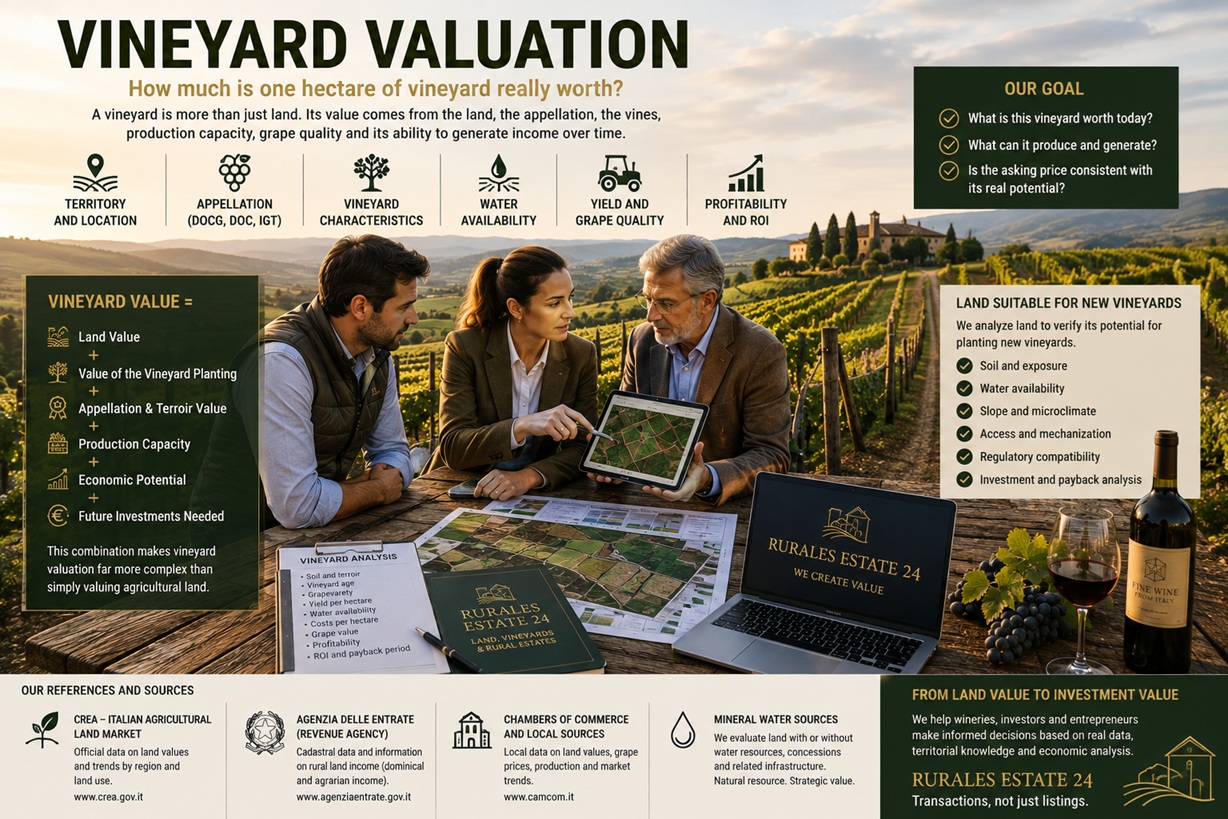
How much is a hectare of vineyard worth?
The value can vary significantly depending on location, appellation, exposure, agronomic characteristics, age and condition of the vineyard, production potential and other relevant factors. The value of the vineyard should not be confused with the overall value of the wine business.
Can a winery be sold confidentially?
Yes. In many transactions, it is preferable to initially use an anonymous or blind profile and disclose identifying and sensitive information only to qualified parties, where appropriate after execution of an NDA.
Can an Italian winery be sold to foreign investors?
Yes. Italian wineries, vineyards and wine estates can attract interest from industrial groups, entrepreneurs, family offices and international investors. Each transaction must, of course, be assessed according to the applicable legal, tax and regulatory framework.
Can I sell only part of my winery?
Yes. Alternatives to a full sale may include bringing in an industrial or financial partner, a capital increase, or the sale of a minority or majority equity stake.
What documents are required to sell a winery?
This depends on the transaction structure. Generally, buyers may require corporate documents, financial statements, information regarding land and real estate, vineyards, production facilities, inventory, employees, permits, trademarks, customers, contracts and the company’s financial position.
How long does it take to sell a winery?
There is no standard timeframe. Company size, asking price, profitability, location, corporate complexity, quality of documentation and the type of buyer can all significantly affect the duration of the process.