

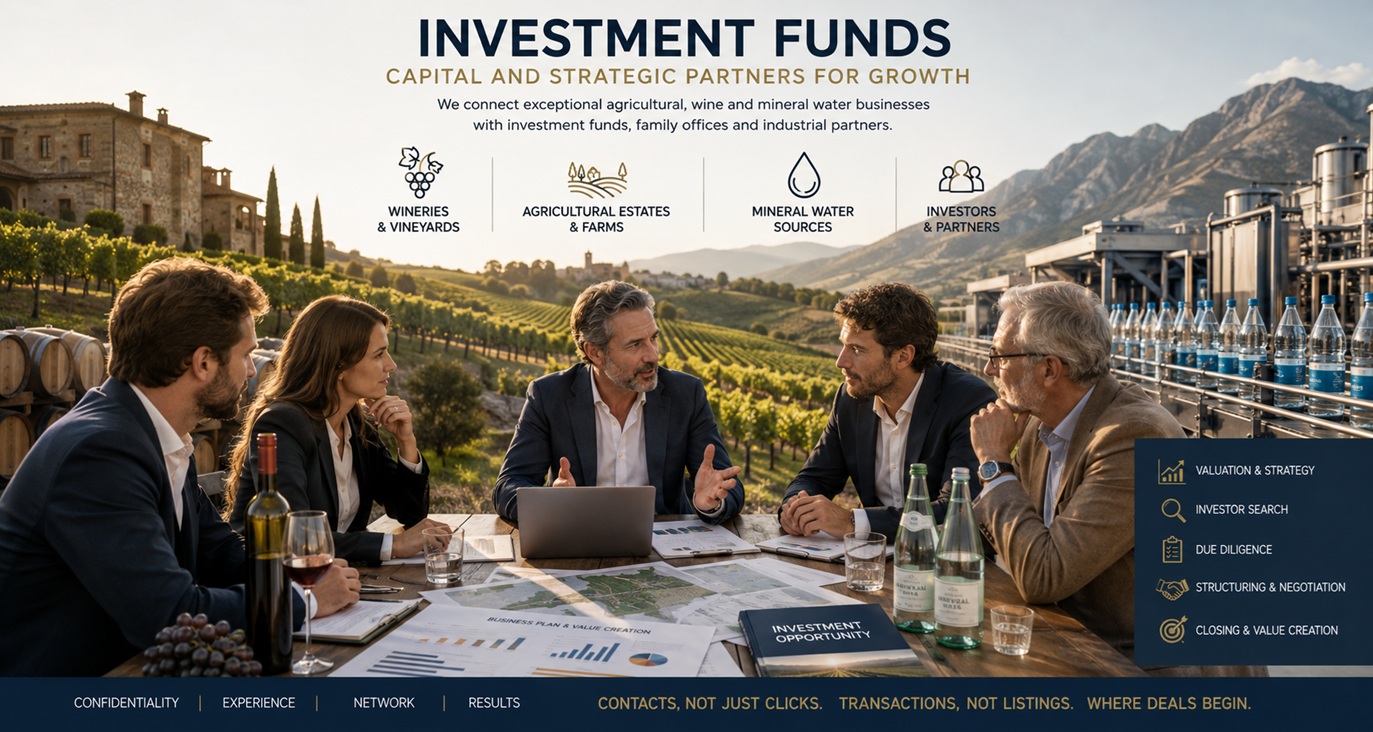
Investment Funds
Capital and Strategic Partners for Wineries, Agricultural Estates and Mineral Water Sources
An agricultural business, winery or mineral water source may own land, real estate, concessions, production facilities, brands, production capacity and significant commercial potential, yet may not always have the financial resources required to unlock its full value.
At the same time, investment funds, family offices, holding companies, industrial groups and private investors are looking for real assets capable of combining tangible value, production, territory and growth potential.
Our role is to bring these two needs together, structuring transactions that are clear, sustainable and attractive to both parties.
We do not simply “look for an investor”.
We prepare the company to meet the requirements of professional investors and structure the transaction so that capital can find a genuine industrial and asset-backed investment opportunity.
Investment Funds in the Wine and Agricultural Sectors
The Italian agricultural and wine industries offer particularly attractive characteristics for investors.
An agricultural or wine estate may simultaneously include:
- agricultural land;
- vineyards;
- DOC, DOCG and IGT appellations;
- rural buildings and real estate;
- wineries and production facilities;
- inventory and stocks;
- brands;
- commercial networks;
- export activities;
- agritourism;
- hospitality;
- restaurants;
- wine tourism;
- valuable landscapes and locations;
- real estate development potential;
- income-generating capacity.
For this reason, an investment should not be assessed solely on the basis of the price per hectare or the value of the real estate.
It is essential to understand the value of the entire business ecosystem and the value it could generate with adequate capital, management and strategy.
Who This Service Is For
The service is designed for entrepreneurs and business owners considering:
Full Sale of the Company
Search for a financial or industrial buyer interested in acquiring the entire business.
Sale of an Equity Stake
Bringing an investor into the company’s share capital while the current owners retain an equity interest.
Capital Increase
Raising financial resources to support the company’s development.
Financial Partner
Bringing in a partner capable of supporting industrial, commercial or real estate investments.
Industrial Partner
Identifying companies operating in the same or complementary sectors interested in developing strategic synergies.
Generational Transition
Structuring solutions designed to ensure business continuity when there is no successor or when the next generation does not intend to assume direct management responsibilities.
Commercial and International Development
Raising capital to increase production, distribution, exports and international market presence.
Acquisitions and Consolidation
Raising capital to acquire competitors, vineyards, wineries, brands, land or other complementary assets.
What Investors Are Really Looking For
An investment fund does not simply acquire hectares, bottles or buildings.
Above all, it invests in a value-creation opportunity.
For this reason, we analyse the company through several key factors:
Assets
Land, vineyards, real estate, wineries, production plants, facilities, machinery and other assets.
Financial and Economic Performance
Revenue, EBITDA, margins, debt, investments made, working capital and prospective cash-generating capacity.
Production
Current and potential production capacity, facility utilisation, sourcing and opportunities to increase production.
Market
Domestic market, exports, distribution, Ho.Re.Ca., large-scale retail, direct sales, e-commerce and other channels.
Brand
Positioning, reputation, registered trademarks, appellations, digital presence and market recognition.
Management
Organisation, dependence on the entrepreneur, internal expertise and the possibility of management continuity following the transaction.
Potential
The central question is:
What could this company be worth in five or ten years with the right capital, organisation and strategy?
This is often precisely where investor interest begins.
Due Diligence: Before Presenting the Company to Investors
A professional investor wants to clearly understand what they are acquiring.
For this reason, we prepare the transaction in advance by identifying the documentation required for subsequent due diligence.
Corporate and Company Information
Official information available through the Italian Chambers of Commerce Business Register makes it possible, among other things, to reconstruct corporate information, directors, ownership structures, shareholdings, corporate changes and filed financial statements.
Company reports may be current or historical, while the company file may include the company registration report, articles of association, latest financial statements, shareholdings and other corporate information.
This documentation represents one of the foundations of corporate due diligence.
Employment and Social Security – INPS
Employees and workforce organisation are important factors when assessing an agricultural or wine business.
Agricultural businesses employing workers are subject to specific INPS social security requirements; registration may also be completed through the Italian Comunicazione Unica d’Impresa when the hiring of employees coincides with the start of business operations.
For 2026, INPS established an overall contribution rate of 30.50% for agricultural employers in general, while certain agricultural companies with industrial-type production processes are subject to a rate of 32.30%.
During the assessment phase, the company’s social security position, workforce structure and prospective labour costs should therefore also be reviewed with the appropriate professional advisers.
Health and Safety – INAIL
Occupational health and safety represent another important component of industrial due diligence.
INAIL highlights specific risks in agriculture associated with machinery, tractors, equipment, plant protection products and work organisation.
Wine businesses also face risks specific to winery operations. INAIL highlights, for example, confined spaces or areas potentially subject to contamination, as well as operations involving silos, tanks, vats and cisterns.
Risk assessment and the related documentation are important employer obligations under the framework outlined by INAIL.
For an investor, this means assessing the safety of facilities and machinery, regulatory compliance, any necessary remedial measures and the related future capital expenditure.
Investing to Modernise the Business
The introduction of new capital can also represent an opportunity to modernise the company.
INAIL provides support instruments aimed at improving workplace safety and, under Axis 5, specific projects for micro and small enterprises engaged in primary agricultural production, including projects designed to modernise machinery and tractors.
At the same time, public and institutional instruments can contribute to the development of agriculture and agricultural land assets.
ISMEA, for example, through the Italian National Agricultural Land Bank (Banca Nazionale delle Terre Agricole), offered 253 properties covering 8,863 hectares in its 2026 edition, with a total starting auction value exceeding €121 million, in addition to the assets available in its permanent portfolio.
These instruments do not replace private capital, but they can form part of the overall assessment of a development project.
Investment Funds and Investors for Wine Companies
In the wine industry, transactions can take many different forms.
We can source capital for:
- winery acquisitions;
- vineyard acquisitions;
- acquisition of DOC and DOCG wine companies;
- expansion of vineyard acreage;
- development of new markets;
- international expansion;
- commercial development;
- brand acquisitions;
- wine tourism development;
- construction or expansion of wineries;
- increased bottling capacity;
- acquisition of competitors;
- consolidation among producers;
- generational transitions.
An investment fund may acquire an equity stake, take control of the company, or develop a growth strategy together with the existing ownership, potentially leading to a future exit.
Investment Funds and Investors for Agricultural Estates
For Rural Estate 24, the service covers the main categories of agricultural assets:
- agricultural businesses;
- wine estates and wineries;
- vineyards;
- olive groves;
- orchards;
- arable land;
- organic farms;
- agritourism businesses;
- rural properties;
- agricultural businesses with prestigious real estate;
- land suitable for development projects;
- agricultural and agro-industrial platforms.
The objective is to identify investors whose investment criteria are compatible with the size, location, profitability and future potential of the asset.
Investment Funds and Investors for Mineral Water Sources
The mineral water industry requires a different investment approach.
In this sector, value may be determined by a combination of:
- mineral water concession;
- source flow rate;
- water quality and characteristics;
- authorised extraction capacity;
- duration and terms of the concession;
- bottling plant;
- bottling lines;
- production capacity;
- permits and authorisations;
- land;
- real estate;
- logistics;
- brand;
- packaging;
- distribution;
- markets served;
- export potential.
We can therefore identify investment funds, family offices, beverage groups, bottling companies, industrial investors and international operators interested in the full or partial acquisition of a mineral water source or bottling company.
Our Method
1. Preliminary Analysis
We analyse the company, its assets, financial position, market and the objectives of the owners.
2. Transaction Assessment
We do not simply assess what the company is worth today.
We seek to understand what it could be worth to a specific investor.
3. Transaction Structure
Full sale, minority stake, majority stake, capital increase, joint venture, industrial partnership or another appropriate structure.
4. Preparation of the Investment Memorandum
We prepare a professional presentation of the opportunity, which may include:
company → market → assets → financials → production → customers → management → strengths → critical issues → development plan → investment required → potential return on investment.
5. Investor Mapping
We identify the categories of investors potentially aligned with the transaction.
6. Confidential Approach
The opportunity is initially presented without disclosing sensitive information.
7. NDA and Data Room
Investors demonstrating genuine interest are progressively granted access to the documentation required to assess the opportunity.
8. Negotiation
We support both the owners and the investor in structuring and negotiating the transaction.
9. Due Diligence
We coordinate the process together with the appropriate professionals: accountants, tax advisers, lawyers, technical specialists, agronomists, oenologists, employment consultants and other specialists.
10. Closing
Our objective is not to provide a list of investors.
Our objective is to support the transaction through to completion.
Why Work With Us
An investment fund understands finance extremely well.
An entrepreneur understands their company extremely well.
Between these two worlds, however, there is often a need for someone capable of translating the industrial value of a business into the language of investment.
That is where we come in.
We have direct knowledge of the sectors in which we operate and can communicate effectively with entrepreneurs, wineries, winegrowers, estate owners, beverage operators and investors.
We do not simply offer properties or land.
We structure transactions.
For Investors
Our service also works in the opposite direction.
We assist investment funds, family offices, holding companies, industrial groups and Italian and international investors in identifying opportunities that may not necessarily be available on the public market.
Our searches may include:
- wineries;
- wine companies;
- DOC and DOCG vineyards;
- agricultural estates;
- agri-food businesses;
- mineral water sources;
- bottling plants;
- production platforms;
- brands;
- equity interests;
- companies facing generational transition issues;
- consolidation opportunities.
Together with the investor, we define the sector, geographical area, size, available investment capital, industrial characteristics and expected return, allowing us to focus exclusively on opportunities that meet the agreed investment criteria.
A Confidential Transaction Requires Method and Discretion
Seeking capital does not necessarily mean that a company is experiencing difficulties.
Quite the opposite.
It may represent the strategic choice of an entrepreneur who wants to:
grow faster, acquire competitors, enter new markets, strengthen the company’s capital base, manage a generational transition or maximise the value created over a lifetime of work.
For this reason, every transaction is managed with particular attention to confidentiality.
Investment Funds: Turning Capital into Growth
In the agricultural, wine and mineral water industries, there are businesses with outstanding assets but insufficient capital to fully develop their potential.
On the other side, there are investors with available capital who often struggle to identify genuinely attractive, verifiable and industrially sustainable opportunities.
Value is created when these two worlds meet.
Rural Estate 24 and the network dedicated to Mineral Water Sources work to create this connection and turn it into a concrete transaction.
Contacts, not just clicks.Transactions, not listings.Where deals begin.
FAQ – Investment Funds in Wine, Agriculture and Mineral Water
Can an investment fund acquire a winery?
Yes. The transaction may involve the entire company, a majority or minority stake, specific assets, or it may be structured through a capital increase.
Can I look for an investor without selling the entire company?
Yes. It is possible to bring in a financial or industrial partner while the family or entrepreneur retains an equity stake.
Can an investment fund invest in vineyards and agricultural land?
The feasibility and structure of the investment depend on the nature of the investor, the transaction and the applicable regulatory framework. Each transaction should therefore be assessed on a case-by-case basis with the appropriate professional advisers.
Are investors also interested in family-owned businesses?
Yes, particularly when the business has a recognised brand, valuable assets, a strong market position, development potential or consolidation opportunities.
Is it possible to find international investors?
Yes. Italian agricultural estates, wine businesses, territories, hospitality assets and beverage companies can also attract significant interest from international investors.
Is it possible to raise capital for a mineral water source?
Yes. The opportunity may be attractive to investment funds, family offices, beverage groups, industrial operators and investors interested in the concession, production capacity, brand or commercial development.
Does the investor search remain confidential?
Confidentiality is a central element of the process. Sensitive information is normally disclosed progressively to qualified counterparties and, where appropriate, following the execution of a Non-Disclosure Agreement (NDA).