

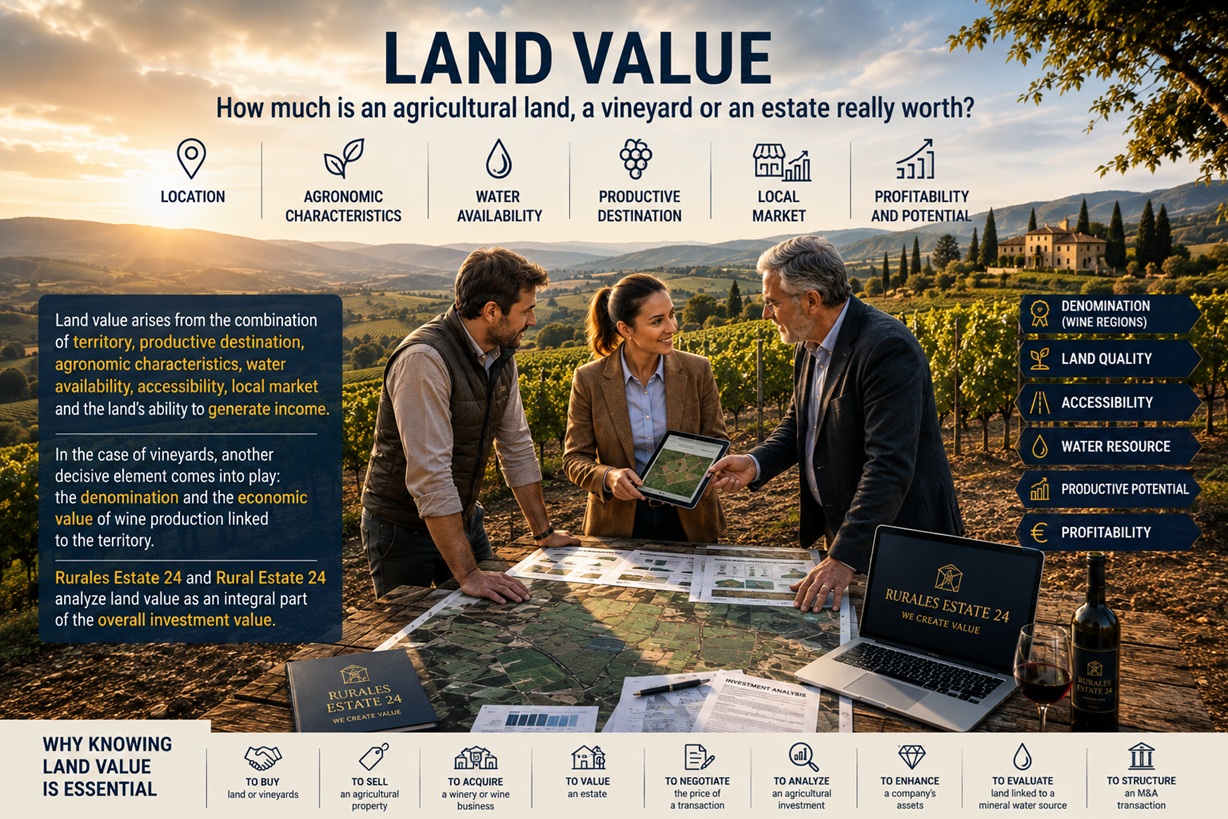
LAND VALUE
What is agricultural land, a vineyard or a rural estate really worth?
Knowing how many hectares a property comprises is easy. Understanding what those hectares are really worth is far more complex.
There is no standard value for one hectare of agricultural land.
Two plots of exactly the same size, located only a few kilometres apart, can have significantly different market values.
The reason is straightforward: land value results from the combination of location, productive use, agronomic characteristics, water availability, accessibility, local market conditions and the land’s ability to generate income.
For vineyards, another decisive factor comes into play:
the appellation and the economic value of the wine production associated with that specific territory.
Understanding land value is therefore essential when you need to:
- acquire agricultural land or vineyards;
- sell an agricultural property;
- acquire a winery or wine business;
- value a rural estate;
- negotiate the price of a transaction;
- assess an agricultural investment;
- enhance the value of a company’s assets;
- assess land associated with a mineral water source;
- structure an M&A transaction.
Rurales Estate 24 analyses land value as an integral component of the overall investment value.
WHAT IS LAND VALUE?
Land value is the economic value attributable to a parcel of land based on its specific characteristics and the market conditions in which it is located.
It should not be confused with cadastral value.
Nor should it be confused with an average provincial or regional quotation.
A reliable valuation requires several factors to be considered together:
Location + Agronomic Characteristics + Productive Use + Market + Profitability + Infrastructure + Water Availability + Restrictions + Future Potential
Ultimately, the analysis should answer one very practical question:
What could this land realistically be worth on today’s market?
CADASTRAL VALUE, AGRICULTURAL VALUE AND MARKET VALUE ARE NOT THE SAME THING
This is one of the areas that often creates the greatest confusion.
Different values may emerge when analysing an agricultural property.
Cadastral Value
This is linked to cadastral records and the income values attributed to land and is used for specific tax and administrative purposes.
It does not necessarily represent the price at which the land could actually be bought or sold on the market.
Average Agricultural Values – VAM
Italy’s Valori Agricoli Medi – VAM are territorial agricultural reference values determined under specific statutory procedures.
They can provide useful background information, but they should not automatically be regarded as the commercial market value of a specific property.
Average Land Value
Land-market surveys provide insight into trends in agricultural land values across different geographical areas and types of agricultural production.
They are extremely useful as benchmarks.
Market Value
This is the figure that matters most to buyers and sellers.
It depends on what the market is actually prepared to pay for that specific property at that specific time.
And this is where the analysis becomes much more interesting.
THERE IS NO SINGLE “PRICE PER HECTARE”
There is the price of that particular hectare, in that particular location, with those particular characteristics.
Saying that “agricultural land is worth €30,000 per hectare” means very little unless we know:
- where it is located;
- what can be cultivated;
- its agronomic quality;
- whether irrigation is available;
- how accessible it is;
- its physical configuration;
- whether the land is consolidated or fragmented;
- which buildings are included;
- which restrictions apply;
- which types of production are permitted;
- how much income it can generate;
- the level of demand in the local market.
For vineyards, additional factors must be considered:
- appellation;
- vineyard registration and production rights;
- grape varieties;
- age of the vineyard;
- planting density;
- training system;
- yield;
- plant health;
- replanting requirements;
- grape value;
- potential value of the wine produced.
1. LOCATION
The first factor is always location.
Agricultural land situated in a marginal area cannot be directly compared with land located in a highly specialised agricultural district.
In the wine sector, these differences can become even more significant.
Consider areas such as:
Barolo – Barbaresco – Brunello di Montalcino – Bolgheri – Chianti Classico – Valpolicella – Amarone – Conegliano Valdobbiadene Prosecco Superiore DOCG – Franciacorta – Trentodoc – Collio – Etna.
In these territories, land is not simply an agricultural surface.
It can represent access to a wine production area with strong international market recognition.
2. PRODUCTIVE USE AND AGRICULTURAL POTENTIAL
It is essential to understand what the land can actually produce.
The property may include:
- arable land;
- vineyards;
- olive groves;
- orchards;
- hazelnut groves;
- citrus groves;
- horticultural land;
- meadows;
- pastures;
- woodland;
- specialised crops.
Production potential can significantly affect value.
Land used for a high-value crop may have a completely different economic profile from generic agricultural land.
3. AGRONOMIC QUALITY
Surface area alone is not enough.
Where information is available, we analyse:
- soil characteristics;
- exposure;
- altitude;
- slope;
- land configuration;
- fertility;
- drainage;
- microclimate;
- frost risk;
- hydrogeological risk;
- mechanisation potential;
- production characteristics.
For vineyards and specialised crops in particular, these factors can directly influence both productivity and product quality.
4. WATER AVAILABILITY
Water is becoming an increasingly important component of agricultural land value.
Irrigated and non-irrigated land should not necessarily be considered equivalent assets.
The analysis may therefore include:
- wells;
- concessions;
- water abstraction rights;
- irrigation availability;
- irrigation consortia;
- reservoirs;
- available water flow;
- irrigation costs;
- long-term reliability of the water resource.
In a context of increasing climate variability, secure access to water can become a genuine competitive advantage for an agricultural asset.
5. ACCESSIBILITY AND LAND CONSOLIDATION
One hundred hectares divided into numerous separate plots do not necessarily have the same operational value as one hundred hectares forming a single consolidated property.
We therefore consider:
- road access;
- internal farm roads;
- distance from production facilities;
- shape of individual plots;
- fragmentation;
- land consolidation;
- machinery accessibility;
- distance from the winery or processing facilities.
Size matters. But the way the land is organised matters too.
6. VINEYARD VALUE
A vineyard is not simply agricultural land planted with vines.
When analysing a vineyard, we consider at least four components:
Land Value + Vineyard Installation Value + Appellation Value + Income-Generating Capacity
The analysis may include:
- total vineyard area;
- DOCG, DOC or IGT appellation;
- grape varieties;
- year planted;
- planting density;
- training system;
- condition of the vines;
- yield per hectare;
- potential production;
- grape value;
- management costs;
- replanting requirements;
- remaining economic life;
- mechanisation;
- irrigation;
- profitability per hectare.
7. APPELLATION: WHEN TERRITORY BECOMES VALUE
The wine sector includes one component that makes vineyard valuation particularly complex:
the appellation.
One hectare of vineyard within a prestigious appellation can have a completely different value from neighbouring agricultural land that does not have the same production potential or designation.
This is why our analysis follows the entire value chain:
Land → Vineyard → Appellation → Production → Grape Value → Wine Value → Profitability
The true economic value of a vineyard must be understood across this entire chain.
8. VINEYARD AGE AND FUTURE INVESTMENT
An existing vineyard represents a productive asset.
But it can also represent a future capital requirement.
It is therefore important to understand:
- when the vineyard was planted;
- how much productive life remains;
- which interventions are required;
- whether replanting will be necessary;
- the CAPEX required;
- how long replanting may affect production.
A vineyard acquired today may require substantial investment only a few years after the acquisition.
Land value should therefore always be assessed alongside future investment requirements.
9. PROFITABILITY PER HECTARE
This is one of the most important aspects of our analysis.
We do not simply ask:
How much is one hectare worth?
We also ask:
How much can one hectare generate?
A simplified analysis may consider:
Production per hectare × Average Price – Management Costs = Potential Margin per Hectare
This enables us to connect:
Land Value → Profitability → ROI → Payback Period
Expensive land is not automatically a poor investment.
Likewise, inexpensive land is not automatically a good investment.
What matters is the asset’s ability to generate income while maintaining or increasing its value over time.
10. BUILDINGS AND LAND IMPROVEMENTS
A rural estate can include much more than land.
It is therefore important to distinguish and value:
- residential buildings;
- manor houses;
- farmhouses;
- wineries;
- warehouses;
- storage facilities;
- livestock buildings;
- greenhouses;
- agricultural facilities;
- agritourism facilities;
- resorts;
- restaurants;
- photovoltaic systems;
- lakes and reservoirs;
- irrigation systems;
- internal roads;
- fencing;
- agricultural infrastructure.
The overall value of the property therefore results from the integration of:
Land + Crops + Buildings + Infrastructure + Economic Activity
11. RESTRICTIONS AND COMPLIANCE
Potential value must always be assessed in light of any restrictions affecting the property.
Factors to be investigated may include:
- planning and zoning designation;
- landscape restrictions;
- environmental restrictions;
- hydrogeological constraints;
- easements;
- rights of way;
- agricultural contracts;
- leases;
- pre-emption rights;
- cadastral compliance;
- planning compliance;
- permits;
- concessions.
An apparently attractive opportunity can change dramatically in value when restrictions affecting the use of the asset emerge.
12. COMPARATIVE MARKET ANALYSIS
Value cannot be determined solely through theoretical formulas.
The market must also be analysed.
Where available, we consider:
- comparable transactions;
- local land values;
- asking prices;
- minimum and maximum values;
- characteristics of comparable properties;
- liquidity of the local market;
- investor demand;
- scarcity of the asset.
Comparisons must, however, be made carefully.
Comparing two properties simply because they are located in the same province can produce misleading results.
OUR REFERENCE SOURCES
CREA – Italian Agricultural Land Market
The CREA – Council for Agricultural Research and Economics is one of the key sources for understanding trends in the Italian agricultural land market.
Its surveys can provide information on:
- average land values;
- historical trends;
- regional differences;
- provincial and altitude-based differences;
- different types of agricultural land;
- minimum and maximum values;
- the agricultural rental market.
These figures provide an important benchmark, which must then be integrated with an analysis of the specific asset.
ITALIAN REVENUE AGENCY – AGENZIA DELLE ENTRATE
The Agenzia delle Entrate – Italian Revenue Agency provides databases and tools that can support real estate and cadastral analysis.
The OMI – Real Estate Market Observatory quotations can be particularly useful when analysing the real estate components included within a rural property.
For an agricultural estate, they may therefore help distinguish between:
Land Value + Building Value + Other Real Estate Components
OMI quotations, however, should not automatically be treated as the market value of agricultural land.
CHAMBERS OF COMMERCE AND LOCAL DATA SOURCES
Italian Chambers of Commerce, together with regional administrations and other competent local authorities, may provide information regarding:
- Average Agricultural Values – VAM;
- prices;
- market bulletins;
- agricultural production;
- local economic data;
- agricultural product quotations.
Again, these are valuable sources for establishing a market framework, but they do not necessarily represent the final market price of a specific property.
THE ITALIAN AGRICULTURAL LAND MARKET
Italy does not have a single agricultural land market.
It has hundreds of local land markets.
The national average can therefore help provide a general picture, but it is far less useful when determining the value of a specific property.
Differences can be substantial between:
North and South → Plains and Mountains → Irrigated and Non-Irrigated Land → Arable Land and Vineyards → Generic Agricultural Areas and Prestigious Appellations
National and regional figures should therefore be used as benchmarks, not as substitutes for a property-specific analysis.
LAND VALUE OF A RURAL ESTATE
For Rurales Estate 24
When analysing a rural estate, we consider:
Land
Crops
Vineyards
Buildings
Infrastructure
Agricultural Business
Hospitality / Agritourism
Development Potential
This enables us to move from the question:
“How much does this estate cost?”
to the far more important question:
“Is the asking price consistent with the value of the assets and their ability to generate income?”
LAND VALUE OF A WINERY
A winery with vineyards should be analysed by separating at least:
Vineyard Value + Real Estate + Production Facilities + Inventory + Brand + Commercial Business + Profitability
Land value is therefore one component of the company’s overall Enterprise Value, not necessarily the entire value of the business.
This distinction is fundamental in acquisition and M&A transactions.
LAND VALUATION FOR RURALES ESTATE 24
Italian Land, Vineyards & Rural Estate Valuation
For international investors, Rurales Estate 24 transforms local and territorial data into a clear investment perspective.
Our analysis can highlight:
Land Value + Vineyard Value + Buildings + Agricultural Business + Income Potential + Hospitality + Development Potential
This enables:
International Investors – Family Offices – Wine Groups – Entrepreneurs – Investment Companies – Strategic Buyers
to understand not only the asking price of an Italian property, but how that price is structured and which components can generate value over time.
LAND VALUE AND MINERAL WATER SOURCES
When land contains a strategic natural resource
In the mineral water industry, land valuation takes on entirely different characteristics.
Land containing a water resource cannot simply be valued according to the standard agricultural price per hectare.
It is essential to distinguish between:
Land Ownership
Water Resource
Rights and Concessions
Protection Areas
Wells and Water-Capture Infrastructure
Bottling Facility
Infrastructure
Production Capacity
Industrial and Commercial Activity
The physical presence of underground water must not be confused with the economic and legal right to exploit that resource.
HOW WE ANALYSE A PROPERTY ASSOCIATED WITH A MINERAL WATER SOURCE
The analysis may include:
- property size;
- geological and hydrogeological characteristics;
- water-capture points;
- wells;
- flow rate;
- water quality;
- concessions;
- duration and conditions of concessions;
- protection areas;
- infrastructure;
- accessibility;
- bottling facility;
- production capacity;
- expansion potential;
- environmental restrictions;
- industrial development potential.
The final value must therefore be assessed according to a different logic:
Land + Water Resource + Concession + Infrastructure + Production Capacity + Market
OUR METHOD
From Land Value to Investment Value
The analysis can be developed through a progressive process:
1. Property Identification↓2. Cadastral and Document Analysis↓3. Location and Territorial Analysis↓4. Agronomic and Production Analysis↓5. Vineyard and Crop Analysis↓6. Building and Infrastructure Analysis↓7. Land Market Benchmark Analysis↓8. Comparable Transaction Analysis↓9. Profitability per Hectare Analysis↓10. Definition of a Valuation Range↓11. Investment ROI Analysis↓12. Negotiation Support
WE DO NOT SIMPLY WANT TO ARRIVE AT A NUMBER. WE WANT TO UNDERSTAND WHY THAT NUMBER MAKES SENSE.
A useful valuation should enable an investor or owner to understand:
How much is the land worth?
How much are the vineyards worth?
How much are the production facilities worth?
How much value do the buildings contribute?
How much value does the appellation contribute?
How important is water availability?
How much does each hectare produce?
Which future investments will be required?
How much could the asset generate?
Is the asking price consistent with the market?
And, above all:
AT THIS PRICE, IS IT A GOOD INVESTMENT?
LAND VALUATION FOR BUYERS
The service can be used by:
- agricultural entrepreneurs;
- wineries;
- wine groups;
- private investors;
- family offices;
- holding companies;
- investment funds;
- international investors;
- real estate companies;
- agribusiness operators;
- beverage companies.
Before submitting an Expression of Interest, LOI or acquisition offer, understanding land value enables the buyer to negotiate based on evidence and economic fundamentals rather than solely on the seller’s asking price.
LAND VALUATION FOR SELLERS
The analysis is equally important for property owners.
Before placing an estate, vineyard or agricultural business on the market, it is essential to understand which elements genuinely determine its value.
Correct positioning from the outset can prevent two opposite mistakes:
undervaluing a high-quality asset
or
entering the market with an asking price that cannot be economically justified.
Both can compromise the transaction.
FROM LAND VALUE TO BUSINESS VALUE
This is the critical distinction.
A rural estate is not necessarily worth simply the sum of its land.
A winery is not necessarily worth only the sum of its vineyards, buildings and machinery.
A mineral water source is not simply worth the land plus the bottling facility.
Where an operating business exists, the analysis must consider:
Asset Value + Income-Generating Capacity + Growth Potential + Strategic Value
This is where land valuation meets business valuation and M&A.
RURALES ESTATE 24
Analysis, valuation, acquisition and sale of Italian land, vineyards and rural estates
We do not simply list a property.
We analyse it to understand its:
Value → Profitability → Positioning → Potential → Investment Appeal
Our objective is to structure transactions in which the asking price is supported by a sound asset, agricultural and business rationale.
RURALES ESTATE 24
Italian Land, Vineyards & Rural Estates for International Investors
For international investors looking at Italian agricultural assets, understanding the asking price is only the beginning.
A proper investment analysis should consider:
Land Value + Vineyard Value + Agricultural Income + Buildings + Hospitality + Growth Potential + ROI
Rurales Estate 24 helps investors understand what they are actually buying, what each component is worth and what return the overall investment may generate.
MINERAL WATER SOURCES
Valuation of land, water resources, concessions and bottling facilities
In the mineral water industry, real estate value represents only one component of the transaction.
A proper valuation should integrate:
Land + Water Resource + Concession + Water Capture + Bottling Facility + Production Capacity + Brand + Distribution + Profitability
Because a mineral water source is not simply a real estate property.
It is a natural resource integrated into a potential industrial and commercial business.
ARE YOU BUYING OR SELLING LAND, A VINEYARD OR A RURAL ESTATE?
Before discussing the price, understand what it is really worth.
We can carry out a preliminary or in-depth analysis of:
Agricultural Land – Vineyards – Wineries – Wine Businesses – Rural Estates – Agricultural Properties – Assets Associated with Mineral Water Sources
We combine territorial data, land-market benchmarks, production characteristics and economic analysis to provide a clear framework for investment decisions.
From Land Value to Investment Value.
Rurales Estate 24 | Mineral Water Sources
Transactions, not simply listings.
FAQ – LAND VALUE
What is the land value of agricultural property?
Land value is the economic value attributable to agricultural land based on its physical characteristics, location, productive use, local market conditions, infrastructure, water availability, profitability and other factors affecting demand and use.
How much is one hectare of agricultural land worth in Italy?
There is no single national figure that can be applied to every property. National and regional averages are useful benchmarks, but differences between locations, crops and production characteristics can be substantial.
How is the value of a vineyard calculated?
The analysis should consider land value, appellation, grape variety, vineyard age, yield, productive condition, irrigation availability, grape value, management costs, replanting requirements and potential profitability.
Is cadastral value the same as market value?
No. Cadastral value and market value serve different purposes and should not automatically be treated as equivalent.
Do Italy’s Average Agricultural Values – VAM indicate the selling price of agricultural land?
Not necessarily. They may provide a useful territorial reference, but a commercial valuation must take into account the specific characteristics of the property and actual market conditions.
Can OMI quotations be used to value agricultural land?
OMI quotations can be particularly useful when analysing real estate components. For agricultural land itself, they should be integrated with specific agricultural land-market data, local benchmarks and actual comparable transactions.
How much does a wine appellation affect vineyard value?
Potentially very significantly. The right to produce wine within a recognised appellation can materially affect the economic potential of a vineyard and consequently investor and market demand.
Is irrigated agricultural land worth more?
Not necessarily in every situation. However, secure water availability is becoming increasingly important for many agricultural activities and can materially affect both market demand and asset value.
How do you value land associated with a mineral water source?
A standard agricultural value per hectare is not sufficient. The analysis must distinguish between land ownership, hydrogeological characteristics, concessions and permits, water-capture infrastructure, bottling facilities and the industrial potential of the resource.
How can you determine whether the asking price of a rural estate is reasonable?
The various components of the property — land, vineyards, crops, buildings, infrastructure and operating business — should be analysed separately and then compared with market conditions and the asset’s ability to generate income.