A network portal of Wine Idea. Discover the world of Wine idea

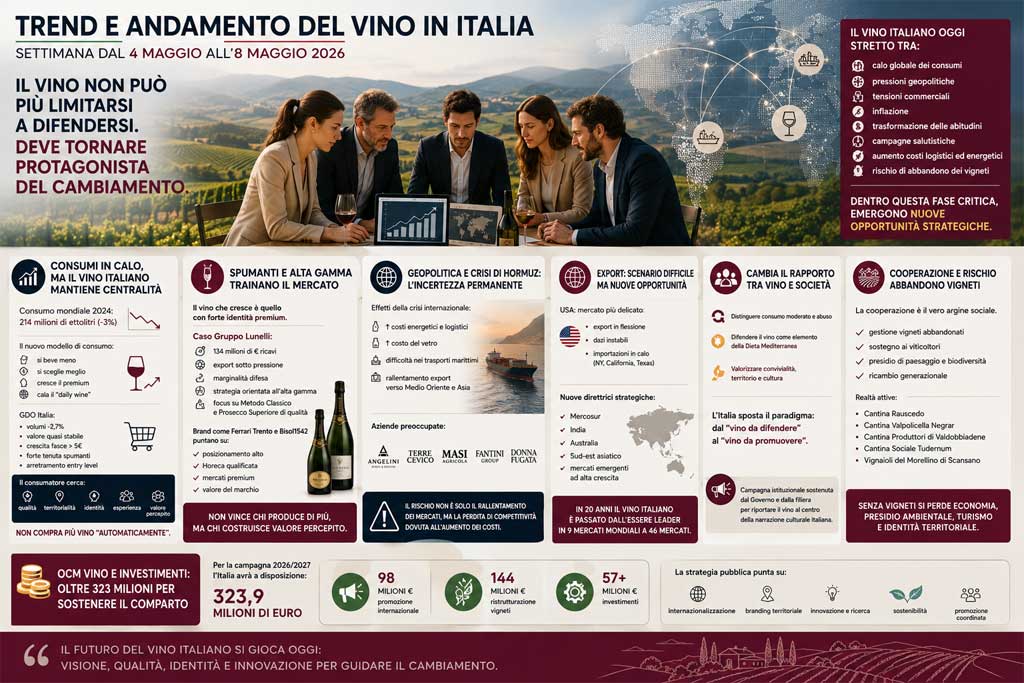
Wine Trends and Performance in Italy – Week of May 4th to May 8th – 2026

This is no longer just a normal market fluctuation, but a structural shift involving consumption, exports, geopolitics, the social perception of wine, and the economic sustainability of the entire supply chain.
The Italian wine sector is going through one of the most complex phases of recent decades.
The message emerging forcefully this week from the Italian wine world is clear: wine can no longer simply defend itself. It must once again become a leader in change.

At the heart of the debate was Piero Mastroberardino’s speech at the inauguration of the Academic Year of the Academy of Vine and Wine, which lucidly captured the current state of the sector.

Italian wine today finds itself caught between:

global decline in consumption,
geopolitical pressures,
trade tensions,
inflation,
transformation of consumer habits,
increasingly aggressive health campaigns,
increasing logistics and energy costs,
risk of abandonment of the vineyards.

Yet, precisely within this critical phase, new strategic opportunities also emerge.

Global consumption is declining, but Italian wine remains central

According to OIV data recalled during the week, world wine consumption in 2024 fell to 214 million hectolitres (-3%).

The United States remains the world’s leading market in terms of overall consumption, but is showing signs of slowdown and significant instability related to tariffs and inflation. Italy, however, remains among the countries with the highest per capita consumption in the world and continues to play a central role in international wine culture.

The real transformation, however, concerns the consumption model:

we drink less,
you choose better,
the premium increases,
“daily wine” drops.

Italian large-scale retail trade confirms this trend:

volumes down (-2.7%),
almost stable value,
growth in the bands above 5 euros,
strong hold of sparkling wines,
decline in entry-level wines.

Today’s consumer is looking for:

quality,
territoriality,
identity,
experience,
perceived value.

He no longer buys wine “automatically”.

Sparkling wines and high-end wines drive the market

The week confirmed the consolidation of a very clear trend: the Italian wine that grows best is that with a strong premium identity.

The case of the Lunelli Group is a concrete example:

revenues of 134 million euros,
exports under pressure,
defended marginality,
high-end oriented strategy,
focus on quality Classic Method and Superior Prosecco.

Brands like:

Ferrari Trento
Bisol1542

they are increasingly focusing on:

high positioning,
Qualified Horeca,
premium markets,
brand value.

The message is clear: in the new global scenario, the winners are not those who produce more, but those who manage to build perceived value.

Geopolitics and the Hormuz Crisis: Wine Enters an Era of Permanent Uncertainty

One of the most pressing issues of the week concerns the effect of the international crisis on Italian wine.

Tension in the Hormuz area is generating:

increasing energy costs,
logistical increases,
rising cost of glass,
difficulties in maritime transport,
slowdown in exports to the Middle East and Asia.

Many large Italian companies are already registering:

orders suspended,
blocked containers,
increase in operating costs,
pressure on marginality.

Among the groups that have expressed concern:

Angelini Wines
Cevico Lands
Masi Agricola
Fantini Group
Donnafugata

The main risk today is not only the slowdown of the markets, but the loss of competitiveness caused by increasing costs along the entire supply chain.

Many operators also believe that increasing price lists could be a strategic mistake, because the international consumer is already under inflationary pressure.

Exports: a challenging scenario but new global opportunities

The United States remains the most sensitive market:

Italian exports in decline,
tariffs still unstable,
reducing imports in key states such as New York, California and Texas.

France is also suffering greatly:

sharp drop in average prices in the US,
reduction in exports,
difficulties on premium French wines.

But within this instability, new strategic directions emerge:

Mercosur,
India,
Australia,
Southeast Asia,
high-growth emerging markets.

Italy today appears better positioned than other competitors thanks to:

strong territorial diversification,
ability to cover different groups,
growth of the image of Made in Italy,
increase of Italian leadership in international markets.

In twenty years, Italian wine has gone from being the leader in 9 world markets to 46 markets.

The relationship between wine and society is changing

The cultural theme is now central.

Wine today is not just fighting a commercial battle, but also a narrative and identity battle.

Health campaigns, especially in Europe, are changing the perception of wine as a product, especially among young consumers.

The Italian supply chain, however, reacts with a very clear position:

distinguish between moderate consumption and abuse,
defend wine as an element of the Mediterranean Diet,
enhance conviviality, territory and culture.

Italy is trying to shift the paradigm:
from “wine to defend” to “wine to promote”.

Important in this regard is the institutional campaign supported by the Italian government together with the wine industry, with the aim of bringing wine back to the center of the Italian cultural narrative.

Cooperation and the risk of abandoning vineyards

Another strategic theme that emerged forcefully is the growing risk of vineyard abandonment.

The economic crisis in the sector is hitting hardest:

marginal areas,
heroic viticulture,
small producers,
historic hilly territories.

Italian wine cooperatives are becoming the true social bulwark of the system.

Cooperative wineries and consortia are taking action:

taking over abandoned vineyards,
by financially supporting winemakers,
preserving landscape and biodiversity,
promoting generational turnover.

Among the most active entities:

Rauscedo Winery
Valpolicella Negrar Winery
Valdobbiadene Producers’ Cellar
Tudernum Social Winery
Winemakers of Morellino di Scansano

The issue is not only agricultural:
Without vineyards, the economy, environmental protection, tourism, and territorial identity are lost.

CMO Wine and Investments: Over 323 Million to Support the Sector

Important signals are arriving on the support policy front.

For the 2026/2027 campaign, Italy will have at its disposal:

323.9 million euros CMO Wine,
of which:
98 million for international promotion,
144 million for vineyard renovation,
over 57 million in investments.

The Piedmont Region is also very active, having allocated over 7.6 million euros for international promotion, wine tourism, and territorial development.

The public strategy today focuses on:

internationalization,
territorial branding,
innovation,
research,
sustainability,
coordinated promotion.


Wine press review for Friday March 13 -2026

Italian wineries, Italian wine producers, and current wine news.

Italian wineries

MASI launches the King’s Pinot Noir from Oltrepò Pavese

In preparation for Vinitaly, the Masi Group presents Pinot Noir del Re , the first still Pinot Noir produced on the Tenuta Casa Re estate in Montecalvo Versiggia, acquired in 2023. The wine is made from a clonal selection across 15 hectares of vineyards and is aged for six months in oak. This project strengthens the Verona winery’s presence in one of Europe’s most renowned Pinot Noir regions.

Valdo celebrates 100 years of innovation and new strategies.

The centenary of the historic Valdobbiadene sparkling wine house coincides with an important strategic phase:

  • A return to still wines thanks to the acquisition of Friuli’s I Magredi
  • launch of the non-alcoholic sparkling wine Purø
  • consolidation of Prosecco production on 150 hectares of vineyards .

Cantina Valpolicella Negrar: Historic Management Change

Christian Zulian becomes the new general manager with technical responsibilities, while Carlo Callari takes over the winemaking department. This concludes the era of Daniele Accordini, a key figure in the cooperative’s development over the past thirty years.

Cantina Valle Isarco celebrates 65 years of Alpine viticulture.

The South Tyrolean cooperative, founded in 1961 and today made up of over 100 members, represents one of the most interesting models of mountain viticulture , with vineyards between 250 and 1000 metres above sea level.

Forbes names Fattoria di Grignano among the 100 most iconic wineries.

Tommaso Inghirami’s company has been included in the Iconic Wineries 2026 list, a recognition that recognizes not only the quality of its wines but also innovation and protection of the local area.

Italian wine and Italian oenology

Horeca 2025: Aperitifs and premiumization drive the market

According to data from the CDA consortium, the out-of-home drinks market will record in 2025:

  • 0.66% in value
  • -0.92% in volume

A balance supported by prices and consumer mix. Lighter, more experiential options are growing, with a strong emphasis on aperitifs.

Italian wine exports close 2025 with a decline

The UIV Observatory records:

  • total exports 7.78 billion euros (-3.7%)
  • volumes -1.9%

The main causes are:

  • tariffs and dollar devaluation
  • drop in demand in the USA (-9.2%)
  • contractions in the UK, Canada and Switzerland.

However, some European markets such as Germany, France and the Netherlands are holding up.

The debate on the Italian “fine wine” model

A critical reflection is emerging in the international press: has Italian wine really surpassed the French model or has it simply adapted the commercial concept of fine wine , based on rarity, longevity and collectible value?

Walter Massa relaunches the debate on Gutturnio

The Colli Tortonesi winemaker criticizes the commercial use of the Gutturnio name for inexpensive sparkling wines, arguing the need to promote it as a great still red wine with strong ties to the region.

Cooperatives under accusation in the Piedmont debate

Former president of the Barolo Barbaresco Consortium Matteo Ascheri attributes part of the difficulties facing Piedmontese wine to the cooperative wineries, accused of failing to innovate their production system sufficiently.

The Barolo Consortium defends the Langhe system

President Sergio Germano responds to a dossier on vineyard labor management, emphasizing that many estimates of undeclared work are theoretical and do not represent the actual production situation in the Langhe.

Landslides in the UNESCO Prosecco Hills

The Association for the Heritage of the Conegliano Valdobbiadene Hills is calling for faster interventions to restore slopes affected by landslides following extreme weather events.

Agri-food exports from the province of Cuneo

In 2025, the primary sector will reach 4.6 billion euros , with strong growth in Poland and good performances in Russia and Israel.

International

After Campari, Kunze-Concewitz invests in non-alcoholic beverages

The former CEO of the Campari group is participating in the venture builder Liquide Ventures , a project dedicated to the development of new non-alcoholic and low-alcohol brands, a segment experiencing strong growth among younger consumers.

Bollinger 2018 arrives in Italy with Meregalli

La Grande Année 2018 and La Grande Année Rosé 2018 are making their debut on the Italian market, champagnes aged on the lees for over seven years and vinified in used oak barrels.

Fantini named best Italian producer at Mundus Vini 2026

The Abruzzo winery wins the title of Best Italian Wine Producer and numerous awards, including:

  • Best of Show Montepulciano d’Abruzzo
  • Best of Show Castile-La Mancha White.

A shower of medals for Cantina Valtidone

The Emilian cooperative conquers:

  • 3 golds and 1 silver at Mundus Vini
  • 2 golds at the Berliner Wine Trophy.

Double international gold for Sardinian Syrah

The Marganai wine from the Arriali winery in Iglesias won gold at both the Berliner Wine Trophy and Mundus Vini 2026, rewarding a winemaking project that combines Syrah and Carignano.

Wine events

Slow Wine Fair 2026: Community and Sustainability

At the fair organized by Slow Food, the area dedicated to the Slow Wine Coalition stood out, a space for discussion on biodiversity, agricultural work and sustainability of the supply chain.

Best Wine Stars 2026

From May 16th to 18th, the international event returns to Milan at the Palazzo del Ghiaccio, featuring tastings, masterclasses, and professional meetings.

DiVinNosiola 2026

On March 27th in Trentino, a masterclass led by Giuseppe Carrus will compare two iconic grape varieties: Nosiola trentina and Albana di Romagna .

Cantina Jazz in Pisa: wine and music

The “Five Wednesdays of Emotions” series combines tasting and sensory exploration of wine, music, and neuroscience.

Wines of the Heart in Genoa

The event dedicated to micro-productions and rediscovered grape varieties confirms the growing attention towards distinctive and niche wines.

Harrykuminciamu: Solidarity Tasting in Sicily

Assovini Sicilia is organizing a large tasting in Catania on March 28th to support businesses affected by the cyclone that damaged the coast.

New languages for telling about wine

The Affinamente cultural format brings psychology, music, and storytelling into the cellars, a sign of an increasingly experiential approach to wine communication.

In summary: the strategic signals of the week

Three dynamics clearly emerge:

1. Changing aperitif and non-alcoholic beverage consumption and premiumization are reshaping the market.

2. Wine is moving towards less volume, more identity, territory and storytelling.

3. Wine becomes a cultural experience: events, tourism, music, storytelling, and sustainability are now an integral part of the product.

Wine is no longer just agriculture. It is becoming a cultural and economic ecosystem .

And it is precisely here that the great strategic opportunities for wineries and territories are being played out today.

Wine press review for Sunday March 8 -2026

Italian wineries, Italian wine producers, and wine news.

Italian Wineries

Cantina Andriano presents “Peter 1893 Lagrein Riserva 2022”

The historic Andriano Winery in Alto Adige is launching a new label dedicated to Peter Pircher, co-founder of the cooperative. The wine comes from historic vineyards in the Bolzano area, planted on sandy soils enriched with porphyry from the Sarntal Valley, which ensure drainage and aromatic finesse. The label celebrates over a century of work with Lagrein, a grape variety that is a symbol of the local tradition.

Rauscedo Winery: Flavio Geretto Appointed General Manager

The Friulian cooperative begins a new strategic phase with the appointment of Flavio Geretto as General Manager. Founded in 1951, Cantina Rauscedo now boasts approximately 2,000 hectares of vineyards between the Tagliamento, Meduna, and Cellina rivers, in an area characterized by stony soils that have helped define a distinctive viticultural identity.

Monte del Frà and the Cà del Magro 2023

Monte del Frà continues its journey to enhance the moraine hills of Custoza. The company, founded in 1958 by the Bonomo family, now manages 137 hectares spread across Bardolino, Lugana, and Valpolicella Classica, maintaining a strong focus on sustainability and the enhancement of historic terroirs.

Tenuta Roveglia: The Lugana of the Three Sisters

On the moraine hills south of Lake Garda, in Pozzolengo, the historic Tenuta Roveglia continues to produce one of the most prized Luganas in the area. Its origins date back to 1404, but the turning point came in the 19th century with Federico Zweifel, who reclaimed abandoned land and introduced the cultivation of Turbiana.

From the Barolo region to Abruzzo: Alessandro Maestri’s selection

The young Turin entrepreneur Alessandro Maestri decided to start his own winery in Cannosa Sannita, Abruzzo, after an education in Gastronomic Sciences and a childhood spent among the vineyards and family winery in Monferrato.

Italian Wine and Oenology

Too much wine in the cellar: the issue of stocks

According to the Cantina Italia ICQRF report, as of December 31, 2025, Italian cellars held 59.5 million hectoliters of wine , exceeding 70 million when musts and fermenting wines are included . The problem isn’t the harvest, which remained stable at 44.3 million hectoliters , but the slowdown in sales. Prices for ordinary white wines have fallen by an average of more than 10% , while exports outside the EU are estimated to decline by 7% in 2025.

International direct wine sales are growing

Direct-to-consumer (D2C) sales in Europe are becoming a strategic lever for many wineries. In some cases, margins can reach 70% , compared to the average 30% for traditional shelf sales . However, tax and regulatory complexity remains one of the main obstacles to the model’s diffusion.

Vino Nobile di Montepulciano in excellent health

The Vino Nobile Preview confirms the denomination’s solidity. The region stands out for the multifunctionality of its wineries:

  • 75% agritourism
  • 50% tastings
  • 35% catering

In some businesses, hospitality and direct sales generate up to 90% of turnover .

The best Aglianico del Vulture wines under €20

The Vulture region in Basilicata continues to emerge as one of Italy’s most exciting areas for characterful red wines. Aglianico grown on volcanic soils offers wines with great tannic structure, vibrant acidity, and smoky mineral notes.

Forbes Italia: The 100 Iconic Italian Wineries

Forbes Italia has published its list of the 100 wineries shaping the future of Italian wine . Among the most notable names are Allegrini, Banfi, Bellavista, Ca’ del Bosco, Ceretto, Donnafugata, Ferrari Lunelli, Frescobaldi, Planeta, and Zenato.

“Post-natural” wine

According to philosopher Roberto Frega, author of the book Post-Natural Wine , the natural wine movement has entered a new phase. From a counterculture, it has become a recognized market category, widespread in restaurants and wine bars around the world.

International

Wine and Health: Professor Simon Feldhaus’s Opinion

Swiss physician Simon Feldhaus, a specialist in longevity medicine, argues that the alcohol debate is often driven by an overly alarmist approach. According to the scholar, moderate wine consumption can be compatible with a healthy lifestyle.

Wine Events

Assoenologi Forum “Wine and Youth”

On March 13th, a forum dedicated to the relationship between new generations and wine will be held at Palazzo Medici Riccardi in Florence . The initiative aims to understand new consumption patterns and promote a responsible approach to wine culture.

Excellence of Tuscany 2026

The 24th edition of Eccellenza di Toscana takes place at the Stazione Leopolda in Florence, with over 450 companies and more than 2,100 wines tasted by 86 AIS sommeliers.

MUNDUS VINI Spring Tasting 2026

The international competition saw 5,500 wines blindly tasted by an international jury. Among the results, 17 Sardinian wines were awarded gold and silver medals. The official ceremony will be held during ProWein 2026 in Düsseldorf .

Garda DOC at ProWein with low alcohol wines

The Garda DOC Consortium will present its new low-alcohol labels (around 9%) for the first time at ProWein, a typology recently introduced into the denomination’s regulations.

Training and Sector Policies

New Agricultural and Viticultural Sciences course at the University of Salento

The university is launching an academic program dedicated to the challenges of contemporary agriculture: climate change, sustainability, technological innovation, and the development of winemaking supply chains.

Wine Investment Call 2026–2027

The regional call for proposals for wine investments under EU Regulation 2021/2115 has been approved. Applications may be submitted via SIAN until May 15, 2026 .

Wine culture

Homage to the scholar Emilio Filieri

The academic volume Verace via , dedicated to the scholar Emilio Filieri, an important figure in the promotion of local culture, was presented at the Oil and Wine Museum in Squinzano.

Investment opportunities in the wine sector

Winery with industrial cellar – Calabria

In the heart of Calabria’s wine-producing region, a 60-hectare agricultural estate is available, with 25 hectares of vineyards and an industrial cellar of over 6,500 square meters with a production capacity of up to 2 million bottles annually . The property is already present on international markets.

Organic Winery – Eastern Hills of Friuli

Prestigious property of approximately 80 hectares with 18 hectares of terraced vineyards , a 1,200-hl cellar, and accommodations with potential for wine tourism development. Average production of 50,000 bottles .

REVOLUTION 20 – Advanced vending machine for wine and water

Technological system installed in a 20′ High Cube container, designed for the automated 24-hour sale of wine, water and soft drinks with total control of flows and stock.

FORBUS – Business Generator for Italian Wineries

A network of professionals created by QUIDQUID Srls to support wine entrepreneurs and investors in strategic transactions: acquisitions, divestments, joint ventures, industrial repositionings, and commercial development.

Thanks for listening.

Today’s wine press review is brought to you by WINEIDEA.IT .

See you tomorrow for the latest news from the world of wine.

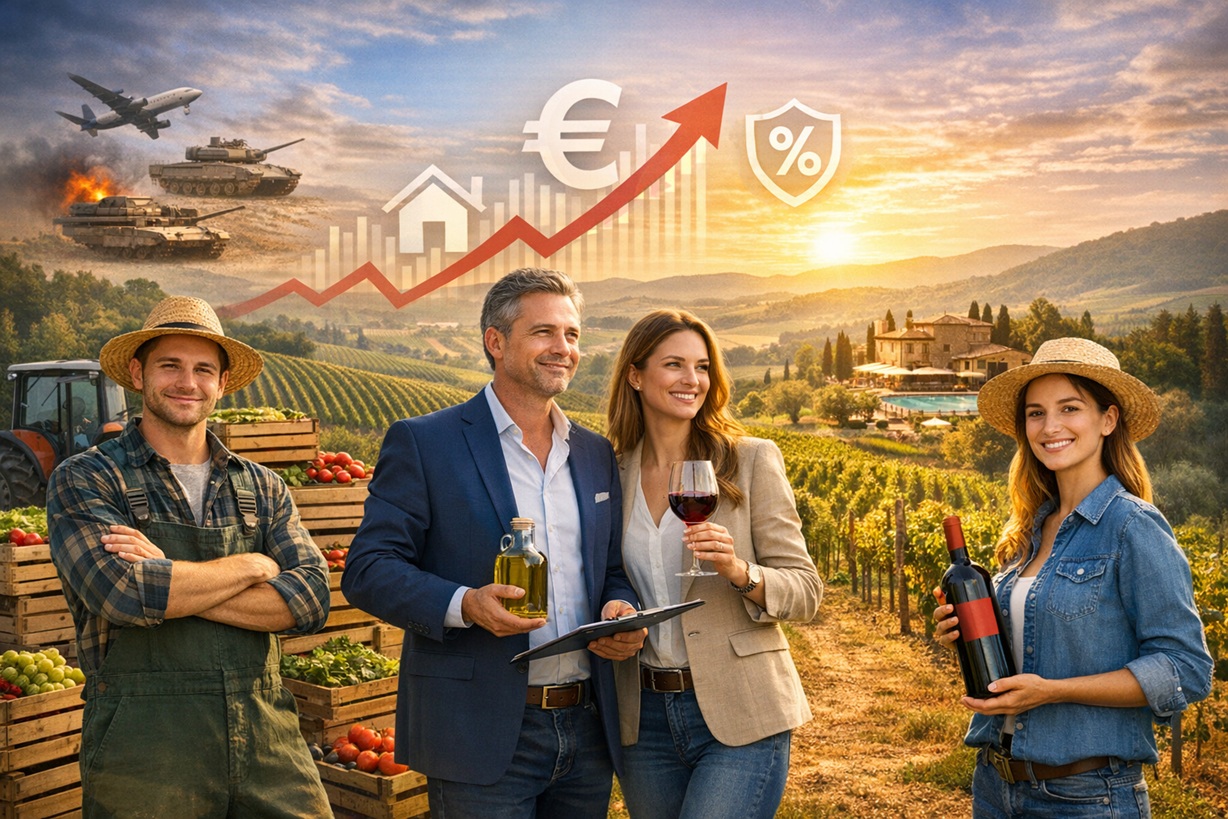
The land does not betray: why Italian agricultural and wine estates are one of the most solid investments today

The world is going through a period of great instability.

Wars, geopolitical tensions, persistent inflation, and increasingly volatile and unpredictable financial markets are changing investors’ perception of risk.

In this context, much capital is returning to what in economic history has always been considered a real and tangible safe haven : land.

This is not rural nostalgia.
It’s about strategy.

An agricultural or winery estate is an asset that produces real value: food, wine, oil, hospitality, territory, cultural identity.
In other words, it generates income, wealth and security at the same time.

And in Italy this is even more true.

Land: the oldest safe haven in history

In modern economic language we talk about real assets .
They are physical goods that maintain value over time because they are linked to primary needs.

Agricultural land belongs to this category.

Three elements explain it very well.

1. It is a finite resource
Agricultural land isn’t growing. In fact, it has shrunk in recent decades due to urbanization. This structural factor supports its value over the long term.

2. Produces essential goods
Food, wine, water, oil, grains. Even in the deepest crises, these goods continue to be in demand.

3. Protects against inflation
Historically, farmland and food prices tend to rise over time, following or exceeding inflation.

For this reason, many institutional investors, funds and family offices are increasing their exposure to the agribusiness sector .

Italy: one of the most attractive agricultural markets in the world

Investing in land makes sense everywhere.
Investing in Italian land often makes even more sense.

The reason is simple: Italy possesses a unique combination of factors.

Territories with a very high international reputation

Chianti
Langhe
Eastern Hills of Friuli
Valdobbiadene – Prosecco DOCG
Montalcino
Bolgheri

These are territories that don’t just sell wine. They sell history, landscape, and culture .

The value of the Made in Italy brand

Italian wine is one of the global symbols of Made in Italy.
Each bottle embodies territory, tradition and premium positioning.

This allows companies to work on higher margins than many other agricultural productions.

Tourism and lifestyle

The hills of Chianti or Tuscany are not just places of production.
They are world-class tourist destinations.

Here an agricultural estate can become:

  • winery
  • farmhouse
  • wine resort
  • event location
  • luxury hospitality

In other words, land produces income on multiple levels .

An investment that generates value from multiple sources

A modern farm is no longer just about agriculture.

It is an integrated economic system.

Sources of income can be different.

Agricultural production

  • wine
  • oil
  • fruit and vegetables
  • organic farming
  • DOP and IGP products

Transformation and branding

The value increases when the product is transformed and sold under its own brand.

A bottle of wine tells the story of its territory, its history, and its identity.
And that creates margin.

Rural tourism

Food and wine tourism is one of the most dynamic segments of global tourism.

An estate can become:

  • farmhouse
  • wine resort
  • country relais
  • structure for tastings and events

Direct sales

More and more farms are selling directly to consumers, reducing middlemen and increasing margins.

Wine estates: high-value agricultural assets

Among all agricultural investments, one of the most interesting remains that in wine-making companies .

Wine is an agricultural product but also a cultural, identity-building, and commercial asset.

A well-located winery can generate value through:

  • production
  • brand
  • international distribution
  • wine tourism
  • valorization of the territory

Areas such as:

  • Prosecco DOC and DOCG
  • Eastern Hills of Friuli
  • Chianti Classico
  • Langhe

They are considered territorial platforms of great interest to Italian and foreign investors.

Public contributions: an accelerator for development

Another element that is often underestimated is the presence of very significant public incentives .

The European Union and the Italian state strongly support agriculture.

Among the most important instruments we find the Rural Development Programmes (RDP) .

A significant example is the SRD01 call – Agricultural productive investments for competitiveness , which can offer:

  • grants up to 60% non-repayable
  • financeable investments between €80,000 and €800,000

In addition to this, there are other tools.

For example:

  • INAIL contributions of up to 80% to improve machinery safety
  • incentives for organic farming
  • funds for technological innovation and sustainability

In practice, a significant part of the investments can be covered by public funds .

Heritage and sustainability: an increasingly strong combination

Agricultural land does not just represent an economic investment.

It is also an investment in environmental sustainability .

Modern farms can contribute to:

  • landscape protection
  • emissions reduction
  • organic farming
  • sustainable water management
  • CO₂ absorption

More and more agricultural projects integrate:

  • precision agriculture
  • digital technologies
  • environmental sensors
  • intelligent resource management

This makes the agricultural sector one of the pillars of the European ecological transition .

The risks you should be aware of

Naturally, agricultural investment also presents some critical issues.

Among the main ones:

Illiquidity
Agricultural transactions take time. It’s not an immediately liquidable investment.

Climate variability
Climate change and weather conditions can affect production.

Bureaucracy
The agricultural regulatory system can be complex and requires specific expertise.

Management costs and taxes
Maintenance, personnel, machinery, and taxes (such as IMU on some properties) must be carefully evaluated.

For this reason, it is essential to always conduct thorough due diligence before purchasing.

Investing methodically: the key to success

An agricultural investment must not be improvised.

Precise analyses are needed on:

  • soil quality
  • vineyard planting rights
  • access to water
  • infrastructure
  • tourist potential
  • outlet markets
  • available tenders and incentives

More and more farms are also using advanced technologies to increase productivity and efficiency.

Precision agriculture, sensors, digital vineyard management, and environmental monitoring systems are transforming the sector.

Land as a long-term strategy

In times of global instability, investors always return to what is real.

The earth is real.

It produces food.
It produces wine.
It produces value.

An Italian agricultural or winery estate can simultaneously represent:

  • a capital investment
  • an entrepreneurial platform
  • a life project
  • a defense against economic uncertainty

And perhaps the simplest truth is also the most powerful.

When the world gets complicated, the earth continues to do what it has always done :

to grow what humanity needs to live.

And this, for millennia, has been one of the smartest investments there is.

Style Selector
Select the layout
Choose the theme
Preset colors
No Preset
Select the pattern