A network portal of Wine Idea. Discover the world of Wine idea

Italian agriculture: FORBUS proposes modern sharecropping to revitalize agricultural and winemaking businesses.

Abandoned lands, struggling businesses, and a lack of generational change.

FORBUS presents a new model of collaboration between owners, families, young entrepreneurs, and investors to recover productivity, enhance agricultural assets, and create new management opportunities, including with the prospect of future purchase.

Italian agriculture: nearly 500,000 fewer farms in ten years

Italian agriculture is undergoing a profound transformation. According to the ISTAT General Census of Agriculture, between 2010 and 2020, the number of farms decreased from approximately 1.62 million to 1.13 million , a reduction of almost 488,000 businesses, or 30% .

Over the same period, the average utilized agricultural area per farm grew from approximately 7.9 to 11.5 hectares, highlighting a progressive process of concentration of agricultural activities.

Added to this transformation are increasingly evident problems: underutilized land, rising costs, difficulty finding labor, uncertain profitability, and the lack of successors in family businesses.

For many owners of farms, wineries, and wine estates, the choice seems to boil down to three options: continue the business, sell, or abandon it.

But there is a fourth option: retain ownership and entrust management to those with the skills, entrepreneurial ability, and a concrete development plan.

The FORBUS proposal: a modern sharecropping system to create new value

From this need was born the FORBUS modern sharecropping project, an initiative developed by Quidquid Srls to encourage new forms of collaboration in the agricultural and wine-growing sectors.

The idea draws on a principle of Italian farming tradition: connecting those who own the land with those who wish to cultivate, manage, and enhance it.

It’s not about reinstating the old sharecropping contract, the new stipulation of which is prohibited by Italian law, but about developing modern, sustainable management agreements that comply with current regulations , tailored to the characteristics of each farm.

The owner can offer land, vineyards, farm buildings, cellars, and production facilities. Management can be entrusted to young agricultural entrepreneurs, Italian or foreign families, cooperatives, agricultural businesses, or qualified operators.

The agreements must regulate responsibilities, investments, duration, remuneration and production objectives, using the applicable legal instruments.

From management to purchasing: a three-step journey

The FORBUS model can also include a gradual path towards the acquisition of the company.

1. Management and relaunch

The owner initially retains ownership of the assets, while selected operators assume management through defined agreements. The goal is to recover productivity and re-establish economic sustainability.

2. Development and valorization

We address corporate organization, production efficiency, costs, marketing, and the investments needed to increase the company’s profitability and value.

3. Possible acquisition

When the economic, financial, and contractual conditions are met, the process can culminate with the management purchasing the company through appropriate legal instruments.

This way, the owner can enhance the value of the assets before selling them, while the future buyer can gradually build their entrepreneurial and financial capacity.

A new opportunity for wineries and wineries

The project is of particular interest to the Italian wine sector, where numerous companies own valuable vineyards, cellars, properties, and brands, but face difficulties in managing them financially, productively, or commercially.

Professional management can help recover unused production capacity, develop new markets, improve distribution, and introduce complementary activities such as wine tourism, rural hospitality, and direct sales.

For a family without generational change, this solution can represent an alternative to an immediate sale.

For a young entrepreneur or investor, it could instead become an opportunity to enter the agricultural and winemaking sector through a progressive path.

Paola Benvenuti: Giving continuity to Italy’s agricultural heritage

In the vision illustrated by Professor Paola Benvenuti, sole director of Quidquid Srls , the transformation of Italian agriculture is not just about reducing the number of businesses, but also about the continuity of production activities, the protection of rural heritage, and job opportunities.

In fact, many agricultural businesses retain significant potential, even though they no longer have the family, organizational, or financial resources necessary to continue operating independently.

The project’s goal is to identify solutions that can keep these assets productive, preventing their sale from becoming a forced choice rather than a strategic decision.

FORBUS: from evaluation to operational management

FORBUS supports owners, entrepreneurs, and investors through an integrated team of professionals with agricultural, winemaking, industrial, commercial, and financial expertise.

The process may include company analysis, asset and financial assessment, identification of managers or partners, definition of the development project, and coordination of legal, tax, and technical specialists.

Each initiative is assessed individually: not all companies are suited to this model, and economic sustainability must be verified before making commitments.

The goal is not simply to find someone willing to manage a company, but to create the conditions for that management to produce results and value over time.

The future of Italian agriculture must not be just sales

Land represents an economic, productive, environmental, and cultural asset. When a farm ceases operations, the risk also affects the territory, employment, and the continuity of production traditions.

The modern sharecropping system proposed by FORBUS aims to offer a possible solution: to foster the encounter between agricultural owners and new entrepreneurial energies, transforming difficult situations into revitalization projects.

Before selling a farm or winery, it’s worth asking yourself how much it might be worth if it were managed differently.

Do you have a farm or winery to promote?

FORBUS is aimed at owners of wineries, farms, and wine estates, families with no generational turnover, cooperatives, Italian and foreign entrepreneurs and investors interested in management, development, and potential acquisition projects.

Present your project to FORBUS and evaluate alternatives to immediate sale.

www.forbus.it

FORBUS – Manage, enhance, develop. And sell when it’s convenient.
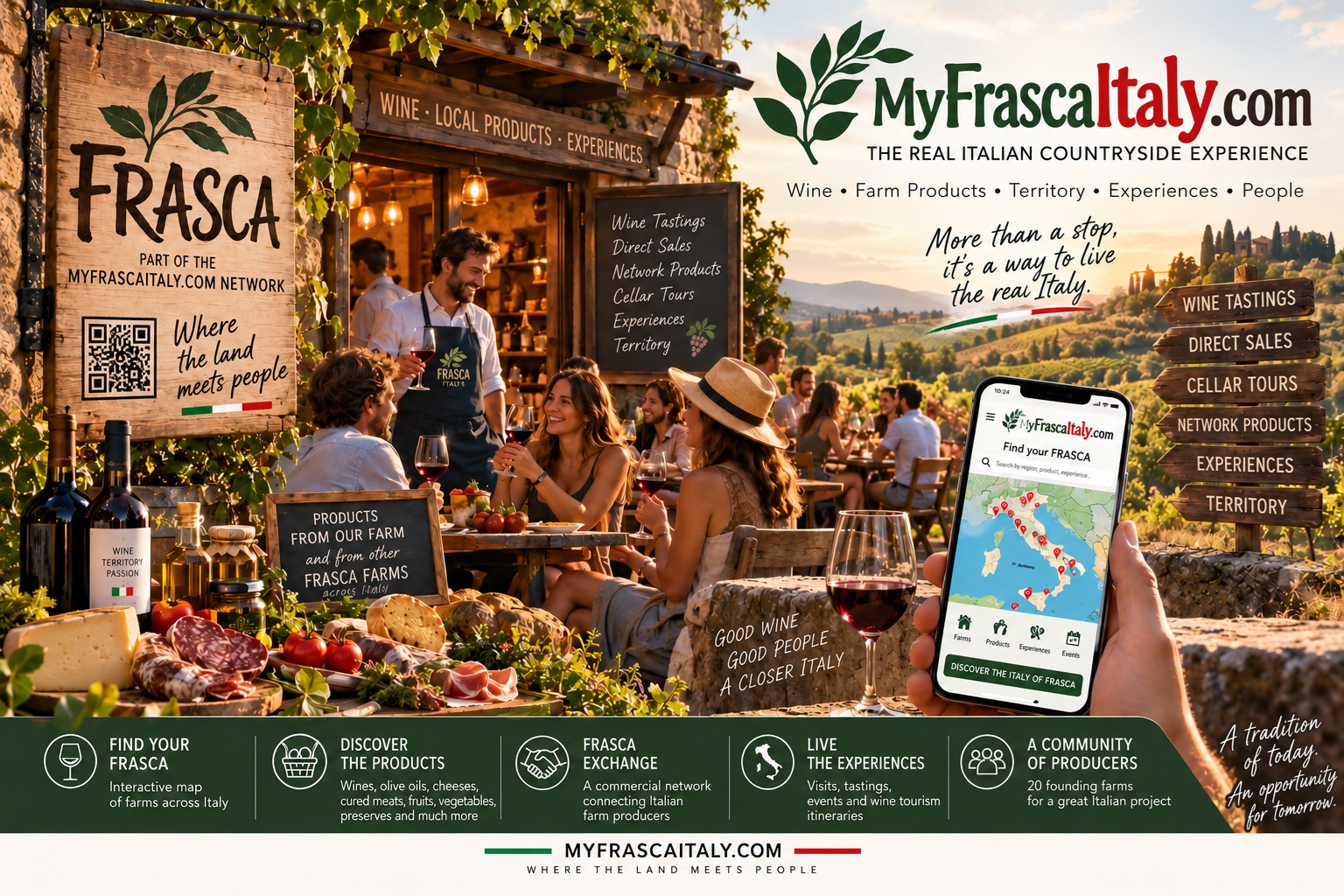
MY FRASCA: A new national network is born to promote Italian wineries, farms, and products.

From ancient farming tradition comes an innovative project that combines direct sales, tastings, rural tourism, and collaboration between producers.

An opportunity to generate new revenue and bring consumers closer to the Italian agricultural world.

There was a time when a green branch, a twig , displayed outside a farmhouse or a cellar indicated that it was possible to stop, drink a glass of wine, taste the products of the land and meet the producer directly.

From this tradition was born LA MIA FRASCA , a project designed to create a national network of reception and sales points at wineries, farms, oil mills, dairies and agritourisms.

The goal is simple: to transform the spaces already available on farms into places for meeting, tasting, and sales , maintaining the authenticity of each territory and creating new economic opportunities.

How does LA MIA FRASCA work?

Each participating company will be able to open its own FRASCA, recognizable by a common brand and sign, using a tasting room, a portico, a courtyard, or other suitable company spaces.

Visitors can meet the producer, taste wines and local specialties, purchase agricultural products, and discover excellent products from other companies in the network, in compliance with applicable permits and regulations.

The project includes three formats that can be adapted to different company sizes:

  • FRASCA SMALL – 20-40 m²: Direct sales and tastings for small businesses and wineries.
  • FRASCA CLASSIC – 40-100 m²: Farm shop, tastings, and convivial spaces.
  • FRASCA EXPERIENCE – over 100 m²: company visits, events, food and wine experiences, and wine tourism.

True innovation: a commercial network between Italian producers

LA MIA FRASCA will not just be a collection of sales outlets, but an organised network of collaboration between agricultural companies .

Through FRASCA EXCHANGE , producers will be able to offer their products, search for suppliers and develop commercial agreements with other member companies.

A Venetian winery can showcase its wines in a Puglian FRASCA and, at the same time, offer visitors oil, cheeses, or preserves from other Italian regions.

This will create a network capable of expanding sales opportunities and promoting national agricultural production.

FRASCA24.it: the network portal

The project includes a national digital platform with three main functions:

  • Find a FRASCA: an interactive map to locate companies, products, tastings, and experiences throughout Italy.
  • FRASCA BUSINESS: a dedicated area for producers to collaborate, supply, and trade.
  • FRASCA MARKET: a space dedicated to the promotion and marketing of products from participating companies.

The FRASCA Passport will also be developed to encourage visits, and the Strade delle Frasche , food and wine itineraries dedicated to Italian regions, from Prosecco to Collio, from the Langhe to Chianti and up to Etna.

How much does it cost to join?

The project provides for three levels of annual membership, with initially hypothesized fees:

MembershipIndicative annual fee
FRASCA POINT€390–590
FRASCA EXPERIENCE€790–990
FRASCA PREMIUM€1,490–1,990

Fees and services will be defined after an initial pilot phase. Membership will include, depending on the chosen level, use of the brand, presence on the portal, digital tools, and opportunities for promotion and commercial collaboration.

An opportunity for the future of Italian agriculture

In a market where many agricultural companies face rising costs, commercial difficulties, and reduced margins, LA MIA FRASCA offers a model that enhances existing assets without distorting the companies’ identity.

More direct sales, more collaboration between producers, more rural tourism, and greater visibility for Italian agricultural excellence.

The project is currently under development and aims to gradually involve farms and wineries interested in participating in the future national network.

MY FRASCA is looking for the first interested companies

Wineries, wine producers, farms, oil mills, dairies, and agritourism businesses can express their interest in learning more about the project and considering future participation.

MY FRASCA – Your company, your land, your products. Together, a new network for Italian agriculture.

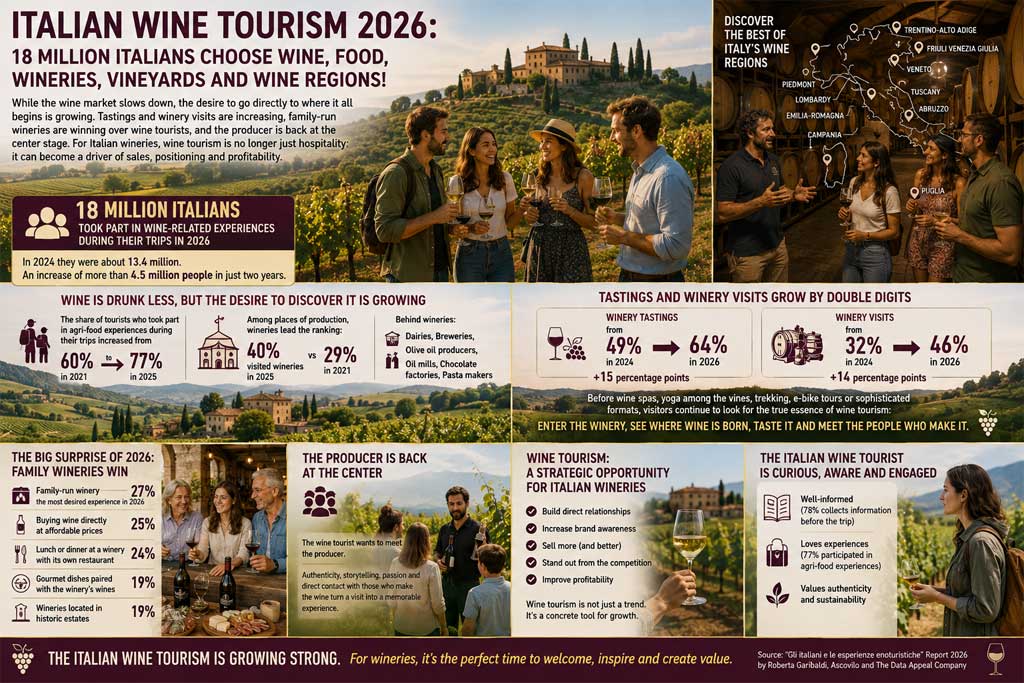
Wine tourism 2026 in Italy: 18 million Italians choose food and wine, wineries, vineyards, and wine regions!

As the wine market slows, the desire to travel directly to the places where it is produced grows. Tastings and winery tours are on the rise, family-run businesses are winning over wine tourists, and producers are once again taking center stage.

For Italian wineries, wine tourism is no longer just hospitality: it can become a lever for sales, positioning, and profitability.
There is an apparent paradox in the Italian wine of 2026 .

On the one hand, consumption is decreasing, exports are going through a difficult phase and many wineries are having to deal with high inventories, pressure on prices and a more cautious and selective consumer.

On the other hand, the number of people who want to enter the cellars, walk through the vineyards, meet the producers and understand where and how the wine is made is growing.

This is one of the most interesting signals emerging from the report “Italians and wine tourism experiences” , edited by Roberta Garibaldi in collaboration with Ascovilo – Association of Consortia for the Protection of Lombard Wines – and The Data Appeal Company.

The most significant fact concerns the size of the phenomenon.

In 2026, an estimated 18 million Italians will have had wine-related experiences during their travels.

In 2024 there were approximately 13.4 million.

This means that in just two years the potential audience for Italian wine tourism has increased by over 4.5 million people .

A fact that deserves to be read not only from a tourist point of view.

For the wine world it contains a much deeper message:

Italians may be drinking less wine, but they haven’t lost interest in it. They’re just changing the way they approach it.

Wine is being drunk less, but the desire to learn about it is growing

The transformation is particularly interesting because it is taking place just as the sector is discussing the structural reduction of consumption.

Wine is no longer necessarily the daily protagonist of the table as it was for previous generations.

But when it becomes territory, travel, gastronomy, storytelling, culture and meeting with the producer , it continues to exert a strong power of attraction.

The share of tourists who participated in agri-food experiences during their trips increased from 60% in 2021 to 77% in 2025 .

And among the places of production, it is precisely the wineries that lead the ranking: in 2025 they were visited by 40% of the interviewees , compared to 29% in 2021.

Behind them come dairies, breweries, olive oil companies, oil mills, chocolate factories and pasta factories.

Wine, therefore, maintains a privileged position within Italian food and wine tourism.

Tastings and winery visits are growing by double digits.

Even more significant is observing what wine tourists actually want to do.

Between 2024 and 2026 , in-cellar tastings increased from 49% to 64% , an increase of 15 percentage points.

Visits to wineries, on the other hand, grew from 32% to 46% , an increase of 14 points.

This is a very clear signal.

Before wine spas, yoga among the vineyards, trekking, e-bikes, or particularly sophisticated formats, visitors continue to search for what represents the very essence of wine tourism:

enter the cellar, see where the wine is born, taste it and meet the person who produces it.

Simplicity, when authentic and well-organized, can therefore have more value than spectacularization.

The surprise of 2026: the family winery wins

Probably the most interesting piece of information in the entire report concerns the type of company that tourists want to visit.

In 2026, the family-run winery , chosen by 27% of wine tourists, became the most popular specific experience for the first time.

It even surpasses buying wine directly from the winery at convenient prices, indicated by 25%.

Next comes lunch or dinner in a winery with a restaurant, with 24%, and the opportunity to taste gourmet dishes paired with company wines, chosen by 19%.

Another 19% appreciate cellars located inside historic homes.

This is a result that should give pause, especially to the thousands of small and medium-sized Italian wineries.

To compete in wine tourism, you don’t need to be a large winery, own a luxury resort, or invest millions of euros in hospitality .

In some cases, the exact opposite may be true.

The family dimension, the company’s history, and the ability to speak directly with the producer become distinctive elements.

What may seem small from an industrial perspective can become exclusive from a tourist perspective.

The producer returns to the center of the experience

The data also explains why.

64% of those interviewed consider wine tourism an opportunity for cultural enrichment , while 63% want to learn the history and anecdotes of the company and its wines.

The visitor, therefore, is not only looking for technical information.

He wants to know who planted that vineyard.

Because that family produces wine right there.

How the cellar has changed over the generations.

What is the relationship between a label and the territory it is visiting?

And this is where the producer plays a fundamental role.

The winemaker isn’t just the one who makes the wine. He becomes part of the perceived value of the wine itself.

A bottle tasted after having met the family who produced it rarely remains just a bottle.

It becomes the memory of an experience.

And it is precisely this step that can create loyalty.

The welcome is as good as the beauty of the cellar

The quality of the wine remains important, of course, but it is not enough.

When wine tourists are asked what would encourage them to return to a winery they have already visited, 68% indicate the hospitality and professionalism of the staff .

66% consider the ease of booking and organizing the visit important.

64% appreciate the possibility of finding something different from their previous experience.

These are extremely concrete indications.

A winery can have extraordinary vineyards, a historic building, and award-winning wines.

But if it takes three days to respond to a request for a visit, doesn’t allow easy booking, gives a cold welcome to visitors, or isn’t able to explain what it offers, it’s losing a significant part of its potential.

Wine tourism is first and foremost a culture of hospitality.

The smartphone has become the entrance door to the cellar

2026 also confirms another transformation that is now irreversible.

Before physically arriving at the company, the visitor almost always enters digitally .

Search for information.

See photos.

Check reviews.

Compare experiences.

Check the times.

Book.

Use your smartphone to reach the property.

The ease with which an experience can be found and booked therefore becomes an integral part of its quality.

And here an interesting apparent contrast emerges.

The more digital the pre-visit phase becomes, the more tourists seem to seek authenticity once they arrive at the winery.

Technology must therefore eliminate obstacles, not replace human relationships.

Digital first.

People, wine and territory after.

Local wine tourism is born

Another important fact concerns distance.

Geographic proximity is considered by 65% of respondents when choosing a wine tourism destination and by 63% when deciding which winery to visit.

So there’s more to the great journey to the Langhe, Tuscany, Mount Etna, or the Prosecco hills.

An interesting space is growing for what we can define as local wine tourism .

A visit to the winery can be organized over a day or weekend, without necessarily requiring a long stay.

For thousands of companies, this greatly expands the potential market.

The customer is not just the international tourist arriving from the other side of the world.

It could even be a family that lives a hundred kilometers away.

A couple looking for a weekend experience.

A group of friends.

A company that organizes a meeting.

Or an enthusiast who wants to learn more about the producers in their area.

The most popular destinations: Cinque Terre, followed by Salento and Chianti.

The geography of wine tourism desired by Italians is also interesting.

At the top of the list of destinations that those interviewed would like to visit is the Cinque Terre , indicated by 20%.

Salento follows with 19% and Chianti with 18%.

The Amalfi Coast and Etna also reach 18%, ahead of Montepulciano with 16%, Montalcino with 15% and Langhe-Barolo and Gallura with 14%.

Valdobbiadene and Vesuvio collect 13%, Franciacorta and Castelli Romani 12%, while Trento Doc, Monferrato and Valpolicella reach 11%.

The ranking contains an interesting indication.

Tourists do not necessarily choose a destination just because it produces great wine.

Look for an area where the wine can be inserted into a broader experience.

Wine alone is not enough: the territory wins

Landscape, gastronomy, culture, catering and hospitality therefore become part of the wine tourism product.

62% of those interviewed consider the presence of tourist services , including accommodation facilities and restaurants, to be important.

61% value the accessibility of the destination.

58% look at the breadth of the wine tourism offering.

When choosing a single winery, the quality and reputation of the wines gain weight, indicated by 60%, followed by outdoor experiences, also at 60%, and the opportunity to deepen one’s knowledge of wine, at 58%.

This means that the competition is no longer just winery against winery .

It also happens between territories .

A denomination capable of networking wineries, restaurants, accommodations, landscape, culture, services, and mobility has a competitive advantage that is difficult for a single company to replicate.

Style Selector
Select the layout
Choose the theme
Preset colors
No Preset
Select the pattern