

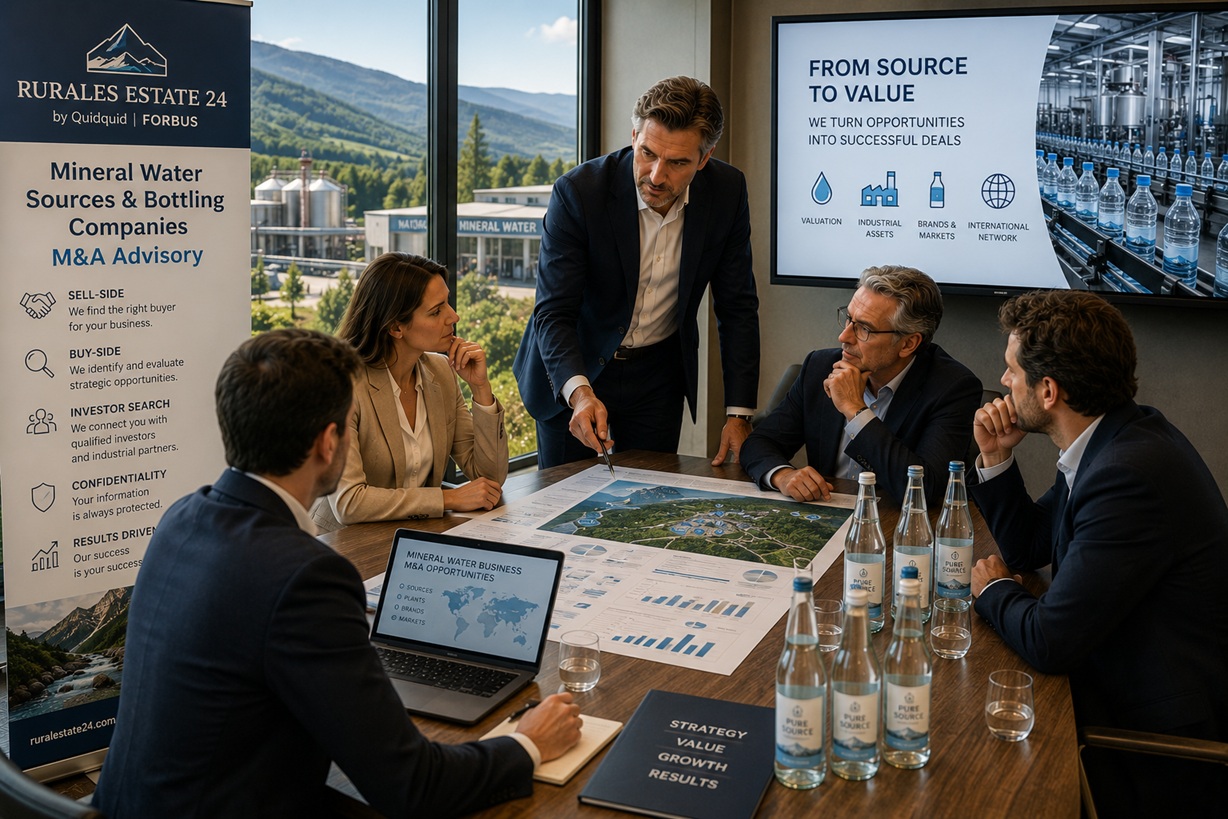
Mineral Water Sources: Advisory, Sale, Acquisition & Investor Search
Strategic Business Advisory & M&A for Mineral Water Sources, Bottling Plants and Mineral Water Companies
A mineral water source is much more than a piece of land from which water naturally emerges.
It can represent a complex industrial asset combining water resources, mineral concessions, water characteristics, extraction capacity, production facilities, bottling lines, brands, distribution networks, market positioning and future development potential.
For this reason, selling, acquiring or enhancing the value of a mineral water source requires expertise that goes far beyond a traditional real estate transaction.
Rurales Estate 24 by Quidquid, together with FORBUS, supports owners, entrepreneurs, beverage companies, industrial groups and investors in transactions involving:
- mineral water sources;
- mineral concessions and extraction rights;
- mineral water companies;
- bottling companies;
- production and bottling plants;
- mineral water brands;
- beverage companies;
- industrial projects to be developed or relaunched.
We bring together more than 50 years of entrepreneurial and commercial experience, in-depth market knowledge and an established Italian and international network.
Our objective is clear:
to understand the true potential of the asset, identify the most appropriate strategy and bring the transaction to a successful conclusion.
Selling a Mineral Water Source: What Are You Really Selling?
The sale of a mineral water source should not begin by simply publishing a listing.
It should begin by understanding exactly what is being sold.
A single transaction may involve several different components.
Water Resource and Concession
- natural spring or well;
- characteristics and composition of the water;
- authorised extraction capacity;
- potential extraction capacity;
- mineral concession;
- duration and conditions of the concession;
- protection areas and related land.
Real Estate and Industrial Assets
- land;
- buildings;
- bottling plant;
- bottling lines;
- storage tanks;
- production equipment;
- warehouses;
- laboratories;
- logistics infrastructure.
Commercial Assets
- brand and trademarks;
- market positioning;
- revenue;
- customer portfolio;
- distributors;
- large-scale retail;
- Ho.Re.Ca.;
- export markets;
- commercial agreements.
Future Development Potential
- unused production capacity;
- potential expansion of extraction capacity, where technically and legally possible;
- additional bottling lines;
- new packaging formats;
- private-label production;
- export development;
- development of other beverage products;
- relaunch of currently inactive plants.
The first question should therefore not simply be:
“How much is the water source worth?”
A more strategic question is:
“What industrial project can be developed around this resource, and which investor or industrial group could attribute the greatest value to it?”
How Much Is a Mineral Water Source Worth?
Two mineral water sources with apparently similar characteristics can have completely different economic values.
A preliminary strategic valuation should consider at least five dimensions.
1. Value of the Water Resource
Quantity, continuity of supply, qualitative characteristics and mineral composition are fundamental factors.
The resource should be assessed through the available technical, hydrogeological, analytical and regulatory documentation.
2. Value of the Concession
The concession is a central element of the transaction.
Together with the relevant professionals and public authorities, it is essential to verify:
- ownership and legal status;
- duration;
- conditions;
- authorised extraction volumes;
- obligations attached to the concession;
- potential for future development.
3. Industrial Value
An operational bottling plant equipped with modern production lines and available capacity represents a very different investment opportunity from a mineral water source without production facilities.
The analysis should include:
- production capacity;
- condition of the equipment;
- PET and glass bottling lines;
- available packaging formats;
- level of automation;
- warehousing;
- logistics;
- energy requirements;
- capital expenditure required.
4. Commercial Value
A mineral water source supported by an established brand, consolidated distribution network and active customer base can have significant commercial value.
The assessment should therefore consider:
- revenue;
- production and sales volumes;
- average selling price;
- margins;
- distribution channels;
- key customers;
- customer concentration;
- geographical coverage;
- export markets;
- brand awareness.
5. Strategic Value
This can be one of the most important components in an M&A transaction.
The same mineral water source may have a very different strategic value for a financial investor, an existing bottler, an international beverage group or a distributor seeking to vertically integrate its operations.
Value depends not only on what the asset is today, but also on what a specific buyer can turn it into tomorrow.
Operating Sources, Inactive Plants and Relaunch Opportunities
The market is not limited to fully operational mineral water businesses.
We can evaluate different types of opportunities.
Operating Mineral Water Sources and Companies
Businesses with active production, bottling facilities, established brands, customers and revenue.
Sources with Development Potential
Operating assets with opportunities to increase production, expand distribution or develop their international presence.
Temporarily Inactive Bottling Plants
The fact that a facility is currently inactive does not necessarily mean that the underlying asset has lost its value.
It is essential to understand why operations were suspended, which concessions and permits remain valid, the condition of the production equipment and how much investment would be required to restart operations.
Mineral Water Sources Without a Bottling Plant
In certain cases, the investment opportunity may be focused primarily on the water resource, the concession and the possibility of developing a new industrial project.
These situations are fundamentally different and should always be evaluated individually.
M&A Sell-Side: Selling a Mineral Water Company
For owners considering a sale, our work begins with an analysis of the transaction.
We do not simply look for “someone willing to buy”.
We seek to understand which type of buyer is most likely to recognise the highest strategic value of the company and its assets.
The process may include:
Analysis → Valuation → Positioning → Teaser → Buyer Search → NDA → Confidential Information → Expressions of Interest → Negotiation → Due Diligence → Closing
The objective is to create a structured and controlled process while avoiding indiscriminate disclosure of sensitive information to the market.
M&A Buy-Side: Acquiring a Mineral Water Source or Bottling Company
We also advise companies and investors seeking to acquire mineral water sources and bottling facilities.
The process begins by defining the investor’s acquisition profile.
Together with the client, we assess:
- preferred geographical area;
- type and characteristics of the water;
- required extraction capacity;
- existing bottling facility or greenfield project;
- required production capacity;
- bottling technologies;
- PET, glass and other packaging formats;
- presence of an established brand;
- target revenue;
- markets currently served;
- export potential;
- available investment budget;
- potential interest in turnaround or relaunch opportunities.
Based on this profile, we can conduct a targeted acquisition search, including opportunities that are not publicly available on the market.
Investor Search and Industrial Partnerships
A complete sale is not always the only solution.
A mineral water company with significant potential may primarily require:
- capital for new equipment;
- increased production capacity;
- new bottling lines;
- an industrial partner;
- commercial expertise;
- international distribution;
- access to large-scale retail;
- export development.
Depending on the circumstances, alternative transactions can therefore be considered, including equity investment, joint ventures, industrial partnerships or the entry of a strategic investor.
The transaction structure should always be tailored to the specific characteristics and objectives of the business.
Due Diligence on a Mineral Water Source
The acquisition of a mineral water source requires particularly thorough due diligence.
In addition to standard corporate, tax, financial and real estate due diligence, several sector-specific areas require particular attention.
Hydrogeological Due Diligence
Characteristics of the spring or well, recharge area, extraction capacity and supporting technical documentation.
Analytical Due Diligence
Water composition, stability of its characteristics and laboratory documentation.
Concession and Regulatory Due Diligence
Ownership and characteristics of the concession, duration, requirements, restrictions and permits.
Health and Regulatory Compliance
Official recognition of the mineral water and documentation required under applicable regulations.
Industrial Due Diligence
Condition of the bottling plant, machinery, production lines, maintenance status, capacity and investment requirements.
Environmental Due Diligence
Site conditions, resource management, wastewater management, permits and other applicable environmental requirements.
Commercial Due Diligence
Brand, customers, distribution network, volumes, pricing, margins and market positioning.
The acquisition of a mineral water business therefore requires a multidisciplinary approach, involving the appropriate legal, financial, technical, hydrogeological, environmental and industrial professionals.
Natural Mineral Water: Why Composition Also Matters Commercially
Mineral composition is not merely a technical parameter.
It contributes to the identity, differentiation and positioning of the water brand.
One of the best-known parameters is the fixed residue at 180°C, which indicates the total amount of minerals remaining after the evaporation of one litre of water.
The main classifications include:
| Water category | Fixed residue at 180°C |
|---|---|
| Very low mineral content | ≤ 50 mg/L |
| Low mineral content / Oligomineral | 50–500 mg/L |
| Medium mineral content | 500–1,500 mg/L |
| High mineral content | > 1,500 mg/L |
The significant presence of specific minerals can further characterise individual mineral waters.
From an investor’s perspective, these characteristics should also be considered in terms of commercial positioning.
Water composition, geographical origin, brand identity, packaging, pricing and distribution strategy should all contribute to a coherent market proposition.
Mineral Water and Communication: Health Claims Require Particular Attention
When presenting a mineral water business to the market, it is important to clearly distinguish between verified chemical and physical characteristics and claims concerning potential health benefits.
Health-related claims and communications concerning natural mineral waters are subject to specific regulations and should therefore be reviewed in accordance with the applicable legislation and by the appropriate professionals.
For investment and M&A purposes, Rurales Estate 24 focuses primarily on objectively verifiable information:
water composition, fixed residue, extraction capacity, concession, production capacity, bottling facilities, market position and industrial potential.
Confidentiality: A Fundamental Part of the Transaction
The sale of a mineral water company may involve highly sensitive information.
Data concerning:
- concessions;
- extraction capacity;
- laboratory analyses;
- customers;
- revenue;
- margins;
- production capacity;
- commercial contracts;
- investments;
- financial position
should not necessarily be disclosed publicly.
For this reason, particularly sensitive opportunities can initially be presented through an anonymous investment teaser.
More detailed documentation can then be provided only after the potential counterparty has been qualified and an NDA – Non-Disclosure Agreement has been signed.
Are You Interested in Acquiring a Mineral Water Source?
For confidential opportunities, we may initially request a non-binding Expression of Interest, providing essential information about the potential buyer or investor.
For more structured transactions, additional information may subsequently be required, including:
- investor profile;
- company or group represented;
- strategic rationale for the acquisition;
- financial capacity;
- investment range;
- expected transaction timeline;
- LOI or other documentation required for the specific transaction.
This process helps protect both the owner and genuinely interested investors.
Why Rurales Estate 24 and FORBUS?
We are not simply real estate intermediaries.
Nor do we replace lawyers, accountants, geologists, technical experts, laboratories, environmental consultants or other regulated professionals.
Our role is that of Strategic Business Advisor and transaction coordinator.
We bring together:
Assets → Strategy → Market → Investors → Professional Advisers → Negotiation → Closing
We work alongside the specialist professionals required to ensure that each element of the transaction is properly reviewed and verified.
Our value lies in providing an integrated strategic vision of the transaction and the ability to align people, expertise and different interests towards a common objective.
A Results-Oriented Model
Our approach is practical and focused on execution.
A significant part of our compensation may be linked to the successful completion of the transaction, according to the terms agreed in each individual engagement.
This creates a clear alignment of interests:
not simply advisory work, but a commitment focused on achieving the result.
Are You Considering Selling a Mineral Water Source in Italy?
If you own a mineral water source, concession or bottling facility and are considering:
Sale → Investor Search → New Shareholder → Industrial Partnership → Business Relaunch → Succession Planning
we can arrange an initial confidential discussion to understand the situation and identify the most appropriate strategy.
Are You Looking to Acquire a Mineral Water Source or Bottling Plant in Italy?
We identify and search for opportunities with different characteristics, including:
operating mineral water sources, bottling facilities, established companies with brands and revenue, undeveloped sources and industrial turnaround opportunities.
We begin with your investment strategy and available budget and then identify the assets that best match your requirements.
Rurales Estate 24 by Quidquid | FORBUS
Strategic Business Advisory & M&A – Mineral Water, Wine & Agricultural Business
50+ Years of Experience. Sector Expertise. International Network. Confidentiality. Results.
The regulatory, technical, health, tax and legal information contained on this page is provided for general information purposes only. Each mineral water source, concession, bottling facility and transaction must be subject to the appropriate due diligence and verification by the relevant authorities and qualified professional advisers.