

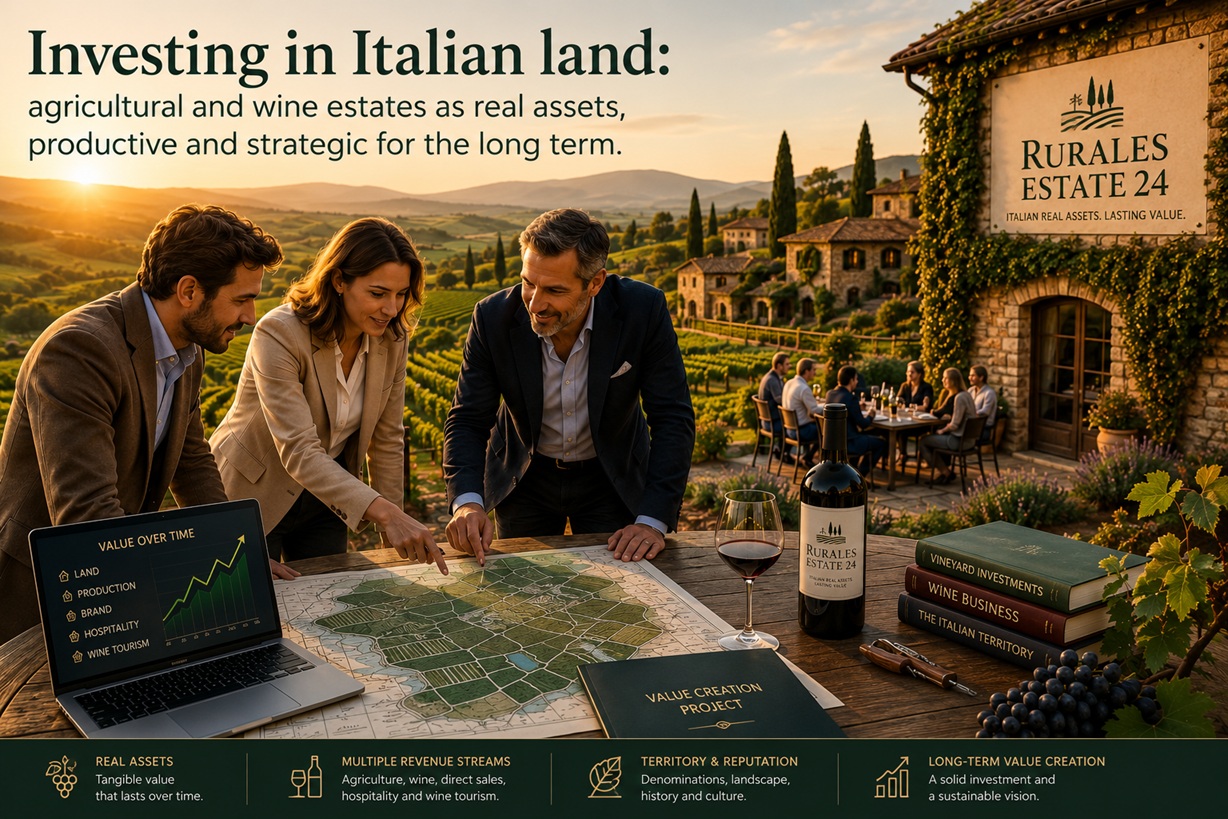
Investing in Italian Land: Why Agricultural and Wine Estates Are Strategic Long-Term Assets
Land, vineyards, agricultural businesses and hospitality: why investors are increasingly looking at Italian real assets
At a time of international economic uncertainty, marked by inflation, geopolitical tensions, financial market volatility and profound changes in global markets, investors are increasingly turning their attention to real assets: tangible assets capable of preserving value and, above all, generating income.
Among them, agricultural land holds a unique position.
Land is not simply a real estate asset. It can produce food, wine, olive oil and other agricultural products; it can support tourism and hospitality activities; and it may incorporate production rights, buildings, infrastructure, water resources, brands and commercial operations.
When these elements come together within an Italian agricultural or wine estate, the investment becomes particularly compelling.
The real question, therefore, is not simply:
How much is one hectare of land worth?
The more strategic question is:
How much value can that hectare generate as part of a well-structured business project?
Land as a Long-Term Real Asset
Land has several structural characteristics that are difficult to replicate in other asset classes.
It is a finite resource
The amount of available land cannot be artificially increased.
And when we consider agricultural land located in highly prestigious areas — particularly vineyards within renowned wine appellations — scarcity becomes even more significant.
One hectare within a recognised wine denomination cannot simply be replaced by purchasing another hectare elsewhere.
Location, appellation, exposure, soil and climate characteristics, water availability and reputation are all integral components of its value.
It produces essential goods
Agriculture means producing goods that respond to fundamental needs:
- wine;
- olive oil;
- cereals;
- fruit and vegetables;
- PDO and PGI products;
- agricultural and food raw materials.
Unlike a purely financial asset, an agricultural property can therefore combine capital value with productive capacity.
It can generate income
Land does not necessarily have to be a passive asset.
When properly managed, it can generate income through agriculture, processing, direct sales, hospitality, restaurants, events, rural tourism and wine tourism.
This ability to combine asset ownership with entrepreneurial activity is precisely what makes certain Italian estates particularly attractive.
Why Italy Is a Unique Market
Italy has approximately 1.1 million farms and 12.6 million hectares of agricultural land.
But numbers tell only part of the story.
Italian agriculture offers an extraordinary diversity of climates, soils, products and territories, while Italy has the highest number of PDO and PGI agri-food products recognised by the European Union.
The broader agri-food system also represents a major component of the Italian economy.
Acquiring an Italian estate can therefore mean entering not merely the agricultural sector, but one of the world’s most recognisable agri-food and territorial ecosystems.
The Territory Becomes Part of the Investment
Consider names such as:
Chianti Classico, Montalcino, Bolgheri, Langhe, Valpolicella, Conegliano Valdobbiadene, Collio, Colli Orientali del Friuli, Franciacorta, Montepulciano and Etna.
In territories such as these, businesses do not simply sell an agricultural product.
They sell:
product + appellation + landscape + history + reputation + experience.
It is this combination that makes certain Italian agricultural and wine estates difficult to compare with purely productive agricultural investments elsewhere.
A Modern Agricultural Estate Is an Integrated Economic System
One of the most common mistakes when valuing an agricultural property is to consider only the value of its land and buildings.
A modern estate can generate several different layers of revenue and value.
1. Agricultural Production
The first source of value naturally remains production:
- grapes and wine;
- olives and olive oil;
- cereals;
- fruit;
- vegetables;
- organic products;
- PDO and PGI certified products.
However, primary production often represents only the first step in the value chain.
2. Processing and Added Value
Processing agricultural products directly enables a business to move further along the value chain.
Wine is perhaps the clearest example.
A kilogram of grapes has a certain market value.
The same grapes, transformed into wine, bottled, properly positioned and marketed under a recognised brand, can incorporate significantly greater value.
This is where one of the most frequently underestimated components of an acquisition comes into play:
the brand.
3. Direct-to-Consumer Sales
Estate wine shops, e-commerce, wine clubs, tastings and direct sales reduce the distance between producer and consumer.
For an investor, this means being able to improve not only production performance but also commercial margins.
4. Wine Tourism and Rural Hospitality
A well-located estate can develop an additional business connected directly to its territory:
- agritourism;
- wine resorts;
- country relais;
- restaurants;
- wine tastings;
- winery tours;
- events;
- weddings;
- food and wine experiences;
- luxury hospitality.
This is far from a marginal phenomenon.
In 2024, Italy had 26,360 agritourism businesses. The number of agritourism guests reached approximately 4.7 million, up 4.3% compared with the previous year, with international visitors accounting for 54.8%.
The economic value of the sector also increased.
This confirms that agriculture and tourism are becoming increasingly complementary.
Wine Estates: When a Vineyard Becomes a Strategic Asset
Within the agricultural sector, wine estates deserve particular attention.
Wine has a unique characteristic: it originates from agriculture but can simultaneously become a premium product, a brand, a tourism experience and a powerful vehicle for enhancing the value of a territory.
A winery can therefore generate value through at least five interconnected components:
vineyards → production → brand → distribution → wine tourism.
When the winery is located within a recognised appellation, another important factor comes into play:
territorial scarcity.
New territories such as Barolo, Brunello di Montalcino, Chianti Classico or Conegliano Valdobbiadene cannot simply be created.
For this reason, analysing an investment in a wine estate requires looking far beyond the simple price per hectare.
The True Value of an Estate Is Not Simply the Price of the Land
Two agricultural businesses with exactly the same surface area may have completely different values.
A proper acquisition analysis should consider at least four levels.
Land Assets
Agricultural land, vineyards, olive groves, woodland and other land holdings.
Real Estate Assets
Wineries, production facilities, villas, farmhouses, agritourism properties, hospitality facilities and buildings with redevelopment potential.
Productive Assets
Equipment, machinery, processing capacity, authorisations, water availability and infrastructure.
Intangible Assets
Brands, appellations, customer portfolios, distribution networks, reputation, international presence, commercial databases and sales capabilities.
It is the integration of these elements that determines the true economic potential of an investment.
Investing in an Estate: Buying What Exists or Developing Its Potential?
Investors can pursue very different strategies.
They may acquire an already profitable property and preserve its existing business model.
Alternatively, they may identify an underutilised estate where there is a significant gap between its current value and its potential value.
This is often where the most interesting opportunities can be found.
A winery may have excellent vineyards but weak distribution.
A Tuscan property may have exceptional buildings but no hospitality business.
An agricultural estate may produce high-quality raw materials but not process them directly.
A winery may own a historic brand that has never been properly developed.
An agritourism property may have strong international appeal but an inadequate digital presence.
In such situations, the investor is not simply acquiring what the business is today.
The investor is acquiring what it could become tomorrow.
Public Funding and the CAP: A Factor to Include in the Investment Plan
European agriculture benefits from a significant system of public support.
Italy’s Common Agricultural Policy Strategic Plan 2023–2027 specifically aims to strengthen the competitiveness, sustainability and resilience of agriculture and rural areas.
Available measures include support for:
- farm modernisation;
- competitiveness;
- innovation;
- sustainability;
- young farmers;
- safety;
- resource efficiency;
- productive investments.
One measure worth monitoring is SRD01 – Productive Agricultural Investments for Farm Competitiveness.
However, an important distinction must be made:
grant percentages, minimum and maximum investment thresholds, eligibility requirements and eligible expenditure vary according to regional programmes and individual calls for funding.
Public incentives should therefore not be treated as an automatic benefit, but rather as an additional component to be assessed when preparing the business plan for an acquisition.
Safety and Innovation: INAIL Incentives
Another potentially interesting instrument is the INAIL ISI funding programme.
Under the 2025 ISI programme, implemented in 2026, non-repayable funding for micro and small enterprises operating in primary agricultural production may cover up to 65% of eligible expenditure, rising to 80% for young farmers, with maximum funding of €130,000 per project.
These measures can support machinery renewal and improvements in workplace safety.
Once again, eligibility requirements, deadlines and qualifying expenditure must be verified for each individual programme.
Technology: Agriculture Is No Longer a Low-Innovation Industry
The traditional image of agriculture is changing rapidly.
A modern agricultural business can use:
- climate sensors;
- satellite systems;
- drones;
- precision agriculture;
- digital vineyard management;
- smart irrigation;
- predictive systems;
- automation;
- consumption monitoring;
- digital traceability.
The objective is not simply to produce more.
It is to produce better, use fewer resources and increase the value generated per hectare.
For investors, this creates opportunities to improve the efficiency of businesses that already possess significant agricultural assets but have not yet realised their full potential.
Sustainability and Asset Value Can Work Together
A well-managed agricultural estate can also contribute to protecting increasingly important resources and values:
- landscape;
- biodiversity;
- soil;
- water resources;
- rural heritage;
- reduced agricultural inputs;
- renewable energy;
- climate resilience.
The European CAP 2023–2027 considers competitiveness, sustainability, natural resource protection and rural development to be closely interconnected objectives.
Sustainability should therefore not be viewed merely as an environmental obligation.
When properly integrated into business strategy, it can become a source of efficiency, reputation, access to funding and stronger market positioning.
The Risks: Why Not Every Estate Is a Good Investment
Land is a real asset, but this does not mean that every agricultural property automatically represents a safe or profitable investment.
Several factors need careful consideration.
Illiquidity
Agricultural property does not have the liquidity of a financial instrument. Selling well takes time and requires access to a qualified buyer market.
Climate Risk
Drought, hail, frost, extreme weather events and changing temperatures can have a significant impact on production.
Water Availability
In many Italian regions, access to water is becoming an increasingly important factor in the strategic valuation of an agricultural property.
Regulatory Complexity
Planning regulations, landscape restrictions, authorisations, wine appellations, agricultural contracts and environmental regulations all require specialist due diligence.
Management
An estate does not generate strong returns simply because it owns high-quality land.
Agricultural, financial, commercial and organisational expertise are all essential.
Due Diligence Before an Acquisition Is Essential
Before acquiring an agricultural or wine estate, investors should carefully examine:
- land ownership and cadastral status;
- planning and zoning regulations;
- existing restrictions;
- agronomic quality;
- vineyard registration;
- DOC, DOCG and IGT appellation rights;
- age and productivity of vineyards;
- water availability and water rights;
- buildings and planning compliance;
- machinery and equipment;
- financial position and performance;
- employees;
- contracts;
- trademarks and brands;
- customers and distribution;
- export potential;
- wine tourism potential;
- required future investment;
- available incentives.
For a winery, there is another fundamental question:
How much additional capital will be required after the acquisition?
The purchase price is only one component of the overall investment.
From Agricultural Property to an Industrial Investment
This is perhaps the most important shift for a sophisticated investor.
The question should not simply be:
“How much does this estate cost?”
The better question is:
“What kind of business opportunity can I build around this estate?”
A property may be acquired to consolidate a wine group.
It may provide access to a new appellation.
It may become a production platform for an international brand.
It may be transformed into a wine resort.
It may integrate agriculture with hospitality.
It may be acquired by a family office as a long-term real asset.
It may even become the starting point for the aggregation of several agricultural or wine businesses.
This is the difference between buying land and buildings and creating a genuine agri-industrial investment.
What Types of Estates Are Most Attractive to Investors?
There is no single answer.
However, certain characteristics can significantly increase the attractiveness of an investment:
recognised territory + agricultural assets + water + production + real estate + brand + commercial and hospitality development potential.
The greater the potential integration between these elements, the stronger the investment opportunity may become.
Particularly interesting opportunities can be found in businesses with significant unrealised value:
- prestigious vineyards but a weak brand;
- excellent products but limited exports;
- valuable buildings without hospitality operations;
- strong assets but an underdeveloped commercial organisation;
- properties with aggregation potential;
- family-owned businesses facing succession issues;
- businesses where new capital and expertise could accelerate growth.
Does Land Never Let You Down? Yes — But You Need to Know What to Buy
Saying that “land never lets you down” does not mean that every agricultural investment is safe or automatically profitable.
The meaning is deeper.
Land remains a real, finite and productive asset.
But value is created when the quality of the asset meets the quality of the business strategy.
In Italy, this combination can be particularly powerful because land comes together with elements that are extremely difficult to replicate elsewhere:
territory, appellations, Made in Italy, wine, gastronomy, landscape, culture and international tourism.
Investing in Italian Agricultural Estates Means Investing for the Long Term
When markets become more uncertain, investors often rediscover the importance of real assets.
An Italian agricultural estate can simultaneously be:
a real estate asset, a productive business, an agri-food enterprise, a brand, a tourism destination and an entrepreneurial project.
It is this combination of functions that makes it particularly interesting.
The land produces.
The territory creates differentiation.
The brand multiplies value.
Hospitality diversifies revenue.
Management transforms assets into profitability.
For this reason, acquiring an agricultural or wine estate should not be viewed simply as a real estate investment.
It can become a genuine long-term industrial and wealth-preservation investment.
Rurales Estate 24: From Finding the Right Property to Building the Right Investment
Rurales Estate 24 selects and presents investment opportunities in Italy’s agricultural, wine and wine-tourism sectors for entrepreneurs, wineries, industrial groups, investors and family offices.
The objective is not simply to identify a property.
It is to understand how much value can be developed through the acquisition.
The analysis may therefore include agricultural and real estate assets, production capacity, market positioning, commercial potential, hospitality opportunities, brand development and alternative value-creation scenarios.
Not just estates to acquire. Investment opportunities to build.
Rurales Estate 24: Italian Agricultural and Wine Estates for International Investors
For international investors, Rurales Estate 24 positions Italian agricultural properties not simply as rural real estate, but as productive real assets and business opportunities.
Vineyards, wineries, agricultural estates, olive farms, agritourism properties and wine resorts can offer international investors the opportunity to combine:
real estate + agriculture + Made in Italy + hospitality + long-term value creation.
Italy does not simply offer rural properties.
It offers territories, products, brands and lifestyles recognised around the world.