A network portal of Wine Idea. Discover the world of Wine idea

Wine Price Trends in Italy for the Week of April 13-17 – 2026

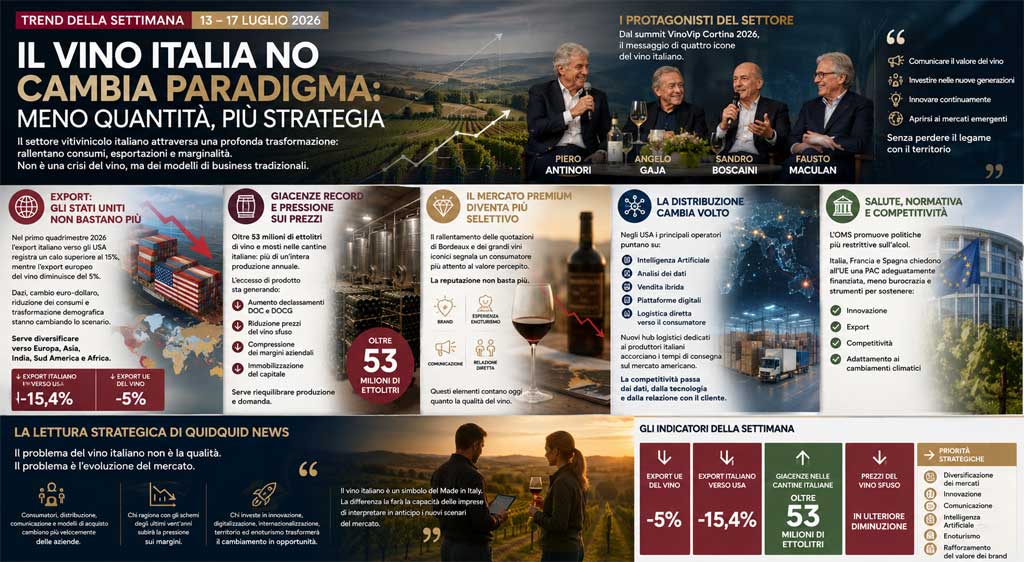
The week of April 13-17, 2026, marked by the Vinitaly trade fair in Verona, provided a clear picture of Italian wine: a sector that remains a world leader in production, strong in reputation, export capacity, and the value of its territories, but which is facing a profound transformation.

The picture that emerged is not that of a simple and temporary crisis, but of a real structural change in consumption, markets, and the strategies needed to compete.

The clearest message coming from institutions, consortia, observers and operators is one: it is no longer enough to defend wine, we need to rethink it in an offensive, selective and higher-value way .

From defense to relaunch: the sector’s new strategic line

Among the most powerful statements to emerge during the week was the position expressed by Agriculture Minister Francesco Lollobrigida, who emphasized the need for a change of approach: not a policy of retreat, but a strategy of relaunch.
The concept is clear: it makes no sense to incentivize exit from production, while it is strategic to support a model that leads to better production, greater value and more effective communication .

This approach comes at a time when Italian wine needs to strengthen its position not only with numbers, but also with a modern narrative capable of capturing new consumers, new markets, and new consumption styles.

Domestic consumption: large-scale retail trade confirms declining volumes

The most recurring data of the week concerns modern distribution.
In 2025, wine sold in large-scale retail outlets confirmed a contraction in volumes, while value held up better thanks to the increase in average price and the shift towards higher-end products.

According to Circana analyses, the wine and sparkling wine sector in large-scale distribution closed the year with a value of approximately 3.2 billion euros and 737 million litres sold , with a 2.7% drop in volumes and substantial stability in turnover ( -0.5% ), supported by an increase in the average price of 2.3% .

The data confirms a now consolidated trend: Italians are buying less wine, but when they do buy, they choose more carefully.
The suffering is concentrated above all in the lower price ranges and less distinctive products, while labels with greater perceived value, territorial identity and premium positioning are holding up better.

Sparkling wines still dominate, while reds and semi-sparkling wines are struggling.

This week too, the most dynamic segment remains that of bubbles.
Sparkling wines remain the category that bucks the trend, with growth of 1.5% in volume and 1.2% in value in large-scale retail trade in 2025. Rosé and white sparkling wines are particularly strong, driven by more informal consumption, home aperitifs, and greater versatility across consumption occasions.

The performance of the Classic Method is even better, growing both in volume and value and confirming itself as one of the most interesting categories for the sector’s premiumization strategy.

The situation is more difficult for still wines, especially reds, which, despite maintaining the largest market share, continue to lose ground.
Sparkling wines are among the most penalized segments, with evident declines in both volumes and values.

The overall picture therefore indicates a change in tastes: consumers are increasingly orienting themselves towards fresher, easier-to-drink, less demanding wines and often with lower alcohol content .

Premiumization: people drink less, but they seek higher quality

One of the most notable trends that emerged this week is premiumization.
Consumers aren’t simply reducing their purchases: they’re changing their criteria for choosing. Price ranges above €10 are performing better than entry-level segments, signaling a market that’s shrinking in volume but improving in value.

This trend is particularly visible in higher-end white wines, but in general it affects the entire sector, which manages to maintain a certain economic stability thanks to a favorable “mix effect”: fewer purchases, but more selective ones.

For the sector, this means that future competition will no longer be based on quantity, but on the ability to build coherent assortments, strong identities, distinctive positioning and credible storytelling .

Wine e-commerce: digital growth and sparkling wines dominate

While traditional distribution is showing signs of slowing down, the online channel is showing signs of dynamism.
In the first quarter of 2026, online searches for wine exceeded 657,000 , an increase of almost 10% compared to the same period in 2025. On an annual basis, overall searches reached 2.67 million in 2025, confirming that wine is now a structural category even in the digital landscape.

Sparkling wines once again dominate online interest, accounting for 52% of searches , ahead of red wines with 36.7% . Whites, rosés, and dessert wines lag further behind.

This data is important because it indicates that the digital channel is not just a space for purchasing, but also for discovery, comparison, and the creation of desire.
Furthermore, the web increasingly favors premium labels and recognizable brands, with a strong focus on price comparisons and the best time to buy.

Young consumers: less faithful to traditional models, more curious and more selective

Among the most interesting signs of the week is the renewed attention towards young consumers.
According to IWSR and UIV analyses, the 34-year-old demographic isn’t abandoning wine, but rather reinterpreting it. Younger consumers are more inclined to experiment, more attentive to sustainability, more open to low-alcohol and alcohol-free wines, and, in many cases, more willing to spend on products perceived as authentic, innovative, and consistent with their values.

Their consumption is less frequent and less ritualistic than that of previous generations, but more oriented towards the experience, quality and identity of the product.
This makes it clear that the future of wine lies not so much in recovering old consumption patterns, but rather in the ability to dialogue with new lifestyles and new cultural codes.

Dealcolati and NoLo: from niche to segment to observe

During Vinitaly 2026, an important part of the discussion also focused on dealcoholized wines and NoLo.
The segment is still small, but it has now firmly entered the industry’s radar. The creation of the Vinitaly NoLo Experience and the dedicated focus groups by UIV and Veronafiere clearly indicate that this is no longer a marginal area of development.

In large-scale retail, the sector is still worth just a few million euros, but distribution is expanding and the topic is taking on strategic importance, especially for reaching younger consumers, international audiences, and alternative consumption opportunities.

It is not the heart of Italian wine today, but it could become an important complementary lever in the medium term.

Exports: Italy strong, but in a more complex scenario

On the international front, Italian wine confirms its structural strength, but in a much more complicated context than in previous years.
Italy remains the world leader in production , with 47.3 million hectolitres in 2025 , and confirms its position as the world’s second largest exporter in value , with exports of around 7.8 billion euros .

However, 2025 ended with a contraction in exports, particularly penalized by the slowdown in the United States and the international geopolitical situation. The US remains the primary destination market, but tariffs and trade uncertainty have had a significant impact. Pressure on the American market remains strong in the early months of 2026.

Alongside this criticality, however, important opportunities emerge.
Indeed, positive signals are growing from alternative and emerging markets such as Mercosur, India, Eastern Europe, Brazil, Vietnam, and some areas of Southeast Asia . The acceleration of the European Union’s free trade agreements is seen as a concrete lever for the geographical diversification of Italian exports.

The key point that emerged this week is that Italian wine can no longer afford to be excessively dependent on a few key markets: it must broaden its reach, better segment its targets and address new demand niches .

Prosecco, the driving force of the system

In this scenario, Prosecco DOC continues to represent the driving force of Italian wine.
In 2025 it closed with a growth of 2.3% at global level , with 667 million bottles bottled and 82% of production destined for foreign countries , for a total value of 3.6 billion euros .

Very positive data from the United States, France, Germany, and several emerging markets confirms the denomination’s great ability to adapt to markets, speak contemporary languages, and intercept international demand.
Prosecco thus continues to be not only a winning denomination, but also the symbol of an export model based on accessibility, recognisability and distribution strength.

High inventories: the structural crux of overproduction

One of the most sensitive issues that emerged this week was that of inventories.
The data from “Cantina Italia” updated to 31 March 2026 indicate 55.9 million hectolitres of wine in stock , with an increase of 5.7% compared to the same period in 2025. To these are added musts and new wine in fermentation.

The data confirms a problem of balance between production and market absorption.
Many operators, from Uiv to retailers and observers, have reiterated that the current level of inventories is essentially equivalent to a harvest and a half in the cellar , a situation considered unsustainable in the medium term.

This is where one of the clearest messages of the week comes from: intelligent production containment is needed , especially in areas and segments where supply clearly exceeds market capacity.
Producing less, but better, is no longer just a slogan: it is the condition for protecting value, prices and profitability.

Territories, identities, and regions: the case of Emilia-Romagna and the role of Veneto

The week also showed how the territories remain the true competitive capital of Italian wine.
Emilia-Romagna presented itself at Vinitaly 2026 with a strong, integrated, and growing regional system: over 14,000 companies , more than 52,000 hectares of vineyards , approximately 5.37 million hectoliters produced in the 2025 harvest, and €433 million in exports . The renovated regional pavilion, the integration with the Food Valley, and the link between wine, PDO and PGI products, and tourism represented one of the clearest models of advanced territorial narrative.

At the same time, Veneto continues to confirm its position as the leading region for exports, with Verona still the leading province in Italy for beverage exports, almost entirely represented by wine.
The province of Verona closed 2025 with 1.21 billion euros in exports , albeit a slight decline, confirming its position as a strategic center for Italian wine both economically and symbolically.

CMO Promotion: More resources and flexibility for internationalization

Another important front of the week is that of support policies.
Over 98 million euros have been made available for the 2026-2027 CMO Promotion campaign, of which 22 million for national programmes and the remainder allocated to regional calls for proposals and multi-regional programmes.

The new tender structure aims to simplify access, digitize procedures, accelerate deadlines, and increase flexibility, helping companies operate more effectively in non-EU markets.
The purpose of the intervention is clear: in an unstable global scenario, international promotion is no longer an afterthought, but a crucial tool for competitiveness.

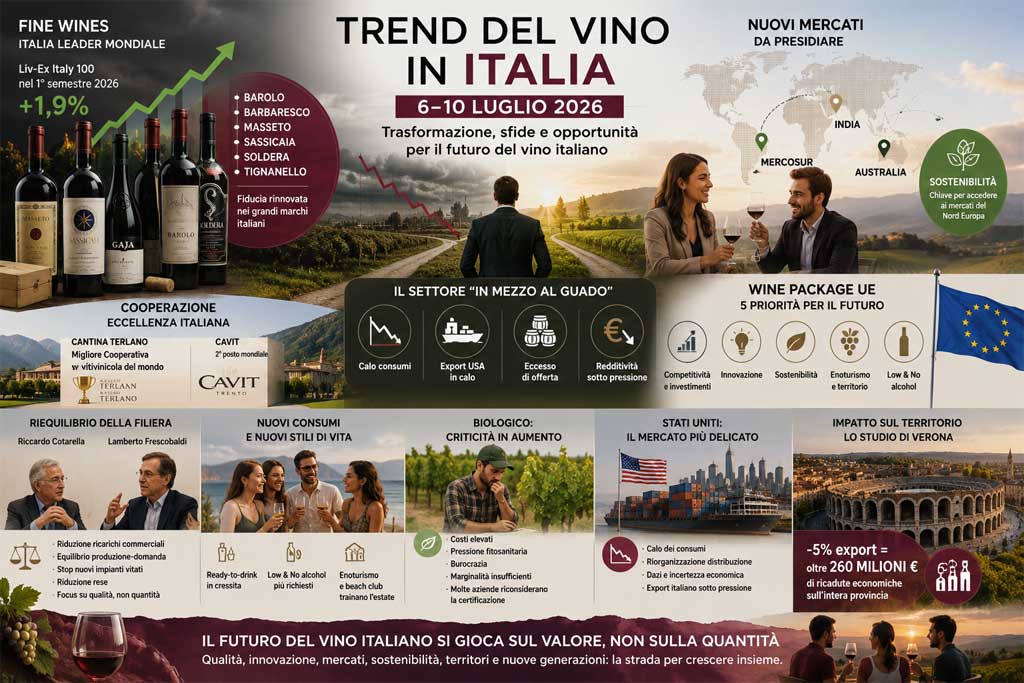
Wine trends and performance in Italy – week of April 6-10, 2026.

The picture that emerged this week confirms that Italian wine is in a complex, but far from static, phase.

The market is not standing still: its structure, languages, consumption opportunities, and competitive logic are changing.

On the one hand, pressures on consumption, prices, exports, and traditional channels remain evident; on the other, trends that can support the sector in the medium term are strengthening, such as premiumization, young consumers, wine tourism, product innovation, and greater commercial integration.

Internationally, wine continues to move within a scenario of potential growth. Estimates predict the global market will reach $328.5 billion in 2026, with the prospect of reaching over $447 billion by 2033, indicating that the sector is not in structural decline, but undergoing transformation. The strategic message is clear: wine will continue to generate value, but will do so by increasingly rewarding those who understand changing consumer behavior. Europe remains the dominant market share, thanks to tradition and wine tourism, while North America is identified as the most dynamic, driven by young people, direct sales, and a more everyday, accessible, and experiential wine culture.

For Italy, this means that wine can no longer be seen simply as an agricultural product or consumer good, but as an integrated system comprising the bottle, the region, hospitality, storytelling, and positioning. The most interesting signs come precisely from the sector’s ability to combine identity and adaptation. There is growing interest in premium, organic, biodynamic, low-alcohol, and no-alcohol wines, in products with sustainability credentials, and in easier-to-drink formulas that are more consistent with a lifestyle focused on well-being. This shift doesn’t eliminate traditional wine, but it does alter its competitive landscape.

One of the week’s most important developments concerns the relationship between wine and young people. International analyses reaffirm a finding that until recently seemed counterintuitive: younger generations aren’t necessarily distant from wine, but rather approach it in different ways. They’re more curious, more open to experimentation, more attentive to food, more responsive to advice and storytelling, more inclined to use digital channels, and more willing to spend when they recognize quality, experience, and brand consistency. Essentially, young consumers no longer seek wine simply as a habit, but as a cultural and identity-building choice. This opens up significant space for wineries capable of crafting contemporary languages without sacrificing authenticity.

On the domestic demand front, however, the picture remains selective. Out-of-home dining continues to show contradictory signals: the market is growing in value, but losing customers. This means people are spending more, but frequenting less. Aperitivo, for years a symbol of socializing and urban consumption, appears to be one of the hardest-hit occasions, with a marked decline in visits and the value generated by alcoholic beverages. This is an important sign, because it points not only to a difficult economic climate, but also to a shift in habits. Italian consumers are more cautious, more price-conscious, more sensitive to well-being, and less inclined to automatically consume alcohol. Regulatory pressure, the issue of driving, health, and changing attitudes toward alcohol are also contributing to reshaping the market.

In this scenario, wine is suffering especially in the segments most exposed to unspecified daily consumption. But not all are declining equally. Dinner remains the most economically powerful moment for eating out, tourism supports the sector with higher average receipts, and premium wine continues to hold up better than the lower end. This is one of the most compelling messages of the week: the market is not rewarding indistinct wines, but rather those that can justify their price, image, story, and perceived value. In other words, sales are lower where differentiation is lacking, while products that express identity, reputation, and a clear purchasing motivation hold up better.

The case of Sicily is also highly relevant, capturing a national trend: declining domestic consumption, rising costs, and pressure on full cellars, but also strong competitiveness in terms of quality-price ratio and the preservation of territorial value. The Sicily brand continues to have great evocative power, supported by tourism, its international reputation, and highly attractive locations like Mount Etna. This teaches a clear lesson for Italian wine as a whole: strong, easily identifiable, and well-touted territories still have the power to attract, even in a challenging market environment. Where recognition exists, the product more easily maintains its market share. Where wine is perceived as a commodity, however, the difficulty increases.

At the same time, the sector is demonstrating a growing organizational capacity for responsiveness. The “Galassia – World Wine Network” project represents one of the most interesting signs of the week because it points to a concrete industrial and commercial direction: building synergies, sharing networks, combining expertise, increasing international coverage, and streamlining market presence without erasing the identity of individual brands. It’s a model that can have broader implications for Italian wine: in a time of compressed margins and complex markets, commercial efficiency and governance become as crucial as wine quality. Producing well is no longer enough; markets must be managed with structure, continuity, and vision.

Exports also remain a sensitive area, requiring close monitoring. The negative signals coming from both Italy to the United States and Spain in January 2026 suggest that the international wine trade is having a difficult start to the year, amid declining volumes, weakening demand, and broader economic tensions. For Italy, this does not mean a loss of centrality, but rather the need for greater strategic prudence: geographical diversification, strengthening less mature markets, maintaining premium status, and more targeted commercial investments are becoming essential. In a less linear international context, those who rely too heavily on a limited number of outlets are likely to suffer the most.

Financially and symbolically, the first quarter of 2026 for Liv-Ex offers encouraging signs. The recovery, though moderate and limited to fine wines, indicates that high-end Italian labels retain their appeal and confidence in the secondary market. Italy is performing well, especially in the more refined segments, with Barolo, Supertuscans, and other top labels showing significant recoveries. This figure doesn’t represent all Italian wines, but it is a useful indicator: the reputational value of top-of-the-line Italian wines remains solid and continues to strengthen the country’s international positioning.

The most dynamic and perhaps most promising aspect, however, is wine tourism. This week’s data shows a clear acceleration: in 2026, an estimated 18 million Italians will be involved in wine-related experiences, a significant increase compared to 2024. But the real issue isn’t just quantitative. The way we experience the winery is changing. Visitors seek authenticity, human connections, winemaking families, landscapes, easy booking, diverse experiences, food and wine pairings, and quality hospitality. The winery is no longer just a place for tasting: it is becoming a commercial interface, a loyalty tool, a branding lever, and a direct sales and reputation channel. For many businesses, this means that wine tourism can no longer be an afterthought, but must become part of their business model.

Furthermore, the growth of wine tourism is intertwined with two key themes for the future: proximity and technology. On the one hand, it increases the potential of nearby destinations and local audiences; on the other, artificial intelligence is beginning to impact the customer journey, from research to inspiration to the personalization of the experience. This opens up a very interesting space for wineries that can combine authentic hospitality with digital tools. The risk, however, is thinking of monetizing experiences simply by raising prices without increasing their perceived value: the market clearly indicates that consumers are willing to spend, but demand consistency, quality, and a connection.

Overall, the week of April 6-10, 2026, therefore, depicts an Italian wine market that isn’t simply experiencing a slowdown, but rather a profound restructuring. Consumption is more cautious, eating out is less automatic, aperitifs are losing steam, costs remain a concern, and exports are off to a shaky start. But at the same time, signs of a new demand structure are growing: greater quality, greater identity, greater terroir, greater experience, greater sustainability, greater connections, and greater segmentation.

Wine Trends and Performance in Italy – Week of March 30-April 3 – 2026

Italian wine closes the week with a complex picture, but not without prospects.

On the one hand, there are clear signs of pressure on markets, consumption, and exports, especially to the United States; on the other, a more strategic approach to the sector is gaining ground, based on the quality, positioning, adaptability, and cultural value of Italian wine.

The underlying theme this week is clear: the sector is not going through an easy phase, but it still has the extraordinary assets to remain competitive. Strong territories, recognized appellations, consolidated brands, international leadership in many categories, and growing integration with tourism, restaurants, and lifestyle continue to make wine one of the pillars of Made in Italy.

In terms of sentiment, the strongest message conveyed at the launch of Vinitaly 2026 was one of responsible optimism. The testimonies of iconic figures in modern Italian wine, from Piero Antinori to Marco Caprai, from José Rallo to Paolo Damilano, and from Gaetano Marzotto, portray a sector that has already endured profound crises and has regenerated from them. The reference to the fortieth anniversary of the methanol scandal was not merely commemorative: it served as a reminder that one of the most difficult moments for Italian wine also marked the beginning of a structural modernization based on controls, quality, international reputation, and a new awareness among businesses, distributors, and consumers.

And it is precisely this industrial memory that today fuels a less defensive vision of the future. The widespread belief is that Italian wine must stop portraying itself merely as a sector under pressure and instead return to more strongly promoting its unique strengths: territoriality, culture, conviviality, biodiversity, narrative ability, and the connection to Italian cuisine. In other words, the sector cannot simply endure the slowdown, but must use this phase to better reposition itself.

The most sensitive issue remains exports, particularly to the US. The start of 2026 appears challenging: the first few months show a sharp decline in value, with January reported at -35% and the first two months projected to decline by 28% compared to 2025. American tariffs, the euro-dollar exchange rate, the slowdown in consumption, the slowdown in out-of-home sales, and a general instability in inventories and distribution are all weighing on the situation. The United States remains a key market for Italian wine, accounting for 23% of the sector’s total exports, and for this very reason, the focus is on the utmost.

The emerging response, however, isn’t simply a wait-and-see approach. There’s open talk of a special promotional plan to relaunch Italian wine in the US, involving institutions, ICE (Italian Trade Agency), Coldiretti (Italian Farmers’ Federation), Filiera Italia (Italian Supply Chain), American buyers, and trade operators. The strategic message is twofold: on the one hand, we must defend Italy’s presence in the world’s leading market; on the other, we must accelerate geographical diversification to reduce dependence on a single market. In this scenario, Vinitaly confirms itself not only as a trade fair, but also as a platform for the industrial and commercial policy of Italian wine.

Within the domestic market, however, more nuanced and less negative signs are emerging than often reported. The UIV-Vinitaly Observatory reports a very significant finding: in Italy, wine consumers remain just under 30 million, equal to 55% of the population. The audience, therefore, is holding steady. The number of consumers isn’t declining; rather, the way they consume is changing. Daily consumption is declining and occasional consumption is increasing, with the ratio now reversed compared to the past: 61% drink wine occasionally, while 39% consume it daily. This is a sign of a structural transformation in the relationship with wine, increasingly less tied to habit and increasingly focused on choice, occasion, and quality.

This shift should be viewed less alarmistly and more progressively. Italians drink less, but seek higher quality, greater gratification, and a more informed relationship with the product. Moderation is therefore part of the sector’s new balance, not necessarily a sign of disaffection. The problem isn’t that wine is disappearing from consumer behavior; the problem is that the marketing language is changing, and those who sell wine must adapt.

Perhaps the most interesting data of the week concerns young people. Contrary to a narrative that has been prevalent for years, young people are not primarily responsible for the decline in consumption. Indeed, the only significant increase in wine penetration is among the 18-24 age group: from 39% to 47% of the category compared to 2011. This share is still numerically small, but strategically very important, as it indicates that wine continues to enter the aspirational universe of the new generations.

Young people’s relationship with wine, however, is radically different from that of older generations. It’s not based on everyday life, but on curiosity, taste, image, discovery, and experiences outside the home. For Gen Z, wine is enjoyable, represents sophistication, and is associated with well-being and relationships. This explains why young people spend more on average on out-of-home consumption and are particularly active in restaurants and bars. This is a crucial strategic key: the future of wine lies less and less in the repetition of everyday gestures and more and more in the ability to create desirability, narrative, experience, and orientation.

Also of note is the reversal of some clichés about consumption preferences. The data shows that Prosecco remains the most versatile and powerful wine among Millennials, Gen Xers, and Boomers, confirming its role as a major contemporary consumer platform. But among younger consumers, a surprising trend emerges: Gen Z favors great Italian reds. Amarone, Barbaresco, Taurasi, Bolgheri, and Chianti top the list of preferences, demonstrating that red wines have by no means disappeared from the younger consumer’s horizons, as long as they are marketed correctly, with appropriate language, context, and advice.

This aspect has very concrete commercial implications. It means that the problem isn’t the product itself, but the way it’s positioned and presented. Younger people are proving more open to experimentation, more willing to seek advice, more inclined to read online reviews, and more receptive to alternative formats and packaging. This means the supply chain must work harder at the point of sale, in restaurants, on digital communication, and on the readability of the product offering. Wine must not just be good: it must be understandable, accessible in its narrative, and consistent with the language of the contemporary consumer.

On the overall economic level, the sector nevertheless retains enormous importance. Wine is worth approximately €14 billion in revenue, net of related industries, with a positive trade balance of €7.2 billion and an overall impact of €45 billion when considering indirect effects. The area under vine, the number of businesses, employment, and production confirm that it is not just an agricultural sector, but an economic and territorial system of primary national importance. For this reason, too, the current situation requires a calm, non-emotional approach: 2025 was challenging but relatively resilient, while 2026 remains entirely unpredictable.

In the domestic market, large-scale retail trade shows stability in value but declining volumes, once again confirming the “less is more” paradigm. Sparkling wines continue to be the most dynamic category, while reds are struggling and whites remain largely stagnant. Rosés are growing, but still at low levels. Prosecco remains the most resilient and cross-sectional phenomenon, while the entire sparkling wine segment continues to play an important countercyclical role for the sector.

The dynamics of fine wine are also interesting. The secondary market for fine wines appears to be slowly stabilizing, with signs of recovery expected towards the end of 2026. After a long period of price correction, lower interest rates and increased interest from European operators are bringing renewed attention to the collectible wine segment. Despite a still cautious outlook and a more uncertain position for the US, fine wine appears to be emerging from its weakest phase. For high-end Italian wine, this is a sign worth watching carefully, as it confirms that the value of great terroirs and iconic labels can once again become central, even in a selective environment.

Another theme that emerged forcefully is the growing need to integrate wine with other worlds: tourism, cuisine, experience, landscape, and culture. This is now an irreversible trend. Companies that can present themselves not just as producers of wines, but as interpreters of local areas and lifestyles, will be best equipped to navigate the new market cycle. Italian wine retains a unique strength: it sells not just product, but a combination of origin, story, hospitality, reputation, and Italianness. This is where a crucial part of future competitiveness will be played out.

This week also highlights the mistake of indiscriminately cutting back on promotion, events, and visibility. In a complex market environment, rationalizing investments is necessary, but reducing commercial presence and market presence risks further weakening brands. Promotion must be made more selective, more targeted, and more measurable, but it cannot be sacrificed. The sector needs more strategic presence, not less.

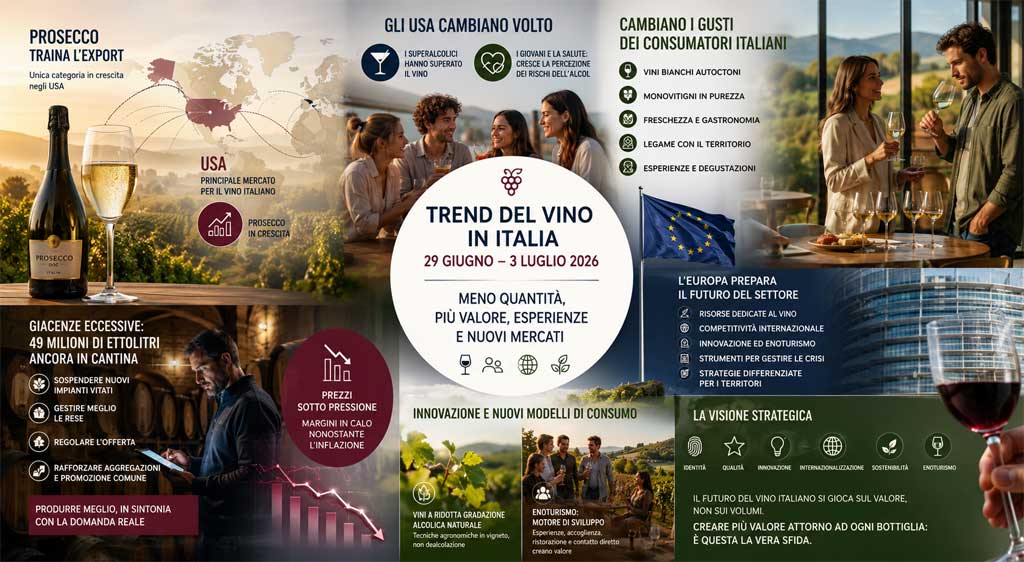
Wine Trends and Performance in Italy – Final Summary – Week 23–27 March 2026

The picture that emerged during the week of March 23-27, 2026, depicts a market that continues to face pressure on multiple fronts—declining domestic consumption, geopolitical tensions, slowing exports, logistical challenges, and growing consumer sensitivity to health, price, and simplicity of language—but which, at the same time, shows some areas of strong resilience and even growth.

The Italian wine sector continues to experience a complex, but uneven, phase.

The most obvious fact is that Italian wine is not facing a linear crisis. Rather, it is immersed in a structural transformation that clearly distinguishes categories, markets, sales channels, and consumption patterns. In this scenario, sparkling wines, and Prosecco in particular, remain the most resilient segment, while the rest of the industry is being called upon to rethink its positioning, communication, and consumer relations.

1. Prosecco confirms itself as the true strength of Italian wine

In a challenging overall environment, Prosecco once again emerges as the most robust product in the national wine scene. In the run-up to Easter 2026, orders are expected to increase by 4%, a sign that Italian sparkling wines continue to naturally satisfy convivial and festive consumption.

The numbers of the three denominations confirm this strength:

  • Prosecco DOC : 667 million bottles in 2025, 1.1% more than in 2024
  • Conegliano Valdobbiadene Prosecco Superiore DOCG : approximately 98 million bottles, 8%
  • Asolo Prosecco DOCG : over 32 million bottles, 16%, the most dynamic growth among the three denominations

Prosecco DOC maintains a strong international appeal, with over 82% of production destined for export and an estimated production value exceeding €3 billion. Even the data for the first two months of 2026, which indicates a technical decline in bottling, is not interpreted as a weakening of demand, but rather as strategic inventory management, particularly with the US market in mind. Cellar stocks have increased by 5.8%, a sign of a system that has preferred to modulate flows to accommodate the absorption of foreign inventories.

On the international front, it is worth noting the excellent performance of France, which recorded double-digit growth (18%) and consolidated its position as the third most profitable market for the denomination after the United States and the United Kingdom.

The strategic interpretation is clear: Prosecco continues to win because it perfectly captures the dominant drivers of contemporary consumption—accessibility, immediacy, conviviality, international recognition, and compatibility with less formal consumption occasions.

2. 2025 closed in decline, but Italy held up better than many competitors

2025 ended with a decline in Italian wine exports of -3.7% in value and -1.8% in volume , but this data must be read against an even more negative international backdrop for many competitors. According to an analysis by Denis Pantini (Wine Monitor Nomisma), Italy lost ground, but held up better than other major exporting countries:

  • France: -4%
  • Spain: -5%
  • Australia: -15%
  • Chile: -10%
  • United States: over -33%

This means that, despite a contraction, Italian wine maintains a relatively stronger competitive edge compared to its main competitors. The German and Brazilian markets have shown positive signs, partially offsetting the greater difficulties experienced in other areas.

For 2026, the forecast remains cautious but not dramatic. If the weaker markets were to rebound, if the geopolitical situation improved, and if Italian consumers regained confidence, the year might not even end in negative territory. This forecast doesn’t warrant easy optimism, but it does confirm that we’re not facing a systemic collapse, but rather a very delicate phase of rebalancing.

3. The start of 2026 is weak: Italian exports slowing, agri-food under pressure

However, the first signs of 2026 point to a difficult start. In January 2026, Made in Italy products fell 4.6% compared to January 2025, while the agri-food sector recorded an even more significant decline, at 7.7% . The United States’ performance was particularly severe, with the agri-food sector contracting by 26.4% .

These figures are also affected by the comparison with the beginning of 2025, when many companies had brought forward orders and inventories in anticipation of possible US tariffs. However, the data confirms the fragility of the international context: Germany (-4.8%), France (-7.5%), and the United Kingdom (-12.3%) also saw declines, while positive signs emerged from Switzerland (-15.5%), China (-14.6%), and Austria (-5.1%).

The message for the wine industry is very clear: dependence on traditional markets increasingly exposes it to geopolitical, fiscal, and distribution cycles. It is therefore crucial to strengthen its presence in high-potential markets, with more flexible commercial strategies and greater direct reach.

4. Large-scale retail trade confirms the decline in consumption, but saves sparkling wines

The most immediate thermometer of the domestic market remains the large-scale retail trade, and the 2025 data show a clear contraction:

  • 737 million liters of wine and sparkling wine sold
  • 20 million liters less than in 2024
  • -3.4% in volume
  • -1.1% in value
  • total turnover of around 2.36 billion euros

The data points to a two-pronged decline: purchases are decreasing, and rising prices are no longer sufficient to offset the decline. Bottled wines with designations of origin (DOC, DOCG, IGT) are also down 2.6% in volume, while fortified wines remain the weakest category.

The only segment that continues to grow is that of sparkling wines :

  • 1.5% by volume
  • 1.2% in value
  • approximately 109 million liters
  • approximately 750 million euros

Growth is more moderate than in the past, but it’s significant because it confirms a distinct trajectory compared to the rest of the market. Italian consumers continue to prize wines that combine freshness, ease of consumption, gastronomic versatility, and a sense of accessible gratification.

5. Best-selling wines: Prosecco dominates, many traditional reds suffer

Among the most purchased wines in large-scale retail trade in 2025, the podium is very clear:

  • Prosecco : over 53 million liters, 2.6%
  • Lambrusco : over 28 million liters, -7.2%
  • Trebbiano : over 23 million liters, 0.3%

Prosecco remains not only the best-selling wine, but also the dominant value, with approximately €392 million spent in large-scale retail trade. Chianti and Vermentino follow, but are far behind.

On the consumption front, some consolidated trends emerge:

  • Italians choose more still wines than sparkling ones
  • they choose more whites than reds
  • but the most purchased individual wine is still still red , with over 261 million litres

Among the growing categories, the following stand out:

  • Grecanico : 13.7%
  • Nebbiolo : 9.7%
  • Pinot Noir : 7.8%
  • Classic Method : 6.3%
  • Ribolla Gialla : 4.2%
  • Primitivo di Puglia : 3%
  • Vermentino : 2.5%

This is an interesting signal: while part of the market is declining, some typologies are growing thanks to a more defined identity, greater recognisability or better harmony with new consumer tastes.

6. Prices are rising, but wine in Italy remains among the least inflated products in Europe.

One of the most significant aspects is that wine continues to suffer in consumer perception, but not because it has seen particularly sharp price increases in Italy. On the contrary, according to Eurostat data compiled by FRED and analyzed by the American Association of Wine Economics, between 2015 and 2025, consumer wine prices in Italy increased by only 7.4% , one of the lowest levels in Europe.

For comparison:

  • Germany: 22.6%
  • France: 25.7%
  • Spain: 27.4%

Even in Italian large-scale retail trade, the average price of bottled wines with a designation of origin stood at 5.69 euros/litre , up 2.1% on 2024, in line with the 2% increase already recorded the previous year.

This data leads to an important reflection: the problem with wine today isn’t just its absolute price, but the relationship between price, perceived value, frequency of consumption, and available alternatives. In other words, it’s not enough to say that wine prices haven’t increased significantly; we need to ask ourselves whether consumers still perceive wine as a natural, simple, and justified purchase.

7. Foreign markets are becoming more selective: Germany is more solid, the United Kingdom is more difficult

On the export front, two different signals emerge.

Germany

Germany remains a major market for Italian wine. In 2025, Italian wine imports exceeded €1 billion , accounting for over 40% of the market. Italian PDO wines are:

  • 5.4% by volume
  • 4.2% in value

Prosecco remains the most exported Italian wine, but Veneto whites, Piedmont reds, and PDO sparkling wines other than Prosecco and Asti are also growing. Germany remains a highly price-oriented market, yet very open to Italian wine, which maintains a competitive advantage thanks to cultural familiarity, the variety of its offerings, and the strength of its appellations.

United Kingdom

The British picture is more challenging. In 2025, wine imports to the UK will decline:

  • -4.6% in value
  • -6% in volume

Italy remains the leading supplier in volume, with 298.3 million liters , but recorded a 2% decline and a 2.4% reduction in average price. Italian sparkling wines still generate more value than still wines, with £440 million versus £431 million , but the British system is clearly showing signs of tightening due to taxation, changing consumption, and increased competition.

Here, the issue isn’t just selling, but selling better: a comparison with France clearly demonstrates this. The French generate almost the same value as Italy on sparkling wines, but with much lower volumes and much higher prices. This signals a strategic difference in positioning that Italian wine will increasingly have to address.

8. The sector must change its language, not just its product

One of the strongest themes that emerged this week is cultural rather than commercial. The most effective summary is this: it’s not consumers who are turning away from wine, it’s wine that’s losing them .

The problem isn’t just tariffs, conflicts, or the Highway Code. The problem also lies in wine’s difficulty in speaking to new generations, simplifying its language, making itself accessible without losing depth, and presenting itself as an experience and not just a technical term.

Wine continues to have enormous symbolic, territorial, and emotional power, but it often presents itself with codes that are too elitist, self-referential, or unsuitable for new audiences. This is why everything that creates a direct connection becomes central:

  • wine tourism
  • opening of the cellars
  • hospitality
  • authentic storytelling
  • commercial training
  • simple but not trivial communication
  • conscious drinking culture

In essence, the industry must shift from a product-centric approach to one that focuses on the consumer, the relationship, and the experience.

9. New directions: dealcoholized products, logistics, geopolitical tensions and supply chain imbalances

Alongside market themes, this week also highlighted new lines of transformation.

Alcohol-free wine

Alcohol-free wine is emerging as a niche with high potential, especially in Northern European, American, and Australian markets. In Italy, the sector is still in its infancy, but the fact that it can be produced in our country as of this year, albeit excluding DOP wines, opens up new opportunities for diversification.

Logistics under pressure

The war in the Middle East is creating significant complications for wine transportation: airspace closures, maritime diversions via Africa, longer lead times, higher costs, temperature risks, and unpredictable deliveries. For a seasonal and promotional industry like wine, the impact on planning can be significant.

Imbalance between wine and grapes

In areas like the Oltrepò, another critical signal is emerging: while bulk wine prices may be rising, grape prices continue to plummet, in many cases to levels close to production costs. This imbalance is challenging the agricultural base and risks structurally weakening entire production areas.

10. Final picture: Italian wine holds up, but needs to reposition itself

The week of March 23-27, 2026, therefore paints a very clear picture. Italian wine isn’t in decline, but it is experiencing a very tough competitive selection process.

Style Selector
Select the layout
Choose the theme
Preset colors
No Preset
Select the pattern