

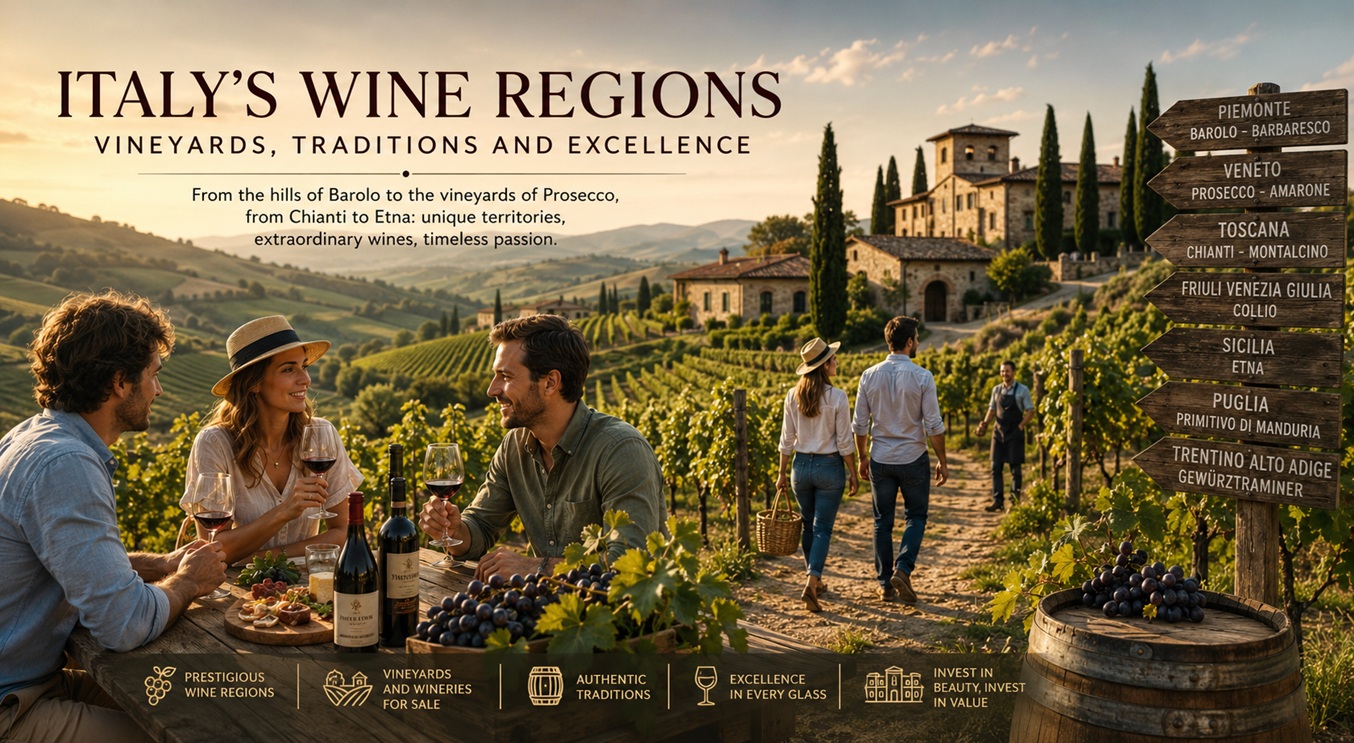
Italy’s Premier Wine Regions and Vineyard Areas
A Complete Guide to Italy’s Main Wine-Producing Regions: Terroirs, Appellations, Vineyards and Agricultural Asset Values
Italy is not simply one of the world’s leading wine-producing countries.
It is a land where vineyards, appellations, landscapes, real estate, history and commercial potential come together to create agricultural assets whose value can vary significantly, even within just a few kilometres.
From the Langhe to Valpolicella, from the Prosecco Hills to Franciacorta, from Chianti Classico and Montalcino to Mount Etna, Puglia and the smaller Italian islands, the value of an Italian vineyard depends on a wide range of factors.
For anyone looking to buy or sell a vineyard, winery or wine-producing estate in Italy, understanding the country’s main wine regions means looking beyond the wines themselves. It means identifying those territories that offer the greatest international recognition, market demand, scarcity of vineyard land and economic potential.
Italy’s official wine appellation system is governed by DOP and IGP production regulations published by the Italian Ministry of Agriculture, Food Sovereignty and Forestry – MASAF, which maintains the official lists of appellations and their respective production specifications.
Italy’s Main Wine Regions, Region by Region
Piedmont
Piedmont is home to some of Italy’s most internationally renowned wine-growing areas.
Langhe – Barolo
Barolo DOCG is produced in the Langhe, in the province of Cuneo, exclusively from Nebbiolo grapes.
Among the best-known municipalities are:
- Barolo
- La Morra
- Monforte d’Alba
- Serralunga d’Alba
- Castiglione Falletto
- Verduno
- Novello
Here, a vineyard is often worth far more than the agricultural land itself. Appellation, location, cru, exposure and reputation can have a substantial impact on its asset value.
Barbaresco
Another prestigious Nebbiolo-producing area, mainly covering:
- Barbaresco
- Neive
- Treiso
- part of the municipality of Alba.
Roero
Located on the left bank of the Tanaro River, Roero is particularly renowned for Roero DOCG and Roero Arneis DOCG.
Monferrato
A major wine-growing territory between Alessandria and Asti, particularly important for:
- Barbera
- Grignolino
- Ruchè
- Freisa
- Moscato.
Asti and Canelli
A historic area for Moscato Bianco, Asti DOCG and sparkling wine production.
Gavi
In the province of Alessandria, Gavi DOCG is produced from Cortese grapes and is one of Italy’s best-known white wine appellations on international markets.
Alto Piemonte
Other highly interesting wine areas include:
- Gattinara
- Ghemme
- Boca
- Lessona
- Bramaterra
- Carema.
These are territories where Nebbiolo develops characteristics that are markedly different from those found in the Langhe.
Veneto
Veneto includes some of Italy’s most important wine districts in terms of production, exports and commercial value.
Conegliano Valdobbiadene
The hills between Conegliano and Valdobbiadene are home to Conegliano Valdobbiadene Prosecco Superiore DOCG.
It is one of Italy’s most internationally recognised wine territories and includes hillside vineyards that, in many cases, feature steep slopes and require particularly demanding vineyard management.
The Prosecco Hills of Conegliano and Valdobbiadene are also recognised as a UNESCO World Heritage Site.
Among the best-known areas are:
- Valdobbiadene
- Conegliano
- Santo Stefano
- Guia
- San Pietro di Barbozza
- Cartizze
- Farra di Soligo
- Miane
- Follina
- Cison di Valmarino.
Particular attention should be given to Cartizze, where the extremely limited availability of vineyard land contributes to its exclusivity.
Asolo Prosecco
The hills surrounding Asolo and Montello are home to Asolo Prosecco DOCG, an appellation that has grown considerably in recent years.
Prosecco DOC
The Prosecco DOC appellation covers a much broader territory, primarily across Veneto and Friuli-Venezia Giulia.
The distinction between DOC and DOCG vineyards is extremely important when assessing vineyard land values.
Valpolicella
North of Verona lies one of Italy’s most prestigious wine districts.
Its main wines include:
- Amarone della Valpolicella DOCG
- Recioto della Valpolicella DOCG
- Valpolicella DOC
- Valpolicella Ripasso DOC.
The Valpolicella Classica area is particularly sought after and includes historic wine-growing municipalities such as Negrar, Marano, Fumane, Sant’Ambrogio and San Pietro in Cariano.
Soave
A renowned wine territory particularly associated with white wines made from Garganega grapes.
Bardolino and Lake Garda
The Veneto shores of Lake Garda represent another important wine-producing and tourism district.
Friuli-Venezia Giulia
Friuli-Venezia Giulia has one of Italy’s strongest concentrations of premium white wine production.
Collio
Located along the Slovenian border, Collio is characterised by hills featuring the traditional “ponca” soil, primarily composed of marl and sandstone.
Its best-known grape varieties and wines include:
- Friulano
- Ribolla Gialla
- Sauvignon
- Pinot Grigio
- Chardonnay
- Malvasia Istriana.
Colli Orientali del Friuli
This area includes territories such as:
- Cividale del Friuli
- Prepotto
- Buttrio
- Manzano
- Corno di Rosazzo.
The area is also renowned for Picolit and Ramandolo.
Grave del Friuli
A highly productive flat wine-growing area characterised by gravel-rich soils.
Friuli DOC
An important appellation extending across both plains and hills, with areas characterised by gravel-rich soils and significant wine production.
Carso
A distinctive wine territory between Trieste and Gorizia, renowned for native grape varieties such as Vitovska and Terrano.
Trentino-Alto Adige
This is one of Italy’s leading regions for Alpine and mountain viticulture.
Trentino
Key wines and varieties include:
- Trentodoc
- Teroldego Rotaliano
- Marzemino
- Nosiola
- Müller-Thurgau.
Particularly interesting areas include:
- Adige Valley
- Vallagarina
- Piana Rotaliana
- Cembra Valley
- Upper Lake Garda.
Trentodoc has played a significant role in increasing the value of vineyards used to produce sparkling wine base wines.
Alto Adige – Südtirol
A highly specialised wine-growing territory with relatively limited vineyard acreage and strong value creation.
Key grape varieties include:
- Gewürztraminer
- Pinot Bianco
- Pinot Grigio
- Sauvignon
- Chardonnay
- Pinot Nero
- Lagrein
- Schiava.
Among the best-known areas are:
- Bolzano
- Caldaro
- Termeno
- Appiano
- Terlano
- Isarco Valley.
Lombardy
Franciacorta
South of Lake Iseo lies Franciacorta, one of Italy’s benchmark regions for Traditional Method sparkling wines.
Franciacorta DOCG is produced mainly from Chardonnay and Pinot Nero, together with other grape varieties permitted under the production regulations.
For investors, Franciacorta offers much more than vineyards: territorial branding, tourism, established wineries and proximity to Lombardy’s affluent consumer market all contribute to its investment appeal.
Oltrepò Pavese
A major wine-producing territory particularly important for:
- Pinot Nero
- Traditional Method sparkling wines
- Barbera
- Bonarda/Croatina
- Riesling.
Valtellina
One of Italy’s most remarkable examples of heroic mountain viticulture.
Main wines include:
- Valtellina Superiore DOCG
- Sforzato di Valtellina DOCG.
The main grape variety is Nebbiolo, locally known as Chiavennasca.
Lugana
The Lugana appellation extends across the southern Lake Garda area and includes territories in both Lombardy and Veneto.
Aosta Valley
The Aosta Valley represents one of Italy’s most distinctive examples of Alpine and heroic viticulture.
Among its best-known wine areas are:
- Donnas
- Enfer d’Arvier
- Torrette
- Blanc de Morgex et de La Salle.
The scarcity of vineyard land and challenging mountain conditions give these wines and vineyards a particularly strong identity.
Liguria
Liguria has limited vineyard acreage, much of it characterised by terraces and steep slopes.
Cinque Terre
Extreme terraced viticulture overlooking the Mediterranean Sea.
Main wines include:
- Cinque Terre DOC
- Sciacchetrà.
Riviera Ligure di Ponente
Particularly renowned for:
- Pigato
- Vermentino
- Rossese.
Dolceacqua
Home to Rossese di Dolceacqua DOC.
In many parts of Liguria, the scarcity of cultivable land is an essential factor when assessing agricultural and vineyard values.
Emilia-Romagna
Emilia
A territory historically associated with Lambrusco.
Key areas include:
- Modena
- Reggio Emilia
- Parma.
Major appellations include:
- Lambrusco di Sorbara
- Grasparossa di Castelvetro
- Salamino di Santa Croce.
Colli Piacentini
Known particularly for:
- Gutturnio
- Ortrugo
- Malvasia di Candia Aromatica.
Romagna
Particularly important for:
- Sangiovese di Romagna
- Albana
- Trebbiano.
The hills of Forlì-Cesena, Ravenna and Rimini are increasingly recognised for their quality potential.
Tuscany
Tuscany is probably one of the Italian regions where wine, landscape, historic real estate, hospitality and international reputation have the greatest combined impact on the overall value of wine estates.
Chianti Classico
The historic territory between Florence and Siena includes municipalities such as:
- Greve in Chianti
- Castellina in Chianti
- Gaiole in Chianti
- Radda in Chianti.
The dominant grape variety is Sangiovese.
Chianti
The broader Chianti appellation includes several subzones extending across Florence, Siena, Arezzo, Pisa, Pistoia and other provinces.
Montalcino
Home to Brunello di Montalcino DOCG, one of Italy’s most internationally recognised and highly valued wine appellations.
Montepulciano
Home to Vino Nobile di Montepulciano DOCG, produced predominantly from Sangiovese, locally known as Prugnolo Gentile.
Bolgheri
Located on the Tuscan coast in the province of Livorno, Bolgheri has built an international reputation for outstanding red wines produced mainly from Bordeaux grape varieties.
These include:
- Cabernet Sauvignon
- Cabernet Franc
- Merlot.
The territory is home to some of Italy’s most internationally renowned wines, including Sassicaia.
Morellino di Scansano and Maremma
The Tuscan Maremma is one of Italy’s most dynamic areas in terms of estate size and the opportunity to combine:
vineyards + agriculture + hospitality + tourism + real estate.
Vernaccia di San Gimignano
One of Italy’s historic territories for premium white wine production.
Umbria
Montefalco
Home to Montefalco Sagrantino DOCG, produced from the native Sagrantino grape.
Montefalco Rosso is another important local wine.
Orvieto
A historic white wine-producing territory extending between Umbria and Lazio.
Torgiano
A wine-growing area strongly associated with the history of Umbrian wine.
Umbrian estates often offer an attractive combination of vineyards, olive groves and hospitality facilities within the same property.
Marche
Castelli di Jesi
One of Italy’s main Verdicchio-producing areas.
Its flagship wine is Verdicchio dei Castelli di Jesi.
Matelica
Verdicchio di Matelica is produced in an inland valley with climatic characteristics that differ from those of Castelli di Jesi.
Conero
A particularly interesting territory for Montepulciano grapes and Conero DOCG.
Piceno
In the southern provinces, important wines include:
- Rosso Piceno
- Offida
- Pecorino
- Passerina.
Lazio
Castelli Romani
The hills south-east of Rome have historically represented one of Lazio’s main wine-producing areas.
Frascati
Frascati DOC and Cannellino di Frascati DOCG are among the region’s best-known wines.
Cesanese
The Cesanese grape is particularly important in the areas of Piglio, Affile and Olevano Romano.
Viterbo and Tuscia
These territories are increasingly interesting from the perspective of wine production, agritourism and rural investment.
Their proximity to Rome can also represent a significant advantage for hospitality and wine tourism projects.
Abruzzo
Abruzzo is one of Italy’s major wine-producing regions.
Montepulciano d’Abruzzo
Montepulciano is the region’s principal red grape variety.
It should not be confused with Montepulciano in Tuscany, which is a town and wine-producing territory associated with Vino Nobile di Montepulciano.
Trebbiano d’Abruzzo
One of the region’s principal white wines.
Cerasuolo d’Abruzzo
A highly distinctive rosé produced predominantly from Montepulciano grapes.
Colline Teramane
A particularly suitable area for premium wine production.
Molise
Molise has a smaller wine industry than neighbouring regions, but it offers several interesting native varieties.
Its flagship grape is Tintilia, alongside:
- Montepulciano
- Aglianico
- Trebbiano
- Falanghina.
Appellations include Tintilia del Molise DOC and Molise DOC.
Campania
Campania has one of Italy’s richest heritages of native grape varieties.
Irpinia
The hills surrounding Avellino are home to three major appellations:
- Taurasi DOCG
- Fiano di Avellino DOCG
- Greco di Tufo DOCG.
Taurasi is produced mainly from Aglianico.
Sannio
An important area for:
- Falanghina
- Aglianico.
Vesuvius
A volcanic wine territory associated with Lacryma Christi.
Amalfi Coast
Terraced viticulture characterised by steep slopes and limited production.
Falerno del Massico
A territory linked to the historic Falernian wine, one of the most celebrated wines of ancient Rome.
Puglia
Puglia has one of Italy’s largest vineyard areas and has experienced significant quality development over recent decades.
Manduria and Salento
The heartland of Primitivo di Manduria DOC.
Salice Salentino
A historic area closely associated with Negroamaro.
Castel del Monte
In northern Puglia, important grape varieties include:
- Nero di Troia
- Bombino Nero
- Bombino Bianco.
Gioia del Colle
Another important Primitivo territory, producing wines with characteristics that differ from those of Manduria.
Basilicata
Vulture
The Monte Vulture area is one of Italy’s great territories for Aglianico.
Aglianico del Vulture Superiore DOCG represents the appellation’s highest classification.
Volcanic soils and altitude strongly influence local viticulture.
Calabria
Calabria is experiencing a gradual rediscovery of its native grape varieties.
Cirò
The region’s best-known wine territory.
Main grape varieties include:
- Gaglioppo
- Greco Bianco.
Other interesting areas include:
- Terre di Cosenza
- Savuto
- Lamezia
- Melissa.
Sicily
Sicily is effectively a wine continent in its own right, with highly diverse territories and growing conditions.
Mount Etna
In recent years, Etna has become one of the Italian wine regions attracting the greatest attention from international producers and investors.
Main grape varieties include:
- Nerello Mascalese
- Nerello Cappuccio
- Carricante.
The distinction between the different slopes and individual contrade is particularly important.
Noto and Pachino
Iconic territories for Nero d’Avola.
Vittoria
Home to Cerasuolo di Vittoria DOCG.
Marsala
The historic territory of the famous fortified wine.
Pantelleria
An island renowned for traditional bush-trained vines and Zibibbo, used to produce the celebrated Passito di Pantelleria.
Menfi and Western Sicily
An important production area that also includes wine estates of significant size.
Sardinia
Sardinia has a highly distinctive wine-growing identity.
Gallura
Home to Vermentino di Gallura DOCG.
Sulcis
The heartland of Carignano del Sulcis.
Cannonau
Widely grown throughout the island, with particular importance in inland and eastern areas.
Vernaccia di Oristano
A historic wine produced in the western part of the island.
Why Wine Region and Location Affect Vineyard Value
Two vineyards of exactly the same size can have completely different market values.
The reason is straightforward:
One hectare of vineyard is not a standard commodity.
Its value may be determined by numerous factors, including:
- DOC, DOCG or IGT appellation;
- actual eligibility to claim a specific appellation;
- location within the production area;
- prestige of the subzone or cru;
- exposure and altitude;
- slope;
- soil composition and characteristics;
- water availability;
- grape variety;
- age of the vineyard;
- planting density;
- vine training system;
- vineyard health;
- production yield;
- degree of mechanisation;
- vineyard planting authorisations;
- grape prices;
- potential profitability;
- presence of buildings, winery facilities or hospitality structures;
- accessibility;
- estate size and land continuity;
- commercial reputation of the territory;
- local demand for vineyard land.
It is therefore misleading to say:
“One hectare of vineyard in Italy is worth X.”
The correct question is:
How much is this specific vineyard worth, within this appellation, in this precise location and with this income-generating potential?
Italian Revenue Agency: Average Agricultural Land Values
Among the institutional sources that can be used when analysing agricultural land are the Average Agricultural Land Values – VAM (Valori Agricoli Medi), published through the Real Estate Market Observatory of the Italian Revenue Agency.
The VAM figures derive from decisions made by the relevant provincial commissions and are classified geographically and according to type of agricultural use.
Important: VAM and Market Value Are Not the Same Thing
This distinction is fundamental.
VAM figures are an administrative reference and should not automatically be interpreted as current market transaction values.
For vineyards located within prestigious appellations, actual market values may be influenced by variables that an average agricultural land value cannot adequately represent.
A realistic vineyard valuation should therefore combine:
VAM + comparable transactions + appellation + profitability + agronomic characteristics + local market demand.
MASAF and Wine Appellation Regulations
Before attributing additional value to a vineyard because it is located within a DOC or DOCG area, it is essential to verify:
- geographical boundaries;
- authorised grape varieties;
- permitted yields;
- production requirements;
- any recognised subzones;
- all requirements established by the relevant production regulations.
The institutional reference is MASAF – the Italian Ministry of Agriculture, Food Sovereignty and Forestry, which publishes the official lists and production regulations governing Italian DOP and IGP wines.
Italy’s national wine legislation is also governed by Law No. 238/2016 – the Consolidated Wine and Vine Act.
Chambers of Commerce and the Italian Business Register
When acquiring a winery or wine-producing company, analysing the land is only one part of the due diligence process.
Where the transaction involves a company, it is also important to review the official information available through the Italian Business Register managed by the Chambers of Commerce.
This can include:
- company registration records;
- shareholders, owners and directors;
- registered office and local business units;
- business activities;
- corporate structure and share capital;
- filed financial statements, where available;
- corporate appointments;
- registered proceedings;
- company history.
The Italian Business Register provides access to official company records, financial statements, corporate files and other relevant information.
Individual Chambers of Commerce may also publish price lists, economic surveys and territorial market information that can help assess the dynamics of specific wine-producing districts.
ISMEA: Agricultural Land Market and Farmland
Another important institutional source for analysing Italian agricultural assets is ISMEA – the Institute of Services for the Agricultural and Food Market.
ISMEA provides data, agricultural market analyses and tools related to the farmland market. It also manages the Banca delle Terre Agricole – Agricultural Land Bank, through which agricultural land is offered for sale.
This information can provide useful additional benchmarks, particularly when analysing larger-scale agricultural investments.
The Most Interesting Italian Wine Regions for Investors
There is no single ranking that applies to every investment.
The right region depends on the objective of the transaction.
Capital Preservation and Vineyard Scarcity
Particular attention may be given to:
Barolo – Barbaresco – Montalcino – Bolgheri – Chianti Classico – Valpolicella Classica – Conegliano Valdobbiadene DOCG – Franciacorta – Alto Adige.
Production and Economies of Scale
Potentially attractive areas include:
the plains of Veneto and Friuli – Abruzzo – Puglia – Sicily – Emilia-Romagna – selected areas of Tuscany and Marche.
Boutique Wineries and Premium Positioning
Particularly interesting areas include:
Langhe – Montalcino – Bolgheri – Etna – Collio – Alto Adige – Franciacorta – Valpolicella – Montefalco.
Wine Tourism and Hospitality
Areas with significant potential include:
Tuscany – Langhe – Prosecco Hills – Valpolicella – Franciacorta – Lake Garda – Umbria – Etna – Sicily – Puglia – Campania.
Buying a Vineyard Means Buying More Than Land
This is probably one of the most important concepts for any investor considering an Italian vineyard acquisition.
A vineyard can simultaneously contain several different layers of value:
land value + production value + appellation value + real estate value + tourism value + commercial value + brand value.
If the estate also includes:
- a winery;
- warehouses;
- a villa or manor house;
- agritourism facilities;
- a restaurant;
- a wine resort;
- tasting rooms;
- a direct sales outlet;
- a commercial brand;
- an existing customer portfolio;
- a distribution network;
- wine inventory;
the analysis must necessarily extend beyond agricultural land valuation into a full business and financial assessment.
You are no longer simply buying a vineyard.
You are acquiring an economic system.
How We Assess a Vineyard or Wine-Producing Estate
For acquisitions, disposals and investment transactions, the assessment should be conducted across several different levels.
1. Land Analysis
Total area, cadastral parcels, land use, continuity of the property and comparable market values.
2. Vineyard Analysis
Grape varieties, planting year, planting layout, yields, vineyard health and production potential.
3. Appellation Analysis
DOC, DOCG or IGT status, subzone, possible cru and eligibility to claim the relevant appellation.
4. Economic Analysis
Revenue per hectare, operating costs, margins and required investments.
5. Real Estate Analysis
Winery buildings, rural properties, production facilities and hospitality assets.
6. Commercial Analysis
Brand, markets, customers, exports, average bottle price and distribution channels.
7. Strategic Analysis
The asset’s potential within an acquisition, consolidation strategy, wine tourism project or financial investment.
Rural Estate 24: Vineyards, Wineries and Wine Estates for Sale in Italy
Rural Estate 24 – RuralEstate24.com operates in the Italian agricultural and wine estate market, connecting owners with entrepreneurs, wineries, wine groups, family offices and investors interested in acquiring:
- vineyards;
- vineyard estates;
- wineries;
- agricultural estates;
- wine-producing companies;
- wine resorts;
- agritourism properties;
- production facilities and real estate connected to the wine industry.
The objective is not simply to publish a property listing.
It is to identify the potential buyer capable of recognising the strategic and economic value of the asset and aligned with its market positioning.
Rural Estate 24: Italian Vineyards and Wineries for International Investors
For international investors, RuralEstate24.com provides access to a highly diversified Italian market offering:
Italian vineyards, wineries, wine estates, agricultural estates, historic properties and wine hospitality investments.
These opportunities attract entrepreneurs, wine groups, family offices, private investors and international buyers looking for real assets connected to Italy’s land, wine culture and territorial heritage.
Vineyards, Agricultural Land and Mineral Water Sources: Natural Assets
There is also an important connection with the mineral water source and bottling industry.
Vineyards, large agricultural estates and mineral water concessions belong to different markets, but they share one fundamental characteristic:
the territory itself represents an essential component of the asset’s economic value.
For vineyards, key factors include:
soil, climate, exposure and appellation.
For mineral water sources, key factors include:
hydrogeological basin, concession rights, water flow rate, water quality, resource protection and industrial potential.
In both cases, the true economic value of the asset cannot be determined solely by the price of the underlying land.
Are You Considering Buying or Selling a Vineyard in Italy?
The first question should not be:
“What is the average value of one hectare of vineyard?”
The correct question is:
“What could this specific vineyard be worth under current market conditions, and which potential buyer could recognise its maximum value?”
Every serious vineyard or winery transaction should begin with this question.
Italian Wine Regions: FAQ
What Are the Most Famous Wine Regions in Italy?
Among the most internationally recognised are Langhe-Barolo, Barbaresco, Chianti Classico, Montalcino, Bolgheri, Valpolicella, Conegliano Valdobbiadene, Franciacorta, Collio, Alto Adige and Etna.
How Much Is One Hectare of Vineyard Worth in Italy?
There is no single nationwide value. Prices vary significantly according to the territory, appellation, exact location, agronomic quality, productivity, estate size and market demand.
Where Can Official Agricultural Land Values Be Checked?
The Italian Revenue Agency – Real Estate Market Observatory publishes Average Agricultural Land Values (VAM), broken down by territory and type of agricultural use.
These figures are administrative references and should not be confused with a professional market valuation.
How Can I Check Whether a Vineyard Falls Within a DOC or DOCG Appellation?
The official production regulations for the relevant appellation should be consulted through MASAF – the Italian Ministry of Agriculture, Food Sovereignty and Forestry.
Which Documents Should Be Reviewed Before Buying a Winery in Italy?
In addition to land and vineyard documentation, investors should assess the company structure, financial statements, permits, real estate, production facilities, inventory, trademarks, contracts, employees, liabilities and any existing disputes.
Which Italian Wine Regions Are Most Interesting for Wine Tourism?
Tuscany, Langhe, Valpolicella, Conegliano Valdobbiadene, Franciacorta, Lake Garda, Umbria, Campania, Puglia, Sicily and Etna offer particularly strong potential for integrating wine, territory and hospitality.
Italy’s Wine Regions: The Territory Is a Winery’s First Capital Asset
Italy has hundreds of wine-growing territories, each with its own economic identity.
Some create value primarily through the scarcity of vineyard land.
Others through production volumes.
Others through the prestige of their appellations, tourism appeal or international wine positioning.
For this reason, valuing a winery or vineyard without fully understanding its territory means valuing only part of the asset.
In the wine industry, the vineyard produces grapes.
The territory creates value.