

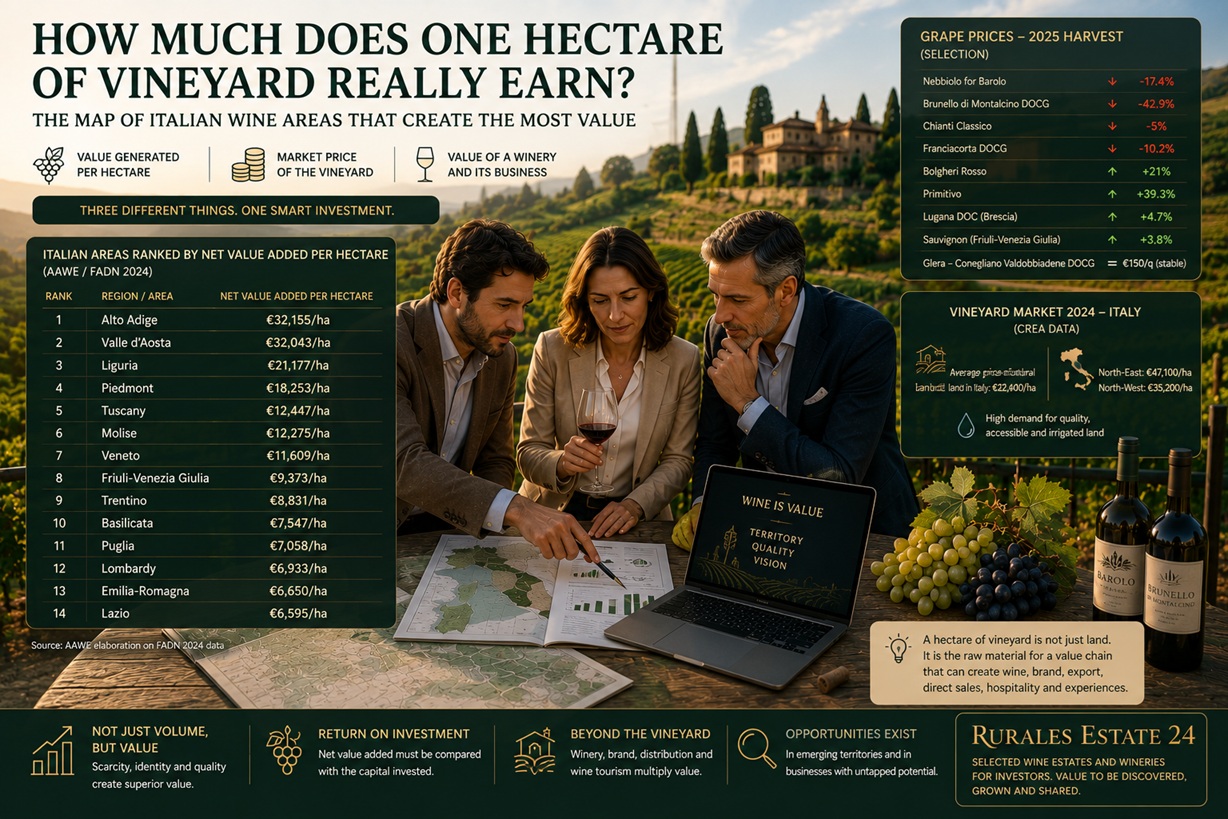
How much does one hectare of vineyard yield? A map of the Italian areas creating the most value
Alto Adige and Valle d’Aosta lead in Italy, followed by Liguria and Piedmont. But vineyard returns, vineyard prices and the value of a winery are three very different things
How much does one hectare of vineyard really yield in Italy?
And how much could that same hectare be worth if it were bought by an investor or by a winery?
The two questions sound very similar. In reality they measure profoundly different things.
The first concerns the economic capacity of the vineyard to generate value.
The second concerns the asset value of the land on the market.
A third question can be added, probably even more important for anyone looking to acquire a wine business:
how much value can that vineyard generate once it is integrated with a winery, an appellation, a brand, distribution, direct sales and wine tourism?
This distinction is the right starting point for understanding where some of the most interesting opportunities in Italian wine can be found today.
The ranking: how much value one hectare of vineyard generates
AAWE data based on FADN 2024 – Farm Accountancy Data Network make it possible to look at European viticulture from an unusual perspective: the net value added generated per hectare of vineyard area.
The result is revealing.
At the top of Europe is Champagne-Ardenne, at approximately €60,030 per hectare.
Immediately after come two Italian territories:
Alto Adige: €32,155/ha
Valle d’Aosta: €32,043/ha
The figures already tell us something important.
The territories producing the most wine are not necessarily the ones creating the most value per hectare.
Scarcity, reputation, identity, quality, positioning and the ability to sell at higher prices can matter more than volume.
The Italian map of value generated by vineyards
Looking at the Italian areas included in the study, the picture is as follows:
| Rank | Region / area | Net value added per hectare |
|---|---|---|
| 1 | Alto Adige | €32,155/ha |
| 2 | Valle d’Aosta | €32,043/ha |
| 3 | Liguria | €21,177/ha |
| 4 | Piedmont | €18,253/ha |
| 5 | Tuscany | €12,447/ha |
| 6 | Molise | €12,275/ha |
| 7 | Veneto | €11,609/ha |
| 8 | Friuli-Venezia Giulia | €9,373/ha |
| 9 | Trentino | €8,831/ha |
| 10 | Basilicata | €7,547/ha |
| 11 | Puglia | €7,058/ha |
| 12 | Lombardy | €6,933/ha |
| 13 | Emilia-Romagna | €6,650/ha |
| 14 | Lazio | €6,595/ha |
These figures must be read correctly: they do not represent the market price of vineyards, but the net value added attributed per hectare in the study.
And it is precisely this distinction that makes the ranking interesting for an investor.
Alto Adige and Valle d’Aosta: creating value without large volumes
The top two Italian positions are held by relatively small territories.
Alto Adige, at €32,155/ha, and Valle d’Aosta, at €32,043/ha, show that scale is not necessarily decisive.
Both can benefit from factors typical of high-value production:
limited surface area + strong territorial identity + quality + reputation + differentiation.
In the case of Valle d’Aosta, the distinctive character of mountain and heroic viticulture adds a further dimension.
The lesson for an investor is significant:
the value of a vineyard does not necessarily come from the quantity of grapes produced, but from the ability of the territory and the business to convert that production into economic value.
Liguria: when scarcity becomes value
Liguria’s result is probably the most surprising.
At €21,177 per hectare, it even outperforms Piedmont.
Yet Liguria is certainly not one of Italy’s major regions by volume.
Its advantage is almost the opposite.
Terraced vineyards, the Cinque Terre, heroic viticulture, the Ponente Ligure, difficult growing conditions and extremely limited land availability make the product very hard to replicate.
This is where one of the most interesting economic rules of wine emerges:
what is difficult to replicate can acquire a greater capacity to create value.
Piedmont: when territory becomes capital
Piedmont reaches €18,253/ha.
But referring simply to “Piedmont” is reductive.
Within the region coexist:
Barolo, Barbaresco, Barbera d’Asti, Asti, Alta Langa, Gavi and numerous other appellations.
A vineyard classified for Barolo clearly does not share the same asset and commercial characteristics as a vineyard located in a lesser-known territory.
In areas such as the Langhe, the vineyard therefore incorporates something that goes beyond its production capacity:
it incorporates territorial reputation.
And that is a form of capital which cannot easily be reproduced elsewhere.
Tuscany: there is no such thing as “the price of a Tuscan vineyard”
Tuscany generates an average of €12,447 per hectare according to the data reported in the study.
Here too, however, the average must be used with extreme caution.
Within the same region coexist:
Brunello di Montalcino – Bolgheri – Chianti Classico – Vino Nobile di Montepulciano – Chianti – Maremma – Vernaccia di San Gimignano – IGT Toscana.
These are profoundly different markets.
And when the investment concerns a complete estate, a further factor comes into play.
In Tuscany, a buyer often acquires at the same time:
vineyard + winery + farmhouse or villa + landscape + brand + hospitality + tourism potential.
For this reason a Tuscan wine estate cannot be valued simply by multiplying the number of hectares by an average price.
Molise: the surprise that invites you to look beyond the best-known territories
Molise, at €12,275/ha, sits immediately behind Tuscany and ahead of Veneto.
This is a particularly interesting result for an investor.
It demonstrates that international reputation and the ability to create value do not necessarily coincide.
Less inflated territories can offer a more favourable ratio between entry cost and value generated.
Tintilia is a good example of how a distinctive native grape variety can help differentiate a territory.
This opens up a theme we consider central:
the best opportunities may not always be found in the most expensive vineyards.
Veneto: completely different markets within a single region
Veneto reaches €11,609/ha.
But this average includes profoundly different wine-producing systems:
Conegliano Valdobbiadene Prosecco Superiore DOCG, Asolo Prosecco DOCG, Prosecco DOC, Amarone della Valpolicella, Valpolicella, Soave, Bardolino and Lugana.
It is perhaps one of the clearest examples of the limits of regional statistics.
A DOCG vineyard in the hills of Conegliano Valdobbiadene and a vineyard destined for volume production formally belong to the same region.
Economically, they can be two completely different assets.
Friuli-Venezia Giulia: value also comes from positioning
Friuli-Venezia Giulia records €9,373/ha.
Here too the average figure does not tell the whole story.
Collio and Colli Orientali del Friuli have built a strong reputation, particularly for high-quality white wines.
Many of the businesses are also relatively small.
This can turn apparently limiting factors — small scale and contained production — into positioning strengths when combined with:
quality + territory + producer + brand + premium distribution.
An important caveat: what a vineyard yields is not what a vineyard costs
This is the fundamental distinction.
Alto Adige’s €32,155/ha does not mean that a vineyard in Alto Adige costs €32,155 per hectare.
These are completely different measures.
The AAWE/FADN figure concerns the wealth generated by the winegrowing activity.
The market price concerns how much a buyer is willing to pay to own the asset.
And the gap between the two can be enormous.
CREA data help to illustrate the phenomenon clearly.
In 2024 the average value of Italian agricultural land was approximately €22,400/ha, rising to €47,100/ha in the North-East and around €35,200/ha in the North-West. These are averages for the entire agricultural market, not for prestigious vineyards alone.
When you look at individual wine-producing areas, values can change radically.
The CREA 2024 report indicates, for example, DOC vineyards along the Adige valley in Trentino at around €250,000/ha, with values in certain hillside situations approaching €500,000/ha.
This shows how misleading it is to speak generically about “the average price of a vineyard”.
The real measure for an investor: return relative to invested capital
Here we can take a step beyond the ranking.
For anyone buying a vineyard, knowing that it generates €10,000, €20,000 or €30,000 per hectare is useful.
But it is not enough.
The economic capacity of the asset must be related to the capital required to acquire and develop it.
In conceptual terms:
capacity to create value per hectare ÷ capital invested per hectare = economic efficiency of the investment
This does not mean automatically calculating a financial return using AAWE data — that would be methodologically incorrect — but adopting the right criterion.
A highly prestigious vineyard may generate a great deal of value while requiring a very high entry cost.
An emerging territory may generate less value in absolute terms, but offer a more attractive relationship between entry price and growth potential.
For an investor, it is precisely this relationship that deserves to be studied.
The 2025 harvest: grape prices confirm that the market is becoming selective
To this structural picture we should add what is happening in the market.
Unioncamere-BMTI data show a 2025 harvest characterised by widespread declines in grape prices, but also by some significant exceptions.
The picture is highly instructive.
Nebbiolo for Barbaresco: -27%
Nebbiolo for Barolo: -17.4%
Franciacorta DOCG: -10.2%
Amarone and Recioto, Classica zone: -14%
Brunello di Montalcino DOCG: -42.9%
Vino Nobile di Montepulciano: -15%
Chianti Classico: approximately -5%
But at the same time:
Bolgheri Rosso: +21%
Primitivo: +39.3%
Lugana DOC in Brescia: +4.7%
Sauvignon in Friuli-Venezia Giulia: +3.8%
and Glera destined for Conegliano Valdobbiadene Prosecco Superiore DOCG remains stable at €150 per quintal.
The message is very clear:
there is no longer a single wine market.
There are territories, appellations and businesses that react in profoundly different ways.
Can falling grape prices create opportunities for buyers?
Potentially yes, but not automatically.
A fall in grape prices can reduce growers’ profitability and, if prolonged, change expectations about vineyard values.
This can encourage:
more rational entry prices → greater availability of properties → consolidation → acquisitions by wineries → aggregation transactions.
But a fall in grape prices can also signal a structural problem within an appellation.
For this reason it is not enough to look for what costs less.
You need to look for what is worth more than the market currently attributes to it.
The Italian land market nevertheless remains solid
It is useful to relate wine data to the agricultural land market as a whole.
According to CREA, in 2024 transactions in agricultural land remained substantially stable and average prices rose by approximately 1%.
Demand also continues to favour land that is:
easily accessible, irrigable and destined for quality production.
Climate change is making water availability in particular an increasingly important factor in how value is formed.
For a wine acquisition this means that the analysis must now include not only appellation and vineyards, but also water, climate resilience and irrigation potential.
What really determines the value of a vineyard?
Buying ten hectares of vineyard does not mean simply buying ten hectares of land.
It means acquiring a system of factors:
- DOC/DOCG/IGT appellation;
- production entitlements and capacity;
- agronomic quality;
- exposure;
- altitude;
- microclimate;
- water availability;
- age of the vines;
- grape varieties;
- yields;
- grape prices;
- accessibility and mechanisation;
- scarcity of supply;
- reputation of the territory;
- potential for appreciation.
CREA itself specifies that its land valuations represent general indications and cannot replace a professional valuation of the individual property, precisely because of the enormous variability of local markets.
And if you acquire an entire wine business?
Here the reasoning changes completely.
Value is no longer:
hectares × vineyard price.
It becomes:
land + vineyards + winery + production facilities + inventory + appellation + brand + customers + distribution + exports + real estate + hospitality + management + future potential.
This is why two wine businesses with the same vineyard area can have completely different values.
One may sell mainly grapes.
Another may turn the same quantity of grapes into wine, bottle it, export it, sell it directly and welcome thousands of visitors every year.
The land is the same physical unit. The economic value created is completely different.
From the value of the hectare to the value of the bottle
This is probably the most important strategic step.
One hectare produces grapes.
But those grapes can follow different paths:
grapes → sold to third parties
or:
grapes → bulk wine
or:
grapes → bottled wine
or again:
grapes → premium wine → brand → export → direct-to-consumer → wine club → hospitality → experience.
At every step, the business can retain a larger share of the value created.
The real challenge for Italian wine should therefore not simply be producing more hectolitres per hectare.
It should be:
creating more value from every hectare.
Where can it be interesting to invest today?
The ranking does not automatically mean that you should buy in Alto Adige because it comes first, or avoid a region because it sits lower down.
An investor should look for at least three types of opportunity.
1. Premium and scarce territories
Langhe, Alto Adige, Montalcino, Bolgheri, Chianti Classico, Conegliano Valdobbiadene and other strongly recognisable appellations.
Here the priorities are scarcity and asset protection, but normally with high entry prices.
2. Territories with a good ratio between value generated and entry cost
This is probably the most interesting category to study.
Molise, certain areas of Friuli-Venezia Giulia, Marche, Abruzzo, Puglia and other less inflated territories can offer opportunities where the capital required is lower and the potential for value creation significant.
3. Businesses with untapped value
These can be even more interesting than the territory itself:
good vineyards + weak brand
important appellation + insufficient exports
prestigious estate + no hospitality
oversized winery + scope for aggregation
family business + no generational succession
excellent product + underdeveloped direct sales
This is where an industrial investor can genuinely create value.
The right question is not “how much does a hectare cost?”
For anyone looking to invest in wine, the question should become:
“How much value can this hectare produce relative to the capital required to acquire it?”
And, if an entire winery is being acquired:
“How much additional value can we create over the next five to ten years?”
This second question brings the investor much closer to the industrial logic of an acquisition.
Because a vineyard should not be seen simply as land.
It is the raw material of an economic system that can include wine, brand, distribution, exports, tourism and real estate.
Rural Estate 24: Italian vineyards as productive real assets
An Italian vineyard should not be evaluated simply according to its price per hectare.
The real investment equation is:
land value + appellation + productive capacity + winery + brand + international distribution + hospitality + future potential.
Italy offers something difficult to reproduce elsewhere: agricultural land located within territories whose names are themselves international brands.
Barolo. Brunello di Montalcino. Chianti Classico. Bolgheri. Prosecco Superiore. Etna.
For an international investor, acquiring an Italian wine estate can therefore mean acquiring not simply agricultural land, but a productive real asset connected to one of the world’s strongest lifestyle and agri-food brands: Made in Italy.
Rural Estate 24 selects Italian estates, vineyards and wine businesses for wineries, entrepreneurs, investors and family offices.
Assessing an opportunity should not stop at the price requested by the owner.
It is necessary to understand:
what it is worth today → what it produces → how much capital it requires → what it could be worth tomorrow.
This is the difference between simply buying a vineyard and building a wine investment.
Not just hectares to acquire. Value to identify and develop.