

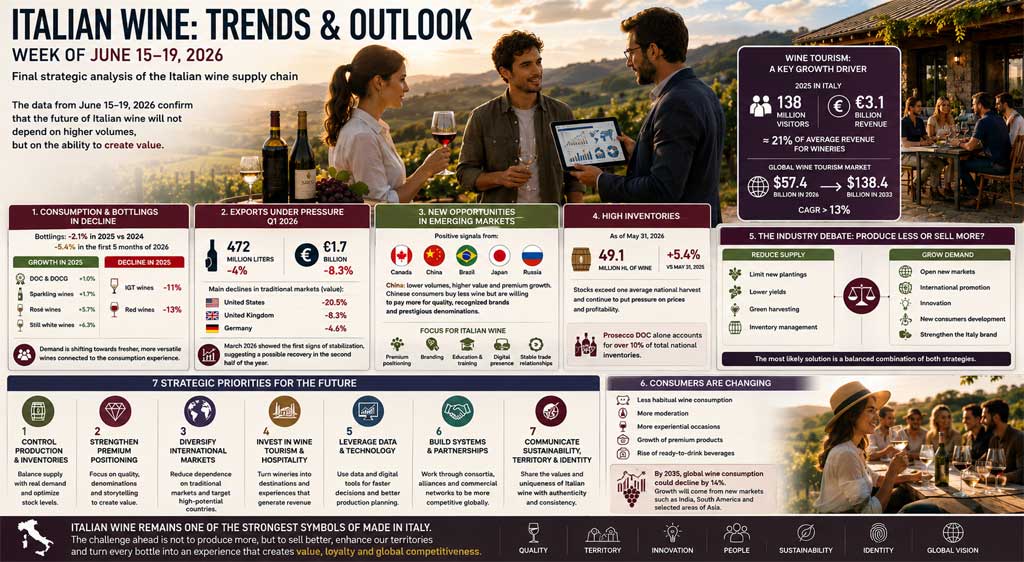


A final, concise and strategic analysis of the Italian wine industry.
The Italian wine sector continues to experience a phase of profound transformation.
The data released during the week of June 15-19, 2026, confirm that the market is not experiencing a temporary crisis, but rather a structural change affecting consumption, exports, production, and business models.
Consumption and bottling in decline
After the growth recorded in the years following the pandemic, 2025 saw a 2.1% reduction in bottlings, followed by a further 5.4% decline in the first five months of 2026.
Consumers are changing their habits and the market is increasingly rewarding products with high added value:
DOC and DOCG: 1%
Sparkling wines: 1.7%
Rosé: 5.7%
Still whites: 6.3%
In difficulty instead:
IGT wines: -11%
Red wines: -13%
Demand is shifting towards fresher, more versatile wines that are more closely linked to the drinking experience.
Exports still under pressure
In the first quarter of 2026, Italian wine exports stood at:
472 million liters (-4%)
1.7 billion euros (-8.3%)
The biggest difficulties come from traditional markets:
United States: -20.5% in value
United Kingdom: -8.3%
Germany: -4.6%
The combined effect of tariffs, inflation, geopolitical tensions, and the economic slowdown continues to weigh on Italian exports.
However, March 2026 showed the first signs of stabilization, suggesting a possible trend reversal in the second half of the year.
Markets that offer new opportunities
Not all markets are slowing down.
The most interesting signals come from:
Canada
China
Brazil
Japan
Russia
China is particularly significant, where volumes are declining but the premium segment is growing. Chinese consumers are buying less wine but are willing to spend more for quality products, recognizable brands, and prestigious denominations.
For Italian wine this means focusing more on:
premium positioning;
branding;
training;
digital presence;
stable trade relations.
Stocks still high
Italian wine inventories remain above normal levels.
As of May 31, 2026, the following are present:
49.1 million hectoliters of wine
5.4% compared to 2025
Inventories still represent more than the national average harvest and continue to put pressure on prices and the profitability of the supply chain.
Prosecco DOC alone represents over 10% of national supplies.
The supply chain debate: produce less or sell more?
The comparison between trade organizations, consortia, and institutions revolves around two main strategies:
Reduce the offer
limitation of new installations;
reduction of yields;
green harvest;
inventory management.
Increase demand
opening of new markets;
international promotion;
innovation;
development of new consumers;
enhancement of the Italian brand.
The most likely solution will be a balanced combination of the two strategies.
Wine tourism: the real driver of growth
While wine slows down, wine tourism continues to grow.
In 2025 in Italy it generated:
138 million visitors
3.1 billion euros in turnover
equal to approximately 21% of the average turnover of the companies involved.
Globally, wine tourism should reach:
$57.4 billion in 2026
$138.4 billion in 2033
with an average annual growth of more than 13%.
For many wineries, wine tourism is becoming a strategic source of income, complementary to wine sales.
Consumers are changing
International research confirms a now consolidated trend:
decreases habitual wine consumption;
moderation is growing;
experiential consumption opportunities are increasing;
premium products are growing;
ready-to-drink beverages are increasing.
By 2035, global wine consumption could decline by 14%, while growth will shift to new markets such as India, South America and some areas of Asia.