

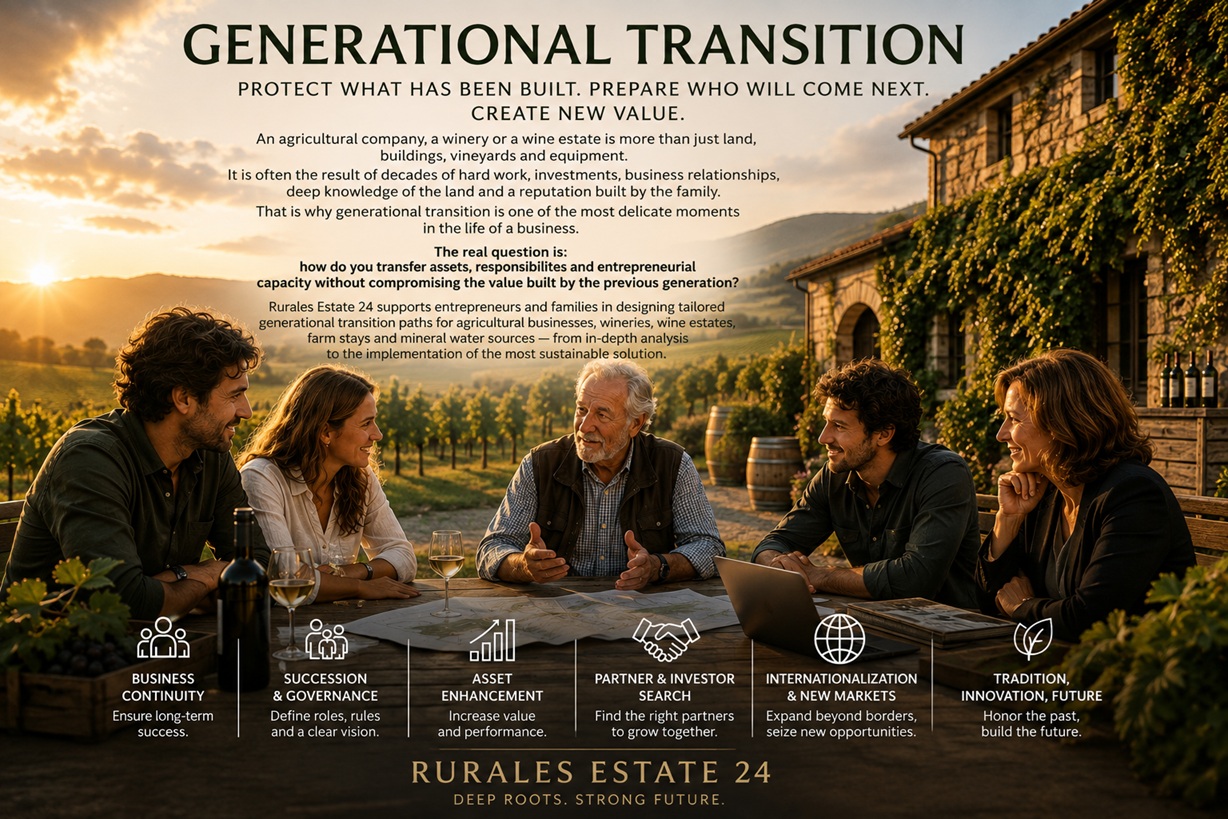
GENERATIONAL TRANSITION IN AGRICULTURAL BUSINESSES, WINERIES AND MINERAL WATER SOURCES
Protect what has been built. Prepare the next generation. Create new value.
An agricultural business, winery or wine estate is much more than a collection of land, buildings, vineyards and equipment.
It is often the result of decades of work, investment, business relationships, knowledge of the land and a reputation built by the family over generations.
This is why generational transition represents one of the most delicate and strategically important moments in the life of a business.
The issue is not simply deciding who will inherit the company.
The real question is:
How can assets, responsibilities and entrepreneurial capabilities be transferred without compromising the value created by the previous generation?
Rurales Estate 24 supports entrepreneurs and families in designing and implementing generational transition and succession strategies for agricultural businesses, wineries, wine estates, agritourism properties, rural estates and mineral water sources, from the initial analysis of the business through to the definition and implementation of the most sustainable solution.
GENERATIONAL TRANSITION SHOULD NEVER BECOME AN EMERGENCY
Many businesses address succession too late.
The founder remains the central figure and primary decision-maker, while the next generation has not yet assumed clearly defined responsibilities or may have chosen entirely different professional paths.
As long as the entrepreneur remains present and operational, the business may continue to function effectively.
However, when succession becomes necessary, issues that have remained hidden for years can quickly emerge:
- undefined family roles;
- multiple heirs with different expectations;
- children who are not interested in operational management;
- entrepreneurial and management skills that have not yet been developed;
- business operations and real estate assets that are closely intertwined;
- the need for new investments;
- commercial challenges;
- debt exposure;
- conflicts between ownership and management;
- lack of clear governance;
- difficulty in determining the true value of the business.
A generational transition planned well in advance can instead become an opportunity to rethink the company, strengthen it and increase its value.
IT IS NOT SIMPLY ABOUT PASSING THE BUSINESS FROM PARENTS TO CHILDREN
This is one of the most common misconceptions.
A successful generational transition must achieve a balance between at least four fundamental elements:
family – ownership – management – future of the business.
These elements do not necessarily have to coincide.
A son or daughter may become a shareholder without necessarily becoming a director.
Another family member may take responsibility for commercial development.
Operational management may be entrusted to external professional managers.
Part of the company’s equity may be opened to an industrial or financial partner.
The company may become part of a broader business network while maintaining its ownership and identity.
In some circumstances, it may instead be more appropriate to prepare for a partial or complete sale of the business, before family or corporate issues begin to reduce its value.
The right solution is therefore not necessarily the traditional one.
It is the solution capable of protecting the family’s assets, interests and business at the same time.
OUR METHOD
1. Analysis of the Business and Entrepreneurial Family
The first step is to understand the real situation.
We analyse:
- corporate structure;
- ownership;
- real estate assets;
- agricultural land and vineyards;
- mineral water sources;
- brands and trademarks;
- economic and financial position;
- organisation;
- employees;
- markets and customers;
- sales channels;
- market positioning;
- required investments;
- the entrepreneur’s role;
- the role, expectations and ambitions of the next generation.
The objective is to build a clear and realistic picture of the company before deciding how ownership and management should be transferred.
2. ASSET AND BUSINESS VALUATION
An agricultural or wine estate may contain very different sources of value.
Land, vineyards, real estate, winery facilities, machinery, licences, brands, commercial networks, customers, production capacity, hospitality activities, mineral water sources and development potential must first be analysed individually and then considered as part of an overall strategic valuation.
A fundamental distinction must be made between:
asset value
and
going-concern business value.
These are two different dimensions of value, and a sound succession strategy must take both into consideration.
3. IDENTIFYING POTENTIAL SUCCESSORS
Having an heir is not enough.
The real question is whether there is an entrepreneurial successor.
Together with the family, we assess:
- genuine interest;
- skills and experience;
- management capabilities;
- knowledge of the company;
- leadership;
- willingness to assume responsibility;
- relationships with employees, customers and suppliers;
- long-term vision for the business.
Where appropriate, a gradual transition and mentoring process between generations can be developed.
The transfer of responsibility does not have to happen overnight.
It can and often should be a progressive process.
4. DEFINING THE NEW GOVERNANCE
One of the most important aspects of a successful generational transition is clearly separating:
ownership, family and management.
Together with the specialist professionals involved, we help define a structure that establishes:
- who owns what;
- who makes decisions;
- who manages the business;
- who is operationally involved;
- how different roles are remunerated;
- which decisions require family approval;
- how potential conflicts are managed;
- which responsibilities are assigned to the next generation.
Clear governance protects both the company and family relationships.
5. BUILDING THE NEXT GENERATION’S BUSINESS PLAN
Transferring a company without defining where it should go means transferring its problems as well.
For this reason, our approach is primarily focused on the future.
For agricultural and wine businesses, we analyse potential development opportunities including:
- commercial growth;
- exports;
- new international markets;
- brand repositioning;
- margin improvement;
- direct-to-consumer sales;
- e-commerce;
- wine tourism;
- hospitality;
- restaurants and food experiences;
- events;
- new products;
- real estate enhancement;
- production efficiency;
- business combinations and strategic alliances;
- acquisitions.
Generational transition can therefore become an opportunity to create a new phase of growth for the business.
6. WHEN THE NEXT GENERATION DOES NOT WANT TO MANAGE THE BUSINESS
This is becoming increasingly common.
And it does not necessarily mean that the business has to be sold.
Several alternatives can be considered.
Family Ownership + Professional Management
The family retains ownership while qualified professionals assume responsibility for managing and developing the business.
Temporary Management and Mentoring
A professional management team can progressively support the next generation until they are ready to assume greater responsibilities.
Gestorius System
For selected businesses, a long-term management model can be developed through Gestorius System, designed to keep the assets within the family while entrusting the development, organisation and growth of the company to a professional management structure.
Industrial Partner
The entry of another winery, agricultural group or strategic operator can provide capital, distribution, management expertise and access to new markets without necessarily requiring the complete sale of the business.
Opening the Company’s Equity
The entry of investors or family offices can be considered while allowing the family to retain a significant ownership interest.
Business Lease or Lease with Purchase Option
In certain circumstances, this can provide an intermediate solution capable of generating income while preserving ownership of the underlying assets.
7. WHEN SELLING IS THE BEST SOLUTION
This possibility must also be considered objectively.
If there is no next generation interested in continuing the business, if the investments required are too substantial, or if market conditions create a particularly attractive opportunity, selling the company can be a strategic entrepreneurial decision rather than a failure.
But the sale must be properly prepared.
Selling an agricultural or wine business means correctly assessing and enhancing the value of:
- land;
- vineyards;
- real estate;
- winery facilities;
- mineral water sources;
- brands;
- production;
- customers;
- distribution;
- licences and authorisations;
- know-how;
- commercial potential;
- wine tourism, hospitality and real estate development opportunities.
In these circumstances, a generational transition process can evolve into a genuine M&A transaction in the agricultural, wine and mineral water sectors, including the confidential search for potential buyers, strategic partners and investors.
ONE STRATEGIC COORDINATION FOR A COMPLEX TRANSACTION
Generational transition inevitably involves different areas of expertise.
Depending on the circumstances, the process may require:
accountants – tax advisors – lawyers – notaries – agronomists – technical specialists – financial consultants – M&A advisors.
Our role is not to replace these professionals.
Our role is to coordinate the process from an entrepreneurial and strategic perspective, ensuring that the different specialists work towards the same objective.
First, we establish where the business needs to go.
Then the most appropriate corporate, tax, financial and legal instruments can be identified to achieve that objective.
THE MAIN SOLUTIONS WE CAN EVALUATE
There is no single model that works for every company.
Depending on the circumstances, different scenarios can be developed.
Direct Transfer to the Next Generation
When the next generation is ready to assume both ownership and management.
Gradual Generational Transition
When a period of mentoring and progressive transfer of responsibilities is required.
Family Ownership with Professional Management
When the heirs wish to retain ownership of the assets but do not want to manage the business directly.
Long-Term Professional Management
When continuity must be guaranteed while simultaneously developing and increasing the company’s value.
Entry of an Industrial Partner
When the business requires market access, expertise, distribution capabilities or additional production capacity.
Entry of Investors
When additional capital is required to develop the business.
Business Aggregation
When scale, distribution and organisational strength can be increased by joining a network or larger group.
Lease or Lease-to-Own
When the owners initially wish to retain the underlying assets.
Partial Sale
When it is appropriate to monetise part of the company’s value while retaining an ownership interest.
Sale of the Business
When a full sale represents the most advantageous solution from both an economic and asset-management perspective.
WHY GENERATIONAL TRANSITION SHOULD BE ADDRESSED BEFORE IT BECOMES NECESSARY
The best time to organise succession is while the entrepreneur is still fully involved in the company.
This allows the gradual transfer of:
knowledge, relationships, authority, customers, responsibilities and corporate culture.
It also creates the opportunity to identify and correct weaknesses in the business before they are transferred to the next generation.
Generational transition should not be regarded as the end of the founder’s entrepreneurial story.
It can be the beginning of a new one.
GENERATIONAL TRANSITION IN WINERIES, WINE ESTATES AND MINERAL WATER BUSINESSES
In the wine sector, succession has particularly distinctive characteristics.
A winery can simultaneously hold:
- agricultural value;
- real estate value;
- production value;
- commercial value;
- brand value;
- value associated with appellations and territory;
- tourism and hospitality value;
- mineral water source value;
- historical and family value.
A vineyard can take decades to build its value.
A brand may take generations.
A commercial network may still depend heavily on the founder’s personal relationships.
For this reason, succession in a winery must be prepared by considering land, wine, mineral water resources, family, markets and capital together.
GENERATIONAL TRANSITION IN AGRICULTURAL ESTATES AND MINERAL WATER SOURCES
For larger agricultural properties, succession is also about much more than inheritance.
Agricultural land, rural properties, agritourism businesses, farming operations, mineral water bottling facilities, renewable energy installations, food production and real estate development opportunities may require different strategies.
In some cases, preserving the estate as a single integrated asset may be the best solution.
In others, it may be advantageous to separate:
real estate ownership from operating activities.
The decision should be based on economic and strategic analysis, not merely on inheritance considerations.
A CONFIDENTIAL PROCESS
Generational transition often involves extremely sensitive family, financial, asset and business information.
For this reason, we operate with particular attention to confidentiality and discretion.
The process can begin with an initial meeting with the entrepreneur and subsequently involve, where appropriate, other family members and the family’s trusted professional advisors.
The ultimate objective is to answer one very simple question:
What do we want this company to look like in 10 or 20 years?
The strategy begins with that answer.
RURALES ESTATE 24
Generational Transition for Agricultural Businesses, Wineries, Wine Estates and Mineral Water Sources
We support entrepreneurs and families in evaluating, designing and implementing strategies for:
business continuity | succession | asset enhancement | new governance | professional management | partner search | equity investment | M&A | sale of the business
We do not begin with a predetermined solution.
We begin with the business, the family and the entrepreneur’s objectives.
Because after a lifetime spent building a company, the most important question is not simply:
“Who will I leave it to?”
but:
“How can I ensure that what I have built continues to create value?”
RURALES ESTATE 24 – INTERNATIONAL GENERATIONAL TRANSITION
Rurales Estate 24 approaches generational transition from an international perspective, supporting owners of wine estates, agricultural estates, wineries, rural properties and mineral water businesses, while also connecting these opportunities with investors interested in acquiring equity stakes or entire businesses where family succession is unavailable or uncertain.
Generational transition can therefore become a meeting point between:
family owners – next-generation entrepreneurs – industrial groups – family offices – investors – international entrepreneurs.
In this context, succession can evolve from a family challenge into a strategic opportunity for investment, partnership, consolidation and long-term value creation.