A network portal of Wine Idea. Discover the world of Wine idea

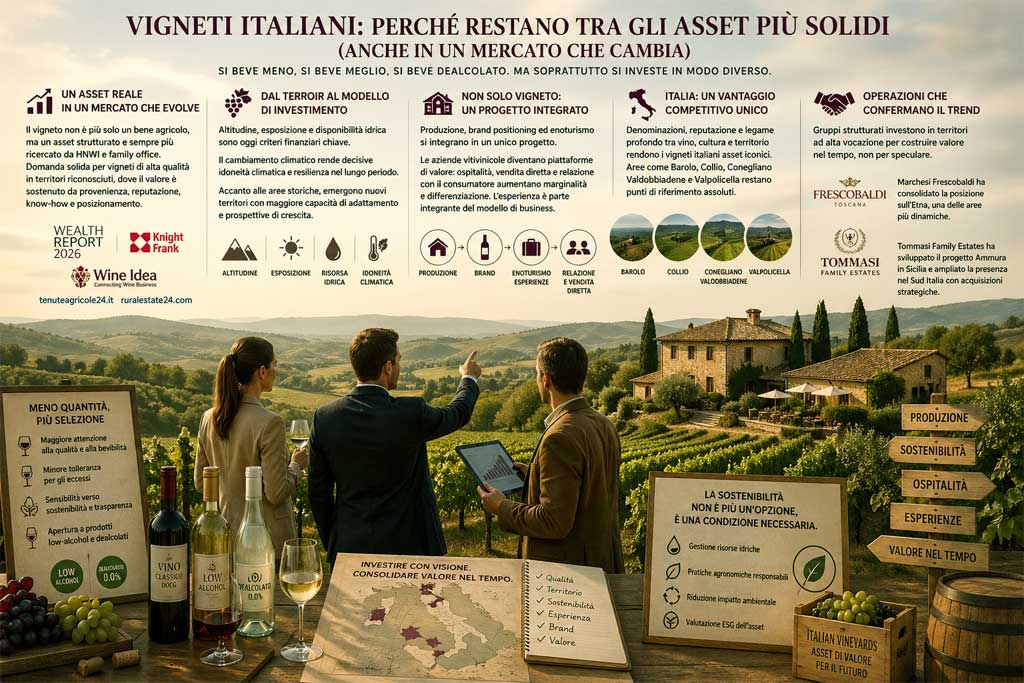
Italian vineyards: why they remain among the most solid assets (even in a changing market)

In a context of declining volumes and a shift in consumption patterns, vineyards—particularly those located in the most suitable areas—continue to represent one of the most solid and strategic alternative assets for those looking to the medium to long term.

People drink less wine, they drink better, they even drink alcohol-free. But above all, they invest differently.

A real asset in an evolving market

The evidence emerging from Knight Frank’s Wealth Report 2026 and the activity of the Wine Idea network (through platforms such as riteneagricole24.it and ruralestate24.com) confirm a trend that is now clear to operators: the vineyard is no longer just an agricultural asset, but a structured asset that is increasingly sought after by HNWIs and family offices.

Demand remains strong, especially for high-quality vineyards in recognized territories, where value is supported by tangible factors: provenance, reputation, production know-how, and market positioning.

From terroir to investment model

Until a few years ago, parameters such as altitude, exposure, and water availability were considered primarily agronomic factors. Today, however, they have become fully integrated into financial evaluation models.

Climate change has transformed these factors into decisive variables. “Climate suitability” and long-term resilience become key criteria in asset selection, directing investments toward territories capable of ensuring production continuity and quality over time.

Alongside the historic areas – which continue to maintain structural solidity – new zones with greater adaptability are emerging, destined to play an increasingly important role in investment strategies.

Not just a vineyard: an integrated business project

Today, acquiring a vineyard means entering a complex system.
Production, brand positioning, and wine tourism are no longer separate elements, but integrated parts of a single project.

Wineries are evolving into true value platforms: places of production but also experiential destinations. Hospitality, direct sales, and consumer relations are becoming strategic levers for increasing margins and differentiation.

In this context, experience is no longer an afterthought: it is an integral part of the business model.

Italy: a competitive advantage that is difficult to replicate

The Italian system continues to exert a strong international appeal.
Appellations, a consolidated reputation, and a profound connection between wine, culture, and territory make Italian vineyards iconic assets, capable of combining economic and symbolic value.

Areas such as Barolo, Collio, Conegliano Valdobbiadene, and Valpolicella remain absolute benchmarks, where the limited supply and global recognition sustain their value over time.

The operations confirm the trend

Market dynamics in recent years have been moving in the same direction.
Structured groups are strengthening their presence in highly vocational areas:

  • Marchesi Frescobaldi has consolidated its position on Etna, one of the most dynamic areas of the Italian wine scene.
  • Tommasi Family Estates developed the Ammura project in Sicily and expanded its presence in Southern Italy with strategic acquisitions.

These operations are not speculative, but rather aimed at building value over time, through territories with strong identities and growth potential.

Consumption: less quantity, more selection

At the same time, the change in consumption is evident.
Consumers – especially the new generations – do not reject wine, but reinterpret it:

  • greater attention to quality and drinkability
  • lower tolerance for excesses
  • growing sensitivity towards sustainability and transparency
  • opening towards low-alcohol and dealcohol-free products

This scenario is pushing the sector towards greater selectivity and production models more consistent with new market expectations.

Sustainability is no longer an option

In this new context, sustainability has changed its role.
It is no longer a distinctive element, but a necessary condition for existing on the market.

Water management, responsible agricultural practices, and attention to environmental impact are now integral to evaluating a winery’s assets, both from a production and financial perspective.

Conclusion: the vineyard as a value platform

The picture that emerges is clear:
Vineyards in Italy’s top wine-growing areas remain a solid investment, but with profoundly different rationales than in the past.

No longer a simple landed property, but an integrated platform where agriculture, brand, tourism and experience coexist.
No longer a passive investment, but an active entrepreneurial project, which requires vision, skills, and positioning ability.

For those who can interpret this evolution, the vineyard continues to represent one of the most interesting opportunities in the real asset landscape.

Wine Trends in Italy – Week of April 20-24 – 2026

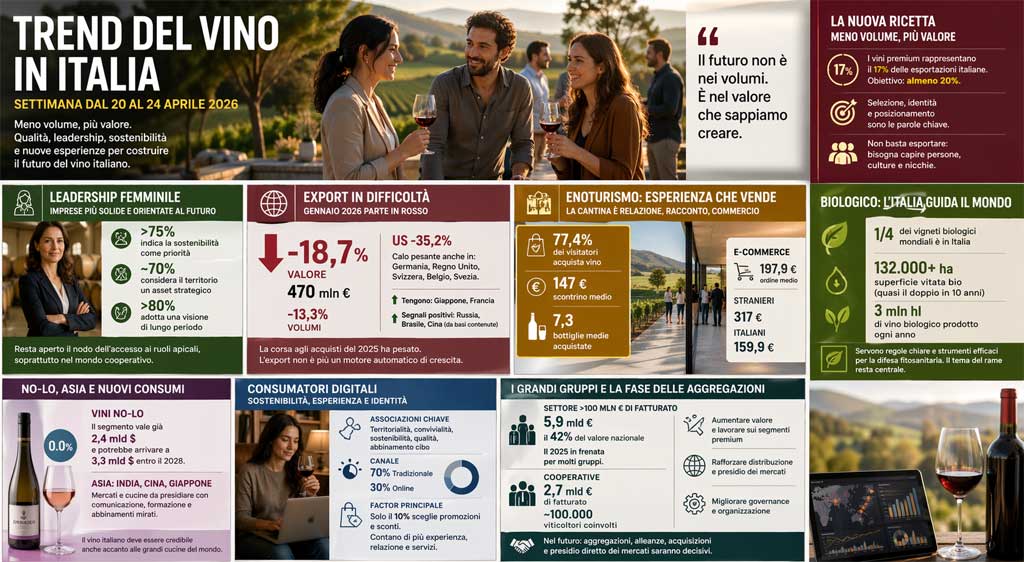
The week of April 20-24, 2026, confirms a complex picture: changing consumption, declining exports, unstable international markets, but also new opportunities related to quality, leadership, wine tourism, organics, sustainability, premiumization, and new sales channels.

Italian wine is entering a phase of intense selection.

The central message is clear: the sector can no longer grow simply by increasing bottles and volumes. It must produce less and better, strengthen brand value, address niche markets, better understand consumers, and build more structured businesses.

Female leadership: stronger and more future-oriented companies

One of the most significant findings comes from the research presented at Vinitaly on the role of women in the governance of wineries. Women-led businesses display more advanced organizational models, with clear roles, greater delegation capacity, long-term planning, and a focus on human capital.

Over 75% of those interviewed cite sustainability as a priority, approximately 70% consider the local area a strategic asset, and over 80% adopt a long-term vision. Female leadership therefore appears not just a matter of representation, but a concrete lever for corporate effectiveness.

However, the issue of access to top management roles remains unresolved, especially in the cooperative world, where the female presence in leadership positions is still limited.

Exports in difficulty: January 2026 starts in the red

The most worrying data concerns exports. In January 2026, Italian wine recorded an 18.7% decline in value, stopping at approximately €470 million, with volumes down 13.3%.

The decline is particularly severe in the United States, where exports fell by 35.2% in value. Germany, the United Kingdom, Switzerland, Belgium, and Sweden also fared poorly. Japan and France held up better, while positive signs came from Russia, Brazil, and China, albeit from even more modest bases.

The decline is also influenced by the rush to purchase in 2025 to anticipate American tariffs, but the signal remains strong: exports are no longer an automatic driver of growth.

The new recipe: less volume, more value

From the Vinitaly discussions, a shared vision emerges: the future lies in a more limited, more qualified offering with greater added value.

Italy still sells a relatively small share of premium wines. Increasing this share from at least 17% to 20% would already be a significant step towards protecting value and margins. The key, therefore, is selection: less quantity, more identity, better positioning.

Companies will also need to better understand markets. “Exporting” is no longer enough: they need to understand people, cultures, consumer communities, and niches. In the United States, for example, Italian wine is still highly concentrated in the Northeast, while segments such as Hispanic communities and the new multicultural America remain to be explored.

Wine tourism: the winery sells experience and bottles

Wine tourism continues to be a key driver. In 2025, 77.4% of winery visitors purchased wine after their experience. The average receipt was €147, with approximately 7.3 bottles purchased.

This data illustrates a crucial shift: the winery is no longer just a production site, but a space for sales, relationships, and storytelling. Experience builds trust, strengthens the brand, and encourages direct sales.

E-commerce is also interesting: the average online order rises to €197.90, despite fewer bottles purchased. Foreigners spend significantly more than Italians, averaging €317 versus €159.90.

Organic: Italy leads the world

Italy confirms an important record: a quarter of the world’s organic vineyards are located in our country. The organic vineyard area exceeds 132,000 hectares, almost double the amount of ten years ago, with approximately 3 million hectoliters of organic wine produced each year.

Organic farming offers a competitive advantage, but requires clear rules and effective pest management tools. Copper remains a key issue: without equally reliable alternatives, organic viticulture would face significant operational challenges.

No-Lo, Asia and new consumption

There’s growing interest in No-Lo wines, meaning those with low or no alcohol content. The segment is already worth $2.4 billion and could reach $3.3 billion by 2028. Even in Italy, some companies are starting to believe in it, while awaiting definitive regulatory clarification.

At the same time, Italian wine is increasingly interested in Asian cuisines. India, China, and Japan represent markets and gastronomic cultures that must be addressed with communication, education, and targeted pairings. It’s no longer enough to simply link Italian wine to Italian cuisine: it needs to be made credible alongside the world’s great cuisines.

Digital Consumers: Sustainability, Experience, and Identity

The PwC Italia and Meregalli Group analysis of digital consumers confirms some key trends. Wine is associated with territoriality, conviviality, sustainability, quality, and pairing with food.

Traditional channels still account for 70% of the total, while online accounts for about 30%. Online shoppers are looking for experience, loyalty, variety, and sustainability. Price matters less than you might think: only 10% cite promotions and discounts as the main factor.

This means that the consumer must not be pursued only with offers, but engaged with content, relationships, belonging and services.

Large groups and the aggregation phase

2025 also saw a slowdown among large operators. The sector with revenues above €100 million is worth €5.9 billion, equal to 42% of the national value, but many groups have seen a decline.

Cooperatives remain crucial, with a turnover of €2.7 billion and approximately 100,000 winemakers involved, but here too there is a need to increase value, strengthen distribution, focus on premium segments, and improve governance.

Looking ahead, mergers, alliances, acquisitions, and direct market presence will become increasingly important tools.

Wine Price Trends in Italy for the Week of April 13-17 – 2026

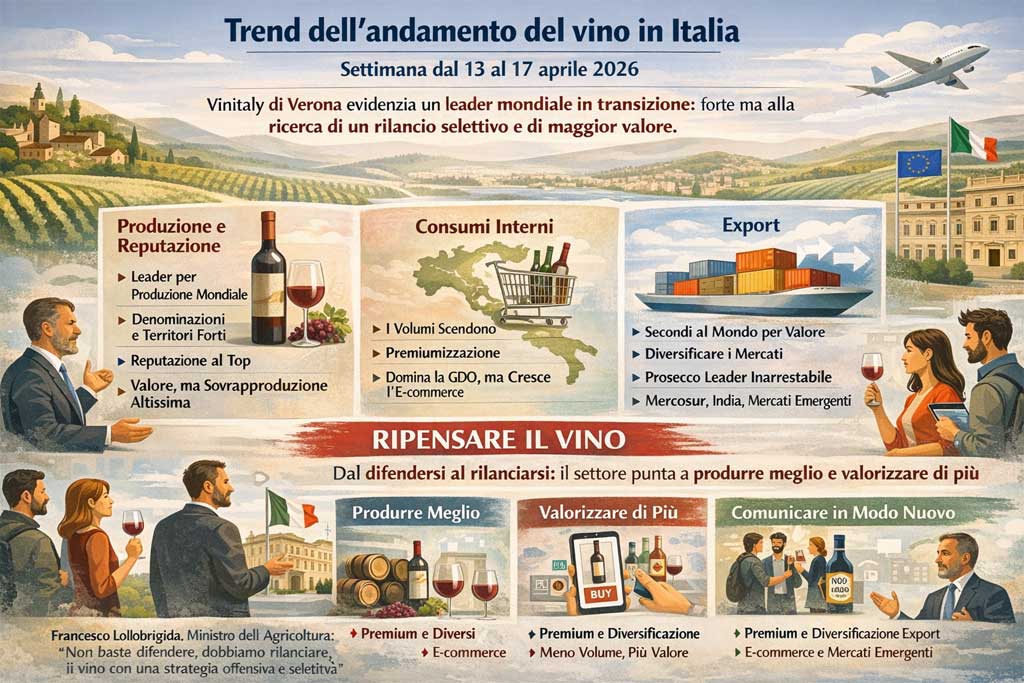
The week of April 13-17, 2026, marked by the Vinitaly trade fair in Verona, provided a clear picture of Italian wine: a sector that remains a world leader in production, strong in reputation, export capacity, and the value of its territories, but which is facing a profound transformation.

The picture that emerged is not that of a simple and temporary crisis, but of a real structural change in consumption, markets, and the strategies needed to compete.

The clearest message coming from institutions, consortia, observers and operators is one: it is no longer enough to defend wine, we need to rethink it in an offensive, selective and higher-value way .

From defense to relaunch: the sector’s new strategic line

Among the most powerful statements to emerge during the week was the position expressed by Agriculture Minister Francesco Lollobrigida, who emphasized the need for a change of approach: not a policy of retreat, but a strategy of relaunch.
The concept is clear: it makes no sense to incentivize exit from production, while it is strategic to support a model that leads to better production, greater value and more effective communication .

This approach comes at a time when Italian wine needs to strengthen its position not only with numbers, but also with a modern narrative capable of capturing new consumers, new markets, and new consumption styles.

Domestic consumption: large-scale retail trade confirms declining volumes

The most recurring data of the week concerns modern distribution.
In 2025, wine sold in large-scale retail outlets confirmed a contraction in volumes, while value held up better thanks to the increase in average price and the shift towards higher-end products.

According to Circana analyses, the wine and sparkling wine sector in large-scale distribution closed the year with a value of approximately 3.2 billion euros and 737 million litres sold , with a 2.7% drop in volumes and substantial stability in turnover ( -0.5% ), supported by an increase in the average price of 2.3% .

The data confirms a now consolidated trend: Italians are buying less wine, but when they do buy, they choose more carefully.
The suffering is concentrated above all in the lower price ranges and less distinctive products, while labels with greater perceived value, territorial identity and premium positioning are holding up better.

Sparkling wines still dominate, while reds and semi-sparkling wines are struggling.

This week too, the most dynamic segment remains that of bubbles.
Sparkling wines remain the category that bucks the trend, with growth of 1.5% in volume and 1.2% in value in large-scale retail trade in 2025. Rosé and white sparkling wines are particularly strong, driven by more informal consumption, home aperitifs, and greater versatility across consumption occasions.

The performance of the Classic Method is even better, growing both in volume and value and confirming itself as one of the most interesting categories for the sector’s premiumization strategy.

The situation is more difficult for still wines, especially reds, which, despite maintaining the largest market share, continue to lose ground.
Sparkling wines are among the most penalized segments, with evident declines in both volumes and values.

The overall picture therefore indicates a change in tastes: consumers are increasingly orienting themselves towards fresher, easier-to-drink, less demanding wines and often with lower alcohol content .

Premiumization: people drink less, but they seek higher quality

One of the most notable trends that emerged this week is premiumization.
Consumers aren’t simply reducing their purchases: they’re changing their criteria for choosing. Price ranges above €10 are performing better than entry-level segments, signaling a market that’s shrinking in volume but improving in value.

This trend is particularly visible in higher-end white wines, but in general it affects the entire sector, which manages to maintain a certain economic stability thanks to a favorable “mix effect”: fewer purchases, but more selective ones.

For the sector, this means that future competition will no longer be based on quantity, but on the ability to build coherent assortments, strong identities, distinctive positioning and credible storytelling .

Wine e-commerce: digital growth and sparkling wines dominate

While traditional distribution is showing signs of slowing down, the online channel is showing signs of dynamism.
In the first quarter of 2026, online searches for wine exceeded 657,000 , an increase of almost 10% compared to the same period in 2025. On an annual basis, overall searches reached 2.67 million in 2025, confirming that wine is now a structural category even in the digital landscape.

Sparkling wines once again dominate online interest, accounting for 52% of searches , ahead of red wines with 36.7% . Whites, rosés, and dessert wines lag further behind.

This data is important because it indicates that the digital channel is not just a space for purchasing, but also for discovery, comparison, and the creation of desire.
Furthermore, the web increasingly favors premium labels and recognizable brands, with a strong focus on price comparisons and the best time to buy.

Young consumers: less faithful to traditional models, more curious and more selective

Among the most interesting signs of the week is the renewed attention towards young consumers.
According to IWSR and UIV analyses, the 34-year-old demographic isn’t abandoning wine, but rather reinterpreting it. Younger consumers are more inclined to experiment, more attentive to sustainability, more open to low-alcohol and alcohol-free wines, and, in many cases, more willing to spend on products perceived as authentic, innovative, and consistent with their values.

Their consumption is less frequent and less ritualistic than that of previous generations, but more oriented towards the experience, quality and identity of the product.
This makes it clear that the future of wine lies not so much in recovering old consumption patterns, but rather in the ability to dialogue with new lifestyles and new cultural codes.

Dealcolati and NoLo: from niche to segment to observe

During Vinitaly 2026, an important part of the discussion also focused on dealcoholized wines and NoLo.
The segment is still small, but it has now firmly entered the industry’s radar. The creation of the Vinitaly NoLo Experience and the dedicated focus groups by UIV and Veronafiere clearly indicate that this is no longer a marginal area of development.

In large-scale retail, the sector is still worth just a few million euros, but distribution is expanding and the topic is taking on strategic importance, especially for reaching younger consumers, international audiences, and alternative consumption opportunities.

It is not the heart of Italian wine today, but it could become an important complementary lever in the medium term.

Exports: Italy strong, but in a more complex scenario

On the international front, Italian wine confirms its structural strength, but in a much more complicated context than in previous years.
Italy remains the world leader in production , with 47.3 million hectolitres in 2025 , and confirms its position as the world’s second largest exporter in value , with exports of around 7.8 billion euros .

However, 2025 ended with a contraction in exports, particularly penalized by the slowdown in the United States and the international geopolitical situation. The US remains the primary destination market, but tariffs and trade uncertainty have had a significant impact. Pressure on the American market remains strong in the early months of 2026.

Alongside this criticality, however, important opportunities emerge.
Indeed, positive signals are growing from alternative and emerging markets such as Mercosur, India, Eastern Europe, Brazil, Vietnam, and some areas of Southeast Asia . The acceleration of the European Union’s free trade agreements is seen as a concrete lever for the geographical diversification of Italian exports.

The key point that emerged this week is that Italian wine can no longer afford to be excessively dependent on a few key markets: it must broaden its reach, better segment its targets and address new demand niches .

Prosecco, the driving force of the system

In this scenario, Prosecco DOC continues to represent the driving force of Italian wine.
In 2025 it closed with a growth of 2.3% at global level , with 667 million bottles bottled and 82% of production destined for foreign countries , for a total value of 3.6 billion euros .

Very positive data from the United States, France, Germany, and several emerging markets confirms the denomination’s great ability to adapt to markets, speak contemporary languages, and intercept international demand.
Prosecco thus continues to be not only a winning denomination, but also the symbol of an export model based on accessibility, recognisability and distribution strength.

High inventories: the structural crux of overproduction

One of the most sensitive issues that emerged this week was that of inventories.
The data from “Cantina Italia” updated to 31 March 2026 indicate 55.9 million hectolitres of wine in stock , with an increase of 5.7% compared to the same period in 2025. To these are added musts and new wine in fermentation.

The data confirms a problem of balance between production and market absorption.
Many operators, from Uiv to retailers and observers, have reiterated that the current level of inventories is essentially equivalent to a harvest and a half in the cellar , a situation considered unsustainable in the medium term.

This is where one of the clearest messages of the week comes from: intelligent production containment is needed , especially in areas and segments where supply clearly exceeds market capacity.
Producing less, but better, is no longer just a slogan: it is the condition for protecting value, prices and profitability.

Territories, identities, and regions: the case of Emilia-Romagna and the role of Veneto

The week also showed how the territories remain the true competitive capital of Italian wine.
Emilia-Romagna presented itself at Vinitaly 2026 with a strong, integrated, and growing regional system: over 14,000 companies , more than 52,000 hectares of vineyards , approximately 5.37 million hectoliters produced in the 2025 harvest, and €433 million in exports . The renovated regional pavilion, the integration with the Food Valley, and the link between wine, PDO and PGI products, and tourism represented one of the clearest models of advanced territorial narrative.

At the same time, Veneto continues to confirm its position as the leading region for exports, with Verona still the leading province in Italy for beverage exports, almost entirely represented by wine.
The province of Verona closed 2025 with 1.21 billion euros in exports , albeit a slight decline, confirming its position as a strategic center for Italian wine both economically and symbolically.

CMO Promotion: More resources and flexibility for internationalization

Another important front of the week is that of support policies.
Over 98 million euros have been made available for the 2026-2027 CMO Promotion campaign, of which 22 million for national programmes and the remainder allocated to regional calls for proposals and multi-regional programmes.

The new tender structure aims to simplify access, digitize procedures, accelerate deadlines, and increase flexibility, helping companies operate more effectively in non-EU markets.
The purpose of the intervention is clear: in an unstable global scenario, international promotion is no longer an afterthought, but a crucial tool for competitiveness.


Wine trends and performance in Italy – week of April 6-10, 2026.

The picture that emerged this week confirms that Italian wine is in a complex, but far from static, phase.

The market is not standing still: its structure, languages, consumption opportunities, and competitive logic are changing.

On the one hand, pressures on consumption, prices, exports, and traditional channels remain evident; on the other, trends that can support the sector in the medium term are strengthening, such as premiumization, young consumers, wine tourism, product innovation, and greater commercial integration.

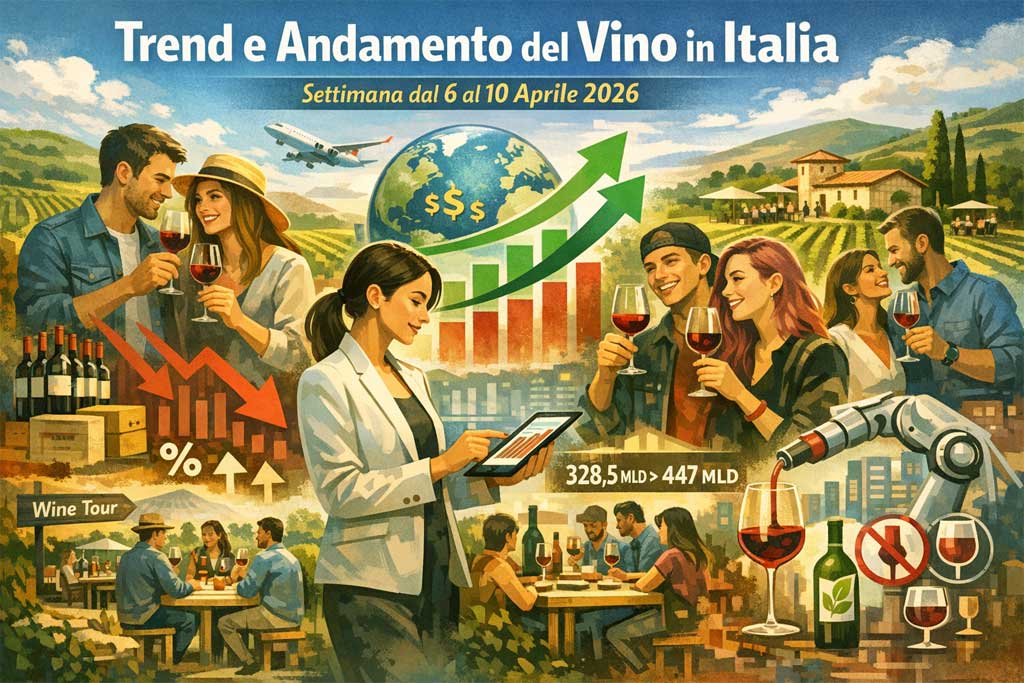
Internationally, wine continues to move within a scenario of potential growth. Estimates predict the global market will reach $328.5 billion in 2026, with the prospect of reaching over $447 billion by 2033, indicating that the sector is not in structural decline, but undergoing transformation. The strategic message is clear: wine will continue to generate value, but will do so by increasingly rewarding those who understand changing consumer behavior. Europe remains the dominant market share, thanks to tradition and wine tourism, while North America is identified as the most dynamic, driven by young people, direct sales, and a more everyday, accessible, and experiential wine culture.

For Italy, this means that wine can no longer be seen simply as an agricultural product or consumer good, but as an integrated system comprising the bottle, the region, hospitality, storytelling, and positioning. The most interesting signs come precisely from the sector’s ability to combine identity and adaptation. There is growing interest in premium, organic, biodynamic, low-alcohol, and no-alcohol wines, in products with sustainability credentials, and in easier-to-drink formulas that are more consistent with a lifestyle focused on well-being. This shift doesn’t eliminate traditional wine, but it does alter its competitive landscape.

One of the week’s most important developments concerns the relationship between wine and young people. International analyses reaffirm a finding that until recently seemed counterintuitive: younger generations aren’t necessarily distant from wine, but rather approach it in different ways. They’re more curious, more open to experimentation, more attentive to food, more responsive to advice and storytelling, more inclined to use digital channels, and more willing to spend when they recognize quality, experience, and brand consistency. Essentially, young consumers no longer seek wine simply as a habit, but as a cultural and identity-building choice. This opens up significant space for wineries capable of crafting contemporary languages without sacrificing authenticity.

On the domestic demand front, however, the picture remains selective. Out-of-home dining continues to show contradictory signals: the market is growing in value, but losing customers. This means people are spending more, but frequenting less. Aperitivo, for years a symbol of socializing and urban consumption, appears to be one of the hardest-hit occasions, with a marked decline in visits and the value generated by alcoholic beverages. This is an important sign, because it points not only to a difficult economic climate, but also to a shift in habits. Italian consumers are more cautious, more price-conscious, more sensitive to well-being, and less inclined to automatically consume alcohol. Regulatory pressure, the issue of driving, health, and changing attitudes toward alcohol are also contributing to reshaping the market.

In this scenario, wine is suffering especially in the segments most exposed to unspecified daily consumption. But not all are declining equally. Dinner remains the most economically powerful moment for eating out, tourism supports the sector with higher average receipts, and premium wine continues to hold up better than the lower end. This is one of the most compelling messages of the week: the market is not rewarding indistinct wines, but rather those that can justify their price, image, story, and perceived value. In other words, sales are lower where differentiation is lacking, while products that express identity, reputation, and a clear purchasing motivation hold up better.

The case of Sicily is also highly relevant, capturing a national trend: declining domestic consumption, rising costs, and pressure on full cellars, but also strong competitiveness in terms of quality-price ratio and the preservation of territorial value. The Sicily brand continues to have great evocative power, supported by tourism, its international reputation, and highly attractive locations like Mount Etna. This teaches a clear lesson for Italian wine as a whole: strong, easily identifiable, and well-touted territories still have the power to attract, even in a challenging market environment. Where recognition exists, the product more easily maintains its market share. Where wine is perceived as a commodity, however, the difficulty increases.

At the same time, the sector is demonstrating a growing organizational capacity for responsiveness. The “Galassia – World Wine Network” project represents one of the most interesting signs of the week because it points to a concrete industrial and commercial direction: building synergies, sharing networks, combining expertise, increasing international coverage, and streamlining market presence without erasing the identity of individual brands. It’s a model that can have broader implications for Italian wine: in a time of compressed margins and complex markets, commercial efficiency and governance become as crucial as wine quality. Producing well is no longer enough; markets must be managed with structure, continuity, and vision.

Exports also remain a sensitive area, requiring close monitoring. The negative signals coming from both Italy to the United States and Spain in January 2026 suggest that the international wine trade is having a difficult start to the year, amid declining volumes, weakening demand, and broader economic tensions. For Italy, this does not mean a loss of centrality, but rather the need for greater strategic prudence: geographical diversification, strengthening less mature markets, maintaining premium status, and more targeted commercial investments are becoming essential. In a less linear international context, those who rely too heavily on a limited number of outlets are likely to suffer the most.

Financially and symbolically, the first quarter of 2026 for Liv-Ex offers encouraging signs. The recovery, though moderate and limited to fine wines, indicates that high-end Italian labels retain their appeal and confidence in the secondary market. Italy is performing well, especially in the more refined segments, with Barolo, Supertuscans, and other top labels showing significant recoveries. This figure doesn’t represent all Italian wines, but it is a useful indicator: the reputational value of top-of-the-line Italian wines remains solid and continues to strengthen the country’s international positioning.

The most dynamic and perhaps most promising aspect, however, is wine tourism. This week’s data shows a clear acceleration: in 2026, an estimated 18 million Italians will be involved in wine-related experiences, a significant increase compared to 2024. But the real issue isn’t just quantitative. The way we experience the winery is changing. Visitors seek authenticity, human connections, winemaking families, landscapes, easy booking, diverse experiences, food and wine pairings, and quality hospitality. The winery is no longer just a place for tasting: it is becoming a commercial interface, a loyalty tool, a branding lever, and a direct sales and reputation channel. For many businesses, this means that wine tourism can no longer be an afterthought, but must become part of their business model.

Furthermore, the growth of wine tourism is intertwined with two key themes for the future: proximity and technology. On the one hand, it increases the potential of nearby destinations and local audiences; on the other, artificial intelligence is beginning to impact the customer journey, from research to inspiration to the personalization of the experience. This opens up a very interesting space for wineries that can combine authentic hospitality with digital tools. The risk, however, is thinking of monetizing experiences simply by raising prices without increasing their perceived value: the market clearly indicates that consumers are willing to spend, but demand consistency, quality, and a connection.

Overall, the week of April 6-10, 2026, therefore, depicts an Italian wine market that isn’t simply experiencing a slowdown, but rather a profound restructuring. Consumption is more cautious, eating out is less automatic, aperitifs are losing steam, costs remain a concern, and exports are off to a shaky start. But at the same time, signs of a new demand structure are growing: greater quality, greater identity, greater terroir, greater experience, greater sustainability, greater connections, and greater segmentation.

Style Selector
Select the layout
Choose the theme
Preset colors
No Preset
Select the pattern