A network portal of Wine Idea. Discover the world of Wine idea

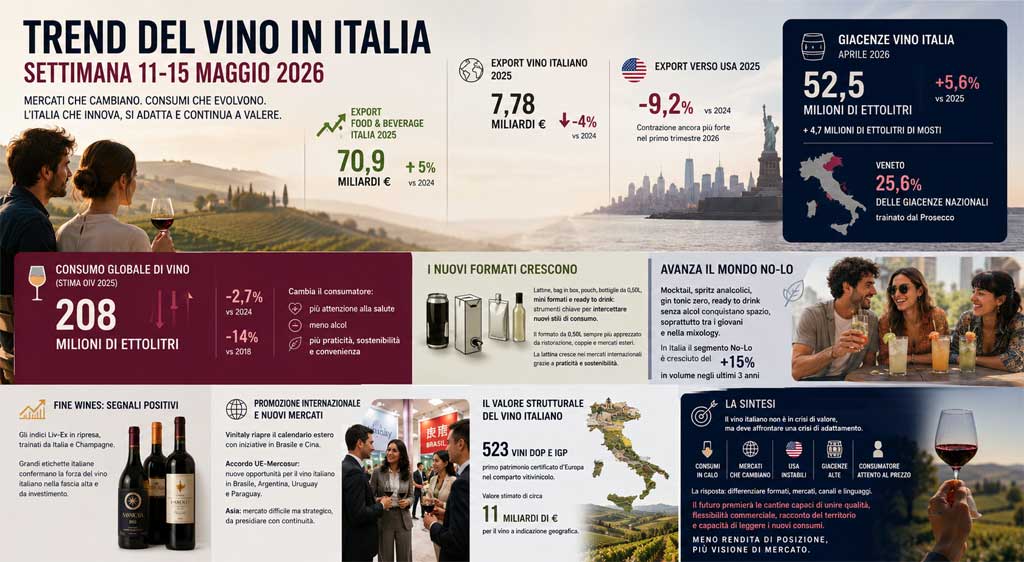
Wine Trends in Italy – Week 11-15 May 2026

This week confirms a complex phase for Italian wine: the sector remains strong, recognized, and central to Made in Italy, but it operates within a more unstable, selective, and less predictable market than in the past.

The overall picture for the Italian agri-food sector remains positive: in 2025, food and beverage exports reached €70.9 billion, up 5%, confirming the strength of the Italian system.
However, wine, while remaining one of the symbolic categories of national exports, has registered a decline: Italian wine exports in 2025 stopped at around 7.78 billion euros , with a drop of around 4% .

The most critical data concerns the United States, a key market for Italian wine, where tariffs and trade uncertainty have clearly weighed. According to the UIV Observatory, Italian exports to the US fell by 9.2% in 2025 , with an even sharper contraction in the first quarter of 2026. This isn’t just an Italian problem: the American supply chain, including importers, distributors, restaurateurs, and wine shops, is also suffering negative impacts, with reduced sales and a reduced presence of European wines on restaurant menus.

On the domestic front, the most sensitive issue remains that of inventory. According to the ICQRF’s “Cantina Italia,” as of April 2026, Italian wineries held 52.5 million hectoliters of wine , 5.6% more than in 2025 , in addition to 4.7 million hectoliters of must . This figure indicates significant production capacity, but also the need to carefully manage the relationship between supply, consumption, exports, and prices. Veneto alone accounts for 25.6% of national inventory, driven primarily by Prosecco.

Worldwide, wine consumption continues to decline. The OIV estimates global consumption of 208 million hectoliters for 2025, down 2.7% from the previous year and 14% from 2018. Consumer habits are changing, especially among young people: greater attention to health, lower alcohol consumption, and a greater search for convenience, sustainability, and affordability.

This is precisely where one of the week’s most important trends comes from: the growth of alternative formats. Cans, bag-in-boxes, pouches, half-liter bottles, mini formats, and ready-to-drinks are becoming strategic tools for capturing new consumption styles. The 0.50-liter format appears increasingly attractive for restaurants, couples, and foreign markets, while the can is growing especially in international markets, thanks to its convenience and perceived sustainability.

At the same time, the No-Lo segment, that is, non-alcoholic or low-alcohol drinks, is gaining ground. Mocktails, non-alcoholic spritzes, zero-alcohol gin and tonics, and alcohol-free ready-to-drinks are gaining ground, especially among young people and in mixology. In Italy, the No-Lo segment has grown by 15% in volume over the last three years , while the traditional alcoholic beverage sector is declining.

However, there are positive signs. The fine wine market is showing signs of recovery, with the Liv-Ex indices supported especially by Italy and Champagne. Some major Italian labels, particularly Barolo, Barbaresco, Masseto, Sassicaia, Solaia, Tignanello, and Soldera, confirm the strength of Italian wine in the premium and investment segment.

International promotion also remains key. Vinitaly has reopened its international calendar with initiatives in Brazil and China, focusing on South America and Asia as high-potential areas. The EU-Mercosur agreement could open new opportunities for Italian wine, especially in Brazil, Argentina, Uruguay, and Paraguay, while Asia remains a challenging but strategic market, requiring continued support.

The structural value of Italian wine remains enormous: Italy boasts 523 DOP and IGP wines , Europe’s largest certified wine heritage, with an estimated value of approximately €11 billion for geographical indication wines. This is the true strength of the system: not a single product, but a map of territories, grape varieties, denominations, landscapes, and local identities.

The summary is clear: Italian wine isn’t experiencing a crisis of value, but rather a crisis of adaptation. Consumption is declining, markets are changing, the United States is more unstable, inventories remain high, and consumers are more price-conscious. The answer can’t simply be to lower margins: we need to differentiate formats, markets, channels, and languages.

The future will reward wineries capable of combining quality, commercial flexibility, a narrative of the region, and the ability to understand new consumer trends. Italian wine still has a powerful competitive advantage, but it must use it more strategically: less vested interest, more market vision.


Wine press review for Thursday May 14 -2026

Italian wineries, Italian wine producers, and current wine news.

Italian wineries

Bellavista hit by hail: 50 hectares of vineyards damaged. The severe weather severely affected some vineyards, including Bellavista’s vineyards. Francesca Moretti emphasizes the need to wait for the plants’ reaction, intervening with cover treatments and careful agronomic work.

Ventiventi opens summer among the vines. The Razzaboni family’s Emilian organic winery offers a calendar of wine tourism experiences, including visits, tastings, and cellar tours, showcasing the Emilian Classic Method and a warm welcome in the vineyard.

Muri-Gries signs the best Pinot Noir in Italy The Abtei Muri Riserva 2023 from the Muri-Gries Convent Winery confirms Alto Adige as the reference territory for Italian Pinot Noir.

Vignaioli del Vulcano Laziale: a new territorial narrative is born. Eleven Lazio producers are launching the “Vignaioli del Vulcano Laziale” project, aiming to showcase the wines of the volcanic regions around Rome through a broader, more contemporary narrative.

Conegliano Valdobbiadene Prosecco Superiore DOCG looks to the United States. The Consortium welcomed American restaurant and hotel professionals, strengthening the link between Prosecco Superiore, the UNESCO landscape, and international markets.

Illegal distillery seized in the Treviso area. The Guardia di Finanza and the ICQRF discovered a clandestine distillery in Mareno di Piave, seizing wine, grappa, liqueurs, and equipment without proper traceability.

Italian wine and Italian oenology

Wine stocks: 52.5 million hectoliters in Italian cellars. According to the ICQRF-Masaf “Cantina Italia” report, inventories remain high: 5.6% compared to April 2025. Over 80% of the wine held is DOP or IGP, and more than half is located in the Northern regions.

DOP and IGP wines dominate Italian stocks. DOP wines represent over 28 million hectoliters, while IGP wines exceed 13 million. Table wines and musts are also growing, a sign of a still complex market phase.

Vintage on the label: when is it mandatory? In Europe, indicating the vintage is optional, but if it is listed, at least 85% of the grapes must come from the indicated year. In Italy, the vintage is mandatory for DOP wines.

Severe weather brings insurance back to the forefront. Hailstorms in Veneto have damaged vineyards, orchards, and crops, confirming the urgent need for adequate insurance to protect agricultural businesses and production continuity.

Wine Tech Challenge: Eight startups for the future of Italian wine. From artificial intelligence for exports to alcohol-free sales, to price monitoring in large-scale retail trade: Verona Agrifood Innovation Hub selects eight startups to accelerate innovation in the supply chain.

Ready-to-drink, alcohol-free mocktails are growing rapidly. The boom in alcohol-free products is confirmed at Tuttofood, with non-alcoholic gin and tonics, spritzes, and negronis increasingly in demand among young people, bartenders, and beverage operators.

Envisioning2035: Italian wine reflects on competitiveness. The summit on June 4, 2026, in Milan will analyze the sector’s strategic priorities: organizational scale, financial strength, data, international markets, and new consumption patterns.

Academy Symposium: Practical training for agri-food, wine, and tourism. In Rodengo Saiano, Franciacorta, the “learning by doing” model connects school and business. 95% of graduates find employment in the sector within a month.

International

Bordeaux and Syrah: the “forbidden” wine that reopens the historical debate. Château Palmer revives the topic of the ancient “Hermitagé” blends, when some great 19th-century Bordeaux wines were enriched with Syrah from the Rhône. A practice unconventional today, but historically documented.

OIV: The wine world seeks balance between production and consumption. The 2025 OIV report highlights global vineyard acreage declining for the sixth consecutive year. Production, consumption, and trade remain under pressure, but the sector demonstrates resilience and adaptability.

John Barker, OIV: Alcohol and health require a scientific approach. The Director General of the OIV calls for a distinction between abuse and moderate consumption, also recalling the cultural value of wine in many countries.

Wine events

San Giorgio di Vino returns for its fifth edition. The event offers tastings, meetings with producers, and the promotion of local areas, bringing wine to the streets of the town.

Wine tourism: the OICCE conference on hospitality in Asti. On May 14th in Asti, the technical, regulatory, organizational, and promotional aspects of wine tourism will be explored.

Teroldego Rotaliano Exhibition 2026 From May 22nd to 24th, the 35th edition dedicated to the prince of Trentino wines returns to Mezzocorona, with Palazzo Martini at the heart of the event.

Open Cellars 2026: On May 30th and 31st, the vineyard becomes an experience. The 34th edition of the Movimento Turismo del Vino event focuses on regenerative tourism, sustainability, immersive experiences, vineyard treks, tastings, and meetings with producers.

Open Cellars in Piedmont’s Langhe, Roero, Monferrato, Colline Novaresi, and Canavese wineries are opening their doors for tastings, masterclasses, picnics, e-bike tours, panoramic brunches, and sensory experiences.

The Filò delle Vigne Experience in the Euganean Hills On May 23rd in Baone, a visit to the vineyard and winery with a tasting of the company’s wines paired with Fontana cured meats.

Winemaking opportunities and featured assets

Valpolicella – 42-hectare Amarone DOCG vineyard Hillside farm with 20 hectares of vineyards suitable for Amarone della Valpolicella DOCG, a single vineyard, drip irrigation, two wells and a building permit for a rural building of approximately 1,000 m2.

Prosecco DOC – Operational sparkling winery In the heart of the Prosecco DOC area, a ready-to-use opportunity for production, storage, and industrial growth.

Frascati DOC – Organic estate on the outskirts of Rome Historic property of 11.36 hectares, of which 9.56 hectares are DOC/DOCG vineyards, certified organic since 1996, in a volcanic territory with a strong identity.

Castelli Romani – Historic winery since 1909. 33 hectares, modern 750 m2 cellar, over 36,000 hl capacity, 300,000 bottles per year, direct sales points and wine tourism.

Gradisca d’Isonzo – Historic Friulian estate with 35 hectares in a single plot, 31.5 hectares of vineyards, a modern cellar, a brand known on the US market and a production potential of up to 300,000 bottles per year.

Riviera Friulana – Winery and wine tourism company Over 70 hectares in a single body, approximately 50 vineyards, 10,000 hl cellar, farmhouse, restaurant, manor house, photovoltaic and geothermal energy.

“Naturalmente” Organic Farm Brewery. Integrated brewing chain from field to bottle, with direct cultivation of organic barley, hops, and cereals, artisanal malting, and a growing production facility.

Closure

Thanks for listening. Today’s wine press review was brought to you by WineIdea.it .

See you tomorrow.

Wine press review for Wednesday May 13 -2026

Italian wineries, Italian wine producers, and current wine news.
Italian wineries

Sicily, wine tourism already accounts for 10% of wineries’ revenues. The Assovini Sicilia–Lumsa Ceseo report confirms the growth of wine tourism on the island, with a strong presence of foreign visitors, increased investment in hospitality, and a greater focus on renewable energy. Sicilian wineries are now aiming to transform wine tourism into a stable economic asset.

Cantina di Vicobarone restarts with the best grape prices. The Piacenza-based cooperative closed its financial year with an average payment of €43 per quintal for 2025 grapes, up from €34 the previous year. This is a positive sign for the 125 members and for the winery’s new direction.

Letrari celebrates 50 years of Trentodoc history. The Trentino winery celebrates half a century of business with three generations of women: Lucia Letrari, her daughter Margherita, and Maria Vittoria. A history tied to the Vallagarina, the classic method, and family continuity.

Cantina del Taburno presents its new vintages of red wines. The new vintages of the company’s red wines are available for tasting, including the 2024 Piedirosso Sannio DOC, confirming the Campania winery’s role in promoting local grape varieties.

Tebano Center, new experimental winery confirmed. The Romagna center strengthens its role in winemaking research with the project of a new educational and experimental winery, conceived as a hub for the future of wine.

Italian wine and Italian oenology

Hail in the Treviso area: vineyards damaged in the Opitergino area. Severe weather hit several areas in the Treviso area, causing significant damage to vineyards. In Mansuè, some winemakers estimate up to 50% of their plants lost.

Agrivoltaic wines, Puglia experiments with a new production model. After four years of experimentation, the first wines made from agrivoltaic vineyards have arrived. Falanghina, Traminer Aromatico, and Primitivo display freshness, balance, and aromatic precision thanks to the microclimate created by the panels.

Alcohol-free, non-alcoholic, and alcohol-dealerted: the need for clarity is growing. The alcohol-free wine market is expanding, but definitions remain confusing. Alcohol-dealerted wine is initially produced as wine and is then completely or partially removed from the alcohol through authorized physical processes.

Green manure in the vineyard: an ancient practice that has become strategic again. Green manure is proving to be an important tool for improving fertility, organic matter, soil structure, and water retention capacity, especially in vineyards subjected to climatic and agronomic stress.

Agrochemicals in stock: beware of revocations and authorizations. Farms must periodically check the validity of plant protection products stored in their warehouses. A product purchased regularly may no longer be usable if it is revoked or subject to new restrictions.

Forgotten grape varieties: the past is useful for the future of wine. Interest is growing in minor native varieties such as Timorasso, Foglia Tonda, Susumaniello, Nascetta, Durella, Oseleta, and Recantina. It’s not nostalgia, but a search for identity, biodiversity, and adaptation to climate change.

Cork, sustainability, and the future of closures The debate on closures is back at the forefront: the natural and sustainable cork stopper remains an important solution, but it must be evaluated with technical data and without simplifications.

Grapevine millerandage: observing flowering and fruit set. Grape bunch quality is built during the flowering and fruit set phases. Balanced nutrition, water stress management, and micronutrient availability help reduce millerandage and promote more uniform bunches.

The most famous Italian wines in the world, region by region From Prosecco to Barolo, from Brunello to the great wines of the South, Italy confirms its strength thanks to over 500 native vines and an extraordinary territorial variety.

International

OIV: Global wine consumption to decline in 2025. Global consumption will decline by 2.7%, reaching 208 million hectoliters. Since 2018, the decline has been 14%, signaling a structural shift in consumption habits.

OIV: The sector seeks balance between production and demand. Global vineyard acreage has declined for the sixth consecutive year. Italy and France remain leaders in production and exports, while the sector aims to reduce production capacity and seek new markets.

U.S.: 70% of wineries expect a recovery within 2-3 years. According to the BMO Wine Market Report 2026, many American wineries are confident about the future. Spending on wine in the U.S. grew 3% in 2025, even though volumes continue to decline.

Canada, a new frontier for Barolo and Barbaresco. Langhe wines are strengthening their presence in Canada, where many provincial monopolies are squeezing out US wines. Toronto remains a strategic market for Piedmontese producers.

Bordeaux launches €20 million fund for the future of uprooted vineyards. The “Foncier d’avenir en Gironde” program is being launched in Gironde, designed to support vineyard restructuring and promote new agricultural projects following the reduction of approximately 20,000 hectares between 2023 and 2025.

European agriculture under pressure: Brussels accelerates risk management. Extreme weather, market volatility, and geopolitical crises are pushing Europe to strengthen insurance tools, mutual funds, and crisis mechanisms in the future CAP.

Apulian Grapes, Foreign Markets Under Pressure Geopolitical tensions and challenging trade routes are worrying Apulian table grape exporters, already penalized by the closure of the Russian market.

Wine and agri-food events

Sicilia En Primeur 2026: wine, territory and wine tourism From May 11th to 15th, the Assovini Sicilia event brings over one hundred international journalists to the island for tastings, winery visits and meetings with producers.

Pietradolce Winery hosts “Incroci di Vite” on Etna. On Saturday, May 16, the Faro family winery will welcome 33 Etna producers for an event featuring wine, street food, and solidarity in support of WonderLAD.

Open Cellars in Ticino 2026 The 26th edition involves over 80 wineries over two weekends: May 16-17 in the Sottoceneri and May 23-24 in the Sopraceneri, with tastings, visits and new mobility solutions.

TuttoFood 2026 in Milan: Made in Italy food remains strong. The fair confirms the centrality of Italian agri-food, with new trends, local products, free-from, proteins, fermented foods, and international interest.

Italian agri-food exports to reach record levels in 2025. According to ICE, Italian agri-food exports reached 72.5 billion euros, up 5%, despite geopolitical tensions and US tariffs.

Italianness is the first claim in large-scale retail. According to Coldiretti, products with claims of Italian origin represent nearly 30% of the agri-food products on shelves. Consumers are increasingly demanding transparency and territorial identity.

Cycling through the vineyards of Oltrepò Pavese A circular route through Borgoratto Mormorolo, hills, vineyards, and rural villages confirms the potential of active and slow wine tourism.

Wines and Culture: Aldo Tagliaferro is the new president of the Veronelli Seminary. The journalist succeeds Angela Maculan as head of the association founded to continue Luigi Veronelli’s cultural work.

Intravino Cup Montalcino: 16 wineries remain in the competition. The competition among enthusiasts enters its decisive phase, showcasing some of Montalcino’s most beloved wineries.

Final summary

Today’s review explores a winemaking sector undergoing rapid transformation. On the one hand, wine tourism, energy innovation, native grape varieties, agrivoltaics, and new agronomic practices are growing; on the other, extreme weather, declining global consumption, unstable markets, and geopolitical tensions are weighing on the sector.

For Italian wineries, the key point is clear: simply producing well is no longer enough. They need to build value around wine, the region, hospitality, sustainability, and the ability to tap into new markets.

Today’s wine press review was brought to you by WineIdea.it.

Wine press review for Tuesday May 12 – 2026

Italian wineries, Italian wine producers, and current wine news.
Italian wineries

Librandi expands its Critone Summer Edition. The Calabrian winery expands its limited edition dedicated to the beaches of Calabria with two new labels. The project brings Critone, the company’s signature white wine, to eight iconic regional destinations.

Le Manzane donates over €25,000 to a school in Ghana. Vendemmia Solidale achieves its best result in history: €25,030 allocated to the construction of a school in Adanu, thanks in part to the sale of solidarity bottles.

Zorzettig renews Myò and Tenaci. The Friulian company begins the rebranding of its Myò and Tenaci lines and strengthens its wine tourism offering, with new itineraries dedicated to biodiversity, the historic cellar, and tasting areas.

Cantina Valle Isarco celebrates 65 years. The Alto Adige cooperative highlights its Aristos line, an excellent selection born from vineyards above 550 meters, with wines focused on acidity, minerality, and territorial precision.

Vecchie Terre di Montefili presents Biancone Toscana Chardonnay 2024 In the heart of Chianti Classico, the estate introduces a Chardonnay from a historic vineyard planted in 1982, at 500 meters above sea level, conceived as a natural complement to its production identity.

Villa Franciacorta takes center stage in Turin. At the OGR, Villa Franciacorta explained its production strategy: only vintage wines, estate-grown grapes, indigenous yeasts, and a strong connection to the vintage.

Giusti Wine inaugurates the summer season. On May 23rd and 24th, the Abbey of Sant’Eustachio will host music, guided tours, and tastings, confirming the company’s cultural and wine tourism role in the Montello area.

Pietradolce Winery unites Etna, wine, and solidarity. On Saturday, May 16, the winery hosts “Incroci di Vite,” an event featuring 33 Etna wineries, street food, and a fundraiser for WonderLAD.

Italian wine and Italian oenology

Italian Wineries: Inventories Still High. In April 2026, wine inventories in Italian wineries grew by 5.6% compared to 2025, reaching 52.5 million hectoliters. Veneto accounts for 25.6% of national inventories, while Prosecco DOP represents 11%.

Italian wine is worth €11 billion in denominations. With 523 DOP and IGP wines, Italy boasts the largest certified heritage in Europe. The value of wines with geographical indications is estimated at €11 billion.

Sustainability: Ruffino tops Agricoltura100. The 2026 Report confirms wine as a pioneering sector in sustainability. Ruffino leads the national ranking, followed by other outstanding agricultural producers.

Equalitas and Italian Sustainable Wine: According to Equalitas, approximately 20% of Italian wine production can be considered certified sustainable. This represents a significant competitive advantage against greenwashing.

Alcohol-free wines: the challenge is quality. The NoLo segment is entering a more mature phase. Following the European regulatory framework, the key issue is producing credible, consistent, and sensorially valuable alcohol-free wines.

NoLo and fine dining: the glass loses alcohol, not pleasure. Non-alcoholic and low-alcohol pairings are growing in high-end restaurants. The push comes primarily from young people and the pursuit of well-being without sacrificing taste.

Mediterranean Diet and Wine: The Issue of Moderation Returns Wine remains an integral part of Mediterranean culture, but the sector must respond with balance to health concerns, new consumption patterns, and generational disaffection.

Wine bars and sustainable markups. Wine bars and establishments are growing, focusing on accessible glasses, intelligent selections, and lower markups, attracting a younger, more price-conscious audience.

Wine tourism increasingly central. Wineries, consortia, and territories are investing in wine tourism as an economic, cultural, and commercial lever, with increasingly integrated strategies.

Bottega defends Prosecco from British attacks Sandro Bottega responds to criticism from the British press, recalling Prosecco’s international success and the high production costs in the most suitable hilly areas.

Tuscany: €13 million for promotion in third-party countries. The Region is allocating new resources to the 2026/2027 CMO wine campaign to support the promotion of Tuscan wines in non-EU markets.

International

China to host the 2026 OIV World Congress From 12 to 16 October 2026, Yinchuan, Ningxia, will host the 47th World Congress of Vine and Wine and the 24th OIV General Assembly.

US tariffs: another judicial rejection, but uncertainty remains. In the United States, the tariffs introduced by Trump have been blocked again by the courts. The situation remains unstable, while American restaurants are showing less interest in European wines.

Bordeaux takes center stage in the AIS Veneto training program. The seminar dedicated to Bordeaux explored Graves, Pessac-Léognan, and Sauternais, including mineral reds, dry whites, and great sweet wines.

Wine events

Alta Langa Roma 2026: a success in the capital. Over 700 guests, 47 producers, 115 cuvées, and three sold-out masterclasses confirm the growing relationship between Alta Langa DOCG, the Horeca industry, and the Roman press.

Sicilia en Primeur 2026 focuses on wine tourism. The 22nd edition opens in Palermo, focusing on wine tourism, education, young people, and artificial intelligence. By 2025, 61.4% of Sicilian wineries had increased their visitor numbers.

Southern Roots, heading towards its 21st edition. Over 80 companies from Southern Italy will be evaluated by national and international juries, with wines and oils from Puglia, Abruzzo, Basilicata, Calabria, Campania, Molise, Sardinia, and Sicily.

Vinorum 2026 in L’Aquila From May 15 to 17, 52 wineries and 250 labels will showcase Abruzzo wines in the historic center of L’Aquila, the Italian Capital of Culture 2026.

Vini Vaganti returns to Lecce. The event dedicated to natural wines introduces a new app to make the tasting experience more interactive and maintain contact between the public and producers.

Apericulture at Villa Ghellini On May 16th and 17th, Villa Ghellini hosts Clinto tastings, platters, bruschetta, music, crafts, and children’s activities.

Exhibitions and festivals in the Treviso area Between Monigo, Fregona, Combai, and Povegliano, the Treviso area celebrates local wines, Torchiato, Verdiso, typical products, and popular traditions.

Wine becomes landscape and architecture in Treviso. From May 22nd, Ca’ Scarpa hosts the exhibition “Cultures and Landscapes of Wine,” dedicated to the relationship between vineyards, architecture, territory, and corporate identity.

Mirabilia at the Aiello Winery In Putignano, the winery becomes a cultural space with painting, sculpture, photography, and installations dedicated to the dialogue between wine, art, and Apulian identity.

Final summary

The day confirms that the Italian wine sector is rich in opportunities, yet also experiencing significant tensions. Inventories remain high, a sign of a market requiring careful management, while sustainability, wine tourism, alcohol-free wines, and international promotion are becoming increasingly crucial levers.

Italian wine continues to express value through denominations, territories, and wineries, but it must address more selective consumption, new languages, and a demand increasingly focused on experience, well-being, authenticity, and accessible quality.

Today’s wine press review is brought to you by WineIdea.it.

See you tomorrow.

Style Selector
Select the layout
Choose the theme
Preset colors
No Preset
Select the pattern