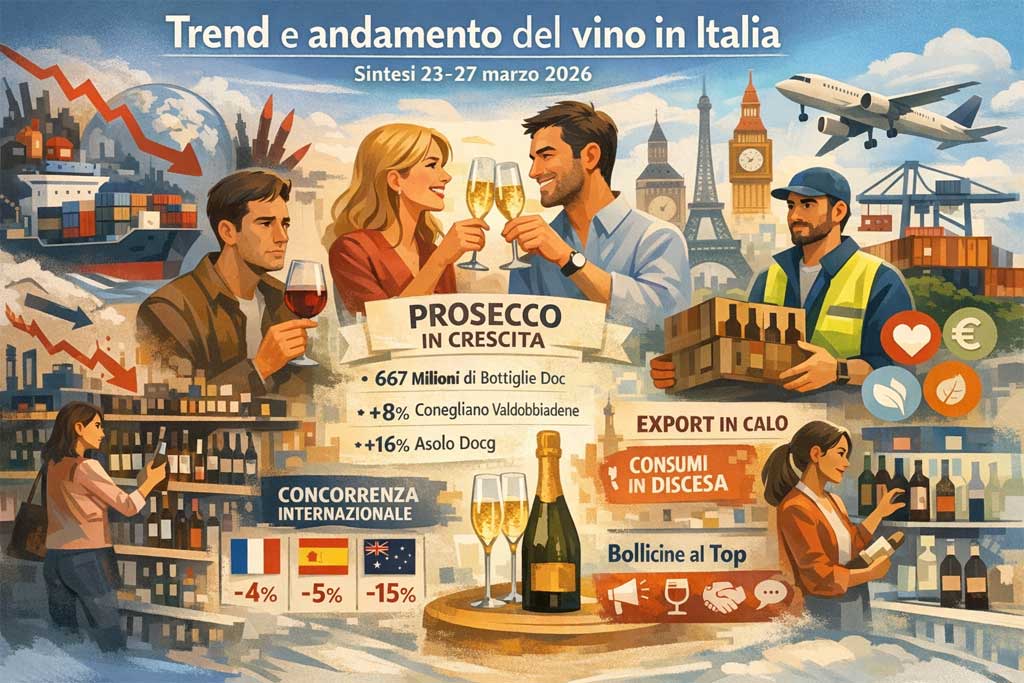
The picture that emerged during the week of March 23-27, 2026, depicts a market that continues to face pressure on multiple fronts—declining domestic consumption, geopolitical tensions, slowing exports, logistical challenges, and growing consumer sensitivity to health, price, and simplicity of language—but which, at the same time, shows some areas of strong resilience and even growth.
The Italian wine sector continues to experience a complex, but uneven, phase.
The most obvious fact is that Italian wine is not facing a linear crisis. Rather, it is immersed in a structural transformation that clearly distinguishes categories, markets, sales channels, and consumption patterns. In this scenario, sparkling wines, and Prosecco in particular, remain the most resilient segment, while the rest of the industry is being called upon to rethink its positioning, communication, and consumer relations.
1. Prosecco confirms itself as the true strength of Italian wine
In a challenging overall environment, Prosecco once again emerges as the most robust product in the national wine scene. In the run-up to Easter 2026, orders are expected to increase by 4%, a sign that Italian sparkling wines continue to naturally satisfy convivial and festive consumption.
The numbers of the three denominations confirm this strength:
- Prosecco DOC : 667 million bottles in 2025, 1.1% more than in 2024
- Conegliano Valdobbiadene Prosecco Superiore DOCG : approximately 98 million bottles, 8%
- Asolo Prosecco DOCG : over 32 million bottles, 16%, the most dynamic growth among the three denominations
Prosecco DOC maintains a strong international appeal, with over 82% of production destined for export and an estimated production value exceeding €3 billion. Even the data for the first two months of 2026, which indicates a technical decline in bottling, is not interpreted as a weakening of demand, but rather as strategic inventory management, particularly with the US market in mind. Cellar stocks have increased by 5.8%, a sign of a system that has preferred to modulate flows to accommodate the absorption of foreign inventories.
On the international front, it is worth noting the excellent performance of France, which recorded double-digit growth (18%) and consolidated its position as the third most profitable market for the denomination after the United States and the United Kingdom.
The strategic interpretation is clear: Prosecco continues to win because it perfectly captures the dominant drivers of contemporary consumption—accessibility, immediacy, conviviality, international recognition, and compatibility with less formal consumption occasions.
2. 2025 closed in decline, but Italy held up better than many competitors
2025 ended with a decline in Italian wine exports of -3.7% in value and -1.8% in volume , but this data must be read against an even more negative international backdrop for many competitors. According to an analysis by Denis Pantini (Wine Monitor Nomisma), Italy lost ground, but held up better than other major exporting countries:
- France: -4%
- Spain: -5%
- Australia: -15%
- Chile: -10%
- United States: over -33%
This means that, despite a contraction, Italian wine maintains a relatively stronger competitive edge compared to its main competitors. The German and Brazilian markets have shown positive signs, partially offsetting the greater difficulties experienced in other areas.
For 2026, the forecast remains cautious but not dramatic. If the weaker markets were to rebound, if the geopolitical situation improved, and if Italian consumers regained confidence, the year might not even end in negative territory. This forecast doesn’t warrant easy optimism, but it does confirm that we’re not facing a systemic collapse, but rather a very delicate phase of rebalancing.
3. The start of 2026 is weak: Italian exports slowing, agri-food under pressure
However, the first signs of 2026 point to a difficult start. In January 2026, Made in Italy products fell 4.6% compared to January 2025, while the agri-food sector recorded an even more significant decline, at 7.7% . The United States’ performance was particularly severe, with the agri-food sector contracting by 26.4% .
These figures are also affected by the comparison with the beginning of 2025, when many companies had brought forward orders and inventories in anticipation of possible US tariffs. However, the data confirms the fragility of the international context: Germany (-4.8%), France (-7.5%), and the United Kingdom (-12.3%) also saw declines, while positive signs emerged from Switzerland (-15.5%), China (-14.6%), and Austria (-5.1%).
The message for the wine industry is very clear: dependence on traditional markets increasingly exposes it to geopolitical, fiscal, and distribution cycles. It is therefore crucial to strengthen its presence in high-potential markets, with more flexible commercial strategies and greater direct reach.
4. Large-scale retail trade confirms the decline in consumption, but saves sparkling wines
The most immediate thermometer of the domestic market remains the large-scale retail trade, and the 2025 data show a clear contraction:
- 737 million liters of wine and sparkling wine sold
- 20 million liters less than in 2024
- -3.4% in volume
- -1.1% in value
- total turnover of around 2.36 billion euros
The data points to a two-pronged decline: purchases are decreasing, and rising prices are no longer sufficient to offset the decline. Bottled wines with designations of origin (DOC, DOCG, IGT) are also down 2.6% in volume, while fortified wines remain the weakest category.
The only segment that continues to grow is that of sparkling wines :
- 1.5% by volume
- 1.2% in value
- approximately 109 million liters
- approximately 750 million euros
Growth is more moderate than in the past, but it’s significant because it confirms a distinct trajectory compared to the rest of the market. Italian consumers continue to prize wines that combine freshness, ease of consumption, gastronomic versatility, and a sense of accessible gratification.
5. Best-selling wines: Prosecco dominates, many traditional reds suffer
Among the most purchased wines in large-scale retail trade in 2025, the podium is very clear:
- Prosecco : over 53 million liters, 2.6%
- Lambrusco : over 28 million liters, -7.2%
- Trebbiano : over 23 million liters, 0.3%
Prosecco remains not only the best-selling wine, but also the dominant value, with approximately €392 million spent in large-scale retail trade. Chianti and Vermentino follow, but are far behind.
On the consumption front, some consolidated trends emerge:
- Italians choose more still wines than sparkling ones
- they choose more whites than reds
- but the most purchased individual wine is still still red , with over 261 million litres
Among the growing categories, the following stand out:
- Grecanico : 13.7%
- Nebbiolo : 9.7%
- Pinot Noir : 7.8%
- Classic Method : 6.3%
- Ribolla Gialla : 4.2%
- Primitivo di Puglia : 3%
- Vermentino : 2.5%
This is an interesting signal: while part of the market is declining, some typologies are growing thanks to a more defined identity, greater recognisability or better harmony with new consumer tastes.
6. Prices are rising, but wine in Italy remains among the least inflated products in Europe.
One of the most significant aspects is that wine continues to suffer in consumer perception, but not because it has seen particularly sharp price increases in Italy. On the contrary, according to Eurostat data compiled by FRED and analyzed by the American Association of Wine Economics, between 2015 and 2025, consumer wine prices in Italy increased by only 7.4% , one of the lowest levels in Europe.
For comparison:
- Germany: 22.6%
- France: 25.7%
- Spain: 27.4%
Even in Italian large-scale retail trade, the average price of bottled wines with a designation of origin stood at 5.69 euros/litre , up 2.1% on 2024, in line with the 2% increase already recorded the previous year.
This data leads to an important reflection: the problem with wine today isn’t just its absolute price, but the relationship between price, perceived value, frequency of consumption, and available alternatives. In other words, it’s not enough to say that wine prices haven’t increased significantly; we need to ask ourselves whether consumers still perceive wine as a natural, simple, and justified purchase.
7. Foreign markets are becoming more selective: Germany is more solid, the United Kingdom is more difficult
On the export front, two different signals emerge.
Germany
Germany remains a major market for Italian wine. In 2025, Italian wine imports exceeded €1 billion , accounting for over 40% of the market. Italian PDO wines are:
- 5.4% by volume
- 4.2% in value
Prosecco remains the most exported Italian wine, but Veneto whites, Piedmont reds, and PDO sparkling wines other than Prosecco and Asti are also growing. Germany remains a highly price-oriented market, yet very open to Italian wine, which maintains a competitive advantage thanks to cultural familiarity, the variety of its offerings, and the strength of its appellations.
United Kingdom
The British picture is more challenging. In 2025, wine imports to the UK will decline:
- -4.6% in value
- -6% in volume
Italy remains the leading supplier in volume, with 298.3 million liters , but recorded a 2% decline and a 2.4% reduction in average price. Italian sparkling wines still generate more value than still wines, with £440 million versus £431 million , but the British system is clearly showing signs of tightening due to taxation, changing consumption, and increased competition.
Here, the issue isn’t just selling, but selling better: a comparison with France clearly demonstrates this. The French generate almost the same value as Italy on sparkling wines, but with much lower volumes and much higher prices. This signals a strategic difference in positioning that Italian wine will increasingly have to address.
8. The sector must change its language, not just its product
One of the strongest themes that emerged this week is cultural rather than commercial. The most effective summary is this: it’s not consumers who are turning away from wine, it’s wine that’s losing them .
The problem isn’t just tariffs, conflicts, or the Highway Code. The problem also lies in wine’s difficulty in speaking to new generations, simplifying its language, making itself accessible without losing depth, and presenting itself as an experience and not just a technical term.
Wine continues to have enormous symbolic, territorial, and emotional power, but it often presents itself with codes that are too elitist, self-referential, or unsuitable for new audiences. This is why everything that creates a direct connection becomes central:
- wine tourism
- opening of the cellars
- hospitality
- authentic storytelling
- commercial training
- simple but not trivial communication
- conscious drinking culture
In essence, the industry must shift from a product-centric approach to one that focuses on the consumer, the relationship, and the experience.
9. New directions: dealcoholized products, logistics, geopolitical tensions and supply chain imbalances
Alongside market themes, this week also highlighted new lines of transformation.
Alcohol-free wine
Alcohol-free wine is emerging as a niche with high potential, especially in Northern European, American, and Australian markets. In Italy, the sector is still in its infancy, but the fact that it can be produced in our country as of this year, albeit excluding DOP wines, opens up new opportunities for diversification.
Logistics under pressure
The war in the Middle East is creating significant complications for wine transportation: airspace closures, maritime diversions via Africa, longer lead times, higher costs, temperature risks, and unpredictable deliveries. For a seasonal and promotional industry like wine, the impact on planning can be significant.
Imbalance between wine and grapes
In areas like the Oltrepò, another critical signal is emerging: while bulk wine prices may be rising, grape prices continue to plummet, in many cases to levels close to production costs. This imbalance is challenging the agricultural base and risks structurally weakening entire production areas.
10. Final picture: Italian wine holds up, but needs to reposition itself
The week of March 23-27, 2026, therefore paints a very clear picture. Italian wine isn’t in decline, but it is experiencing a very tough competitive selection process.