A network portal of Wine Idea. Discover the world of Wine idea

Wine press review for Friday May 8 -2026

Italian wineries, Italian wine producers, and current wine news.
Italian wineries

Maculan Winery appears on the set of “The Devil Wears Prada 2.” The Breganze winery appears in the film with two bottles of Acininobili, a sweet Vespaiola wine. A presence with strong communicative value for Italian wine.

Le Monde and the Pinot Bianco of Western Friuli The Friulian estate focuses on precision, single-varietal and understanding of the territory, with 120 hectares of vineyards and a strong identity in white wines.

Tinazzi between Amarone, Metodo Classico, and experimentation. The Veronese family confirms a dynamic vision: from Garda to Puglia, up to resistant vines, with a broad and contemporary production strategy.

Cantine Iannella presents Intus Nel Sannio, a Falanghina aged in amphorae, a symbol of family continuity, innovation, and territorial valorization.

Caruso & Minini looks at the present of Sicilian wine. In Marsala, Stefano Caruso describes a Sicily capable of innovating with elegance, sustainability, and new projects like Perluci.

Cantina del Fucino closes “Taste & Discover.” Wine becomes culture, history, and knowledge through a series of meetings that combined tasting, local culture, and social reflection.

Italian wine and Italian oenology

Valtènesi, elegance between sun and lake The Brescia-based Garda area confirms its position as one of Lombardy’s most distinctive areas, with Groppello and Valtènesi DOC rosé wines increasingly popular.

Bardolino: continuity, wine tourism, and a new production protocol . Fabio Dei Micheli is confirmed as head of the Consortium. The appellation encompasses 2,400 hectares, 817 members, and 21 million bottles by 2025.

CMO Wine: €323.9 million for the 2026/2027 campaign . Significant resources for promotion, investments, and vineyards. Over €98 million will be allocated to promoting Italian wine in non-EU countries.

Cooperation against vineyard abandonment. The crisis in the sector threatens to weaken social protection in the countryside. The key issue is not only production, but also territorial and generational.

New wine formats Cans, mini bottles, bag-in-boxes, and 0.5-liter formats respond to new consumer trends: convenience, moderation, sustainability, and price.

Sfuso Buono relaunches bag-in-box. Alessandra Costa’s project breathes new life into quality bulk food, with e-commerce, social media, and a language that’s accessible to new generations.

Italian wine exports decline in 2025. According to “Wine Numbers,” Italian exports stood at €7.78 billion, a 4% decline. Veneto leads the way, while Campania, Liguria, Friuli Venezia Giulia, and Puglia are growing.

Casauria DOCG: A new denomination in Abruzzo. The Montepulciano d’Abruzzo subzone becomes DOCG. The first eligible vintage will be 2024.

Marsala calls for greater attention to wine. Some local producers are asking mayoral candidates to discuss sustainability, business development, and wine tourism.

Drones in agriculture: regulations and expertise are needed. The Cuneo case highlights the need for proper use of technology in the fields, avoiding improvisation.

International

Ryanair calls for alcohol restrictions at airports. Michael O’Leary proposes a ban on alcohol sales in the early hours and a maximum of two drinks per passenger, following problems caused by drunken travellers.

Italian wine is looking to foreign markets with new tools. CMO promotion, new formats, and positioning strategies confirm how crucial exports remain, especially in a period of weaker global consumption.

Wine events

The Milan Wine Week and Wine List Italia awards the Italian Dining Room Excellence Award to 30 dining room leaders: maîtres, sommeliers, and hospitality professionals who are increasingly crucial to restaurant success.

Villa Sceriman celebrates the purple artichoke and wines of the Euganean Hills. Sunday, May 17th, a day of tastings, local products, music, and winery tours.

Pinot Grigio DOC delle Venezie at the 2026 Giro d’Italia The denomination will be the Official Wine of the Giro d’Italia, Giro Women and Giro Next Gen thanks to the partnership with RCS Sports & Events.

Aosta Valley wines at Castello Gamba. Tastings dedicated to the DOP wines of the Aosta Valley on Saturday, May 16, to mark the 70th anniversary of the École Hôtelière.

Spazio Villalta dedicates a vertical tasting to the “Head of State”. AIS FVG offers a tasting of Loredan Gasparini’s famous wine, featuring six historic vintages.

SIP & FEEL at Cantina Valpanera in Fiumicello, Sunday, May 17th: guided meditation, vineyard walk, and sensory tasting.

Calici DiVini at the Fortezza in Civitella del Tronto On May 16th and 17th, the Fortezza will host tastings, meetings with producers, and the promotion of local excellence.

Vini Bagnanti 2026 On June 20, in San Vincenzo, 50 artisanal wineries will be the protagonists of a seaside tasting dedicated to wine, landscape and sustainability.

Isolabella in the Langhe area of Asti. A nature project enhances the relationship between vineyards, biodiversity, landscape, and rural rebirth.

Final summary

The day confirms that the Italian wine sector is undergoing a period of transformation. On the one hand, there are challenges: declining consumption, declining exports, the risk of vineyard abandonment, and the need for new regulations for technologies and markets. On the other, strong signs of a response emerge: new formats, international promotion, growing appellations, wineries capable of innovating, and regions focusing on identity, wine tourism, and culture.

The message is clear: Italian wine cannot stand still. It must dominate the markets, better communicate its identity, innovate without losing its soul, and transform each terroir into tangible value.

Today’s wine press review was brought to you by WineIdea.it.
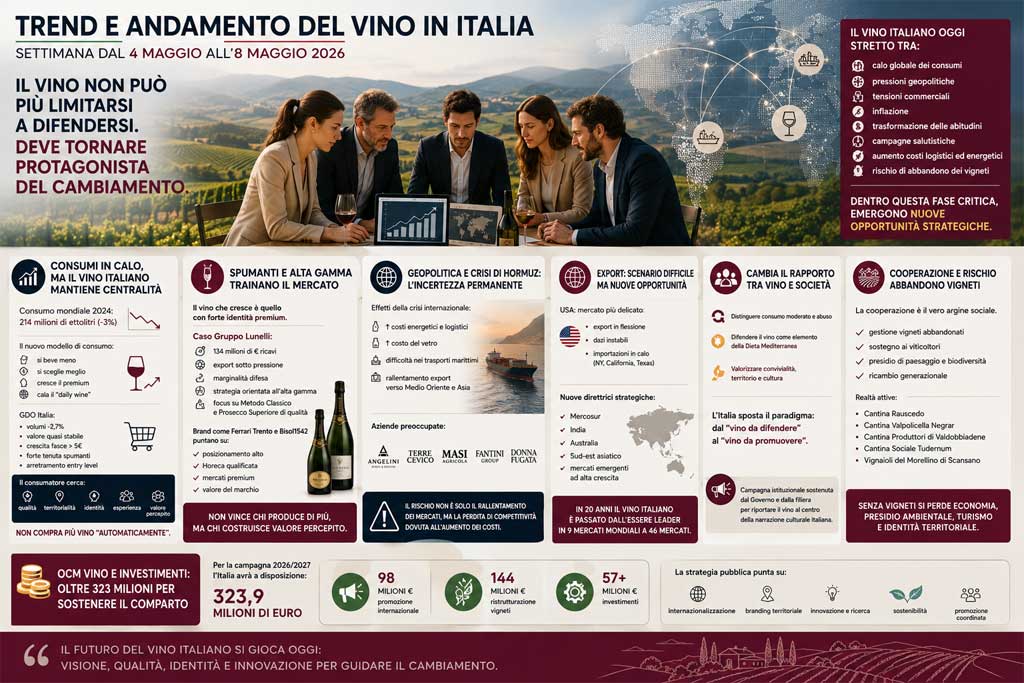
Wine Trends and Performance in Italy – Week of May 4th to May 8th – 2026

This is no longer just a normal market fluctuation, but a structural shift involving consumption, exports, geopolitics, the social perception of wine, and the economic sustainability of the entire supply chain.
The Italian wine sector is going through one of the most complex phases of recent decades.
The message emerging forcefully this week from the Italian wine world is clear: wine can no longer simply defend itself. It must once again become a leader in change.

At the heart of the debate was Piero Mastroberardino’s speech at the inauguration of the Academic Year of the Academy of Vine and Wine, which lucidly captured the current state of the sector.

Italian wine today finds itself caught between:

global decline in consumption,
geopolitical pressures,
trade tensions,
inflation,
transformation of consumer habits,
increasingly aggressive health campaigns,
increasing logistics and energy costs,
risk of abandonment of the vineyards.

Yet, precisely within this critical phase, new strategic opportunities also emerge.

Global consumption is declining, but Italian wine remains central

According to OIV data recalled during the week, world wine consumption in 2024 fell to 214 million hectolitres (-3%).

The United States remains the world’s leading market in terms of overall consumption, but is showing signs of slowdown and significant instability related to tariffs and inflation. Italy, however, remains among the countries with the highest per capita consumption in the world and continues to play a central role in international wine culture.

The real transformation, however, concerns the consumption model:

we drink less,
you choose better,
the premium increases,
“daily wine” drops.

Italian large-scale retail trade confirms this trend:

volumes down (-2.7%),
almost stable value,
growth in the bands above 5 euros,
strong hold of sparkling wines,
decline in entry-level wines.

Today’s consumer is looking for:

quality,
territoriality,
identity,
experience,
perceived value.

He no longer buys wine “automatically”.

Sparkling wines and high-end wines drive the market

The week confirmed the consolidation of a very clear trend: the Italian wine that grows best is that with a strong premium identity.

The case of the Lunelli Group is a concrete example:

revenues of 134 million euros,
exports under pressure,
defended marginality,
high-end oriented strategy,
focus on quality Classic Method and Superior Prosecco.

Brands like:

Ferrari Trento
Bisol1542

they are increasingly focusing on:

high positioning,
Qualified Horeca,
premium markets,
brand value.

The message is clear: in the new global scenario, the winners are not those who produce more, but those who manage to build perceived value.

Geopolitics and the Hormuz Crisis: Wine Enters an Era of Permanent Uncertainty

One of the most pressing issues of the week concerns the effect of the international crisis on Italian wine.

Tension in the Hormuz area is generating:

increasing energy costs,
logistical increases,
rising cost of glass,
difficulties in maritime transport,
slowdown in exports to the Middle East and Asia.

Many large Italian companies are already registering:

orders suspended,
blocked containers,
increase in operating costs,
pressure on marginality.

Among the groups that have expressed concern:

Angelini Wines
Cevico Lands
Masi Agricola
Fantini Group
Donnafugata

The main risk today is not only the slowdown of the markets, but the loss of competitiveness caused by increasing costs along the entire supply chain.

Many operators also believe that increasing price lists could be a strategic mistake, because the international consumer is already under inflationary pressure.

Exports: a challenging scenario but new global opportunities

The United States remains the most sensitive market:

Italian exports in decline,
tariffs still unstable,
reducing imports in key states such as New York, California and Texas.

France is also suffering greatly:

sharp drop in average prices in the US,
reduction in exports,
difficulties on premium French wines.

But within this instability, new strategic directions emerge:

Mercosur,
India,
Australia,
Southeast Asia,
high-growth emerging markets.

Italy today appears better positioned than other competitors thanks to:

strong territorial diversification,
ability to cover different groups,
growth of the image of Made in Italy,
increase of Italian leadership in international markets.

In twenty years, Italian wine has gone from being the leader in 9 world markets to 46 markets.

The relationship between wine and society is changing

The cultural theme is now central.

Wine today is not just fighting a commercial battle, but also a narrative and identity battle.

Health campaigns, especially in Europe, are changing the perception of wine as a product, especially among young consumers.

The Italian supply chain, however, reacts with a very clear position:

distinguish between moderate consumption and abuse,
defend wine as an element of the Mediterranean Diet,
enhance conviviality, territory and culture.

Italy is trying to shift the paradigm:
from “wine to defend” to “wine to promote”.

Important in this regard is the institutional campaign supported by the Italian government together with the wine industry, with the aim of bringing wine back to the center of the Italian cultural narrative.

Cooperation and the risk of abandoning vineyards

Another strategic theme that emerged forcefully is the growing risk of vineyard abandonment.

The economic crisis in the sector is hitting hardest:

marginal areas,
heroic viticulture,
small producers,
historic hilly territories.

Italian wine cooperatives are becoming the true social bulwark of the system.

Cooperative wineries and consortia are taking action:

taking over abandoned vineyards,
by financially supporting winemakers,
preserving landscape and biodiversity,
promoting generational turnover.

Among the most active entities:

Rauscedo Winery
Valpolicella Negrar Winery
Valdobbiadene Producers’ Cellar
Tudernum Social Winery
Winemakers of Morellino di Scansano

The issue is not only agricultural:
Without vineyards, the economy, environmental protection, tourism, and territorial identity are lost.

CMO Wine and Investments: Over 323 Million to Support the Sector

Important signals are arriving on the support policy front.

For the 2026/2027 campaign, Italy will have at its disposal:

323.9 million euros CMO Wine,
of which:
98 million for international promotion,
144 million for vineyard renovation,
over 57 million in investments.

The Piedmont Region is also very active, having allocated over 7.6 million euros for international promotion, wine tourism, and territorial development.

The public strategy today focuses on:

internationalization,
territorial branding,
innovation,
research,
sustainability,
coordinated promotion.

Wine press review for Thursday May 7 -2026

Italian wineries, Italian wine producers, and today’s wine news.

Italian wineries

Ceretto opens Le Brunate in the La Morra cru. In the heart of the Langhe, Le Brunate opens, a new Ceretto space combining wine, cuisine, contemporary art, and landscape. A table immersed in the Barolo vineyards, with works and artistic references that strengthen the connection between territory, hospitality, and culture.

Tenuta Casali offers a “Murder Mystery Picnic” at Mercato Saraceno. The winery combines tastings, nature, and entertainment: on Saturday, May 9th, visitors can enjoy an experience including a farm snack, estate wines, and mysteries to solve among the vines.

Cantine Dei, between architecture, music, and Nobile di Montepulciano In Montepulciano, Cantine Dei is presented as an example of the integration of landscape, sustainable architecture, travertine, music, and excellent wine production.

Organic wine from 22 female producers enters Bvlgari restaurants. Bvlgari Hotels & Resorts promotes Italian organic wine with a menu dedicated to 22 female producers, from north to south, focusing on sustainability, territorial identity, and biodiversity.

The Marsciano Nord wineries launch the “Winery Passport.” A grassroots territorial promotion tool is being developed in Umbria, designed to showcase an agricultural and winemaking microdistrict founded on community, quality, and respect for the environment.

Italian wine and Italian oenology

Mastroberardino: Wine must return to being a leader in change. Piero Mastroberardino calls on the industry to shift gears: less passive defense and more promotion of the positive values of wine, from the Mediterranean diet to social interaction, from the region to the economy.

Cooperation to combat vineyard abandonment. Declining profitability and a lack of generational turnover are putting many Italian winegrowing areas at risk. Cooperation is seen as a key social and economic tool for keeping these areas alive.

€6.5 million to promote non-EU Emilia-Romagna wines. The Emilia-Romagna Region is launching a new call for proposals for 2026-2027 to support the international presence of wineries, with particular attention to smaller businesses.

Premium vineyards remain strategic assets According to Alexander Hall of Knight Frank, despite the slower wine market, quality vineyards remain attractive alternative assets, especially in countries like Italy, which are rich in prestigious terroirs.

Wine must be brought back to the center of the table. A critical reflection invites us to overcome excessive prices and collectible logic, recovering the convivial, cultural and everyday value of wine.

Spritz, the symbol of the Italian aperitif. Focus on the recipe for the Spritz, an Italian cocktail that has become international, made with prosecco or white wine, Aperol or Campari, soda, ice, and orange.

Truffles as an ally of wine In the Marche region, a new approach to revitalization is proposed: combining wine and truffles as integrated territorial experiences, capable of enhancing culture, forests, cuisine, and local identity.

Oslavia and the seven winemakers of Ribolla In Gorizia, the story of Ribolla di Oslavia becomes a story of borders, resilience and viticultural rebirth, thanks to producers such as Radikon, Gravner, Prinčič and La Castellada.

Pietro Monti: Wine Beyond Sight A story that explores the relationship between wine, disability, and sensitivity, demonstrating how the wine experience is not only visual, but also cultural, tactile, olfactory, and human.

International

US tariffs: wine imports to decline in 2025. American tariffs and declining consumption have impacted wine imports into the United States. According to the data analyzed, the decline has primarily affected key markets such as New York, California, and Texas.

Dom Pérignon presents three vintages together The French maison has simultaneously launched Dom Pérignon Vintage 2017, Vintage 2008 Plénitude 2 and Rosé Vintage 2010, focusing on the concept of harmony as a stylistic key.

Cross-border Wine and Rose Festival At the Winery of Friendship and Peace, located between Italy and Slovenia, 17 winemakers will participate in an event dedicated to rosé, sparkling rosé, and floral white wines, a symbol of collaboration between border territories.

Wine events

Majenca 2026 in San Dorligo della Valle From May 7th to 12th, the historic event dedicated to wine, oil, art, music, and the local community returns, with popular wine tastings and cultural initiatives.

Verona Natural Wine in Montorio: A day with 32 Veronese natural wine producers, free tastings, and a special Ribolla vertical tasting with Mateja Gravner.

Vertical tasting of the “Capo di Stato” in Udine The AIS Friuli Venezia Giulia is organizing a tasting dedicated to the famous wine of Loredan Gasparini, with six historic vintages guided by producer Lorenzo Palla.

Grignolino&Co. Preview in Casale Monferrato On Sunday, May 10th, wine, literature, music, and tastings will enliven the Casale Monferrato Castle to showcase Grignolino and the Casale Monferrato region.

Wine Notes in Aieta In the Calabrian village, from May 8th to 10th, music, wine and local traditions meet in the setting of the “Vino da aMare” event.

Collective Agricultural Identity Itineraries in Vinci On May 10th, the calendar restarts in Tuscany, with a journey through Leonardo’s places, food stops, local wines and the promotion of agricultural identity.

The Casa del Moscato di Saracena is born. A permanent space dedicated to Moscato di Saracena, a unique passito wine in the world for its production method and identity, is taking shape in Calabria.

The fourth edition of the Intravino Cup dedicated to Brunello di Montalcino has begun, with 64 Brunello wineries competing for popular votes, humor, and enthusiast participation.

Campania Stories 2026 The second day of the event is dedicated to Campania’s red wines, with a focus on Aglianico, Piedirosso, Lacryma Christi, and other regional varietals.

Gourmet Cellars in Cogne From June 5th to 7th, the Aosta Valley event dedicated to local dishes, regional wines, craft beers, and mountain conviviality returns.

Open Cellars in Tuscany The event organized by the Tuscan Wine Tourism Movement returns on May 30th and 31st, increasingly focused on organized, innovative, and accessible wine tourism experiences.

Thanks for listening. Today’s wine press review was brought to you by WINEIDEA.IT. See you tomorrow.

Wine press review for Wednesday May 6 -2026

Italian wineries, Italian wine producers, and current wine news.

Italian wineries

Cavit focuses on value and looks to the United States. Cavit confirms its strategy focused on product enhancement in an international market marked by declining consumption and rising logistics and production costs. The focus is on the United States, still a key market for Italian wine.

Crisis at the Carpi and Sorbara Winery: Mantua Producers Affected. The crisis at the Lambrusco cooperative is also causing concern in the Mantua Oltrepò area, where approximately thirty members and the Poggio Rusco pressing center are affected. Regional support has been requested.

Arnaldo Caprai, quality and social responsibility in the heart of Sagrantino. The Umbrian winery confirms its leading role in Montefalco, through qualitative research, territorial identity, and social projects related to workplace integration.

Tenuta Le Vignole in Faicchio: between rural tradition and hospitality. A Campanian estate that combines rural architecture, local grape varieties, and a vocation for hospitality, showcasing Aglianico, Camaiola, Falanghina, Coda di Volpe, and Greco.

Renata Garofano and Italian wine through women. The story of the Apulian producer of Garofano Vigneti e Cantine confirms the growing importance of women in the management, communication, and promotion of winemaking businesses.

Italian wine and Italian oenology

Willaertia magna: a new frontier against downy mildew and powdery mildew. Research is looking at new biological tools to reduce the use of traditional pesticides, in line with the Green Deal, Farm to Fork, and limits on copper use.

Wine must once again become a protagonist of change. Piero Mastroberardino urges the sector to move beyond mere protection to active promotion, valorizing entrepreneurial culture, the Mediterranean Diet, local area, and social interaction.

Nobile di Montepulciano rediscovers its identity with the Pievi. The new territorial setting strengthens the positioning of Vino Nobile, focusing on recognisability, stylistic coherence and the value of the sub-zones.

Vernaccia di San Gimignano: 60 Years of History and New Consumers The historic Tuscan DOC, the first Italian wine to achieve recognition in 1966, continues to revitalize itself through festivals and selections accessible under €20.

High lands and heroic viticulture: wine protects the territory. Viticulture in terraced and fragile areas is not just production, but environmental protection, landscape protection, and the maintenance of local communities.

Water Management: Each Winegrowing Region Has Its Own Strategy From the Mediterranean to Burgundy, from Etna to California, water management is becoming increasingly central amid climate change, soils, and fungal diseases.

Fertilizers and diesel fuel under pressure due to geopolitical tensions International crises are impacting agricultural costs, with direct repercussions on fertilizers, energy, transportation, and the margins of wineries.

Rome favors white wines and sparkling wines. Interest in and consumption of white wines, Italian sparkling wines, Champagne, and other recognized quality products is growing in the capital. Rome Wine Week 2027 has also been announced.

The right glass according to Riedel An evening with Gaja wines at Pinchiorri brings the focus back to the wine service: the glass is not a detail, but part of the experience and the enhancement of the bottle.

“Pouring wine traitor-style”: the origins of an Italian gesture. An anthropological study explores the historical, convivial, and symbolic significance of an expression that remains alive in the culture of wine at the table.

International

Enjoy, experience dealcoholized wine. In the famous Barcelona restaurant, among the best in the world, dealcoholized wine becomes the object of gastronomic experimentation, intercepting new styles of consumption.

The French model according to Attilio Scienza The comparison with France reopens the issue of Italian fragmentation: a few strong denominations and recognizable terroir versus a more widespread and complex Italian viticulture.

Piedmont: over 7.6 million to promote wine abroad. The Piedmont Region is investing in CMO Wine and international promotion, with resources dedicated to consortia, producer associations, wine shops, and wine routes.

Wine events

The Winemaker’s Saturday is now taking place throughout May. FIVI is changing its format: no longer just one national event, but rather events spread across the Saturdays of May, involving 21 delegations and 15 exceptional locations.

35th Verdiso Wine Show in Combai The show dedicated to Verdiso, an ancient and niche native grape variety, included in the Primavera del Prosecco Superiore, kicks off this weekend.

Open Cellars in Tuscany 2026 Among the proposals, Castelfalfi Hiking & Wine combines nature, history, vineyards, winery and organic tastings on the weekend of May 30th and 31st.

Open Cellars at the Giuseppe Marini Agricultural Company. Guided tours, tastings, sommeliers, and art will accompany the public in discovering the winery’s wines on the weekend of May 30th and 31st.

Enolia: two days of oil, wine, and flavor. Enolia returns to Versilia, showcasing over 300 wines, forty types of oil, and artisans of flavor, confirming the event’s role in promoting food and wine.

RPMN Cellar Passport In Umbria, a grassroots territorial tool is born to promote the wineries of the Marsciano Nord People’s Republic, an agricultural and winemaking microdistrict with a distinctive identity.

Vino al vino 2.0: Valle d’Aosta and heroic grape varieties. An evening in Turin dedicated to Aosta Valley viticulture, including Prié Blanc, Petit Arvine, Fumin, and Nebbiolo di Donnas.

Final summary

The day confirms a wine sector undergoing rapid transformation: more selective consumption, rising costs, climate pressure, and the need for new production and marketing strategies. The most established wineries are focusing on value, territorial identity, international promotion, and corporate culture. The role of widespread events, wine tourism, and direct producer storytelling is also growing: today, wine must not only be well-produced, but also explained, experienced, and marketed with greater awareness.

Style Selector
Select the layout
Choose the theme
Preset colors
No Preset
Select the pattern