A network portal of Wine Idea. Discover the world of Wine idea

The Italian wine giants: 27 wineries earning over €100 million. The sector is accelerating toward concentration, exports, and mergers.

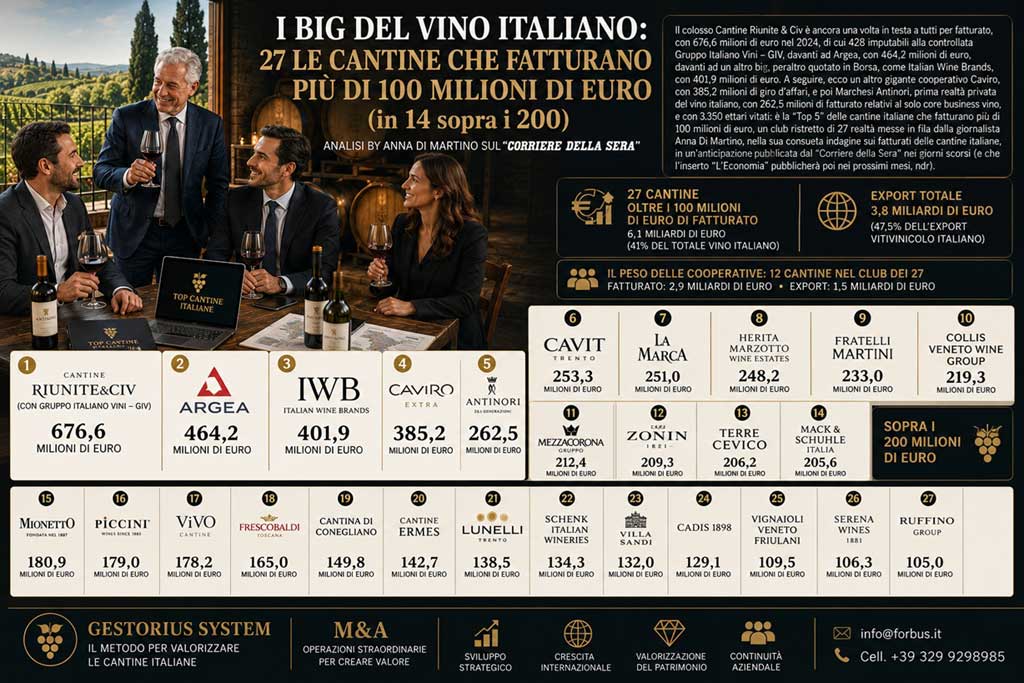
Riunite & Civ leads the ranking ahead of Argea, Italian Wine Brands, Caviro, and Antinori. In 2024, 27 Italian wineries will have revenues exceeding €100 million, and 14 will exceed €200 million.

But the most interesting fact goes beyond the rankings: a few large operators now concentrate a significant share of the business and almost half of Italian wine exports.
Italian wine continues to be a universe composed of thousands of wineries, farms, families, territories, and appellations. At the highest end of the market, however, a different reality is emerging: the economic and commercial scale of Italy’s major winemaking groups continues to grow, and the process of concentration is becoming increasingly evident .

In 2024 , 27 Italian wine companies exceeded 100 million euros in turnover and 14 surpassed the 200 million threshold .

The numbers emerge from the analysis of the balance sheets of the main Italian wine companies carried out by journalist Anna Di Martino and previewed by Corriere della Sera .

A photograph that does not only serve to establish who sells the most.

Above all, it allows us to understand how the economic structure of Italian wine is changing and which models today seem to have the necessary strength to compete on international markets.

Cooperatives, family businesses, listed companies and large private groups follow different strategies, but they share some factors: commercial size, exports, brand strength, distribution, financial capacity and organisation .

The 5 largest Italian wineries by turnover

Cantine Riunite & Civ remains at the top of the ranking, reaching a turnover of 676.6 million euros in 2024, compared to 670.6 million the previous year.

Within the group, Gruppo Italiano Vini (GIV) alone represents 428 million euros in revenues .

The weight of international markets is particularly significant: Riunite & Civ records 478.4 million euros in exports , over 70% of turnover, while for GIV the incidence of foreign markets is almost 79%.

1. Cantine Riunite & Civ – €676.6 million

It is the largest Italian operator in the ranking and represents one of the most important examples of the cooperative system’s ability to reach industrial and international dimensions.

2. Argea – 464.2 million

Argea reaches 464.2 million euros , up 3.27% compared to 449.5 million in 2023.

The group has a very strong international vocation: 418.1 million comes from exports , over 90% of the turnover.

The profitability indicated in the analysis is also important: EBITDA of 74.5 million euros , higher than 16% of revenues.

3. Italian Wine Brands – 401.9 million

Italian Wine Brands ranks third with 401.9 million euros , down 6.34% compared to the 429.1 million of the previous year.

Here too, internationalization represents a determining factor: exports are worth 328.2 million , over 81% of revenues.

4. Caviro Group – 385.2 million

Caviro Group reaches 385.2 million euros in turnover .

The result is lower than the 423.1 million of 2023, but the group retains an industrial scale that keeps it firmly among the main players in the Italian wine sector.

5. Marchesi Antinori – approximately 262 million

The fifth position introduces a completely different model.

Marchesi Antinori , the first large private family-owned company in the ranking, achieved a turnover of approximately 262 million euros , compared to 245 million the previous year.

Growth is close to 7%, but the figure that stands out most is the one relating to profitability.

The EBITDA reported in the analysis exceeds 139 million euros , with an incidence of over 53% .

Added to this is a 3,350-hectare estate of owned vineyards .

The 14 Italian wineries above 200 million euros

The upper end of the market is not limited to the top five operators.

In 2024, in fact, there will be 14 groups that will exceed 200 million euros in turnover :

Cantine Riunite & Civ – 676.6 million
Argea – 464.2 million
Italian Wine Brands – 401.9 million
Caviro Group – 385.2 million
Marchesi Antinori – approximately 262 million
Cavit – 253.3 million
La Marca Wines and Sparkling Wines – 251 million
Herita Marzotto Wine Estates – $248.2 million
Martini Brothers – 233 million
Collis Veneto Wine Group – 219.3 million
Mezzacorona Group – 212.4 million
Zonin Group 1821 – 209.3 million
Cevico Lands – 206.2 million
Mack & Schuhle Italy – 205.6 million

Among the most interesting dynamics is that of Mack & Schuhle Italia , which went from 172.4 to 205.6 million euros, with a growth of 19.25% .

From Mionetto to Frescobaldi: the second group of big names

Just below the 200 million threshold we find companies and brands of great national and international importance.

Mionetto reaches 180.9 million euros , growing by 17.87% compared to 153.5 million in 2023. Almost 82% of revenues come from exports.

The following are:

Piccini Estates – 179 million
Vi.VO Cantine Group – 178.2 million
Marchesi Frescobaldi – 165 million
Conegliano Vittorio Veneto Winery – 149.8 million
Ermes Wineries – 142.7 million
Lunelli Group – 138.5 million
Schenk Italian Wineries – 134.3 million
Villa Sandi – 132 million
Cadis 1898 – 129.1 million
Veneto-Friulian winemakers – 109.5 million
Serena Wines – $106.3 million
Ruffino Group – 105 million.

The case of Marchesi Frescobaldi is particularly significant: 165 million in revenues and an EBITDA indicated at 64.3 million , almost 39% of the turnover, accompanied by approximately 1,700 hectares of owned vineyards .

The Conegliano Vittorio Veneto Winery’s boom: 54.4%

One of the most interesting findings in the ranking comes from the heart of the Prosecco region.

The Conegliano Vittorio Veneto winery will in fact go from 97 million in 2023 to 149.8 million euros in 2024 , recording an increase indicated at 54.4% .

This is a particularly significant result considering the economic importance of the Conegliano Valdobbiadene area and, more generally, the Prosecco system within the Italian wine industry.

Wine cooperatives are getting bigger and bigger

The ranking highlights another phenomenon that deserves attention: the growing economic strength of Italian wine cooperatives .

Among the 27 companies above 100 million euros there are 12 cooperatives , one more than the previous year.

Overall, they generate a turnover of approximately 2.9 billion euros and exports of 1.5 billion .

The cooperative model therefore demonstrates that it can perform a function that will probably become even more important in the coming years: aggregating production without necessarily erasing the widespread structure of the Italian vineyard .

Its size allows it to build commercial networks, support investments, organize exports, and address markets that are difficult for a single producer to reach.

27 companies represent 41% of the Italian wine market

This is probably the number that best captures the transformation underway.

The 27 largest companies together generate revenues of over 6 billion euros .

The value is equivalent to approximately 41% of an Italian wine market estimated at 14.5 billion euros in 2024 .

The concentration becomes even more evident when looking at exports.

The 27 operators generate approximately 3.8 billion euros in exports , equal to 47.5% of the 8.1 billion euros of Italian wine exports .

In essence, just over two dozen companies represent almost half of the Italian wine sold on international markets .

Turnover and value of a winery are not the same thing

However, the ranking presents an interpretative risk.

Being bigger does not necessarily mean being more profitable and, above all, turnover and company value do not coincide .

The data show very significant differences.

Antinori’s EBITDA margin exceeds 53% of the figures reported in the survey, Frescobaldi’s margin is close to 39%, and Herita Marzotto Wine Estates’ margin exceeds 32%, while other large operators show lower margins.

To understand how much a winery is really worth, you need to look at many elements simultaneously:

Brand, denominations, owned vineyards, margins, product mix, distribution, exports, real estate, production capacity, direct sales, hospitality, wine tourism, and commercial positioning.

Two wineries with the same turnover can have profoundly different economic values.

Export: for large groups the market is now global

The ranking also highlights how much the major Italian operators now depend on international markets.

Ruffino generates more than 93% of its turnover abroad.

Argea exceeds 90%.

The Brand is approaching 88%.

Mack & Schuhle Italia and Zonin are around 85%.

Italian Wine Brands exceeds 81%.

For a significant portion of Italy’s leading companies, therefore, simply speaking of the “Italian wine market” becomes almost reductive.

The real competition is played simultaneously in the United States, Germany, the United Kingdom, Canada, Northern Europe, Asia and other international markets .

Does Italian wine need to get bigger?

This is the strategic question that emerges from the numbers.

Italy has an extremely fragmented production structure.

It is one of its greatest strengths because it represents territories, biodiversity, denominations, families, grape varieties, traditions, and thousands of different identities.

But this same fragmentation can turn into a weakness when it is necessary to invest millions of euros in international distribution, brands, commercial networks, digitalisation, wine tourism, technology and exports .

The solution, however, is not necessarily to sell all the companies or create a few giant groups.

Wine press review for Wednesday August 12 -2026

Italian wineries, Italian wine producers, and current wine news.

Good morning,

The day highlights a sector torn between commercial pressure and new opportunities : Italian wineries are experiencing growing inventories, exports are slowing, and harvests are coming early due to high temperatures. At the same time, investments in wine tourism, winemaking innovation, and new winery development models are increasing.

ITALIAN WINERIES

Ferrari: Great bubbles can have a second life

Ferrari Trento focuses on the value of time through the Archivio di Famiglia project, dedicated to the evolution of Trentodoc wines after long refinements.

The project includes Original Editions and Recent Disgorges, allowing us to compare bottles that have followed different maturation paths, in some cases lasting 15, 16 or even 20 years .

The goal is to demonstrate how sparkling wine is also a living product, capable of profoundly evolving over time.

Montalbera: wine, hospitality, and Ruchè in the heart of Monferrato.

Montalbera further develops its wine tourism model with the Montalbera 360° Experience .

Vineyards, tastings, rooms, panoramic terraces and swimming pool become part of a unique experience built around the Ruchè di Castagnole Monferrato DOCG .

An example of how wine tourism can transform from a complementary activity into a true tool for the economic valorization of the winery.

Alois Lageder: Wine tourism becomes an experience of nature

In Magrè, in Alto Adige, Alois Lageder proposes a model in which the cellar, vineyards, garden, kitchen, and animals are part of the same ecosystem.

The “Diversity is Key” philosophy accompanies a path that began decades ago towards biodynamic agriculture, biodiversity and sustainability.

The experience offered to visitors thus becomes a tool for concretely describing the relationship between wine, territory, and nature.

Murgo: when the Classic Method on Etna was still a gamble

The Murgo winery recalls its pioneering role in the production of Metodo Classico from Nerello Mascalese on Etna .

Between the late 1980s and early 1990s, the company chose to use the native Sicilian grape variety to produce Classic Method sparkling wines, anticipating a trend now followed by many Etna wineries.

Centopassi: Confiscated Vineyards Become Symbols of Rebirth

In Sicily, Centopassi represents a project in which wine, territory, and social commitment meet.

In the Alto Belice Corleonese area, lands linked to the history of the fight against the Mafia have become productive vineyards and a winemaking project capable of transforming confiscated heritage into economic and cultural development.

Italian cellars become works of architecture

The phenomenon of cellars designed by great international architects and artists continues.

From Mario Botta’s Petra to Renzo Piano’s Rocca di Frassinello, to the Folonari family’s new Cantina del Cabreo and new projects in Chianti Classico, architecture becomes an integral part of the positioning and experience of wine.

ITALIAN WINE, MARKET AND OENOLOGY

Exports: almost 3 billion euros in the first five months, but the decline continues

From January to May 2026, Italy exported wine worth approximately 2.98 billion euros , a decrease of 6.86% compared to the same period in 2025.

Volumes fell by 5% , reaching approximately 809 million litres.

The US market is particularly worrying: €709 million, down 15.4% . Germany, down 8.2%, and the United Kingdom, down 6.5%, are also struggling.

Italian cellars still too full: 42.6 million hectoliters

As of July 31, 2026, Italian cellars held 42.6 million hectolitres of wine , 6.9% more than a year earlier.

To these are added 3.1 million hectolitres of must.

55.9% of the stocks are concentrated in Northern Italy , especially in Veneto, while 55.4% of the wine in stock belongs to the PDO denominations.

With the harvest now underway in several areas, the high level of inventories is increasing pressure on prices, storage, and production planning.

Tuscany: Up to a year and a half of unsold wine remains in cellars.

The situation is particularly delicate in Tuscany, where, according to the information reported in the review, stocks have reached levels equivalent to approximately a year and a half of production .

Prices are also showing signs of weakness: Chianti is said to have lost around 35% from pre-Covid highs and Chianti Classico around 30%.

A situation that could increase the pressure on producers with the arrival of the new harvest.

Puglia: Over 5 million hectoliters in the cellars

CIA Puglia draws attention to the regional situation: there are reportedly at least 5 million hectolitres of wine still unsold , of which over 3 million belong to the IGP and DOP categories.

Production costs, phytosanitary problems, reduced consumption, and more difficult exports are squeezing companies’ profitability.

Sicily: Concern in the Agrigento area

Fears are also growing in the Agrigento area over excess wine in storage and a possible drop in grape prices.

The difficulties particularly affect the cooperative wineries of Canicattinese and Menfitano, in an area where viticulture represents an important component of the local economy.

Marche: Harvest is early, but quality is promising.

In the Marche region, the 2026 harvest starts about ten days early .

The first harvests concern the sparkling bases and subsequently Chardonnay, Bianchello and Sangiovese.

The quality outlook is positive, especially in the provinces of Ancona and Pesaro-Urbino, while some areas suffered damage from hailstorms at the end of July.

2026 Harvest: Hot Nights Are Another Problem

High night temperatures are becoming a determining factor for ripening.

When the temperature remains high even after sunset, the vine continues to breathe intensely and consumes malic acid more quickly.

The result can be an acceleration of ripening accompanied by a loss of acidity, with consequences on the final balance of the grapes.

Marche: Hail and heat make it difficult to predict the harvest

Stefano Dezi, a producer from Servigliano, emphasizes how the situation can change significantly even in the space of a few hundred meters.

Early varieties such as Chardonnay and Sauvignon are ripening early, but it will be necessary to wait until the grapes arrive in the cellar before making definitive assessments on the quality of the vintage.

Italian vineyards among the most profitable in Europe

Italy occupies eight positions among the top twenty European wine-growing regions in terms of net added value generated per hectare, according to the AAWE ranking based on FADN-FSDN 2024 data.

Champagne-Ardenne leads with around 60,000 euros per hectare , but Alto Adige comes in close behind with 32,100 euros and Valle d’Aosta with 32,000 euros .

Liguria and Piedmont also did very well.

The data demonstrates that the prestige of the denomination, the value of the land and profitability per hectare do not necessarily coincide.

Alcohol Dealing: Vason Group Also Looks to Portable Devices

Vason Group continues to develop dealcohol removal technologies through the membrane-based Mastermind Remove system.

Technological evolution could lead from large industrial plants to laboratory systems and portable devices intended, in the future, also for restaurants and consumers.

An important sign of the growth of the low and no alcohol segment.

Italian agriculture ranks first in the EU for added value

According to the report cited in the review, Italy generates 16.9% of the European Union’s agricultural added value .

The Italian agri-food supply chain overall reaches approximately 89 billion euros in added value , confirming the strategic economic weight of agriculture and the national food industry.

INTERNATIONAL

Hungary: Drought, Villány harvest expected to be 30% lower

The Villány wine region is facing a severe drought.

The berries are smaller, and the heat has accelerated ripening. Quality could remain good, but producers estimate a decline in quantities of nearly 30% , with particularly high risks for late-ripening varieties.

London: Wine Produced in a Train Station Is Born

Denmark Hill station in the London borough of Camberwell is preparing for the first harvest of grapes grown within its area.

The Bacchus grapes are expected to give rise to Château Denmark Hill , a white wine that could arrive in glasses in 2027.

A curious example of urban viticulture.

Oregon: Willamette Valley Vineyards Raises New Capital

Willamette Valley Vineyards, an Oregon producer specializing primarily in Pinot Noir, has launched a $1.75 million Preferred Stock Offering .

The operation confirms a unique model of a winery with widespread shareholding, in which enthusiasts and customers can become direct investors in the company.

Hungary: The Spectacular Rock Cellars of Hercegkút

In the Tokaj-Hegyalja wine region, the village of Hercegkút preserves a fascinating system of ancient cellars carved into the rock.

The unique architecture, reminiscent of a fairytale village, has also become an important tourist attraction linked to Hungarian wine culture.

WINE TOURISM, TERRITORIES AND EVENTS

Summer 2026: 25 million Italians choose food and wine experiences.

According to a Coldiretti/Ixè survey, approximately 25 million Italians will participate in food and wine tourism activities during the summer of 2026.

Tastings, cellar tours, direct purchases, cooking classes, wellness programs, and vineyard activities are expanding the offerings.

Wine tourism alone is estimated at around 3.5 billion euros .

Abruzzo: The 21st Wine Tourism Report presented

The 21st Report of the National Observatory of Wine Tourism was presented at the Frentana Winery in Rocca San Giovanni.

The discussion focused on the role of wine tourism on the Trabocchi Coast and its ability to integrate wine, territory, hospitality, and the local economy.

Salento: wine can become part of the seaside experience.

Salento emerges among the most popular wine tourism destinations for Italians.

The goal is to transcend a simple calendar of events and create integrated experiences combining the sea, vineyards, gastronomy, culture, landscape, and history , increasing visitor stay and spending in the area.

Stramare: the stone village between the Piave River and the Prosecco Hills

Above Segusino, in the Treviso area, the small village of Stramare represents a lesser-known face of the Prosecco region.

Woods, ancient stone houses, and proximity to the Piave River can expand the touristic narrative of the Prosecco Hills beyond the traditional winery-vineyard combination.

San Martino della Battaglia: Six Days Dedicated to Wine

From 11 to 16 August, the San Martino Wine Festival returns, now in its 49th edition.

Six days of tastings, local wineries, food, and music confirm the value of local events as a tool for promoting wine production.

HIP: Innovation and Investment for the Hospitality Sector

HIP aims to be an international platform dedicated to innovation, technology, and investment in the hospitality industry, with over 10,000 professionals expected and opportunities for wine and wine tourism businesses.

QUIDQUID – Wine Press Review

How much does a hectare of vineyard yield? A map of the most valuable Italian winegrowing areas.

Alto Adige and Valle d’Aosta lead the European rankings, followed by Liguria and Piedmont. Tuscany, Molise, Veneto, and Friuli-Venezia Giulia complete the Italian picture. But beware: the value generated by a vineyard does not coincide with its market price.

How much is a hectare of vineyard really worth? And, above all, how much economic value can it generate each year?
These are two different questions, but increasingly important for those working in the wine sector: winemakers, wineries, investors, family offices, and entrepreneurs interested in acquiring agricultural companies.

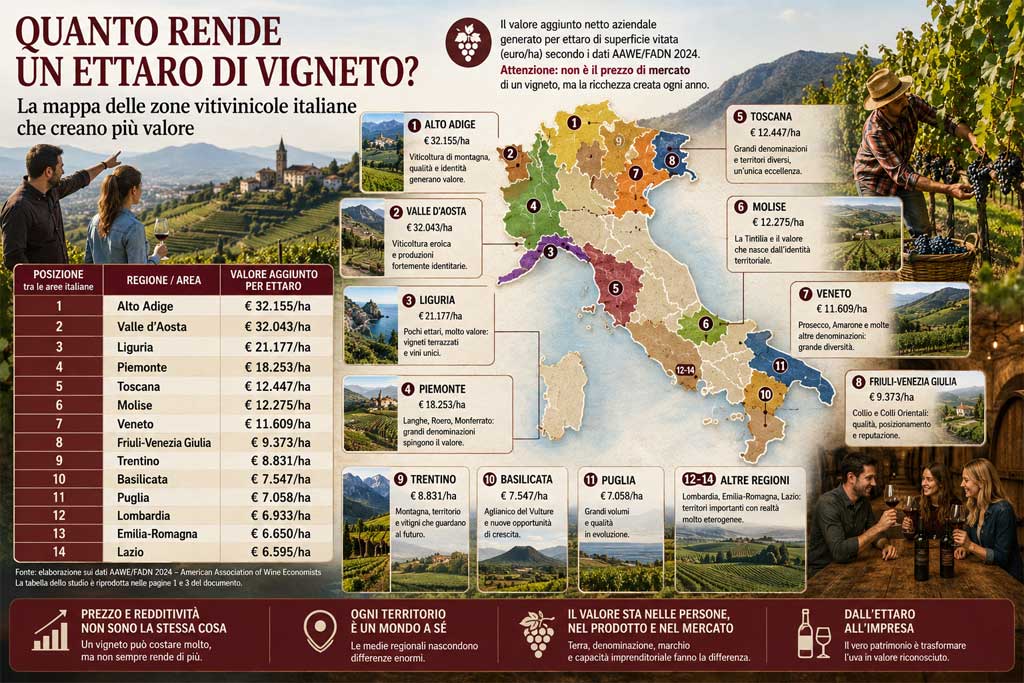
A study by the American Association of Wine Economists (AAWE) , developed on the basis of FADN 2024 – Farm Accountancy Data Network data, allows us to observe the vineyard from a particularly interesting perspective: the net added value generated by the company per hectare of vineyard surface .

The result highlights a geography of European wine very different from what might emerge by simply observing the fame of the denominations, the number of bottles produced, or the price of the land.

Champagne is out of reach, but Italy takes the podium.

In first place we find Champagne-Ardenne , with a net added value of around 60,030 euros per hectare .

Behind it, however, come two Italian territories.

Alto Adige reaches 32,155 euros per hectare , while Valle d’Aosta is practically at the same level, with 32,043 euros per hectare . These two relatively small regions are characterized by strongly identifiable production and, in the case of Valle d’Aosta, also by mountainous and heroic viticulture.

An interesting fact because it demonstrates one thing: to create value it is not necessarily essential to produce large volumes .

The ability to differentiate the product, territorial identity, positioning and limited availability can become economically more important than production size.

The ranking of the main Italian areas

Considering the Italian territories reported by the AAWE study, this picture emerges:

Position among the Italian areas

Region/area

Added value per hectare

1

South Tyrol

€32,155/ha

2

Aosta Valley

€32,043/ha

3

Liguria

€21,177/ha

4

Piedmont

€18,253/ha

5

Tuscany

€12,447/ha

6

Molise

€12,275/ha

7

Veneto

€11,609/ha

8

Friuli-Venezia Giulia

€9,373/ha

9

Trentino

€8,831/ha

10

Basilicata

€7,547/ha

11

Puglia

€7,058/ha

12

Lombardy

€6,933/ha

13

Emilia-Romagna

€6,650/ha

14

Lazio

€6,595/ha

Source: Based on AAWE/FADN 2024 data reported in the attached document. The study table is reproduced on pages 1 and 3 of the document.

Liguria: little vineyard, a lot of value

Liguria ‘s result is particularly significant, with 21,177 euros per hectare even placing it ahead of Piedmont.

It is an emblematic example of how scarcity can be transformed into value.

The terraced vineyards, the Cinque Terre, Western Liguria, the difficulties of cultivation and the limited availability of land make this viticulture difficult to replicate.

Liguria is in fifth place overall in the ranking, immediately after Burgundy, which reaches 25,312 euros per hectare.

Piedmont: Barolo and Barbaresco push up value

Piedmont reaches 18,253 euros of added value per hectare .

Here we find some of the strongest names in Italian wine: Barolo, Barbaresco, Barbera d’Asti, Alta Langa, Gavi and Asti.

The region occupies eighth position in the European ranking considered by the study.

Even in this case, however, the regional average figure must be interpreted with caution.

A hectare in the Langhe area of Barolo evidently does not have the same economic, commercial, and patrimonial characteristics as a vineyard located in a lesser-known area of Piedmont.

And this is precisely one of the most important aspects to consider when talking about the value of vineyards .

Tuscany: the weight of the major denominations

Tuscany records 12,447 euros per hectare .

Behind this average, extremely diverse realities coexist: Chianti Classico, Bolgheri, Brunello di Montalcino, Vino Nobile di Montepulciano, Vernaccia di San Gimignano, Maremma, Chianti and IGT Toscana.

It is therefore difficult to speak of a single “Tuscan vineyard”.

The economic value of a hectare depends significantly on the denomination in which it is included, the possibility of claiming certain DOC or DOCG status, the quality of the location and, of course, the commercial capacity of the company that transforms those grapes into wine.

The Molise surprise

One of the perhaps least predictable results of the study is that of Molise .

With 12,275 euros per hectare , it is placed immediately behind Tuscany and ahead of Veneto.

This fact deserves attention because it demonstrates how even regions less present in international communication can demonstrate a strong capacity for value creation.

Tintilia probably represents the most interesting example of this search for territorial identity.

Veneto: Prosecco, Amarone, and a highly diversified viticulture

Veneto , with 11,609 euros per hectare , represents a special case.

In fact, within the same regional data, profoundly different territories and production models coexist: Conegliano Valdobbiadene Prosecco Superiore DOCG, Asolo Prosecco Superiore DOCG, Prosecco DOC, Amarone della Valpolicella, Soave, Valpolicella, Bardolino and Lugana .

This makes the limitation of regional averages particularly evident.

There can be enormous differences between a vineyard intended for the production of a wine with a high potential for commercial valorization and one intended primarily for volume production.

Friuli-Venezia Giulia: quality and positioning

Friuli-Venezia Giulia reaches 9,373 euros per hectare , with particularly suitable territories such as Collio and Colli Orientali.

Even here, the value of the land does not tell the whole story.

Over the years, Friuli has built a particularly strong identity around quality white wines and often small-sized wineries, where the region, brand, and producer’s reputation can significantly impact their ability to create value.

Vineyard price and profitability: two values not to be confused

This is probably the most important point of the whole analysis.

The values indicated by the study do not represent the purchase price of a hectare of vineyard.

Instead, they represent the company’s net added value per hectare , and therefore a measure of the wealth generated by the wine-growing activity.

A vineyard may have a very high capital value but it does not necessarily guarantee, proportionally, the highest profitability.

Likewise, a lesser-known area may have more affordable land prices and produce interesting returns.

And it is precisely this relationship between purchase price and income-generating capacity that should become one of the main evaluation parameters for those considering a wine investment today.

There is no single price per region

The same study calls for caution in interpreting the ranking.

The data aggregates very large territories, and the internal differences can be enormous. The document explicitly cites cases like Tuscany, Piedmont, and Burgundy, where highly prestigious areas coexist with more volume-oriented areas within the same region.

For this reason, when evaluating the purchase of a vineyard or an entire winery, the simple average value per hectare risks being insufficient.

We need to go into the details of each individual property.

What really determines the value of a vineyard?

For an investor, purchasing ten hectares of vineyard does not simply mean purchasing ten hectares of agricultural land.

It means acquiring a set of factors: denomination, rights and production potential, agronomic quality, exposure, altitude, water availability, accessibility, age and condition of the vines, yield, price of the grapes, processing possibilities, commercial strength of the territory and scarcity of land supply .

If the acquisition involves an entire winery, additional factors come into play: the winery, brand, distribution, customers, exports, inventory, accommodations, wine tourism, and the company’s ability to transform agricultural value into commercial value.

And this is where the perspective changes completely.

From the value of the hectare to the value of the company

The true heritage of Italian viticulture is not only constituted by the agricultural surface area.

It is the combination of land, denomination, product, brand, territory and market .

One hectare can produce grapes.

The same hectare, owned by a company capable of transforming those grapes into a recognizable bottle, selling it directly, exporting it, and linking it to a wine tourism experience, can generate much greater economic value.

The AAWE ranking therefore offers an important cue: the future competition of Italian wine should not be played exclusively on the quantity produced, but above all on the wealth generated by each hectare cultivated .

For a country like Italy, characterized by unique territories, historic denominations, family-run businesses, and necessarily limited land availability, this could be one of the strategic keys to viticulture in the coming years.

Wine press review for Tuesday August 11 -2026

Italian wineries, Italian wine producers, and current wine news.

Good morning,

Italian wine is entering the heart of the 2026 harvest with a two-tiered scenario. On the one hand, innovation, sustainability, growth in wine tourism, and investments by the most established wineries are emerging; on the other, concerns about inventory levels, slowing consumption, and the need to rebalance production and demand are growing. The inventory problem is particularly evident in Tuscany, where unsold stock equivalent to about a year and a half of production is reported.

ITALIAN WINERIES

The wine giants: 27 companies with revenues exceeding €100 million. The concentration of Italian wine continues. In 2024 , 27 wineries will have revenues exceeding €100 million , while 14 will exceed €200 million. Riunite & Civ leads the way, followed by Argea, Italian Wine Brands, Caviro, and Antinori. The large groups are thus assuming increasing influence, especially on international markets.

Vistorta looks to the future with a new winery. The historic Brandolini d’Adda family estate, on the border between Veneto and Friuli, encompasses approximately 140 hectares of agricultural land and about thirty hectares of vineyards. Production is organic, and plans call for a new winery by 2028. Nals Margreid showcases Alto Adige through three wines. Sirmian Pinot Bianco, Mantele Sauvignon, and Punggl Pinot Grigio represent three different regions and altitudes of Alto Adige, with a product line strongly rooted in gastronomy and local expertise. Castagner is growing despite the spirits crisis. The Veneto distillery surpasses €14 million in revenue , with an EBITDA of more than 10% of revenue net of excise taxes. In large-scale retail trade, which accounts for 65% of the business, it posted 6.6% in value and 4.6% in volume, while the Italian grappa market continues to contract. Corte Laureana focuses on sparkling wines and local products. The Serpico family’s winery in Cilento develops a winemaking experience that combines winemaking and hospitality. There are eight labels in total, including sparkling wines, semi-sparkling wines, and still wines. Gozzelino: Monferrato, identity, and family. In Costigliole d’Asti, Sergio and Lorenzo Gozzelino showcase Barbera and Grignolino through a project that connects wine, a UNESCO World Heritage site, hospitality, and the renovation of tasting spaces.

ITALIAN WINE AND OENOLOGY

Stocks still high: 42.6 million hectoliters

This is one of the most important figures of the day. As of July 31, 2026 , Italian wineries held 42.6 million hectoliters of wine , in addition to 3.1 million hectoliters of must.

Compared to the same period in 2025, wine inventories increased by 6.9% . This data confirms one of the main structural challenges facing the sector: gradually restoring balance between production, inventories, and the market’s real absorption capacity.

Tuscany: strong pressure on unsold properties

The situation appears particularly delicate in Tuscany, where the cellars reportedly have unsold wine equivalent to around a year and a half of production .

Bulk wine prices have dropped significantly from pre-Covid highs: approximately 35% for Chianti and 30% for Chianti Classico, according to the data reported.

Sicily: 20-25 million euro proposed for crisis distillation

Sicily is also facing the problem of full cellars on the eve of the grape harvest. The Region has proposed resources of between €20 and €25 million for a possible crisis distillation aimed at reducing stocks.

The slowdown in consumption, difficulties in exports, and increasing energy and logistics costs are weighing heavily.

2026 harvest anticipated, but with good quality prospects

The harvest has already begun in various Italian regions, from Sicily to Franciacorta, from Oltrepò Pavese to Alta Langa.

In the Alta Langa, expectations are positive: Pinot Noir and Chardonnay present conditions considered favorable for the production of sparkling wine bases characterized by freshness, finesse, and elegance.

PIWI: Italian research on resistant grape varieties

The Edmund Mach Foundation and CIVIT are carrying out important work on grape varieties resistant to the main grapevine diseases.

Around 40 varieties were presented during a technical day, around thirty of which were developed through the Foundation’s genetic improvement efforts. Eight were particularly interesting for sparkling wine production.

Four new selections— Termantis, Nermantis, Charvir, and Valnosia —have been registered in the National Register of Vine Varieties.

A national strategy on supply is needed

Senate Vice President Gian Marco Centinaio proposes more selective management of new vineyard areas, directing them toward growing denominations and businesses with concrete growth potential.

At the same time, a strategy is proposed for abandoned vineyards, encouraging their acquisition, uprooting, or conversion by active agricultural companies.

Europe intervenes on the high cost of fertilizers

The European Commission has approved new measures to help agricultural businesses address rising fertilizer costs, including greater flexibility in CAP instruments and the possibility of national co-financing.

MARKET, CONSUMPTION AND WINE TOURISM

25 million Italians choose tourism and food

By the summer of 2026, approximately 25 million Italians would have chosen tourism experiences that also included food and wine.

Food and wine tourism involves approximately 18 million Italians , 4.5 million more than in 2024. Wine is increasingly becoming part of an overall experience made up of landscape, cuisine, territory, sea, culture and hospitality.

The cellar becomes an experience

Donatella Cinelli Colombini’s estates perfectly exemplify this evolution: tastings, hospitality, cuisine, walks in the vineyards, photography activities, and multi-sensory itineraries transform the visit into a true local experience.

In Friuli Venezia Giulia, seven wineries will also open their vineyards and cellars to educational grape harvesting, directly involving enthusiasts and families in the harvesting and winemaking activities.

Alto Adige: wine and cycling tourism

South Tyrol continues to develop an advanced model of wine tourism in which wineries, vineyards, restaurants, hospitality, cycling routes, and landscape become components of the same experience.

Restaurants in cellars are growing

Wine Enthusiast selected 57 winery restaurants around the world, 22 of which are in Europe and six in Italy . Four Italian locations are located in Tuscany, confirming the growing importance of the integration of wine, fine dining, and hospitality.

Aperol Spritz global phenomenon

According to data reported by Campari Group, Aperol Spritz has reached 1.5 billion consumptions worldwide , compared to 60 million twenty years ago. Approximately 395 million are concentrated in Italy.

A result that demonstrates the international strength of beverage products capable of associating a brand with a recognizable consumption style.

INTERNATIONAL

Treasury Wine Estates downsizes US footprint

Australian wine giant Treasury Wine Estates has decided to profoundly rebalance its American business.

Production reductions, the fallowing of some vineyards, the reduction of bulk wine stocks, and the devaluation of assets and brands are expected.

The additional expected extraordinary impact is AUD$558.4 million after tax .

The restructuring has also been confirmed by updated international sources, which link it to slowing demand and production overcapacity in the United States.

The Treasury case is also significant for the Italian market: it demonstrates that the problem of excess supply compared to demand does not only concern Italy , but is taking on international dimensions.

WINE EVENTS

September 7-8 – Voghera | OltreGusto Oltrepò Land of Pinot Noir. A new format dedicated to the Pinot Noir of Oltrepò Pavese, featuring 32 wineries and 18 restaurants , along with chefs, industry professionals, and the press. A masterclass with Alessandro Masnaghetti and the presentation of the region’s new winegrowing maps are also planned.

September 26-27 – Velletri Wine Festival “Nicola Ferri”. The 13th edition will bring together wine, art, memory, and local identity within the Velletri Grape and Wine Festival. October 1-4 – DoloViniMiti, Val di Cembra and Val di Fiemme. The fourth edition of the vertical wine festival will focus on dry stone walls, a key element of the Cembra Valley’s viticultural landscape and a UNESCO Intangible Cultural Heritage site.

TREND OF THE DAY – QUIDQUID NEWS

The problem is not just how much wine to produce, but how much wine the market is actually able to absorb, creating value.

The 42.6 million hectoliters present in Italian cellars , the pressure on stocks in Tuscany and Sicily and, on the international level, the American restructuring of Treasury Wine Estates indicate a fairly clear direction.

The sector seems to be entering a phase in which producing more does not necessarily mean growing .

For many wineries, the challenge in the coming years will likely be to produce more consistently with demand, improve positioning, develop international markets, strengthen wine tourism, and transform the value of the territory and the brand into greater profitability.

At the same time, the 27 large Italian groups with a turnover above €100 million are showing a progressive consolidation at the top end of the sector.

The photograph of August 11, 2026 is therefore that of an Italian wine that must find a new balance between production, market and value .

QUIDQUID – Wine Press Review A summary of the main news in the sector dedicated to entrepreneurs, wineries, investors and professionals in the supply chain.

Style Selector
Select the layout
Choose the theme
Preset colors
No Preset
Select the pattern