A network portal of Wine Idea. Discover the world of Wine idea

Wine press review for Sunday May 10 -2026

Italian wineries, Italian wine producers, and current wine news.
Italian wineries

Alto Adige, the Riesling from Juval Castle beneath Messner’s castle. The Unterortl Juval Castle Estate confirms Alto Adige’s value as a model of balance between grape variety, vineyard, and terroir. On the slopes of the Val Venosta, a Riesling with a strong identity is born, linked to the history of the Messner family.

Campi Flegrei, Falanghina grown on an active volcano. The Loffredo family continues a heroic viticulture in a complex and fascinating volcanic area. Their agricultural history began in the 19th century and today focuses on the valorization of the Phlegraean Falanghina.

Kettmeir, technology and mountain bubbles in Alto Adige. The Alto Adige winery reopens after a major structural investment, focusing on gentle technology, hospitality, and wine storytelling to strengthen the positioning of this mountain sparkling wine.

Andreola, heroic viticulture in the Valdobbiadene DOCG The Col San Martino company enhances the Valdobbiadene region through 250 parcels, 110 hectares of vineyards, and nearly a million bottles annually, confirming the role of manual viticulture in the UNESCO hills.

Terre de’ Trinci Winery takes center stage in Bellaria. The Umbrian winery promotes DOCG, DOC, organic, and sustainable wines at an event dedicated to the region’s history and certified quality.

Cantina Valtidone celebrates 60 harvests. The Piacenza-based cooperative celebrates a long production history, confirming the bond between tradition, territory, and future prospects.

Pasetti Wineries, sea and vineyards in Francavilla al Mare. An evening dedicated to Pasetti wines highlighted the connection between the Abruzzo coast, seafood cuisine, and mountain viticulture.

Cantine Fraponti, Girò returns to the forefront in Sardinia. With Pintadera 2025, Cantine Fraponti relaunches Girò, a historic and rare grape variety from southern Sardinia, in a rosé version.

Tenuta San Giaime, Sicilian wine and an international project. In Gangi, in the Madonie mountains, Lisa Ann’s winemaking project was born, featuring wines produced from high-altitude vineyards and a strong communication component.

Italian wine and Italian oenology

Conegliano, focus on sustainable viticulture and integrated pest management. The Municipality of Conegliano has launched a refresher course for winemakers, dedicated to plant protection products, integrated pest management, organic farming, and sustainable management of hillside vineyards.

Valpolicella, wine tourism between Verona and Lake Garda. San Giorgio di Valpolicella has established itself as a symbolic village for Veronese wine tourism, thanks to its vineyards, history, landscape, and proximity to Lake Garda.

Fortified wines are revisiting Port, Sherry, Madeira, and Marsala as products with great personality, capable of speaking to the modern consumer as well.

Valter Bosticardo and the Gamba di Pernice The recovery of a rare vine becomes a symbol of biodiversity and climate adaptation, with the Calosso DOC the result of an identity journey.

Alcohol-free wine on Etna Cantine Patria brings the topic of alcohol-free wine to the forefront of “Storie da Bere,” confirming its growing focus on new consumers and international markets.

Montepulciano awards Cellar Master of the Year: Antonio Troisi of the Raspanti winery receives recognition from the Consortium of Vino Nobile di Montepulciano, highlighting a key figure in the supply chain.

Piedmont, experiments with low- and zero-alcohol wines With the Interreg “Devin0” project, Piedmont is testing low- and zero-alcohol wines from native grape varieties such as Barbera, Dolcetto, Cortese, Moscato, and Brachetto.

Fine wines, Italy drives Liv-Ex recovery The secondary market for fine wines shows positive signs in the first months of 2026, with significant performances for Barolo, Masseto, Soldera and other major Italian labels.

Romagnolo gin awarded in London Alba87 Gin, also born from the connection with the Albana grape, wins new recognition at the 2026 World Gin Awards, confirming the value of the fusion between wine and distillation.

International

Bollinger, La Grande Année Rosé 2018 The Champagne house confirms its style with a cuvée of great tradition: vinification in wood, long aging on the lees and a strong influence of Pinot Noir.

Vinitaly looks to Brazil and China. After Verona, Vinitaly restarts with Wine South America in Bento Gonçalves and Wine to Asia in Shenzhen, focusing on markets that are still small but strategic for the future growth of Italian wine.

Costa Smeralda, fine wines and international luxury Wine remains an integral part of the luxury experience on the Costa Smeralda, with its fine Champagnes, Bordeaux wines, Italian fine wines, and high-profile international clientele.

Wine events

Euganean Wines at Villa dei Vescovi From May 8th to 10th, 2026, Villa dei Vescovi hosts the event dedicated to the Euganean Hills, with FAI and Strada del Vino committed to promoting the area.

Saturday of the Winemaker in Rende On May 23, 2026, FIVI will bring the Calabrian format to an urban space for the first time, bringing independent winemakers, the public, and operators together.

Porto Cervo Wine & Food Festival The event kicks off the Costa Smeralda season, showcasing wine, haute cuisine, luxury hospitality, and top international labels.

Showcooking in Bellaria with Cantina Terre de’ Trinci: An event dedicated to pairing cuisine, certified wines, and the stories of Umbrian excellence.

Opportunities and strategic assets reported by QUIDQUID

Historic winery in Trentino. Family-owned since 1912, just a few kilometers from Rovereto: 14 hectares of land, over 13 vineyards, a modern operational cellar, and a production potential of up to 400,000 bottles per year.

Two strategic winemaking assets between Conegliano Valdobbiadene and Friuli. A confidential transaction uniting a historic Prosecco DOC/DOCG company and a complete Friulian estate, creating an integrated platform for production, winemaking, packaging, and distribution.

Moriago della Battaglia, an industrial hub in the heart of Veneto’s manufacturing region. A 49,000 m2 site with approved building permit, ideal for manufacturing and logistics development in the Northeast.

Today’s wine press review is brought to you by WineIdea.it. See you tomorrow.

Wine press review for Saturday May 9 -2026

Italian wineries, Italian wine producers, and current wine news.

Italian wineries

Andreola, the heroic winery of Valdobbiadene DOCG. In the heart of the UNESCO Prosecco Superiore hills, Andreola confirms its heroic viticulture model: 110 hectares of vineyards, approximately 250 parcels, and nearly 980,000 bottles annually. Quality comes from challenging slopes, manual labor, and a strong territorial identity.

Conte Vistarino focuses on premium Pinot Noir. In Oltrepò Pavese, the historic estate led by Ottavia Vistarino strengthens its premium positioning, reducing volumes and enhancing the Bertone, Tavernetto, and Pernice crus. Pinot Noir becomes a strategic link between history, elegance, and high-end dining.

Kettmeir renovates its winery with technology and storytelling. The historic South Tyrolean winery, part of the Herita Marzotto group, has completed a major renovation of its winery, with an investment of nearly €10 million. The goal: to enhance its mountain bubbles with gentle technology and a more engaging experience for the public.

Casa Paladin looks to 2026 between family roots and new projects. The Veneto-based group continues to grow by promoting diverse territories, from the parent company in Annone Veneto to the Franciacorta of Castello Bonomi, where a 2011 Riserva with over 120 months on the lees was presented.

Mosnel in Franciacorta promotes biodiversity and landscape. The winery confirms the importance of the coexistence of forests and vineyards. An increasingly relevant model, where biodiversity, climate balance, and agronomic quality become concrete tools for strengthening the vineyard.

Vicobarone Winery Improves Grape Prices. The Piacenza cooperative reverses course: the average price of grapes from the 2025 harvest rises to €43 per quintal, compared to €34 the previous year. This is a positive sign for the 125 contributing members.

La Calcinara and the Conero Rosé In the Marche region, La Calcinara’s Mun rosé joins the new Conero Rosato DOCG. This represents an important step for a pure Montepulciano wine, already considered one of Italy’s best rosés for its quality-price ratio.

Gran Premio Metodo Classico Pas Dosé debuts in Puglia. A new limited-edition winemaking project, created by Titti Dell’Erba and Irene Sindaco, is born, featuring a Metodo Classico Pas Dosé blend of Fiano and Aglianico vinified as a white wine. The 48-month sur lie version is being previewed.

Italian wine and Italian oenology

Fine wines, the secondary market restarts with Italy and Champagne in the spotlight. The Liv-Ex shows signs of recovery after the first four months of 2026. Italy stands out with labels such as Bruno Giacosa’s Barolo Falletto Vigna Le Rocche Riserva 2016, Bartolo Mascarello’s Barolo 2019, Masseto 2022, and Soldera Case Basse.

Wine and art, an increasingly strategic connection . More and more Italian wineries are investing in the relationship between wine, art, and territory. From Antinori to Planeta, from Ca’ del Bosco to Ceretto, art becomes a tool for identity, communication, and tourism development.

Lugana VITAE, the scientific map of the denomination is born. The Lugana Consortium presents a research project dedicated to the relationship between soil, climate, and grape variety. The goal is to develop a true scientific identity card for the denomination, useful for both production and communication.

The mystery of the “punt” under the bottle The recessed bottom of bottles arises from technical and historical reasons: stability, resistance to pressure, and the tradition of glassblowing. Today, however, in many productions, it tends to be reduced for economic and environmental reasons.

Independent Winemakers: Entrepreneurial Continuity Prevails. According to the SDA Bocconi analysis of FIVI winemakers, the majority of companies have no ongoing capital transactions. This data confirms a strong desire for continuity and entrepreneurial independence.

Etruscan wine returns to Manciano. A cultural event dedicated to the production and consumption of wine 2,500 years ago brings attention to the profound connection between wine, archaeology, and territorial identity.

Italian agri-food exports exceed €70 billion . The Italian food & beverage sector confirms its strength: exports will exceed €70 billion in 2025. Sustainability, innovation, and quality remain the key drivers of growth.

Young people and agriculture: only 9% choose the fields. The CIA survey highlights the difficulty the agricultural sector faces in attracting young people. However, agriculture and innovation can become a new field, where artificial intelligence can support, without replacing, human labor.

International

Burgundy, the paradox that supports prices. Burgundy grows because it can’t. With historic borders and essentially immutable appellations, supply remains limited while international demand continues to support the value of the most prestigious wines.

EU-Mercosur, tariff agreement and new trade prospects. The agreement between the European Union and Mercosur provides for the progressive elimination of most tariffs between the two blocs. This opens up opportunities for the European agri-food sector, but also raises questions about competition and the protection of production.

US tariffs, uncertainty weighs on Italian wine. Unione Italiana Vini, with its president Lamberto Frescobaldi, emphasizes how the decisions and judicial rejections in the United States are increasing uncertainty for Italian companies, already exposed to a strategic market.

Vinitaly relaunches its promotion in Brazil and China. After Vinitaly 2026, Veronafiere is restarting with Wine South America in Brazil and Wine to Asia in Shenzhen. South America and Asia remain areas with high potential for diversifying Italian wine exports.

Loire, growing interest in Marie-Lise and Thomas Batardière The wines of the French couple confirm the allure of the small artisanal Loire productions, increasingly sought-after and often the object of close attention from enthusiasts and collectors.

Bad Ragaz, the problem of margins in the restaurant industry. A Swiss restaurant reignites the debate over the decline in alcohol consumption in restaurants. Without beverages, especially wine and spirits, the profitability of the restaurant industry becomes more fragile.

Krug recounts the philosophy of the House Olivier Krug and Julie Cavil open the doors of the Maison de Famille, confirming the value of hospitality, memory and blending as central elements of the Krug legend.

Farewell to Roberto Mostini Roberto Mostini, food critic and expert on French wines, has passed away. A free and knowledgeable figure, he played a leading role in Italian food and wine communication.

Wine events

ReWine Canavese 2026 at Ivrea Castle. The sixth edition of the event showcases Alpine wine and the Canavese winemaking heritage, with tastings, cultural events, and opportunities for learning.

Matasci Open Cellars in Ticino On Saturday, May 23rd and Sunday, May 24th, Matasci Vini opens the doors of its Tenero winery with tastings, tours, and new labels, including Selezione d’Ottobre Rosato and Keramis Bianco.

Borgo Conventi celebrates Cantine Aperte on May 30th and 31st. The Friulian winery, part of the Villa Sandi group, offers tours, tastings, live music, and a food workshop dedicated to ‘likrofi.

Benetton Foundation: Wine, Landscape, and Architecture From May 23 to August 2, Ca’ Scarpa in Treviso hosts the exhibition “Cultures and Landscapes of Wine,” dedicated to the relationship between architecture, vineyard landscapes, and production identity.

Final summary

Today’s review highlights a wine sector increasingly divided between rarity, terroir, and storytelling. On the one hand, fine wines, Burgundy, and the most iconic Italian labels, are growing; on the other, wineries are investing in biodiversity, technology, art, architecture, and hospitality.

The message is clear: wine is no longer just a product, but a system. Those who succeed in combining territorial identity, entrepreneurial vision, and international markets will gain greater strength in the coming years.

Today’s wine press review is brought to you by WINEIDEA.IT .

Wine press review for Friday May 8 -2026

Italian wineries, Italian wine producers, and current wine news.
Italian wineries

Maculan Winery appears on the set of “The Devil Wears Prada 2.” The Breganze winery appears in the film with two bottles of Acininobili, a sweet Vespaiola wine. A presence with strong communicative value for Italian wine.

Le Monde and the Pinot Bianco of Western Friuli The Friulian estate focuses on precision, single-varietal and understanding of the territory, with 120 hectares of vineyards and a strong identity in white wines.

Tinazzi between Amarone, Metodo Classico, and experimentation. The Veronese family confirms a dynamic vision: from Garda to Puglia, up to resistant vines, with a broad and contemporary production strategy.

Cantine Iannella presents Intus Nel Sannio, a Falanghina aged in amphorae, a symbol of family continuity, innovation, and territorial valorization.

Caruso & Minini looks at the present of Sicilian wine. In Marsala, Stefano Caruso describes a Sicily capable of innovating with elegance, sustainability, and new projects like Perluci.

Cantina del Fucino closes “Taste & Discover.” Wine becomes culture, history, and knowledge through a series of meetings that combined tasting, local culture, and social reflection.

Italian wine and Italian oenology

Valtènesi, elegance between sun and lake The Brescia-based Garda area confirms its position as one of Lombardy’s most distinctive areas, with Groppello and Valtènesi DOC rosé wines increasingly popular.

Bardolino: continuity, wine tourism, and a new production protocol . Fabio Dei Micheli is confirmed as head of the Consortium. The appellation encompasses 2,400 hectares, 817 members, and 21 million bottles by 2025.

CMO Wine: €323.9 million for the 2026/2027 campaign . Significant resources for promotion, investments, and vineyards. Over €98 million will be allocated to promoting Italian wine in non-EU countries.

Cooperation against vineyard abandonment. The crisis in the sector threatens to weaken social protection in the countryside. The key issue is not only production, but also territorial and generational.

New wine formats Cans, mini bottles, bag-in-boxes, and 0.5-liter formats respond to new consumer trends: convenience, moderation, sustainability, and price.

Sfuso Buono relaunches bag-in-box. Alessandra Costa’s project breathes new life into quality bulk food, with e-commerce, social media, and a language that’s accessible to new generations.

Italian wine exports decline in 2025. According to “Wine Numbers,” Italian exports stood at €7.78 billion, a 4% decline. Veneto leads the way, while Campania, Liguria, Friuli Venezia Giulia, and Puglia are growing.

Casauria DOCG: A new denomination in Abruzzo. The Montepulciano d’Abruzzo subzone becomes DOCG. The first eligible vintage will be 2024.

Marsala calls for greater attention to wine. Some local producers are asking mayoral candidates to discuss sustainability, business development, and wine tourism.

Drones in agriculture: regulations and expertise are needed. The Cuneo case highlights the need for proper use of technology in the fields, avoiding improvisation.

International

Ryanair calls for alcohol restrictions at airports. Michael O’Leary proposes a ban on alcohol sales in the early hours and a maximum of two drinks per passenger, following problems caused by drunken travellers.

Italian wine is looking to foreign markets with new tools. CMO promotion, new formats, and positioning strategies confirm how crucial exports remain, especially in a period of weaker global consumption.

Wine events

The Milan Wine Week and Wine List Italia awards the Italian Dining Room Excellence Award to 30 dining room leaders: maîtres, sommeliers, and hospitality professionals who are increasingly crucial to restaurant success.

Villa Sceriman celebrates the purple artichoke and wines of the Euganean Hills. Sunday, May 17th, a day of tastings, local products, music, and winery tours.

Pinot Grigio DOC delle Venezie at the 2026 Giro d’Italia The denomination will be the Official Wine of the Giro d’Italia, Giro Women and Giro Next Gen thanks to the partnership with RCS Sports & Events.

Aosta Valley wines at Castello Gamba. Tastings dedicated to the DOP wines of the Aosta Valley on Saturday, May 16, to mark the 70th anniversary of the École Hôtelière.

Spazio Villalta dedicates a vertical tasting to the “Head of State”. AIS FVG offers a tasting of Loredan Gasparini’s famous wine, featuring six historic vintages.

SIP & FEEL at Cantina Valpanera in Fiumicello, Sunday, May 17th: guided meditation, vineyard walk, and sensory tasting.

Calici DiVini at the Fortezza in Civitella del Tronto On May 16th and 17th, the Fortezza will host tastings, meetings with producers, and the promotion of local excellence.

Vini Bagnanti 2026 On June 20, in San Vincenzo, 50 artisanal wineries will be the protagonists of a seaside tasting dedicated to wine, landscape and sustainability.

Isolabella in the Langhe area of Asti. A nature project enhances the relationship between vineyards, biodiversity, landscape, and rural rebirth.

Final summary

The day confirms that the Italian wine sector is undergoing a period of transformation. On the one hand, there are challenges: declining consumption, declining exports, the risk of vineyard abandonment, and the need for new regulations for technologies and markets. On the other, strong signs of a response emerge: new formats, international promotion, growing appellations, wineries capable of innovating, and regions focusing on identity, wine tourism, and culture.

The message is clear: Italian wine cannot stand still. It must dominate the markets, better communicate its identity, innovate without losing its soul, and transform each terroir into tangible value.

Today’s wine press review was brought to you by WineIdea.it.

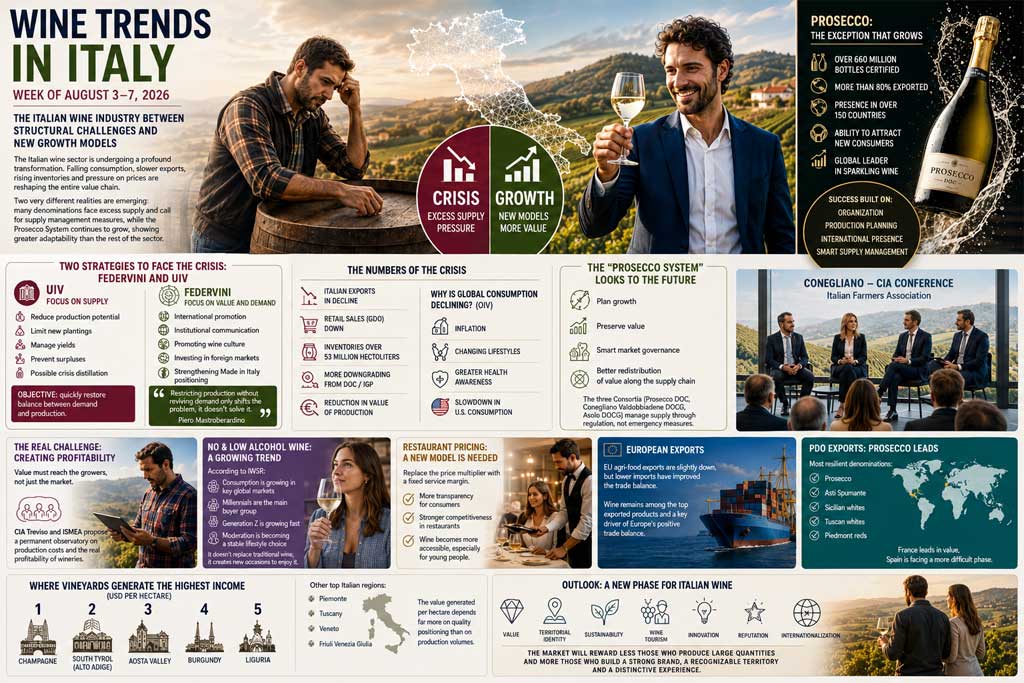
Wine Trends and Performance in Italy – Week of May 4th to May 8th – 2026

This is no longer just a normal market fluctuation, but a structural shift involving consumption, exports, geopolitics, the social perception of wine, and the economic sustainability of the entire supply chain.
The Italian wine sector is going through one of the most complex phases of recent decades.
The message emerging forcefully this week from the Italian wine world is clear: wine can no longer simply defend itself. It must once again become a leader in change.

At the heart of the debate was Piero Mastroberardino’s speech at the inauguration of the Academic Year of the Academy of Vine and Wine, which lucidly captured the current state of the sector.

Italian wine today finds itself caught between:

global decline in consumption,
geopolitical pressures,
trade tensions,
inflation,
transformation of consumer habits,
increasingly aggressive health campaigns,
increasing logistics and energy costs,
risk of abandonment of the vineyards.

Yet, precisely within this critical phase, new strategic opportunities also emerge.

Global consumption is declining, but Italian wine remains central

According to OIV data recalled during the week, world wine consumption in 2024 fell to 214 million hectolitres (-3%).

The United States remains the world’s leading market in terms of overall consumption, but is showing signs of slowdown and significant instability related to tariffs and inflation. Italy, however, remains among the countries with the highest per capita consumption in the world and continues to play a central role in international wine culture.

The real transformation, however, concerns the consumption model:

we drink less,
you choose better,
the premium increases,
“daily wine” drops.

Italian large-scale retail trade confirms this trend:

volumes down (-2.7%),
almost stable value,
growth in the bands above 5 euros,
strong hold of sparkling wines,
decline in entry-level wines.

Today’s consumer is looking for:

quality,
territoriality,
identity,
experience,
perceived value.

He no longer buys wine “automatically”.

Sparkling wines and high-end wines drive the market

The week confirmed the consolidation of a very clear trend: the Italian wine that grows best is that with a strong premium identity.

The case of the Lunelli Group is a concrete example:

revenues of 134 million euros,
exports under pressure,
defended marginality,
high-end oriented strategy,
focus on quality Classic Method and Superior Prosecco.

Brands like:

Ferrari Trento
Bisol1542

they are increasingly focusing on:

high positioning,
Qualified Horeca,
premium markets,
brand value.

The message is clear: in the new global scenario, the winners are not those who produce more, but those who manage to build perceived value.

Geopolitics and the Hormuz Crisis: Wine Enters an Era of Permanent Uncertainty

One of the most pressing issues of the week concerns the effect of the international crisis on Italian wine.

Tension in the Hormuz area is generating:

increasing energy costs,
logistical increases,
rising cost of glass,
difficulties in maritime transport,
slowdown in exports to the Middle East and Asia.

Many large Italian companies are already registering:

orders suspended,
blocked containers,
increase in operating costs,
pressure on marginality.

Among the groups that have expressed concern:

Angelini Wines
Cevico Lands
Masi Agricola
Fantini Group
Donnafugata

The main risk today is not only the slowdown of the markets, but the loss of competitiveness caused by increasing costs along the entire supply chain.

Many operators also believe that increasing price lists could be a strategic mistake, because the international consumer is already under inflationary pressure.

Exports: a challenging scenario but new global opportunities

The United States remains the most sensitive market:

Italian exports in decline,
tariffs still unstable,
reducing imports in key states such as New York, California and Texas.

France is also suffering greatly:

sharp drop in average prices in the US,
reduction in exports,
difficulties on premium French wines.

But within this instability, new strategic directions emerge:

Mercosur,
India,
Australia,
Southeast Asia,
high-growth emerging markets.

Italy today appears better positioned than other competitors thanks to:

strong territorial diversification,
ability to cover different groups,
growth of the image of Made in Italy,
increase of Italian leadership in international markets.

In twenty years, Italian wine has gone from being the leader in 9 world markets to 46 markets.

The relationship between wine and society is changing

The cultural theme is now central.

Wine today is not just fighting a commercial battle, but also a narrative and identity battle.

Health campaigns, especially in Europe, are changing the perception of wine as a product, especially among young consumers.

The Italian supply chain, however, reacts with a very clear position:

distinguish between moderate consumption and abuse,
defend wine as an element of the Mediterranean Diet,
enhance conviviality, territory and culture.

Italy is trying to shift the paradigm:
from “wine to defend” to “wine to promote”.

Important in this regard is the institutional campaign supported by the Italian government together with the wine industry, with the aim of bringing wine back to the center of the Italian cultural narrative.

Cooperation and the risk of abandoning vineyards

Another strategic theme that emerged forcefully is the growing risk of vineyard abandonment.

The economic crisis in the sector is hitting hardest:

marginal areas,
heroic viticulture,
small producers,
historic hilly territories.

Italian wine cooperatives are becoming the true social bulwark of the system.

Cooperative wineries and consortia are taking action:

taking over abandoned vineyards,
by financially supporting winemakers,
preserving landscape and biodiversity,
promoting generational turnover.

Among the most active entities:

Rauscedo Winery
Valpolicella Negrar Winery
Valdobbiadene Producers’ Cellar
Tudernum Social Winery
Winemakers of Morellino di Scansano

The issue is not only agricultural:
Without vineyards, the economy, environmental protection, tourism, and territorial identity are lost.

CMO Wine and Investments: Over 323 Million to Support the Sector

Important signals are arriving on the support policy front.

For the 2026/2027 campaign, Italy will have at its disposal:

323.9 million euros CMO Wine,
of which:
98 million for international promotion,
144 million for vineyard renovation,
over 57 million in investments.

The Piedmont Region is also very active, having allocated over 7.6 million euros for international promotion, wine tourism, and territorial development.

The public strategy today focuses on:

internationalization,
territorial branding,
innovation,
research,
sustainability,
coordinated promotion.

Style Selector
Select the layout
Choose the theme
Preset colors
No Preset
Select the pattern