


A network portal of Wine Idea. Discover the world of Wine idea

Wine press review for Monday August 17 -2026

The picture emerging from today’s news shows a rapidly changing sector: increasingly early harvests, pressure on inventories, the need to defend prices and margins, growing wine tourism, and increased attention to brand and regional value. Italian inventories, as of July 31, 2026, reached 42.6 million hectoliters, up 6.9% from the previous year, while the harvest is already well underway in many regions.

ITALIAN WINERIES

Carema, the heroic Nebbiolo of Piedmont

The small Carema DOC continues to represent one of the most distinctive examples of Piedmontese Nebbiolo. The Cantina dei Produttori Nebbiolo di Carema , founded in 1960 by ten winemakers, today has around one hundred members.

Production covers approximately 15 hectares of the DOC’s 25 hectares , with an average of around 50,000 bottles per year .

A distinctive feature are the terraced vineyards supported by traditional stone pillars, the “pilun,” which hold up the local pergolas called “topie”: a significant example of heroic viticulture and landscape conservation.

Dievole consolidates its relaunch in the Chianti Classico region

Dievole strengthens its position in the Chianti Classico region through organic vineyards, vinification in concrete vats, aging in large wooden barrels, and a company zoning project.

Among the flagship labels, the 2023 Chianti Classico DOCG Casanova stands out, coming from the cru of the same name. The company currently has 152 hectares of organic vineyards and produces a total of approximately 350,000 bottles .

Cordero di Montezemolo: Barolo between history and territory

The Monfalletto Estate of Cordero di Montezemolo represents one of the historic estates of the Langhe.

Today the company has 56 hectares of organic vineyards , distributed between La Morra, Alba, Castiglione Falletto, Guarene and Cherasco, cultivated mainly with Nebbiolo, Dolcetto, Barbera, Arneis and Chardonnay.

Total production reaches approximately 300,000 bottles , with the Barolo Monfalletto 2022 among the representative labels.

Berlucchi closes a record harvest in Oltrepò Pavese

Berlucchi has completed the Pinot Noir harvest at its Oltrepò Pavese estate, acquired in 2023 and destined for the production of sparkling wine.

The harvest, which began on August 3rd , was completed in just ten days. The intense heat forced harvesting to be concentrated in the early hours of the day and required extensive organization of the work teams.

Tommasi focuses on widespread wine tourism

Tommasi Family Estates is increasingly transforming hospitality into a strategic component through Tommasi Wine Hospitality .

The group, founded in Valpolicella over 120 years ago and now also present in Collio, Montalcino, Vulture, Salento, and Etna, proposes a model in which each estate maintains its own identity, connecting wine, territory, culture, and hospitality.

Bosco alle Vigne invests in technology and organization

The Bolgheri winery Bosco alle Vigne is undergoing a major renovation, expanding its production facilities and improving its logistics.

The project includes advanced temperature control systems, new areas for grape management, and greater valorization of individual parcels, maintaining a winemaking philosophy geared toward limited intervention.

Novacella Abbey: wine, history, and wine tourism

Founded in 1142 , Novacella Abbey in South Tyrol is home to one of the oldest active wineries in the world.

Today, it produces around 900,000 bottles a year , 80% of which are white wines. The vineyards in the Isarco Valley reach altitudes between 600 and 900 meters.

The Abbey is also expanding its wine tourism offering, integrating wine, historical heritage, spirituality, and the local area.

Italian cellars become works of architecture

From Mario Botta’s Petra to Renzo Piano’s Rocca di Frassinello, up to the new Cantina del Cabreo inaugurated in May 2026, architecture has become an integral part of the positioning of major wineries.

A new Mario Botta project is also planned for the opening of the Terrabianca estate in Radda in Chianti in 2027 .

The contemporary winery is therefore not just a production site: it can become an element of branding, hospitality, communication, and heritage enhancement.

ITALIAN WINE AND OENOLOGY

2026 Harvest: Good Quality, But Heat and Drought Bring Harvest Forward

The 2026 harvest is confirmed as one of the earliest in recent years. This phenomenon affects many Italian regions and is linked to high temperatures and the rapid ripening of the grapes.

In the Treviso area, quality prospects are considered very positive, but yields are uneven. Drought and the need for irrigation are the main challenges, especially in the foothills.

The situation is similar in Piana Rotaliana , where the first Chardonnays destined for sparkling wine have already entered the cellar. The grapes are healthy, and initial estimates indicate slightly higher production in 2025, but water availability remains crucial.

Even in the Euganean Hills and in the Maremma Toscana, the early harvest highlights how vineyard management and monitoring ripening have become crucial to determining the correct time for the harvest.

Piedmont: Early harvest, grape prices and inventory under observation

In Piedmont, the harvest began with Sauvignon, Arneis and Moscato, earlier than traditional calendars.

Despite the good quality prospects, however, the problem of inventory is weighing heavily. According to the information reported in the review, the Barolo and Barbaresco Consortium has urged its members to reduce production by 10% .

The issue fits into a national scenario characterised by 42.6 million hectolitres of wine in stock as of 31 July 2026, 6.9% on an annual basis .

Wine prices: the entire supply chain under scrutiny

Luca Cuzziol, head of Cuzziol Grandi Vini, draws attention to the issue of prices and margins.

According to the distributor, when faced with wines that are difficult to sustain commercially, one must also have the courage not to buy them.

The issue does not only concern restaurateurs or producers, but the entire value chain: price at source, distribution, restaurant markups, sales capacity and communication to the consumer .

Dealcoholized Wines: What Happens When You Remove Ethanol

The NO-LO segment continues to be a topic of discussion in the wine world.

Dealcoholization, however, begins with a wine obtained through normal fermentation. According to the review, below the thresholds established by the legislation, the classification changes, but the starting product remains wine vinified according to traditional procedures.

Natural wines: after the “funky wine” season

The so-called “funky” wine movement, particularly visible in the years before the pandemic, appears to have entered a more mature phase.

The debate is gradually moving from the alternative aesthetics of labels and the simple belonging to the “natural” world towards actual quality, territorial recognition and oenological correctness .

Wine and health: a new study reopens the debate.

Research presented in 2026 at the American College of Cardiology analyzed 340,924 adults from the UK Biobank , followed for an average of more than 13 years.

According to the data reported in the review, the study observed different profiles between moderate wine consumption and consumption of beer, cider, and spirits.

However, these are epidemiological associations , which do not demonstrate a direct cause-effect relationship and do not transform alcohol consumption into a health recommendation.

WINE TOURISM

18 million Italians choose wine-related experiences

Wine tourism continues to grow and is becoming increasingly important for the economy of wineries.

According to the report cited in the review, food and wine tourism involves approximately 18 million Italians, 4.5 million more than in 2024 .

Cinque Terre and Salento lead the list of destinations, followed by Chianti, the Amalfi Coast, and Etna, followed by Montepulciano, Montalcino, Langhe-Barolo, and Gallura.

Ferragosto confirms the strength of rural tourism

Around 700,000 Italian and foreign tourists spend the week of Ferragosto in Italian farmhouses.

According to Coldiretti/Ixè, 49% of Italians participate in activities such as tastings, visits to wineries, oil mills and dairies, or cooking classes.

The grape harvest becomes a tourist experience

Grape harvesting is no longer just an agricultural activity: more and more wineries are transforming it into an experience for wine lovers and tourists.

The phenomenon involves territories such as Bolgheri, Franciacorta, Oltrepò Pavese and Etna , combining participation in the harvest, tasting, hospitality and social communication.

The Buglioni Harvest Experience 2026 , scheduled from September 5th to October 4th in San Pietro in Cariano, Valpolicella, represents a concrete example: the visitor does not simply witness the grape harvest, but participates directly in the harvest.

Cembra Valley: the value of heroic viticulture

The Cembra Valley represents one of the most characteristic wine-growing landscapes in Trentino, with terraced vineyards and thousands of dry stone walls built on the slopes of the Avisio Valley.

It is an example of how landscape, heroic viticulture and territorial identity can become central elements of the narrative and attractiveness of a wine destination.

INTERNATIONAL

European wine benefits from the reputation of EU agri-food

The international reputation of European agri-food products continues to be supported by three fundamental factors: quality, safety and authenticity .

According to the Flash Eurobarometer 2026 cited in the review, conducted on 11,119 consumers in 11 non-EU countries , 40% of respondents declared they consume European agri-food products at least once a week.

Among the most receptive markets are the United Arab Emirates (58%), the United Kingdom (50%) and Saudi Arabia (45%) , while Mexico and Japan still show significant room for growth.

Fine wine: first signs of recovery

The international investment wine market is said to have reached a low in February 2026, before recording four consecutive months of recovery.

According to the analysis by Cult Wine Investment reported in the review, the recovery is driven mainly by a limited number of strong, emerging labels.

In the first half of 2026, Tuscany stands out with 1.52% , while Piedmont recorded -0.36% . In France, Champagne recorded 0.63%, Rhone 0.35% and Bordeaux 0.29%, while Burgundy (-0.2%) and US fine wines (-0.46%) remained in negative territory.

Istria: from seaside tourism to wine tourism

Croatian Istria represents an interesting model of tourism diversification.

The region has gradually used the strong appeal of its seaside resorts to direct some of its visitors inland, developing wineries, gastronomy, the region and wine-related experiences .

A model that also allows the tourist season to be extended beyond the traditional summer months.

Champagne 2026: Early Harvest in France, Too

The change in the harvest calendar doesn’t just affect Italy. In Champagne, spring frost, extreme heat, and drought have accelerated ripening, and in some areas, the harvest began as early as August 6, 2026 .

WINE EVENTS

Franciacorta Festival – September 18-20, 2026

Villa Franciacorta offers three days dedicated to experiencing the area, with guided tastings, visits to underground cellars, aperitifs in the vineyards, a Wine Garden, dinners under the stars, and even hot air balloon flights over the vineyards .

The Festival will take place from 18 to 20 September 2026 in Monticelli Brusati.

Caraglio – Discovering Merola Wine

On Saturday 22 August , starting at 5.30 pm from the Filatoio di Caraglio, a walk dedicated to the rediscovery of Merola wine is planned.

The tour will end with a tasting in the vineyard and a picnic with local products.

Trebisacce – Wine Festival Art

The 13th edition of the Wine Festival Art brought together 20 wineries from eight regions of Southern Italy .

The format combines wine, territory, and culture through tastings, painting, and satire, featuring companies from Calabria, Basilicata, Puglia, Campania, Lazio, Sicily, Abruzzo, and Sardinia.

Arcidosso: a new space dedicated to local excellence opens

The Porta Castello Association’s new winery has opened in Arcidosso, a space dedicated to Maremma and Amiata products.

Wine, oil, honey, gin, pasta and other local products coexist with exhibitions and cultural initiatives, creating a meeting point between agri-food, art and territorial promotion .

QUIDQUID – Wine Press Review

The main Italian and international news dedicated to wine, cellars, viticulture, oenology, the market, investments, harvests and wine tourism .

Wine press review for Friday August 14 – 2026

Italian wineries, Italian wine producers, and current wine news.

Good morning,

ITALIAN WINE AND OENOLOGY

2026 Harvest: Heat and Drought Bring Forward the Harvest

The climate is one of the main protagonists of the 2026 harvest . In several Italian areas, the harvest began much earlier than usual.

In Veneto , especially in the eastern part, the harvest of Chardonnay, Pinot Grigio, and Pinot Noir has already begun. Heat and water shortages have accelerated ripening, simultaneously increasing the need for irrigation and thus farm costs. Initial indications, however, point to normal production and good quality.

The situation is even more significant in Friuli-Venezia Giulia . In Dolegna del Collio, the harvest began on August 10th, exceptionally early compared to the past. The grapes are healthy thanks to the dry climate, but irrigation has been crucial, especially for the young vineyards. The situation is more challenging in the Colli Orientali, where reduced irrigation availability is causing the vines to suffer and potentially reducing yields.

In the Bergamo area, Cantina Val San Martino also brought forward the Chardonnay harvest by about 15 days, starting work as early as 5:00 a.m. to avoid the highest temperatures. Initial assessments indicate very good quality of the grapes destined for Blanc de Blancs.

Harvest and worker safety

As temperatures rise, protecting those who work in the vineyards also becomes crucial.

The ASL CN2 Alba-Bra has reminded agricultural companies to comply with the measures established by the Piedmont Region to protect workers from heat and solar radiation: scheduling, breaks, water availability, and special attention to the most vulnerable. The regional measures remain in effect until August 31, 2026.

Roero: early harvest, but positive quality prospects

The new president of the Consorzio Tutela Roero, Alessandro Costa , foresees an early harvest but with good quality prospects.

The challenge, however, goes beyond the vineyard: changing consumption patterns, international tensions, tariffs, and the need to diversify markets require greater collaboration among producers. The Consortium currently has 265 members and over 1,300 hectares of vineyards .

Lazio: Chestnut barrels are back

The Lazio Region has approved a project to once again experiment with local chestnut trees in the production of barrels and barriques .

The project will involve the University of Tuscia, Arsial, forestry companies, coopers, and ten pilot wineries.

The goal is to reconstruct a forest-barrel-wine supply chain, valorizing the territory, craftsmanship, sustainability and traceability of the wood and simultaneously developing new technologies to analyze tannins and polyphenols during the refinement process.

Primitivo di Manduria: even great reds can be served chilled.

Masseria Cuturi’s Monte Diavoli 2021 was recognized as the best Primitivo di Manduria DOP as part of the celebrations for the 60th anniversary of the Carosino Wine Festival.

Produced in just 2,200 bottles , this Primitivo is characterized by freshness, flavor, fruitiness, and aromatic complexity. This recognition also draws attention to the issue of serving temperatures for full-bodied red wines, which don’t necessarily need to be enjoyed at high temperatures.

Valtènesi: Rosé Becoming More and More Identifiable

Valtènesi , on the Brescia shores of Lake Garda, continues to establish itself as one of the Italian areas most identified with rosé wine.

The qualitative growth of the denomination demonstrates how rosé can become more than just a seasonal wine, but a product strongly tied to the territory, also capable of positively evolving with aging in the bottle.

San Martino della Battaglia: Quality and Value in Lesser-Known Appellations

The San Martino della Battaglia Ottocento 2024 from Pratello , produced from pure Tai grapes, some of which come from old ungrafted vines, has been included in the BereBene 2026 guide.

With an indicated price of around 16 euros , it represents an example of how lesser-known Italian denominations can offer wines with a strong identity and an interesting quality-price ratio.

ITALIAN WINERIES

Planeta: 17 generations tell the story of Sicily through wine.

The Planeta family interprets Sicily through profoundly different territories: Menfi, Vittoria, Noto, Etna and Capo Milazzo.

The company’s philosophy focuses on the land, landscape, research, and territorial identity, using wine as a tool to convey the island’s agricultural and cultural complexity.

Etna: quality remains the main defense against the consumer crisis.

According to producer Ciro Biondi , Etna is going through a phase of adjustment after years of strong growth.

The general contraction in consumption is accompanied by an increase in production. However, for those companies with a strong focus on quality, demand remains strong.

Biondi manages approximately 7 hectares of vineyards at 600 metres above sea level , with a production of around 25,000 bottles , and underlines how the market is becoming more selective: the name “Etna” alone is no longer sufficient to automatically guarantee commercial success.

Sicily: Five producers tell the story of the island’s evolution.

Sicily continues to be one of the most interesting laboratories of Italian wine.

From the history of Marsala to the growth of Nero d’Avola to the international success of Etna DOC, the island’s viticulture is increasingly focused on enhancing its territorial and varietal identities.

Tenuta Casali among the best wines of Romagna

Tenuta Casali’s Vigna Quartosole Romagna DOC Sangiovese Mercato Saraceno Riserva has once again been included among the “Best 50” of the Emilia Romagna da Bere guide by the Italian Sommelier Association.

The recognition comes after the gold medal obtained at the international Città del Vino competition and confirms the ability of some local reds to maintain strong interest despite the market favoring mainly whites and sparkling wines.

La Nobra Winery: Montefiascone DOC, a blend of freshness and affordability

The 3 est Est! Est!! Est!!! di Montefiascone DOC 2025 from Cantina La Nobra is produced in just 2,000 bottles and is offered at the winery for around 10 euros.

A white wine characterized by freshness, fragrance, and personality that enhances a historic Lazio denomination.

ITALIAN WINE MARKET

Italian wine: high inventories, consumption and exports under pressure

The sector continues to face a structural problem: a lot of wine available and slowing demand .

According to the data reported in the review, Italy has approximately 42 million hectolitres of wine and must in its cellars , while wine purchases in large-scale Italian distribution between January and May 2026 have seen a 2% drop.

In the first quarter, exports would have marked -4% in volume and -8.3% in value .

The problem, therefore, does not seem to concern exclusively production, but the progressive change in demand and the ability of the entire system to adapt supply, positioning, and commercial strategies.

European PDO exports are struggling, but sparkling wines are holding up.

In the first four months of 2026, exports of the main European PDO wines recorded a contraction in value.

Italy recorded -6.2% , France -3.4%, Germany -5.5% and Spain -8.5%.

However, the situation varies greatly among the denominations. French Crémants grew by 19.4% in volume , Champagne by 3%, while Prosecco limited the decline to -0.8%. Asti returned slightly to positive territory (1%), while Spanish Cava lost more than 9%.

The market therefore seems to reward whites and sparkling wines more, while many red wines continue to suffer.

Brazil: Wine imports on the rise

Brazil confirms itself as one of the most interesting emerging markets for the sector.

In the first half of 2026, imports reached 79.4 million litres (9.1%) , for a value reported in the body of the news of 234.3 million euros (5.9%) , with an average price of 2.95 euros/litre.

Bottled wine represents approximately 96% of the volume and 92% of the value of Brazilian imports.

For Italian wine, it is a market that deserves particular attention as part of geographical diversification strategies for exports.

INTERNATIONAL WINE

Champagne: Exceptionally early 2026 harvest

Champagne is also facing an increasingly earlier harvest.

The Comité Champagne has set harvest opening dates for 2026 between August 8 and 22 , varying by municipality and grape variety, with some producers starting even earlier thanks to specific exemptions.

This advance confirms how rising temperatures are profoundly altering European viticulture calendars.

San Marino: Drought and sharp decline in grape production

In San Marino, heat and lack of rainfall are causing problems for vineyards and olive groves.

Initial estimates indicated in the review speak of a possible reduction in grape production of 40% compared to 2025 , despite qualitative prospects considered positive.

Added to the drought are the rising costs of agricultural production and fuel.

Albania: Kallmet as a symbol of winemaking rebirth

In northern Albania, producer Altin Prenga , founder of Mrizi i Zanave, is working to promote Kallmet , one of the country’s most representative native red grape varieties.

Historically widespread between Lezhë and Shkodër, Kallmet produces wines characterized by fruit, freshness, tannic texture and evolutionary capacity.

The revival of the grape variety also represents a cultural strategy: using native varieties to build a recognizable identity for the new Albanian viticulture on international markets.

WINE TOURISM

18 million Italians interested in wine tourism experiences

Wine tourism is becoming an increasingly important component of Italian vacations.

According to the report Italians and wine tourism experiences , cited in the review, food and wine tourism today involves around 18 million Italians, 4.5 million more than in 2024 .

Among the most popular destinations are Cinque Terre and Salento (20%) , Chianti (19%), Amalfi Coast and Etna (18%), followed by Montepulciano (16%), Montalcino (15%), Langhe-Barolo and Gallura (14%).

A particularly interesting fact is the presence of four coastal territories in the top five positions: wine, landscape, sea, gastronomy and hospitality are becoming parts of the same tourist experience .

WINE EVENTS

Bancarel’Vino 2026: Over 40 Producers in Mulazzo

The 43rd edition of the Bancarel’Vino Award , organized from 7 to 9 August in Mulazzo, has concluded.

Over 40 producer stands and 98 finalist wines enlivened the event, dedicated primarily to the products of Lunigiana and Tuscany.

Award-winning wines include Cantina Le Canne, Tenuta Ca’ Bianca, Terenzuola, Donna di Denari, Candia Bio, and L’Altra Donna.

The event confirms the role of local events as tools for promoting not only wine, but the entire local economy and identity.

Vinitaly and the City in Calabria: a debate on economic returns for wineries

According to reported data, the Calabrian stages of Vinitaly and the City recorded approximately 50-60,000 visitors in Reggio Calabria and 30,000 in Sibari .

At the same time, a debate has emerged about the actual commercial return for producers, especially due to the lack, according to the source cited in the review, of structured B2B matching activities with buyers and distributors.

The topic raises a broader question for the sector: how can we measure the real economic return on wineries’ participation in wine events and festivals?

AGRICULTURE AND INVESTMENTS

Umbria: Over €50 million for agriculture, youth, and supply chains

The Umbria Region is making over 50 million euros available through six calls for proposals under the 2023-2027 Rural Development Complement.

The measures include €9 million for the establishment of young farmers and €8 million for road infrastructure in rural areas.

The interventions aim to support investments, generational turnover, business competitiveness, agri-food supply chains, biodiversity, and forestry heritage.

QUIDQUID – Wine Press Review The main daily news on the Italian and international wine sector.

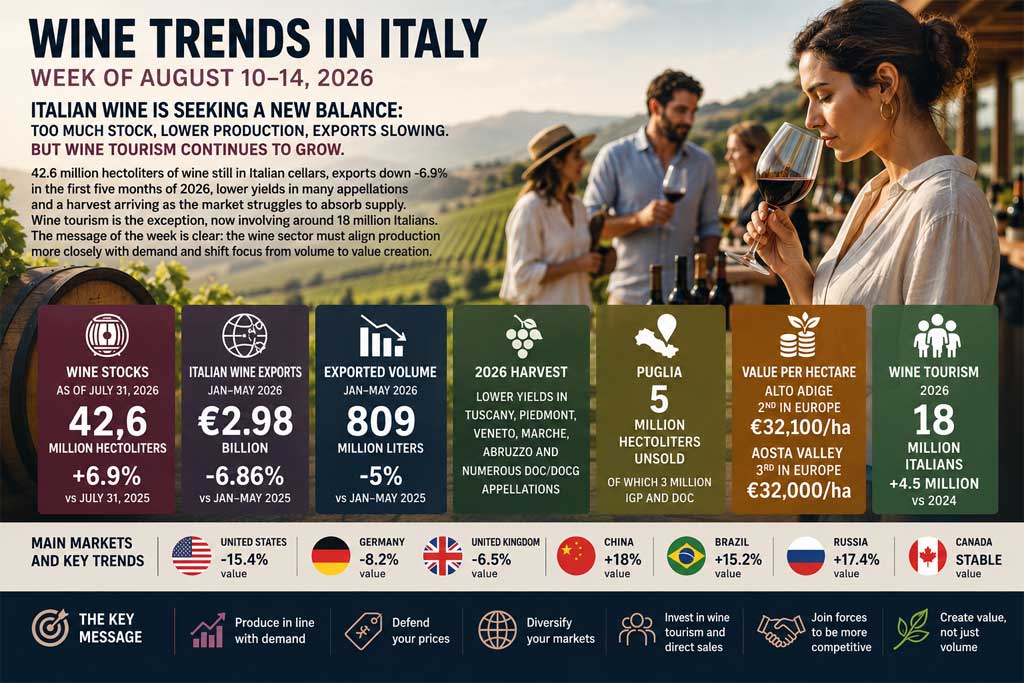
Wine Trends in Italy – Week 10-14 August 2026

Italian wine is seeking a new balance: too many inventories, declining exports, and lower production. But wine tourism continues to grow: 42.6 million hectoliters of wine remain in Italian cellars, exports down 6.9% in the first five months of 2026, reduced yields in numerous appellations, and a harvest that arrives while the market struggles to absorb production.

Wine tourism, which now involves approximately 18 million Italians, bucks the trend.

This week’s message is clear: the wine sector must produce more in line with demand and shift its focus from volumes to value creation.

This week’s figure: 42.6 million hectoliters still in the cellar

The most important photograph comes from Cantina Italia , the ICQRF bulletin processed through the electronic registers.

As of July 31, 2026, there were 42.6 million hectolitres of wine in Italian wineries, to which were added approximately 3.1 million hectolitres of must and over 42,000 hectolitres of new wine still fermenting.

The most significant figure is the comparison with a year earlier: wine stocks are 6.9% higher than on 31 July 2025 .

This data was also confirmed by the findings published this week based on the latest ICQRF report.

Compared to June, the situation has improved, with a monthly reduction in inventories of 8.6%, but the annual comparison remains the real alarm bell.

In other words, cellars are emptying, but not fast enough .

And this is happening just as the 2026 harvest is gradually getting into full swing.

Where is the wine found?

55.9% of the stocks are concentrated in the Northern regions , with Veneto in a predominant position.

The composition of the stocks also shows the weight of certified productions:

55.4% DOP wines
25.8% PGI wines
1.7% varietal wines
17.1% other wines

Even more significant is the level of concentration: just 20 denominations out of the 523 registered represent 57.6% of the total stock of wines with Geographical Indication .

Prosecco DOC alone represents approximately 9.4% of stocks , with 3.2 million hectolitres.

They are followed by IGP Toscana and Puglia, Chianti DOCG, Montepulciano d’Abruzzo, Terre Siciliane IGP, Sicilia DOC, Salento IGP, Veneto IGP and Delle Venezie DOC.

The problem isn’t having wine in the cellar. It’s how quickly it goes.

Inventories, taken in isolation, do not necessarily indicate a crisis.

The problem arises when production, sales and inventory turnover rate are no longer balanced .

And this is precisely the point that the sector will have to question itself on in the coming months.

Exports: nearly 3 billion euros, but 2026 remains negative

The second signal comes from international markets.

In the first five months of 2026, Italy exported wine worth approximately 2.98 billion euros , registering a contraction of 6.86% compared to the same period in 2025 .

Volumes also decreased: 809.1 million litres , approximately 5% less than in the first five months of last year.

The issue becomes particularly delicate when looking at the three main Italian wine markets.

United States

They remain the first international market, with approximately 709 million euros , but the value of exports records a heavy:

-15.4%.

Volumes fall by 6%.

This means that we are not only losing bottles sold: the average value generated by the American market is also decreasing .

Germany

Second largest market in the world for Italian wine:

439.1 million euros , with a decrease of 8.2% .

Volumes decreased by 9.3%.

United Kingdom

Exports reached 278.5 million euros , down 6.5% , while volumes fell by 6.6%.

Not all markets, however, are going in the same direction.

Interesting signals are coming from:

China 18%

Brazil 15.2%

Russia 17.4%

while Canada remains essentially stable.

The message for wineries: diversification becomes essential

For many years, a significant portion of Italian exports relied on a few large markets.

2026 is showing how risky this addiction can become.

The United States will continue to be key, as will Germany and the United Kingdom.

But an international strategy built on three or four markets is no longer sufficient .

Asia, Latin America, Canada and other emerging markets must gradually enter companies’ business planning.

Not to replace the United States, but to reduce dependence on a single market .

2026 Harvest: Italy Begins to Produce Less

With cellars still full of product, several areas have chosen to intervene before the arrival of the new harvest.

Tuscany, Piedmont, Veneto, Marche and Abruzzo, together with numerous Consortia, are adopting or evaluating yield reductions, storage and other forms of production containment .

The initiatives concern important denominations, from the Chianti system to Valpolicella, from Soave to the Piedmontese denominations up to the territories of Abruzzo and Marche.

The logic is simple:

If demand slows, continuing to increase supply risks further compressing prices and margins.

For years, a part of the sector has thought mainly in terms of production.

Today we need to reverse the reasoning:

We must not only ask ourselves how much we can produce, but how much the market is willing to buy and at what price.

The Puglia case: 5 million unsold hectoliters

The most delicate situation probably emerges from Puglia.

According to data reported by CIA Puglia based on Cantina Italia, there are at least 5 million hectolitres of unsold wine in regional cellars.

Even more significant: over 3 million hectolitres belong to the IGP and DOP categories .

We are therefore not faced with a problem limited to generic wines.

The pressure also affects production linked to denominations and territorial identity.

The excess availability is impacting the prices of grapes and wine, with consequences for the profitability of winemakers and wineries.

Among the proposals put forward, the following stand out:

Targeted crisis distillation, varietal reconversion, voluntary uprooting of less profitable vineyards, greater aggregation of supply, investments in irrigation, internationalization, and greater valorization of native grape varieties.

The Apulian case probably anticipates a theme destined to become national:

produce less where the market no longer absorbs and invest more where there is demand.

We need a national supply policy

The debate is now also reaching a political level.

Among the hypotheses put forward is that of managing new plant authorizations differently, favoring territories and denominations that demonstrate concrete growth potential.

At the same time, a more effective management of abandoned vineyards is proposed, encouraging their acquisition, uprooting, or reconversion.

This is a major change.

Because it means moving from a predominantly agricultural policy to a true industrial wine policy .

The vineyard area should not grow automatically.

It should grow where there is a market, positioning and economic prospects.

Not all vineyards create the same value

Another piece of news this week helps us understand how important it is to go beyond simple volume thinking.

The ranking drawn up by the American Association of Wine Economists , based on FADN-FSDN data from the European Commission for 2024, analyses the net added value generated per hectare of vineyard .

Champagne-Ardenne dominates with around 60,000 euros per hectare .

But immediately behind we find two Italian territories:

South Tyrol – approximately €32,100/ha

Aosta Valley – approximately €32,000/ha

Burgundy, Liguria, Luxembourg, Galicia and Piedmont follow.

The interesting aspect is not only the ranking.

It is the economic principle that emerges.

A hectare of vineyard is not only worth what it produces.

It’s about how much value it can generate.

Then the following come into play:

price of wine;
identity of the denomination;
positioning;
production costs;
commercial capacity;
direct sales;
hospitality;
farmhouse;
notoriety of the territory.

It is also an important indication for those evaluating acquisitions of wineries and vineyards .

The real estate value of the land and the economic capacity of the company are two different things.

The great countertrend: wine tourism continues to grow

While consumption and exports are slowing, a wine-related sector continues to grow.

Wine tourism.

In 2026, it is estimated that around 18 million Italians will be involved in wine-related experiences , approximately 4.5 million more than in 2024 .

This data is confirmed by the report edited by Roberta Garibaldi: the growth concerns not only the number of visitors, but also the way the winery is experienced.

Wine tastings increased from 49% to 64% , while visits to wineries increased from 32% to 46% .

But perhaps the most interesting fact concerns what the visitor is looking for.

In 2026, the family-run winery becomes one of the most sought-after experiences.

The tourist wants to know who produces the wine.

He wants to hear a story.

He wants to see the vineyard.

He wants to understand the territory.

And he often wants to eat, stay and shop directly.

Wine is increasingly sold through experience

This could be one of the most important changes for the industry.

On average, consumers drink less wine, but seem to be willing to spend to experience wine .

The cellar is therefore no longer just a production site.

It can become simultaneously:

place of production, tourist destination, point of sale, restaurant, accommodation facility, cultural space and brand communication tool.

Food and wine tourism in the summer of 2026 will involve a total of around 25 million Italians , confirming how food, wine and the region are now an integral part of travel choices.

Wine press review for Thursday August 13 -2026

QUIDQUID News presents today’s wine press review: a summary of the main news on Italian wineries, the wine market, the 2026 harvest, oenology, exports, wine tourism, and events..

Good morning,

The picture that emerges is very clear: the quality of the grapes appears generally good, but the market remains under pressure . Slowing exports and high inventories are the main challenges, while wine tourism, regional development, and innovation in consumption patterns offer new opportunities.

ITALIAN WINERIES

Terre Cevico brings forward the harvest: grapes delivered by 6 a.m.

Climate change is also altering the organization of the grape harvest. Terre Cevico , a company with a consolidated turnover of €213 million, over 500 employees, and approximately 900 members, has consolidated its early harvest program, launched in 2024.

For Pinot Bianco, Chardonnay, and Pinot Grigio, the facilities are open from 6:00 a.m. to 1:30 p.m. The goal is to harvest and process grapes at lower temperatures, improving the quality and performance of the facilities and reducing workers’ exposure to the hottest hours of the day.

Berlucchi experiments with harvesting from 4am

In Franciacorta, Berlucchi also moved up its harvest schedule, starting at 4 a.m. for the first time. This decision was driven by high temperatures and the need to improve working conditions for the grape harvesters.

In the same area, the I Barisèi winery also experimented with night harvesting. This phenomenon confirms how the climate is significantly altering the timing and organization of wine production.

Siddùra launches Èros, the red wine designed to be drunk cold.

The Sardinian winery Siddùra focuses on the evolution of consumption with Èros , a red wine designed to be served at lower temperatures than traditionally.

The goal is to attract consumers who prefer more elegant, refined, and less structured wines, while also expanding the pairing options with raw seafood, fish, and light cuisine. A proposal that responds simultaneously to new tastes and increasingly warmer seasons.

Centopassi: Sicilian wine becomes a symbol of redemption

In the Alto Belice Corleonese area, Centopassi represents a project that goes beyond simple winemaking. Its name recalls the story of Peppino Impastato and the rebirth of lands confiscated from organized crime.

Vineyard, community, and wine production thus become elements of a single territorial and social narrative.

Merotto Space: In Prosecco Superiore, wine becomes an experience.

In the heart of the Conegliano and Valdobbiadene Hills, a UNESCO World Heritage Site , in Col San Martino, Merotto has developed a space dedicated to welcoming and enhancing the area.

The Merotto Space , created from the renovation of an old farmhouse, offers tastings, wine tours, direct sales, events, concerts, and cultural initiatives. It’s a concrete example of how a winery can transform wine into an experience and a connection with the local area.

La Roccola: Wine, Cuisine, and Territory in the Euganean Hills

Since 1972, the La Roccola winery and farmhouse in Cinto Euganeo has combined wine production, cuisine, and hospitality.

The company has 25 hectares of land, 20 of which are vineyards, and produces approximately 100,000 bottles annually. The company philosophy focuses on non-mass production, direct control from the vineyard to the cellar, and the valorization of the Euganean Hills terroir.

Cantina Fazio promotes the Erice DOC

In Sicily, the Fazio family continues to invest in the identity of the Erice DOC, a denomination created in 2004.

The winery has approximately 70 hectares of vineyards and produces approximately one million bottles a year. Its wines include the Erice DOC Brut Blanc de Blancs made from Chardonnay, alongside other sparkling wines.

Etna: Ciro Biondi focuses on quality to combat declining consumption

According to Etna producer Ciro Biondi , the market slowdown isn’t affecting all wineries equally. His company, with approximately seven hectares of vineyards and a production of around 25,000 bottles, continues to see demand exceeding supply.

The message is significant: after the strong growth of the Etna brand, the market is becoming more selective and quality can represent a decisive element of differentiation.

ITALIAN WINE, MARKET AND OENOLOGY

Italian wine exports: -6.8% in the first four months of 2026

International trade represents one of the main critical issues for Italian wine.

According to data from the Italian Wine Union Observatory, processed using Istat data, in the first four months of 2026 Italian exports decreased by 6.8% in value , reaching 2.34 billion euros .

Volumes fell 3.7% , reaching 641 million liters. The slowdown in international sales is increasing pressure on wineries and inventory management.

Stocks: 42.6 million hectoliters in Italian cellars

As of July 31, 2026, 42.6 million hectolitres of wine were present in Italian cellars, an increase of 6.9% compared to the same period in 2025 .

Added to these are 3.1 million hectolitres of must , an increase of 31.5%, and 42,000 hectolitres of new wine still fermenting.

55.9% of the stocks are concentrated in the northern regions, with Veneto alone accounting for 24.2% of the national wine stock. 55.4% of the stocks are DOP wines.

A particularly significant figure concerns concentration: just 20 out of 523 denominations represent 57.6% of the stocks of Geographical Indication wines . Prosecco DOC is among the denominations with the largest stocks.

2026 Harvest in Puglia: High Quality and Expected Growth in Production

Initial indications from Coldiretti Puglia describe a qualitatively positive 2026 harvest.

The grapes are healthy and regional production could grow by around 10% compared to 2025. Winter and spring rains have created good water reserves and favored the balance of the vineyards.

However, there remain uncertainties related to the market, grape prices and the presence of alien insects such as the leafhopper.

Langhe and Roero: early harvest but vineyards in good condition

According to Sergio Germano , president of the Consorzio di Tutela Barolo Barbaresco Alba Langhe e Dogliani, the prospects for the 2026 harvest are interesting despite almost two months of scarce rainfall.

For Pinot Noir and Chardonnay destined for the Alta Langa, ripening is in the order of four to five days early, reaching about a week in some areas.

However, the vineyards show a good capacity to resist water stress, favoured by the reserves accumulated thanks to winter rainfall.

Euganean Hills: Harvest begins at 5 a.m. to protect against the heat.

In the Euganean Hills, the harvest of grapes for sparkling wines began early. To avoid excessively high temperatures, work in the vineyards is concentrated between 5:00 a.m. and noon .

However, initial indications speak of intact bunches and positive qualitative prospects.

Tenuta Mariani: three weeks early ripening

At Tenuta Mariani too, high temperatures have significantly accelerated ripening.

Harvest began in early August, about three weeks earlier than in previous years. Despite the heat and drought, the health of the grapes raises positive expectations for final quality.

Sardinia: Quality on the Rise in the 2027 Vinodabere Guide

Vinodabere’s 2027 Guide to the Best Wines of Sardinia recorded over 600 samples tasted, a slightly lower number than the previous edition.

The quality, however, continues to grow: 330 wines deserved the review and 118 obtained the Standing Ovation , equal to 35.8% of the selected wines.

Valtenesi: Groppello and rosé tell the story of Garda

Valtenesi , on the Brescia shore of Lake Garda, continues to build its identity around Groppello and rosé.

The lake’s mild climate and moraine soils favor fresh, elegant wines. Valtenesi rosé is one of the most distinctive expressions of the appellation, while Groppello, Marzemino, Barbera, and Sangiovese constitute the area’s ampelographic heritage.

Incentives for the promotion of wine production

The Ministry of Agriculture, through the Ministerial Decree of 12 June 2026 , provides non-repayable contributions equal to 50% of expenses, up to 40,000 euros , for promotional events of local, regional or interregional interest.

The measures affect agricultural, agri-food, and wine production for the years 2026 and 2027.

INTERNATIONAL

US tariffs: Cottarelli emphasizes the strength of Italian quality

Economist Carlo Cottarelli highlights how agriculture is particularly exposed to geopolitical tensions and rising energy and fertilizer costs.

Regarding Italian wine in the United States, Cottarelli notes that the impact of tariffs may initially be absorbed by importers, while the quality of Italian production could help sustain demand even in the presence of higher prices.

It remains to be seen, however, what will happen if the increased cost is passed on entirely to the American consumer.

Italy and Spain meet in the center of Genoa

La Cava , a food and wine project that brings together Italian and Spanish products, was born in Genoa.

The selection favors small producers, limited production, local produce, and minimal cellar intervention. The format integrates wine, tasting, and gastronomy, with a special focus on preserves from the Spanish Atlantic coast and specialties from both countries.

WINE TOURISM

Wine tourism: 18 million Italians choose wineries and regions

As traditional wine consumption slows, interest in wine-related experiences grows.

According to the report Italians and wine tourism experiences , edited by Roberta Garibaldi in collaboration with ASCOVILO, in 2026 there would be approximately 18 million Italians who had wine tourism experiences during their travels , compared to approximately 13.4 million in 2024.

In two years the potential audience would have increased by over 4.5 million people .

The data highlights an important transformation: wine maintains a strong power of attraction when associated with territory, travel, gastronomy, meetings with producers and visits to cellars .

Friuli Venezia Giulia: Seven wineries open their harvest season to visitors.

From August 28th to the end of September, seven wineries in Friuli Venezia Giulia will allow the public to experience the grape harvest firsthand.

The experiences involve the Friuli Colli Orientali, Friuli Grave, and Collio DOCs and include grape harvesting, pressing, winemaking tours, tastings, picnics, grape harvesters’ lunches, and dinners featuring local products.

A concrete example of integration between wine production and tourism experience.

WINE EVENTS

Barolo showcases Piedmont’s short supply chains with COMPA

At Barolo Castle, the COMPA – Compagnia dei Sapori Piemontesi project promotes not only wine and agri-food products, but also producers, techniques, families, landscapes, and agricultural culture.

Through Agrilab and multimedia tools, the project reaches the tens of thousands of Italian and international visitors who visit Barolo every year.

Rimini: Rebola and Sangiovese take center stage at the Parco del Mare.

“ Dire Mare Mangiare 2026 ” brings three evenings dedicated to wine, gastronomy, oil, music, and the culture of hospitality to the Rimini seafront.

Rebola and Sangiovese become tools to narrate the Riviera’s food and wine identity and strengthen the relationship between wine, tourism, and the region.

Carosino celebrates 60 years of the Wine Festival

In Carosino, in the province of Taranto, the 60th Wine Festival relaunches the historic relationship between the territory and viticulture by introducing the Epops Wine Festival Award .

At the heart of the initiative is Primitivo , the symbolic grape variety of Puglia, described through discussions between producers, professionals and the public.

Vibo Marina: “Calici Sotto le Stelle” a success

The second edition of Calici sotto le stelle (Goblets Under the Stars) brought the Vibo Marina waterfront to life with local wine tastings, sommeliers, music, and entertainment.

The initiative confirms the growing use of summer events as a tool for promoting local wine production.

Ferragosto in a Tuscan cellar

On August 15th, Cantina Le Pietre is offering an evening dedicated to wine, food, and hospitality, with tastings, aperitifs, artisanal products, and cocktails.

A format that interprets the winery not only as a place of production, but also as a space for experience and socializing.

Manduria: music and culture at Fonte Pliniano

The evocative Fonte Pliniano in Manduria , a spring already described by Pliny the Elder, hosts “aquæ – A soundbath”, a performance built around sound, resonance and a relationship with a highly symbolic place.

The initiative connects historical heritage, water, territory, and contemporary culture. The most important strategic indications of the day for the future of Italian wine.

QUIDQUID – Wine Press Review

Style Selector
Select the layout
Choose the theme
Preset colors
No Preset
Select the pattern