A network portal of Wine Idea. Discover the world of Wine idea

Wine Trends in Italy from September 15 to 19, 2025

On the supply side, the 2025 harvest is estimated at 47–47.4 million hl with good/excellent quality and high cellar stocks (~37 million hl): a “precarious equilibrium” scenario in which protecting profitability is more important than maximizing volumes.

Global demand slowing, US tariffs at 15% compressing margins, Italian large-scale retail trade holding up in value but losing in volume.

Key points of the week

  • Cavit (Trentino) : Message to suppliers — possible reductions in remuneration due to pressure on costs and profitability; declining international demand, US tariffs = ~$1 per shelf on wines priced at $14–$15. First half of 2025: -6–10% in various markets; sparkling wines 7.6% . Strategy: pass 10% on to consumers, 5% absorbed by the supply chain.
  • Italian exports H1 2025 (Istat) : -0.4% value , -3.1% volume (~1 billion l). USA and Canada growing ; declines in Germany, UK, Russia, Asia (China, Japan) . Sparkling wines : value -0.4% (€1 billion), volume 0.1% (254.1 million l).
  • Tre Bicchieri/Gambero Rosso : H1 2025 -0.48% value (€3.86 billion) ; volumes -3.2% . Prosecco Dop : volumes 3.9%, value 1.3% (€836 million) but lower mix ; Asti declines (quantity -16%, value -12%) in Russia. Bottles <2 l: values stable, volumes -3%.
  • Large-scale retail trade in Italy (Circana) : last 12 months -0.7% value (€1.88 billion) , -2.5% volume (427.8 million litres) . Formats: 0.75 litre -0.9% (but 80% of the value, €1.4%), large bottles -7.7% , bricks -5.4% , bag-in-box 2.5% .
  • US tariffs and prices : companies absorb the impact ; average price -13.5% in July (from $6.52 to $5.64/l). Tariff costs for Italy: $61 million in three months , just below France ($62.5 million).
  • Regional export geography (H1 2025): Veneto leader €1.4 billion (1.5%, 37.1% of the total). Tuscany follows with €588 million (~-1%) , Piedmont with €553 million (-2.2%) . Lombardy (9.1%) , Friuli Venezia Giulia (15.2%) , Puglia (5.7%) , and Sicily (4.8%) are growing.
  • China : Italy at €33.6 million (-21.7%) ; overall Chinese imports to restart in 2024, but sentiment with Italian wine remains weak ; the spotlight is on the Vinitaly China Roadshow .
  • 2025 production : Italy expected to be #1 in the world (~ 47–47.4 million hl , 8% over 2024). Driven by the South (19%) ; Central Italy -3% (Tuscany -13%). Good/excellent quality, but risk of price pressure from high inventories.
  • Climate & Policy : Supply chain divided over uprooting , yield reduction , plant permit management, and supply chain agreement (hypothesis of lower Ho.Re.Ca. markups versus rising restaurant costs). Convergence on extraordinary promotions (primarily in the USA) and on quality as a defensive lever.

Main markets (H1 2025)

  • USA : €988 million (5.2%) , L179–180 million (1.1%) ; ongoing tariff impact, signs of slowdown in Q2 (Apr-Jun -1/-2%).
  • Germany : €573 million (-1.8%) , 234.5 million l (-7.4%) .
  • UK : €370 million (-4.5%) , €118 million (-2.1%) .
  • Canada : €198 million (12.8%) , 34.9 million l (6.6%) .
  • Switzerland : €195 million (0.4%) .
  • France : €158 million (1.8/1.9%) .
  • Russia : €75.6 million (-37.5%) , volumes halved; Prosecco -30% .
  • Japan : €87–88 million (-7.4/7.5%) .
  • China : €33.6 million (-21/22%) .
  • Brazil : €18.6 million (5.5%) ; under special observation.
  • Vietnam : €6.1 million (16%) .

Strategic reading (for wineries, consortia, investors)

  • Profitability under pressure : tariffs, mix-downs, cost inflation and more moderate consumption are pushing us to reduce yields , reposition price lists and tighten promotional controls (avoiding “blind” discounts that erode brands).
  • Portfolio shift : sparkling wines still resilient , but no longer the automatic locomotive; fresh whites and fast-moving denominations perform better than structured reds in large-scale retail outlets.
  • Channels : Large-scale retail trade maintains value; bag-in-box growth: opportunities for “quality BIB” lines. On-trade must be revitalized with targeted policies and staff training.
  • Geographies : The USA remains core but requires surgical pricing and anti-tariff plans (hedging, long-term contracts, co-promotions with distributors). Canada and Brazil are developing; Russia and China must be managed with selective tactics and B2B/B2C education projects. Northern EU is cooling: work on value/service .
  • Supply : abundant harvest, high stocks ⇒ manage volumes (scheduled bulk sales, technical distillations where available, deferred bottling, selective private label only if it protects margins).
  • Communication : telling the story of origin, sustainability, and conscious moderation ; less “extravagance,” more authenticity and accessibility .

Operational moves (next steps)

  1. US plans : simulate scenarios with 15% tariffs over 12 months; define absorption splits between supply chain and shelf; promotional contracts with anti-speculation clauses on pre-tax stocks.
  2. Mix & yields : for DOC/DOCG with price tension, evaluate a 10–20% yield cut and block excess spillovers on IGP where sustainable.
  3. Format portfolio : push premium 0.75L with perceived value; manage quality BIBs ; reduce unprofitable bottles/bricks.
  4. Market diversification : maintain US/Canada share; task force on Brazil/Vietnam ; B2B education projects in China (targeted roadshows, pairings with local Italian cuisine).
  5. Targeted Capex : Invest in cellar efficiency and commercial data analytics ; delay non-critical expenses.
  6. Supply chain agreement : collaboration with distribution and catering for sustainable markups and promotional scheduling; public-private co-branding campaigns.

TL;DR

Italy is #1 for 2025 production and high quality, but with full inventories and slower demand . US tariffs are compressing margins; large-scale retail trade is holding up in value, but volumes are declining ; Veneto is the export powerhouse. The key: protect margins with lower yields, a smart product mix, and targeted promotion in growing markets (USA, Canada, and Brazil), while the Chinese bet is rekindled with education projects.

Wine Report of September 18, 2025

Recent Updates (Italy & Global)

News from the wineries and the winemaking industry:

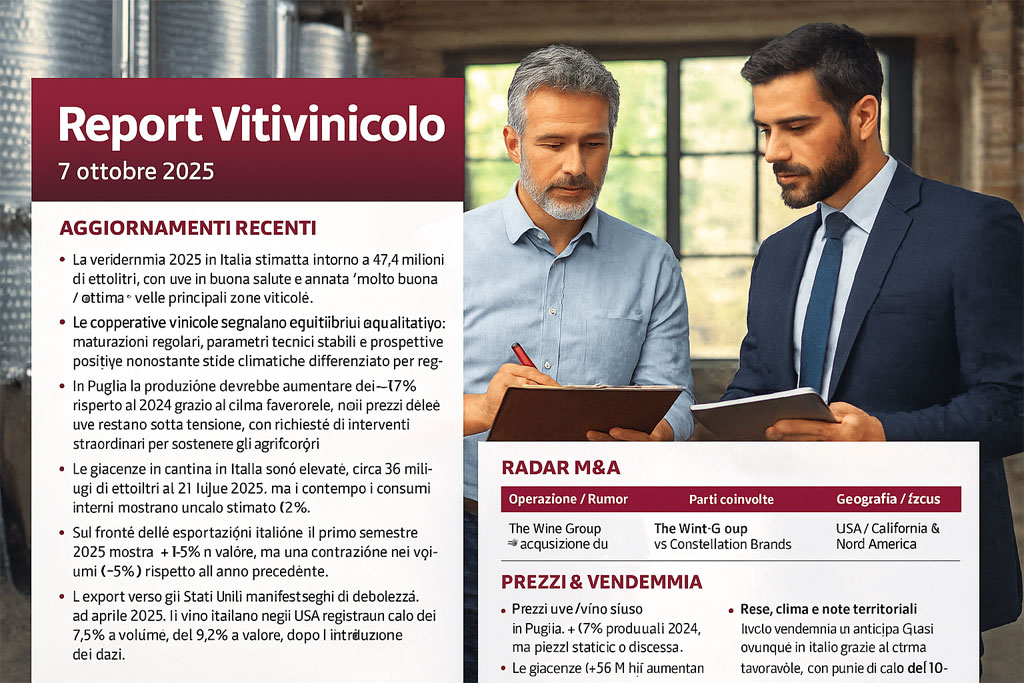
  • According to the 2025 harvest survey by Assoenologi UIV ISMEA, Italian production is estimated at ≈ 47.4 million hectoliters , 8% compared to 2024. Grapes in good-excellent general condition.
  • At the regional level, Veneto remains the leading producing region (~12 million hl), followed by Puglia and Emilia-Romagna. Tuscany recorded a sharp decline (-13%) compared to the previous year.
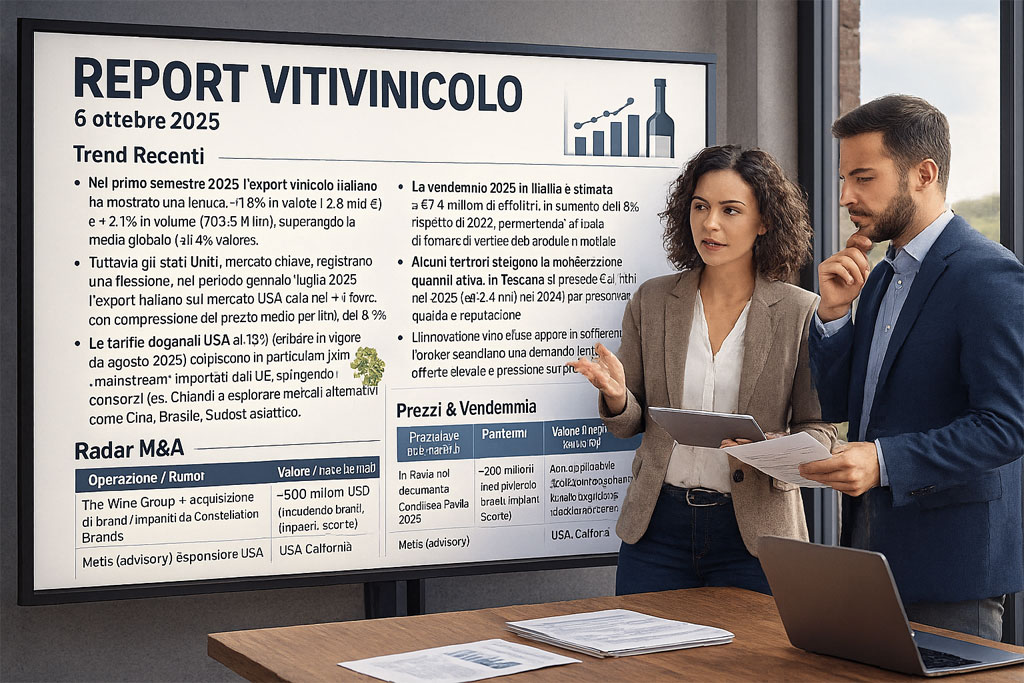
  • Foreign markets: Italian exports grew in value (1.5%) and volume (2.1%) in the first six months of 2025 in the main international markets, despite trade tensions, tariffs, and inventory postponements.
  • Wine prices and segmentation: slight increase in producer prices (Producer Price Index 1%), but differing trends: 4% for white table wines; decline for DOC‑DOCG red wines; slight increase for IGT.
  • Domestic consumption in Italy is slowing: in large-scale retail channels, value is stable or slightly increasing, but volume is decreasing; “traditional” formats (0.75 L, bottles up to 2 L, bricks) are declining, while alternative formats such as bag-in-box are seeing slight increases.
  • Innovation & Sustainability: Recent studies highlight the growing use of targeted agronomic practices, water management, preventative pest management, and technologies such as artificial intelligence to monitor vineyards, predict phenolic maturity, and optimize resources.
  • Awards / Prizes: Italy wins 138 medals at the 2025 Decanter World Wine Awards , with 6 “Best in Show”.

M&A Radar

Operation / RumorParties involvedDimensions / terms if availableGeographySource & Date
Acquisition of Tenuta Rapitalà by Gruppo Italiano Vini (GIV)GIV acquires 100% of the shares of Tenuta Rapitalà (already owning 90%)Organic Estate, with organic vineyards; size: 176 hectares of organic vineyards in the Camporeale area (Palermo-Trapani)Sicily, ItalyJune 9, 2025
Fantini Wines acquires former Venta la Vega in SpainFantini Wines (Abruzzo) takes control of the former Venta la Vega, integrating it with Finca FellaOwnership of 60 hectares with rights to 180 hectares of vineyards; potential production to be multiplied within 10 yearsCastile-La Mancha, SpainJune 12, 2025
Campari sells Cinzano and Frattina to Caffo GroupCampari sells the Cinzano and Frattina brands to Caffo Group 1915Value around €100 millionItalyJune 26, 2025

Ideas for professional posts

  1. Title: “2025 Harvest: How to Make the Most of a Blessed Harvest in a Saturated Market” Focus: Analysis of strategies wineries can adopt to avoid devaluing their production — product differentiation (premium, organic, sustainable), supply chain agreements, contractual financing, strong territorial branding.
  2. Title: “Wine M&A Transactions: Emerging Opportunities Between Internationalization and Consolidation” Corner: Recent case studies (Fantini, GIV, Campari/Caffo) to understand the drivers of acquisitions: access to land, geographic diversification, economies of scale, quality control; tax and organizational implications.
  3. Title: “Prices, Costs, Markets: The Delicate Balance Between Profitability and Competitiveness in Italian Wine” Focus: Production costs (labor, energy, transportation), the risk of US tariffs, the € exchange rate effect, and how these factors are pushing or compressing margins; practical suggestions for protecting them (market diversification, added value, premiumization).

Wine Report of September 17, 2025

Recent major updates (Italy & global).

Today’s wine world update:

  • The 2025 Italian harvest is estimated at ≈ 47.4 million hectoliters , 8% compared to 2024. Healthy grapes, favorable climate, quality promised to be good-excellent in most regions.
  • Regional production: Southern Italy is growing strongly, with Abruzzo up 25%, Molise 25%, Marche 18%, and Umbria 10%. Tuscany is down approximately 13%. Veneto is stable/slightly increasing compared to 2024.
  • Production surpluses are forecast in some areas, with consumption not appearing to be growing at the same pace. Existing inventories in Italy are quite high.
  • Exports in the first half of 2025: Italy up 1.5% in value and 2.1% in volume compared to the first half of 2024. Some concerns about markets with tariffs, a strong currency (the euro) penalizing exports.
  • Ranking & Awards: In James Suckling’s Top 100 Wines of Italy 2025, the wine of the year is Etna Rosso San Lorenzo 2023 (Tenuta delle Terre Nere) — a sign of how Etna is gaining global clout and credibility.
  • Innovations/sustainability: Increasing use of precise viticultural practices and meticulous health management; interest in technologies such as AI for sensory analysis and spectroscopy to predict grape quality and origin.
  • International Awards: At the 2025 Decanter World Wine Awards , Italy received 138 medals, including six “Best in Show” awards. The constant push toward quality recognized in international competitions is evident.

Prices & Harvest (Mini‑Box)

Region / Variety / SegmentCurrent situationTrend vs last year / vs last few weeksNotes on yield, quality, weather
Generic Italian black grapes (wholesale, counter)~ €4/kg for non-varietal/undifferentiated black grapes.Prices stable compared to recent weeks; slightly higher than the 2024 low for similar varieties.Good health conditions; some critical issues in isolated areas, but overall a positive spring and early summer; modest yields in some denominations to ensure quality.
2025 Italian Harvest (Volume and Regional Distribution)National estimate ≈ 47.4 million hl; Southern and central regions growing, Tuscany declining.8% vs 2024; some regions 20-25% (e.g. Abruzzo, Molise), others physiological reductions (e.g. Tuscany -13%).Expected quality is good to excellent; relatively favorable climate, but regional volatility remains; controlled yields in premium appellations.
Stocks & bulk winesBulk wine prices ex-cellar stable vs. previous month; relative shortage of white wine/must stock; red wine supply/demand more balanced.No strong fluctuations but pressure on costs, reduced availability for certain segments.Especially white wines/musts: risk of supply gap; red wines more protected; climate and phytosanitary management crucial in regions with spring rains/hot summers.

Ideas for professional posts

  1. Title: “2025: Abundant Harvest, but Strategic Balance Needed to Avoid Falling Margins” Corner: Concrete Analysis of Production Surplus: How Companies Can Plan Yield, Promote Premium vs. Volume Wines, Optimize Inventory, and Seek High-Value Markets to Counter Cost Pressure.
  2. Title: “Exporting in 2025: Tariffs, a Strong Euro, and New Safe-Haven Markets” Focus: Details on the impact of US tariffs and the currency; export diversification strategies (Asia, Africa, South America); examples of wineries already moving into alternative markets; international co-marketing.
  3. Title: “Sensory Innovation and Sustainability: The Key to Standing Out in International Rankings” Focus: Presenting how technologies such as AI, spectroscopy, and sustainable vineyard management are no longer optional extras but rather required by critics and consumers; practical cases; and opportunities for those targeting premium brands or prestigious denominations

Morning report for Sunday, September 8, 2025

Designed as strategic support for your professional post in the wine and cellar sector:

Key Updates (5–7 points)

  • California 2025 harvest under pressure : the harvest is expected to be even more critical than 2024, with reduced production, vineyard abandonments, and approximately 100,000 tons of grapes unsold. The bulk market is stagnant and foreign competition is fierce.
  • Chianti turns to alternative markets : faced with fears of new tariffs from the US, the Chianti Consortium is pushing towards South America, Asia, Africa, Canada, and the Middle East to diversify.
  • US tariffs threaten Italian exports : the imposition of a 20% duty on European imports could reduce Italian wine revenues by approximately €323 million annually. Concerns are growing over the potential decline in consumption and product recalls.
  • Global trends favor Italian sparkling wines : despite the general decline, Prosecco continues to support exports. In some markets, demand for premium wines remains resilient.
  • Australia’s wine producers are declining : the number of producers is expected to decline by 13% between 2018 and 2024; in response, new South Australian laws will require grape pricing by the end of September.
  • Fine wine: a growing pillar of luxury : the high-end wine market reached €30 billion in 2024 and remains a strategic asset in the luxury sector, especially in the out-of-home sector (27% from 2022).
  • AI for sustainability and performance : a recent study highlights the role of artificial intelligence in optimizing irrigation, vineyard monitoring, production, and food and wine tourism.

M&A Radar

(There have been no recent transactions or significant rumors in the wine M&A sector at this time. Continued monitoring is recommended.)

Prices & Harvest (Mini Box)

  • Bulk wine prices (Italy, ex-cellar) : According to Ciatti (June 2025), prices are stable compared to the previous month , with limited stocks of white wine and grape juice, while red wine remains balanced between supply and demand.
  • Pre-harvest stocks : Reduced availability of white wine and grape concentrate; normal red wine stocks.
  • 2025 harvest conditions : scenario to monitor, with potential surplus in some areas and macroeconomic price pressure due to a strong euro and slowdown in consumption.

Post Ideas for Your Professional Audience

  1. Title : “California 2025: a harvest season to watch and learn from” Angle : highlights the response model – foresight and adaptation – in an area that is now climatically and commercially advanced.
  2. Title : “Diversification to win: Italy explores new markets despite US tariffs” Angle : tells how Chianti and other players are focusing on alternative areas, transforming a threat into strategic opportunities.
  3. Title : “Artificial Intelligence in the Vineyard: Sustainability That Produces Value” Angle : Illustrates the concrete application of AI in the supply chain (monitoring, wine tourism, production), positioning wineries as centers of innovation and resilience.
Style Selector
Select the layout
Choose the theme
Preset colors
No Preset
Select the pattern