A network portal of Wine Idea. Discover the world of Wine idea

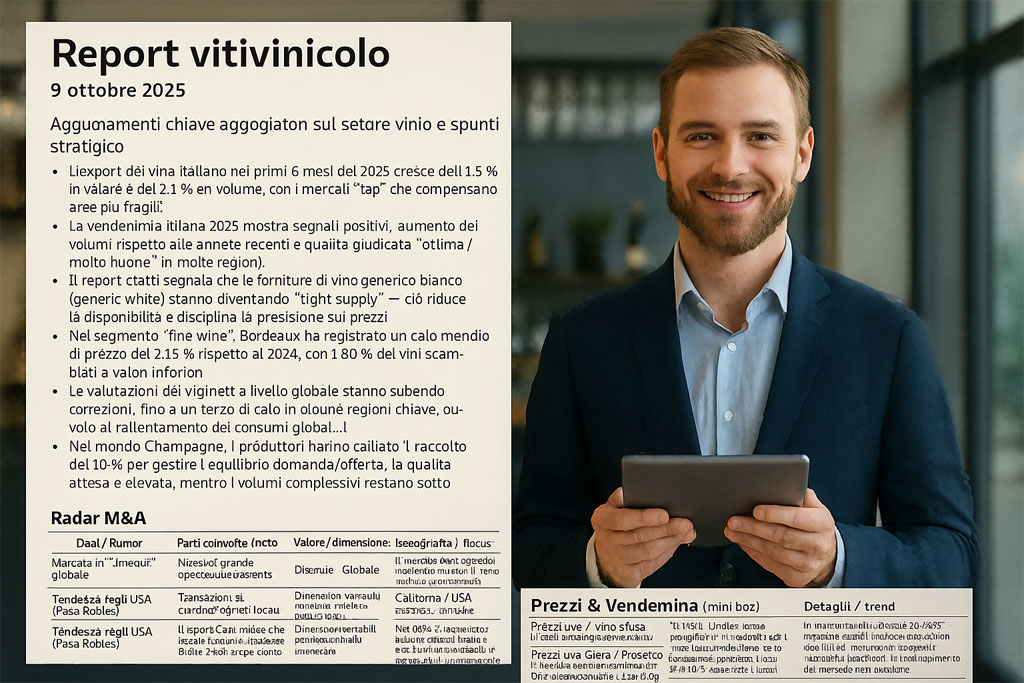
Wine Report of September 23, 2025

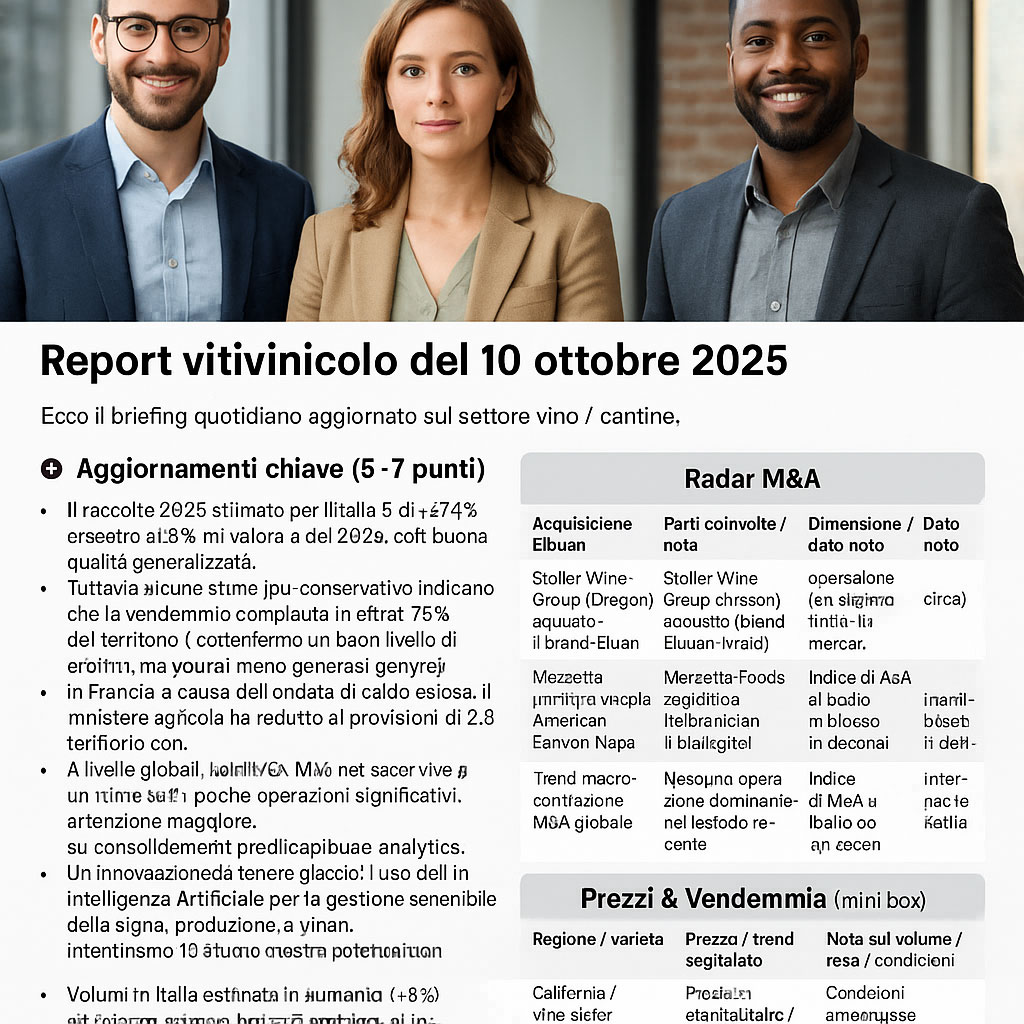
Here it is: this morning’s report (September 23, 2025) with the latest updates useful for operations, positioning, and strategy in the world of wine & cellars.

Recent news

  • Italian exports in the first six months of 2025 remained essentially stable in value (-0.47%) compared to 2024, but recorded a decline in volume (-3.1%). Veneto continues to lead the way, with a 1.5% share in value and ~37.1% of total exports.
  • The 2025 Italian harvest is estimated at ~ 47.4 million hectoliters , 8% vs 2024. Production is growing especially in the South (Puglia 17-19%, Sicily 20%), while Tuscany expects a decrease compared to 2024 for certain varieties, although with an improvement in the organic share.
  • Grape prices: Strong demand for generic whites, especially in Puglia; prices have recently risen, but could stabilize by the end of September.
  • Exports to the USA: In July 2025, the value of Italian wine exports to the USA will be ‐1.1% lower than in July 2024; volumes will increase slightly, but the average price/liter will decrease (≈ ‐13.9%) due to the new tariffs that came into effect.
  • Winemakers report a global market suffering from saturation: production growth risks supply exceeding demand; US tariff policies and changes in consumption (health trends, “no/low alcohol”) add to uncertainty.

Prices & Harvest (mini box)

Region / VarietyCurrent price / signalTrend vs. pastNotes on yield / quality / weather
Puglia, generic white grapesRising prices, especially for grapes intended for generic wines or rectified/concentrated musts.Up compared to the same period in 2024; but signs that they could level off by the end of September.Favorable climate; few phytosanitary issues in the South; high demands from growers/bottlers.
Tuscany, red varieties (e.g. Sangiovese)Less dynamic prices, potential premiums for quality/organic products; but expected total yield is down vs. 2024.Reduced production compared to 2024; quality expected to be good-excellent in areas with traditional/organic management.Estimated production of ~2.4 million hl vs. ~2.7 in 2024; strategic choice in some areas to lower yields to preserve quality.
Italy in generalEstimated production 47.4 million hl (8% vs 2024); generally good quality.Production significantly higher than 2024, returning to the five-year average after difficult years.Some areas in the North are experiencing problems with humidity and mold; conditions in the South are more stable; harvests have begun for white grapes, with red grapes on the way.

Strategic themes & risks in focus

  • Exposure to new US tariffs: not only a direct impact on prices, but also the risk that the “stockpiling” effect (advance purchases) will distort real demand.
  • Overcapacity and competition in the generic/bulk segment: differentiation in value (cru, organic, storytelling) is needed to avoid competing solely on price.
  • The “no/low alcohol” trend and changes in consumption: opportunities for innovation in products, packaging, and commercial positioning.
  • Rising production costs (energy, logistics, and plant protection); significant agronomic/technological choices to reduce weather risks, disease, and poor yields.

Content ideas for professional (business-oriented) posts

  1. Title : “Quality vs. Quantity: How Italian wineries are modulating yields to increase value” Angle : focusing on cases in Tuscany or Piedmont where they have chosen to reduce volume to maintain quality, understanding the impact on costs, sales prices and product image.
  2. Title : “Exporting Without Surprising: Italian Strategies After US Tariffs” Focus : Analyze how companies are adjusting prices, packaging, and alternative markets (Canada, Asia, and emerging markets) to offset the negative effects of tariffs; the role of institutional promotion and trade agreements.
  3. Title : “The Return of Generic Wine: Risk or Opportunity for Artisan and Medium-Sized Wineries?” Focus : Exploring how demand for “entry-level” or generic wines is driving up the prices of generic grapes; which companies can leverage this segment; and how to differentiate (brand, label, packaging) to avoid being caught in competition based solely on costs.

Wine Report of September 22, 2025

Here’s this morning’s updated report on the world of wine and wineries—operational insights, strategic signals, and risks to monitor.

Main news

  1. Italian exports first semester 2025
    • In the first six months, Italian wine exports recorded a -0.47% in value compared to the same period in 2024, while exported volume fell by -3.1%.
    • The US market continues to be central, showing growth driven mainly by pre-tariff stockpiling.
    • Veneto remains the driving force: 1.5% in value, with export share rising to 37.1%. Sparkling wines remain almost stable in value, with only slightly positive volumes.
  2. 2025 Italian Harvest: Abundant and (mostly) Good Quality
    • Production estimated at ~47.4 million hectoliters, 8% vs 2024.
    • Southern regions such as Puglia and Sicily show very strong increases (≈ 19%) in production.
    • Some areas, such as Tuscany, are forecasting a reduction compared to last year for certain varieties (e.g. Sangiovese), but they remain above the recent average.
    • Organic production is growing (Tuscany) and the general qualitative balance is improving, although local disparities due to weather conditions persist.
  3. Consolidation & Acquisitions
    • WarRoom Cellars has acquired Iris Vineyards (Willamette Valley, Oregon). The acquisition is designed to strengthen the portfolio, with national distribution handled by Total Beverage Solutions.
    • Heineken Beverages is making significant moves to revitalize its wine brands, including Nederburg, through investments and more aggressive positioning strategies.
  4. Trends and signals from foreign markets
    • The European bulk wine sector is looking closely at the 2025 harvest season: surplus production in some areas, prices under pressure.
    • In Australia, despite the reduction in supply, price pressures persist. The vineyard market also remains “quiet”—little movement, with decisions on the most valuable varieties pending.

Emerging Risks & Challenges

  • US Tariffs / Trade Policy : Stockpiling has mitigated the effects for now, but buyers and producers signal that real demand could weaken over time, especially after protectionist measures are enacted or announced.
  • Global market saturation : With increasing production and stagnant or declining demand in some markets, the risk of oversupply in less diverse categories increases. Logistics, energy, and environmental costs are variables that compress margins.
  • Regional Varieties & Quality : Differences in yield and quality between regions could penalize less powerful or less powerful brands if they don’t maintain rigorous standards; vigilance is needed regarding early grapes, water stress, and bunch health.

Strategic opportunities

  • Promote appellations/crus/premium/organic wines : quality becomes a lever for distinctiveness. Areas with growing organic production (e.g., Tuscany) have scope for promoting them with a strong brand.
  • Strengthen the narrative around emerging markets, those less exposed to tariffs (or those that absorb them better). Diversify not only geographically, but also in terms of consumption: “lighter” wines, aromatic whites, wines destined for the HoReCa market versus retail.
  • Explore targeted acquisitions or partnerships: As with Iris Vineyards, merging brands with strong local reputations can help achieve economies of scale and distribution.
  • Cost optimization & operational improvement: Given the pressure on margins, companies that already invest in advanced agronomy, traceability, sustainability, and efficient logistics will have a competitive advantage.

Wine Report of September 21, 2025

“Wine 2025: Record Production, Unstable Exports, and Sustainability at the Center”.

  • Key Points
    1. Italian production recovers, confirming its global leadership. Italy expects a 2025 harvest of approximately 47 million hectoliters , 8% higher than 2024, allowing it to maintain its world leadership ahead of France and Spain. Southern regions such as Puglia and Sicily are driving growth.
    2. Sparkling wines and green certifications as differentiating levers. According to the Valoritalia 2025 Report, sparkling wines will grow by 5% in 2024, while red wines will decline by 6.8%. Interest in sustainability certifications is growing (among both producers and consumers); they are becoming key factors for accessing premium markets and building perceived value.
    3. Exports: top markets growing, but widespread instability In the first six months of 2025, Italian wine performed well in Canada (~11% in value), Germany (10.3%) and Japan (0.7%) compared to 2024. However, important markets (United Kingdom, Switzerland, China) are showing declines, often linked to tariffs, changes in consumption or economic pressure on consumers.
    4. Wine tourism and direct sales: opportunities with digitalization and quality of experience. The Divinea-Wine Suite 2025 Report notes that wineries that invest in hospitality, digital marketing, direct sales, and staff training achieve tangible competitive advantages. Wine tourism, as a cultural and tourism phenomenon, continues to integrate with sustainability, local storytelling, and differentiated experiential offerings.
    5. Global trends that cannot be ignored: climate change, consumption moderation, technological innovation . Climate change is pushing wineries to develop drought-resistant varieties, regenerative practices, and more efficient water management. Global wine consumption is under pressure: an aging consumer population, new preferences for “light,” low-alcohol, or experiential beverages. Technology and AI are increasingly integrated, not only in production but also in the customer experience (virtual tasting, recommendations, direct management).

    Quick Strategic Implications

    • When making acquisitions or investing, focus on producers with established sustainable certifications who have already experimented with direct-to-consumer and responsive wine tourism: these tend to maintain or increase value even in unstable markets.
    • In southern regions with strong production, enhancing the “territorial brand” combined with consistent quality can be distinctive in foreign markets, especially where sustainability is required.
    • Monitor tariffs, trade policies, and currency exchange rates: In many key markets, competitiveness can be eroded by factors beyond your direct control.
    • Investing in digitalization not as a “luxury,” but as an operational asset: direct sales, CRM tools, personalized experiences, and storytelling already make a difference.
    • Anticipating and managing the risks of climate change: resistant varieties, irrigation management, and adapting agronomic practices to ensure quality and production continuity.

Wine Report of September 20, 2025

Wine report for today, September 20, 2025, with updated data and operational analysis to support your acquisition, sale, or positioning decisions.

Key numbers of the day

MetricsValue / trendQuick implications
Wine exports (first half of 2025 vs 2024)-0.47% in value (≈ €3.86-3.87 billion), -3.1% in volume.Exports are close to breakeven, but the loss of volume exposes margin risks; focus is needed on premium segments and growing markets.
2025 Harvest (Expected Production and Quality)≈ 47.4 million hectoliters, 8% compared to 2024; grapes in good-excellent health.Good production potential, but attention must be paid to stock management and valuation to avoid sell-offs.
Large-scale retail trade, sparkling wines & internal channelItalian large-scale retail trade holds up in value (0.7% in the last 12 months), but loses volume (-2.5%); sparkling wines 7.6% in volume in many cases.A modern channel remains essential; sparkling wines are a driving force: invest in packaging, promotion, and premiums for differentiation.

Italian wineries (news, strategies, mergers, events)

  • No significant mergers have been reported recently; the prevailing strategy is to differentiate between quality and terroir rather than aggregation. Various sources emphasize that many wineries are focusing on improved agricultural practices, territorial identity, and certifications.
  • Some wineries are putting pressure on their contractors/suppliers (e.g. in Trentino) to adjust their remunerations, given the rising costs and pressure on margins.
  • Recent noteworthy events: Sip of Italy / Wine Enthusiast in New York with over 300 Italian labels, an opportunity for international visibility.

Italian wines (new labels, awards, trends)

  • Italian sparkling wines: holding steady or growing in some markets; volumes of sparkling wines increase (0.1%) despite a slight decline in overall value.
  • Prosecco DOP: continues to be a driving force, with growing volumes and a strong presence on foreign markets.
  • White and sparkling wines in large-scale retail trade: still white wines and sparkling wines are the best-performing categories in many large-scale retail channels; red and sparkling wines are suffering losses in volume.
  • The trend of “drinking better, not as much”: consumers are becoming increasingly selective, prioritizing identity, sustainability, packaging, and authenticity.

Italian wine trends (exports, consumption, economic data)

  • Exports maintain almost the same value share as in 2024 (-0.47%), but volumes are decreasing: -3.1%.
  • The 2025 harvest promises good quantities (8%) and high quality, but with significant stocks (cellars already have high stocks) which require the domestic and foreign markets to absorb the surplus.
  • Regional: Veneto consolidates its export leadership (1.5% value, approximately €1.4 billion). Tuscany and Piedmont slightly decline in value.
  • Large-scale retail trade: stable or slightly growing in value; volume losses, especially for generic wines, non-premium reds, and larger formats. Sparkling wines and white wines are the most resilient categories.

Emerging Risks & Opportunities

Here they are, with practical suggestions for interventions that can make a difference:

  • Opportunities: Premiumization & Territorial Enhancement Investing in labels with strong territorial ties, historical heritage, and native grape varieties; producing wines with distinctive packaging and storytelling communication can yield higher margins in foreign markets.
  • Opportunity: Sparkling Wines as a Strategic Lever The sparkling wine segment is currently one of the few experiencing significant growth; wineries with production capacity, reputation, and quality control can increase their export/domestic spending share by leveraging this category.
  • Risk: Margin Compression for Non-Differentiated Wines Generic wines, non-premium reds, and large or bulk formats risk seeing margins eroded by energy costs, tariffs, and unfavorable exchange rates. It’s important to evaluate whether to continue in these segments or reorient.
  • Opportunities: Non-EU markets and geographic diversification. Positive signs from Canada, the USA (despite tariffs), and Australia. Asian markets are declining in some cases, but demand for quality remains high. Strengthening sales, logistics, and brand awareness in those markets showing growth is worthwhile.
  • Risk: Inventory and Average Price Management With the harvest increasing and stocks already large, those who do not monitor the unit cost/price ratio may find themselves forced to discount, promotional offers or sales below cost, which damage their positioning.

Final summary

Italian wine is experiencing a precarious balance , but it’s not without levers for building value. Despite stable exports in value and supported by specific segments (sparkling wines, leading regions like Veneto), the challenge of declining volumes and cost pressures remains. The 2025 harvest offers an excellent opportunity in terms of both quantity and quality, but the surplus and inventory necessitate a careful differentiation strategy (premium, terroir, packaging) and a strong commercial presence in markets that reward these characteristics.

Style Selector
Select the layout
Choose the theme
Preset colors
No Preset
Select the pattern