A network portal of Wine Idea. Discover the world of Wine idea

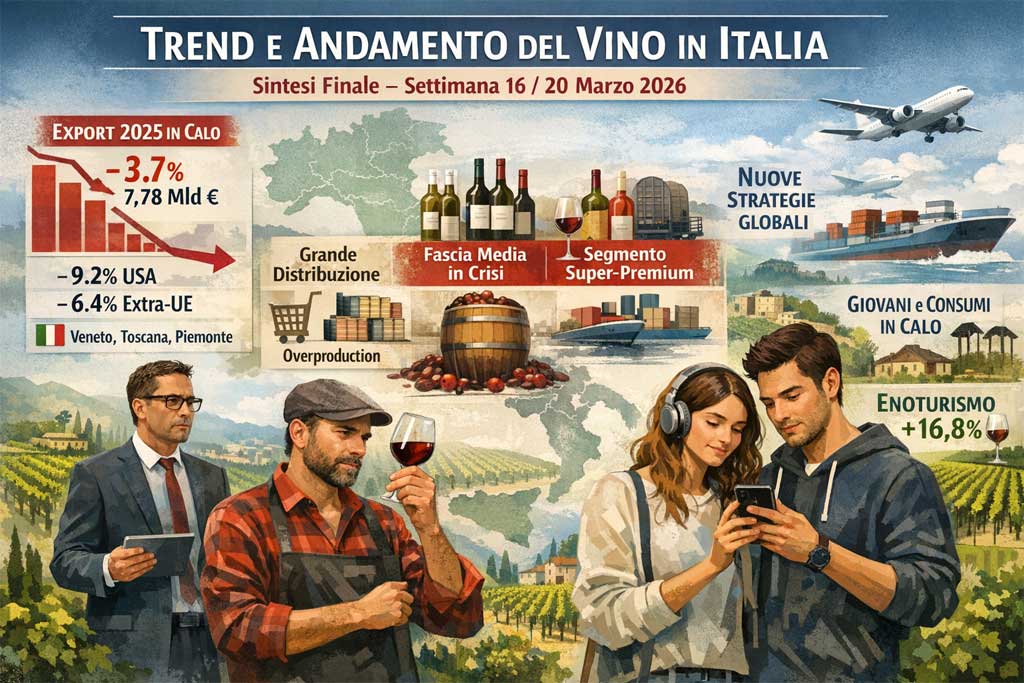
Wine Trends and Performance in Italy – Final Summary – Week 16 – March 20 – 2026

The Italian wine sector is currently undergoing a structural transformation that simultaneously affects production, consumption, international trade, and market models.

The data and analyses released during the week of March 16-20, 2026, confirm that the wine industry is not simply experiencing a cyclical phase, but rather a profound shift in the economic balance that has sustained the sector over the past few decades.

Exports down in 2025: the impact of tariffs and the global slowdown

2025 ended on a negative note for Italian wine exports. According to data from the Italian Wine Union Observatory based on Istat, exports reached 7.78 billion euros , a 3.7% decrease compared to 2024 , equal to approximately 300 million euros , while volumes fell 1.9% to approximately 21 million hectoliters .

The slowdown was primarily driven by tensions in non-EU markets, particularly the United States, the world’s leading market for Italian wine, where sales fell by 9.2% , resulting in a loss of approximately €178 million . In the second half of 2025, the decline was even more pronounced, with peaks approaching 23% and a significant reduction in average prices.

Overall, non-European markets recorded a contraction of -6.4% , while the European Union demonstrated greater stability, with growth of 0.5% driven by Germany, France and the Netherlands.

At a territorial level, the three major Italian wine regions remain dominant:

  • Veneto : 2.9 billion euros (-1.2%)
  • Tuscany : 1.17 billion (-2%)
  • Piedmont : 1.15 billion (-2.2%)

Together they represent over 66% of national exports , confirming the strong geographical concentration of the value of Italian wine in the world.

Global consumption and demand: the market is polarizing

The most significant change, however, concerns demand. Global wine consumption is not simply decreasing: its structure is changing .

The market is polarizing into three large segments:

  1. Large-scale distribution and accessible segment
    It remains relatively stable because it caters to more controlled and price-conscious domestic consumption. In a context of inflation and reduced spending outside the home, many consumers are protecting their daily purchases by choosing more affordable bottles.
  2. Super-premium segment
    Iconic wines with a strong territorial reputation demonstrate strong resilience. Here, wine is purchased as an experience, a gift, or a collectible. Consumption decreases in frequency but maintains its value.
  3. Mid-market range
    This is the segment most exposed to the crisis. Too expensive to be considered everyday consumption and not distinctive enough to be perceived as a premium choice, it is experiencing strong competitive pressure and margin compression.

This dynamic represents one of the main factors of the current overproduction , that is, production exceeding the market’s actual absorption capacity.

Overproduction: From an Agricultural Problem to a Strategic Problem

For many years, the excess wine was managed as a technical or agricultural problem, using tools such as emergency distillations or temporary storage. Today, it’s clear that these solutions are merely stopgap measures.

The key issue is strategic and industrial : part of the supply is no longer aligned with current demand. Continuing to produce large volumes of undistinguished wines aimed at the mid-range market represents one of the riskiest decisions for many companies today.

The market increasingly rewards:

  • territorial identity
  • stylistic recognisability
  • range coherence
  • clarity of positioning

The Prosecco case: bottling to slow down in 2026

Among the most evident signs of the new context is the slowdown of Prosecco DOC , one of the driving forces of Italian exports in recent years.

In the first two months of 2026 , bottling recorded:

  • -19% in January
  • -14% in February

The decline is partly linked to the rush to buy stocks that occurred in 2025 before the introduction of US tariffs, but even analyzing the average of the last four years, the figure remains negative ( -7% ). This signal highlights a phase of readjustment for one of the symbolic products of Italian wine.

International markets: new strategies and investments

In parallel with the slowdown in some emerging markets, such as China – where wine imports decreased by -14.6% in value and -26.7% in volume – some companies continue to invest in building international distribution platforms.

Operations such as Ethica Wines’ expansion into the Chinese market demonstrate how the sector is seeking to strengthen its presence in global markets through more structured and integrated distribution models.

New consumption models: drinkability, moderation and simplicity

The style of wines finding their way onto the market is also changing. Consumers are increasingly seeking:

  • drinkability and freshness
  • more moderate alcohol content
  • gastronomic versatility
  • immediacy of consumption

In a context where people drink less, the ease of returning to purchase becomes a decisive metric.

Young People and Wine: A Cultural Challenge

One of the central themes that emerged in the sector debate concerns the relationship between wine and new generations.

The decline in consumption among young people stems not only from economic factors but also from cultural distance. Wine is often perceived as too complex or elitist, while cocktails and spirits convey conviviality, simplicity, and immediacy.

The challenge for the sector is therefore to change its language and storytelling methods , maintaining the cultural depth of wine but making it more accessible, contemporary and inclusive.

Wine tourism: one of the drivers of growth

In contrast to the slowdown in traditional consumption, wine tourism continues to grow strongly.

In 2025:

  • visitors in structured cellars 16.8%
  • direct sales 21.4%
  • Average booking value: 39.4 euros per adult

More and more wineries consider wine tourism not as an ancillary activity but as a strategic business asset and relationship with the consumer .

Sustainability and regenerative viticulture

Another strategic direction concerns the adoption of more sustainable agricultural models. There is growing interest in regenerative viticulture , which aims not only to reduce environmental impact but also to improve soil fertility, biodiversity, and the resilience of vineyards to climate change through digital technologies and innovative agronomic practices.

Conclusion: a sector entering economic maturity

Italian wine remains a cornerstone of the European agri-food economy and a cultural symbol of Made in Italy. However, the sector is entering a phase of economic maturity similar to that experienced by other premium cultural and consumer goods.

The future will no longer depend on the quantity produced, but on the ability to create value.

In a world that consumes less wine, the producers and territories capable of making every bottle necessary, recognizable, and desirable will win. The challenge is not to fill the market, but to conquer a space within an increasingly aware and selective consumer base.


Wine press review for Thursday March 19 -2026

Italian wineries, Italian wine producers, and current wine news.

A daily overview of the main news from the world of wine: companies, markets, innovation, events, and international scenarios impacting the wine sector.

Italian Wineries

Villa Sandi begins generational transition

Diva and Leonardo Moretti Polegato will join Villa Sandi’s Board of Directors as vice presidents. Owner Giancarlo Moretti Polegato thus begins the generational transition of the Treviso-based company, while maintaining strategic leadership of the group. The recognition received in Düsseldorf with the Meininger Award for Excellence in Wine & Spirits underscores the winery’s international role in promoting Prosecco and wine tourism.

Valdo acquires 100% of the Friulian winery I Magredi

Valdo completes the acquisition of I Magredi in the Grave del Friuli area, creating a group with approximately €90 million in revenue and 19.5 million bottles produced. The transaction strengthens the group’s regional presence and exports, with a particular focus on the DACH and North American markets.

Bottega Spa: Four Centuries of Wine and Grappa Tradition

Treviso-based Bottega consolidates its global positioning with a model that integrates its winery and distillery. The brand has become a symbol of Made in Italy in travel retail thanks to the renowned Bottega Gold , a Prosecco DOC with a golden bottle.

New Territorial Identities: Mamoiada and Ostuni

  • Cantina Mussennore relaunches the historic Ghirada Conzimu vineyard with a new Cannonau production.
  • Amalberga , in Puglia, enhances the Ostuni DOC by working on native vines and historic vineyards, with a winemaking project strongly rooted in the territory.

Torrecuso Fortress: cellar and wine museum

Entrepreneur Enzo Rillo’s project integrates production, wine tourism spaces, and a virtual museum dedicated to Taburno and Aglianico, strengthening the area’s cultural offerings.

Winery events in the Langhe area of Asti

The Colombo winery in Bubbio is organizing a series of events featuring tastings, culture, and the local area, with Pinot Noir and Chardonnay as the protagonists.

Italian Wine and Oenology

Gen Z and alcohol consumption: the “zebra striping” phenomenon is born

The younger generations drink about 20% less than Millennials , alternating between alcoholic and non-alcoholic beverages throughout the evening. Bars and restaurants are adapting their offerings with lighter drinks and no-/low-alcohol options.

Amarone: Between Identity and New Challenges

The prestigious Valpolicella red wine is expected to decline by 2.4% in 2025 , but maintains a strong international positioning. The debate within the appellation concerns the balance between traditional style and trends toward lighter wines.

Toscana IGT: the sparkling wine category arrives

The National Wine Committee has approved the modification to the regulations that will introduce Toscana IGT sparkling wines , expanding the production scope of the denomination.

The price of wine and the perception of value

Neuromarketing studies from IULM University demonstrate that perceived price directly influences the sensory experience of wine, modifying brain activity linked to pleasure.

Wine and inflation

Over the last ten years, consumer wine prices in Italy have grown by 7.4% , one of the smallest increases in the European Union.

Innovation and experimentation

  • Mountain orange wine projects such as Kaleidoscope in the Isarco Valley are born.
  • Formula 1 manager Mattia Binotto makes his debut as a producer in Trentino with Animantica wine.

Wine in Italian restaurants remains local

Between 70% and 75% of the labels on restaurant wine lists come from the same region as the establishment, strengthening the connection between gastronomy and territory.

Controls on Prosecco on tap

The Italian Food and Agriculture Organization (MASAF) is initiating inspections of bars and restaurants to prevent the sale of bulk Prosecco DOC or DOCG. Fines can reach up to €5,000 .

International

Antinori: Wine Will Return to Growth in the United States

According to Piero Antinori, the decline in US consumption is primarily due to temporary factors such as high inventories and trade tensions. The medium-term outlook remains positive.

Wine takes center stage at the Oscars

Cinema is once again influencing wine consumption: in the 2026 Oscar -winning film, starring Leonardo DiCaprio, a bottle of Spanish wine becomes a narrative symbol and generates great international visibility.

Portugal: A New Destination for Wine Tourism

Between Douro and Alentejo, the country records over 3 million visits to wineries and tourism represents approximately 12% of the national GDP , confirming the growing role of wine tourism in the economic strategy.

Wine Events

Bubbles in the Villa – Villa Farsetti

On March 28th and 29th, the event dedicated to Italian and international sparkling wines returns to Santa Maria di Sala, with over 100 wines for tasting , producers and sommeliers at the tasting tables.

“IO VINO 2026” in Rome

The event dedicated to the native grape varieties of Marche and Campania brought together over 75 producers and 150 B2B operators , promoting biodiversity and regional traditions.

Open Vineyards in Friuli Venezia Giulia

From March 21st until autumn, the Wine Tourism Movement is organizing visits, tastings, and meetings with winemakers to promote the area through immersive experiences among the vines.

Garda DOC at Vinitaly with “Garda360”

The Garda DOC Consortium will present a program of tastings and social tastings at Vinitaly, in addition to the new regulations dedicated to low-alcohol wines .

Slow Wine Coalition

In Bologna, the international community promoted by Slow Food discussed the future of viticulture in inland areas, including sustainability, agricultural income, and land protection.

New Beverage Trends

Liquid Ventures and the no/low alcohol market

Three protagonists of the beverage sector – Bob Kunze-Concewitz, Paolo Dalla Mora and Luca Gargano – founded Liquid Ventures , a European venture builder dedicated to the development of new non-alcoholic and low-alcohol brands.

Innovation in fermented beverages

From beer made with grape must to experimentation with plant-based ingredients like carrots, the intersection between craft beer and the world of wine is growing.

“The Wine of Champions”

Fabio Cordella’s entrepreneurial project involves famous international footballers in the production and promotion of Italian wines, creating a bridge between sport, branding, and the global market.

Strategic synthesis

The emerging picture confirms some lines of transformation in the sector:

  • growing attention to moderate consumption and low-alcohol alternatives
  • strengthening industrial operations between wineries
  • development of experiential wine tourism
  • technological innovation in wine communication and perception
  • growing international competition between wine tourism territories

Today’s wine press review was provided by WINEIDEA.IT

See you tomorrow with new news from the world of wine.

Wine press review for Wednesday March 18 -2026

Italian wineries, Italian wine producers, and current wine news.

Italian wine today is navigating a balance between identity, innovation, market tensions, sustainability, and new ways of engaging with consumers. Alongside signs of difficulty in the sector, there are emerging investments, acquisitions, international awards, wine tourism, and technologies for the viticulture of the future.

Italian wineries

Cuvage, Piedmontese elegance between Alta Langa and Moscato d’Asti

Cuvage, founded in Acqui Terme in 2011, continues to promote Piedmont’s sparkling wine tradition through the Classic Method. The company works with native grape varieties such as Nebbiolo, Cortese, and Moscato, alongside Pinot Noir and Chardonnay for its Alta Langa DOCG. It has a strong focus on sustainability, certified through ISO 14001 and SA8000 protocols.

Piedmontese cooperatives respond to Ascheri

The debate over the crisis in Piedmontese wine is heating up. Following Matteo Ascheri’s statements, Confcooperative Fedagripesca Piemonte has responded firmly, rejecting the idea that cooperative wineries are the scapegoat for the sector’s difficulties and calling for a more serious and structural discussion.

Argea joins Stronger Together

Argea joins the international Stronger Together program to combat labor exploitation in the agri-food supply chain. This membership strengthens the group’s position in terms of social sustainability and responsibility along the supply chain.

Casa Vinicola Martino: Wine Returns to Relationships

In a more competitive and less linear market, Casa Vinicola Martino identifies the direct relationship between producer and consumer as a strategic lever. The message is clear: less technicality, more simplicity, accessibility, and the ability to inspire emotion.

La Dormiente Winery: New Arrivals in Torrecuso

The Sannio-based winery, led by Guerino Cocchiaro, announces changes to the winery with the arrival of enologist Ernesto Buono and the launch of two new labels. While expanding its range to include an international grape variety, Merlot, the winery maintains its ties to the historic Taburno varietals: Aglianico, Falanghina, and Coda di Volpe.

Valdo Spumanti acquires 100% of I Magredi

A significant move in the Italian wine scene: Valdo Spumanti acquires 100% of Friuli-based I Magredi, after previously owning 20%. The acquisition expands the group’s reach into the no-alcohol and low-alcohol segments, strengthening a diversification strategy already supported by production and sales growth.

Cantina Vogadori, premium experience in Valpolicella

The Fratelli Vogadori winery offers “The Art of Terroir,” an exclusive experience in Valpolicella Classica, including historic vineyards, a fruit cellar, a wine shop, and premium tastings of the great Veronese reds.

Italian wine and Italian oenology

Italian wine: the numbers of excellence

A special feature on Italian wine highlights the value of a production spread across all regions, with a wealth of DOC and IGP labels that tell the story of its history, territories, biodiversity, and winemaking tradition.

Agricultural Civil Service kicks off with over a thousand young people

The Agricultural Civil Service has officially launched, with 82 selected projects and 1,057 young people involved. This isn’t just a tool for recruiting workers, but rather a training and civic program focused on promoting the local area, sustainability, food education, and inclusion.

Robots, vineyards, and intelligent machines: the future lies in Chianti.

Enovitis in campo is celebrating its twentieth anniversary and is focusing on robotics, electrification, soil and canopy management, biostimulants, and agronomic innovation. The event is scheduled for June 17th and 18th at the Nozzole Estate, in the Chianti Classico region.

Renzo Cotarella awarded by the Masters of Wine

The Institute of Masters of Wine has awarded Renzo Cotarella the 2026 “Winemakers’ Winemaker Award,” recognizing the value of his winemaking journey and the pivotal role he has played within Marchesi Antinori. This award confirms Italy’s central role in the global premium wine scene.

World Pignolo Day: Udine celebrates the Friulian grape variety.

“World Pignolo Day” returns to Udine on Friday, March 20th, an initiative dedicated to the protection and promotion of Pignolo, an ancient native Friulian grape variety. The event confirms the growing attention paid to distinctive grape varieties and niche productions with a strong territorial focus.

Mattia Binotto from Formula 1 to the vineyard

The former Ferrari manager presents his first wine, Animantica, produced in Faedo, Trentino, at the new Eleusi winery. A project that combines anticipation, precision, and identity, transforming wine into a new form of personal and entrepreneurial expression.

Between a difficult 2025 and a vision for 2026

ProWein Düsseldorf offers important insights from numerous Italian wineries. 2025 is seen as a complex but not catastrophic year, while 2026 highlights the need to focus on passion, the market, adaptation, and a renewed ability to engage consumers.

Campanian wines take center stage at ProWein

The Campania Region confirms the centrality of wine in its agri-food sector, bringing tastings, masterclasses, and protection consortia to Düsseldorf. Public support for international promotion remains a strategic cornerstone for the competitiveness of regional businesses.

Women Producers: Gilda Guida and Campanian Wine Through a Female Eye

Gilda Guida’s journey, linked to Cantine Grotta del Sole and the promotion of native Campanian grape varieties, expresses an entrepreneurial vision in which wine, territory, and the presence of women become drivers of rebirth and consolidation.

Tariffs and exports: expectations for 2026 trends

ICE President Matteo Zoppas reports a slowdown in Italian exports to the United States at the end of 2025, despite a still positive outlook. Attention now shifts to the first months of 2026, which are crucial for understanding the evolution of the impact of tariffs on wine and Made in Italy products.

International

Artémis Domaines supports wine professionals affected by wars

The Pinault family holding company, in conjunction with the Gérard Basset Foundation, is launching the “Golden Vines 2026” scholarships for wine professionals whose careers have been interrupted by war or geopolitical crises. The project offers six-month paid internships at the group’s estates.

Duclot challenges restaurant markups

In France, a concrete debate is taking place regarding the price of wine at restaurants. Duclot’s initiative, which aims to offer great Bordeaux wines at more accessible prices, is reigniting the debate on consumption, margins, purchasing power, and the economic sustainability of the supply chain.

Canadian wine booms in the domestic market

In Canada, sales of American wines are plummeting, while local wines are growing strongly, especially in Ontario. Trade tensions with the United States are driving a reconfiguration of domestic consumption and a new visibility for domestic producers.

Wine events

The Agricultural Show in Trento drew 13,000 visitors.

The 79th Agricultural Exhibition and Bio-logicA in Trento were well attended, with 13,000 attendees. The event confirmed the public’s growing interest in biodiversity, sustainability, the agricultural supply chain, and local produce.

Fairs, festivals, and events for the weekend of March 20-22

With the onset of spring, events dedicated to wine, craft beer, regions, and gastronomic traditions are multiplying throughout Italy. Tastings, e-bike tours through the vineyards, cooking demonstrations, and experiential tours reinforce the role of wine as a driver of tourism and connection.

Open Vineyards returns to Friuli Venezia Giulia

Starting March 21st, “Vigneti Aperti” (Open Vineyards) will resume, an initiative by the Movimento Turismo del Vino FVG (FVG Wine Tourism Movement) that will accompany wine tourists until autumn with visits, walks, tastings, and meetings in the region’s vineyards and wineries.

Drops of Beauty Brings Cantina Destefanis to Turin

On March 25th, Locanda Bellezia hosts an evening of wine, live music, and cuisine with Cantina Destefanis. This urban and convivial format brings the winery experience directly to the city.

Pianzio celebrates spring in the Euganean Hills

The Venetian winery offers an aperitif in the cellar overlooking the Pianzio Valley, focusing on conviviality, local tradition, and hospitality as tools for engaging the public.

Calici a Palazzo: Wine, History, and Beauty

On Saturday, March 21st and Sunday, March 22nd, Palazzo Ducale hosts “Calici a Palazzo,” an event that combines tastings, historical heritage, and direct encounters with producers and wineries in a setting of great cultural value.

Strategic focus of the day

The March 18 snapshot highlights five very clear guidelines for the wine sector:

1. Consolidation and acquisitions The Valdo-I Magredi transaction signals that the market is seeking critical mass, new categories, and greater commercial presence.

2. Agricultural and technological innovation Robotics, electrification, and intelligent vineyard management are becoming increasingly central to competitiveness and sustainability.

3. Wine tourism and direct relationships Open Vineyards, winery tastings, and local events demonstrate that wine is increasingly sold through experience and human contact.

4. Territorial identity and native vines From the Pignolo of Friuli to the Taburno vines, the strategic value of productions with a strong identity is growing.

5. International pressure and the need to adapt. Between tariffs, unstable markets, restaurant markups, and new consumer habits, the sector is being called upon to rethink its positioning, accessibility, and narrative.

Wine press review for Tuesday March 17 -2026

Italian wineries, Italian wine producers, and current wine news.

The wine sector continues to navigate market transformations, new commercial strategies, technological innovation, and the valorization of local areas. From export challenges to new wine tourism models, sustainability, counterfeiting, and major wine events, here are the top stories of the day.

Italian Wineries

Ermes Cellars: Wine, Art, and Territory for Growth

In the heart of the Belice Valley, Cantine Ermes is strengthening its cultural and regional project with the new Bistrot Orestiadi , which will be presented on March 19th in Gibellina. The cooperative, one of Italy’s leading wineries, boasts over 14,000 hectares of vineyards and more than 2,700 members in six regions , with approximately 190 permanent employees. The Tenute Orestiadi project was created to showcase the Sicilian region through wine, art, and cultural identity.

Avignonesi: The Biodynamic Sangiovese That’s Conquering the World

The Avignonesi winery in Montepulciano today represents one of the most advanced models of biodynamic viticulture in Italy. Led by Virginie Saverys, the company exports to 37 countries and continues to develop a production model based on sustainability, environmental responsibility, and the valorization of Sangiovese in the Vino Nobile di Montepulciano region.

Caparra & Siciliani, historic custodians of Cirò

Among the leading figures in Calabrian winemaking, Caparra & Siciliani cultivates approximately 120 hectares of vineyards in the heart of the Cirò appellation , producing approximately 500,000 bottles annually . Their goal remains to promote the area’s native grape varieties while maintaining a strong bond between tradition and quality.

Cantina 366 and the winemaking identity of Canavese

In the Canavese area, shaped by the ancient glaciations of the Dora Baltea River, viticulture finds an ideal microclimate for denominations such as DOC Canavese and DOCG Erbaluce di Caluso . Local viticulture continues to tell a story of geology, rural tradition, and territorial identity.

Siddùra: Gallura’s Vermentino among Italy’s finest white wines.

Sardinian winery Siddùra has won important awards for its Vermentino wines. The Spèra Vermentino di Gallura DOCG earned 96 points and was named among Italy’s best white wines, while the Bèru Vermentino di Gallura Superiore won the Best of Show Sardinian White title at the Mundus Vini Spring Tasting 2026.

Italian Wine and Italian Oenology

Italian wine exports to decline in 2025

According to the UIV Observatory, Italian wine exports in 2025 totaled €7.78 billion (-3.7%) and 21 million hectoliters (-1.9%) . The decline is mainly attributed to the US market, which fell 9.2% , with a loss of approximately €178 million . The United Kingdom, Canada, Switzerland, and Russia also experienced difficulties.

Agritourism on the rise: over half of guests are foreigners

Rural tourism continues to grow: in 2024, there were 26,360 agritourism businesses in Italy, a 0.9% increase over the previous year. Agritourism visitors reached 4.7 million , with 54.8% coming from abroad , a sign of the growing international appeal of Italian food and wine tourism.

Wine tourism: visitors and direct sales are growing rapidly.

The Wine Suite 2026 Report highlights a strong development in wine tourism:

  • visitors to structured cellars 16.8% annually
  • direct sales 21.4%
  • average booking value 39.4 euros per adult

The theme will also be central to Vinitaly Tourism 2026 .

Tuscany and wine: a mosaic of territories

Tuscany isn’t just about Sangiovese or Bolgheri. The regional wine scene is a veritable puzzle of terroirs, microclimates, and grape varieties, ranging from reds to whites, from coastal areas to inland hills to islands.

In Roero, production remains balanced

The Piedmontese Roero continues to stand out for its balanced production model, with viticulture that maintains a deeply rooted territorial and cultural dimension.

Trapani social wineries: wine sold but not collected

Wine cooperatives in the province of Trapani are raising the alarm: some of the wine sold is sitting in cellars due to rising transportation costs, exacerbated by geopolitical tensions in the Gulf.

Palmento Costanzo and gravity-driven winemaking on Etna

The restoration of the ancient lava stone wine presses demonstrates the continuity between tradition and innovation in Etna viticulture. Gravity-assisted winemaking preserves the integrity of the grapes, reducing mechanical intervention.

Precision viticulture: automatic grape detection

New technologies now allow us to estimate production in advance thanks to the automatic detection of bunches , improving resource management, harvest planning and commercial strategies.

International

US tariffs and the European export crisis

In 2025, European wine exports recorded a 6% decline in value , with an overall loss estimated at €1 billion . Wine represents around 7% of European agri-food exports , but is one of the sectors most affected by trade tensions.

Counterfeit wine and Prosecco in the UK

British authorities have seized over 67,000 bottles of counterfeit wine and Prosecco , worth approximately £500,000 . The operation was conducted by the National Food Crime Unit in collaboration with the Food Standards Agency.

Record early harvest in New Zealand

Climate change is driving New Zealand to its earliest-ever grape harvest in 2026. The country has 42,000 hectares of vineyards and exports wine to over 100 countries , generating around NZ$2.1 billion in exports in 2025.

Sotheby’s: Collectible wine continues to grow

In 2025, wine sales at Sotheby’s auctions reached $127.5 million (12%) . Burgundy dominates with 39% of sales , followed by Bordeaux with 28% . The presence of new, young collectors is also growing.

François Carillon and the Chardonnays of Burgundy

Winemaker François Carillon continues to distinguish himself with an elegant and measured style in the production of Puligny-Montrachet Chardonnays, characterized by freshness, aromatic complexity and a very balanced use of wood.

Wine Events

Vinetia Tasting 2026

On March 22nd , Vinetia Tasting – Veneto in a Glass, organized by AIS Veneto, returns to Santa Lucia di Piave (Treviso). The event will showcase over 800 wines from 150 wineries , with the participation of eight Consortia and four masterclasses dedicated to Veneto wines.

Tuscia Wine 2026

The event brought together over 100 producers and 214 wineries from the Tuscia del Vino guide. It was an event dedicated to promoting the Lazio region with tastings, meetings with producers, and awards for the best labels.

Wine tourism experience in the Euganean Hills

On March 28th, Monteversa will host a new tasting experience organized by Stayinveneto, including a visit to the organic vineyards and a guided tasting.

Cantina Giardino meets Cantillon

In Irpinia, an original event brought together the world of natural wine and the spontaneous fermentation of Belgian Cantillon beer, creating a dialogue between European artisanal traditions.

Work and Agricultural Innovation

Charter of Labor in Agriculture

Confagricoltura Siena has presented a joint declaration to address the transformation of agricultural work, focusing on safety, technological innovation, and greater attractiveness for young people.

Young farmers and technology

In Southern Italy, hi-tech agriculture is growing, led by those under 35, with investments in drones, blockchain, and precision agriculture . The average productivity of young farmers exceeds €4,800 per hectare , almost double the European average.

Curiosity

The cellar of the Gintoneria in Milan is up for auction.

The second auction of the wine and champagne collection once owned by the Milanese venue Gintoneria is underway until March 27. Lots range from €8.50 to over €2,000 , including rare bottles from the seized cellar.

Strategic summary of the day

Three signals clearly emerge from the international wine scene:

  • the global wine market is experiencing a phase of commercial and geopolitical realignment
  • the weight of wine tourism and territorial experience as an economic lever is growing
  • technology and sustainability are becoming concrete operational tools for modern viticulture

Wine continues to be not just an agricultural product, but a complex economic system that unites territory, tourism, culture, and global markets.

Style Selector
Select the layout
Choose the theme
Preset colors
No Preset
Select the pattern