


A network portal of Wine Idea. Discover the world of Wine idea

Wine Press Review – Top News for Saturday August 29 -2026

Italian wineries, Italian wine producers, and current wine news.

Good morning,

ITALIAN WINERIES

Franciacorta: the wineries and their leading labels . Several Franciacorta producers are taking center stage. Uberti presents the distinctive De Quinque RP 02-19 , a Chardonnay crafted from a perpetual reserve that brings together cuvées from 17 vintages and ages on the lees for over 70 months. Ca’ del Bosco presents the Dosage Zéro Vintage Collection 2021, while Tenuta Montenisa – Marchesi Antinori creates the Brut Satèn Donna Cora 2022. Among the local producers is Bosio, a 22-hectare organic winery producing approximately 150,000 bottles.

Villa Raiano, tradition and innovation in Irpinia. Located in San Michele di Serino, Villa Raiano interprets Irpinia through a winery designed to exploit gravity throughout the various production phases. The goal is to combine territorial identity, tradition, and winemaking innovation.

Jerzu, the Cannonau that unites wine and solidarity. The 2023 Cannonau di Sardegna “Vittoria” from the Jerzu Social Winery was also born as a memorial and solidarity project dedicated to Maria Vittoria Orrù. The initiative supports two annual scholarships for deserving students from Jerzu. Etna, Michele Scammacca: the region seeks a new balance. According to Michele Scammacca of Murgo, Etna is undergoing profound change and must bridge the gap between different price ranges. For the winery, the Metodo Classico represents an important strategic choice: approximately 200,000 of the 400,000 bottles produced are made with this method. The market is slowing and the skills required by wineries are changing. According to Andrea Pecchioni of WineJob, companies are increasingly seeking sales professionals capable of developing managerial vision and new markets, from Africa to South America. Furthermore, the importance of hospitality skills at the winery is growing, increasingly linked to direct sales, loyalty, and brand positioning.

ITALIAN WINE AND ITALIAN OENOLOGY

2026 Harvest: Promising Quality, but Climate Increasingly Determining. Initial indications point to a common thread: high temperatures, early ripening, and narrower harvest windows . From Chianti Classico to Alto Adige, the need for highly precise monitoring of vineyards and ripening is evident. Quality expectations remain positive, however.

Oltrepò Pavese: National Wine Strategy Requested As the harvest progresses, Coldiretti Pavia is calling for a National Strategic Plan for the wine sector , developed in collaboration with the wineries. The year was characterized by intense heat and water shortages, and the harvest could end in the first ten days of September. Lugana: Early Harvest and Good Quality Expectations. In Lake Garda, the Turbiana harvest began approximately ten days early . The district covers 2,670 hectares, and approximately 60% of production is intended for export. Quality expectations are positive, and no significant declines in quantity are expected, except in areas affected by hailstorms. Turin: High Quality, but Production Expected to Drop 20%. The harvest has begun with white grapes destined for sparkling wine. Coldiretti Turin predicts a reduction in production of approximately 20% , which could reach 50% in the Canavese areas affected by the Japanese blight. The estimated economic loss is approximately €2 million , while the quality of the grapes is judged to be very good. Hailstorm in the Verona area during the grape harvest. A hailstorm hit Peschiera del Garda, Colà di Lazise, Castelnuovo del Garda, and Bosco di Sona during the ripening and harvesting of the grapes. Investigations are underway to assess the extent of the damage to the companies. Veneto: Clearer rules on the exchange of agricultural labor. The Veneto Region aims to define a clearer framework for the exchange of labor between farmers and for the assistance provided by family members during periods of greater work intensity, such as the harvest. Grappello Ruberti, rediscovering a historic grape variety from the Po Valley . Attention is returning to Grappello Ruberti, a variety historically linked to the territories between Mantua and Cremona. Its history testifies to the value of Italian viticultural biodiversity and the preservation of local grape varieties. Tasting: technique and subjectivity coexist in judging wine. Acidity, tannin, alcohol content, structure, and persistence can be assessed technically; The subsequent qualitative assessment, however, inevitably retains a personal component. A reflection on the boundary between objective analysis and individual interpretation of wine. Italian wine: €1.45 billion in revenue affected by potential changes in ownership or governance. According to reports, at least six or seven major Italian wineries could face significant governance changes in the next 6-12 months, with transactions that would overall affect approximately €1.45 billion in revenue . Fine wine: Italy maintains a role in the international collectibles market. Some of the most prestigious Italian labels find space in the Liv-ex: Piedmontese Barolo and Barbaresco, Masseto, Ornellaia, Sassicaia, Solaia, Tignanello, and Soldera. The secondary market remains separate from the dynamics of ordinary consumption and continues to represent an interesting indicator of the value of fine wines. Vermouth di Torino among the most searched Italian PDO/PGI products on Wikipedia A study of 99 Italian products with a designation of origin places Vermouth di Torino among the most searched for excellences online, along with Gorgonzola, Parmigiano Reggiano, Grana Padano, and Taggiasca olives.

INTERNATIONAL

France: Small yields, but 2026 could be a great vintage. Despite temperatures above 40°C, drought, and fires, early indications suggest potentially highly concentrated and qualitatively interesting wines. The harvest began early in several regions, from Burgundy to Beaujolais and the Loire. In July, French rainfall was 67% lower than the national average .

Rhone Valley: 73% of winemakers adopt climate change mitigation measures. A survey by the Institut Rhodanien shows that 72 of the 98 producers interviewed have already adopted at least one adaptation practice, from early harvesting to irrigation. Climate change is significantly altering viticulture timing and techniques. Albania, early harvest also in Berat. At the Çobo Winery, the harvest of Puls, a native white grape variety also used for Classic Method base wines, began about ten days earlier than usual , further evidence of the impact of temperatures on ripening. Farewell to Branko Čotar, pioneer of orange wines from the Slovenian Karst . Branko Čotar, a leading figure in natural viticulture in the Slovenian Karst, has died at the age of 78. He practiced long macerations on white grapes decades before orange wines became an international trend.

WINE EVENTS, WINE TOURISM AND WINE CULTURE

Open Cellars during Harvest: two months dedicated to wine tourism. From August 24th to October 25th, the Wine Tourism Movement brings visitors to Italian wineries during one of the most important times of the year. Foreigners already represent 35-40% of winery visitors , but the potential for attracting them to Italy’s overall international tourism flows remains significant.

Franciacorta in Cantina Festival. This September, the event dedicated to discovering the Franciacorta region through wineries, tastings, vineyards, historic homes, art, and outdoor activities returns. An example of how wine and the region can become an integrated tourist experience. Gessopalena: Abruzzo’s rare grape varieties take center stage. The “Gli Irripetibili” tasting presents five years of micro-vinifications made with native varieties from the Abruzzo mountains. The Bio Cantina Sociale Orsogna project aims to preserve the genetic heritage and local viticultural heritage. Ardauli: young people discover the origins of Sardinian viticulture. The “Trekking among the Palmenti” led about one hundred participants through historic vineyards and ancient palmenti carved into the rock of the Oristano area, highlighting the relationship between wine, rural archaeology, and territorial identity. Crema Wine Festival: wine, music, and new tasting formats. The Offanengo edition experimented with a format without the traditional lineup of wineries: two expert tasters directly accompany the audience through tastings of wines, accompanied by music and food. Emilia-Romagna: dinners and aperitifs in the vineyard continue. The food and wine events in the vineyards continue until the end of August, transforming tastings, landscapes, and local cuisine into tools for learning about the region and the rural culture of Romagna.

PICTURE OF THE DAY

The 2026 harvest is highlighting a structural shift: the climate is altering the timing, quantity, and methods of wine production . From Oltrepò to Lugana, from Piedmont to France, early harvests, heat, and water shortages are forcing wineries to make increasingly rapid and precise decisions.

Quality, however, remains the positive aspect: in many areas, expectations are good or very good, even when volumes are decreasing.

On the economic front, a second important phenomenon is emerging: the sector is entering a phase of reorganization . The commercial slowdown is changing the skills required by wineries, and at the same time, several major Italian companies could face changes in ownership, the entry of new shareholders, or new governance.

Finally, the importance of wine tourism is growing. Open Cellars, the Franciacorta Festival, tastings in the villages, and initiatives in the vineyards demonstrate how the winery is no longer just a place of production: it is increasingly becoming a place to sell directly, build the brand, tell the story of the region, and create a lasting relationship with the consumer .

Today’s summary: less focus on quantity alone, more quality, adaptability, brand value, direct consumer relationships, and appreciation of the local area. These are the factors reshaping Italian wine.

Today’s wine press review is brought to you by WINEIDEA.IT.

See you tomorrow.

Wine press review for Friday August 28 -2026

Italian wineries, Italian wine producers, and current wine news.

Good morning,

Wine Idea presents the main news from the world of wine , reorganized in a concise and immediate format to offer a clear understanding of the dynamics affecting wineries, production, markets and consumers.

ITALIAN WINERIES

Harvest 2026: Alto Adige, Montello, and Valpolicella face an extreme year . Heat, drought, and early ripening are shaping the harvest. Alto Adige is experiencing the earliest start ever, while in Asolo Montello, the winemakers’ experience has resulted in healthy grapes with good acidity and sugar levels. The issue of water and the adaptation of hydraulic infrastructure is becoming increasingly strategic.

Cantina Contini brings forward the harvest in Sardinia. At the historic Cantina Contini estates in the Sinis and Lower Tirso Valleys, the harvest began on August 17th with Nieddera and Vernaccia grapes destined for sparkling wines. The goal is to precisely time the harvest to preserve freshness and acidity in the presence of high temperatures.

The “I Castelli” winery in Bolano nominated by Slow Wine. The Dante Alighieri Society of La Spezia nominated the “I Castelli – Viticoltori in Bolano” cooperative to Slow Wine, highlighting its role in protecting the local winemaking tradition and the region between Liguria and Tuscany, with a particular focus on Vermentino. Farewell to Vittorio Frescobaldi, a key figure in the international development of Tuscan and Italian wine , Vittorio Frescobaldi, a key figure in the international development of Tuscan and Italian wine, has passed away at the age of 97. Under his leadership, the family business strengthened its presence in foreign markets, leading to a joint venture with Robert Mondavi in 1995. Cantina Cav. Mennato Falluto remembers Antonio. The Torrecuso winery bids farewell to a man deeply tied to his family, his land, and his vineyard, remembering his work, sacrifice, and passion, passed down to new generations.

ITALIAN WINE AND OENOLOGY

Inventories remain high: 42.5 million hectoliters in Italian wineries. As of July 31, 2026, Italian inventories amounted to 42.5 million hectoliters. Veneto leads the way with 10.28 million hectoliters, equal to 24.2% of the national total, followed by Tuscany with 5.38 million and Puglia with 4.29 million. Inventories remain one of the key economic issues in the supply chain.

Reducing supply isn’t enough: demand must be boosted. According to Luca Castagnetti, the crisis requires immediate action but, above all, medium-term strategies. Companies must rigorously monitor cash flows and simultaneously decide how they want to position themselves over the next five years, starting with the understanding that the market will not return to its former state. Full cellars and an approaching harvest: inventory problems are growing. The early harvest risks increasing pressure on wineries, especially in the red wine sector. The problem isn’t just about production volumes, but also the market’s ability to absorb previous vintages before the new production arrives. Sicily: 2026 production reduced by heat, but quality expected to be high. High temperatures could limit volumes, but they could create favorable conditions for the development of grape varieties such as Catarratto, Grillo, Frappato, and Perricone. The debate over green harvesting and production reduction policies remains heated. Climate change: wine is changing, but viticulture can adapt. Higher temperatures alter ripening, alcohol content, and organoleptic characteristics. The answer lies in new agronomic and oenological techniques and increasingly precise vineyard management: wine will therefore continue to evolve along with the climate. Is wine always vegan? No. Animal-based additives such as albumin, casein, gelatin, and isinglass can be used in clarification. For consumers interested in vegan products, alternative processes and specific certifications are therefore important. Pouring wines becomes strategic for wine shops and quality consumption . Selling by the glass can encourage the discovery of regions and producers, reduce the price barrier, and cater to consumers who drink less but seek higher quality. In Milan, Remedy takes the concept to the extreme, offering wines by the glass ranging from €15 to €300.

Eric Asimov chooses three Italian wines for the end of summer. The New York Times critic includes in his selection Ampeleia Toscana Unlitro Bianco 2025, Tiberio Cerasuolo d’Abruzzo 2025 and Istine Chianti Classico 2023. The criterion is not color, but lightness, freshness and moderate alcohol content.

INTERNATIONAL

China: European wine imports continue to decline. In the first six months of 2026, Chinese imports of bottled wine from EU countries decreased by 16.6% in volume and 7.9% in value , to $251 million. Italian shipments fell by 17.7%. China’s weakness could simultaneously create opportunities for European collectors of fine Bordeaux wines.

USA: Alcohol Consumption at an All-Time Low. Only 54% of American adults report consuming alcohol, a figure stable at the low recorded in 2025 and well below the 62% recorded in 2023. The perception of the health risks associated with daily alcohol consumption is also growing. Essex: Wine Growth Accompanied by the Risk of Counterfeiting . In the United Kingdom, an investigation concerns an alleged fraud of approximately £500,000 involving 55 counterfeit bottles sold for £10,000 each. The case highlights the importance of traceability and supplier verification in the fine wine market. Portugal: Three Cellar Restaurants Among the World’s Best Experiences. Mesa de Lemos in the Dão, Bomfim 1896 in the Douro, and Malhadinha Nova in the Alentejo have been included in Wine Enthusiast ‘s 2026 selection. This signals the growing international strength of the integration between wine, fine dining, and hospitality.

EVENTS, TASTINGS AND WINE CULTURE

Gustus 2026 in Vicenza. On September 19th and 20th, over 120 labels from the Colli Berici, Vicenza, and Gambellara DOCs will be featured at the “Arrigo Pedrollo” Conservatory. Tastings and a Wine Lab dedicated to new trends are scheduled, including an in-depth look at the evolution of Tai Rosso.

Terra Madre 2026 celebrates 40 years of Slow Food. From September 24th to 27th, Turin will host Terra Madre Salone del Gusto, a particularly symbolic edition celebrating the fortieth anniversary of the movement founded in 1986 by Carlin Petrini and its relationship with the qualitative evolution of Italian wine. The Wine Nights are nearing their grand finale in Friuli Venezia Giulia. The final events involve San Dorligo della Valle, San Quirino, and Chiopris-Viscone, featuring local wineries, food producers, and cultural events, alongside a University of Udine project focusing on participants’ relationship with wine. Cosenza returns to the Cities of Wine list. The Calabrian city returns to the national network, focusing on the Terre di Cosenza DOP, native grape varieties such as Magliocco Canino, and the development of wine tourism as a tool for the economic and cultural development of the region. Piedmont: The Novaresi Hills Trail is born. The project unites agriculture, wine, culture, tourism, and the local area through several itineraries spanning over 380 kilometers, strengthening the connection between local produce and the tourism experience. Best Mediterranean Rosé: Organic Calabria Wins. The second selection of the competition honors an organic Cabernet from the province of Cosenza; Aglianico del Cilento and Greco Nero del Lametino also performed well. The finals, dedicated to sparkling rosé wines, are scheduled for Rome by September. Experiential Harvest: “Ganzega” Recognized in Trentino. The Trento Chamber of Commerce has formally recognized the voluntary work during the grape and fruit harvest provided by friends, relatives, neighbors, and acquaintances, reviving a tradition of rural collaboration that can also have social and wine tourism value.

PICTURE OF THE DAY

The review of August 28, 2026, shows a sector in which production, market and climate are changing simultaneously .

The first issue is production: the early harvest confirms how climate change is altering vineyard management times and methods. Grape quality may be good, but the technical ability to choose when to harvest and how to manage water, acidity, and ripeness becomes crucial.

The second issue is economic. The 42.5 million hectoliters still in cellars are a signal that cannot be ignored. Simply reducing production may help in the short term, but the real challenge remains rebuilding demand, protecting the value of the bottle, and improving the wineries’ marketing capabilities.

The third signal comes from consumers. People are drinking less, but there’s a growing interest in quality, experience, and discovery. Wine tasting, wine tourism, winery dining, and local events are therefore becoming increasingly important marketing tools.

Finally, international markets require greater diversification: China continues to contract, and alcohol consumption in the United States remains at an all-time low . For Italian wine, relying on traditional markets is no longer sufficient.

The challenge is not to produce more wine, but to produce what the market is willing to recognize, to better convey its value and create new reasons to choose it.

Today’s wine press review is brought to you by WINEIDEA.IT.

See you tomorrow.
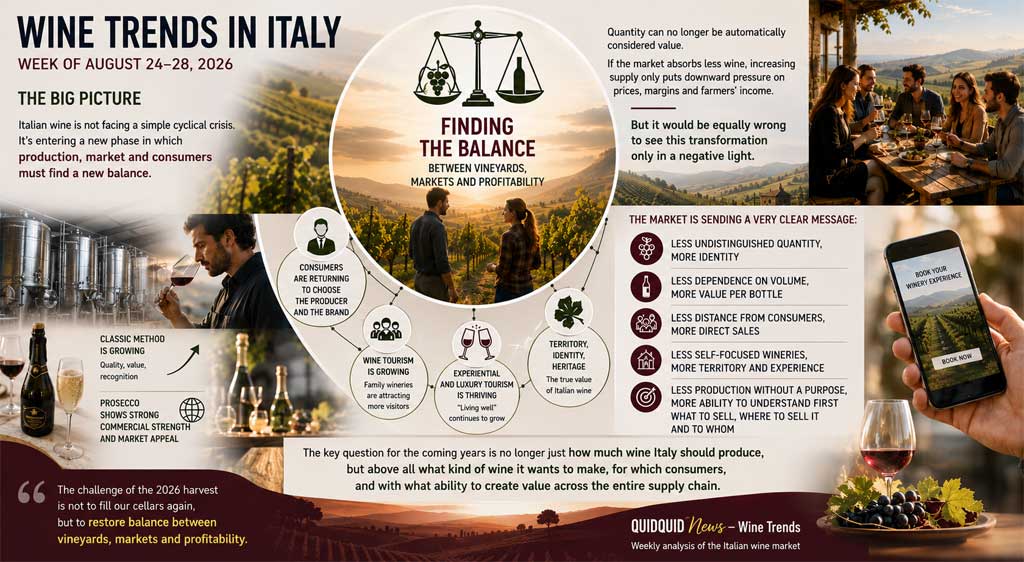
Wine Trends in Italy – Week of August 24–28-2026

Italian wine is entering the harvest season facing a challenge that is no longer limited to production: supply, demand, and value must be rebalanced.

This week confirms even more clearly the structural change that Italian wine is undergoing.
The 2026 harvest started early in many areas, the quality of the grapes appears interesting overall, but the real problem is not how much wine we will be able to produce: it is how much wine the market is actually able to absorb and at what price .

High inventories, pressure on grape prices, more selective consumption, export difficulties, and production costs continue to squeeze profitability. At the same time, however, successful markets and models are emerging: sparkling wines, Metodo Classico, direct sales, wine tourism, premium experiences, and wineries’ ability to build direct relationships with consumers.

This week’s message is therefore quite clear: Italian wine must not simply produce less. It must produce, position, and sell better.

1. 2026 Harvest: The real problem is the stocks

The early harvest reflects the increasingly evident effects of climate change. Heat and drought have accelerated ripening in several Italian regions, and in some traditionally later-ripening areas, harvesting began as early as the first half of August.

But the supply chain’s attention is mainly focused on stocks.

The sources collected in the analyzed material report figures that are not entirely consistent: 42.6 million hectoliters of wine according to Cantine Italia-Icqrf, or 45.6 million hectoliters considering wine and must . Regardless of the different calculation bases, the signal is the same: Italy is approaching the new harvest with heavily loaded warehouses.
The consequence is increasing pressure on prices. In June, bulk DOC wines averaged 1.57 euros/liter, down 7% , while for common wines the drop reached 19% .

According to UIV, under current market conditions, a national production of around 35-38 million hectoliters would be more sustainable. The issue, therefore, no longer concerns only the 2026 harvest, but the need to plan supply for subsequent years.

2. Appellations begin to reduce yields

An initial response is coming from the Consortia.

Several important denominations have decided to intervene on yields: Brunello di Montalcino -12.5%, Chianti Classico -13.3%, Valpolicella -16.7%, Soave -10%, Pinot Grigio delle Venezie -11.1%, Asti DOCG -15%, up to Verdicchio di Jesi with a reduction of 21.4%.

This is an important signal because it shows that part of the system has understood that continuing to produce volumes not absorbed by the market inevitably means destroying value .

However, a problem remains: reducing the yield allocated to the DOC doesn’t necessarily mean reducing the entire vineyard production, because some of the grapes can be allocated to other categories. Hence the discussion about the need for more effective planning tools.

3. Grape prices: the alarm goes straight to the vineyards

The supply crisis is transferring its effects to the most exposed link in the supply chain: the winemaker.

In Valpolicella, very low prices are reported, with offers for grapes destined for Amarone even in the range of 1.20-1.30 euro/kg , while more economically correct levels between 1.50 and 1.80 euro are indicated.

The loss of profitability per hectare can exceed 35% . To limit supply, the Valpolicella Wine Consortium has decided to store 172,280 quintals, equal to 20% of production , effectively reducing availability from 100 to 80 quintals per hectare.

The problem isn’t limited to Veneto. Signs of tension are also coming from Piedmont and especially Puglia, where producers and organizations are calling for action on surpluses and greater control over supply.

Defending the value of grapes today means defending the entire supply chain.

4. Large-scale retail trade: less wine, but sparkling wines continue to grow

A very interesting signal is coming from the domestic market.

In the twelve months ending in July 2026, Italian large-scale retail trade sold 414 million litres of wine, -3.4% , for a value of 1.8 billion euros, -1.2% .

Value therefore falls much less than volume: further confirmation of the trend towards quantitatively lower but more quality-oriented consumption.

The bubbles, however, continue to move against the trend:

Sparkling wines 1% by volume and 1.2% by value; Prosecco 3.8% by volume; Italian Classic Method 7.6% by volume and 6.2% by value.

The decline in private labels is also particularly significant: -5.4% in volume and -5% in value . In a period in which consumers are choosing more carefully, the manufacturer’s brand appears to be regaining increasing importance.

5. As the consumer changes, the way of producing wine also changes

The transformation is not just about how much wine is consumed, but what wine is sought .

Freshness, drinkability, aromatic clarity, and lighter styles are also influencing winery investments. The material analyzed shows a growing international preference for stainless steel tanks over wood.

By 2025, steel would have accounted for 42.5% of global wine tanks and 85% of purchases by wineries. The winery tank market, valued at $1.8 billion in 2025, could reach $2.7 billion by 2034.

This is an industrial signal that shouldn’t be underestimated: changing consumption patterns are reaching the cellar, altering production and technological choices.

6. It’s not just Gen Z who are drinking less

Another cliché is being debunked: attributing the decline in consumption exclusively to young people.

The American analysis cited in the material shows a much more complex phenomenon. Among 21- to 29-year-olds, participation in consumption remains around 75%, but the intensity decreases: average weekly consumption drops from 6.5 to 4.5, about 30% less .

Even among adult generations, however, participation and attendance tend to progressively decrease.

The real challenge for wine, beer and spirits therefore becomes recreating consumption opportunities , in a market in which they compete not only with each other, but with functional drinks, non-alcoholic alternatives, entertainment and many other destinations of available spending.

For wine, this means returning to being contemporary without losing culture, territory, and identity.

7. Wine tourism: consumers are looking for people, not just bottles

One of the most positive signs of the week comes from wine tourism.

In 2026, Italian wine tourists are estimated to be around 18 million , compared to 13.4 million in 2024.

But the most interesting data is qualitative: the most popular experience is no longer simply tasting. 27% indicate a visit to a family-run winery .

Tourists want to know who produces the wine, hear their story, see the vineyard, understand the territory and have an authentic experience.

For 68% of those interviewed, the staff’s hospitality and professionalism are key factors in returning to a winery; 66% also consider the wines’ reputation and ease of booking.

However, a significant gap emerges here: 42% still encounter difficulties in booking online , while bookings made during the trip via digital platforms are rapidly growing.

Even more significant is the digital divide: wineries represent 1.3% of the points of interest surveyed in wine tourism destinations but generate just 0.4% of digital traces , despite a very high sentiment of 94.7/100 .

In other words: those who visit Italian wineries appreciate them greatly, but many wineries are still too little visible and talked about in the digital world and, increasingly, in AI-based search systems.

8. Wine tourism won’t save wine, but it can significantly improve margins

It would be wrong to think that wine tourism could absorb millions of hectoliters of surplus wine.

But direct sales, tastings, catering and hospitality allow companies to sell value rather than just bottles .

According to reported data, Italian wine tourism is worth over 3.1 billion euros , with a 9.2% growth rate. However, in Italian wineries, only one in ten bottles is sold to tourists, compared to one in five in France and two in three in the United States.

The margin for growth is therefore considerable.

The point isn’t to transform every farm into a resort. It’s to better utilize what many wineries already possess: the land, vineyards, history, family, architecture, landscape, cuisine, and direct customer relationships.

9. Premium and luxury: what grows most is what becomes an experience

The luxury market also offers interesting indications for high-end wine.

Global luxury is expected to see moderate growth of around 2% through 2026, while the experiences segment could grow by around 4% .

The premium consumer appears to be gradually shifting their focus from simple ownership to authentic, personalized, and culturally meaningful experiences. Bookings for immersive experiences have increased by 30% , while trips to lesser-known and more authentic destinations have increased by 20%.
For mid- to high-end wineries, this is a clear strategic recommendation: a premium bottle alone is no longer enough. It must be embedded in a universe of territory, culture, hospitality, and meaning.

Wine press review for Thursday August 27 -2026

Italian wineries, Italian wine producers, and current wine news.

Good morning,

The day highlights a sector undergoing rapid transformation: early harvest, high inventories, more selective consumption and pressure on prices , but also interesting signs from sparkling wines, consumption by the glass, sustainability and new technologies.

ITALIAN WINERIES

Farewell to Vittorio Frescobaldi, a leading figure in Tuscan wine worldwide.

Italian wine says goodbye to Vittorio Frescobaldi , a key figure in the international development of Tuscan winemaking. Together with his brothers Ferdinando and Leonardo, he contributed to the growth of the historic family business, focusing on foreign markets and the promotion of Tuscany’s great terroirs. This entrepreneurial and cultural legacy is now continued by his son Lamberto.

Contini begins its 128th harvest in Sardinia

The historic Sardinian winery’s 128th harvest has begun at the Contini estates in the Lower Tirso Valley and Sinis. The first grapes harvested were Nieddera and Vernaccia, destined for sparkling wines. In a year characterized by heat and accelerated ripening, precision in choosing the right harvest time is crucial to preserving freshness and acidity.

The grape harvest is becoming increasingly social

From Banfi to Terra Moretti, Settesoli, Masi Agricola, Tasca d’Almerita, Masciarelli, Tenuta San Guido, Umani Ronchi, Venica, Terlano, Mezzacorona, and Berlucchi , numerous wineries are sharing the start of the 2026 harvest on social media. The harvest thus also becomes a communication tool capable of bringing consumers and regions closer together.

Antica Bottega del Vino: a glass of wine accounts for 40% of the company’s turnover.

Verona’s historic Antica Bottega del Vino reported 6% revenue growth in the first half of 2026. The proportion of sales by the glass is particularly significant, accounting for approximately 40% of revenue , confirming the growing interest in more flexible consumption options than full-bottle sales.

Alto Adige: quality sparkling wines without chasing large volumes

Alto Adige sparkling wines have reached approximately 600,000 bottles per year , but producers intend to maintain a niche position. The objective set by the Alto Adige Wine Consortium is to favor high-quality Metodo Classico wines and particularly suitable vineyards, without making quantitative growth the primary objective.

ITALIAN WINE AND OENOLOGY

Large-scale retail trade: wine sales are decreasing, but value is holding up. Sparkling wines are growing.

In the 12 months ending in July 2026, Italian large-scale retail trade sold 414 million litres of wine , down 3.4%, for a value of 1.8 billion euros , down 1.2%.

Sparkling wines, on the other hand, are bucking the trend: 1% in volume and 1.2% in value . Prosecco is doing well, but especially Italian Metodo Classico, which is growing by 7.6% in quantity and 6.2% in value .

2026 Harvest: The Real Problem Is Inventory

Drought is reducing grape yields, but the decline in production may not be enough to rebalance the market. As of July 31, 2026, Italian wineries produced 45.6 million hectoliters of wine and must , an 8.2% increase over the previous year.

The situation is weighing heavily on red wines in particular and fuels a paradox: in some areas, producers are looking to a less abundant harvest as a potential way to rebalance supply and demand.

Grape prices under pressure

High inventories and slowing demand are also impacting grape prices. In Valpolicella, offers for grapes destined for Amarone are reported at around €1.20/kg , below what is considered economically correct. Concerns are also emerging in other Italian regions.

Capaldo: “The problem is oversupply.”

According to Antonio Capaldo, president of Feudi di San Gregorio , the Italian sector must first address the quantitative imbalance between supply and demand. Pressure on consumption has been compounded by accumulated stocks along the supply chain and high production in recent years.

Early harvest: the importance of precision grows

Smaller grapes, accelerated sugar maturation, and increasingly narrow harvest windows characterize the 2026 harvest. The experience of several wineries confirms how daily monitoring of the vineyard has become essential to identifying the correct time for harvest.

Valpolicella already harvested and more careful management of volumes

The Corvina harvest began approximately two weeks earlier than the historical average . The Consortium estimates a harvest of just over 861,000 quintals, essentially in line with 2025, but introduces storage of 172,280 quintals, equal to 20% of production .

South Tyrol is increasingly sustainable

There are 2,897 SQNPI-certified wineries in South Tyrol , covering approximately 3,913 hectares . Integrated production now covers over two-thirds of the province’s vineyards, strengthening the path toward more sustainable viticulture.

Alcohol-dealers: Growing interest and technology investments

Alcohol-free and low-alcohol wines remain a niche market, but consumer interest, especially among international consumers, is growing. More and more wineries are therefore evaluating dealcohol removal technologies and systems, even those shared at the local level.

Trentino: “ganzega” recognized

The traditional “ganzega,” a form of occasional, unpaid assistance between farmers, also becomes operational during the grape harvest and harvest season. This measure is particularly useful for small businesses during periods of increased labor demand.

INTERNATIONAL AND NEW CONSUMPTION

Consumers drink fewer bottles and more glasses

An interesting finding comes from the restaurant market: wine consumption isn’t decreasing equally across all formats. According to the experience shared by a historic Roman wine bar, bottle sales have significantly decreased, while demand for wine by the glass has increased.

This phenomenon, confirmed by the Antica Bottega del Vino experience, suggests a shift in consumption patterns: less quantity, greater choice, and a focus on the experience.

New York Times: Three Italian wines among the late-summer offerings

Eric Asimov’s selection of 12 wines for late summer also includes three Italian labels . The main criteria aren’t the wine’s color, but rather its lightness, drinkability, and generally lower alcohol content (13.5%).

EVENTS, TASTINGS AND WINE CULTURE

Cinema in the Cellar 2026

From September 9th to 11th, “Cinema in Cantina,” promoted by the Consortium for the Protection of DOC Prosecco, returns to the province of Treviso. Three free evenings include guided tours, Prosecco DOC tastings, and open-air cinema in the vineyards, with sport as the theme for this ninth edition.

Vinestate 2026: Sannio takes center stage

From September 3rd to 6th, Torrecuso hosts the 51st edition of Vinestate , with 18 wineries showcasing the wines of Taburno. This year’s theme is “Sannio on the Road to the 2027 America’s Cup,” connecting wine, territory, tourism, and international visibility.

Franciacorta Festival in the Cellar

Starting September 18th, I Barisèi will be participating in the Franciacorta in Cantina Festival with sunset tastings, guided tours, and the opportunity to observe the disgorging line firsthand, sharing one of the most characteristic stages of Franciacorta production with the public.

AIS Veneto: sommelier courses resume

The AIS Veneto courses resume in September. They are divided into three levels and are aimed at both enthusiasts and professionals. The program covers tasting, grape varieties, terroirs, winemaking techniques, and wine and food pairing.

Wine as a place of community

In L’Aquila, the “Quarto in Cantina” initiative, hosted by Cantina del Boss, also highlights the social dimension of wine: not just an agricultural and commercial product, but an opportunity for encounters, culture, and connections between people and the region.

PICTURE OF THE DAY

August 27, 2026 returns the image of an Italian wine that must face above all a problem of balance between production, supplies and demand .

High inventories and price pressure indicate that simply producing well isn’t enough: it’s becoming increasingly important to produce what the market can truly absorb and protect the product’s value . Large-scale retail data, however, show that consumers aren’t simply abandoning wine: they’re changing the way they buy and consume it.

Sparkling wines and the Classic Method are growing , wine by the glass is gaining ground, sustainability and precision in the vineyard are becoming competitive elements, and even dealcoholized wines are starting to enter the strategies of some companies.

The message that emerges is therefore more complex than the simple “wine crisis”: the market is selecting products, territories, formats and consumption models .

For Italian wineries, the challenge will be to adapt production and positioning to real demand, avoiding simply chasing volumes and returning to focusing on value, territorial identity, quality, communication, and commercial capacity .

Today’s wine press review is brought to you by WINEIDEA.IT.

See you tomorrow.

Style Selector
Select the layout
Choose the theme
Preset colors
No Preset
Select the pattern