A network portal of Wine Idea. Discover the world of Wine idea

Wine press review for Saturday June 6 -2026

Italian wineries, Italian wine producers, and current wine news.

Italian Wineries

Venissa presents the new Venetian Dorona Crus. The Bisol family promotes the revival of Dorona through three crus grown on the islands of the northern Venice lagoon, confirming the growing interest in historic vines and unique territorial identities.

The Vatican’s Official Wine Is Born. The Villa Russiz Foundation will produce the red blend “Laudato Sie,” intended for official Holy See events. Initial production will be 5,000 bottles from the Collio Friulano area. Moncalisse: A New Trentodoc Project Is Born. Julia and Karoline Walch are launching a new winery dedicated exclusively to Trentodoc on Monte Calisio, focusing on establishing a distinct identity from the historic family winery. Pertinace Closes 2025 with Record Revenue. The Treiso cooperative celebrates the 50th anniversary of the first Barbaresco, confirming financial results that buck the trend of the international market. Ceretto Strengthens Wine Tourism in the Langhe. In La Morra, “Le Brunate” opens, a new restaurant nestled in the vineyards, designed to bring together hospitality, local tradition, and a food and wine experience. New Awards for the Giuntelli Winery in Sardinia. Three international awards confirm the quality of the work with native Sardinian grape varieties and strengthen the visibility of the Trexenta region. Roeno promotes the Terradeiforti DOC The company continues to invest in biodiversity, native vines and the longevity of its wines, with particular attention to Enantio.

Italian Wine and Italian Oenology

UIV proposes a plan to contain production. Unione Italiana Vini approves a package of measures to rebalance supply and demand: reduced yields, a temporary ban on new plantings, and updated specifications.

Piedmont: Anti-crisis strategy called for. Cia Piemonte and Valle d’Aosta proposes green harvesting, limits on new plantings, and general wine conditions to address the slowdown.

Italian wine is not in crisis, but must change. The Envisioning2035 summit highlights the need to invest in management, new markets, speed of decision-making, positioning, and new consumers. Wine tourism and emerging markets will be the drivers of the future. According to Nomisma Wine Monitor, wine tourism already generates over €3 billion and represents one of the sector’s main growth opportunities. Vermentino as the new Pinot Grigio. Ettore Nicoletto suggests building a new international phenomenon around Vermentino, expanding the Italian offering beyond Prosecco and Pinot Grigio. Pinot Grigio del Collio takes center stage. The extraordinary capacity for evolution of Pinot Grigio del Collio has been recognized, increasingly identified as a quality, territorial wine. Sicily confirms its leadership in wine tourism. The island’s leading companies highlight a growing demand for authentic, quality experiences tied to the region. Marina Cvetic named Cavaliere del Lavoro. Recognized for her contribution to the international promotion of Abruzzo and Italian wine and the promotion of regenerative agriculture. Mariano Murru, Knight of Merit of the Republic, was recognized for his contribution to the growth of Sardinian wine and the international recognition of Argiolas wines. Alto Adige Schiava takes center stage at the Vernatsch Cup. Fliederhof and Ansitz Waldgries won the title of “Vernatsch of the Year,” confirming the qualitative growth of Alto Adige Schiava.

International Scenario

Global wine market still under pressure. Declining consumption and exports, full warehouses, and reduced margins continue to worry the sector, especially in the Piedmontese production areas.

China opens new opportunities for Italian companies. A memorandum of collaboration has been signed with Confapi to encourage investment and commercial development of Italian companies in the Chinese market. Vetropack presents Europe’s lightest bottle. The new 350-gram Reno bottle reduces emissions, logistics costs, and environmental impact throughout the wine supply chain. Farewell to Mario Matasci. A historic figure in Swiss winemaking and Ticino’s artistic culture has passed away at the age of 94.

Agricultural Policies and Regulations

Agea surpasses €10 billion in aid disbursed. A record amount of aid to Italian agriculture is expected in 2025, with a significant increase in resources for rural development and business support.

New decree on Protection Consortia The Ministry strengthens the role of the DOP and IGP Consortia in promoting, defending, and enhancing certified Italian products.

Wine Events

Asolo Prosecco Superiore DOCG Selection – June 9th In Montebelluna, a new formula directly involving the Ho.Re.Ca. sector and supply chain operators.

Wine Experience Abruzzo – June 18 in Rome. Twenty-two wineries will showcase their regional excellence to the press, industry professionals, and wine lovers. Meetings with the Author and Wine – Lignano. From June 11 to September 3, one of the most important cultural and food and wine events in Friuli Venezia Giulia returns. Colline Teramane è Vino. The event dedicated to Abruzzo’s first DOCG makes its debut, featuring tastings and masterclasses. Cantine all’Aperto – Cesena. Tastings, producers, and social initiatives to promote Romagna wine and inclusion. Città del Vino 2026 International Wine Competition. Record-breaking edition with over 1,400 wines and grappas tasted. Presentation of the book “Vino & Turismo.” The first university textbook dedicated to wine tourism will be presented on June 10 in Rome. “Bere il Territorio” Literary Competition. Go Wine launches the 25th edition of the initiative dedicated to the culture of wine, landscape, and sustainability.

Strategic Summary of the Day

The most significant news of June 6, 2026, is the growing consensus surrounding the need to curb domestic wine production to rebalance the market. At the same time, three increasingly clear directions for development are emerging:

Wine tourism as a new source of profitability .
Research into new international markets , with particular attention to Asia.
Promoting local grape varieties (Vermentino, Schiava, Dorona, Enantio) as a competitive lever for the future.

The sector does not appear to be in decline, but rather undergoing profound transformation that requires greater strategic vision, control of supply, and the ability to create value beyond the simple sale of wine.

Episode 2 – Wine is not in crisis

Wine tourism: the true driving force behind the new growth of Italian wine.

If wine were truly in crisis we wouldn’t be witnessing the boom in wine tourism.
Yet the numbers tell a different story.

According to the ilGolosario Wine Tour Observatory, analyzing approximately 1,700 Italian companies, over 60% of wineries have seen an increase in direct sales thanks to wine tourism activities.

This is a huge number.

This means that wine is no longer purchased only on shelves or through distributors and importers.

More and more often it is purchased directly where it grows.

The modern consumer wants to live an experience.

He wants to visit the vineyards.

He wants to know the manufacturer.

He wants to understand the territory.

He wants to eat, taste, photograph and share.

In fact, 82% of visitors choose itineraries that combine:

visit to the cellar
tasting
gastronomic experience
discovery of the territory

Wine thus becomes an integral part of a tourist ecosystem.

Italy has an extraordinary competitive advantage.

No other country can offer simultaneously:

unique landscapes
thousand-year history
an immense artistic heritage
regional cuisine
hundreds of denominations
widespread hospitality

Many Italian wineries are still only exploiting part of this potential.

And this is where one of the key growth opportunities for the next decade lies.

Rather than increasing production, we need to increase the value of experience.

Those who visit a winery often become loyal customers for years… and this is worth much more than a single sale.

Wine press review for Friday June 6 -2026

Italian wineries, Italian wine producers, and current wine news.

Italian Wineries

Villa Russiz presents “Laudato Sie.” This new red wine is part of the Borgo Laudato Si’ project in Castel Gandolfo. This initiative combines sustainability, social inclusion, and the promotion of the Friuli region.

Fattoria Sardi launches 15 Primavere Rosé 2025. The biodynamic winery in the Colline Lucchesi area celebrates the fifteenth vintage of its flagship rosé, made from organic Sangiovese, Syrah, and Vermentino grapes. Boschetto Campacci, a rebirth in Chianti Classico. The Sienese estate, led by the Frascino family, continues its development journey, focusing on high quality and territorial identity. Casorzo winery wins awards in Croatia . The Malvasia di Casorzo DOC It’s Rock 2024 won the bronze medal at the 2026 Vinistra Wine and Spirits Awards. Turrini winery: new management after the crisis. The historic Romagna winery is being taken over by Enoitaly. The employment issue remains open for some of the workers still on furlough. Calabria’s first underwater winery. The Sinus Underwater Wines project is taking shape in San Nicola Arcella, with wines aged 35 meters deep in the Tyrrhenian Sea.

Italian Wine and Oenology

Envisioning 2035: Italian wine changes model. A clear vision emerges from the Milan summit: less focus on volumes and more attention to wine tourism, emerging markets, management, and value creation.

UIV approves production containment. Green light for measures to reduce yields and rebalance a market characterized by high inventories and slowing consumption. Assoenologi: strategies against climate change. The Conegliano Congress highlights the need to adapt vineyards and wineries to higher temperatures, rising alcohol levels, and soil impoverishment. Beneficial bacteria and fungi combat grapevine diseases . New international research opens up interesting prospects for the biological control of grapevine trunk diseases. Catarratto, a new strategy for Sicily. The historic Sicilian grape variety is being relaunched as a tool for territorial identity, cultural valorization, and market positioning. Verjus: agresto is back in the spotlight. The ancient juice obtained from unripe grapes is experiencing a new wave of interest in contemporary restaurants and mixology. The world’s smallest vineyard in Reggio Emilia. On a terrace measuring just 20 square meters, ViaMari10 is born, a curious urban viticulture experience that produces approximately 30 bottles per year. Severe weather in Emilia-Romagna. Hailstorms and thunderstorms are jeopardizing up to 80% of production in some areas of the Carpi province, with significant damage to vineyards. Sweet wines: new communication is needed. Experts emphasize the need to revitalize the cultural and commercial value of sweet wines through more modern and accessible communication.

International

Global wine exports slowing In 2025, global wine trade will fall to 33.8 billion euros, while the weight of emerging markets and the importance of geographical diversification increase.

Cremisan Wine Estate takes center stage at Vini d’Abbazia. The historic Holy Land winery will be the focus of a masterclass dedicated to the dialogue between religions and wine culture. International research on vine health. A University of Oregon study explores the use of native microorganisms as a sustainable tool for plant protection.

Wine Events

Abbey Wines 2026 – Fossanova (Latina) From June 12th to 14th, meetings, tastings, contemporary art, and masterclasses dedicated to the relationship between wine, culture, and spirituality.

Conegliano Valdobbiadene Prosecco Spring 2026 Tastings, gastronomy, culture, and a partnership with the Vulture area of Basilicata enliven the event program. Record-breaking Open Cellars in Abruzzo. Over 50,000 glasses distributed and approximately 100,000 attendees confirm the growth of regional wine tourism. Dialogues on Franciacorta at Barone Pizzini. A meeting between Silvano Brescianini and Armando Castagno dedicated to the history, territories, and great reserves of Franciacorta. Tuesday in the Cellar at Letrari. Aperitifs, vinyl music, and tastings highlight the relationship between wine and conviviality. Franciacorta Road. Six cycling routes through vineyards, villages, and wineries to discover the region in a sustainable way. Caravaggio: Genius and Madness. In Rome, a cultural itinerary dedicated to Caravaggio concludes with a themed wine tasting. Vo’ Vecchio and the Parco del Venda Winery: A historic visit to Villa Contarini Giovanelli and a tasting of Euganean Hills wines. “Vini e Cantine” Award in Venosa: Young designers showcase innovative and sustainable ideas for the wineries of the future.

Strategic Scenario of the Day

Today’s news confirms five now evident trends for the Italian wine sector:

production containment to rebalance the market;
growth of wine tourism as an economic lever;
agronomic and oenological innovation to address climate change;
valorization of identity grape varieties and territories;
need for new communication and business models to intercept the consumers of the future.

Wine Trends and Performance in Italy for the Week of June 1-5 – 2026

The Italian wine sector continues to experience profound transformation. This week’s data confirms that we are not simply facing a cyclical crisis, but rather a structural shift affecting consumption, exports, distribution models, communication, wine tourism, and production management.

Italian wine remains a world power, but it must adapt.

Italy maintains its international leadership thanks to a unique heritage of territories, denominations, biodiversity, and globally recognized quality. The sector continues to represent one of the most important assets of the Made in Italy agri-food industry and is confirmed by the support of institutions, supply chain organizations, and international markets.

The message that emerges forcefully from the contributions of producers, analysts, winemakers, and associations is clear: Italian wine must no longer focus solely on volume growth, but on value creation, economic sustainability, and the ability to understand new consumers.

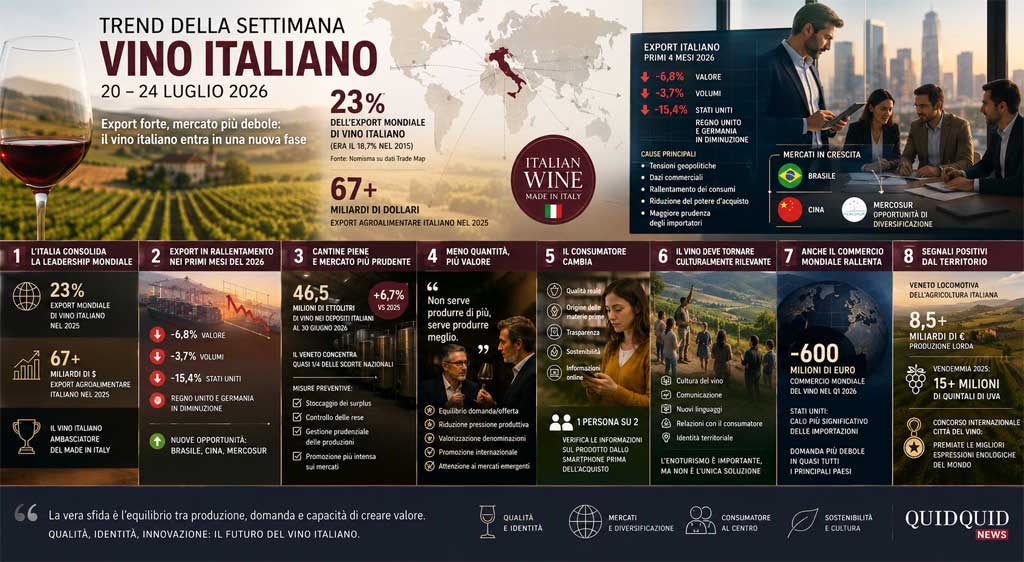
Exports: Traditional markets slow, emerging markets grow

Exports continue to be the main driver of the sector’s growth, but the first quarter of 2026 still highlights significant tensions.

The data from the UIV Observatory show:

extra-EU exports of approximately 1 billion euros
drop in value of approximately -11%
United States at -20.5%
China still slowing down sharply
Canada on the rise
Japan in strong growth
Mexico, Brazil, Russia and Vietnam among the most dynamic markets

The American market continues to pose the main challenge, primarily due to the effects of tariffs and the decline in domestic consumption. However, Prosecco and numerous premium labels are maintaining positive performances.

At the same time, there is a growing awareness that the future of Italian wine will depend on the ability to diversify markets. Vietnam, Thailand, South Korea, India, Mercosur, Mexico, Colombia, Poland, and Romania are emerging as strategic areas with high growth potential.

The Vietnamese leg of the “Wines Experience” project confirms this very direction: tapping into new markets before they become mature and highly competitive.

Production: avoiding excesses to protect value

One of the most important topics that emerged this week concerns supply management.

Lamberto Frescobaldi sent a very clear message:

Producing more than the market can absorb risks depressing prices along the entire supply chain.

The high stocks present in many wine-growing areas are pushing some denominations to consider reducing yields for the next harvest.

The strategy is no longer to maximize the quantity produced, but to preserve the economic value of the wine and the sustainability of the companies.

This issue becomes particularly sensitive in areas with a strong viticultural vocation such as Piedmont, where agricultural organizations report situations in which the price of grapes risks falling below production costs, jeopardizing the profitability of businesses and the social stability of rural areas.

Consumption: the problem is not the wine, but the consumer

The most important change concerns consumer behavior.

According to Nomisma Wine Monitor:

usual consumption decreases
occasional consumption increases
Consumption related to social moments is growing
the role of wine as an everyday drink is decreasing
the demand for experiences is increasing

Over the last twenty years, the traditional Mediterranean model has progressively weakened.

Young people don’t reject wine, but they experience it differently:

they seek authenticity
they want simple languages
they favor experiences over technical knowledge
they want inclusiveness and accessibility
they are sensitive to the quality-price ratio

The real challenge for the sector is not convincing young people to drink wine, but making it culturally relevant to the new generations.

For this reason, projects dedicated to Gen Z are multiplying, aiming to simplify communication and eliminate the perception of wine as an elitist product or reserved for experts.

Wine tourism: the engine that continues to grow

While traditional sales are slowing, wine tourism continues to record very positive results.

Data from the ilGolosario Wine Tour Observatory highlights that:

Over 60% of wineries increase direct sales thanks to wine tourism
82% of visitors choose experiences integrated between wine, gastronomy and territory
approximately 40% of companies plan new investments in hospitality
Millennials represent the fastest growing segment

The modern visitor is not just looking for a tasting.

Near:

territory
landscape
culture
gastronomy
hospitality
authenticity

The wineries that grow the most are those that manage to transform wine into experience and the territory into a story.

Wine tourism thus confirms its position as one of the main tools for creating value for the Italian wine sector.

Cooperation: a pillar of Italian wine

The week also highlighted the strategic importance of cooperation.

Italian agri-food cooperatives:

generate approximately 38 billion euros in turnover
represent over 20% of Made in Italy agri-food products
they produce over 60% of Italian wine
they export approximately 8 billion euros

The cooperative model continues to represent one of the most effective tools for bringing together production, investment, innovation, and sales force, especially in a time of growing international competition.

Climate change, innovation and identity

The sector also continues to face structural challenges:

climate change
water resources management
sustainability
agronomic innovation
digitalization
generational transition

Future competitiveness will depend on companies’ ability to integrate innovation and territorial identity without losing authenticity.

As Renzo Cotarella emphasized, Italian wine has already undergone its major revolutions. Today, the key is to evolve, understand consumers, and better communicate the true value of its products.

Style Selector
Select the layout
Choose the theme
Preset colors
No Preset
Select the pattern