


A network portal of Wine Idea. Discover the world of Wine idea

Wine press review for Sunday September 20-2026

Italian wineries, Italian wine producers, and current wine news.

Good morning,

The main news from the world of wine selected and summarized by QUIDQUID : Italian wineries, the 2026 harvest, viticulture and oenology, international markets, investments and events.

ITALIAN WINERIES

San Donaci: Relaunching the Historic Candido Winery

In San Donaci, in the heart of Salento, the project to recover and relaunch the historic Cantina Candido , founded in 1929 and acquired by the Leo family, owners of Cantine Paolo Leo, is taking shape.

The project includes the recovery of native vines, the restoration of the historic site, the valorization of Negroamaro, Aleatico and Malvasia Nera, the promotion of the territory and the creation of a Wine Museum .

Colli di Luni: A new generation at Giacomelli

In Castelnuovo Magra, in the Colli di Luni area, Tommaso Petacchi continues the journey he began at a young age in the Giacomelli family business. At just 14, he asked his father Roberto for a small plot of land to cultivate on his own.

From that vineyard was born Tàoma , a personal project dedicated to Vermentino and a symbol of a generational change gradually built within the family business.

Suvereto: Ten Years for La Batistina

The La Batistina estate in Suvereto celebrates ten years of activity. Irene Batistini and Margherita Brogi have developed the family farm by renovating the land, the cellar, and the vineyards, and also initiating the conversion to organic farming.

Valtellina: La Trama is founded to reclaim family vineyards.

Three hectares of vineyards between Tresivio and Piateda become the starting point of La Trama , a new business founded by Mauro Beltrama, Laura Arena and Paolo Beltrama.

The project was born with the aim of preventing the abandonment of family vineyards. The first label, Trio – Rosso di Valtellina DOC , was produced in approximately 1,200 bottles.

Wildbacher: the historic grape variety of the Treviso Hills

At the Conte Collalto Winery in Susegana, the long Italian history of Wildbacher continues, a grape variety originally from Styria but present on the Treviso hills since the 18th century.

A centuries-old presence that has favored its adaptation to the soil and climate of the area, transforming it into one of the most unique varieties of the local viticultural heritage.

ITALIAN WINE AND OENOLOGY

2026 Harvest: Early Harvest in Calabria Due to Heat and Drought

In the Vibo Valentia area, the heat of summer 2026 significantly accelerated grape ripening. At Cantine Lacquaniti, Zibibbo was harvested as early as August , while some red grapes were harvested up to a month earlier than normal.

Added to the climatic difficulties is the pressure from wild fauna, particularly wild boars.

Langhe: harvest brought forward by about ten days

Even in the Langhe, the heat has altered the harvest calendar. According to the Consortium for the Protection of Barolo, Barbaresco, Alba, Langhe and Dogliani, the 2026 harvest will be about ten days earlier than in 2025.

Technical monitoring indicates good ripening of the grapes in terms of sugar, phenolic and acidity.

Viticulture increasingly at higher altitudes

Climate change is pushing part of Italian viticulture toward higher altitudes in search of cooler temperatures, temperature ranges, and more favorable conditions for ripening.

Altitude, however, is not a solution by itself: exposure, water availability, ventilation, soil characteristics and processing costs remain determining factors.

The Italian DOC turns 60

The Controlled Designation of Origin (DOP ), one of the fundamental tools for the protection and territorial identification of Italian wine, celebrates sixty years since its establishment. In Alba, the anniversary is also being commemorated with dedicated tastings.

Cellar Safety: Three People Rescued During a Decanting

In Cinquefrondi, Calabria, three people were rescued after falling ill inside a cellar where must had been decanted.

The episode draws attention to the risks associated with gases produced by fermentation and the need for ventilation, environmental monitoring, and safety procedures during cellar work.

Agriculture: Controls against illegal work

As part of the “Alt caporalato” project, the Territorial Labor Inspectorate of Grosseto and Siena carried out checks on agricultural companies, identifying 13 undeclared workers out of 17 verified positions .

Four companies were suspended and fines totaling approximately €60,000 were imposed for violations of labor, health, and safety regulations.

Bologna: Growing selection of natural wines

Bologna’s wine scene continues to diversify, with wine shops, wine bars, and boutiques dedicating greater space to artisanal wines and niche products.

The phenomenon highlights the evolution of urban consumption and the interest of a portion of the public in less conventional productions.

Tasting: technical quality and personal taste are not the same thing

A technically well-crafted wine doesn’t necessarily have to please everyone. Tasting distinguishes between technical evaluation and personal preference.

A simple but important principle: knowing wine also means developing your own taste without feeling obliged to share the opinion of experts.

Olive growing: over 800 olive trees from 32 countries in Gubbio

The scientific project Domus Olear∑ , promoted by the CNR-IBBR together with the Di Murro Agricultural Company, brings together over 800 olive trees from 32 countries in Gubbio.

The goal is to create an international living collection to study and conserve the genetic heritage of the olive tree.

INTERNATIONAL, MARKETS AND INVESTMENTS

Crédit Agricole acquires stake in Miraval Provence

Crédit Agricole has announced that it is taking a minority stake in Miraval Provence , a company linked to the winemaking and commercial activities of Château Miraval, the Provençal estate associated with Brad Pitt and the Famille Perrin.

According to Vitisphere, the investment would amount to 15 million euros . Brad Pitt would retain a 50% stake in the company.

This transaction represents a further example of institutional investors’ interest in wineries with strong real estate, territorial, and brand value.

China: How the wine market is changing

The Chinese wine market is undergoing a profound transformation in terms of consumption, size, and buyer profile.

An analysis promoted by Unione Italiana Vini , based on IWSR data, aims to identify the opportunities for Italian wine in the so-called “New China.” Despite the decline compared to past expectations, the market continues to be considered strategic from a medium- to long-term perspective.

Champagne: the climate modifies maturation and alcohol content

Higher temperatures are also affecting Champagne. The increased sugar accumulation in the grapes can result in wines with a potentially higher alcohol content.

A temporary exemption from the established limits has been authorized in France for the 2026 harvest, confirming how climate change is impacting even denominations characterized by particularly rigorous specifications.

Campari: Focus on Spritz, Ready-to-Drink, and International Expansion

According to the aforementioned UBS analysis, Campari is focusing on the growth of the Spritz category, the development of ready-to-drink products and geographical expansion.

Management has reportedly indicated organic sales growth of around 3% for 2026, in a still complex international spirits environment.

WINE TOURISM AND WINE-RELATED EVENTS

Prosecco Wine Route: Wine, Territory, and Experiential Tourism

The hills between Conegliano and Valdobbiadene continue to offer a popular destination for three- or four-day stays centered around wineries, tastings, villages, gastronomy, walks, and scenic heritage.

A model that confirms how wine is increasingly the starting point of a broader tourist experience.

Morbegno in the Cellar 2026

From 25 to 27 September, from 2 to 4 October and from 9 to 11 October , Morbegno hosts a new edition of Morbegno in Cantina .

The program features over 60 labels , tastings, and meetings with producers, AIS sommeliers, and ONAV tasters dedicated to the various expressions of Valtellina viticulture.

Unusual Marsala: five days of wine, food, and hospitality.

Starting September 30 , Marsala, Trapani, and the Egadi Islands will host five days of events dedicated to wine, catering, hospitality, and wine tourism.

The program includes over 40 events , including tastings, masterclasses, exhibitions, temporary wine shops, and gastronomic experiences.

Vino al Vino 2026 in Panzano in Chianti

From 18 to 20 September , Panzano in Chianti hosts the 31st edition of Vino al Vino , organised by the Panzano Winegrowers’ Union.

Over 80 labels from 22 wineries are available for tasting, including Chianti Classico and IGT. The area also has a strong environmental commitment: 95% of the vineyards are certified organic.

San Eusebio Grape Festival

The San Eusebio Grape Festival returns to Villa Angarano, Bassano del Grappa, from September 18 to 20, 2026 .

Three days dedicated to rural culture and the grape harvest, with tastings, traditional cuisine, music, children’s activities, grape pressing, and reenactments.

SELECTED WINE-GROWING OPPORTUNITIES – ETNA

A complete winery in the heart of Etna DOC

On the northern slope of Etna , between Solicchiata and Passopisciaro, an already operational winery of approximately 11 hectares is available for sale, including approximately 3 hectares of vineyards, 3 hectares of olive groves, cellar, buildings, equipment, registered trademark, stocks, authorisations and planting rights .

The vineyard includes approximately 2 hectares of Nerello Mascalese and 1 hectare of Carricante , as well as approximately one hectare of replanting/new planting rights.

Current production is around 14,000 bottles per year , with an indicative capacity of 20,000 bottles and a range of six labels.

A particularly interesting asset for producers, wine groups and investors who wish to enter Etna through an already operational company , with the possibility of further production, commercial and wine tourism development.

Wine-growing countryside with historic wine press from 1890

Also in the Etna area, an agricultural property of approximately 4 hectares is available, of which approximately 3.5 hectares could potentially be used as a vineyard , subject to technical-administrative verification.

A distinctive element is a Sicilian palmento from 1890 of approximately 600 m2 on three levels , to be renovated.

The asset could represent the basis for a new project that integrates viticulture, architectural restoration, a cellar, tastings, and possible rural hospitality , subject to the necessary authorizations.

THE WEEK’S SYNOPSIS

Today’s news shows a wine sector in transformation: the climate is bringing forward harvests and changing the areas best suited to wine production; companies are investing in the recovery of territorial identities; new generations are entering the cellar; wine tourism and hospitality are gaining importance; institutional investors are eyeing winemaking assets, and international markets are demanding increasingly selective strategies .

Wine therefore remains an agricultural product, but increasingly also a territory, a business, a heritage, tourism, a brand and an investment .

Today’s wine press review is brought to you by WINEIDEA.IT.

See you tomorrow.

Wine press review for Saturday September 19-2026

Italian wineries, Italian wine producers, and current wine news.

Good morning,

The main news from the world of wine, wineries, viticulture, and markets: Italian companies, the 2026 harvest, exports, winemaking innovation, regions, guides, wine tourism, and events.

ITALIAN WINERIES

Muzic: four generations of winemakers in the Collio

In San Floriano del Collio, Friuli Venezia Giulia, the Muzic family continues a winemaking tradition that began in 1927. The company has grown steadily since purchasing the first five hectares in 1963, maintaining a strong family identity and a deep connection to the Ponca grape and the border region between the Italian Collio and Slovenian Brda.

Sarah Dei Tos: The Night Harvest Becomes the Object of Research

The nighttime harvest of Glera is included in a scientific study conducted with the University of Bolzano, CREA, and the Consortium for the Protection of Conegliano Valdobbiadene Prosecco DOCG. The research will analyze the effects of temperature, light, and environmental conditions on the aromatic characteristics of the grapes and the quality of work in the vineyard.

Candido: Brand Relaunch, New Wines, and Wine Museum

In San Donaci, Puglia, the Paolo Leo family continues the relaunch of the historic Candido Winery, acquired about a year and a half ago. The project includes renovating the headquarters, reclaiming the production spaces, redesigning the wines, and developing wine tourism with a new Wine Museum. The sale of historic labels has returned to profitability, with revenues up 33%.

Casanova di Neri: Brunello di Montalcino on the world markets

Founded in 1971, Casanova di Neri continues to build its international presence through a philosophy based on experience, understanding of the terroir, and style. Giacomo Neri continues the work begun by his father Giovanni, with wines designed to express territorial identity, elegance, and depth.

La Trama reclaims family vineyards in Valtellina

Mauro and Paolo Beltrama and Laura Arena created a new winery from approximately three hectares of vineyards between Tresivio and Piateda that were at risk of abandonment. The first wine, “Trio,” a Rosso di Valtellina DOC, was produced in approximately 1,200 bottles.

Le Macchiole: A 100% Syrah from the Bolgheri area

Scrio is a pure Syrah produced by Le Macchiole in approximately 4,000 bottles per year. This is a unique project for Bolgheri, a region known primarily for Cabernet Sauvignon, Merlot, and Cabernet Franc. Over time, the winery has modified its winemaking and aging process, seeking greater freshness, precision, and balance.

Carlo Cracco and Rosa Fanti: Agriculture, Wine, and Hospitality in Romagna

On the 18 hectares of Vistamare, in the hills of Romagna, Carlo Cracco and Rosa Fanti have developed a project that integrates an organic farm, vineyards, olive groves, and hospitality. Three old farmhouses have been renovated to create a small agriturismo nestled in the rural landscape.

ITALIAN WINE AND OENOLOGY

Italian wine exports to the US: July returns to positive territory

In July 2026, Italian wine exports to the United States grew by approximately 9.5-10% in value and 1.3% in volume. The average price increased by approximately 8%. This recovery reduces the cumulative decline seen in the first seven months, but according to the Italian Wine Union, it’s still too early to talk about a real reversal of the trend.

Strategic USA, but the market remains complex

According to an analysis by Banca Akros, the United States accounted for approximately 23% of the value of Italian wine exports in the first half of 2026. However, weak consumption, inflation, and growing competition from alternative categories such as sparkling wines, ready-to-drink cocktails, and hard tea remain.

CMO Sicilian Wine: 11 projects approved for non-EU markets

Eleven projects promoting Sicilian wine in third-party countries have been approved, totaling over €4 million in funding. The program finances up to 50% of the costs of advertising campaigns, international trade fairs, trade missions, incoming visitors, and market research.

Brazil: Growing interest in Italian wine

In the first half of 2026, Brazil imported Italian wine worth €20.1 million, an 8.1% increase compared to the same period in 2025. The market remains relatively small, but it represents one of the areas to monitor in the international diversification strategy of Italian wine.

Valtellina: more land, new subzones, and high-altitude vineyards

Valtellina boasts approximately 750 hectares of terraced vineyards, supported by over 2,500 kilometers of dry stone walls, with vines reaching altitudes of 800 meters. Approximately 90% of the vineyard area is devoted to Chiavennasca, the local name for Nebbiolo. The debate is moving toward an increasingly precise territorial definition and greater valorization of the subzones.

2026 Harvest in the Larian Lands: Early Harvest

The heat accelerated the growing season and significantly brought forward the harvest in the Terre Lariane IGT. The first sparkling wine bases were harvested in early August. The Consortium reports generally healthy grapes and positive initial quality results.

Viticulture: How to Propagate Grapevines by Cuttings

Grapevines can be propagated using one-year-old woody shoots. The recommended time for harvesting is during the vegetative dormancy period, generally between January and February. A cutting of about 30 centimeters should have at least three or four buds and come from a healthy, vigorous plant.

Harvest and training: in Lamezia Terme, the vineyard becomes a laboratory.

At the Professional Institute for Agriculture and Rural Development in Lamezia Terme, students participate directly in vineyard and winery activities. Harvesting is used as an educational experience, combining theoretical training, agricultural work, and knowledge of the local area.

Bibenda 2027: Over 700 Award-Winning Wineries

The 29th edition of Bibenda awards over 780 “5 Grappoli” recognitions to 701 wineries. Among the companies with three award-winning wines are Giacomo Conterno, Gaja, La Spinetta, Ca’ del Bosco, Cantina Terlano, and Fontodi. The presentation is scheduled for November 28th in Rome.

DoctorWine 2027: The selection of the best Italian wines continues.

The 2027 Essential Guide to Italian Wine continues to publish wines awarded the “DoctorWine Face.” The selections include, among other regions, Campania, Lazio, and Umbria. The guide will be presented in Milan on October 3rd.

Tre Bicchieri 2027: Spotlight on Sicilian Wines

The tastings dedicated to Sicily highlight the region’s great diversity: coastal vineyards, inland areas, hilly terrain, islands, and Mount Etna. The hot and dry year produced varying results depending on altitude, exposure, water availability, and soil characteristics.

INTERNATIONAL

Domaine de la Romanée-Conti 2022: nine Grand Crus for tasting

At Villa d’Este on Lake Como, Domaine de la Romanée-Conti’s entire 2022 portfolio was tasted: nine Grand Crus, including Échézeaux, Richebourg, La Tâche, Romanée-Conti, Montrachet, and Corton-Charlemagne. It was an exceptional opportunity to compare some of Burgundy’s most prestigious expressions.

Queen’s Roger Taylor signs a Côtes de Provence Rosé

The Queen drummer enters the world of wine with Queen Côtes de Provence Rosé. The project was developed with Sony Music, Watermill Wines, Les Caves du Commandeur, and Rupert Clevely. Taylor participated in defining the blend, concept, and bottle design.

Champagne: In Como, tasters will choose what to import.

On September 30th, Olmo Vini and Captain Drake are organizing a tasting for approximately 15 participants. Nine Champagnes from three French houses will be tasted, and participants will contribute to the selection of labels for future import.

WINE EVENTS AND WINE TOURISM

Great Wine Festival: 153 exhibitors from 29 countries

On September 26 and 27, Villa Farsetti in Santa Maria di Sala will host the 19th edition of the Grande Festa del Vino. 153 exhibitors from 29 countries, 132 wineries, approximately 420 labels and 8,000 bottles are expected, along with tastings, masterclasses, and a food court.

Welcome Brunello 2026 meets Vespa

The 2026 Benvenuto Brunello commemorative tile will be dedicated to Vespa, marking the 80th anniversary of the historic Piaggio scooter. The 2026 Benvenuto Brunello event will take place in Montalcino from November 19th to 23rd.

Pizzolato celebrates 45 years

The Pizzolato winery is celebrating 45 years of business by opening its doors to the public. The program includes tastings, food specials, DJ sets, and activities, including those for families, while keeping the company’s history and commitment to organic production at its core.

Gessopalena: Rare Native Grape Varieties Take Center Stage

The “Gli Irrepetibili” (Unrepeatable) tour offers tastings of micro-vinifications made from local varietals and ecotypes from the Abruzzo mountains. The Bio Cantina Sociale Orsogna project aims to preserve viticultural biodiversity and promote ancient varietals.

Cartizze: wine, landscape, and trekking

The Anello del Cartizze offers a route through the vineyards, villages, and hills of Conegliano Valdobbiadene. The itinerary combines landscapes, outdoor activities, food and wine, and the discovery of Cartizze DOCG, strengthening the connection between wine and tourism.

Merano WineFestival looks to Brazil

The Merano WineFestival is heading to São Paulo at a time when Brazil is showing growing interest in Italian wine, gastronomy, and lifestyle. The initiative is part of the search for new international markets and the growing relationship between wine promotion and tourism.

THE PICTURE OF THE WEEK

The news of September 19th shows an Italian wine sector engaged on multiple fronts. Exports to the United States are showing initial positive signs, but remain under pressure; Brazil is emerging as a market to watch; wineries are investing in identity, terroir, wine tourism, and new hospitality models; research and innovation are increasingly entering the vineyard, from night harvesting to the promotion of native varieties.

At the same time, the importance of the territory as a distinctive element is growing: Collio, Valtellina, Bolgheri, Montalcino, Sicily, Etna and the Prosecco Hills confirm that the value of Italian wine increasingly depends on the ability to connect product, origin, experience and story .

Today’s wine press review is brought to you by WINEIDEA.IT.

See you tomorrow.
Wine press review for Friday September 18-2026

Italian wineries, Italian wine producers and today’s wine news.
Good morning,

Markets, wineries, exports, innovation, regions, and events: a summary of the key news shaping the Italian and international wine world.

ITALIAN WINERIES

Berlucchi renews its Nature line

Berlucchi is transforming its historic ’61 Nature line into Vintage Nature , strengthening its position in the reserve segment. The vintage Franciacortas in the line mature on the lees for over five years and include the 2020 Vintage Nature Terroir, the 2019 Blanc de Blancs, and the 2019 Rosé de Noirs.

Fattoria La Maliosa: a new winery nestled in the Maremma landscape.

In Saturnia, Fattoria La Maliosa has inaugurated a winery designed to blend into the landscape with minimal visual impact. The winemaking spaces are mostly underground, and the roof has been transformed into a garden. The estate now extends over approximately 170 hectares .

Caiarossa: Biodynamics and an International Vision in Tuscany

Located in Riparbella, in the Cecina Valley, Caiarossa represents an intriguing blend of Tuscan tradition and international culture. The estate encompasses approximately 100 hectares, 40 of which are vineyards . Since 2004, it has been owned by the Dutch Albada Jelgersma family, who have continued to develop the project while maintaining its territorial and biodynamic identity.

Candido: Relaunching the Historic Apulian Winery

A year and a half after acquiring Candido , the Paolo Leo family presents the first results of its relaunch project: renovation of the historic San Donaci headquarters, new production spaces, a revamped product line, and development of wine tourism. Marketing of the winery’s historic wines has returned to profitability, with revenue growth projected at 33% .

Solopaca Winery: 60 Years of Cooperation

The Solopaca Winery celebrates its sixtieth anniversary. Founded in 1966 by 25 winemakers, it represents a historic example of cooperation aimed at promoting local grapes and strengthening producers’ bargaining power.

Moser: new generation and family continuity

The Moser family winery in Trentino continues its generational journey. Ignazio Moser combines family tradition with a growing focus on research, innovation, and brand development, maintaining the Metodo Classico as a key aspect of production.

Passo delle Tortore: Wine, Women, and Family in Irpinia

In Pietradefusi, in the province of Avellino, Passo delle Tortore is a winemaking project with a strong female leadership. Four women in the family, along with winemaker Francesco De Pierro, are transforming a family legacy into a contemporary project rooted in the identity of Irpinia.

Delibori Cellars: Recognition for Alta Corte Lugana

Cantine Delibori’s Alta Corte Lugana 2025 received 90 Falstaff points in Ulrich Sautter’s 2026 evaluation.

ITALIAN WINE AND ITALIAN OENOLOGY

Italian exports: first half of 2026 still difficult

In the first six months of 2026, Italian wine exports reached approximately 3.6 billion euros , with a contraction of 6.2% in value and 4% in volume compared to the same period in 2025.

Sparkling wines show greater staying power: around 1 billion euros of exports , 0.4% in value, with 252.2 million litres exported (-0.7%).

Regional Exports: Italy at Two Speeds

Veneto remains the leading exporting region with approximately 1.3 billion euros , despite an 8.4% decline. Piedmont grew by 2.4% to 566 million euros, surpassing Tuscany , which fell to 543 million (-7.4%).

Declines were also recorded in Lombardy, Trentino-Alto Adige, Abruzzo, Sicily, Marche, Campania, Lazio, Umbria, and Sardinia.

United States: A positive sign arrives in July

After a difficult few months, Italian wine exports to the United States rebounded in July: 9.5% in value and 1.3% in quantity , according to EU Commission data processed by the UIV Observatory. The average price also rose by 8%.

The monthly figure represents a signal to follow in the coming months, without erasing the weakness recorded in the first half of the year.

Primitivo di Manduria: bottlings on the rise, but pricing remains a sticking point.

Bottlings increased by 6% for Primitivo PGI and 12.6% for Primitivo di Manduria PDO . The Consortium emphasizes, however, that the growth in bottled wine does not automatically lead to an increase in grape prices. Inventories and winegrowers’ remuneration therefore remain key issues.

Sicily: Concerns Over Unsold Wine and Costs

The situation of Sicilian cooperative wineries has come to the attention of the Sicilian Regional Assembly’s Productive Activities Commission. Among the problems reported: wine still to be sold, rising costs and financial burdens, declining consumption, and commercial difficulties .

Interest in low-alcohol wines is growing

Naturally low-alcohol wines are attracting increasing attention in Italy and international markets. However, the industry is calling for more precise definitions to distinguish naturally low-alcohol wines from dealcoholized products.

Italian sparkling wines and climate change

Following the Comité Champagne’s decision to raise the maximum permitted alcohol content from 13% to 15%, the debate has also affected Italy. In the Oltrepò Pavese area, according to data cited by the Consortium, the average alcohol content has remained around 12.3-12.4% since 2018, indicating very different conditions than in Champagne.

Training: The Wine Business Program is back

Italia del Vino, together with Luiss Business School, is relaunching the Wine Business Program 2026 , aimed primarily at young undergraduates and graduates. The goal is to bridge the gap between academic training and the skills required by wine businesses.

Adriano Zago: 25 years of agronomy, oenology, and biodynamics

Agronomist, oenologist, coach, and trainer, Adriano Zago has been working in agronomic and oenological consulting for 25 years in Italy, Europe, and the United States. Over the course of his career, he has supported over 150 companies , working on the entire production process and introducing the biodynamic approach, even in large-scale wineries.

INTERNATIONAL

Global exports: different strategies between France, Argentina, Chile, and Spain

The first half of 2026 showed very different situations among the main producing countries. Argentina increased export volumes by 16.3% and value by 4.2%, but with an average price reduction of 10.4%.

Chile and Spain, on the other hand, had to deal with smaller harvests and consequent different price dynamics.

France: Axel Heinz talks about the challenges of winemaking

Winemaker Axel Heinz , after almost 18 years at Ornellaia and now at Château Lascombes, describes a particularly complex French context for wine, citing advertising constraints, generational changes and growing attention to health aspects.

Champagne and alcohol content

The Comité Champagne has raised the maximum permitted alcohol content from 13% to 15%, a measure linked to the particularly hot weather conditions of the year. The decision reopens the international debate on the impact of climate change on viticulture and production styles.

TERRITORIES, WINE TOURISM AND NEW TRENDS

September: Italy’s wine region is revealed during the grape harvest

The grape harvest continues to be one of the most attractive times to experience Italy’s wine regions firsthand. The Langhe, Tuscany, Veneto, Friuli, Sicily, and other areas of the country transform the harvest period into an opportunity for experiential tourism.

Langhe: wine, landscape, and hospitality

The Langhe , a UNESCO World Heritage Site, demonstrates the power of the interplay between vineyards, villages, gastronomy, and hospitality. Barolo, Barbaresco, Nebbiolo, Barbera, Dolcetto, Arneis, and Moscato become part of a broader regional experience beyond mere tasting.

From wine to beauty care

In Guagnano, Salento, Cantina Moros by Masseria Surani offers “RADICATE,” an experience that combines wine, art, and botanical cosmetics. Grapes and pomace are enhanced as ingredients for skincare products, showcasing new uses for byproducts of the winemaking industry.

Wine and Sports: Prosecco DOC and Asti DOCG Focus on Volleyball

The relationship between wine denominations and sports continues. The Prosecco DOC Consortium is partnering with Imoco Volley Conegliano, while the Asti DOCG Consortium becomes the official sponsor of Reale Mutua Fenera Chieri ’76 for the 2026-2027 season.

WINE EVENTS

September 19 – La Viarte, Eastern Hills of Friuli

In Prepotto, a day dedicated to wine, music, food, and contemporary art . Artist Gianpaolo Pagni will create a limited edition of labels live, accompanied by tastings and music.

September 19 – Vinetica and Alta Langa Day, Ferrara

At Castello Estense, 35 wineries from the Alta Langa DOCG Consortium will be the protagonists, with tasting tables and masterclasses dedicated to Blanc de Blancs and Blanc de Noirs.

September 20 – Vo’ Grape Festival

In Vo’, in the Euganean Hills, the traditional Grape Float parade returns, with events at 3:30 pm and 8:30 pm.

September 20 – Open Cellars for Harvest in Tuscia

Poggio Bbaranèllo , in Montefiascone, opens its winery for the End of Harvest Festival: meetings with winemakers, tours of the production facilities, and tastings in the Lake Bolsena area.

September 26 – Walk through the Boca vineyards

The walk through the Boca vineyards returns to the Novara area, included in the national project of Collective Agricultural Identity itineraries.

September 26 – ROOTED in Salento

At Cantina Moros, wine, pomace, botanical cosmetics, art, and sustainability take center stage in an experience dedicated to the integral valorization of the raw materials.

September 30–October 4 – Unusual Marsala 2026

Five days between Marsala, Trapani, and the Egadi Islands , with over 40 events dedicated to wine, gastronomy, hospitality, culture, and communication.

October 25–26 – Taste Alto Piemonte in Giardini Naxos

The Consorzio Tutela Nebbioli Alto Piemonte brings Alto Piemonte wines to Sicily with tastings and meetings aimed at professionals, the press, and wine enthusiasts.

October 25–26 – Gambero Rosso celebrates 40 years in Rome

At La Nuvola in Rome, Gambero Rosso will celebrate forty years of activity with two days dedicated to great wines, cuisine, pizza, regions, and the transformation of taste.

THE PICTURE OF THE WEEK

The news of September 18th shows a wine sector in a phase of strong transformation.

Italian exports remain under pressure , but sparkling wines are proving more resilient, and the first signs of recovery are coming from the United States in July. At the same time, inventory levels, grape prices, and cooperatives’ difficulties confirm that managing volumes and profitability remains key.

On the business front, other important signals are emerging: brand repositioning, investments in wineries, generational turnover, training of new skills, wine tourism and diversification of the wine-related experience .

Italian wine, therefore, no longer competes solely through its bottle. Territory, brand, hospitality, sustainability, communication, innovation, and commercial prowess are becoming part of the same development model.

Today’s wine press review is brought to you by WINEIDEA.IT.

See you tomorrow.

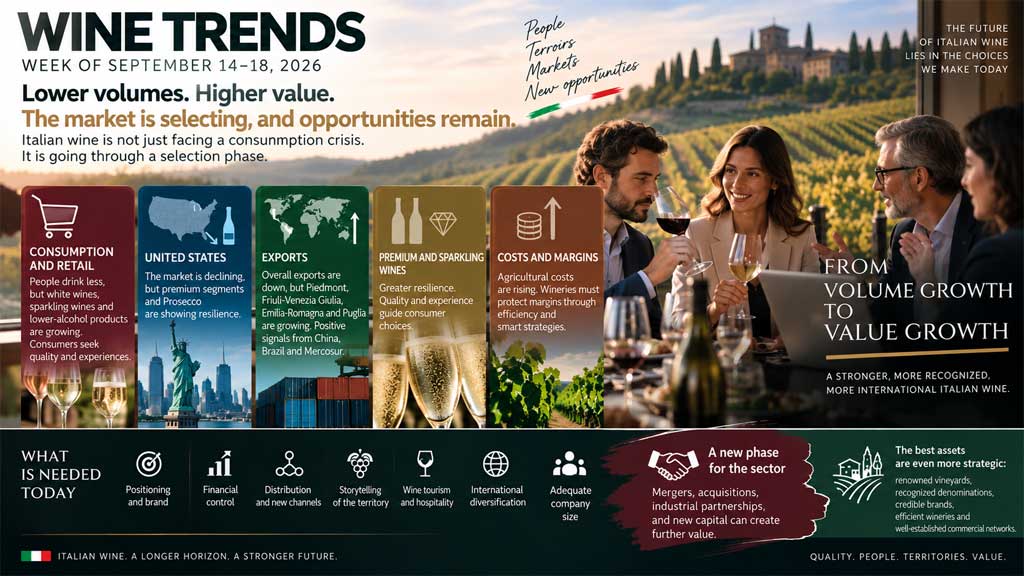
WINE TRENDS – WEEK 14–18 SEPTEMBER 2026

Lower volumes, greater selection: Italian wine is entering a phase where quality, positioning, and diversification become crucial.

The picture emerging from the wine market this week is more complex than the simple drop in consumption might suggest.
Italian exports are slowing, the United States remains under pressure, and large-scale retail trade also confirms a decline in volumes. At the same time, however, there are interesting signs from premium wines, sparkling wines, Prosecco, and some growing international markets.

The market isn’t just buying less wine: it’s becoming more selective.

And this is probably the most important data for understanding where the sector is going.

Italian exports: -6.2% in the first half of the year

In the first six months of 2026, Italian wine exports exceeded 3.6 billion euros , recording a decrease of 6.2% in value and 4% in volume compared to the same period in 2025.

The average export price decreased by 2.3%.

The data remains negative, but shows a partial improvement compared to the first months of the year.

The United States , the leading foreign market for Italian wine, has the greatest impact, with 849 million euros and a -14.1% .

Germany (-6.8%) and the United Kingdom (-6.6%) are also in difficulty.

However, there are markets that go against the trend: China 19.8%, Brazil 8.2% and Mercosur 18.4% .

The product types also show different behaviors: sparkling wines hold up (0.4%) , while still bottled wines fall by 8.9%.

The message for companies is clear: depending on a few markets, a few importers, or a single distribution model increases risk.

Commercial diversification therefore becomes an integral part of the company strategy.

Veneto is the leading exporter, Piedmont is growing

Veneto clearly maintains its leadership in Italian wine exports with approximately 1.3 billion euros , despite recording an 8.4% decrease.

Piedmont grew by 2.4% , reaching 566.9 million euros and overtaking Tuscany, which recorded 543.6 million and a decrease of 7.4%.

Veneto, Piedmont and Tuscany together represent almost 67% of the value of Italian wine exports .

Among the other regions, positive signals emerge from Emilia-Romagna (5.6%) , Puglia (6%) and Friuli-Venezia Giulia (2.5%) .

The territorial snapshot therefore confirms that Italy’s wine industry is progressing at different speeds.

United States: The market suffers, but premium wines and Prosecco are responding.

The American data deserves a more in-depth reading.

While the overall market remains weak, the higher-end segment is showing greater resilience.

According to SipSource data referring to July 2026, in the last three months wine volumes decreased by 6.8% and turnover by 4.2%, but performances are progressively improving as prices rise.

The segment above $50 saw revenue growth of 0.9% over the last twelve months .

Even more significant is the behavior of some categories in the last three months:

Champagne 14.7%, Prosecco 10.2%, Sauvignon Blanc 3.2%.

The HoReCa channel also appears more resilient: over the last twelve months, wine and spirits sold on-premises have lost 2.8% in volume, compared to -7.5% for retail.

The American market, therefore, cannot be interpreted solely through the overall decline in imports.

There are still consumers willing to spend, but they are looking for recognizable products, experiences and a higher perceived value.

Large-scale retail trade: people drink less, but choices are changing

The Italian market also confirms a structural transformation in consumption.

According to the Coop 2026 Report, between 2019 and 2026, wine sales lost 9.7% in volume , while the Champagne-sparkling wine category grew by 20.9% .

Furthermore, 42% of Italians say they intend to reduce their alcohol consumption in the next 12-18 months.

But reducing volumes does not mean the disappearance of interest in wine.

Consumption becomes more occasional, more selective and more experiential .

In large-scale retail trade , white wines, low-alcohol products and sparkling wines intended for home consumption are growing.

For wineries, therefore, the problem is not only how much wine is consumed, but which wine the consumer continues to choose and for which occasion .

Italian sparkling wines: quality and international reputation

An important signal also comes from the Italian Classic Method.

Trentodoc won 35 gold medals at the 2026 Champagne & Sparkling Wine World Championships, confirming its position as one of the most internationally recognized Italian appellations.

Ferrari Trento won 9 gold medals and was named “Sparkling Wine Producer of the Year” for the sixth consecutive year.

Franciacorta, Alto Adige, Prosecco DOC and Conegliano Valdobbiadene Prosecco Superiore DOCG also received awards.

Beyond the medals, the interesting fact is strategic: Italian sparkling wines continue to build value through territory, quality, brand, and international recognition.

Diversification means building markets, not simply exporting

The difficulties of the United States are accelerating a reflection that has already begun for some time.

Going international can no longer just mean finding an importer and shipping bottles.

Companies must spread risk across countries, customers and trade channels .

Alongside the established markets, China, Japan, Korea, India, Vietnam, Thailand, Singapore, Canada, Northern Europe, Brazil, and Mercosur, with very different characteristics, are becoming interesting.

Not all of them can replace US volumes, but they can help build a more balanced trading portfolio.

Importers, HoReCa, distribution, direct sales, tastings, wine tourism, communities, and digital communication must be considered part of the same commercial system.

The United Kingdom remains a market to be monitored carefully

The United Kingdom, the third largest foreign market for Italian wine, purchased approximately 345.5 million euros of Italian wine in the first half of 2026, 6.6% less than in 2025.

Taxes and excise duties also weigh on the market.

The Wine & Spirit Trade Association has expressed serious concern about the prospect of further increases in alcohol duties in a market where consumption is already under pressure.

For Italian producers, this means dealing not only with demand, but also with final prices, taxation and consumer spending power .

Pressure also comes from agricultural costs

The problem is not just about sales.

According to Eurostat data reported in the analyzed material, in the second quarter of 2026, European agricultural output prices decreased by an average of 5.8% , while non-investment agricultural inputs increased by 4.7% .

Energy and lubricants grew by 22% and fertilizers and soil conditioners by 13.4%.

The combination is particularly delicate: pressured selling prices and rising production costs are compressing margins .

For agricultural and winemaking companies, efficiency, size, cost control and commercial capacity are therefore becoming increasingly important.

A transformation that comes from afar

Istat data for the period 2006-2025 show that the transformation of Italian wine will not begin in 2026.

In 2006, Italy exported 39.9 liters for every 100 liters of wine produced . In 2025, the share rose to 44 liters .

In the same period, production increased from 49.6 to 47.8 million hectolitres, while exports grew from 18.8 to 21 million hectolitres.

Italy therefore produces slightly less than twenty years ago, but a larger share of production depends on international markets.

It is a structural element that makes the commercial solidity of companies even more important.

Style Selector
Select the layout
Choose the theme
Preset colors
No Preset
Select the pattern