

Italian Wine Faces a Slowdown, but New Opportunities Are Emerging
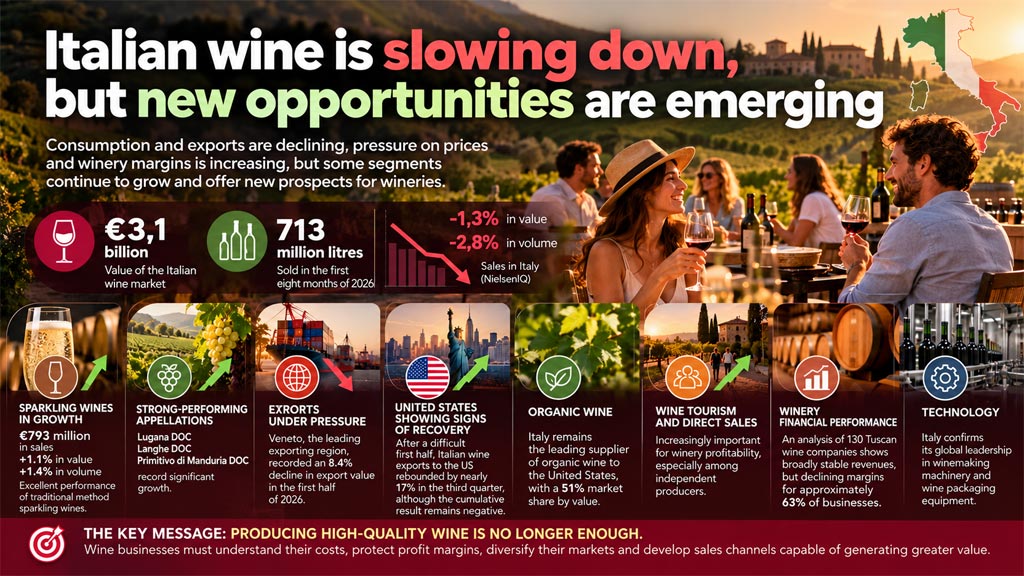
The Italian wine market is undergoing a period of transformation. Consumption and exports are declining, pressure on prices and winery profit margins is increasing, yet several market segments continue to demonstrate growth potential.
The domestic wine market is worth €3.1 billion, with 713 million litres sold during the first eight months of 2026. According to NielsenIQ, sales declined by 1.3% in value and 2.8% in volume.
The main trends include:
- Sparkling wines continue to grow: Sales reached €793 million, increasing by 1.1% in value and 1.4% in volume. Traditional Method sparkling wines performed particularly well.
- Strong-performing appellations: Lugana DOC, Langhe DOC and Primitivo di Manduria DOC recorded significant growth.
- Exports under pressure: Veneto, Italy’s leading wine-exporting region, recorded an 8.4% decline in export value during the first half of 2026.
- US market showing signs of recovery: Following a difficult first half, Italian wine exports to the United States rebounded by nearly 17% in the third quarter, although cumulative performance remains negative.
- Organic wine: Italy remains the leading supplier of organic wine to the United States, accounting for 51% of the market by value.
- Wine tourism and direct sales: These activities are becoming increasingly important to winery profitability, particularly for independent producers.
- Winery financial performance: An analysis of 130 Tuscan wine companies shows broadly stable revenues, but declining margins for approximately 63% of the businesses surveyed.
- Technology: Italy confirms its global leadership in winemaking machinery and wine packaging equipment.
The key message: Producing high-quality wine is no longer enough. Wine businesses must understand their costs, protect profit margins, diversify their markets and develop sales channels capable of generating greater value.
ITALIAN WINE MARKET TRENDS: DECLINING CONSUMPTION, RECOVERING EXPORTS AND NEW OPPORTUNITIES FOR WINERIES
October 26–30, 2026: The Italian wine market is entering a new phase. Sparkling wines, organic production and wine tourism are expanding, while wineries face pressure on profitability, weaker demand for red wines and the need to strengthen their commercial presence.
Weekly Market Analysis by WINE IDEA News – Markets, Businesses and Outlook for the Italian Wine Industry.
The Italian Wine Market Is Worth €3.1 Billion, but Consumption Is Declining
Italian wine remains an important component of the country’s agricultural and food economy, but 2026 figures confirm an increasingly selective market.
According to NielsenIQ, wine sales in Italy reached €3.1 billion during the first eight months of the year, with 713 million litres sold.
Compared with the previous year, sales declined by 1.3% in value and 2.8% in volume.
The average price of wine and sparkling wine stands at €4.31 per litre, while still wine averages €3.81 per litre, an increase of 1.6%.
Wine continues to be purchased by more than 80% of Italian households, but purchasing volumes, consumption occasions and consumer preferences are changing.
For wineries, the challenge is no longer simply to sell more bottles. It is becoming essential to offer the right wine to the right consumer through the most appropriate distribution channel.
Sparkling Wines and Appellations: The Most Resilient Market Segments
Sparkling wines continue to stand out as one of the strongest-performing categories.
Sparkling wines and Champagne generated €793 million in sales, increasing by 1.1% in value and 1.4% in volume.
Traditional Method sparkling wines recorded growth exceeding 6% in value and 9% in volume.
Several Italian appellations also demonstrated a particularly strong ability to attract consumer demand:
- Lugana DOC: +18.1% in value and +18.4% in volume.
- Langhe DOC: +11.9% in value and +14.9% in volume.
- Primitivo di Manduria DOC: +7.5% in value and +11.4% in volume.
- Valpolicella Ripasso DOC: +5.2% in value.
- Vermentino di Gallura DOCG: +5.1% in value.
These results demonstrate that, even in a contracting market, certain wine categories can continue to grow thanks to their territorial identity, established reputation and ability to respond to changing consumer preferences.
Italian Wine Exports: Veneto Slows Down While the United States Shows Signs of Recovery
International trade remains one of the most important areas of concern for the Italian wine industry.
According to Veneto Agricoltura, regional wine exports reached €2.93 billion in 2025, declining by 1.1% in value despite a 1.2% increase in exported volumes.
The average export price fell by 2.3%, reaching €3.64 per litre.
The situation worsened during the first half of 2026, when Veneto’s wine exports declined by 8.4% in value to €1.32 billion.
Nevertheless, Veneto continues to account for 36.3% of the total value of Italian wine exports.
In the United States, a key market for many Italian producers, the first half of 2026 ended with a 14.1% decline in export value, according to an analysis by Ebury.
However, preliminary figures from Unione Italiana Vini indicate a recovery of nearly 17% in exports to the US market during the third quarter.
The cumulative result for the first nine months remains negative, at approximately -6%, but the improvement compared with the first half represents an encouraging signal.
It remains unclear how much of this recovery reflects a genuine increase in consumption and how much is attributable to renewed purchasing and inventory replenishment by importers.
Tariffs, fluctuations in the euro-dollar exchange rate and pricing pressure continue to influence the commercial strategies of Italian wine producers.
Italian Organic Wine: The United States Confirms Italy’s Leading Position
Against a challenging international backdrop, organic wine represents one of the most promising opportunities.
According to research conducted by Nomisma for the Ita.Bio platform, Italy is the leading supplier of organic wine to the United States, holding a 51% market share by value.
In 2025, US imports of Italian organic wine reached €35.6 million, while the first eight months of 2026 recorded growth of 2.2%.
The perceived quality of Italian products represents an important competitive advantage.
Among American consumers who already purchase Italian organic wine, 71% consider it superior to organic wines produced in the United States and France.
However, several commercial barriers remain, including high prices, insufficient distribution and difficulties in identifying Italian organic products.
For organic wineries, future growth opportunities will therefore depend on stronger market visibility, wider distribution and more effective communication of the distinctive qualities associated with Italian origin.
Wine Tourism and Direct Sales: New Sources of Profitability for Wineries
One of the most significant changes in the wine industry concerns the direct relationship between producers and consumers.
Research conducted by Nomisma Wine Monitor for FIVI, the Italian Federation of Independent Winegrowers, highlights the growing importance of direct sales and wine tourism in the financial performance of smaller wineries.
Nine out of ten independent winegrowers sell directly from their wineries, with this channel accounting for an average of 20% of turnover.
Wine tourism contributes an average of 14% of revenues among businesses offering these activities, while 56% of producers report an increase in wine tourism revenues over the past two to three years.
The HoReCa channel remains important, accounting for an average of 47% of company revenues, but is experiencing greater difficulties.
A separate study by Nomisma and UniCredit estimates that wine tourism generated approximately €3.1 billion in 2025, contributing an average of 21% of turnover among the wineries included in the analysis.
Although the two studies examine different business samples and market segments, both confirm the growing economic importance of winery hospitality.
Wine tastings, vineyard tours, accommodation, restaurants and direct-to-consumer sales are no longer merely promotional activities. They can become structural components of a winery’s business model.
Tuscan Wineries: Stable Revenues but Profit Margins Under Pressure
Preliminary research conducted by the Management DiVino Research Centre at Studio Impresa, covering 130 Tuscan wine companies, highlights the economic challenges affecting even Italy’s most prestigious wine regions.
In 2025, the companies analysed generated combined revenues of €1.431 billion, broadly unchanged compared with 2024 (-0.2%).
However, the most significant finding concerns profitability: approximately 63% of the companies recorded a decline in EBITDA margins.
Within the sample, 64 companies increased their revenues, and 28 of these also managed to improve their margins.
The difference between resilient businesses and those experiencing difficulties therefore depends not only on sales performance, but also on their ability to manage costs, investments, debt and financial structure.
The pressure affecting red wines, particularly relevant in Tuscany, makes careful financial management even more important.
For producers, understanding the actual cost of each bottle, the profit margin of individual products and the minimum sales volume required to break even is becoming essential.
Wine Bottling: Positive Signs in the Third Quarter
Following several difficult months, some indicators are beginning to improve.
According to Valoritalia, wine bottling volumes increased by 4.9% in September 2026 compared with the same month in 2025.
During the third quarter, DOC wines recorded growth of 5%, while DOCG wines increased by 4.9%.
The cumulative decline in bottling volumes during the first nine months of the year narrowed to 3%.
IGT wines, however, continued to struggle, recording an 18.9% decline during the quarter.
The recovery in wines with protected designations of origin is an encouraging signal, although it is still too early to speak of a structural reversal in market trends.
Winemaking Technology: Italy Maintains Its Global Leadership
Italy’s winemaking machinery industry continues to represent an area of industrial excellence.
According to research by Simei and Mecs, Italy accounts for 47% of the global market for winemaking technologies and 60% of the wine packaging machinery segment.
The worldwide market for wine processing and packaging machinery was worth approximately €2.6 billion in 2025.
Simei, scheduled to take place at Fiera Milano Rho from November 17 to 20, 2026, will provide an opportunity to explore technologies designed to improve productivity, efficiency and competitiveness across the wine industry.
WINE IDEA NEWS – STRATEGIC MARKET PERSPECTIVE
The Future of Italian Wine Will Increasingly Depend on the Ability to Create Value, Not Simply Produce More Wine
This week’s developments reveal an industry undergoing profound transformation.
Italian wine retains an extraordinary heritage of wine regions, appellations, production expertise and international reputation.
However, these strengths alone are no longer sufficient to guarantee satisfactory financial performance.
Five strategic priorities emerge particularly clearly.
- Protect business profitability.
Rising costs and pricing pressure require more rigorous financial management. Selling more wine does not necessarily mean generating higher profits.
- Diversify markets and distribution channels.
Dependence on a limited number of countries or importers exposes wineries to increasing risks. Exports, direct sales, e-commerce and HoReCa should be developed as complementary channels.
- Invest in wine tourism and direct consumer relationships.
Wineries capable of offering experiences, hospitality and additional services can generate new revenue streams while strengthening customer loyalty.
- Strengthen market positioning.
Recognisable appellations, established brands, organic wines and distinctive products can create growth opportunities even in an otherwise weak market.
- Improve the financial and economic structure of wine businesses.
Understanding profit margins, production costs, liquidity and the financial sustainability of investments is essential for navigating market challenges and protecting business value.
The Outlook for Entrepreneurs and Investors
The ongoing transformation of the wine industry may create new opportunities for consolidation, mergers and acquisitions, equity investment and corporate restructuring.
Wineries with recognised brands, established markets, efficient production facilities and a proven ability to generate profits are likely to become more attractive to investors.
Conversely, businesses facing reduced margins, limited commercial diversification or financial difficulties should promptly consider turnaround strategies, industrial partnerships or alternative management models.
The value of a winery is no longer determined solely by its vineyards, buildings and production volumes, but increasingly by its ability to transform these assets into sustainable profitability.
Conclusion
2026 is proving to be a year of significant change for the Italian wine industry.
Declining consumption, export difficulties and pressure on profit margins coexist with encouraging developments in sparkling wines, organic production, prestigious appellations, wine tourism and direct sales.
The challenge for wine businesses is not simply to wait for the market to recover, but to prepare themselves to compete under different conditions.
Companies that successfully anticipate these changes, reorganise their operations and strengthen their competitive advantages will be better positioned to consolidate their businesses and pursue future growth.
WINE IDEA News – Italian Wine Market Trends, October 26–30, 2026.