


A network portal of Wine Idea. Discover the world of Wine idea

Wine press review for Sunday January 25 -2026

Italian wineries and producers, and wine news.

Italian wineries

Ca’ dei Zago – Valdobbiadene Prosecco Superiore DOCG Dosaggio Zero 2024 A small family-run business in San Pietro di Barbozza that interprets Prosecco DOCG by recovering historic vines and a strong territorial identity, led by the Zanatta brothers.

Cantina di Lisandro – Castel Campagnano (Campania) Restoration of a historic winery with a project focused on the native Pallagrello and Casavecchia grape varieties, organic farming, and integrated wine tourism.

My Casale (Rimini) triumphs at the Concours Mondial de Bruxelles. The Cabernet Colli di Rimini DOC awarded in Brussels: international recognition and regional valorization for a small excellence from Romagna.

Le Carline – Eastern Veneto Pioneers of organic and resistant grape varieties (PIWI), sustainability, experimentation, and structured growth in an area traditionally devoted to simple wines.

Cantina Valtidone launches “Grinta,” a new artistic label inspired by sport and the Olympics, combining wine, urban art, and local storytelling.

Italian wine and Italian oenology

Angelo Gaja: Fairs, Inventories, and the Future of Red Wine Strategic reflections on international fairs, overproduction, consumer education (“Rosso-Fresco”), and new wine languages.

Wine Defects: How to Recognize Them in Your Glass A practical guide to the main sensory defects and the chemical-microbiological causes that compromise the quality and identity of wine.

From “King Sangiovese” to terpenes. Winemaker Paolo Vagaggini’s book explores the genetics, aromas, and culture of Tuscany’s iconic grape variety.

60 million hectoliters in the cellar, but prices aren’t dropping. Record stocks, slow sales, and no price reduction: a system that postpones the problem of marketing and positioning.

Montalcino wines and cellars: no unanimity among the guides. WineNews analysis of the divergences among wine critics: the end of “certainties” and a plurality of interpretations regarding value.

Wine as a noble biomass: ten million hectoliters sitting in the cellar . From stock as a problem to wine as an industrial platform for ingredients, functional beverages, and alternative supply chains.

International

Tariffs and markets: Sandro Bottega’s position Criticism of European constraints and defense of a free but regulated market, based on brand protection and WTO principles.

Nicolas Joly’s biodynamic crusade The debate between radical naturalism and a balanced approach: the wine of 2026 transcends the “natural vs. modern” dichotomy.

TAP Air Portugal: wine as a travel experience 55 new Portuguese labels selected for the 2026 wine list: winemaking becomes part of the flight’s identity.

Names, protection and innovation

Fake Chianti on the web: over 2,500 illegal entries. Digital counterfeiting alert: improper use of the name in e-commerce, wine kits, clothing, and domains.

Wine you can touch and listen to. AIS Lombardia presents its Braille label with NFC: accessibility and inclusion enter the story of wine.

Territories, governance and wine communities

“Visione Vino Oltrepò” is born, a strategic community focused on Pinot Noir, supported by TEHA-Ambrosetti: an alliance between institutions and businesses for the territorial revitalization.

Women of Wine Tuscany: Donatella Cinelli Colombini reappointed. Female leadership and membership growth: Italy’s largest delegation renews its board.

Federica Fina elected president of MTV Sicilia. A new direction for Sicilian wine tourism: marketing, hospitality, and events at the heart of the 2026 strategy.

Wine and culture events

“Changing Stories” in Fagagna – I’ll Give You a Rose: A botanical and narrative workshop featuring gardens, cuttings, and storytelling, intertwining nature, memory, and culture.

Strategic wine assets (QUIDQUID – WineIdea)

Castelli Romani – Ariccia: Integrated agro-winemaking and hospitality platform in the Rome area: territorial value, the Rome DOC, and potential for scale.

Friuli Venezia Giulia – Export-oriented asset , 74 hectares, industrial winery, 70% exports, energy self-sufficiency: a platform ready for structured groups.

Chianti Classico – Historic estate 18 km from Florence. 120 hectares, historic DOCG rights, and premium real estate: a highly strategic asset acquisition.

Thanks for listening. Today’s wine press review was brought to you by WINEIDEA.IT .

See you tomorrow.
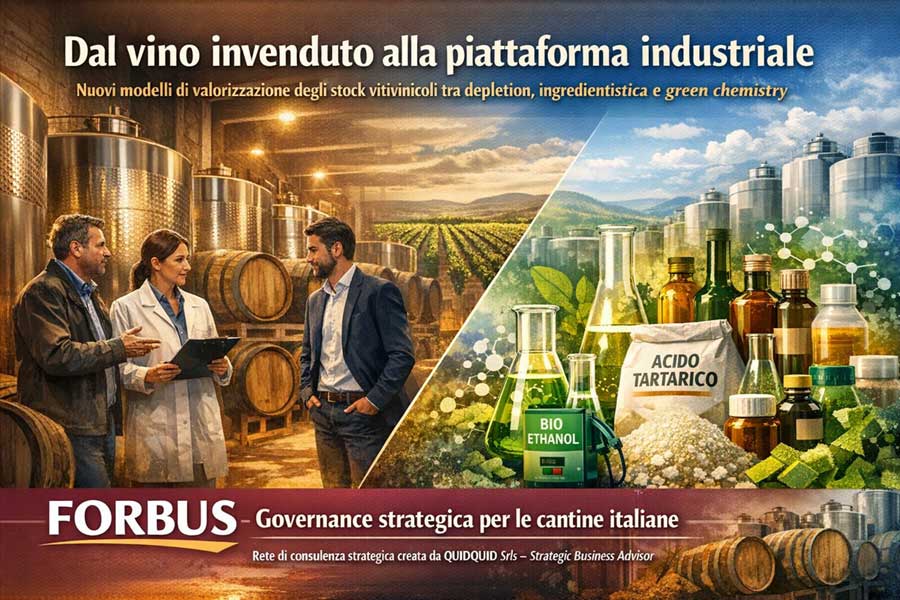
Strategic Analysis – From Unsold Wine to Industrial Platform (forbus)

New models for valorizing wine stocks: depletion, ingredients, and green chemistry.

From unsold wine to the industrial platform.

FORBUS – Strategic Governance for Italian Wineries
Strategic consulting network created by QUIDQUID Srls – Strategic Business Advisor

In wine there comes a point when stock stops being an asset and becomes pressure.
Ten million hectoliters sitting in the cellar aren’t a reserve: they’re a financial cost, a health risk, and a devaluation of assets.

But they can also be something else.

If managed with an industrial logic, those volumes become a platform of products, ingredients, and supply chains capable of generating value outside the traditional wine perimeter.

Because today the market no longer rewards “wine itself”.
It rewards specific functions: drinkability, serviceability, low alcohol content, sustainability, ingredients, industrial stability.
Wine is no longer just a bottle with a poetic label. It is an agricultural raw material with high chemical and functional content.

From this awareness a new strategy is born: managing wine as a noble biomass.

From wine to the product portfolio

Part of the stock can still be valorized by remaining in the beverage orbit, but with industrial logic.

The fastest solutions concern private label wines for large-scale European distribution, bag-in-boxes and lightweight formats, which allow for rapid rotation and immediate liquidity.

The bases for sparkling and semi-sparkling wines transform low-alcohol technical wines into cuvées for bubbles, one of the few segments still dynamic on international markets.

Dealcoholized and low-alcohol wines today represent the true “second life” of European wine. Demand is growing in Northern Europe, Canada, the United States, and Asia, while the supply of technical raw materials remains insufficient.

Finally, the RTD and mixology channel opens up to the world of industrial beverages: ready-to-drink spritzers, wine-based cocktails, and premium sangria. In this segment, what matters is not names or storytelling, but stability, alcohol content, color, and continuity of supply.

These solutions allow you to quickly reduce inventory.
But the real strategic leap occurs when we definitively exit the wine and spirits sector.

Wine as a “noble chemical broth”

Chemically, wine is an extraordinary mixture: structured water, alcohol, organic acids, polyphenols, residual sugars, aromas, mineral salts.

If we stop calling it wine and start calling it organic feedstock, a huge industrial ecosystem opens up: ingredients, cosmetics, nutraceuticals, pharmaceuticals, food processing, green chemistry.

There are at least seven main supply chains active today.

Tartaric acid and tartaric salts

Wine is the world’s leading natural source of tartaric acid.
Food additives, pharmaceuticals, fine chemicals, and green stabilizers represent a structural demand with stable prices and multi-year contracts.

Polyphenols and antioxidants

Resveratrol, flavonoids, and catechins are extracted from red wines for use in anti-aging cosmetics, supplements, and functional beverages.
Here the price is not per liter but per kilogram: one of the few cases in which an unsold wine becomes a premium ingredient.

Bioethanol and green chemistry

Renewable fuels, solvents, detergents, medical disinfectants.
Low unit margin, but the ability to absorb enormous volumes and guarantee constant flows.

Industrial vinegar and organic acids

Food processing, preserves, ready-to-eat products, and sauces.
Simple technology, stable market, massive uptake.

Natural flavors and aromatic waters

Premium soft drinks, iced teas, kombucha, natural perfumes.
The industry is moving away from synthetic flavors in favor of certified natural sources.

Fertilizers and biostimulants

Real circular economy: liquid fertilizers, fermented substrates, soil conditioners for intensive and organic agriculture.

Biomaterials and bioplastics

Natural resins, green solvents, additives for paper and fabrics.
Large European chemical groups enter here with multi-year agreements.

The industrial model: “empty warehouse, create business unit”

The real turning point isn’t choosing a product. It’s designing industrial architecture.

The most effective model today is the twin-engine one.

Engine 1 – Depletion (0–24 months)

Objective: drain volumes, generate cash, reduce risk.

Bioethanol and technical alcohol, industrial vinegar, fertilizers, and biogas allow for rapid inventory reduction, reduced health risks, and restored cash flows.

Here we are looking for speed, not margin.

Engine 2 – Valorization (12–60 months)

Objective: to create a new high-value industrial division.

The three strategic business units are:

  • antioxidant ingredients and polyphenols,
  • tartaric acid and tartaric salts,
  • natural aromas and flavours.

The winning model is the selective joint venture: the manufacturer supplies volumes and guarantees continuity, while the industrial partner invests in facilities, certifications, and customers.

The result is a radical transformation of the economic profile: no longer selling wine at a few cents a liter, but the creation of industrial participations.

From cellar to agricultural refinery

This isn’t a sales crisis. It’s a model crisis.

With ten million hectolitres there is no need to look for marginal alternative products.
We need to build a platform for the industrial valorization of wine, as already happens for sugar, corn and sugar cane.

Looking ahead, a “Bio-Ingredients & Green Chemistry” division could become worth more than the winery itself in just a few years.

Wine press review for Saturday January 24 -2026

Italian wineries and producers, wine news.

Italian wineries

VentiVenti Winery abandons certified organic production. “Organic isn’t enough”: the young Modena-based winery specializing in Metodo Classico is abandoning certification to focus on integrated pest management. This is an interesting sign of a rethinking of sustainability models in Lambrusco.

Cirò DOC to grow strongly (24%) in 2025. Sales exceeded 4 million bottles, driven by Cirò Rosso. The Consortium plans events in Rome, Bologna, and Milan to strengthen its national positioning.

Abbazia di Novacella: style, identity, and future. Freshness, fruit, and minerality are the guiding principles of this historic South Tyrolean winery. Focus on verticality and territorial coherence in the Isarco Valley.

Viarte turns 50 and accelerates its €8.5 million investment, a newly renovated cellar, and a target of 300,000 bottles by 2026. The Polegato family has developed a relaunch strategy.

Cantine Due Palme: Melissa Maci confirmed as president. Continuity at the helm of the cooperative during a challenging period for the sector, with a focus on sustainability and value for money.

Bertolani Alfredo awarded in the 2026 Vitae Guide. The 2021 Brut di Spergola obtains 94 points and the 4 AIS Viti: recognition of excellence for an Emilian sparkling wine undergoing strong qualitative growth.

Italian wine and Italian oenology

Women and “heroic” and sustainable viticulture. Organic, natural, and mountain viticulture as an environmental and cultural asset. Over 127,000 hectares of organic vineyards in Italy: a European record and female leadership for change.

Phytosanitary emergencies: January 2026 update. Bacillus thuringiensis approved in Sardinia to combat cork oak defoliants; experimental peptide on tomatoes halted. Clear signals on integrated emergency management.

Wine & Criticism: No Unanimity Among the Nine National Guides . A lack of consensus on top wineries and labels. This is indicative of the “fluid” phase of criticism and the shift in winemaking styles.

Global passion for Italian wine is growing online (20%). In 2025, searches for “Italian Wine” will boom on Google Trends. Wine tourism, conviviality, and digital are driving the international imagination.

Wine Proposal: 2025 Balance Sheet and 2026 Trends . Slight growth in turnover (1%) and a moderately positive outlook for 2026. Focus: young consumers, new consumption opportunities, and premium spirits.

Alberto Lusini (Angelini Wines & Estates): “We need pop wines.” Drinkability, accessibility, and consumption opportunities are key strategic keys to the future of large winemaking groups.

Italian wine numbers and geopolitics: Exports will exceed €8.1 billion in 2024. Global leadership confirmed, but international tensions and evolving consumption are ushering in a transitional phase.

Fake Chianti alert online: Over 2,500 pieces of illicit content identified in six months. Digital counterfeiting and trademark misuse are being monitored by the Consortium.

PIWI: Awards and New Resistant Varieties The 5th PIWI Wine Show was a success, along with the presentation of the three-year “Spumares” project for sparkling wines made from resistant grape varieties.

Pievalta among James Suckling’s Top 100 Value Wines The 2021 Castelli di Jesi San Paolo Riserva Verdicchio enters the international ranking, confirming the excellence of Italian whites.

International

The highest vineyard in the world is in Tibet At 3,700 meters in the Shannan region: new extreme frontiers of Chinese viticulture with eight operating companies.

Nicolas Joly speaks out against modern viticulture : “Standardized wines and a market in crisis”: the biodynamic pioneer relaunches the debate between naturalness, style, and economic sustainability.

The United States is moving toward 100% American wines. A bill is being proposed to ban foreign grapes from “American” wines. Potentially significant impact on imports and global supply chains.

Vinho dos Mortos: Portugal’s Buried Wine A unique tradition born to save wine during invasions: today, only one winery keeps this historic practice alive.

Wine events

Consorzio Vini Venezia at the 2026 Milan-Cortina Olympics. Official tasting on February 19th at Casa Veneto to showcase the five appellations of the Serenissima to an international audience.

Natural Evolution 2026 in Grottaglie. Seventh edition dedicated to artisanal wine: Fuori Salone, tastings, workshops, and dialogue between producers and the local area.

Vinario4: a new wine shop is born. A cultural and educational project combining communication, events, and a community of enthusiasts, focusing on craftsmanship and local tradition.

Kiwon, a Korean wine bar in Milan. A new format combining Korean cuisine and European natural wines: an urban laboratory combining fermentation, bistro, and wine bar.

This edition captures a clear picture of a structural transition in Italian wine : sustainability under review, fragmented criticism, exports still solid but geopolitically fragile, and a strong buzz around events, formats, and new generations. A fertile ground for those who manage operations, positioning, and investments with a long-term vision.

Wine press review for Friday January 23 -2026

Canine and Italian wine producers, wine news.

ITALIAN WINERIES

Contini 1898 Winery: 2025 Vintage Gets Off to a Positive Start. The historic Cabras winery is returning to growth: increased quantity, confirmed quality, and a production schedule increasingly adapted to the climate.

Col Dovigo Winery (Breganze DOC): a family history and a wine tourism vocation. Profile of a Venetian winery of excellence, combining a volcanic microclimate, distinctive wines, and structured wine tourism.

Cantine Due Palme: Melissa Maci reappointed as president. Continuity at the helm of the Apulian cooperative amid a challenging market environment, amid declining consumption and new strategies for sustainability and value-for-money.

Bertolani Alfredo Winery: A shower of awards for its Brut di Spergola. The classic method “Bertolani Brut” receives 94 points and the 4 Viti in the 2026 Vitae Guide: a recognition of excellence for Emilia.

Argiano and Sarzi Amadè: an alliance for Brunello di Montalcino. Exclusive distribution agreement for the Italian market: a new strategic phase for Argiano in the high-end segment.

ITALIAN WINE AND ITALIAN ENOLOGY

Veneto is a national leader: production and exports grow in 2025. Vineyard area exceeds 104,000 hectares, Prosecco is central, and exports are on the rise: Veneto confirms its position as the driving force of Italian wine.

Record stocks: over 60 million hectoliters in the cellar. Surplus alert according to Cantina Italia: stocks at a ten-year high, pressure on prices and the supply chain.

Langhe Nebbiolo DOC now available in bag-in-box. The Consortium approves the modification to the specifications: an open debate on tradition and new formats.

Lambrusco, a plural identity between past and revival. A reflection on the ten souls of Lambrusco and its evolution after the “Italian red cola” era.

Diamond dust against counterfeiting Feudi Spada adopts Dust Identity technology (MIT) to protect bottles with unclonable physical signatures.

Fewer and fewer pesticides available. Drastic reduction in authorized active substances: a growing technical challenge for plant protection.

Wine in the Age of Surplus: From Quantity to Design. A Structural Analysis of the Global Consumer Crisis (OIV): Unbalanced Inventories, Incentives for Culling in France, and a Necessary Paradigm Shift.

Conventional wine according to Nicolas Joly The biodynamic pioneer criticizes industrial winemaking: “wine made in the cellar, not in the vineyard.”

In vino “novitas”: new Slow Food Presidia Promoting Abruzzo Cotta and Recioto della Valpolicella as wine and cultural heritage.

INTERNATIONAL

Champagne in crisis: 60 million bottles lost in three years. 2025 sales at 266 million (-2%): domestic market in decline and structural difficulties post-pandemic.

Oniwines strengthens its position in Champagne. The Oniverse group is looking at new acquisitions in Northern Italy and France and is focusing on hospitality in the cellar.

Dry January, Lonely January – The Economist The decline in wine prices speaks to a social crisis: less conviviality, less shared time, fewer rituals.

Alcohol-free debuts at Wine Paris 2026. The “Be No” area is born: a strategic response to new consumer trends and the changing market.

WINE EVENTS, CULTURE AND TRAINING

Prosecco and denominations conference – Godega di Sant’Urbano (January 30) Focus on markets, sustainability and new viticultural authorisations, prelude to the Antica Fiera di Godega.

Taste Alto Piemonte 2026 – Milan, March 9 Grand tasting of the 10 Alto Piemonte appellations at the Westin Palace.

5th PIWI Wine Show 141 labels from resistant grape varieties awarded: sustainability as a technical and commercial lever.

Sicilian Wine Tourism Movement: Federica Fina appointed new president. New governance to strengthen hospitality, territorial synergies, and regional promotion.

Wine changes its story – Rimini, January 24th. Meetings on wine, health, and the Mediterranean diet promoted by Enio Ottaviani and HeresLAB.

Wine and Health: A Discussion in Rimini. Scientific dissemination with Dr. Michele Scognamiglio on conscious consumption.

Call for Papers 2026 – Enotria, Rivista del Vino (UIV) The historic scientific journal is back: an interdisciplinary discussion on the future of the sector is underway.

Review brought to you by WINEIDEA.IT . See you tomorrow.

Style Selector
Select the layout
Choose the theme
Preset colors
No Preset
Select the pattern