A network portal of Wine Idea. Discover the world of Wine idea

Wine press review for Friday April 24 – 2026

Italian wineries, Italian wine producers, and current wine news.

Italian wineries

Trentino Wine Consortium: Vinitaly 2026 closes with enthusiastic buyers. The Trentino wine industry closed Vinitaly with a positive outcome: a strong institutional presence, a cohesive regional network, and new international relationships. Pavilion 3 showcased wine, grappa, Trento DOC, research, taste itineraries, and B2B meetings.

Pala Wineries: New Leadership with Lia Tolaini In Serdiana, the historic Pala Winery enters a new phase under the leadership of Italian-Canadian entrepreneur Lia Tolaini, with a vision that combines Sardinian identity, internationalization, and production responsibility.

Tenuta Biodinamica Mara: a biodynamic model in Romagna The Valconca estate is one of the most consistent examples of Italian biodynamic viticulture, with an integrated agricultural ecosystem and a strong focus on biodiversity.

Vinchio Vaglio Serra: a cooperative symbol of Monferrato. Founded in 1959, the Asti cooperative remains an example of unity between small winemakers, territorial valorization, and recognized quality.

Siddùra wins awards from Wine Spectator, Decanter, and Bigot. The Gallura winery consolidates its international positioning with its Vermentino Maìa, featured at Wine2Digital and recognized for its quality and territorial identity.

Cantina Sociale Orsogna: Revenues growing strongly. The Abruzzo-based cooperative expects revenue to reach approximately €62 million by 2025, a 32% increase, thanks to organic, biodynamic, export, and private label production.

Italian wine and Italian oenology

The Italian wine giants are slowing in 2025. According to financial statement previews, 16 out of 27 companies with revenues above €100 million have reported declining revenues. Exports, domestic consumption, and the international economy are weighing heavily.

Agrivoltaics in the vineyard: the Italian model is growing. From Puglia to Caviro, experiences integrating viticulture and renewable energy are growing. Photovoltaic pergolas can reduce water stress, protect plants, and create favorable microclimates.

The first Italian agrivoltaic wines from Puglia— Falanghina, Traminer Aromatico, and Primitivo—produced using agrivoltaics attracted interest at Vinitaly for their freshness, aromatic precision, and new sustainable approach.

Wineries and art: over 60 Italian companies invest permanently. From permanent collections to signature architecture, the connection between wine, contemporary art, and the region is growing, with examples like Antinori, Ca’ del Bosco, Frescobaldi, Planeta, Donnafugata, and many others.

Dealcoholized wines: production is allowed in Italy, but bureaucracy is a drag. Frizero, in Valpolicella, opened the first Italian plant authorized for dealcoholization in March, ushering in a new era for the no-low segment.

The silent crisis of the barrel industry The wineries’ cash flow difficulties are reflected throughout the supply chain: cooperages, leasing, used barrels, and supplies are feeling the effects of the market slowdown.

Wine and health: a debate still open. The debate continues between strict positions on alcohol and studies that support moderate wine consumption during meals. The topic remains central to the sector’s communication, culture, and reputation.

Falanghina del Sannio: Growing Identity Value Falanghina remains the iconic grape of Sannio, while the Consortium is working on revising its denominations, with a possible application for DOCG status.

Bonarda dell’Oltrepò Pavese Il Baldo 2023 Finigeto A still, intense and fruity Bonarda, with Croatina leading the tannic structure and Barbera providing freshness.

International

Champagne hit by frost: losses up to 85%. 2026 is shaping up to be the worst year for frost damage in Champagne since 2003. The abnormally warm weather has accelerated the growing season, making the vineyards more vulnerable.

French winemaking in crisis: 83 companies bankrupt in 2026. Amid declining consumption, struggling exports, bankruptcies, uprootings, and crisis distillation, the French government is stepping in to support a struggling sector.

War and wine: UIV reports orders blocked for €80 million. Instability in the Middle East is halting orders in approximately twenty markets, especially in the Gulf region. UIV calls for urgent responses from the Italian government and the European Union.

Vineyards as solid alternative assets According to Knight Frank’s Wealth Report 2026, vineyards remain attractive to HNWIs and family offices, especially in suitable, resilient and climatically suitable areas.

Wine events

Euganean Wines at Villa dei Vescovi From May 8 to 10, 2026, Villa dei Vescovi will host the event dedicated to the wines of the Euganean Hills, promoted by FAI and the Colli Euganei Wine Route.

Carignano Trails in Sulcis-Iglesiente The project combines hiking, mining history, and historic vineyards, promoting the Carignano del Sulcis area through slow tourism, culture, and landscape.

Agriculture and tourism: meeting at the Grosseto University Center. The strategic role of quality agriculture and sustainable tourism for the future of the Maremma region will be discussed in Grosseto.

Wine tourism is growing rapidly . An estimated 18 million Italians will be involved in wine-related experiences by 2026. Winery visits, tastings with food pairings, and a focus on quality hospitality are on the rise.

Bee Day in Negrar di Valpolicella On May 17, 2026, Parco Nord will host an event dedicated to bees, biodiversity, local products, environmental education, and conscious consumption.

Oltrepò Pavese: appeal for a round table discussion Gian Marco Centinaio invites us to listen to the producers and to work on wine tourism, wine routes and territorial relaunch.

Winemaker’s Saturday in Ancona On May 16th, 80-90 exhibitors, mostly from the Marche region, are expected at the Mole Vanvitelliana for a FIVI day dedicated to wine, local produce, and craftsmanship.

Campania in a Glass at the Wine Bank in Pollenzo, an evening showcased Falanghina and Piedirosso between Sannio and Campi Flegrei, showcasing the grape varieties, territories, and identity of Campania.

The Wine Routes in Calabria On April 26, 2026, Condojanni will host tastings, conferences, music, and culture to promote Calabrian wine and local tourism.

Closure

The day confirms a winemaking sector undergoing rapid transformation: dynamic wineries, international crises, new production models, growing wine tourism, and a growing focus on sustainability, art, health, and the heritage value of vineyards.

Thanks for listening. Today’s wine press review was brought to you by WINEIDEA.IT . See you tomorrow.

UMBRIAN QUALITY WINE DISTRICT HEADS TO LONDON FOR THE REAL ITALIAN WINE & FOOD EXPERIENCE

Just a few days have passed since the close of a Vinitaly 2026 that saw the Umbria Quality Wine District take center stage for the first time in initiatives dedicated to the wines of Umbria—from the preview evening to activities at the Umbria Pavilion, featuring a highly appreciated regional wine shop and a talk that involved several other Italian wine districts.

The team is now ready to depart for another major international event: the Real Italian Wine & Food Experience, scheduled for April 26–27 at the ExCeL Exhibition Centre, one of the largest and most important exhibition venues in Europe. The event, which continues the Real Italian Wine & Food format active for over 15 years, confirms its role as one of the most strategic trade platforms for promoting Italian wine and food in international markets.

The London edition takes place in a highly relevant international context, with over 250 agri-food producers participating and more than 1,500 professional operators expected, including buyers, importers, distributors, agents, restaurateurs, and sommeliers. Thanks to a digital matchmaking system, the platform enables the scheduling of numerous B2B meetings, fostering targeted and highly profiled commercial connections. The 2025 edition saw over 230 exhibitors arrive from overseas to meet more than 1,650 buyers from across North America—United States, Canada, and Mexico—as well as from Latin American countries such as Brazil.

Representing Umbria will be the wineries Chiorri, Azienda Agricola Mevante, Castello di Montegiove, Terre de la Custodia, and Guerrini—companies that embody the regional sector and the coordinated efforts of the production system led by Umbria Top Wines.

This participation is part of a broader shared promotional strategy involving collaboration between the Distretto del Vino Umbro di Qualità and the Camera di Commercio dell’Umbria, with the goal of strengthening the region’s presence in international markets and enhancing not only wine but also other regional agri-food excellences.

Alongside the wineries, producers of extra virgin olive oil, a craft brewery, and chocolate makers will also be present, showcasing an integrated offering of Made in Umbria.

“The British market shows growing curiosity and a strong inclination to deepen its knowledge of Umbrian wines,” says Gioia Bacoccoli, coordinator of the District. “After years in which collective promotional activities had come to a halt, today—thanks to District funding and collaboration with the Umbria Chamber of Commerce—we can once again establish a presence in a strategic market. The goal is to reactivate existing business relationships and consolidate new opportunities for our companies, in a country that continues to demonstrate great interest in Umbria and its products.”

Ahead of the two exhibition days, a Blind Tasting will take place on April 25 from 4:00 pm to 7:00 pm. Designed as an opening and networking moment, the event will give visitors the opportunity to taste the wines blind and provide structured feedback, which will later be collected and shared with exhibitors—an informal yet highly qualified occasion for direct exchange between producers, buyers, and industry professionals.

The Real Italian Wine & Food Experience thus confirms itself as a strategic platform for the international promotion of Italian wine, capable of combining exhibition, business relations, and digital innovation, while strengthening Umbria’s role within the world’s leading food and wine markets.


Wine Trends in Italy – Week of April 20-24 – 2026

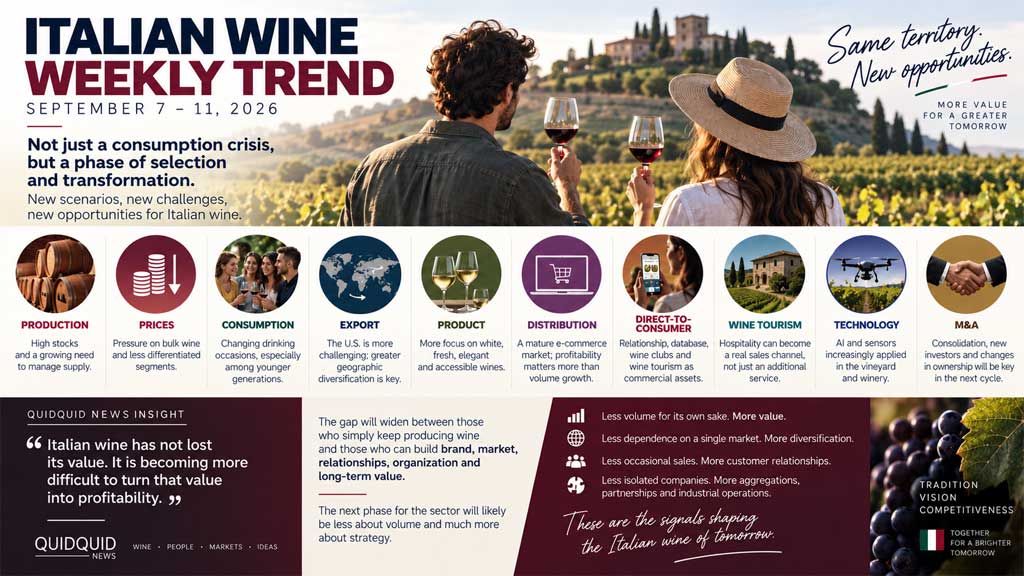
The week of April 20-24, 2026, confirms a complex picture: changing consumption, declining exports, unstable international markets, but also new opportunities related to quality, leadership, wine tourism, organics, sustainability, premiumization, and new sales channels.

Italian wine is entering a phase of intense selection.

The central message is clear: the sector can no longer grow simply by increasing bottles and volumes. It must produce less and better, strengthen brand value, address niche markets, better understand consumers, and build more structured businesses.

Female leadership: stronger and more future-oriented companies

One of the most significant findings comes from the research presented at Vinitaly on the role of women in the governance of wineries. Women-led businesses display more advanced organizational models, with clear roles, greater delegation capacity, long-term planning, and a focus on human capital.

Over 75% of those interviewed cite sustainability as a priority, approximately 70% consider the local area a strategic asset, and over 80% adopt a long-term vision. Female leadership therefore appears not just a matter of representation, but a concrete lever for corporate effectiveness.

However, the issue of access to top management roles remains unresolved, especially in the cooperative world, where the female presence in leadership positions is still limited.

Exports in difficulty: January 2026 starts in the red

The most worrying data concerns exports. In January 2026, Italian wine recorded an 18.7% decline in value, stopping at approximately €470 million, with volumes down 13.3%.

The decline is particularly severe in the United States, where exports fell by 35.2% in value. Germany, the United Kingdom, Switzerland, Belgium, and Sweden also fared poorly. Japan and France held up better, while positive signs came from Russia, Brazil, and China, albeit from even more modest bases.

The decline is also influenced by the rush to purchase in 2025 to anticipate American tariffs, but the signal remains strong: exports are no longer an automatic driver of growth.

The new recipe: less volume, more value

From the Vinitaly discussions, a shared vision emerges: the future lies in a more limited, more qualified offering with greater added value.

Italy still sells a relatively small share of premium wines. Increasing this share from at least 17% to 20% would already be a significant step towards protecting value and margins. The key, therefore, is selection: less quantity, more identity, better positioning.

Companies will also need to better understand markets. “Exporting” is no longer enough: they need to understand people, cultures, consumer communities, and niches. In the United States, for example, Italian wine is still highly concentrated in the Northeast, while segments such as Hispanic communities and the new multicultural America remain to be explored.

Wine tourism: the winery sells experience and bottles

Wine tourism continues to be a key driver. In 2025, 77.4% of winery visitors purchased wine after their experience. The average receipt was €147, with approximately 7.3 bottles purchased.

This data illustrates a crucial shift: the winery is no longer just a production site, but a space for sales, relationships, and storytelling. Experience builds trust, strengthens the brand, and encourages direct sales.

E-commerce is also interesting: the average online order rises to €197.90, despite fewer bottles purchased. Foreigners spend significantly more than Italians, averaging €317 versus €159.90.

Organic: Italy leads the world

Italy confirms an important record: a quarter of the world’s organic vineyards are located in our country. The organic vineyard area exceeds 132,000 hectares, almost double the amount of ten years ago, with approximately 3 million hectoliters of organic wine produced each year.

Organic farming offers a competitive advantage, but requires clear rules and effective pest management tools. Copper remains a key issue: without equally reliable alternatives, organic viticulture would face significant operational challenges.

No-Lo, Asia and new consumption

There’s growing interest in No-Lo wines, meaning those with low or no alcohol content. The segment is already worth $2.4 billion and could reach $3.3 billion by 2028. Even in Italy, some companies are starting to believe in it, while awaiting definitive regulatory clarification.

At the same time, Italian wine is increasingly interested in Asian cuisines. India, China, and Japan represent markets and gastronomic cultures that must be addressed with communication, education, and targeted pairings. It’s no longer enough to simply link Italian wine to Italian cuisine: it needs to be made credible alongside the world’s great cuisines.

Digital Consumers: Sustainability, Experience, and Identity

The PwC Italia and Meregalli Group analysis of digital consumers confirms some key trends. Wine is associated with territoriality, conviviality, sustainability, quality, and pairing with food.

Traditional channels still account for 70% of the total, while online accounts for about 30%. Online shoppers are looking for experience, loyalty, variety, and sustainability. Price matters less than you might think: only 10% cite promotions and discounts as the main factor.

This means that the consumer must not be pursued only with offers, but engaged with content, relationships, belonging and services.

Large groups and the aggregation phase

2025 also saw a slowdown among large operators. The sector with revenues above €100 million is worth €5.9 billion, equal to 42% of the national value, but many groups have seen a decline.

Cooperatives remain crucial, with a turnover of €2.7 billion and approximately 100,000 winemakers involved, but here too there is a need to increase value, strengthen distribution, focus on premium segments, and improve governance.

Looking ahead, mergers, alliances, acquisitions, and direct market presence will become increasingly important tools.

Wine press review for Thursday April 23 -2026

Italian wineries, Italian wine producers, and current wine news.

Italian wineries

Pasqua Vini looks beyond borders with “QuattroMani”. Born from a collaboration with Charles Smith, this multi-vintage Pinot Noir combines Valpolicella with an American winemaking vision, strengthening the international positioning of the Veronese winery.

1701 Franciacorta launches two new vintages of high stylistic precision. The winery presents the Dosaggio Zero Riserva 2019 and the Ellessedì 2022, confirming a limited, distinctive production oriented towards the expressive purity of the Franciacorta method.

Sicily consolidates its central role in wine tourism. Assovini Sicilia highlights how hospitality at wineries is increasingly a strategic asset for communicating identity, biodiversity, and the region, with tangible economic and reputational benefits.

Alessio Planeta, Sicilian wine as a global language The figure of the new president of the DOC Sicilia Consortium is interpreted as a synthesis of entrepreneurial vision, territorial roots, and the ability to tell Sicily’s story to the world.

Tenuta Cavalier Pepe relaunches Open Cellars in Irpinia. On May 31st, the Campanian estate offers an immersive day among the vineyards, the cellar, technical tastings, and promotion of the territory.

Icaro, the young winery from Castelli Romani that’s already exporting. Four friends transformed a passion into a business venture, building a business capable of tapping into international markets in just a few years.

Wineries and art: a growing structural bond in Italy. Over 60 wineries are investing steadily in contemporary art, architecture, installations, and artist residencies, strengthening the dialogue between wine, aesthetics, and cultural positioning.

Three Cesena wineries are at Vinitaly: Cantina Sociale di Cesena, Tenuta Casali, and Zavalloni. They bring the story of Romagna wine to the Verona fair, combining local identity and territorial promotion.

Trentino closes Vinitaly with encouraging signs. Interested buyers, a coherent territorial narrative, and new international opportunities emerge from the Trentino Wine Consortium’s report.

Italian wine and Italian oenology

ViteLab Network: Northern Italy’s viticultural research unites. Eleven centers of excellence and CREA are joining together in a permanent network to coordinately address the challenges of climate, plant diseases, and the competitiveness of viticulture.

Verona nominated as a national center for wine culture. Institutions and operators are relaunching the idea of a center dedicated to promotion, research, and dissemination, with the aim of strengthening the cultural role of wine in the Italian economy.

Corteva accelerates its commitment to biologicals. The multinational focuses on innovation and training to disseminate biostimulants and biological solutions capable of improving crop sustainability and resilience.

VITESAT brings precision farming to everyday vineyards. The Tuscan project coordinated by CNR-IBE develops a free DSS with a web platform and app to make site-specific vineyard management more accessible.

Syngenta evolves the Syngrape model The program born as the Grape Quality Agreement is strengthening itself as a useful tool for sustainability, phytosanitary management and export compliance of wine companies.

Young farmers, the Generazione Terra call is open. From April 22nd to May 19th, the Ismea tool that facilitates access to agricultural land for those under 41, encouraging generational turnover, is open.

Ronco della Chiesa, appeal to save a symbolic Collio vineyard. After the November floods, producers from across Italy are calling on institutions to discuss protecting Friuli’s historic winemaking heritage.

Copper emerges from a long regulatory dispute. EU Regulation 2026/840 redefines maximum residue limits, bringing to an end a matter that for years has generated considerable uncertainty for European farmers.

Italian agri-food sector to continue growing in the fourth quarter of 2025. The CreAgritrend bulletin reports an increase in GDP and agricultural added value, confirming a moderately positive picture for the primary sector as well.

Urban viticulture in Rome: high-tech vineyard on the Celio Hill. After the first planting at Villa Celimontana, the “Roma Mater Vinorum” project is evolving with new PIWI vines and an innovative experiment in the heart of the capital.

EU puts a stop to greenwashing in wine. The new European regulation requires specific, verifiable, and demonstrable environmental claims, ushering in a more rigorous era of communication in the sector.

“Let’s Gasify”: Oenological Research for More Sustainable Red Wines The DAGRI of the University of Florence is launching a project focused on the timely use of gases in winemaking to improve the quality, sustainability, and aesthetic of the product.

Moscato di Saracena is presented in a book presented at Vinitaly. Saveria Sesto’s book revitalizes the cultural and identity value of one of Calabria’s rarest wines, placing memory and protection at the center.

Four Sicilians among the 40 Under 40 of Italian Wine. Sicily confirms its dynamism also in terms of the new generation of wine professionals, between communication, branding and international projection.

International

The Umbrian Wine District flies to London After Vinitaly, the Umbrian system will participate in the Real Italian Wine & Food Experience on 26 and 27 April, strengthening its presence on international trade markets.

Santorini, wine beyond the tourist image. An in-depth study explores the other side of the Greek island: that of heroic viticulture, hard work, and wine as a defining feature of the region.

Eleven bubbles to tell the story of the terroir. A selection dedicated to the world of sparkling wines highlights Champagnes and productions with character, with attention to style, refinement, and expressive complexity.

Wine events

Milan Design Week: Food & Beverage Takes Center Stage The Fuorisalone confirms the integration of design, cuisine, and beverage, transforming food and wine into an active part of urban creative experiences.

Udine Cocktail Week kicks off with a widespread format. From April 25th, the event dedicated to mixology will expand its scope between the city center and the hinterland, consolidating its national profile.

Nova Eroica Prosecco Hills brings together sport, wine, and families. Over the weekend of April 25th, Borgoluce and the Conegliano Valdobbiadene area will host tastings, outdoor activities, and entertainment for a diverse audience.

Abbey Wines arrives in Calabria. On May 2nd and 3rd, the Abbey of Santa Maria della Matina hosts tastings and meetings that intertwine wine, spirituality, history, and local grape varieties.

Thanks for listening. Today’s wine press review is brought to you by WINEIDEA.IT .

See you tomorrow.

Style Selector
Select the layout
Choose the theme
Preset colors
No Preset
Select the pattern