

The Italian wine sector is experiencing a phase in which signs of structural strength coexist with tensions on international markets, competitive pressures, and profound transformations in consumer habits.
Exports: United States struggling due to tariffs and unfavorable exchange rate
The U.S. market, the primary outlet for Italian wine, is experiencing a marked slowdown. The UIV Wine Observatory recorded a 28% drop in export volumes and a 13.5% reduction in average price (from $6.52 to $5.64/liter) in the two-month period July–August.
The tariffs introduced by the Trump administration and the weak dollar are compressing margins and jeopardizing the mid-market, which is exposed to competition from American producers. UIV emphasizes the need for effective cost sharing along the supply chain, while Frescobaldi encourages companies to strengthen their international presence with a medium- to long-term perspective.
Global scenario: slight recovery in production but still weak trend
According to OIV estimates, global wine production in 2025 is expected to reach 232 million hectolitres: 3% higher than in 2024, but still 7% lower than the five-year average.
Italy maintains its world lead with 47.3 million hectoliters, ahead of France and Spain. However, the recovery is patchy: the weather continues to slow many regions, including France, which recorded a 16% decline compared to recent years’ averages. Despite the fluctuations, the international market remains substantially balanced thanks to slowing demand.
Italy: Growing exports and consolidated quality
In 2025, the value of Italian exports will exceed 8.2 billion euros , confirming the country as the world’s leading exporter by volume and second by value after France.
Production is back on track after a decline in 2023, while domestic consumption remains stable (37.8 liters per capita, 8.5 million daily consumers). This growth, however, faces the uncertainties of US tariffs, which could potentially erode significant market shares.
Increasing inventories and slower markets
As of October 31, 2025, national inventories reached 44.5 million hectoliters , up 5.2% from the previous year. This high level is driven by a bountiful harvest and slower demand, especially in the US. Veneto, Emilia-Romagna, and Tuscany account for over 50% of the stocks; Prosecco, IGT Toscana, and IGT Puglia lead the ranking of the most commonly stocked denominations.
Consumption: France down and Gen Z moving towards low-alcohol
France is seeing declines in large-scale retail trade: still wines are down 3% in volume and value, reds are suffering significantly, and Champagne is declining. Prosecco, however, is booming (up 14% in volume).
At the same time, young European consumers are turning to low-alcohol drinks: ciders, non-alcoholic sparkling wines, Christmas spritzes, and alcohol-free mulled wines are becoming key features of the 2025 festivities, driven by a concern for well-being and sustainability.
Finance and mergers: the “Compagnia del Gusto” is born
The wine and food sector continues to be considered a strategic investment asset. The new holding company, Compagnia del Gusto, aims to bring together food and wine excellence—from seafood specialties to premium wines—with a strategy of international growth, innovation, and sustainability.
The project, structured around three business units (Compagnia del Mare, delle Vigne, and dei Sapori), aims to create a synergistic model for distribution, logistics, and local development, with a target turnover of €200 million.
European Policies: Progress in the “Wine Package”
Confagricoltura welcomes the new regulatory framework approved by the European Parliament: permits for replanting have been extended from three to eight years and EU funding of up to 80% for climate mitigation investments. However, critical areas remain to be addressed to truly strengthen European competitiveness.
Italian competitiveness: promotion and innovation as strategic levers
A clear need emerged from the Confcooperative conference: to secure the future of the sector with a long-term vision based on promotion, research, sustainability, and market development. Global consumption continues to decline for red wines, while white, rosé, and sparkling wines are growing.
Land Value: Barolo Leads the Ranking of Most Valuable Vineyards
The land market continues to show marked territorial disparities. Barolo reached record values of up to €2.3 million per hectare , followed by areas such as Bolgheri, Montalcino, Valdobbiadene, and Caldaro. Italy’s finest vineyards remain among the most sought-after agricultural assets internationally.
Awards: Italy already in Wine Spectator’s Top 10
Castello di Ama’s Chianti Classico San Lorenzo Gran Selezione 2021 has entered the provisional Top 10 of Wine Spectator’s “Top 100,” ranking at number 9, confirming the strong identity of Tuscan winemaking on global markets.
Conclusion
This week confirms a complex yet opportunity-rich picture: Italy maintains its manufacturing leadership and growing exports, despite facing more selective markets, changing consumers, and an uncertain geopolitical environment. The answers lie in innovation, aggregation, supply chain efficiency, and a more robust international strategy, elements that define the trajectory of future competitiveness.
The Italian and European wine sector is experiencing a period of apparent stability, but beneath the surface, profound transformations are taking place that are reshaping production, trade, and consumption.
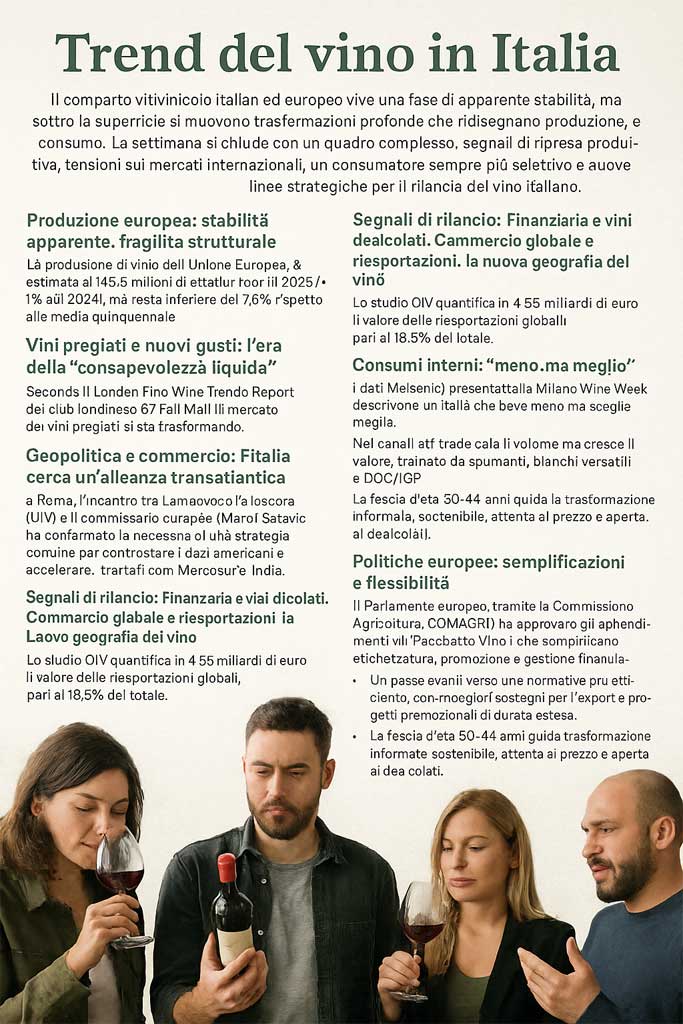
Wine Trends in Italy – Week 3-7 November 2025 (Analysis by Eros Zago)
The week ends with a complex picture: signs of production recovery, tensions on international markets, an increasingly selective consumer, and new strategic lines for the relaunch of Italian wine.
European production: apparent stability, structural fragility
European Union wine production is estimated at 145.5 million hectolitres for 2025 (1% compared to 2024), but remains 7.5% below the five-year average.
Italy confirms its leadership with 47 million hectolitres (8%), ahead of France (37 Mhl, 2.3%) and Spain (31.5 Mhl, -15%).
Behind the slight recovery in volumes lies a long-term downward trend: since 2018, EU production has fallen by over 40 million hectoliters. 2025 was marked by extreme weather events and a complex trade environment, exacerbated by new US tariffs on European wines.
Fine wines and new tastes: the era of “liquid awareness”
According to the London Fine Wine Trends Report from London club 67 Pall Mall , the fine wine market is transforming.
The evolved consumer favours authenticity, drinkability and immediate value , while the myth of big labels and the “en primeur” system is losing its appeal.
Interest in South Africa (26% in 10 years), English Sparkling Wine (79% since 2015) and consumption of Italian wines (37.5%) are growing, particularly from regions such as Sicily and Tuscany .
The future of fine wine will be driven by a more informed, digital and independent public, with increasing attention to sustainability, low alcohol content and lightweight packaging .
Geopolitics and Trade: Italy Seeks a Transatlantic Alliance
In Rome, the meeting between Lamberto Frescobaldi (UIV) and European Commissioner Maroš Šefčovič confirmed the need for a common strategy to counter American tariffs and accelerate treaties with Mercosur and India .
Italy is aiming for an alliance with American trade , emphasizing that every dollar invested in EU wines generates $4.50 for the US economy. Wine thus also becomes a tool of economic diplomacy .
Signs of recovery: Financial law and dealcoholized wines
Two pieces of news fuel confidence in the future of the sector:
- 2026 Budget Law – Budget law provides for an increase in funding for promotion and internationalization of up to €250 million annually for the three-year period 2026-2028.
- Decree on dealcoholized wines – currently awaiting final approval, will open a new production frontier, meeting the growing demand for low- and no-alcohol wines .
A double strategic step towards a more competitive, modern, and international Italian wine.
Global trade and re-exports: the new geography of wine
The OIV study quantifies the value of global re-exports at 4.55 billion euros , equal to 13.5% of the total.
New hubs are emerging: the UK, Belgium and Singapore , high-value clearinghouses for premium and super-premium wines.
For Italy, re-export represents approximately 8% of total exports , highlighting the growing importance of distribution as a strategic lever for competitiveness and profitability.
Domestic consumption: “less, but better”
The NielsenIQ data presented at Milan Wine Week depicts an Italy that drinks less but makes better choices.
In off-trade channels, volume is decreasing but value is increasing, driven by sparkling wines, versatile whites and DOC/IGP .
The 30-44 age group is leading the transformation: informed, sustainable, price-conscious and open to deal-alcohol .
In the Horeca channel, the “quality of the experience” dominates: a thoughtful wine list, local storytelling, and staff training.
The trend towards premiumisation is consolidating: less quantity, more identity and transparency.
European policies: simplifications and flexibility
The European Parliament, through the Agriculture Committee (COMAGRI), has approved the amendments to the “Wine Package” , which simplify labelling, promotion and financial management .
A step forward towards more efficient regulation, with greater support for exports and long-term promotional projects.
Conclusion: the future of Italian wine
Italian wine enters 2026 with solid foundations but decisive challenges : economic sustainability, market diversification, digitalization, and new consumption styles.
Italy maintains its manufacturing leadership, but must now consolidate it with a vision of value, identity, and innovation .
The watchword is clear: less quantity, more strategic quality —from the vineyard to the table, from the territory to the world.
From the economic situation to operational steps: what’s really happening and how to proceed now.
Trend of Italian and world wines.
Snapshot of the week
- US administrative stalemate : shutdown halts TTB on COLA and COLA Waivers → delays on labels and halts entry of samples for trade fairs/tastings. Real risk of export promotions being blocked in Italy’s top wine market.
- Growing tourist demand for family-run wineries : interest from international visitors is booming, led by US Gen Z ; authenticity and a personal welcome are the real drivers.
- Fine Wine is in a “reset” phase : after the 2020–2022 boom, markets are recovering and becoming more experience-oriented (drinking, not just investing). Italy 100 is more resilient than other regions.
- Vinitaly.USA (Chicago, October 5–6) : Strong participation from North American companies/consortia and buyers; practical focus on tariffs, trade, and Millennial/GenZ engagement.
- HNWI migration to the EU : 46% of the super-rich consider relocation and investments in vineyards/olive groves as “hybrid” assets (lifestyle value); Tuscany tops the list among non-urbanites.
- Italy–USA economic relationship : Italian wine generates ~$19 billion in impact on the US economy (out of a total of $144.4 billion), with a 38% share of foreign wines consumed.
- EU structural overproduction : 13% of consumption in 2024/25, in line with the 20-year average → pressure on inventories/prices.
- European consumption : 71% of consumers are cutting back on alcohol; 25% of 25-35 year-olds don’t buy at all. Low-/no-alcohol, functional, and non-alcoholic beverages are on the rise.
- Italy at a crossroads : US tariffs at 15% (devaluation), declining domestic consumption, and high inventories; structural measures and innovation (including AI ) are needed.
Key insights
1) US Shutdown: immediate impacts on exports and promotion
- COLA standard : manageable impact (long-term planning).
- COLA Waivers : high criticality → impossible to ship samples for fairs/masterclasses.
- Ripple effect on consortia and companies with promotional activities scheduled in the USA.
2) Wine tourism: the (global) choice goes to the family
- Winery visits: top experiences for the US/UK/DE; family-run wineries beat out brand-name ones.
- Gen Z USA : 82% want to visit; authenticity and hospitality = competitive advantage.
- Next step: digital, multichannel promotion, AI for visibility and CRM; the role of specialized wine tourism consultants (revenue, omnichannel sales) to scale without losing brand identity.
3) Fine Wine: From the Covid bubble to the return to the glass
- World production in 2024 at its lowest since 1961; consumption down to 214 mhl .
- Indices: Liv-ex 100 −4.9% YTD (Jun ’25); Fine Wine 50 −7.4% YTD; Burgundy 150 −30.2% in 2 years; Italy 100 −3.0% YTD but 12.2% at 5 years.
- New focus: ready-to-drink, mature wines , and attention to storage costs. The focus shifts back to provenance, authenticity, and drinkability .
4) Vinitaly.USA Chicago: strategic presence
- 250 exhibitors, a strong presence of consortia and top brands; >1,500 operators expected, with over 2,200 in the final estimates.
- Program: masterclass, talks, and wine2wine Business Forum ; focus on tariffs, North America, and wine tourism .
- Sentiment: Fewer tariff scares at meetings, greater openness of importers/distributors to sales programs and new projects.
5) Olive grove-vineyard capital: Europe attracts HNWIs
- Push for premium agricultural assets (organic/terroir, integrated experiences).
- Hot areas for Italy: Tuscany, Piedmont, Puglia (wine and oil).
- “Hybrid” returns: lifestyle income and asset appreciation.
6) Italy–USA: economic symbiosis
- Italian exports 2024: $2.2–2.3 billion ; US share ~ 24% of Italian wine export value.
- Every $1 spent on EU/IT wine → $4.5 in value in the US economy.
- 15% tariffs starting in August: pressure on prices and mix; economic diplomacy and channel strategies needed.
7) EU supply and falling demand: the structural issue
- EU self-sufficiency 113.6% : chronic surplus → inventories and cash flow under stress.
- In Europe, alcoholic beverages −1.8% vs. non-alcoholic beverages 5.1%; no/low-fat and functional beverages ~60% of the beverage category.
8) Italy: critical issues and levers of sectoral policy
- 30,000 processing companies, 250,000 agricultural companies; €16 billion turnover; world’s leading producer.
- Operational proposals (safeguard package):
- Revision of the Consolidated Law : yields per hectare, alignment of yields with five-year data, management of surpluses, simplification of controls, labelling (ingredients & nutritional information).
- Planting/replanting permits : suspension of fines for unused permits (pre-Jan 2025); validity extended to 8 years .
- Anti-tariff measures : temporary compensation for sub-marginal profits; proposed reduced VAT on wine served with meals in restaurants to stimulate domestic demand.
- Finance & Operations : Business unit lease; joint venture/newco for technologies and new markets (e.g., dealcoholized products); revolving lien on inventory for liquidity.
- End-to-end Artificial Intelligence : vineyard (targeted dosages), winery (fermentations/blends), marketing (segmentation/CRM), sales (dynamic pricing), supply (demand forecasting).
What to do now (essential playbook for wineries and consortia)
- Mitigating the US Shutdown
- Reschedule your export promotion calendar: move activities requiring COLA Waivers to alternative markets in the next 6–8 weeks.
- Prepare a documentation pipeline ready for TTB reopening; maintain standard COLAs in progress (even if not reviewed).
- Activate B2B digital tastings , domestic shipments via importers with stock already cleared through customs.
- Portfolio repositioning
- Increase the white/sparkling/rosé mix (GenZ hookup & multi-cuisine pairing).
- For reds, focus on ready- to-drink vintages ; storytelling on origin and sustainability .
- Introduce a no/low test line on 1–2 SKUs in selective large-scale retail or DTC.
- Wine tourism as a marginal channel
- Family-Hosted format with digital booking, dynamic ticketing, and add-ons (vertical, food pairing, olive grove tour).
- CRM with lead magnets (photo tours, home recipes, playlists) and automations (welcome → cross-sell → wine club subscription).
- North American exports, beyond tariffs
- Net Pricing : Protect top placements with value-adds (bundles, library releases, magnums).
- Channels : Strengthens specialized e-retail, clubs, and premium Italian restaurants; serves as a buffer in Canada and Mexico .
- Finance and liquidity
- Activates a revolving lien on slow-moving inventory; evaluates a joint venture for third-party dealcoholization/bottling plants.
- Review delivery/yield contracts to align production with actual demand.
- AI & Operational Data
- Vineyard: sensors/vision algorithms for targeted treatments (less input, higher quality).
- Winery: Predictive fermentation models; blends assisted by a human validation panel.
- Go-to-market: elastic pricing by market/segment; look-alike campaigns targeting GenZ/Millennial audiences.
Conclusion
2025 marks an active selection process : less dispersion, more focus on high-margin markets/channels and authentic experiences. Amid tariffs, shutdowns, and shifting demand , the winners are wineries capable of three key moves: diversifying , rethinking their portfolio (including low/no), and monetizing wine tourism with digital and AI. Italian wine leadership begins here: consistent quality, authentic storytelling, and financial discipline. The rest is just background noise.
The sector is in a “reorganization phase”: weak global demand for reds, US tariffs slowing purchases in Q2, inventories still high, but signs of stability in some markets (Canada, Germany, Japan, Brazil) and volume leadership confirmed in the USA.
Prosecco is the undisputed star. Domestically, consumer confidence is slightly up; more inclusive pricing policies are needed in the Ho.Re.Ca. channel to attract Gen Z and new wine consumers.
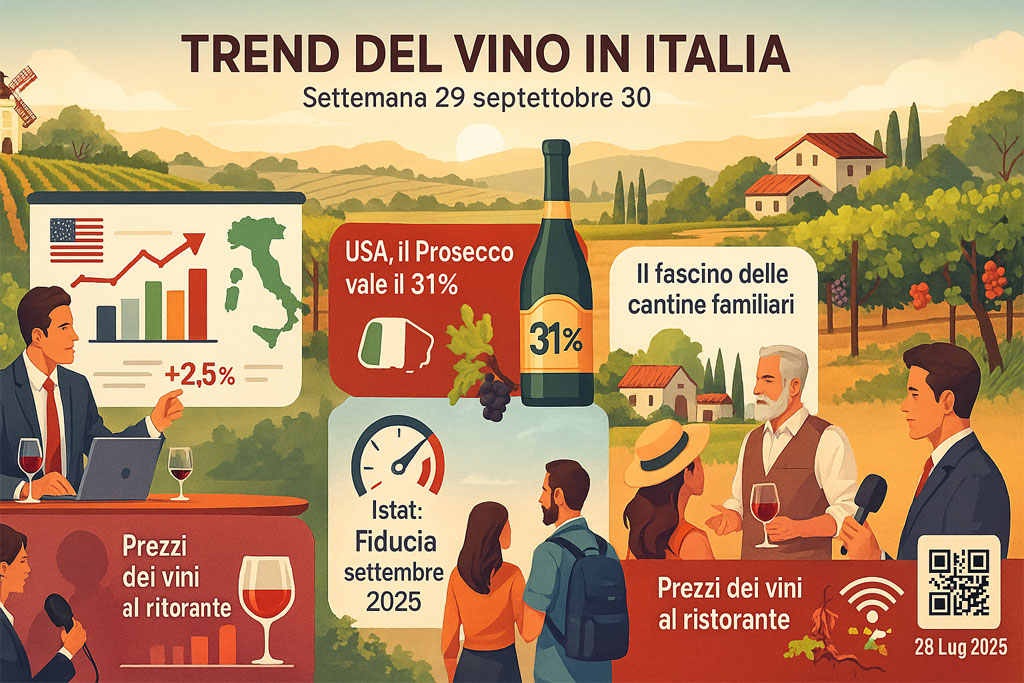
Wine Trends in Italy Week 29 September – 3 October 2025
Executive summary
Strategic priorities: export diversification, selective premium repositioning, inventory management, anti-counterfeiting traceability, and a push for data-driven “family” wine tourism.
Exports first semester 2025 (source Nomisma: monitored markets)
- USA : leading market but pre-tariff “pre-stocking” halted → from 22% (Jan–Mar) to -7% (Apr–Jun) . Italy: 2.5% in the first half thanks to Q1. Court of Appeals decision on legitimacy of tariffs pending.
- Canada : 11% imports from Italy; strong substitution of US wines on the shelves ( –65% ).
- Germany : 10.3% in value (still and sparkling goods: 14.2% ).
- Japan and Brazil : positive performances.
- United Kingdom : –7% in value ; sparkling wines –6.6% , still/sparkling wines –8.1% .
- Others in decline : Switzerland, South Korea, Norway, China ( -10.5% for still/sparkling wines).
- Italian sparkling wines (12 markets): growth slowed to 1% value / 6% vol ; dynamic Japan, USA, China . Weak UK, France, Australia .
Production, inventory and structure
- Supply chain: 30,000 processing companies (1,800 industrial), 250,000 agricultural; turnover €16 billion (excluding related industries), 2024 exports €8.1 billion , 74,000 employees.
- Italy: world’s leading producer (average 47 million hl ), leading exporter by volume ( >22 million hl ).
- Production volatility: peak 55 million hl (2018) ; minimum 38 million hl (2023) ; 2024 rising but below average; 2025 UIV estimate: 47.4 million hl ( 8% on 2024).
- Inventories : 2023 > production; July 2024: 40 million hl (–20% y/y with production –23%); 30 June 2025: 43.6 million hl (0.3% y/y; –6.4% on May), 2.7 million hl must and 63,926 hl new wine .
- Areas : Italy 728k ha (0.8%) ; national structural decline –15% (2000–2023) . EU27 3.2 million ha ; Spain 930k ha (–15%) , France 783k ha (–0.7%) ; China 753k ha (–0.4%) ; India growing 185k ha , CAGR 4.5% (from 2019) .
Prices, US tariffs and their impact
- Average export price (still in bottles): Italy €4.43/l , below France €7.81 , Australia €5.56 , New Zealand €5.86 .
- USA : worth ~ €2 billion (24% of Italy’s export value). Average tariff 2.9% until Jan 2025 → 15% from Apr 2025 .
- Estimated UIV impact : €317 million (up to €460 million with a weaker USD). Final markup from origination: estimated from 123% to 186% .
- Apr 2025 : Italy → USA –7.5% vol / –9.2% val . Jun 2025 : Italy €169.8 m (–4.2% m/m vs Jun ’24) ; France €191.3 million (5.9%) .
- Volume leadership confirmed: June 2025 Italy ~33 million liters (3.5%) = 32.6% of US imports; H1 2025 Italy 188.9 million liters (7.5%) > France (20.1% vol).
Focus Prosecco (UIV–Vinitaly / IWSR / SipSource)
- In the USA it is worth 31% of the value of Italian wine consumption ( $531 million in 2024 ).
- Awareness 40% (vs Champagne 52% ), but conversion to purchase 31% (Champagne 24% ).
- Sparkling wine share in the US (first 7 months of 2025): Prosecco 30% , Champagne 28% .
- Drivers: average price < $18 , strong penetration among women and Gen Z , use in mixology/RTD .
- Challenge: Growth in multi-ethnic communities (competitor: cocktails, hard seltzer, RTD).
Domestic demand and confidence (ISTAT, September 2025)
- Consumers : index from 96.2 → 96.8 ; economic climate 97.0 → 98.8 ; current 99.2 → 99.9 ; future 92.2 → 92.6 ; personal ≈96.0 .
- Businesses : 93.6 → 93.7 (stable); construction 101.3 → 101.5 , services 95.1 → 95.6 ; manufacturing stable 87.3 ; retail 102.7 → 101.6 .
- Wine implications: propensity for durable goods purchases slightly improved, but retail suffers; need to push by-the-glass , experiences, and entry-level pricing.
Ho.Re.Ca channel and distribution (Partesa interview)
- Excessive markups on entry-level labels are driving young people away.
- Virtuous model: wine by the glass with pouring technology, minimum quantities and continuity of supply, expansion of Italian labels.
- In 2025 price lists: avoid both drastic increases and decreases; focus on fresh whites and “pure” appellations with high quality/price ratios (Verdicchio, Garganega, Sangiovese, Chianti, Morellino).
Wine tourism and territorial branding
- International attraction for family-run wineries is growing: intention to visit on next trips → USA 78% , UK 74% , Germany 61% .
- Preference for family-run businesses : USA 68% , UK 57% , DE 49% ; very strong interest from Gen Z USA (82%) .
- Priorities: digital communication , multichannel promotion , AI to design experiences and manage flows. Key role: specialized consultant for omnichannel positioning and sales.
Policy, risks and operational proposals
- Safeguard Package (Eurispes): revision of Consolidated Law 238/2016 , yields/specifications/controls more in line with demand; labeling with ingredients and nutrition information ; simplification of inspections.
- Multi-level anti-counterfeiting : serial QR , RFID , NFC anti-tamper ; testing of new fiscal stamps started from 28 July 2025 .
- End-to-end AI : precision viticulture, winery (controlled fermentations, blends), marketing and CX.
- Plant authorizations : 1-year suspension of fines for non-use before January 2025; extension of replanting period to 8 years .
- Insurance/guarantees : evaluate an export coverage scheme similar to Cap Francexport; yield mutualization fund to stabilize prices (avoid sell-offs, dispose of surpluses, including through juice/distillation).
- US Tariffs : USWTA mobilizes industry with survey for economic evidence; leverage for negotiating pressure.
- Uprooting : German pan-European plan proposed (based on the 2009–2011 model); Italy more cautious → preference for reconversions and active vineyard management.
Opportunity to be seized immediately
- Rebalance export portfolio : boost Canada, Germany, Japan, and Brazil ; monitor the UK and China with targeted plans.
- Selective premium : communicating value (territory, sustainability, winemaking precision) to close the €-/l gap with the French.
- Prosecco : defend US share (mixology, RTD, non-Caucasian communities, West & East North Central).
- Family-friendly wine tourism : packages bookable online, transparent pricing, CRM and AI-driven UGC content.
- Ho.Re.Ca : inclusive price lists, by-the-glass , menus under €20–25 for quality entry-level options.
- Supply/Inventories : harvest-sales plans, cuvée segmentation, alternative channels for surpluses.
- Trust & Anti-Fake : Progressive rollout of QR-RFID-NFC new tags; storytelling on product security.
Final route note
2025 is the year for “active selection”: less product dispersion, more focus on markets and channels that boost margins and reputation, with Prosecco as the battering ram, wine tourism as the catalyst, and the digital/AI supply chain as the neural network. This is where the competitive advantage for the next 24 months will be built.