All posts by admin

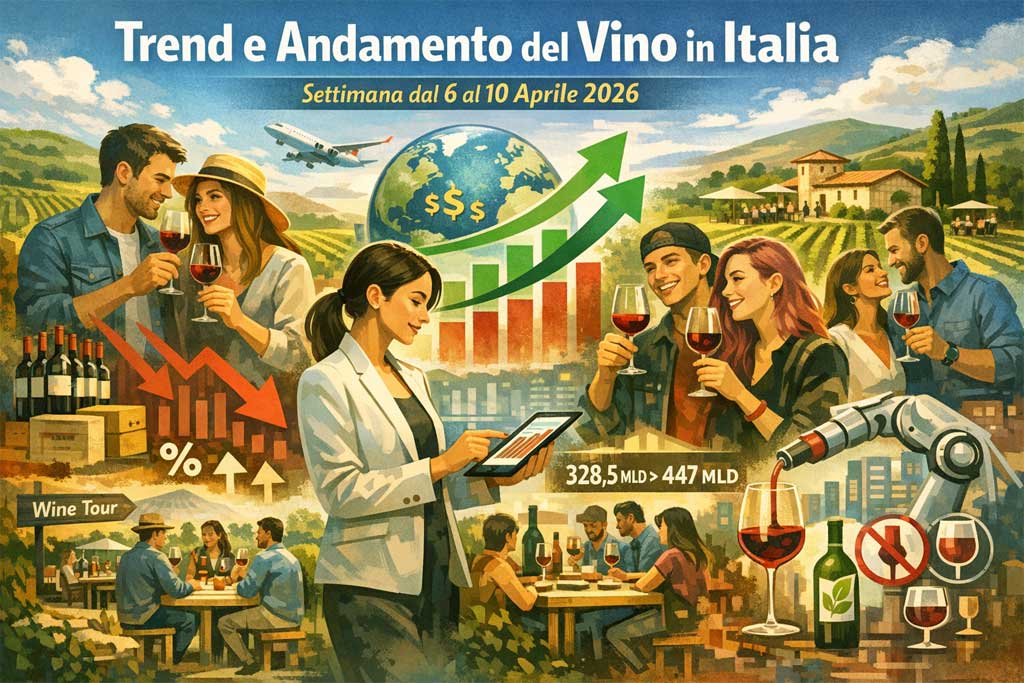
Wine trends and performance in Italy – week of April 6-10, 2026.

The picture that emerged this week confirms that Italian wine is in a complex, but far from static, phase.

The market is not standing still: its structure, languages, consumption opportunities, and competitive logic are changing.

On the one hand, pressures on consumption, prices, exports, and traditional channels remain evident; on the other, trends that can support the sector in the medium term are strengthening, such as premiumization, young consumers, wine tourism, product innovation, and greater commercial integration.

Internationally, wine continues to move within a scenario of potential growth. Estimates predict the global market will reach $328.5 billion in 2026, with the prospect of reaching over $447 billion by 2033, indicating that the sector is not in structural decline, but undergoing transformation. The strategic message is clear: wine will continue to generate value, but will do so by increasingly rewarding those who understand changing consumer behavior. Europe remains the dominant market share, thanks to tradition and wine tourism, while North America is identified as the most dynamic, driven by young people, direct sales, and a more everyday, accessible, and experiential wine culture.

For Italy, this means that wine can no longer be seen simply as an agricultural product or consumer good, but as an integrated system comprising the bottle, the region, hospitality, storytelling, and positioning. The most interesting signs come precisely from the sector’s ability to combine identity and adaptation. There is growing interest in premium, organic, biodynamic, low-alcohol, and no-alcohol wines, in products with sustainability credentials, and in easier-to-drink formulas that are more consistent with a lifestyle focused on well-being. This shift doesn’t eliminate traditional wine, but it does alter its competitive landscape.

One of the week’s most important developments concerns the relationship between wine and young people. International analyses reaffirm a finding that until recently seemed counterintuitive: younger generations aren’t necessarily distant from wine, but rather approach it in different ways. They’re more curious, more open to experimentation, more attentive to food, more responsive to advice and storytelling, more inclined to use digital channels, and more willing to spend when they recognize quality, experience, and brand consistency. Essentially, young consumers no longer seek wine simply as a habit, but as a cultural and identity-building choice. This opens up significant space for wineries capable of crafting contemporary languages without sacrificing authenticity.

On the domestic demand front, however, the picture remains selective. Out-of-home dining continues to show contradictory signals: the market is growing in value, but losing customers. This means people are spending more, but frequenting less. Aperitivo, for years a symbol of socializing and urban consumption, appears to be one of the hardest-hit occasions, with a marked decline in visits and the value generated by alcoholic beverages. This is an important sign, because it points not only to a difficult economic climate, but also to a shift in habits. Italian consumers are more cautious, more price-conscious, more sensitive to well-being, and less inclined to automatically consume alcohol. Regulatory pressure, the issue of driving, health, and changing attitudes toward alcohol are also contributing to reshaping the market.

In this scenario, wine is suffering especially in the segments most exposed to unspecified daily consumption. But not all are declining equally. Dinner remains the most economically powerful moment for eating out, tourism supports the sector with higher average receipts, and premium wine continues to hold up better than the lower end. This is one of the most compelling messages of the week: the market is not rewarding indistinct wines, but rather those that can justify their price, image, story, and perceived value. In other words, sales are lower where differentiation is lacking, while products that express identity, reputation, and a clear purchasing motivation hold up better.

The case of Sicily is also highly relevant, capturing a national trend: declining domestic consumption, rising costs, and pressure on full cellars, but also strong competitiveness in terms of quality-price ratio and the preservation of territorial value. The Sicily brand continues to have great evocative power, supported by tourism, its international reputation, and highly attractive locations like Mount Etna. This teaches a clear lesson for Italian wine as a whole: strong, easily identifiable, and well-touted territories still have the power to attract, even in a challenging market environment. Where recognition exists, the product more easily maintains its market share. Where wine is perceived as a commodity, however, the difficulty increases.

At the same time, the sector is demonstrating a growing organizational capacity for responsiveness. The “Galassia – World Wine Network” project represents one of the most interesting signs of the week because it points to a concrete industrial and commercial direction: building synergies, sharing networks, combining expertise, increasing international coverage, and streamlining market presence without erasing the identity of individual brands. It’s a model that can have broader implications for Italian wine: in a time of compressed margins and complex markets, commercial efficiency and governance become as crucial as wine quality. Producing well is no longer enough; markets must be managed with structure, continuity, and vision.

Exports also remain a sensitive area, requiring close monitoring. The negative signals coming from both Italy to the United States and Spain in January 2026 suggest that the international wine trade is having a difficult start to the year, amid declining volumes, weakening demand, and broader economic tensions. For Italy, this does not mean a loss of centrality, but rather the need for greater strategic prudence: geographical diversification, strengthening less mature markets, maintaining premium status, and more targeted commercial investments are becoming essential. In a less linear international context, those who rely too heavily on a limited number of outlets are likely to suffer the most.

Financially and symbolically, the first quarter of 2026 for Liv-Ex offers encouraging signs. The recovery, though moderate and limited to fine wines, indicates that high-end Italian labels retain their appeal and confidence in the secondary market. Italy is performing well, especially in the more refined segments, with Barolo, Supertuscans, and other top labels showing significant recoveries. This figure doesn’t represent all Italian wines, but it is a useful indicator: the reputational value of top-of-the-line Italian wines remains solid and continues to strengthen the country’s international positioning.

The most dynamic and perhaps most promising aspect, however, is wine tourism. This week’s data shows a clear acceleration: in 2026, an estimated 18 million Italians will be involved in wine-related experiences, a significant increase compared to 2024. But the real issue isn’t just quantitative. The way we experience the winery is changing. Visitors seek authenticity, human connections, winemaking families, landscapes, easy booking, diverse experiences, food and wine pairings, and quality hospitality. The winery is no longer just a place for tasting: it is becoming a commercial interface, a loyalty tool, a branding lever, and a direct sales and reputation channel. For many businesses, this means that wine tourism can no longer be an afterthought, but must become part of their business model.

Furthermore, the growth of wine tourism is intertwined with two key themes for the future: proximity and technology. On the one hand, it increases the potential of nearby destinations and local audiences; on the other, artificial intelligence is beginning to impact the customer journey, from research to inspiration to the personalization of the experience. This opens up a very interesting space for wineries that can combine authentic hospitality with digital tools. The risk, however, is thinking of monetizing experiences simply by raising prices without increasing their perceived value: the market clearly indicates that consumers are willing to spend, but demand consistency, quality, and a connection.

Overall, the week of April 6-10, 2026, therefore, depicts an Italian wine market that isn’t simply experiencing a slowdown, but rather a profound restructuring. Consumption is more cautious, eating out is less automatic, aperitifs are losing steam, costs remain a concern, and exports are off to a shaky start. But at the same time, signs of a new demand structure are growing: greater quality, greater identity, greater terroir, greater experience, greater sustainability, greater connections, and greater segmentation.

Wine press review for Thursday April 9 -2026

Italian wineries, Italian wine producers, and current wine news.

Italian wineries

Ornellaia, art and high-end at auction. Ornellaia brings “Vendemmia d’Artista 2023 – La Vitality,” signed by Marina Abramovic, to Bonhams with large formats and exclusive experiences. This move strengthens the brand’s luxury and international positioning, while also supporting philanthropic causes.

The journalist who chooses natural wine in the Matese area. Francesco Fossa, a television correspondent, is developing a micro-winery in the Caserta area, producing around 4,000 bottles annually. A small-scale, artisanal project with a distinctive identity and a distinctly unconventional feel, built with strong local roots.

Collis suspends Terre d’Oltrepò relaunch. The relaunch project promoted by Collis Veneto Wine Group for Terre d’Oltrepò has been put on hold, at least for now. The support received has proven insufficient to financially and operationally support the operation.

Pietramatta and Nove Lune at Vinitaly with amphorae and PIWI. The two Bergamo-based wineries of the Sala brothers will be presenting at Vinitaly in the “Amphora Revolution” area. The focus will be on cellar innovation, resistant grape varieties, the classic method, and experimentation with materials.

Terre Margaritelli is researching low-alcohol wines with the University of Perugia. The Umbrian winery is launching a scientific project using indigenous yeasts to produce wines with a low alcohol content without artificial intervention. This approach combines research, territorial identity, and new consumer trends.

Cantina del Taburno takes center stage at Vinitaly. The Rillo Group brings Cantina del Taburno and La Fortezza to Verona, with tastings focusing on Falanghina, Aglianico del Taburno, and Metodo Classico. This initiative aims to boost the visibility of the Sannio region.

Feudo Apiano, a new winery and territorial identity for Fiano di Avellino. Angelo Silano consolidates his project in Lapio with a new winery and a focus on the Fiano crus. This consistent growth enhances technical expertise, terroir, and niche positioning.

Monte Maletto and the mountain Carema. The spotlight is on the wines of Monte Maletto, a young winery already recognized for its stylistic precision. The Carema stands out as a mountain Nebbiolo, more slender, taut, and spicy, with a strong territorial personality.

Italian wine and Italian oenology

Restaurant wine and the markup issue. The gap between the new wine market and the old restaurant model is growing. Premiumization holds up on the value side, but the menu markup system risks penalizing consumption, rotation, and affordability.

Agriculture in Sicily, nearly €100 million for generational turnover. The Sicilian Region has published the provisional rankings for calls for applications for young and new farmers. This is an important measure to foster new entrepreneurship and innovation in agriculture.

Vineyard defense strategy: starting well makes all the difference. Early management of the growing cycle is considered a crucial tool for preventing downy mildew, powdery mildew, and botrytis. Early prevention remains key to yield, physiological balance, and final quality.

Altroconsumo’s best white wine under €10. Of the 48 wines tested, the Zavalloni Romagna Albana Secco DOCG 2024 stands out as the best buy. Among the organic wines, the Antonelli San Marco Montefalco Grechetto DOC 2024 stands out.

Italian wine can still innovate. According to Fabiola Sfodera, the Italian wine industry has already demonstrated its ability to respond to crises with innovation in quality, communication, and technology. In a more selective market, growth will come from quality consumption and value.

Wine e-commerce on the rise: more searches, greater attention to quality and affordability. In the first quarter of 2026, wine searches on Trovaprezzi.it increased by 10%. Sparkling wines dominate, followed by reds and whites, while interest in premium labels and more informed purchases is growing.

Agivi: dealcoholized products and AI should be integrated, not tolerated. Young wine entrepreneurs see dealcoholized products and artificial intelligence as tools to be carefully incorporated into business strategies. The key is not replacing traditional wine, but expanding the offering and improving efficiency.

2026 still complex, but premium and youth markets open up. Market analyses indicate a still challenging scenario, but with encouraging signs: premium segments holding up, interest from young people, growing attention for no/low alcohol and sustainability.

International

Bollinger opens its new cellar and begins its journey toward its 200th anniversary. Maison Bollinger inaugurates a new production facility in Aÿ, described as one of the most significant transformations since its founding. This investment combines prestige, architecture, and brand continuity.

Dom Pérignon relaunches three key vintages of its style. The new 2017 releases, Rosé 2010, and Plénitude 2 2008, showcase the maison’s dedication to maturation and stylistic coherence. This initiative reinforces the brand’s legacy and the value of time in the cellar.

The EU compromise on Australian Prosecco divides producers. The European agreement allows for a transitional use of the DOC and IGP labels in Australia, with a planned end in ten years. This delicate compromise leaves open tensions on identity and commercial levels.

From Lebanon, Sept Winery, blocked by the war, issues an appeal. The Lebanese biodynamic winery denounces its inability to travel, export, and attend international trade fairs due to the conflict. A powerful reminder of the need for productive survival in crisis-stricken areas.

Chiara Pepe from Abruzzo to Hermitage. Emidio Pepe’s winemaker will lead the viticulture and winemaking operations at Domaine de La Chapelle in Hermitage starting with the 2026 harvest. This represents an internationally recognized recognition of Italian expertise.

Spain opens 2026 with a decline in wine exports. In January 2026, Spanish exports fell 15.1% in value and 21.4% in volume. This figure confirms the fragility of the international wine trade at this stage.

Wine events

Natural wine: sustainability, wellness, and new audiences. With Summa, ViniVeri, and VinNatur Tasting, April remains a key month for natural wine events. The connection between sustainability, local culture, and engagement with discerning wine lovers is growing.

Vinitaly 2026: Sicily presents 164 wineries. The Sicilian group focuses on biodiversity, organic products, and native grape varieties with dedicated panels and masterclasses. The island’s presence in Verona confirms a high-intensity promotional strategy.

“Viva – International Wine Exhibition” in Vicenza On April 12th and 13th, Vicenza will host over 70 European producers, talks, masterclasses, and a food area. This event focuses on natural, organic, and sustainable wines, with strong urban and regional roots.

The 10 wines not to be missed at Vinitaly according to Giancarlo Gariglio. The classic selection of must-see wines at the fair returns. A useful tool for orienting professionals and enthusiasts among the pavilions, emerging labels, and trends to be identified.

Casa Toscana debuts at Vinitaly with an institutional stand. For the first time, the Tuscany Region will be present with its own official space. The strategy aims to unite large consortia, lesser-known territories, small producers, and heroic viticulture in a unified narrative.

Vinitaly: Verona nears a sell-out, ministers expected, and large attendance. The city is preparing for a major economic and media impact, with 4,000 exhibitors and 97,000 trade visitors expected. The event confirms its position as a key platform for Italian wine.

Vinitaly and the City lights up Verona from April 10th to 12th. The Fuorisalone will enliven the historic center with over 70 events including tastings, mixology, art, and wine regions. This increasingly strategic format expands audiences beyond the trade fair business.

The Valdobbiadene DOCG Show turns 70. The seventieth edition of a historic event for the Prosecco Superiore region opens in Col San Martino. Local involvement is strong, including among the younger generations.

Strategic Summary of the Day: Today’s review shows a sector that remains under pressure, but continues to respond with three specific levers: premiumization , production innovation , and experiential positioning . On the one hand, concrete critical issues emerge regarding exports, restaurant margins, and the sustainability of certain supply chain models; on the other, positive signs are emerging regarding low-alcohol products, scientific research, events, natural wines, and the ability of Italian regions to better present themselves to the markets.

Thanks for listening, we remind you that today’s wine press review was brought to you by WINEIDEA.IT .

See you tomorrow.

Wine press review for Wednesday April 8 -2026

Italian wineries, Italian wine producers, and current wine news.

Italian wineries

Costaripa presents its new vintages at Vinitaly 2026. The Moniga del Garda winery, led by the Vezzola family, brings new vintages to Vinitaly that elegantly interpret the Valtènesi terroir. This project combines research, tradition, and contemporary sensibility, confirming the winery’s commitment to refined, territorial wines.

Cielo & Terra launches “The History of Gio” line. The historic Vicenza-based company presents a new line dedicated to its founder, Giovanni Cielo, at Vinitaly. Three labels designed to tell the family’s story and highlight the identity, quality, and contemporary style of a group with a turnover of over €66 million.

Salvaterra presents the “Lovers’ Gambit” collection. Tenute Salvaterra, in the heart of Valpolicella, launches a new narrative line of wines inspired by the region’s 15th-century history. Each bottle represents a chapter in a story set in medieval Valpolicella.

Bava presents “Sullavìa” Pinot Noir 2024. The Bava family presents the first vintage of their single-vineyard Piemonte DOC Pinot Noir at Vinitaly. The wine comes from the Bricco Roche cru in Agliano and is vinified without oak to enhance the terroir and character of the grape.

Caiarossa at Vinitaly and Summa 2026. The Tuscan winery presents the new 2022 vintages of its iconic reds (Caiarossa, Aria di Caiarossa, and Pergolaia). The stand will showcase the winery’s production philosophy, based on sustainability and terroir appreciation.

Masi presents Pinot Noir del Re . Masi’s new still Pinot Noir comes from the Casa Re estate in the Oltrepò Pavese. The 15-hectare vineyard is entirely dedicated to the area’s iconic grape variety and represents a new step in the winery’s strategy.

Monte Cicogna tells the story of Garda in a bottle. A historic winery in Moniga del Garda, Monte Cicogna represents one of the most deeply rooted wineries in the Garda area, with a winemaking history that dates back to the early 1900s and continues today with a contemporary vision.

Gravida Winery, the Irpinia of fine white wines. Entrepreneur Alberto Fabbricini’s project aims to promote Irpinia through high-quality white wines, an authentic expression of a region characterized by biodiversity and a strong winemaking identity.

Tenute del Cabreo: new winery and investments. Ambrogio and Giovanni Folonari Tenute closed 2025 with a turnover of over €10 million. The new Tenute del Cabreo winery will open in May, part of an investment plan that also includes hospitality.

Collis Veneto Wine Group at Vinitaly The Veneto cooperative group, with 7,200 hectares of vineyards and over 2,450 members, presents itself at Vinitaly with a new corporate website and a strategy that strengthens its international presence in over 70 countries.

Crisis at the Carpi and Sorbara Winery: The Modena-based cooperative winery is entering the process of negotiated resolution of its crisis. The case is being brought before local institutions to protect the Lambrusco di Sorbara wine sector, which is central to the local economy.

Italian wine and Italian oenology

20% Tax Credit for Agricultural Fuels The Fuel Decree 42/2026 introduces a tax credit of up to 20% to offset the increase in energy costs incurred by agricultural businesses in March 2026. The measure has a total budget of €30 million.

The future of wine according to Renzo Cotarella The winemaker and manager of Marchesi Antinori, winner of the “Winemakers’ Winemaker Award 2026”, invites the sector to simplify wine communication and to produce wines that are ready to drink but also capable of aging.

Wine communication needs to change. According to export wine manager Gabriele Pezzuto, overly technical language alienates young consumers. Wine must be described clearly, without losing its distinctive cultural depth.

The Chianti Classico Consortium launches the “Chianti Classico is culture” campaign. The Black Rooster’s new communication campaign aims to promote wine as a cultural expression of the territory, a complex system that unites history, landscape, rural architecture, and tradition.

Manduria: The Story of Primitivo’s Identity The history of Primitivo di Manduria began in 1932 with the founding of the Producers’ Consortium. From blending wine to a symbol of Puglia’s identity, the journey recounts the transformation of a region.

Theft of fine wines in Lodi: Two suspects. Two people from the Pavia area face indictment for receiving stolen goods after stealing luxury bottles from the Michelin-starred restaurant La Coldana.

International

Modern Pinot Noir Is Identical to Medieval Pinot Noir. A study published in Nature demonstrates that a grape seed found in France, dating back approximately 600 years, is genetically identical to modern Pinot Noir. This discovery confirms the effectiveness of clonal propagation of vines, a process used for centuries.

Rosé is growing in the UK market. In 2025, rosé will see a 3% increase in volume and a 5% increase in value in the UK market, reaching approximately £882 million in turnover. This positive trend is seen against a backdrop of declining red and white wines.

Champagne Bollinger inaugurates a new cellar. The historic French house has announced the opening of a new cellar designed to respect the landscape of Aÿ. The initiative precedes the celebrations for the 200th anniversary of the house, founded in 1829.

Wine events

Vinitaly 2026: Campania takes center stage with 170 companies. The Campania Region is participating in the 58th edition with a 5,600-square-meter pavilion and over 20 events. The focus will be on tastings and the promotion of native grape varieties through the six regional consortia.

VinNatur Tasting 2026: The event dedicated to natural wines returns to Gambellara from April 11th to 13th. President Angiolino Maule emphasizes the importance of scientific research in improving quality and stylistic consistency.

Women of Umbrian Wine: Tastings and Meetings In April, a calendar of events dedicated to promoting Umbrian wine through women, with tastings and masterclasses at Vinitaly and other events in the area.

Wine e-commerce on the rise. In the first quarter of 2026, online searches for wine exceeded 657,000 (10%). Sparkling wines drive user interest, while price comparisons are becoming increasingly important in purchasing decisions.

New trade routes for Italian wine. With uncertainty in the US market, producers are looking to new markets such as Japan, Brazil, China, and Vietnam. Vinitaly aims to strengthen the presence of buyers from these regions.

Wine tourism boom in Italy. In 2026, an estimated 18 million Italians will be involved in wine-related experiences, an increase of 4.5 million compared to 2024. The desire to visit wineries directly and meet the producers is growing.

Thanks for listening. We remind you that today’s wine press review was brought to you by WineIdea.it .

See you tomorrow.

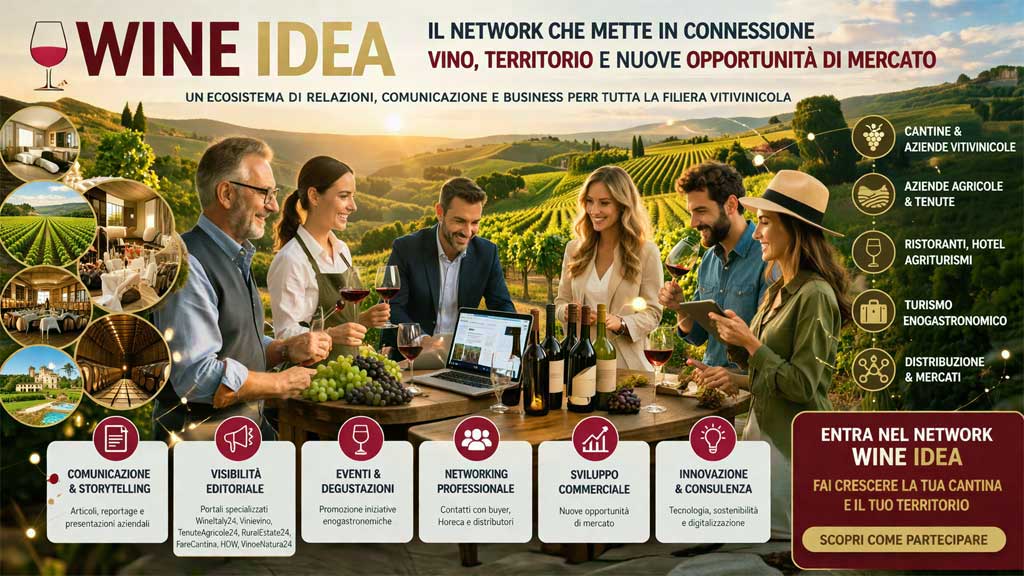
Wine Idea: il network che fa crescere cantine, aziende agricole e operatori del vino

Nel mercato del vino di oggi non basta produrre bene.
Serve essere visibili, costruire relazioni commerciali e comunicare il valore del proprio territorio.

È proprio con questo obiettivo che nasce Wine Idea, un network professionale dedicato alla filiera del vino e dell’agroalimentare che aiuta aziende e professionisti a sviluppare mercato, visibilità e opportunità di business.

Wine Idea non è semplicemente un portale di informazione: è una rete di servizi e piattaforme editoriali progettata per mettere in connessione cantine, aziende agricole, tecnici del settore, strutture ricettive e operatori del beverage con un pubblico di professionisti, buyer e appassionati del vino.

L’obiettivo è chiaro: aiutare le imprese a crescere, farsi conoscere e creare nuove opportunità commerciali.

Un network pensato per tutta la filiera del vino

Wine Idea si rivolge a un sistema molto ampio di operatori:

  • cantine e aziende vitivinicole
  • tenute agricole e proprietà rurali
  • enologi e agronomi
  • ristoranti e wine bar
  • alberghi e agriturismi
  • operatori del turismo del vino
  • aziende beverage e fonti d’acqua minerale.

Il network crea connessioni concrete tra produzione, mercato, comunicazione e turismo enogastronomico, offrendo strumenti operativi per chi vuole sviluppare il proprio business nel settore.

I vantaggi per cantine e aziende del vino

Entrare nel network Wine Idea significa accedere a una serie di servizi pensati per aumentare visibilità, contatti commerciali e opportunità di crescita.

Comunicazione e promozione del brand

Il network offre alle aziende la possibilità di raccontare la propria storia, i propri vini e il territorio attraverso:

  • articoli dedicati alle cantine
  • interviste e storytelling aziendale
  • presentazioni dei vini e delle etichette
  • promozione di eventi e degustazioni
  • visibilità su portali specializzati del settore.

In un mercato sempre più competitivo, la comunicazione diventa una leva strategica per valorizzare il lavoro in vigneto e in cantina.

Accesso a nuovi mercati

Uno degli obiettivi principali di Wine Idea è favorire l’incontro tra produttori e mercato.

Attraverso il network di operatori e piattaforme dedicate, le aziende possono:

  • entrare in contatto con distributori e buyer
  • sviluppare relazioni nel canale Horeca
  • ampliare la propria presenza commerciale
  • promuovere i propri vini verso nuovi clienti e operatori del settore.

Per molte cantine questo significa aprire nuove opportunità di vendita e partnership.

Visibilità sui portali del network

Wine Idea è supportato da una rete di portali tematici dedicati al mondo del vino e dell’agricoltura, tra cui:

  • WineItaly24
  • Vinievino
  • TenuteAgricole24
  • RuralEstate24
  • FareCantina
  • HO-W
  • VinoeNatura24

Questi portali consentono alle aziende di raggiungere un pubblico ampio e qualificato di operatori, appassionati e professionisti del vino.

Servizi per tecnici, ospitalità e turismo del vino

Il network non è dedicato solo alle cantine, ma anche ai professionisti che lavorano nella filiera.

Enologi, agronomi, consulenti e tecnici possono trovare in Wine Idea una piattaforma per promuovere le proprie competenze e sviluppare nuovi contatti professionali.

Allo stesso modo, ristoranti, alberghi e agriturismi possono valorizzare la propria offerta enogastronomica e rafforzare il legame con il territorio del vino.

Questo approccio integrato permette di costruire un vero ecosistema del vino, dove produzione, accoglienza e turismo lavorano insieme.

Un’opportunità anche per il mondo beverage e acqua minerale

Il network si rivolge anche alle aziende del settore beverage e alle fonti di acqua minerale, realtà che condividono con il vino valori come territorio, qualità e cultura gastronomica.

Grazie alla rete di portali e contatti professionali, queste aziende possono aumentare visibilità e sviluppare nuove relazioni commerciali nel mondo dell’ospitalità e della ristorazione.

Entrare nel network Wine Idea

Il vino italiano ha oggi davanti grandi sfide: mercati più competitivi, nuovi modelli di consumo e una comunicazione sempre più digitale.

In questo scenario fare rete diventa fondamentale.

Entrare nel network Wine Idea significa:

  • aumentare la visibilità della propria azienda
  • rafforzare il posizionamento del brand
  • sviluppare nuovi contatti commerciali
  • entrare in relazione con operatori qualificati del settore
  • valorizzare il proprio territorio e la propria storia.

Per cantine, aziende agricole, professionisti del vino e operatori dell’ospitalità, Wine Idea rappresenta una piattaforma concreta per trasformare il lavoro quotidiano in nuove opportunità di mercato.

info@wineidea.itwww.wineidea.itcell. +39 349 8142125