All posts by admin

Wine press review for Friday April 3 -2026

Italian wineries, Italian wine producers, and current wine news.

Here’s a brief press review of the main news from the Italian and international wine sector, highlighting the most relevant topics for businesses, wineries, and wine market participants.

Italian wineries

Tenute Nicosia relaunches the Hybla brand at Vinitaly 2026. The historic Etna winery presents the redesign of its Hybla line, dedicated to Vittoria wines, at Vinitaly. The company, founded in 1898 and now in its fifth generation, manages approximately 85 hectares on Etna and 60 in southeastern Sicily, all organically farmed.

Argentiera, the Bolgheri project with an international vision. The Bolgheri estate Argentiera strengthens its position among the leading producers in the appellation. With the arrival of Austrian entrepreneur Stanislaus Turnauer and the technical guidance of winemaker Nicolò Carrara and general manager Leonardo Raspini, the company consolidates a strategy focused on quality and international reach.

Rechsteiner: wine, culture, and sustainability in Veneto. The historic Piavon estate in Oderzo (Treviso), led by Baron Florian von Stepski-Doliwa, integrates viticulture, culture, and tourism. With 54 hectares of vineyards and approximately 120,000 bottles produced, the company focuses primarily on Prosecco DOC, mostly destined for export.

Biondi-Santi between wine and culture with “La Voce di Biondi-Santi.” The historic Montalcino winery continues the cultural project that accompanies the release of new vintages. The fifth edition features young writers from the Holden School of Turin, creating a literary podcast that explores the value of the “Generation” between tradition and the future.

Cantine Rivera hosts the Master of Wine course. In Andria, Cantine Rivera hosted an introductory course from the Institute of Masters of Wine for the first time in Puglia. The initiative involved professionals from nine European countries, strengthening the connection between international education and the region.

New commercial synergies with “Galassia – World Wine Network” A commercial network uniting Medici Ermete, Cantine Giacomo Montresor, and Terre Cevico has been established. The goal is to optimize commercial resources and strengthen their presence in international markets through a shared strategy.

Terre d’Oltrepò, rescue increasingly uncertain. The future of the Lombardy cooperative Terre d’Oltrepò is becoming more complicated. Collis Veneto Wine Group has withdrawn its interest due to low grape deliveries expected for 2026, far below the volumes needed to support the business plan.

Trebbiano di Spagna returns to prominence in Emilia. The Trebbiano di Spagna grape variety was featured on the Rai program “È sempre mezzogiorno.” The Buonariva winery in Castelvetro is focusing on the revival of native varieties to strengthen the identity and originality of local wines.

Italian wine and Italian oenology

Dealcoholization: Italy accelerates its efforts to develop low- and no-alcohol wines. Following the Masaf-Mef decree clarifying the issue of excise duties, businesses are increasingly interested in producing dealcohol-free wines. Northern Italy is leading the way, with initiatives in Veneto, Piedmont, and Emilia-Romagna, and initial developments in Puglia.

Caviro launches Tavernellow 3%. The Romagna-based cooperative group has invested €1.8 million in a dealcoholization plant at its Savignano plant. The facility can produce up to 30,000 liters per day, with an annual potential of over 9 million bottles.

Piedmont experiments with dealcoholized wines from native grape varieties. The “Devin0” project, developed between Italy and France, studies dealcoholization applied to varieties such as Barbera, Dolcetto, Cortese, Moscato Bianco and Brachetto, with the aim of creating zero-alcohol wines without losing their territorial identity.

Vermentino increasingly a symbol of Maremma The Top Ten of the Vermentino Grand Prix 2026, promoted by the Consorzio Vini Maremma Toscana, confirms the growth of this iconic white wine, which represents approximately 32% of the DOC’s production with over 2.4 million bottles.

Pizza and wine: an increasingly popular pairing. More and more Italian pizzerias are introducing structured wine lists and tasting menus. Wine and pizza pairing is evolving toward a more informed approach, overcoming the traditional dominance of beer.

Forest and Vineyard: New Scientific Discoveries According to Professor Attilio Scienza, biological communication exists between trees and vines through volatile organic compounds that promote resistance to climate stress and parasites, improving the balance of viticultural ecosystems.

The aperitif market shows signs of crisis. In 2025, out-of-home consumption grew in value (1.5%) but with fewer visits (-1.1%). The geopolitical context and economic uncertainty are changing consumer behavior, especially in the HoReCa channel.

Agricultural Diesel Tax Credit Agriculture Minister Francesco Lollobrigida announced the introduction of a tax credit to offset the rising cost of agricultural diesel, a measure requested by industry organizations.

International

Prosecco under pressure from EU-Australia deal. Producer Sandro Bottega criticizes the trade agreement between the European Union and Australia, which would allow the use of the term “Prosecco” for some Australian wines destined for the domestic market for ten years. According to the producer, the measure risks causing significant economic damage to Italian businesses.

Wine events

Vinitaly and the City livens up Verona. From April 10th to 12th, the Vinitaly off-site event will bring tastings, shows, and cultural initiatives to Verona’s historic center. Purchased tokens can also be used along the Valpolicella Wine Route until May 3rd.

Vinitaly 2026: Lombardy takes center stage between wine and tourism. The region will be present at the fair with a pavilion integrating wine, gastronomy, and local promotion, also focusing on the international visibility linked to the 2026 Milan-Cortina Olympics.

Lazio brings the “Dolce Vita” concept to Vinitaly. Sixty-one companies and three regional consortia will be present with a space of over 2,000 square meters. The project aims to showcase wine as part of a broader system of cuisine, culture, and hospitality.

Alto Adige Wine Road: Spring among vineyards and villages With 4,400 hectares of vineyards and a 150-kilometer route through 15 villages, the Alto Adige Wine Road is one of Italy’s main wine tourism itineraries.

National Exhibition of Dessert and Meditation Wines . The 22nd edition of the event dedicated to dessert wines will be held in Volta Mantovana from May 1st to 3rd. Greece will be the international guest of honor for the 2026 edition.

Strategic Summary The Italian wine landscape highlights three strong trends: technological innovation (dealcoholization and new products), growing integration between wine, tourism, and culture, and increased international competitive pressure on the most iconic appellations. In this scenario, companies are focusing on territorial identity, commercial synergies, and new consumption models to strengthen their positioning.
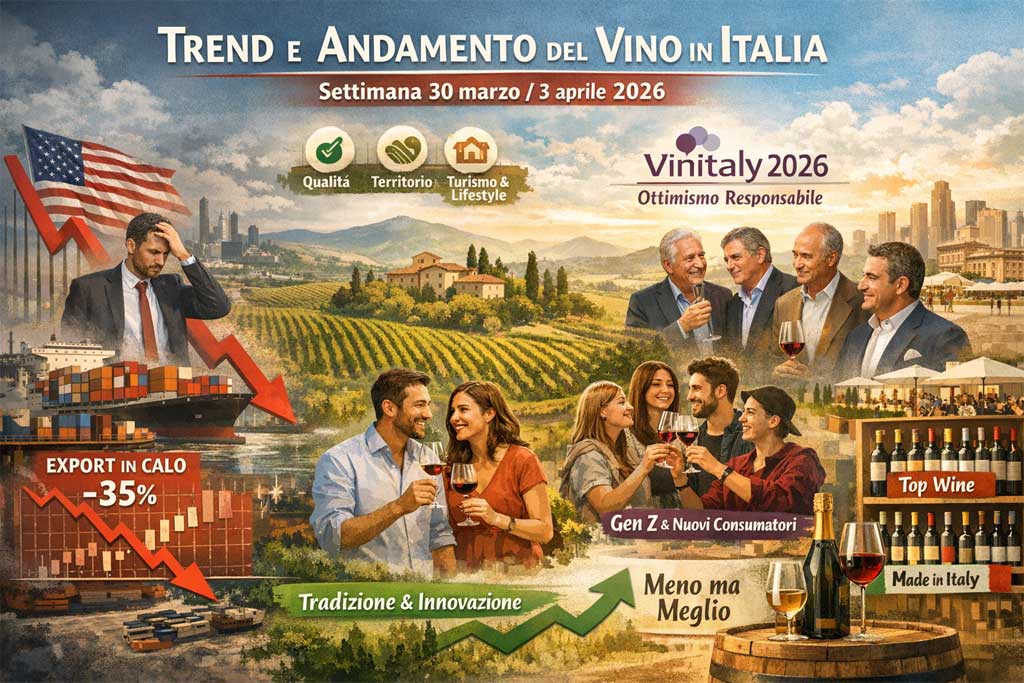

Wine Trends and Performance in Italy – Week of March 30-April 3 – 2026

Italian wine closes the week with a complex picture, but not without prospects.

On the one hand, there are clear signs of pressure on markets, consumption, and exports, especially to the United States; on the other, a more strategic approach to the sector is gaining ground, based on the quality, positioning, adaptability, and cultural value of Italian wine.

The underlying theme this week is clear: the sector is not going through an easy phase, but it still has the extraordinary assets to remain competitive. Strong territories, recognized appellations, consolidated brands, international leadership in many categories, and growing integration with tourism, restaurants, and lifestyle continue to make wine one of the pillars of Made in Italy.

In terms of sentiment, the strongest message conveyed at the launch of Vinitaly 2026 was one of responsible optimism. The testimonies of iconic figures in modern Italian wine, from Piero Antinori to Marco Caprai, from José Rallo to Paolo Damilano, and from Gaetano Marzotto, portray a sector that has already endured profound crises and has regenerated from them. The reference to the fortieth anniversary of the methanol scandal was not merely commemorative: it served as a reminder that one of the most difficult moments for Italian wine also marked the beginning of a structural modernization based on controls, quality, international reputation, and a new awareness among businesses, distributors, and consumers.

And it is precisely this industrial memory that today fuels a less defensive vision of the future. The widespread belief is that Italian wine must stop portraying itself merely as a sector under pressure and instead return to more strongly promoting its unique strengths: territoriality, culture, conviviality, biodiversity, narrative ability, and the connection to Italian cuisine. In other words, the sector cannot simply endure the slowdown, but must use this phase to better reposition itself.

The most sensitive issue remains exports, particularly to the US. The start of 2026 appears challenging: the first few months show a sharp decline in value, with January reported at -35% and the first two months projected to decline by 28% compared to 2025. American tariffs, the euro-dollar exchange rate, the slowdown in consumption, the slowdown in out-of-home sales, and a general instability in inventories and distribution are all weighing on the situation. The United States remains a key market for Italian wine, accounting for 23% of the sector’s total exports, and for this very reason, the focus is on the utmost.

The emerging response, however, isn’t simply a wait-and-see approach. There’s open talk of a special promotional plan to relaunch Italian wine in the US, involving institutions, ICE (Italian Trade Agency), Coldiretti (Italian Farmers’ Federation), Filiera Italia (Italian Supply Chain), American buyers, and trade operators. The strategic message is twofold: on the one hand, we must defend Italy’s presence in the world’s leading market; on the other, we must accelerate geographical diversification to reduce dependence on a single market. In this scenario, Vinitaly confirms itself not only as a trade fair, but also as a platform for the industrial and commercial policy of Italian wine.

Within the domestic market, however, more nuanced and less negative signs are emerging than often reported. The UIV-Vinitaly Observatory reports a very significant finding: in Italy, wine consumers remain just under 30 million, equal to 55% of the population. The audience, therefore, is holding steady. The number of consumers isn’t declining; rather, the way they consume is changing. Daily consumption is declining and occasional consumption is increasing, with the ratio now reversed compared to the past: 61% drink wine occasionally, while 39% consume it daily. This is a sign of a structural transformation in the relationship with wine, increasingly less tied to habit and increasingly focused on choice, occasion, and quality.

This shift should be viewed less alarmistly and more progressively. Italians drink less, but seek higher quality, greater gratification, and a more informed relationship with the product. Moderation is therefore part of the sector’s new balance, not necessarily a sign of disaffection. The problem isn’t that wine is disappearing from consumer behavior; the problem is that the marketing language is changing, and those who sell wine must adapt.

Perhaps the most interesting data of the week concerns young people. Contrary to a narrative that has been prevalent for years, young people are not primarily responsible for the decline in consumption. Indeed, the only significant increase in wine penetration is among the 18-24 age group: from 39% to 47% of the category compared to 2011. This share is still numerically small, but strategically very important, as it indicates that wine continues to enter the aspirational universe of the new generations.

Young people’s relationship with wine, however, is radically different from that of older generations. It’s not based on everyday life, but on curiosity, taste, image, discovery, and experiences outside the home. For Gen Z, wine is enjoyable, represents sophistication, and is associated with well-being and relationships. This explains why young people spend more on average on out-of-home consumption and are particularly active in restaurants and bars. This is a crucial strategic key: the future of wine lies less and less in the repetition of everyday gestures and more and more in the ability to create desirability, narrative, experience, and orientation.

Also of note is the reversal of some clichés about consumption preferences. The data shows that Prosecco remains the most versatile and powerful wine among Millennials, Gen Xers, and Boomers, confirming its role as a major contemporary consumer platform. But among younger consumers, a surprising trend emerges: Gen Z favors great Italian reds. Amarone, Barbaresco, Taurasi, Bolgheri, and Chianti top the list of preferences, demonstrating that red wines have by no means disappeared from the younger consumer’s horizons, as long as they are marketed correctly, with appropriate language, context, and advice.

This aspect has very concrete commercial implications. It means that the problem isn’t the product itself, but the way it’s positioned and presented. Younger people are proving more open to experimentation, more willing to seek advice, more inclined to read online reviews, and more receptive to alternative formats and packaging. This means the supply chain must work harder at the point of sale, in restaurants, on digital communication, and on the readability of the product offering. Wine must not just be good: it must be understandable, accessible in its narrative, and consistent with the language of the contemporary consumer.

On the overall economic level, the sector nevertheless retains enormous importance. Wine is worth approximately €14 billion in revenue, net of related industries, with a positive trade balance of €7.2 billion and an overall impact of €45 billion when considering indirect effects. The area under vine, the number of businesses, employment, and production confirm that it is not just an agricultural sector, but an economic and territorial system of primary national importance. For this reason, too, the current situation requires a calm, non-emotional approach: 2025 was challenging but relatively resilient, while 2026 remains entirely unpredictable.

In the domestic market, large-scale retail trade shows stability in value but declining volumes, once again confirming the “less is more” paradigm. Sparkling wines continue to be the most dynamic category, while reds are struggling and whites remain largely stagnant. Rosés are growing, but still at low levels. Prosecco remains the most resilient and cross-sectional phenomenon, while the entire sparkling wine segment continues to play an important countercyclical role for the sector.

The dynamics of fine wine are also interesting. The secondary market for fine wines appears to be slowly stabilizing, with signs of recovery expected towards the end of 2026. After a long period of price correction, lower interest rates and increased interest from European operators are bringing renewed attention to the collectible wine segment. Despite a still cautious outlook and a more uncertain position for the US, fine wine appears to be emerging from its weakest phase. For high-end Italian wine, this is a sign worth watching carefully, as it confirms that the value of great terroirs and iconic labels can once again become central, even in a selective environment.

Another theme that emerged forcefully is the growing need to integrate wine with other worlds: tourism, cuisine, experience, landscape, and culture. This is now an irreversible trend. Companies that can present themselves not just as producers of wines, but as interpreters of local areas and lifestyles, will be best equipped to navigate the new market cycle. Italian wine retains a unique strength: it sells not just product, but a combination of origin, story, hospitality, reputation, and Italianness. This is where a crucial part of future competitiveness will be played out.

This week also highlights the mistake of indiscriminately cutting back on promotion, events, and visibility. In a complex market environment, rationalizing investments is necessary, but reducing commercial presence and market presence risks further weakening brands. Promotion must be made more selective, more targeted, and more measurable, but it cannot be sacrificed. The sector needs more strategic presence, not less.

Wine press review for Thursday April 2 -2026

Italian wineries, Italian wine producers, and current wine news.

A daily overview of the main news in the world of wine: from the strategies of Italian wineries to market dynamics, from innovations in the vineyard to international trends, and even the events that animate the wine sector.

Italian wineries

Angelini Wine & Estates Approves Acquisition of Arnaldo Caprai Winery

Major developments are underway in the Italian wine scene: Angelini Wine & Estates, the winemaking division of the Angelini group, is reportedly close to acquiring the Umbrian winery Arnaldo Caprai, a leading producer of Sagrantino di Montefalco. The transaction, estimated at between €10 and €15 million, would further strengthen the group’s portfolio, which already includes prestigious wineries such as Bertani, Val di Suga, San Leonino, Puiatti, and Fazi Battaglia.

Sicilian cooperative wineries: growing concern over the sector’s crisis

Sicily’s main wine cooperatives are raising concerns about the state of the sector. During a meeting organized by Legacoop Sicilia and Confcooperative Sicilia, with the participation of wineries such as Settesoli, Colomba Bianca, Paolini, and CVA, a call for urgent interventions emerged to support a system that involves thousands of winemakers and represents a key component of the regional agricultural economy.

“Appia Wine Road” is born: seven wineries join forces for wine tourism.

Seven wineries between Brindisi and Salento—Cantina Botrugno, Cantine Risveglio, Masseria Incantalupi, Masseria Masciullo, Tenute Bellamarina, Tenute Lu Spada, and Tenute Rubino—have founded the Appia Wine Road association, with the goal of promoting the area along the Appian Way, a UNESCO World Heritage Site. The project aims to integrate wine, landscape, culture, and hospitality into a coordinated wine tourism development strategy.

Ciro Picariello Winery: A benchmark for Fiano di Avellino

Among Campania’s small, excellent wineries, Ciro Picariello’s winery in Summonte, at the foot of the Montevergine Sanctuary, stands out. The winery, born from a long family winemaking experience, is now considered a benchmark for Fiano di Avellino. Among its most anticipated new releases is the release of a 2000 Riserva, a testament to this grape’s remarkable potential for evolution.

Borgo La Caccia: wine, hospitality, and social inclusion

In Pozzolengo, near Brescia, Borgo La Caccia represents a model of integrating winemaking and social commitment. The estate hosts the Lautari therapeutic community for addiction recovery. Agricultural activities, including manual harvesting, are part of the reintegration and training program for the residents.

Cantina Marilina presents its new low-alcohol wines

The Sicilian winery in Noto introduces two new low-alcohol wines: a white made from Catarratto Mantellato and a red made from Nero d’Avola. The project stems from the desire to respond to new market trends while maintaining a strong connection to the terroir and local viticultural biodiversity.

Centopassi presents its rosé “Tuttovaben 2025”

Centopassi winery, part of the Libera Terra project, is bringing its second vintage of its Tuttovaben Nocera Rosato IGT Terre Siciliane rosé to Vinitaly. Produced from Nocera and Lucignola grapes grown in the Alto Belice Corleonese area, the wine comes from organic vineyards located up to 950 meters above sea level.

Italian wine and Italian oenology

Italian wine: between resilience and new challenges

The Italian wine sector is facing a complex phase: 2025 was a challenging year, but the system has shown good resilience. According to several industry players interviewed at ProWein 2026—including Donnafugata, Walch, Villa Sandi, Mezzacorona, and Italian Wine Brands—rationalizing investments and more targeted promotional strategies will be crucial.

The future of wine also depends on reducing yields

During the Italian Cuisine Forum in Manduria, Lamberto Frescobaldi, president of the Italian Wine Union, outlined some possible strategic lines for the sector: reducing production, blocking new plantings, and strengthening international promotional activities to rebalance the market.

Green Harvest 2025/2026

Among the management tools for the European wine market, the Green Harvest measure returns, which involves the elimination of bunches before ripening to eliminate yields and reduce oversupply. The financial support, paid per hectare, aims to prevent market crises and rebalance demand and production.

Agrivoltaics and sensors for supply chain sustainability

The ENERVITIS project will be the focus of a technical meeting in Cesena on April 24th. The initiative will present the results of two years of experiments on agrivoltaics, digital monitoring, and technological innovation applied to viticulture, with the aim of making wine production more sustainable.

Syrah di Cortona: the history and identity of an international grape variety

Syrah, originally from the Rhone Valley, has found one of Italy’s most suitable terroirs in Cortona. The Chianina & Syrah event continues to showcase the synergy between this grape variety and the local gastronomic tradition, highlighting one of Tuscany’s most exciting winemaking projects.

Wine and health: the scientific debate continues

A new study based on data from the Spanish Predimed study suggests that moderate wine consumption as part of a Mediterranean diet may reduce cardiovascular risk. However, experts urge caution when interpreting the results and reiterate the importance of moderation.

Wines for Easter and Easter Monday

According to a YouGov survey for Airbnb, 70% of Italians consider spending Easter with loved ones a priority, while 64% consider the table to be the central moment of the celebration. Several food and wine publications offer selections of wines ideal for convivial moments on Easter and Easter Monday.

Holy Thursday and Red Wine: Tradition and Symbolism

An in-depth study of wine explores the symbolic significance of red wine in the Holy Thursday meal, historically linked to the celebration of the Last Supper and the regional gastronomic traditions of Holy Week.

Wines and dishes for Easter 2026

The Identità di Vino newsletter offers twelve pairings of traditional Italian dishes and selected wines to accompany the Easter table, highlighting the concept of conviviality and the country’s gastronomic richness.

International

Langhe and Japan strengthen wine dialogue

Japan remains the main Asian market for Italian wine, with imports worth €176.4 million in 2025 (-4.1%). Relations between Piedmont and Japan are also strengthening thanks to projects inspired by Piedmontese viticulture, such as “Muscat Shiragai,” born from the influence of Moscato di Alessandria.

Telling the story of French wine in Italy

In an interview, Daniela Paris, a communicator and importer specializing in French wines, shares her experience of over twenty years building a dialogue between France and Italy in the world of wine, including selection, training, and cultural dissemination.

Wine events

Vinitaly 2026: A Guide to Visiting the Fair

From April 12th to 15th, Verona returns to the center of the wine world with Vinitaly 2026. The pavilions will be open from 9:30 am to 6:00 pm (Wednesdays until 4:30 pm). Among the most useful tips for visitors: choose trains and shuttles to avoid traffic and parking difficulties during the event.

The consortia protagonists at Vinitaly

Several protection consortia will be present at the Verona fair, including DOC Sicilia, Garda DOC, Barbera d’Asti, and Vini del Monferrato e Oltrepò Pavese. The appellations will present promotional and in-depth initiatives aimed at industry professionals and the international press.

University of Turin at Vinitaly with its degree course in Viticulture and Oenology

The DISAFA Department of the University of Turin will be present at the event, hosted by the GD Vajra winery. The initiative aims to promote the degree program in Viticulture and Oenology based in Alba and strengthen the dialogue between academia and wine companies.

International Wine Competition Città del Vino

The 24th edition of the competition will be held in Pramaggiore (Venice) from 29 to 31 May 2026 and will be dedicated to the memory of Matteo Forner, a Venetian agricultural entrepreneur who passed away in 2025.

Bardolino Grape and Wine Festival

The 94th edition of the historic festival dedicated to Bardolino will be held on the lakeside promenade of the Verona town from October 1 to 5, 2026. The program includes tastings, concerts, cultural events, and the traditional folk parade.

Olive Oil Festival in Torri del Benaco

From April 10th to 12th, the Olive Oil Festival returns, dedicated to Garda extra virgin olive oil. Events also include guided tastings and a workshop on Garda wines.

Today’s wine press review was brought to you by WINEIDEA.IT.

See you tomorrow with new news from the world of wine.

Wine press review for Wednesday April 1 -2026

Italian doors, Italian wine producers and current wine news.

The wine sector continues to evolve amidst production innovation, new consumer trends, industrial operations, and major international events. In this review, we analyze the day’s key events, which reveal a dynamic sector undergoing profound transformations: from consumption to the simplification of wine language, from new winery strategies to the opportunities offered by international events like Vinitaly.

Italian wineries

Angelini Wine & Estates Approaches Acquisition of Arnaldo Caprai

The Angelini Wine & Estates group is reportedly close to acquiring the historic Umbrian winery Arnaldo Caprai , a symbol of the international revival of Sagrantino di Montefalco . The transaction, estimated at between 10 and 15 million euros , would mark a new phase of growth for the winemaking group linked to the Angelini pharmaceutical holding company. Investors’ interest demonstrates how brands with a strong territorial identity continue to have great market appeal.

Hofstätter and the Pinot Noir of Mazon

The South Tyrolean Hofstätter winery, led by Martin Foradori, confirms its role as a benchmark in South Tyrolean winemaking with the 2020 Pinot Noir Barthenau Vigna Sant’Urbano . The company has over 60 hectares of vineyards and 850,000 bottles produced , and has also expanded its reach to the Moselle with the Weingut Dr. Fischer – Bocksteinhof project. The wine is made from grapes partly vinified whole bunch and ages for 12 months in barrique and a year in large barrels , offering aromas of ripe red fruits, spices and balsamic notes.

Ronco dei Tassi wins at the Wine Awards

The 2023 Fosarin Collio Bianco from the Ronco dei Tassi winery in Cormòns, Friuli, was named “White Wine of the Year” at the 2026 Food and Travel Italia Wine Awards . This recognition honors a wine that elegantly represents the Collio region, thanks to its freshness, winemaking precision, and great sensory balance.

Podere Casanova and the Age of Nobile di Montepulciano

The Tuscan winery Podere Casanova , led by Susanna Ponzini and Isidoro Rebatto, is celebrating its first ten years of business, focusing on organic farming and eco-sustainability as the cornerstones of its production project. The organic conversion began in 2021 and was followed by Equalitas certification in 2023, confirming its commitment to responsible viticulture.

Brilùs relaunches Oltrepò Pavese Pinot Noir

In a complex market context, the Brilùs company is focusing on Pinot Noir from the Oltrepò Pavese region , drawing inspiration from the model of the great Champagne Houses . The goal is to enhance one of the largest Italian areas dedicated to the grape variety, strengthening its positioning and territorial identity.

Cantina Marilina and its naturally low-alcohol wines

The Sicilian winery Marilina , led by the winemaker Angelo Paternó together with his daughter Marilina, will present two new low-alcohol labels at Vinitaly 2026 :

  • a white from Catarratto Mantellato
  • a red from Nero d’Avola

The project stems from a growing demand for lighter wines and agronomic research aimed at enhancing viticultural biodiversity.

Partesa expands its portfolio with five wineries

Partesa , a leading company in the Ho.Re.Ca. distribution sector, is enriching its catalogue with five new Italian wineries: Abraxas, Oskiros, Podere Poggio Scalette, La Stellara and Gottardi , bringing the total to over 130 selected producers from Italy, Europe and the United States.

Italian wine and Italian oenology

Italian farmers amid stable prices and declining consumption

According to Eurostat , between 2015 and 2025, Italian wine recorded the lowest price increase in Europe ( 7.4% ), compared to 25.7% in France , 27.4% in Spain , and 22.6% in Germany . Despite this, consumption continues to decline, creating a growing tension between producer prices and distribution prices.

Gianni Moriani: Wine is not a financial asset

Culinary historian and sociologist Gianni Moriani invites us to refocus wine on its cultural and social dimension. In a context marked by overproduction, declining consumption, and high margins in the restaurant industry, Moriani reminds us that wine originates first and foremost as a ritual of conviviality and connection , not as a mere commodity.

Viticulture and vineyard protection

Crop protection remains central to the economic sustainability of companies. Gowan Italia offers technical tools such as the VitExpert information service, which supports winegrowers in preventing downy mildew, powdery mildew, and botrytis , with zoxamide -based fungicides being particularly effective.

Cortona Syrah: History and Territorial Identity

The Syrah grape, originally from the Rhone Valley, has found one of its most interesting terroirs in Italy in Cortona . Events like Chianina & Syrah celebrate the connection between viticulture and local gastronomy, demonstrating how this international grape variety can become an authentic interpreter of the Tuscan terroir.

International

In the United States, 38 million people don’t understand wine.

A survey by the Wine Market Council highlights one of the most significant challenges for the future of wine: consumers’ difficulty understanding the product.

Among the most significant data:

  • 57% of non-regular consumers do not know whether they will like the wine they have chosen
  • 43% of marginalized consumers feel overwhelmed by too much choice
  • 31% struggle to understand the language of wine
  • 30% find labels not very useful

The theme of simplifying the language of wine therefore becomes strategic for intercepting new consumers.

World record for a bottle of Romanée-Conti

A bottle of Romanée-Conti 1945 sold at auction for $812,500 , setting a new world record for a bottle of wine. The wine came from Robert Drouhin ‘s personal cellar and is one of only 600 bottles produced before the famous Burgundy vineyard was replanted.

Wine events

Vinitaly 2026: Friuli Venezia Giulia focuses on “Connections of Excellence”

At the 58th edition of Vinitaly , scheduled in Verona from 12 to 15 April , Friuli Venezia Giulia will present a new territorial communication format that will involve over 110 companies , with 80 producers in the regional collective and another 31 external companies coordinated under the same visual identity.

Nearly 80 tastings in the official program

The Vinitaly 2026 calendar includes almost 80 thematic tastings , including:

  • The Reason WHYTE with the Master of Wine Gabriele Gorelli
  • Tasting of Italian and international grape varieties led by Ian D’Agata and Andrea Gualdoni
  • Excellences of Italy , with Riccardo Cotarella and Luciano Ferraro

Vinitaly and the City and wine tourism

The Vinitaly and the City Fuorisalone event celebrates its tenth edition with tastings dedicated to rare grape varieties and numerous wine tourism initiatives. These include events organized by the Tedeschi winery in Pedemonte, Valpolicella.

Sicily takes center stage at Vinitaly

Five Sicilian wineries will be among the protagonists of the event, including Principe di Corleone , which will present new interpretations of Catarratto and Nero d’Avola , promoting the viticulture of the hilly areas of the Palermo hinterland.

Wine tourism and tastings in Sardinia

In Stintino , the Pozzo San Nicola Cellars – Tenute Stintino will reopen the “Alle Cantine – Sardinian Experience” space from 1 April , dedicated to tastings of the company’s wines, including Vermentino di Sardegna DOC, Cannonau and Cagnulari .

Grandi Marchi Institute and international training

The Grandi Marchi Institute continues its collaboration with the Institute of Masters of Wine , hosting training sessions in Italy dedicated to aspiring Masters of Wine , one of the most prestigious qualifications in the sector.

Music and wine at the Bentivoglio Winery

In April, Cantina Bentivoglio in Bologna will host a musical project led by trumpeter Diego Frabetti , who combines jazz, funk, and hip hop in an ensemble of great artistic impact.

Today’s wine press review was provided by WINEIDEA.IT

See you tomorrow for the latest news from the world of wine.