All posts by admin

Wine press review for Saturday May 2 -2026

Italian wineries, Italian wine producers, and current wine news.

Italian wineries

Ca’ del Bosco focuses on the winery experience. The Franciacorta winery has chosen a specific path: fewer trade shows and traditional advertising, and more in-person hospitality. With approximately 25,000 visits a year, the winery transforms wine into an experience, including art, tastings, bike tours, and the local area.

Tolaini talks about the 2022 Chianti Classico Gran Selezione. The Chianti winery presents the 2022 Vigna Montebello Sette, an elegant and structured organic Chianti Classico Gran Selezione, aged in large oak barrels.

Producers of Manduria, a symbol of Apulian Primitivo. The historic Apulian cooperative, founded in 1932, continues to promote Primitivo di Manduria DOC thanks to 300 winemaking members and over 700 hectares of vineyards.

Antinori: wine, hospitality, and dining as a value system Marchesi Antinori confirms an advanced winery model: not just production, but storytelling, hospitality, dining, and brand experience.

Lodali and the Barolo Bricco Ambrogio 2022 The Piedmontese winery in Treiso presents its Barolo da Roddi, the expression of a family-run business with 10 hectares of estate-owned vineyards and a varied production.

Tenuta Carretta, Nebbiolo beyond Barolo In Piobesi d’Alba, Tenuta Carretta promotes the Roero and Piedmontese appellations with a winemaking history dating back to 1467.

Farina Wines: Amarone between history and innovation. The Farina family’s Amarone vertical tasting tells the story of a Valpolicella that unites memory, art, winemaking research, and contemporary communication.

Eleusi, the Trentino Chardonnay signed by Mattia Binotto In the small Trentino winemaking project of Cantina Eleusi, time takes center stage: Chardonnay, long aging and a simple winemaking approach.

Italian wine and Italian oenology

Drink well to live better: the International Academy of Healthy Drinking is born. Signorvino presents a project dedicated to conscious drinking, with the aim of defending the cultural value of wine in the Italian diet and conviviality.

Sobriety Economy: No-Alcohol Changes the Concept of Luxury The growth of conscious consumption and no- and low-alcohol products is redefining premium beverages: less sacrifice, more quality, well-being, and customization.

EU aid of up to 70% for diesel and agricultural fertilizers The European Commission introduces support measures for agriculture, fisheries, and transport, with contributions of up to €50,000 per beneficiary to address the high cost of energy and fertilizers.

Mountain Professions: A Hub for Young People in the Highlands is Born. A project is taking shape in Lombardy to train under-35s in professions related to agriculture, tourism, agri-food supply chains, forestry, and digital innovation.

Aglianico, between Hellenic origins and the history of Campania’s viticulture. An in-depth look at the theories surrounding the origins of Aglianico confirms the richness of Campania’s viticultural genetic heritage.

Italian White Wines: The Sensory Map of Native Varieties Arrives. An international study analyzed 246 labels from 18 Italian varietals, creating a sensory atlas useful for producers, technicians, consortia, and buyers.

Ciliegiolo, the Maremma’s red ace. Maremma focuses on a fresh, elegant, and immediate red, capable of standing out from the great Tuscan classics without imitating them.

REDWine: transforming CO₂ and winery effluents into biological value. The European project demonstrates how fermentation emissions can be transformed into a resource through CO₂ recovery and microalgae cultivation.

Loreto Aprutino and civic winemaking In Abruzzo, wine becomes a story of community, territory, and local identity through the experience of the Custodes Laureti.

International

Uruguay: Viticulture Becomes the Country’s “Living Culture” The Uruguayan government launches a program to promote viticulture as a national cultural expression, uniting wine, landscape, community, identity, and international diplomacy.

Nobile di Montepulciano flies between the United States and Canada From May 4th to 15th, the Consorzio del Vino Nobile is organizing a road show in North America, with stops in New York, Los Angeles, San Francisco, Vancouver, Calgary, and Toronto.

Wine aged 40 meters under the sea. In France, experiments with underwater aging continue: bottles are being immersed off the coast of Provence to study the effects of darkness, constant temperature, and depth.

Wine events

Chianti Lovers Week from May 3rd to 9th , Florence, Siena, Prato, Montespertoli, Pistoia, and Arezzo will host tastings, aperitifs, vineyard hikes, and guided tours to share the Chianti story in a shared and engaging way.

Balbi aperitifs from May 9th in Pieve di Soligo. At Fondaco del Gusto, a monthly series dedicated to the excellence of the Alta Marca Trevigiana begins, featuring Balbi, a historic selection linked to the world of Prosecco.

Tuttofood 2026 from 11 to 14 May in Milan The Rho agri-food fair is preparing to welcome 5,000 exhibitors, 4,000 top buyers and over 100,000 professional visitors from 80 countries.

Fermento Emilia 2026 in Montecchio Emilia On May 17th and 18th, the event dedicated to artisanal, natural, organic, and biodynamic wines from Emilia returns, with tastings and masterclasses.

Colico in Cantina between lake, mountains and tastings On May 31st, June 1st and June 7th the event returns to Lake Como, with itineraries among wineries, local wines, typical products and Lario landscapes.

Winemaking opportunities and assets

Winery in the heart of Prosecco DOC. In the province of Treviso, we offer an already operational sparkling wine production and storage cellar, with a warehouse of approximately 1,800 m2, an attached house, offices, and direct access to the main road.

A property to be seen as an integrated platform combining vineyards, facilities, hospitality, brands, and tourism potential, in a historic area near Rome.

Winery in Friuli Venezia Giulia. 74-hectare property in a single block, with approximately 55 hectares of vineyards, a fully equipped cellar, bottling plant, 500 kW photovoltaic system, agritourism, apartments, and catering.

Borgo Capietaglio – Tellurit Winery A hamlet nestled among vineyards, designed for a rustic-chic welcome amidst nature, wine, relaxation, and scenery.

Final summary

Today’s event confirms an important shift for wine: the product alone is no longer enough. Growing wineries are those capable of transforming wine into experience, culture, terroir, sustainability, and a direct relationship with the public.

From Uruguay, which promotes viticulture as a living culture, to the Italian models of Ca’ del Bosco, Antinori, Manduria, Chianti, and Prosecco, a clear direction emerges: the future of wine will be increasingly tied to the ability to convey value, identity, and vision.

Today’s wine press review was brought to you by WINEIDEA.IT . See you tomorrow.
Wine press review for Friday May 1 – 2026

Italian wineries, Italian wine producers, and current wine news.

Italian wineries

Lunelli Group closed 2025 with a slight decrease in revenue of €134 million, but confirmed its strategy of focusing on high-end sparkling wines and strengthening its classic method and Prosecco Superiore wines internationally.

Mosnel celebrates 190 years of history in Franciacorta: 41 hectares of organic vineyards in Passirano and 250,000 DOCG bottles by 2025.

In Marsala, Nino Barraco confirms an artisanal vision of natural wine, linked to coastal parcels, Mediterranean flavor, and territorial identity.

Carpineto presents its 2024 Chianti Classico, confirming the group’s influence in the main Tuscan denominations with over 225 hectares of vineyards.

Enoteca Vini di Toscana in Siena showcases great Italian and international labels, including icons like Masseto.

Italian wine and Italian oenology

Soave is preparing a major quality overhaul: DOC in the plains, DOCG only in the hills, a new designation pyramid, and a reduction in the number of hectares claimed to curb overproduction.

Female-led agriculture is growing: in Italy, there are over 400,000 farms run by women . Viticulture stands out as a virtuous sector, with no gender gap in performance.

The new EU regulation on copper residue limits brings to a close a long regulatory process that had raised concerns in the European agricultural and wine sectors.

Veneto is launching a 2026-2027 call for winemaking investments: €8.5 million for farms, wineries, technology, processing, and marketing.

In Val di Cembra , 29 winemakers and distillers have joined together in a committee to promote wine, the region, dry stone walls, and tourism.

Ciliegiolo emerges as the Maremma’s signature grape: fresh, elegant, and immediate, it offers a unique take on the great Tuscan reds.

Bonarda dell’Oltrepò Pavese is being relaunched with the “La Mossa Perfetta” project, a collaborative initiative by 14 companies across the entire supply chain.

International

The EU-Mercosur agreement comes into force, destined to modify trade relations between Europe and South America, with a progressive reduction in tariffs and significant impacts on exports, businesses and geographical indications.

Italian wine is closely monitoring the Hormuz crisis , which risks increasing energy, transport, and fertilizer costs and putting pressure on price lists.

Lombard wines are growing in Canada , with exports increasing by 7% and the presence in Toronto of the Oltrepò Pavese, Valtènesi, Lugana and Valtellina consortia.

Burgundy continues to sustain high prices thanks to the structural limitations of production: the most prestigious vineyards cannot expand, making the supply rare and sought-after.

Wine events

Land of Wine 2026 takes place in Peschiera del Garda from 1 to 3 May, with tastings, typical products, music and Veneto wines.

On May 1st, the Pigozzo winery offers tours, tastings, and pairings at Cantina Salvan – Vigne del Pigozzo.

Cantina Bentivoglio opens its May concert calendar with the Mauro Mussoni Quintet.

From Centorame , in Casoli di Atri, May Day is celebrated among vineyards, music, food, and company wines.

The preview of San Giorgio di Vino 2026 arrives in Bologna, with over 60 wineries taking part on May 9th and 10th.

The 2026 Mevania Wine Festival hosts over 50 wineries and dedicates this edition to the Slow Wine Coalition and Women in Wine.

On June 10th, Valtènesi in Tavola returns to Villa Galnica, a format dedicated to the dialogue between the wines of the denomination and local cuisine.

O-Vini , a food and wine festival featuring wines, local products, and conviviality, returns to Costalunga di Faedis.

At Villa Contarini , from May 1st to 3rd, over 300 Italian labels will be the protagonists of “Città in Vino”.

Final summary

The day confirms a sector undergoing strong transformation: denominations are reviewing their quality strategies, companies are focusing on value and identity, wine tourism is becoming increasingly central and international markets remain decisive but complex.

Italian wine faces costs, tariffs, geopolitical instability, and evolving consumption patterns, but it still boasts key assets: recognized territories, distinctive grape varieties, historic wineries, collaborative projects, and a growing ability to integrate production, tourism, and local storytelling.

Wine press review provided by WineIdea.it

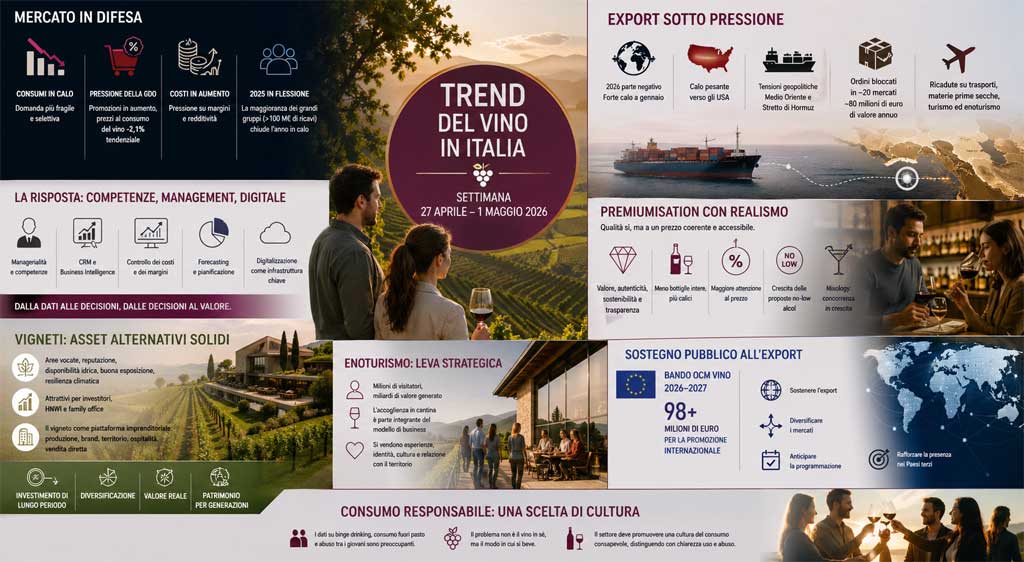
Wine Trends in Italy – Week of April 27 – May 1 – 2026

Italian wine is going through a complex phase, marked by declining consumption, pressure on exports, rising costs, and severe market selection.

2025 also put large groups under stress: among the main companies with revenues above 100 million euros, the majority closed the year with declining turnover.

The data confirms that the difficulty no longer concerns only small wineries, but the entire system.

The economic picture shows a market in defensive mode. Exports and domestic sales are slowing, large-scale retail trade is pushing promotions, and consumer wine prices are still declining, at a 2.1% annual rate. This signals a more fragile, selective demand that is less willing to absorb price increases, despite the higher production, logistics, and energy costs borne by businesses.

On the international front, Italian wine is facing renewed tensions. Exports in 2026 got off to a slow start, with a sharp decline in January and a particularly severe decline to the United States. Added to this are the geopolitical challenges related to the Middle East and the Strait of Hormuz: according to the UIV (Italian Wine and Spirits Association), orders in approximately twenty markets, with an estimated annual value of around €80 million, have been blocked. The impact also affects transportation, dry raw materials, tourism, and wine tourism.

In this scenario, the sector’s response increasingly relies on managerial skills, expertise, and digitalization. Italian wine companies are challenged to better manage margins, markets, price lists, distribution, and sales data. CRM, business intelligence, cost control, forecasting, and digital tools are no longer ancillary elements, but essential infrastructures to remain competitive.

Premiumization remains a viable option, but with a clear limit: the market rewards quality only if the price remains consistent and accessible. Consumers are drinking less, but are seeking greater value, authenticity, sustainability, and transparency. The way restaurants consume wine is changing: fewer full bottles, more glasses, greater attention to price, a growth in no- and low-alcohol options, and competition from mixology.

Despite the challenges, Italian vineyards remain solid and attractive alternative assets for investors, HNWIs, and family offices. Suitable areas, with reputation, water availability, good exposure, climate resilience, and wine tourism potential, continue to represent a long-term investment. The vineyard is no longer just an agricultural asset, but a business platform that integrates production, brand, territory, hospitality, and direct sales.

Wine tourism remains one of the most important levers for the future. With millions of visitors and billions in value generated, hospitality at the winery has become an integral part of the business model. The most advanced companies sell not just wine, but experiences, identity, culture, and a connection with the local area.

At the public level, the new CMO Wine 2026-2027 call for proposals, with over €98 million earmarked for international promotion, represents a strategic tool to support exports and foster market diversification. In a time of significant uncertainty, anticipating planning and strengthening presence in third countries is crucial.

Finally, the topic of responsible consumption enters the debate forcefully. Data on binge drinking, drinking outside of mealtimes, and abuse among young people show that the problem isn’t wine itself, but how it’s consumed. The industry must move beyond defensive positions and contribute to a culture of conscious consumption, clearly distinguishing between use and abuse.

Wine press review for Thursday April 30 -2026

Italian wineries, Italian wine producers, and current wine news.

Italian Wineries

Ribolla di Oslavia: Identity and Resilience In the heart of Oslavia, seven winemakers preserve a unique tradition spanning borders and cultures. Ribolla becomes a symbol of territorial identity and rebirth.

Growth and Strategies – Italian Wine Brands Despite the overall decline in exports, the group is seeing growth in the UK and Eastern Europe. The market is evolving: more occasional consumption and new competition from other beverages.

Strategic Partnerships – Caviro Entrance to the Vecchia Cantina di Montepulciano: Strengthening the supply chain and developing Sangiovese synergies between Emilia-Romagna and Tuscany.

Energy efficiency in the winery: ENEA Guide presented at Vinitaly 2026: focus on reducing consumption (over 500 million kWh/year) and improving productivity.

Controls and legality : 8,000 liters of wine seized from an illegal winery in Palma di Montechiaro: increased surveillance of PDO/PGI and traceability.

Italian Wine and Oenology

Vine defense – phytosanitary innovation Zoxamide (Zoxium® 240 SC) establishes itself as the benchmark for downy mildew control: flexibility of use and integration into preventive strategies.

Agricultural diesel tax credit Reintroduced in Legislative Decree 42/2026: partial relief for energy costs, which impact up to 20% of agricultural budgets.

PAC Digitalization Dematerialization of company files and introduction of digital tools (satellites, drones, Agrifoto apps) operational from 2027.

New frontiers in wine storytelling. An innovative sensory approach with olfactory mapping developed by Claudia Scattolini for Mack & Schühle: wine told through aroma.

Falanghina del Sannio: affordable quality. Growth of the denomination and possible evolution to DOCG status: enhancing the Campania region with an excellent quality/price ratio.

Protecting denominations – Primitivo di Manduria New regulation for use of the name in derivative products: protection against Italian-sounding names has been strengthened.

Consumption and Social Change: Binge drinking is on the rise (4.45 million Italians). Wine must redefine its cultural role in light of new habits and rapid consumption.

Fine wines: a paradigm shift. From status symbol to identity experience: rarity, territory, and authenticity remain central, but with new criteria for value.

The problem of wine language Communication perceived as distant: need for simplification and greater connection with the modern consumer.

International

French wine crisis : Production in 2025 is down (34.4 million hl) and exports are down (-10% in value). The combined impact of climate change and US tariffs is putting pressure on the sector.

Wine Events

Vino da aMare – Aieta (8–10 May) Event dedicated to Calabrian wine, including tastings, culture, and slow tourism in the village on the Riviera dei Cedri.

Rose Books Music Wine – Trieste (May 2026) Multidisciplinary format between wine, culture and music promoted by the University of Trieste.

Strategic Summary for Operators

Market in transition : less volume, more value → repositioning needed (branding communication).
Efficiency and costs : Energy and agricultural inputs remain critical levers → invest in technologies and management.
Territorial value : local denominations and identities (Oslavia, Sannio) increasingly central.
Innovation : digital, sensorial, and regulatory are reshaping the supply chain.
Complex global scenario : opportunities for structured players, difficulties for traditional models.

A clear picture: the sector is not in structural crisis, but in a process of redefinition . Those who interpret change today will build a competitive advantage tomorrow.

Until tomorrow.