All posts by admin

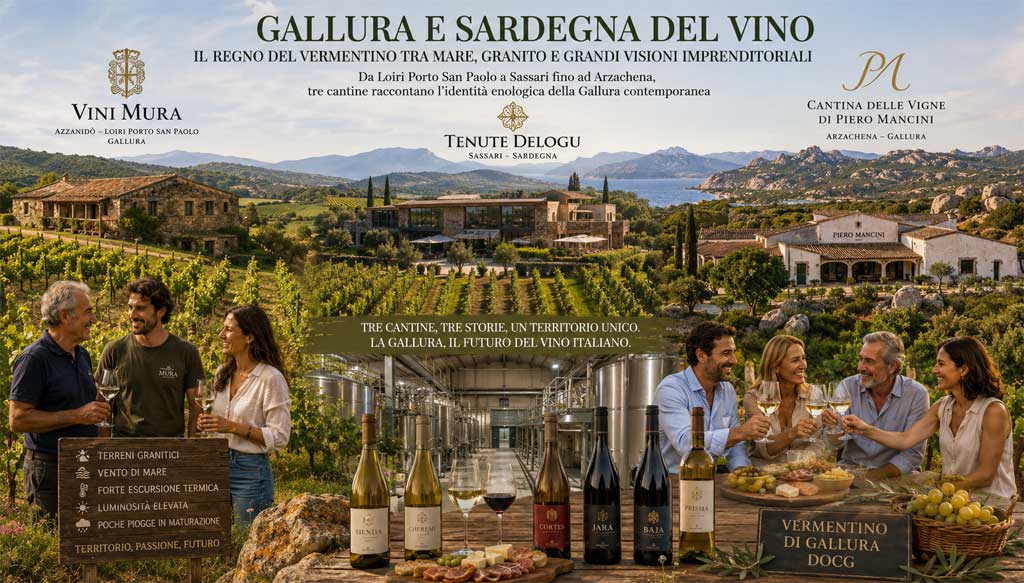
Gallura and Sardinia’s Wine Heritage: The Kingdom of Vermentino Between Sea, Granite and Great Entrepreneurial Vision.

From Loiri Porto San Paolo to Sassari and Arzachena, three wineries tell the story of contemporary Gallura’s wine identity
When speaking about Sardinian wine, the mind immediately turns to Gallura. This unique territory within the Italian wine landscape is where the sea meets the mountains, granite emerges from the soil, and the wind becomes a fundamental element in the quality of the grapes.
It is here that Vermentino di Gallura DOCG is born, the only DOCG denomination in Sardinia and the symbol of a land that, over the past twenty years, has built an international reputation based on authenticity, territorial character, and a strong landscape identity.
From the hills of Loiri Porto San Paolo to the countryside around Sassari and the historic vineyards of the Costa Smeralda, Gallura is home to wineries that differ greatly in size and production philosophy, yet share one common trait: the ability to transform an extraordinary territory into distinctive and highly sought-after wines.
Among these, three representative estates stand out in modern Gallurese viticulture: Vini Mura, Tenute Delogu, and Cantina delle Vigne di Piero Mancini.
Gallura: Sardinia’s Most Distinctive Terroir
Gallura represents one of the most unique wine-growing areas in the Mediterranean.
The landscape is characterized by:
• Ancient granite-based soils;
• Significant day-to-night temperature variations;
• Constant maritime ventilation;
• Exceptional sunlight exposure;
• Low rainfall during the ripening season.
These elements create wines of remarkable personality, distinguished by freshness, salinity, and a pronounced mineral character.
The undisputed star remains Vermentino di Gallura DOCG, but the region is increasingly successful with varieties such as Cannonau, Moscato di Gallura, Bovale, Cabernet Sauvignon, Merlot, and Chardonnay.
Vini Mura: Authentic Gallura Through the Story of a Family
In the locality of Azzanidò, within the municipality of Loiri Porto San Paolo, stands one of the most authentic wineries of southern Gallura.
The story of Vini Mura began in 1975 when Filippo Mura planted the first vineyards in a valley protected by the Gallurese hills, an area blessed with a particularly favorable microclimate for viticulture.
A Unique Terroir Between Sea and Mountains
The estate extends across approximately 20 hectares and benefits from constant ventilation generated by the meeting of sea breezes and inland mountain currents. The soils are composed of clay, sand, and decomposed granite, a combination that gives the wines a strong territorial identity.
The winery remains entirely family-managed and follows a production philosophy that today would be defined as sustainable, although for the Mura family it simply reflects the traditional way of farming the land:
• Predominantly manual vineyard operations;
• Low yields per hectare;
• Use of organic products;
• Recycling of winemaking by-products as natural fertilizers;
• Reduced sulfur usage;
• Energy sourced from alternative renewable resources.
Vineyards and Labels
Each vineyard parcel possesses its own distinct characteristics:
• Vigna Sienda, dedicated to Vermentino di Gallura Superiore DOCG;
• Vigna Cheremi, for Vermentino di Gallura DOCG;
• Vigna Cortes, producing Cannonau di Sardegna DOC;
• Vigna Baja, dedicated to Bovale;
• Vigna Prisma, reserved for selected Vermentino and Cannonau productions.
Among the winery’s flagship labels are:
• Sienda Vermentino di Gallura Superiore DOCG;
• Cheremi Vermentino di Gallura DOCG;
• Cortes Cannonau di Sardegna DOC;
• Jara Isola dei Nuraghi IGT;
• Baja Rosso IGT;
• Prisma Vermentino and Cannonau.
A Boutique Winery with Strong Identity
With approximately 18 hectares overall, including 8.8 hectares of vineyards, seven registered trademarks, and a highly artisanal approach, Vini Mura represents an outstanding example of a family winery capable of enhancing the territory through limited, high-quality production.
Piero Mancini: The Pioneer of Modern Vermentino
Speaking about Gallura without mentioning Piero Mancini means telling only part of the story.
Cantina delle Vigne di Piero Mancini is one of the wineries that has contributed most significantly to the international recognition of Vermentino di Gallura.
Located in the heart of Gallura, the company was among the first to recognize the qualitative and commercial potential of Vermentino, helping establish its reputation across both Italian and international markets.
Today, it remains one of the historic names of the denomination, associated with wines that elegantly express the mineral, maritime, and Mediterranean character typical of Gallura’s soils.
Gallura: One of Italy’s Most Attractive Wine Investment Regions
Today, Gallura is arguably one of Italy’s most attractive wine-producing areas from an investment perspective.
The reasons are numerous:
• Continuous growth in the reputation of Vermentino di Gallura DOCG;
• Strong international tourism appeal;
• Proximity to the Costa Smeralda;
• Availability of highly distinctive terroirs;
• Growing demand for identity-driven white wines;
• Expansion of premium wine tourism.
The stories of Vini Mura, Tenute Delogu, and Piero Mancini demonstrate how very different business models can coexist successfully in Gallura: the small family winery, the large-scale producer, and the historic estate that helped build the reputation of an entire region.
It is precisely this diversity, combined with the uniqueness of the landscape and the strength of Vermentino, that makes Gallura one of the most fascinating and promising territories in contemporary Italian wine.
Tenute Delogu: One of Sardinia’s Leading Wine Estates
If Vini Mura embodies the artisanal soul of Gallura, Tenute Delogu represents the industrial and entrepreneurial dimension of Sardinian wine.
Located near Sassari, the company owns more than 213 hectares, including approximately 80 hectares of vineyards spread across four separate estates situated in the most suitable wine-growing areas of northern Sardinia.
A Valuable Vineyard Heritage
The vineyards are planted on Hercynian granite soils at elevations ranging from 50 to 500 meters above sea level.
Cultivated varieties include:
• Vermentino di Gallura DOCG;
• Vermentino di Sardegna DOC;
• Moscato di Gallura DOC;
• Cannonau di Sardegna DOC;
• Merlot;
• Cabernet Sauvignon;
• Pinot;
• Chardonnay.
A Modern and Highly Technological Winery
The production facility covers more than 2,400 square meters and is among the most advanced winemaking structures in Sardinia.
Its main features include:
• Three winemaking lines;
• 74 stainless-steel tanks;
• Storage capacity of 12,000 hectoliters;
• 14 pressure tanks for sparkling wine production;
• Barrel cellar with barriques and oak casks;
• Bottling line capable of producing up to 3 million bottles annually.
Current production ranges between 1.3 and 1.5 million bottles per year, generating an estimated turnover of approximately €5.5 million, with a strong presence in the domestic market.
Wine Resort and Wine Tourism
The company has also invested significantly in hospitality by restoring historic buildings dedicated to:
• Accommodation;
• Wine tastings;
• Winery tours;
• Premium wine tourism experiences.
Tenute Delogu represents a successful example of how modern viticulture can combine production efficiency, territorial identity, hospitality, and tourism, creating an integrated business model capable of enhancing the value of Sardinian wine both in Italy and abroad.

Wine press review for Saturday June 20 -2026

Italian wineries, Italian wine producers, and current wine news.

The main news from the world of wine, oenology and Italian wineries .

ITALIAN WINERIES AND WINE COMPANIES

Vallepicciola invests 3 million euros

The leading Chianti Classico company is embarking on a new growth phase with €3 million earmarked for distribution, services, and management reinforcement. Objectives: consolidation of the premium segment, growth in the Horeca (Horeca) sector, and international expansion.

Bersano renews the identity of his Icons

The historic Piedmontese winery reinterprets the famous “Napoleonic bottle” thanks to designer Mario Di Paolo, launching a major rebranding project that highlights nearly 120 years of company history.

New cellar for Nino Caravaglio in Salina

The historic producer from the Aeolian Islands inaugurates a new facility dedicated to Malvasia, with spaces for winemaking, aging, tasting, and tourist reception.

Tenuta Le Forconate enhances the Tuscan border

The Barbanera family continues its project to promote the Colli dell’Etruria Centrale DOC, focusing on regional, contemporary, and long-lived wines.

Di Sipio and the Dream of the Abruzzo Classic Method

From a family project to a consolidated presence in Abruzzo’s winemaking scene: the winery now produces around 10,000 bottles of Metodo Classico from Chardonnay and Pinot Noir.

ITALIAN WINE AND OENOLOGY

Market and economic scenario

Valoritalia photographs a sector in transformation

The 2026 Annual Report highlights:

Decline in PGI bottlings and red wines.
Longer shelf life for DOC, DOCG, white and sparkling wines.
Increasing concentration of production.
Sustainability is increasingly strategic for competitiveness.

DOC, DOCG and IGT down 5%

According to Giuseppe Liberatore (Valoritalia), in the first five months of 2026, all categories recorded a decline in volumes of around 5%, which is however still considered manageable.

Italian wine in front of the mirror

The real challenge is no longer tariffs but the structural changes in consumption and markets. There is a growing need to reduce supply, contain yields, and focus on value.

The Italian Academy of Vine and Wine: a steering committee is needed.

The international workshop “Geopolitics and Wine” calls for a national governance capable of coordinating strategies, innovation, and competitiveness.

IST Uva Fund: the first anti-crisis fund is born

Trentino is launching Italy’s first mutual fund dedicated exclusively to the wine sector, to stabilize farm income in the event of severe economic downturns.

Production and viticulture

Veneto: 2026 harvest in line with 2025

Despite extreme weather events and temperature fluctuations, regional production forecasts remain positive.

Data 2025:

104,000 hectares of vineyards.
14.7 million quintals of grapes.
11.4 million hectolitres of wine.

Conegliano Valdobbiadene and climate change

A study has been presented that identifies adaptation strategies:

increase of organic matter in soils;
rainwater harvesting;
new rootstocks;
anti-hail nets;
innovative canopy management.

The sub-zones become protagonists

The role of UGA (Additional Geographic Units) is growing in territories such as:

Etna
Barolo
Barbaresco
Chianti Classico
Nobile di Montepulciano Wine
South Tyrol
Marsala

The trend aims to increasingly valorize the concept of terroir.

Wine tourism

Wine tourism is growing rapidly

According to the ilGolosario Wine Tour Observatory:

over 60% of wineries increase direct sales;
almost 70% see Millennials as the most dynamic audience;
82% of visitors are looking for immersive experiences;
40% of companies will invest further in hospitality.

Wine tourism remains one of the main drivers of growth in the sector.

Communication, culture and training

Reunion Wine Business Management MIB Trieste

Over 50 industry professionals gathered in Valpolicella for the first reunion of the MIB Trieste Wine Business Management community.

Women of Wine: New Pact with the Restaurant Industry

The National Convention proposes:

more territorial wine lists;
more balanced prices;
Tax incentives for those who promote local DOP wines and products.

Enotria relaunches its cultural project

The second issue of the historic scientific wine journal has been published, accompanied by a new digital portal.

Luca Cesari: Wine must speak a simpler language

The food historian calls on the sector to communicate in a more accessible and engaging way to win over new generations.

Riccardo Cotarella wins the Bruno Lunelli Library Award

The book “Il vino, la mia vita,” an autobiographical and professional account of one of Italy’s leading winemakers, has won an award.

Ian D’Agata made honorary citizen of Novello

Recognition for the renowned wine critic’s contribution to promoting native Italian grape varieties.

INTERNATIONAL WINE

Decanter World Wine Awards 2026

Italy conquers:

27 Platinum Medal
109 Gold Medal

The absolute protagonist is the Cantina Terlano winery with 5 Platinum awards.

International gold for the Kalimera of Ischia

Cenatiempo Vini’s Biancolella “Kalimera” wins the Gold Medal at the Decanter Awards with 96/100.

European Wine Summit 2026 in Taranto

On June 25, European institutions, businesses, and associations will discuss the future of the CAP and the competitiveness of European wine.

TRENDS AND NEW CONSUMPTION

Fruit Spritz: the new light aperitif

There is growing interest in lower-alcohol cocktails, customizable and made with natural ingredients and Italian fruit.

Wine after wine

Cultural debate on the future of wine is broadening: declining consumption, changing young people’s habits, and the need to rethink the role of wine in contemporary society.

Sandro Bottega: “The wine bubble isn’t about Prosecco.”

According to the president of Bottega Spa

Prosecco continues to show solidity and growth in value, despite the general difficulties in the sector.

WINE EVENTS

Volcanic Serprino 2026

– Praglia Abbey (Padua) – June 20

26 cellars
tastings of Serprino sparkling wine and spumante
show cooking and live music

Sea and Vitovska 2026

– Duino Castle (Trieste) – June 26-27

35 cellars
over 50 labels
tastings and meetings dedicated to the Vitovska del Carso

Müller Thurgau: Mountain Wine

– Cembra Valley – July 2-5

Four days of tastings, masterclasses, excursions, and meetings on heroic Alpine viticulture.

Sub-evening 2026

– Potenza Picena (Marche) – Every Wednesday in July

Five evenings featuring wineries from the Marche and Emilia regions, along with food and wine pairing sessions.

Alba Wine Festival

– Alba (CN) – September 20th and 27th

The 28th edition of the historic event dedicated to the wines of Langhe, Roero, and Monferrato.

THE THREE STRATEGIC THEMES OF THE WEEK

1. The sector enters a phase of structural transformation

It is no longer a cyclical crisis but a change in the consumption and market model.

2. Wine tourism and direct sales become central

Wineries that invest in experience generate greater value and higher margins.

3. Climate and sustainability go from obligation to competitive advantage

From climate adaptation to mutual funds, resilience is becoming the key strategic factor for the future of winemaking businesses.

Press review provided by WINEIDEA.IT – Contacts, not just clicks. Transactions, not announcements. Where negotiations begin.

Press review provided by Wine Idea.

Wine press review for Friday June 19 – 2026

Italian wineries, Italian wine producers, and Italian wine news.

The main news from the world of wine, oenology and Italian wineries .

ITALIAN WINE: MARKET, CONSUMPTION, AND SCENARIOS

They consume less wine and bottling is decreasing

Valoritalia’s 2025 Report confirms a slowdown in the supply chain:

Bottling 2025: -2.1%
January-May 2026: -5.4%
Italian wine exports 2025: -3.7% in value

Positive signs:

DOC and DOCG: 1%
Sparkling wines: 1.7%
Rosé: 5.7%
Still whites: 6.3%

In great difficulty:

IGT wines: -11%
Red wines: -13%

Strategic indication

The larger denominations and more structured Consortia show greater resilience than the micro-denominations.

Italian cellars still very full of wine

According to ICQRF data updated to May 31, 2026:

49 million hectoliters of wine in stock
5.4% compared to 2025
4.2 million hectolitres of must (37.4%)

Distribution:

Veneto: 12.3 million hl
Tuscany
Puglia
Emilia-Romagna
Piedmont

Strategic indication

Production management for 2026 will be crucial to avoid further pressure on prices.

Italian wine risks reaching the point of no return

At the international workshop “Geopolitics and Wine” in Rome, academics and businesses highlighted:

decline in global consumption
geopolitical instability
inflation
growing international competition

Key message

A national control room is needed to guide the sector’s transformation.

Wine-restaurant pact to boost consumption

A concrete proposal emerges from the National Convention of Women in Wine:

more territorial wine lists
more balanced markups
tax incentives for those who promote local PDOs

Objective

Bringing consumers closer to wine through the Horeca channel.

ITALIAN WINE AND INNOVATION

The No-Lo and dealcoholized phenomenon is growing

Valdo enters the European stadiums

The new VALDO PURØ Alcohol Free Blanc de Blancs debuts in the hospitality area of the Cegeka Arena in Genk (Belgium).

Emerging trend:

moderate consumption
new audiences
Northern European markets

Garda DOC focuses on low alcohol wine

The Garda DOC Consortium is accelerating its No-Lo segment.

Focus:

foreign markets
young consumers
Northern Europe

Challenge

Develop new products without compromising the identity of the name.

Delle Venezie: label dedicated to wines with a low natural alcohol content

The DOC Delle Venezie Consortium requests:

specific recognition on the label
greater transparency for the consumer

The following experiments also continue:

Pinot Grigio with a low natural alcohol content
resistant vines

The Schioppettino looks to the future

The Prepotto area continues to invest in promoting its iconic grape variety through experiential events and promotional activities.

The sparkling wine that matures in a salt mine

The Sicilian Tenuta San Giaime presents “Sotto Sale”:

Classic Method
36 months of refinement
Active salt mine in the Madonie Mountains

An example of strong territorial characterization.

Bortolomiol: 60 Years Since the Prosecco Brut Revolution

We remember the innovative path of Giuliano Bortolomiol, who introduced the first Prosecco Brut di Valdobbiadene in the 1960s.

A historic transition that changed the Italian sparkling wine market.

Wine tells the story of climate change

According to the analysis by Wired, Coldiretti and ISPRA:

By 2050:

increasingly earlier harvests
vineyards at higher altitudes
increased pressure on water resources
increase in ESG obligations

Scenario

Less quantity and higher quality.

Young people and wine: the problem is communication

Generation Z confirms its interest in wine but highlights:

too traditional language
distant communication
need for greater presence on social media

ITALIAN WINERIES AND STRATEGIC OPERATIONS

Compagnia del Gusto Acquires Cantine Romagnoli

New consolidation operation in the sector.

Objective:

build a premium national platform
enhance historic brands
strengthen territorial identities

Moncaro returns to auction

The second attempt to sell the assets of Terre Cortesi Moncaro has begun.

For sale:

cellars
vineyards
accommodation facilities
farmhouses
machinery

Prices reduced by 20%.

Russiz Superiore: 150 Years of Collio History

The Felluga family continues to represent one of the symbols of quality Friulian viticulture.

Modigliana: The new Maurizio Costa winery is born

From a family project to a structured entrepreneurial reality.

An example of new entrepreneurship in Italian wine.

Tenuta di Castellaro: A Model of Advanced Wine Tourism

The Aeolian winery enters the top 10% of Tripadvisor experiences worldwide for 2026.

Strengths:

heroic viticulture
biological
resort
catering
local culture

INTERNATIONAL SCENARIO

France: Organic wine crisis

According to Agence Bio:

organic vineyard areas are decreasing
organic farms are decreasing
sales are slowing down

Causes:

drop in consumption
lower profitability
uprooting of vineyards

Swiss success at the Mondial du Merlot

The Mendrisio Social Winery conquers:

4 gold medals

Best result among Ticino wineries.

European Wine Summit 2026

On June 25, Taranto will host the European debate on the future of wine.

Main topics:

new CAP
competitiveness
innovation
sustainability
investments

AGRICULTURAL POLICY AND SUPPLY CHAIN

The ColtivaItalia Decree has been approved

Over 1 billion euros for the period 2027-2029.

Main resources:

900 million for food sovereignty
150 million for generational turnover
14.5 million for research and innovation

CMO Wine 2026/2027

The evaluation phase for projects promoting Italian wine in third countries has begun.

WINE EVENTS

Emilia-Romagna

Divine Sunset – Fiscaglia (June 20)

Friuli Venezia Giulia

Corno di Rosazzo Wine Fair (June 19-23)
Prepotto’s Schioppettino in Villa (June 27)

Piedmont

Roero Wine Fest – Turin (June 24)

Liguria

Solstice DiVino – Vineyards on the Riviera

Veneto

Sunsets in Ongaresca (July)
Aperitifs at the Tenute Tomasella Winery (June 23 – July 28)

Lazio

Rocca in Cantina – Tolfa (June 26-27)

Campania

Casavecchia & Pallagrello Wine Festival (July 3-5)

STRATEGIC CONCLUSION

This week confirms a now clear message: the problem with Italian wine isn’t quality, but the balance between production and demand.

The guidelines that emerge most strongly are:

Production and inventory control.
Growth of the premium DOC and DOCG segment.
Development of low- and no-alcohol wines.
Strengthening wine tourism as a source of profitability.
Consolidation of companies through acquisitions and mergers.
More modern communication towards the new generations.
Adapting to climate change and new sustainability requirements.

Italian wine is entering a new phase: less volume-oriented and increasingly focused on creating value, territorial identity, and consumer experience.

Press review provided by Wine Idea.

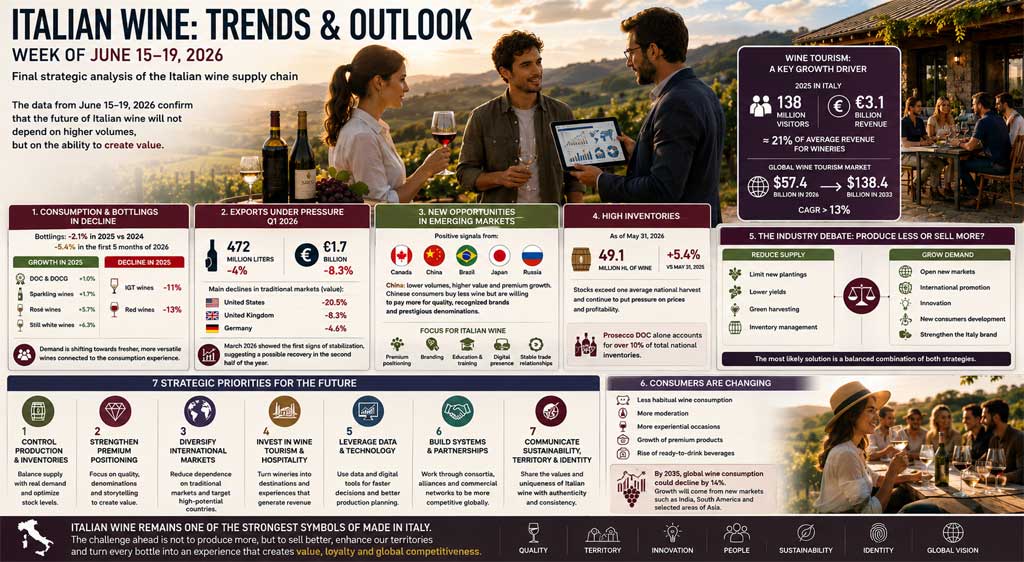
Wine Trends and Performance in Italy – Week of June 15-19 – 2026

A final, concise and strategic analysis of the Italian wine industry.
The Italian wine sector continues to experience a phase of profound transformation.
The data released during the week of June 15-19, 2026, confirm that the market is not experiencing a temporary crisis, but rather a structural change affecting consumption, exports, production, and business models.

Consumption and bottling in decline

After the growth recorded in the years following the pandemic, 2025 saw a 2.1% reduction in bottlings, followed by a further 5.4% decline in the first five months of 2026.

Consumers are changing their habits and the market is increasingly rewarding products with high added value:

DOC and DOCG: 1%
Sparkling wines: 1.7%
Rosé: 5.7%
Still whites: 6.3%

In difficulty instead:

IGT wines: -11%
Red wines: -13%

Demand is shifting towards fresher, more versatile wines that are more closely linked to the drinking experience.

Exports still under pressure

In the first quarter of 2026, Italian wine exports stood at:

472 million liters (-4%)
1.7 billion euros (-8.3%)

The biggest difficulties come from traditional markets:

United States: -20.5% in value
United Kingdom: -8.3%
Germany: -4.6%

The combined effect of tariffs, inflation, geopolitical tensions, and the economic slowdown continues to weigh on Italian exports.

However, March 2026 showed the first signs of stabilization, suggesting a possible trend reversal in the second half of the year.

Markets that offer new opportunities

Not all markets are slowing down.

The most interesting signals come from:

Canada
China
Brazil
Japan
Russia

China is particularly significant, where volumes are declining but the premium segment is growing. Chinese consumers are buying less wine but are willing to spend more for quality products, recognizable brands, and prestigious denominations.

For Italian wine this means focusing more on:

premium positioning;
branding;
training;
digital presence;
stable trade relations.

Stocks still high

Italian wine inventories remain above normal levels.

As of May 31, 2026, the following are present:

49.1 million hectoliters of wine
5.4% compared to 2025

Inventories still represent more than the national average harvest and continue to put pressure on prices and the profitability of the supply chain.

Prosecco DOC alone represents over 10% of national supplies.

The supply chain debate: produce less or sell more?

The comparison between trade organizations, consortia, and institutions revolves around two main strategies:

Reduce the offer

limitation of new installations;
reduction of yields;
green harvest;
inventory management.

Increase demand

opening of new markets;
international promotion;
innovation;
development of new consumers;
enhancement of the Italian brand.

The most likely solution will be a balanced combination of the two strategies.

Wine tourism: the real driver of growth

While wine slows down, wine tourism continues to grow.

In 2025 in Italy it generated:

138 million visitors
3.1 billion euros in turnover

equal to approximately 21% of the average turnover of the companies involved.

Globally, wine tourism should reach:

$57.4 billion in 2026
$138.4 billion in 2033

with an average annual growth of more than 13%.

For many wineries, wine tourism is becoming a strategic source of income, complementary to wine sales.

Consumers are changing

International research confirms a now consolidated trend:

decreases habitual wine consumption;
moderation is growing;
experiential consumption opportunities are increasing;
premium products are growing;
ready-to-drink beverages are increasing.

By 2035, global wine consumption could decline by 14%, while growth will shift to new markets such as India, South America and some areas of Asia.