All posts by admin

Wine press review for Sunday August 30-2026

Italian wineries, Italian wine producers, and current wine news.

Good morning,

Here is the review, restructured in a concise, comprehensive, and easily readable format, maintaining the four required thematic areas. I’ve eliminated duplications and non-wine-related information, giving greater emphasis to the issues impacting the sector today: inventory, harvest, profitability, changing consumption patterns, and wine tourism.

ITALIAN WINERIES

Franciacorta, four interpretations of the appellation . Several Franciacorta wineries are featured in recent wine reviews. Castello Bonomi presents its Extra Brut Cru Perdu Grande Annata 2019 and boasts 65 hectares of vineyards producing approximately 200,000 bottles. Camilucci presents its Dosaggio Zero Anthologie Blanc 2022, an expression of a production focused exclusively on Dosaggio Zero. Ricci Curbastro, with 33.5 hectares and approximately 200,000 bottles annually, confirms the connection between wine, agritourism, and culture, including through its Wine Museum. Finally, Terre d’Aenòr has reached 50 hectares of organic vineyards and approximately 250,000 bottles.

Campania, three wineries awarded by the Untold Guide 2027 Tenuta Cavalier Pepe, Sorrentino Vesuvio and Vini Contrada are among the Campanian companies awarded by the Untold Guide 2027 for quality, territorial identity and ability to express their territories of origin through wine.

Abruzzo, warning from the Bio Cantina Sociale Orsogna. Camillo Zulli, enologist and director of the Bio Cantina Sociale Orsogna, reports a challenging situation for the 2026 harvest, with drought, reduced production, and price pressures threatening to jeopardize winemakers’ incomes. Liguria, the value of local wines is growing . Between Cinque Terre and Luni, the presence of local wines in restaurants is increasing. According to the provincial president of the Italian Federation of Pecorino Romano, Diego Sommovigo, at least one in two wines on restaurant tables now comes from the region, while investments by wineries are contributing to increased quality and professionalism.

ITALIAN WINE AND OENOLOGY

Inventories: 42.6 million hectoliters in Italian wineries. In July 2026, inventories decreased by 8.6% compared to June, but remain 6.9% higher than a year earlier: over 2.7 million hectoliters more. PDO and PGI wines represent the bulk of the stocks, with Veneto leading the way and Prosecco the most represented designation.

Harvest 2026: Lower Production May Protect Value. Heat, drought, and water stress are reducing yields and grape weight in several Italian regions. But the main problem remains the high level of inventories and the market’s ability to absorb production. With exports and prices under pressure, lower production for some denominations could help rebalance supply and demand and protect profitability. Cellars Full: Some Consortia Reduce Harvest. Sales difficulties are pushing part of the sector to curb production. The situation for red wines is particularly delicate, penalized also by the changing preferences of younger consumers, while interest in sparkling wines and fresher products is growing. Red Wine Under Pressure Between Climate and New Consumer Trends . Chianti, Lambrusco, and Montepulciano are feeling the effects of both the climate and evolving consumption habits. Increasingly early harvests and high temperatures are complicating the ripening of grapes destined for red wines, while some consumers are turning to lighter, fresher wines. Puglia, structural crisis in Capitanata. Alarm bells are ringing from the Foggia area over high inventories, declining grape prices, and rising production costs. This combination risks further compressing winemakers’ margins. COPAGRI: the value of wine must begin with the return on the grapes. COPAGRI Benevento draws attention to the economic sustainability of viticulture: quality and territorial valorization, the organization maintains, must also translate into adequate remuneration for grape growers, preventing market difficulties from being passed on to the farmer. Popillia japonica: focus on grape quality . In the Aosta Valley, the beetle does not appear to have significantly affected yields, but damage to the foliage may have slowed grape ripening and therefore affected their quality. Irrigation: water management increasingly strategic. With water stress and high temperatures, the importance of irrigation systems capable of uniformly distributing water throughout the vineyards is growing. Pressure-compensating drippers allow for a more constant flow rate even with long rows and uneven terrain. The New York Times also selects three Italian wines for late summer . Three Italian labels appear in the selection of twelve wines proposed by critic Eric Asimov. The key criteria are not so much color as lightness, structure, and moderate alcohol content, with wines that do not exceed 13.5%.

INTERNATIONAL

Global bulk wine: sharp contraction in the first quarter of 2026. Global bulk wine exports fell to €566 million, down 18.8% in value , while volumes decreased by 18.9% to 7.1 million hectoliters . The average price remained essentially stable at around €80 per hectoliter. On an annual basis, the market recorded exports of 30 million hectoliters worth €2.3 billion.

The data confirms an important trend: the pressure isn’t limited to Italian wine, but also affects international trade, with the bulk segment experiencing a contraction greater than the overall global wine market average.

WINE EVENTS AND WINE TOURISM

Wine tourism 2026: towards 18 million Italians involved . The growth of wine-related experiences continues. In 2026, approximately 18 million Italians are estimated to be involved in wine tourism, 4.5 million more than in 2024. Among the most sought-after experiences are visits to family-run wineries, followed by the opportunity to purchase wine directly.

Tuscany, September a Key Month for Wine Tourism The grape harvest is increasingly becoming a tourist experience. In Tuscany, September accounts for 16.3% of annual winery visits , compared to the national average of 14.8%. Wine tourism is also proving to be a tool for increasing direct sales and building longer-lasting relationships with consumers. Greve in Chianti: Black Rooster and Haute Cuisine for Meyer On September 3, TastinGreve Food Edition 2026 will bring together six Michelin-starred chefs and 29 Chianti Classico producers. Proceeds will go to the Meyer Children’s Hospital Foundation in Florence. Open Cellars during Harvest until October 25. The Wine Tourism Movement’s initiative brings enthusiasts and families to Italian wine regions to experience harvesting, fermentation, and tastings. Furthermore, on September 12 and 13, Maremma will host InGRAVEL Morellino, dedicated to slow tourism among vineyards, farms, and Morellino di Scansano DOCG. Oltrepò Pavese: Pinot Noir takes center stage in Voghera. Oltrepò Terra di Pinot Noir and OltreGusto return on September 7th and 8th, featuring wineries, 18 restaurants, Michelin-starred chefs, and partner companies. Oltrepò accounts for 70% of Italy’s Pinot Noir production, a key grape variety for both the Metodo Classico and red winemaking. Romagna: Harvesting Returns to Experience and Tradition. In Riolo Terme, the Nasano farmhouse-winery’s end-of-summer celebration features grape pressing by foot, tastings, ancient crafts, and local products, reviving the connection between wine, agriculture, and rural culture.

PICTURE OF THE DAY

Today’s review presents an Italian wine sector affected by two opposing dynamics .

On the one hand, there’s clear economic pressure: 42.6 million hectoliters still in cellars, higher inventories than the previous year, difficulties for red wines, grape prices under pressure, and a sharply declining international bulk wine market . The 2026 harvest therefore comes at a time when producing more doesn’t necessarily mean creating more value.

On the other hand, it is becoming increasingly clear where new opportunities are opening up: wine tourism, direct sales, local areas, family wineries, vineyard experiences, catering, and products capable of responding to new consumer tastes .

The key issue, therefore, becomes value. The challenge is not simply deciding how much wine to produce , but deciding which wine to produce, at what price, for which consumer, and through which channels to sell it .

For many Italian wineries, the 2026 harvest could represent precisely this transition: from a strategy based primarily on volumes to a model more oriented towards margins, positioning and a direct relationship with the market .

Today’s wine press review is brought to you by WINEIDEA.IT.

See you tomorrow.
Wine tourism 2026 in Italy: 18 million Italians choose food and wine, wineries, vineyards, and wine regions!

As the wine market slows, the desire to travel directly to the places where it is produced grows. Tastings and winery tours are on the rise, family-run businesses are winning over wine tourists, and producers are once again taking center stage.

For Italian wineries, wine tourism is no longer just hospitality: it can become a lever for sales, positioning, and profitability.
There is an apparent paradox in the Italian wine of 2026 .

On the one hand, consumption is decreasing, exports are going through a difficult phase and many wineries are having to deal with high inventories, pressure on prices and a more cautious and selective consumer.

On the other hand, the number of people who want to enter the cellars, walk through the vineyards, meet the producers and understand where and how the wine is made is growing.

This is one of the most interesting signals emerging from the report “Italians and wine tourism experiences” , edited by Roberta Garibaldi in collaboration with Ascovilo – Association of Consortia for the Protection of Lombard Wines – and The Data Appeal Company.

The most significant fact concerns the size of the phenomenon.

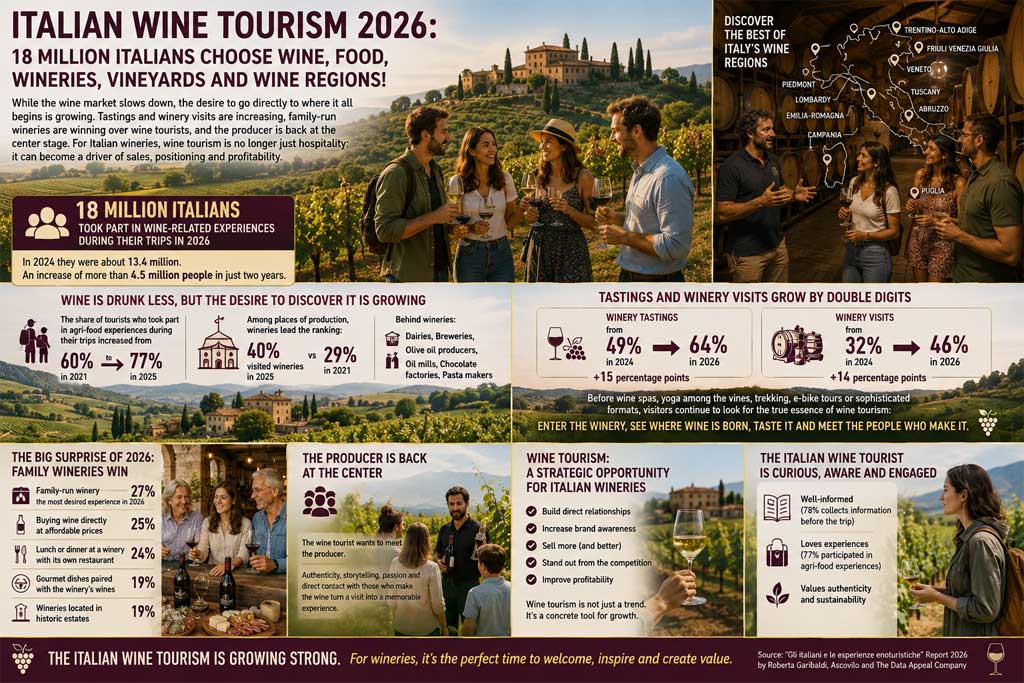
In 2026, an estimated 18 million Italians will have had wine-related experiences during their travels.

In 2024 there were approximately 13.4 million.

This means that in just two years the potential audience for Italian wine tourism has increased by over 4.5 million people .

A fact that deserves to be read not only from a tourist point of view.

For the wine world it contains a much deeper message:

Italians may be drinking less wine, but they haven’t lost interest in it. They’re just changing the way they approach it.

Wine is being drunk less, but the desire to learn about it is growing

The transformation is particularly interesting because it is taking place just as the sector is discussing the structural reduction of consumption.

Wine is no longer necessarily the daily protagonist of the table as it was for previous generations.

But when it becomes territory, travel, gastronomy, storytelling, culture and meeting with the producer , it continues to exert a strong power of attraction.

The share of tourists who participated in agri-food experiences during their trips increased from 60% in 2021 to 77% in 2025 .

And among the places of production, it is precisely the wineries that lead the ranking: in 2025 they were visited by 40% of the interviewees , compared to 29% in 2021.

Behind them come dairies, breweries, olive oil companies, oil mills, chocolate factories and pasta factories.

Wine, therefore, maintains a privileged position within Italian food and wine tourism.

Tastings and winery visits are growing by double digits.

Even more significant is observing what wine tourists actually want to do.

Between 2024 and 2026 , in-cellar tastings increased from 49% to 64% , an increase of 15 percentage points.

Visits to wineries, on the other hand, grew from 32% to 46% , an increase of 14 points.

This is a very clear signal.

Before wine spas, yoga among the vineyards, trekking, e-bikes, or particularly sophisticated formats, visitors continue to search for what represents the very essence of wine tourism:

enter the cellar, see where the wine is born, taste it and meet the person who produces it.

Simplicity, when authentic and well-organized, can therefore have more value than spectacularization.

The surprise of 2026: the family winery wins

Probably the most interesting piece of information in the entire report concerns the type of company that tourists want to visit.

In 2026, the family-run winery , chosen by 27% of wine tourists, became the most popular specific experience for the first time.

It even surpasses buying wine directly from the winery at convenient prices, indicated by 25%.

Next comes lunch or dinner in a winery with a restaurant, with 24%, and the opportunity to taste gourmet dishes paired with company wines, chosen by 19%.

Another 19% appreciate cellars located inside historic homes.

This is a result that should give pause, especially to the thousands of small and medium-sized Italian wineries.

To compete in wine tourism, you don’t need to be a large winery, own a luxury resort, or invest millions of euros in hospitality .

In some cases, the exact opposite may be true.

The family dimension, the company’s history, and the ability to speak directly with the producer become distinctive elements.

What may seem small from an industrial perspective can become exclusive from a tourist perspective.

The producer returns to the center of the experience

The data also explains why.

64% of those interviewed consider wine tourism an opportunity for cultural enrichment , while 63% want to learn the history and anecdotes of the company and its wines.

The visitor, therefore, is not only looking for technical information.

He wants to know who planted that vineyard.

Because that family produces wine right there.

How the cellar has changed over the generations.

What is the relationship between a label and the territory it is visiting?

And this is where the producer plays a fundamental role.

The winemaker isn’t just the one who makes the wine. He becomes part of the perceived value of the wine itself.

A bottle tasted after having met the family who produced it rarely remains just a bottle.

It becomes the memory of an experience.

And it is precisely this step that can create loyalty.

The welcome is as good as the beauty of the cellar

The quality of the wine remains important, of course, but it is not enough.

When wine tourists are asked what would encourage them to return to a winery they have already visited, 68% indicate the hospitality and professionalism of the staff .

66% consider the ease of booking and organizing the visit important.

64% appreciate the possibility of finding something different from their previous experience.

These are extremely concrete indications.

A winery can have extraordinary vineyards, a historic building, and award-winning wines.

But if it takes three days to respond to a request for a visit, doesn’t allow easy booking, gives a cold welcome to visitors, or isn’t able to explain what it offers, it’s losing a significant part of its potential.

Wine tourism is first and foremost a culture of hospitality.

The smartphone has become the entrance door to the cellar

2026 also confirms another transformation that is now irreversible.

Before physically arriving at the company, the visitor almost always enters digitally .

Search for information.

See photos.

Check reviews.

Compare experiences.

Check the times.

Book.

Use your smartphone to reach the property.

The ease with which an experience can be found and booked therefore becomes an integral part of its quality.

And here an interesting apparent contrast emerges.

The more digital the pre-visit phase becomes, the more tourists seem to seek authenticity once they arrive at the winery.

Technology must therefore eliminate obstacles, not replace human relationships.

Digital first.

People, wine and territory after.

Local wine tourism is born

Another important fact concerns distance.

Geographic proximity is considered by 65% of respondents when choosing a wine tourism destination and by 63% when deciding which winery to visit.

So there’s more to the great journey to the Langhe, Tuscany, Mount Etna, or the Prosecco hills.

An interesting space is growing for what we can define as local wine tourism .

A visit to the winery can be organized over a day or weekend, without necessarily requiring a long stay.

For thousands of companies, this greatly expands the potential market.

The customer is not just the international tourist arriving from the other side of the world.

It could even be a family that lives a hundred kilometers away.

A couple looking for a weekend experience.

A group of friends.

A company that organizes a meeting.

Or an enthusiast who wants to learn more about the producers in their area.

The most popular destinations: Cinque Terre, followed by Salento and Chianti.

The geography of wine tourism desired by Italians is also interesting.

At the top of the list of destinations that those interviewed would like to visit is the Cinque Terre , indicated by 20%.

Salento follows with 19% and Chianti with 18%.

The Amalfi Coast and Etna also reach 18%, ahead of Montepulciano with 16%, Montalcino with 15% and Langhe-Barolo and Gallura with 14%.

Valdobbiadene and Vesuvio collect 13%, Franciacorta and Castelli Romani 12%, while Trento Doc, Monferrato and Valpolicella reach 11%.

The ranking contains an interesting indication.

Tourists do not necessarily choose a destination just because it produces great wine.

Look for an area where the wine can be inserted into a broader experience.

Wine alone is not enough: the territory wins

Landscape, gastronomy, culture, catering and hospitality therefore become part of the wine tourism product.

62% of those interviewed consider the presence of tourist services , including accommodation facilities and restaurants, to be important.

61% value the accessibility of the destination.

58% look at the breadth of the wine tourism offering.

When choosing a single winery, the quality and reputation of the wines gain weight, indicated by 60%, followed by outdoor experiences, also at 60%, and the opportunity to deepen one’s knowledge of wine, at 58%.

This means that the competition is no longer just winery against winery .

It also happens between territories .

A denomination capable of networking wineries, restaurants, accommodations, landscape, culture, services, and mobility has a competitive advantage that is difficult for a single company to replicate.

2026 Harvest in Italy: Drought Reduces Harvest, But Inventories Are Worrying Italian Wine

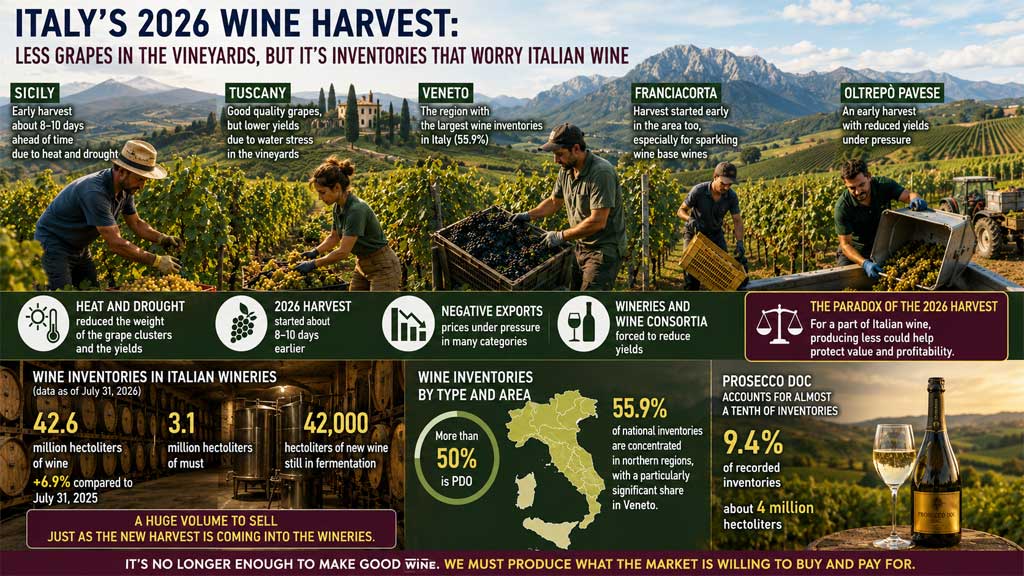
Fewer grapes in the vineyards due to heat and water stress, while 42.6 million hectoliters of wine remain in the cellars. Exports remain negative, prices are under pressure, and consortia are forced to reduce yields.

The paradox of the 2026 harvest: for some Italian wine, producing less could help maintain value and profitability.
The 2026 harvest in Italy presents a paradox that until a few years ago would have seemed difficult even to imagine: a lower production could represent, at least from an economic point of view, not entirely bad news for the wine sector .

Drought, high temperatures, and water stress are impacting grape weight and yields in several areas. But the issue most worrying producers and wineries doesn’t seem to be how much wine Italy will be able to produce in 2026.

The real question is another: how much wine can the market absorb today?

Because the new harvest arrives while Italian cellars still hold 42.6 million hectoliters of wine , 6.9% more than in the same period in 2025, to which must be added 3.1 million hectoliters of must.

At the same time, exports remain in negative territory, prices for numerous categories are under pressure, and several denominations have already decided to reduce yields.

The 2026 harvest therefore risks being remembered not so much for the quantity harvested, but for having highlighted a now structural issue in Italian wine:

It’s no longer enough to produce well. We must produce what the market is willing to buy and pay for.

An early harvest due to the heat

The 2026 harvest started in several Italian areas around 8-10 days early , especially for the early varieties and for the bases intended for sparkling wine production.

From Sicily to Oltrepò Pavese, from Franciacorta to the other wine-growing areas, high temperatures have accelerated ripening.

According to the indications that emerged in the first weeks of the harvest, the quality of the grapes appears generally good and in some areas very promising.

However, it is more difficult to formulate a reliable quantitative forecast.

Precisely for this reason , the Italian Wine Union, Assoenologi and Ismea have decided in 2026 not to present the traditional national harvest forecast , postponing the evaluation until the final data are available once the harvest is concluded.

A significant decision, which calls for caution given the quantitative estimates circulating in recent weeks.

Drought and high temperatures reduce the weight of the bunches

The main problem in the vineyards is the combination of heat and water availability .

The drought affected different regions differently, even in very close areas. Where water stress was greatest, vines faced difficult conditions precisely during crucial stages of ripening.

Added to this are high night temperatures and, in some areas, little temperature difference between day and night .

The result can be a greater concentration of the grapes, dehydration phenomena and above all a reduction in the average weight of the bunches .

In other words, apparently full vineyards may yield, at harvest time, quantities lower than expected.

The drought will therefore likely contribute to containing domestic production.

But that might not be enough.

And this is where the real paradox of the 2026 harvest arises.

The problem is not only how much we harvest, but how much wine we already have in the cellar

To understand the situation, we need to look beyond the vineyards.

As of July 31, 2026 , according to the Icqrf “Cantina Italia” report, Italian cellars contained:

42.6 million hectoliters of wine ,
3.1 million hectolitres of must ,
in addition to approximately 42,000 hectolitres of new wine still fermenting .

Wine stocks alone were 6.9% higher than on July 31, 2025 .

It is a huge mass that must be progressively marketed just as the product of the new harvest enters the cellars.

Over half of the stored wine is PDO and 55.9% of national stocks are concentrated in the northern regions , with Veneto accounting for a particularly significant share.

The problem, therefore, does not only concern some marginal productions.

It directly involves important territories and denominations of Italian wine.

Prosecco alone represents almost a tenth of the stocks

One piece of data helps to understand how complex the issue is.

Prosecco DOC alone represents 9.4% of the total inventory , with approximately 3.2 million hectoliters. The main categories held by wineries are Toscana and Puglia PGI, Chianti DOCG, Montepulciano d’Abruzzo, Terre Siciliane PGI, Sicilia DOC, Salento PGI, Veneto PGI, and Delle Venezie DOC.

This does not automatically mean that all these denominations are in commercial crisis.

Stocks must be read in relation to the refinement times, the size of the denominations and their rotation speed.

But the overall data clearly indicates that the new harvest enters a system that already has very significant quantities of product available .

And when supply grows faster than demand, the economic consequence is inevitable: it increases pressure on prices.

Wine prices under pressure

The phenomenon is already visible in the bulk market.

In the first five months of 2026, according to data from the Unione Italiana Vini Observatory, prices recorded a drop of 6% for PDO wines, 7% for PGI wines and 14.4% for common wines .

Even more significant is the phenomenon of downgrades .

Some of the wine is reclassified into commercially easier-to-place categories: from DOCG to DOC, from DOC to IGT, or, in some cases, to ordinary wine.

It is a strategy that allows you to free up product, but it comes at a clear cost.

It is sold, but part of the value built by the denomination is destroyed.

And this is precisely one of the greatest risks of the current situation.

Exports 2026: Some improvements, but the trend remains negative.

Added to the pressure of inventory is a second factor: the difficulty of international markets.

In the first four months of 2026, Italian wine exports reached approximately 2.33 billion euros , registering a 6.8% decrease in value compared to the same period in 2025.

Volumes also decreased, reaching approximately 640.7 million litres, -3.7% .

There are signs of a gradual recovery from the sharp decline recorded at the beginning of the year, but the picture remains complex.

The situation in the United States , the leading foreign market for Italian wine, remains particularly delicate, where in the first four months of the year the value of exports was still down by 15.4%.

This means that the traditional safety valve represented by exports, at least for the moment, is unable to completely absorb the pressure on supply.

The winemaker’s paradox: hoping to harvest less

This is probably the most interesting aspect of the 2026 harvest.

For generations, a bountiful harvest has been considered synonymous with prosperity.

More quintals meant greater potential revenue.

Today this equation is no longer necessarily valid.

If the market cannot absorb the product, increased production can become a problem: it increases inventories, reduces the producer’s bargaining power, and further compresses prices.

This is why drought produces a seemingly contradictory effect.

From an agricultural point of view it certainly represents a problem.

From an economic perspective, a moderate reduction in production could help at least partially ease supply pressure.

But relying on the climate to rebalance the market would clearly be an absurd strategy.

The sector must intervene sooner.

Consortia begin to reduce yields

And that’s exactly what’s happening.

In several Italian denominations, measures have been adopted to reduce yields, manage the quantities that can be claimed, or resort to storage , with the aim of realigning supply with demand.

Interventions have been adopted or discussed in important areas of Veneto, Tuscany, Piedmont, Marche and Abruzzo , involving denominations such as Valpolicella, Delle Venezie, Barbera d’Asti, Langhe, Soave, Chianti, Chianti Classico and other areas.

The economic principle is simple:

less quantity, greater possibility of defending the value.

But this solution also has limitations.

Reducing the yield of a single denomination does not necessarily mean eliminating that quantity from the market.

In fact, when permitted by production rules, grapes can be destined for different categories.

The risk is therefore that of moving excess production from one denomination to another, without truly solving the overall problem.

Italian wine must decide how much it wants to produce

The 2026 harvest therefore brings to light an issue that goes far beyond this single campaign.

What is the sustainable production level for Italian wine today?

Not only from an agronomic point of view.

From an economic point of view.

For many years the goal has been to increase production, conquer new markets and increase exports.

That phase contributed enormously to the international success of Italian wine.

Today, however, the context is changing.

Consumers are drinking less wine on average, are more selective, are increasingly concerned about price, and are changing the occasions and ways in which they consume it.

The international market has also become more competitive and geopolitically less predictable.

Continuing to think exclusively in terms of hectolitres produced therefore risks becoming dangerous.

From quantity to value

The central question should not simply be:

“How much wine will Italy produce in 2026?”

The most strategically important question is:

“How much value will each bottle produced generate?”

This is a fundamental difference.

The future of Italian wine probably does not depend on achieving new production records, but on the ability to increase the average value of production .

This means working simultaneously on several fronts: brand positioning, more diversified exports, direct sales, wine tourism, hospitality, new consumers, product innovation, and greater company sales capacity.

Above all, it means preventing wine from simply becoming an agricultural commodity.

Because Italy will hardly be able to win the international competition on price.

Instead, it can continue to win on territory, denomination, quality, history, producer and brand .

Wineries and vineyards: profitability becomes the real emergency

Behind the harvest numbers there is finally an even more important issue: the producers’ income .

A vineyard can be perfectly cared for, produce excellent grapes, and still find itself in financial difficulty if the price paid does not adequately cover production costs.

And this is the risk that the sector must avoid.

Because a prolonged profitability crisis doesn’t just produce negative balance sheets.

It produces something much more difficult to recover:

the abandonment of the vineyards.

When cultivation is no longer economically sustainable, especially in the most difficult and expensive areas, the producer first reduces investments and may subsequently decide to abandon it.

At that point, not only does he lose the agricultural business.

He loses his territory.

Wine Press Review – Top News for Saturday August 29 -2026

Italian wineries, Italian wine producers, and current wine news.

Good morning,

ITALIAN WINERIES

Franciacorta: the wineries and their leading labels . Several Franciacorta producers are taking center stage. Uberti presents the distinctive De Quinque RP 02-19 , a Chardonnay crafted from a perpetual reserve that brings together cuvées from 17 vintages and ages on the lees for over 70 months. Ca’ del Bosco presents the Dosage Zéro Vintage Collection 2021, while Tenuta Montenisa – Marchesi Antinori creates the Brut Satèn Donna Cora 2022. Among the local producers is Bosio, a 22-hectare organic winery producing approximately 150,000 bottles.

Villa Raiano, tradition and innovation in Irpinia. Located in San Michele di Serino, Villa Raiano interprets Irpinia through a winery designed to exploit gravity throughout the various production phases. The goal is to combine territorial identity, tradition, and winemaking innovation.

Jerzu, the Cannonau that unites wine and solidarity. The 2023 Cannonau di Sardegna “Vittoria” from the Jerzu Social Winery was also born as a memorial and solidarity project dedicated to Maria Vittoria Orrù. The initiative supports two annual scholarships for deserving students from Jerzu. Etna, Michele Scammacca: the region seeks a new balance. According to Michele Scammacca of Murgo, Etna is undergoing profound change and must bridge the gap between different price ranges. For the winery, the Metodo Classico represents an important strategic choice: approximately 200,000 of the 400,000 bottles produced are made with this method. The market is slowing and the skills required by wineries are changing. According to Andrea Pecchioni of WineJob, companies are increasingly seeking sales professionals capable of developing managerial vision and new markets, from Africa to South America. Furthermore, the importance of hospitality skills at the winery is growing, increasingly linked to direct sales, loyalty, and brand positioning.

ITALIAN WINE AND ITALIAN OENOLOGY

2026 Harvest: Promising Quality, but Climate Increasingly Determining. Initial indications point to a common thread: high temperatures, early ripening, and narrower harvest windows . From Chianti Classico to Alto Adige, the need for highly precise monitoring of vineyards and ripening is evident. Quality expectations remain positive, however.

Oltrepò Pavese: National Wine Strategy Requested As the harvest progresses, Coldiretti Pavia is calling for a National Strategic Plan for the wine sector , developed in collaboration with the wineries. The year was characterized by intense heat and water shortages, and the harvest could end in the first ten days of September. Lugana: Early Harvest and Good Quality Expectations. In Lake Garda, the Turbiana harvest began approximately ten days early . The district covers 2,670 hectares, and approximately 60% of production is intended for export. Quality expectations are positive, and no significant declines in quantity are expected, except in areas affected by hailstorms. Turin: High Quality, but Production Expected to Drop 20%. The harvest has begun with white grapes destined for sparkling wine. Coldiretti Turin predicts a reduction in production of approximately 20% , which could reach 50% in the Canavese areas affected by the Japanese blight. The estimated economic loss is approximately €2 million , while the quality of the grapes is judged to be very good. Hailstorm in the Verona area during the grape harvest. A hailstorm hit Peschiera del Garda, Colà di Lazise, Castelnuovo del Garda, and Bosco di Sona during the ripening and harvesting of the grapes. Investigations are underway to assess the extent of the damage to the companies. Veneto: Clearer rules on the exchange of agricultural labor. The Veneto Region aims to define a clearer framework for the exchange of labor between farmers and for the assistance provided by family members during periods of greater work intensity, such as the harvest. Grappello Ruberti, rediscovering a historic grape variety from the Po Valley . Attention is returning to Grappello Ruberti, a variety historically linked to the territories between Mantua and Cremona. Its history testifies to the value of Italian viticultural biodiversity and the preservation of local grape varieties. Tasting: technique and subjectivity coexist in judging wine. Acidity, tannin, alcohol content, structure, and persistence can be assessed technically; The subsequent qualitative assessment, however, inevitably retains a personal component. A reflection on the boundary between objective analysis and individual interpretation of wine. Italian wine: €1.45 billion in revenue affected by potential changes in ownership or governance. According to reports, at least six or seven major Italian wineries could face significant governance changes in the next 6-12 months, with transactions that would overall affect approximately €1.45 billion in revenue . Fine wine: Italy maintains a role in the international collectibles market. Some of the most prestigious Italian labels find space in the Liv-ex: Piedmontese Barolo and Barbaresco, Masseto, Ornellaia, Sassicaia, Solaia, Tignanello, and Soldera. The secondary market remains separate from the dynamics of ordinary consumption and continues to represent an interesting indicator of the value of fine wines. Vermouth di Torino among the most searched Italian PDO/PGI products on Wikipedia A study of 99 Italian products with a designation of origin places Vermouth di Torino among the most searched for excellences online, along with Gorgonzola, Parmigiano Reggiano, Grana Padano, and Taggiasca olives.

INTERNATIONAL

France: Small yields, but 2026 could be a great vintage. Despite temperatures above 40°C, drought, and fires, early indications suggest potentially highly concentrated and qualitatively interesting wines. The harvest began early in several regions, from Burgundy to Beaujolais and the Loire. In July, French rainfall was 67% lower than the national average .

Rhone Valley: 73% of winemakers adopt climate change mitigation measures. A survey by the Institut Rhodanien shows that 72 of the 98 producers interviewed have already adopted at least one adaptation practice, from early harvesting to irrigation. Climate change is significantly altering viticulture timing and techniques. Albania, early harvest also in Berat. At the Çobo Winery, the harvest of Puls, a native white grape variety also used for Classic Method base wines, began about ten days earlier than usual , further evidence of the impact of temperatures on ripening. Farewell to Branko Čotar, pioneer of orange wines from the Slovenian Karst . Branko Čotar, a leading figure in natural viticulture in the Slovenian Karst, has died at the age of 78. He practiced long macerations on white grapes decades before orange wines became an international trend.

WINE EVENTS, WINE TOURISM AND WINE CULTURE

Open Cellars during Harvest: two months dedicated to wine tourism. From August 24th to October 25th, the Wine Tourism Movement brings visitors to Italian wineries during one of the most important times of the year. Foreigners already represent 35-40% of winery visitors , but the potential for attracting them to Italy’s overall international tourism flows remains significant.

Franciacorta in Cantina Festival. This September, the event dedicated to discovering the Franciacorta region through wineries, tastings, vineyards, historic homes, art, and outdoor activities returns. An example of how wine and the region can become an integrated tourist experience. Gessopalena: Abruzzo’s rare grape varieties take center stage. The “Gli Irripetibili” tasting presents five years of micro-vinifications made with native varieties from the Abruzzo mountains. The Bio Cantina Sociale Orsogna project aims to preserve the genetic heritage and local viticultural heritage. Ardauli: young people discover the origins of Sardinian viticulture. The “Trekking among the Palmenti” led about one hundred participants through historic vineyards and ancient palmenti carved into the rock of the Oristano area, highlighting the relationship between wine, rural archaeology, and territorial identity. Crema Wine Festival: wine, music, and new tasting formats. The Offanengo edition experimented with a format without the traditional lineup of wineries: two expert tasters directly accompany the audience through tastings of wines, accompanied by music and food. Emilia-Romagna: dinners and aperitifs in the vineyard continue. The food and wine events in the vineyards continue until the end of August, transforming tastings, landscapes, and local cuisine into tools for learning about the region and the rural culture of Romagna.

PICTURE OF THE DAY

The 2026 harvest is highlighting a structural shift: the climate is altering the timing, quantity, and methods of wine production . From Oltrepò to Lugana, from Piedmont to France, early harvests, heat, and water shortages are forcing wineries to make increasingly rapid and precise decisions.

Quality, however, remains the positive aspect: in many areas, expectations are good or very good, even when volumes are decreasing.

On the economic front, a second important phenomenon is emerging: the sector is entering a phase of reorganization . The commercial slowdown is changing the skills required by wineries, and at the same time, several major Italian companies could face changes in ownership, the entry of new shareholders, or new governance.

Finally, the importance of wine tourism is growing. Open Cellars, the Franciacorta Festival, tastings in the villages, and initiatives in the vineyards demonstrate how the winery is no longer just a place of production: it is increasingly becoming a place to sell directly, build the brand, tell the story of the region, and create a lasting relationship with the consumer .

Today’s summary: less focus on quantity alone, more quality, adaptability, brand value, direct consumer relationships, and appreciation of the local area. These are the factors reshaping Italian wine.

Today’s wine press review is brought to you by WINEIDEA.IT.

See you tomorrow.