
All posts by admin

Wine press review for Saturday May 16 -2026

Italian wineries, Italian wine producers, and current wine news.

Wine press review for Saturday, May 16, 2026

Italian wineries

  • New ownership for the historic Dario Coos: entrepreneur Mauro Savio has acquired 80% of the Friulian winery, marking the arrival of an industrial manager in the winemaking sector with the goal of relaunching and consolidating the business.
  • Pinino inaugurates the Ferragamo family’s new era with Rosso di Montalcino 2024. Investments in packaging, brand identity, and territorial development for one of the appellation’s historic wineries.
  • The Montemiglietto Winery received a special mention at Intesa Sanpaolo’s “Imprese Vincenti” (Winning Companies) program: young producer Luca Lesina was recognized for innovation, climate adaptation, and promoting Made in Italy.
  • In Segonzano, the historic Barone a Prato winery continues to promote the famous “Dürer vineyards,” combining wine, culture, and experiential tourism.
  • In the US, Honig Vineyard & Winery is making headlines for its innovative, family-friendly business model: employees can bring their children to work directly at the winery.
  • The role of young Italian women producers is growing in the “Sbarbatelle” project: over 160 Italian producers are participating in Toronto to promote Barolo and Italian wine on the Canadian market.

Italian wine and Italian oenology

  • Consumer tastes are changing: the “less but better” paradigm is taking hold in Italian wine. There’s a growing focus on quality, experience, and product recognition, while consumption is decreasing in quantity but not in perceived value.
  • The winemaking debate is shifting to lower-alcohol wines: for years, high alcohol content was synonymous with quality, but today the market rewards balance, drinkability, and elegance.
  • Signorvino closed 2025 with a turnover of 90 million euros: strong growth in the restaurant business (6%) and confirmation of the centrality of the gastronomic experience in wine consumption.
  • Lombardy is launching the OCM Vino Promozione 2026/2027 call for proposals with €2.4 million to support exports and promotion in non-EU markets.
  • The wine tech sector is accelerating: eight startups selected by the Wine Tech Challenge will work on sustainability, agritech, digitalization, and evolving consumption.
  • Alessandra Piubello sends a clear message to the industry: wine must rediscover a language more in tune with young consumers and reclaim its cultural role.
  • The evolution of precision agriculture continues: the Cremona Agricultural Consortium is investing in multispectral drones for crop monitoring and advanced agronomic management.
  • Growing attention is being paid to agronomic sustainability and natural crop protection with new biological solutions against powdery mildew and bacterial diseases.
  • The agricultural sector is paying close attention to the potential urea ban in the Po Valley starting in 2028: according to Nomisma, it could increase cereal production costs by up to 7%.
  • Environmental sustainability is increasingly becoming part of corporate culture: Fratelli Campagnolo launches the “Park for Bees” project to protect biodiversity.
  • Italian consumption remains stable but increasingly fragmented: food e-commerce is growing and the purchasing habits of Italian families are changing.
  • Geopolitical attention on the agricultural sector is high as the race to renew the FAO leadership continues, with tensions escalating between Italy and Spain over control of the main UN agricultural agencies.

International

  • Asia returns to the forefront of Italian wine strategies with Wine To Asia 2026: over 400 exhibitors and a strong Italian presence to strengthen trade relations with emerging Asian markets.
  • The debate over the international competitiveness of Italian wine continues: exports are slowing, but premium wines and sparkling wines are showing strong resilience.
  • Bordeaux returns to the spotlight with the “Bordeauxgraphy” publishing project: over 2,000 wines tasted to relaunch the cultural and oenological value of the French region.

Wine events

  • Bologna Wine Week 2026 brings tastings of around 40 Italian wineries from Emilia-Romagna to Sicily, focusing on local wines and regional identities.
  • Vinorum 2026 transforms L’Aquila into the capital of Abruzzo wine: 52 wineries, 250 labels, masterclasses, tastings, and a focus on heroic viticulture.
  • “The Purple Heart of Venice and the Euganean Hills” returns to the Euganean Hills, an event dedicated to local wines and the purple artichoke of Sant’Erasmo.
  • The “Vigna & Tavola” event kicks off, showcasing Karst and haute cuisine: wine tastings and gastronomic journeys featuring local wines.
  • Vitigno Italia 2026 hosts the Campania Region with a story integrated into wine, the fish supply chain, and territorial promotion.

Focus on wine-growing assets and opportunities

  • For sale is a prestigious organic and biodynamic estate of approximately 80 hectares in the Eastern Hills of Friuli, with terraced vineyards, charming hospitality, and high wine tourism potential.
  • A historic estate in Vulture dedicated to Aglianico DOCG, with a strong premium positioning and an integrated hospitality project, is now available on the market.
  • In the Castelli Romani area, we offer an organic farm with a winery, a farmhouse, a B&B, and a photovoltaic system, focusing on sustainability and wine tourism.

Final summary for the web

Italian wine continues to undergo profound transformation. Consumption patterns are changing, volumes are decreasing, but the demand for quality, experience, and authenticity is growing. The market increasingly rewards wines with a strong territorial identity and well-presented stories, while the industry is accelerating its efforts in sustainability, technological innovation, and wine tourism.

At the same time, the need to open new international markets, especially in Asia, is growing, while operators are paying close attention to climate change, new generations, and new languages for wine communication.

In this scenario, structured winemaking assets, with a strong territorial identity, hospitality capacity, and premium positioning, are becoming increasingly strategic for investors, wine groups, and international operators.

Thanks for listening. Today’s wine press review is brought to you by WINEIDEA.IT
Wine press review for Friday May 15 -2026

Italian wineries, Italian wine producers, and current wine news.

Italian wineries

Cantina Moros: fairy tale, wine, and territory Cantina Moros hosts a meeting dedicated to the Griko fairy tale “The Little Girl Who Brought Patience ,” an event that unites biodiversity, local culture, memory, and the Negroamaro territory.

Bertani opens the historic Amarone library On May 23 and 24, Bertani offers “Bertani On,” an exclusive tasting of great vintages of Amarone della Valpolicella Classico, paired with creations by chef Giancarlo Perbellini.

Valpolicella Wine Consortium: New Board of Directors and Positive Results The new Board of Directors of the Valpolicella Wine Consortium has been elected, serving until 2028. The 2025 financial statements show a record profit, despite a challenging market for red wines.

Emilia Wine invests in photovoltaic energy. The Emilia Wine cooperative winery inaugurates a nearly one million euro agri-solar system in Arceto, supported by PNRR funds, to reduce energy costs and strengthen sustainability.

Pasqua and the Hey French project Pasqua Vigneti e Cantine recounts the journey of Hey French , a multi-vintage wine created to transcend the vintage paradigm and enhance time, territory, and company identity.

Ca’ di Rajo: The trial continues over the winery accident. The Treviso Court is returning to the case of the death of winemaker Marco Bettollini, who died in 2023 in a nitrogen-saturated autoclave. The focus of the proceedings will be on winery safety.

Italian wine and Italian oenology

Sicily: Positive 2025 Harvest The 2025 harvest restores confidence in Sicily’s winemaking: more rain, better vegetative balance, and quality grapes, with an estimated increase in production of up to 20%.

Lazio, Santarelli calls for more space for regional wines. Antonio Santarelli, owner of Casale del Giglio, decries the lack of Lazio wines on local restaurant menus and draws attention to their value for money.

Orange wine: a return to an ancient practice. Interest in orange wines, made from white grapes macerated on the skins, is growing. This trend emphasizes traditional techniques, complexity, and new ways of enjoying them.

Tignanello among the most desired wines in the world Marchesi Antinori’s Tignanello is the only Italian wine included in Wine-Searcher’s 2026 ranking of the ten most desired wines in the world.

Excessive wine price increases at restaurants. Italgrob is raising the alarm over rising wine and beverage price tags, which threaten to make wine increasingly unaffordable in restaurants.

CMO Wine: Call for Third Country Promotion Opened. The call for submissions of CMO Wine projects “Promotion on Third Country Markets” for the 2026/2027 wine year has been approved. Applications must be submitted by June 26, 2026.

Winemaking innovation with the Wine Tech Challenge Eatable Adventures’ Wine Tech Challenge rewards startups working on water, precision agriculture, customs, large-scale retail trade, dealcoholization, and sustainability, with the involvement of leading Italian wineries.

International

Crisis in the Middle East: Italian agri-food sector concerned According to a TEHA survey, seven out of ten Italian agri-food companies fear negative market effects due to the international crisis, energy costs, and raw materials.

Wine by the glass is growing worldwide. According to Coravin, 57% of global consumers prefer to drink wine by the glass, driven by moderation, curiosity, variety, and the pursuit of quality.

Global wine slows. The OIV report confirms the global slowdown in the sector: consumption is declining, exports are under pressure, vineyard area is shrinking, and the value of international trade is penalized by tariffs and uncertainty.

Famille Perrin invests in non-alcoholic beverages The Perrin family, owners of Château de Beaucastel, enters the non-alcoholic beverage sector by acquiring a majority stake in Alain Milliat, a French brand of premium juices for high-end hotels and restaurants.

Negroni, an Italian symbol around the world The Negroni is confirmed as an iconic international cocktail, born in Florence between 1919 and 1920 and today recognized as one of the most powerful symbols of the Italian aperitif.

Wine events

Soave, Refrontolo, and other wine regions celebrate. Festivals, wine exhibitions, guided tours, farmers’ markets, and events related to wine, culture, and the region continue throughout Veneto and the UNESCO hills.

Aperitif-trekking among the hills of Farra di Soligo. An evening trek through the UNESCO vineyards of Conegliano-Valdobbiadene is planned for May 23rd, with aperitif dinner and return under the stars.

Vinarius in Trentino From May 24th to 26th, the Trentino Wine Consortium will host the Italian wine merchants of Vinarius for a tour of vineyards, cellars, grappa, and the surrounding area.

Cantine Aperte 2026 Cantine Aperte returns on May 30th and 31st: 52 participating wineries are expected in Abruzzo, while in Piedmont the event will involve Langhe, Roero, Monferrato, Colline Novaresi and Canavese.

Gemme di Gusto in Trentino From May 15th to 17th, the event dedicated to wines, trekking, local flavors, and experiential tourism continues, with wine tastings, excursions, and e-bike tours.

Vin-Tour Guagnano: A new itinerary between Lecce and Guagnano dedicated to Negroamaro, local culture, and slow tourism, including visits to museums, the library, the mother church, and local wineries.

Etna Wine at Cantina Pietradolce On May 16th, Cantina Pietradolce hosts a day of Etna wines, signature street food, and solidarity on the slopes of Etna.

Final summary

The day confirms a rapidly evolving wine sector. On the one hand, obvious critical issues emerge: declining global consumption, market tensions, rising restaurant prices, climate risks, and increased attention to winery safety. On the other, Italian wine continues to demonstrate vitality through investments in sustainability, technological innovation, wine tourism, regional development, and new forms of consumption.

The central message is clear: wine can no longer rely solely on tradition. It must better communicate its value, engage with new consumers, and create more accessible, authentic, and recognizable experiences.

Today’s wine press review was brought to you by WineIdea.it.

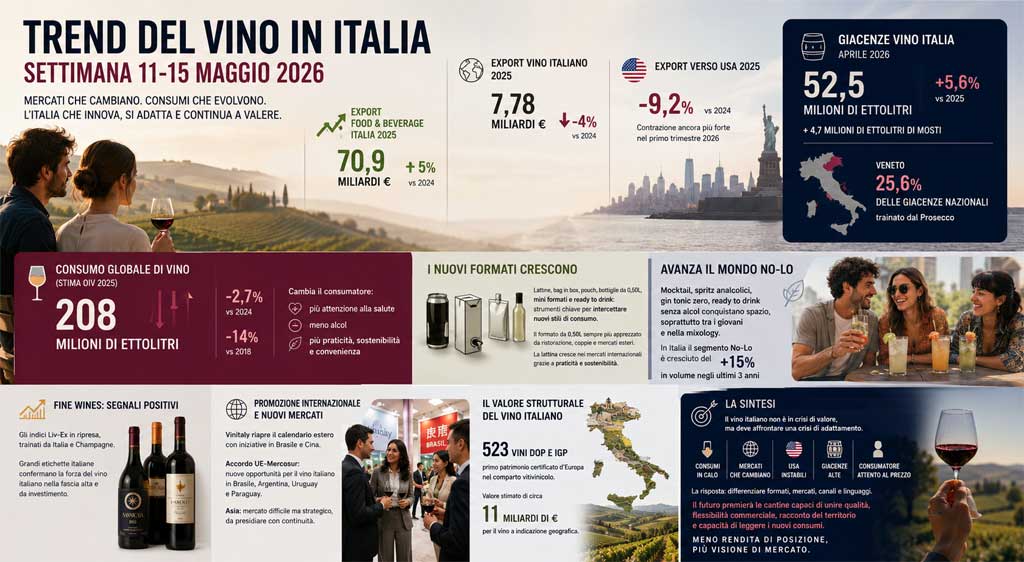
Wine Trends in Italy – Week 11-15 May 2026

This week confirms a complex phase for Italian wine: the sector remains strong, recognized, and central to Made in Italy, but it operates within a more unstable, selective, and less predictable market than in the past.

The overall picture for the Italian agri-food sector remains positive: in 2025, food and beverage exports reached €70.9 billion, up 5%, confirming the strength of the Italian system.
However, wine, while remaining one of the symbolic categories of national exports, has registered a decline: Italian wine exports in 2025 stopped at around 7.78 billion euros , with a drop of around 4% .

The most critical data concerns the United States, a key market for Italian wine, where tariffs and trade uncertainty have clearly weighed. According to the UIV Observatory, Italian exports to the US fell by 9.2% in 2025 , with an even sharper contraction in the first quarter of 2026. This isn’t just an Italian problem: the American supply chain, including importers, distributors, restaurateurs, and wine shops, is also suffering negative impacts, with reduced sales and a reduced presence of European wines on restaurant menus.

On the domestic front, the most sensitive issue remains that of inventory. According to the ICQRF’s “Cantina Italia,” as of April 2026, Italian wineries held 52.5 million hectoliters of wine , 5.6% more than in 2025 , in addition to 4.7 million hectoliters of must . This figure indicates significant production capacity, but also the need to carefully manage the relationship between supply, consumption, exports, and prices. Veneto alone accounts for 25.6% of national inventory, driven primarily by Prosecco.

Worldwide, wine consumption continues to decline. The OIV estimates global consumption of 208 million hectoliters for 2025, down 2.7% from the previous year and 14% from 2018. Consumer habits are changing, especially among young people: greater attention to health, lower alcohol consumption, and a greater search for convenience, sustainability, and affordability.

This is precisely where one of the week’s most important trends comes from: the growth of alternative formats. Cans, bag-in-boxes, pouches, half-liter bottles, mini formats, and ready-to-drinks are becoming strategic tools for capturing new consumption styles. The 0.50-liter format appears increasingly attractive for restaurants, couples, and foreign markets, while the can is growing especially in international markets, thanks to its convenience and perceived sustainability.

At the same time, the No-Lo segment, that is, non-alcoholic or low-alcohol drinks, is gaining ground. Mocktails, non-alcoholic spritzes, zero-alcohol gin and tonics, and alcohol-free ready-to-drinks are gaining ground, especially among young people and in mixology. In Italy, the No-Lo segment has grown by 15% in volume over the last three years , while the traditional alcoholic beverage sector is declining.

However, there are positive signs. The fine wine market is showing signs of recovery, with the Liv-Ex indices supported especially by Italy and Champagne. Some major Italian labels, particularly Barolo, Barbaresco, Masseto, Sassicaia, Solaia, Tignanello, and Soldera, confirm the strength of Italian wine in the premium and investment segment.

International promotion also remains key. Vinitaly has reopened its international calendar with initiatives in Brazil and China, focusing on South America and Asia as high-potential areas. The EU-Mercosur agreement could open new opportunities for Italian wine, especially in Brazil, Argentina, Uruguay, and Paraguay, while Asia remains a challenging but strategic market, requiring continued support.

The structural value of Italian wine remains enormous: Italy boasts 523 DOP and IGP wines , Europe’s largest certified wine heritage, with an estimated value of approximately €11 billion for geographical indication wines. This is the true strength of the system: not a single product, but a map of territories, grape varieties, denominations, landscapes, and local identities.

The summary is clear: Italian wine isn’t experiencing a crisis of value, but rather a crisis of adaptation. Consumption is declining, markets are changing, the United States is more unstable, inventories remain high, and consumers are more price-conscious. The answer can’t simply be to lower margins: we need to differentiate formats, markets, channels, and languages.

The future will reward wineries capable of combining quality, commercial flexibility, a narrative of the region, and the ability to understand new consumer trends. Italian wine still has a powerful competitive advantage, but it must use it more strategically: less vested interest, more market vision.

Wine press review for Thursday May 14 -2026

Italian wineries, Italian wine producers, and current wine news.

Italian wineries

Bellavista hit by hail: 50 hectares of vineyards damaged. The severe weather severely affected some vineyards, including Bellavista’s vineyards. Francesca Moretti emphasizes the need to wait for the plants’ reaction, intervening with cover treatments and careful agronomic work.

Ventiventi opens summer among the vines. The Razzaboni family’s Emilian organic winery offers a calendar of wine tourism experiences, including visits, tastings, and cellar tours, showcasing the Emilian Classic Method and a warm welcome in the vineyard.

Muri-Gries signs the best Pinot Noir in Italy The Abtei Muri Riserva 2023 from the Muri-Gries Convent Winery confirms Alto Adige as the reference territory for Italian Pinot Noir.

Vignaioli del Vulcano Laziale: a new territorial narrative is born. Eleven Lazio producers are launching the “Vignaioli del Vulcano Laziale” project, aiming to showcase the wines of the volcanic regions around Rome through a broader, more contemporary narrative.

Conegliano Valdobbiadene Prosecco Superiore DOCG looks to the United States. The Consortium welcomed American restaurant and hotel professionals, strengthening the link between Prosecco Superiore, the UNESCO landscape, and international markets.

Illegal distillery seized in the Treviso area. The Guardia di Finanza and the ICQRF discovered a clandestine distillery in Mareno di Piave, seizing wine, grappa, liqueurs, and equipment without proper traceability.

Italian wine and Italian oenology

Wine stocks: 52.5 million hectoliters in Italian cellars. According to the ICQRF-Masaf “Cantina Italia” report, inventories remain high: 5.6% compared to April 2025. Over 80% of the wine held is DOP or IGP, and more than half is located in the Northern regions.

DOP and IGP wines dominate Italian stocks. DOP wines represent over 28 million hectoliters, while IGP wines exceed 13 million. Table wines and musts are also growing, a sign of a still complex market phase.

Vintage on the label: when is it mandatory? In Europe, indicating the vintage is optional, but if it is listed, at least 85% of the grapes must come from the indicated year. In Italy, the vintage is mandatory for DOP wines.

Severe weather brings insurance back to the forefront. Hailstorms in Veneto have damaged vineyards, orchards, and crops, confirming the urgent need for adequate insurance to protect agricultural businesses and production continuity.

Wine Tech Challenge: Eight startups for the future of Italian wine. From artificial intelligence for exports to alcohol-free sales, to price monitoring in large-scale retail trade: Verona Agrifood Innovation Hub selects eight startups to accelerate innovation in the supply chain.

Ready-to-drink, alcohol-free mocktails are growing rapidly. The boom in alcohol-free products is confirmed at Tuttofood, with non-alcoholic gin and tonics, spritzes, and negronis increasingly in demand among young people, bartenders, and beverage operators.

Envisioning2035: Italian wine reflects on competitiveness. The summit on June 4, 2026, in Milan will analyze the sector’s strategic priorities: organizational scale, financial strength, data, international markets, and new consumption patterns.

Academy Symposium: Practical training for agri-food, wine, and tourism. In Rodengo Saiano, Franciacorta, the “learning by doing” model connects school and business. 95% of graduates find employment in the sector within a month.

International

Bordeaux and Syrah: the “forbidden” wine that reopens the historical debate. Château Palmer revives the topic of the ancient “Hermitagé” blends, when some great 19th-century Bordeaux wines were enriched with Syrah from the Rhône. A practice unconventional today, but historically documented.

OIV: The wine world seeks balance between production and consumption. The 2025 OIV report highlights global vineyard acreage declining for the sixth consecutive year. Production, consumption, and trade remain under pressure, but the sector demonstrates resilience and adaptability.

John Barker, OIV: Alcohol and health require a scientific approach. The Director General of the OIV calls for a distinction between abuse and moderate consumption, also recalling the cultural value of wine in many countries.

Wine events

San Giorgio di Vino returns for its fifth edition. The event offers tastings, meetings with producers, and the promotion of local areas, bringing wine to the streets of the town.

Wine tourism: the OICCE conference on hospitality in Asti. On May 14th in Asti, the technical, regulatory, organizational, and promotional aspects of wine tourism will be explored.

Teroldego Rotaliano Exhibition 2026 From May 22nd to 24th, the 35th edition dedicated to the prince of Trentino wines returns to Mezzocorona, with Palazzo Martini at the heart of the event.

Open Cellars 2026: On May 30th and 31st, the vineyard becomes an experience. The 34th edition of the Movimento Turismo del Vino event focuses on regenerative tourism, sustainability, immersive experiences, vineyard treks, tastings, and meetings with producers.

Open Cellars in Piedmont’s Langhe, Roero, Monferrato, Colline Novaresi, and Canavese wineries are opening their doors for tastings, masterclasses, picnics, e-bike tours, panoramic brunches, and sensory experiences.

The Filò delle Vigne Experience in the Euganean Hills On May 23rd in Baone, a visit to the vineyard and winery with a tasting of the company’s wines paired with Fontana cured meats.

Winemaking opportunities and featured assets

Valpolicella – 42-hectare Amarone DOCG vineyard Hillside farm with 20 hectares of vineyards suitable for Amarone della Valpolicella DOCG, a single vineyard, drip irrigation, two wells and a building permit for a rural building of approximately 1,000 m2.

Prosecco DOC – Operational sparkling winery In the heart of the Prosecco DOC area, a ready-to-use opportunity for production, storage, and industrial growth.

Frascati DOC – Organic estate on the outskirts of Rome Historic property of 11.36 hectares, of which 9.56 hectares are DOC/DOCG vineyards, certified organic since 1996, in a volcanic territory with a strong identity.

Castelli Romani – Historic winery since 1909. 33 hectares, modern 750 m2 cellar, over 36,000 hl capacity, 300,000 bottles per year, direct sales points and wine tourism.

Gradisca d’Isonzo – Historic Friulian estate with 35 hectares in a single plot, 31.5 hectares of vineyards, a modern cellar, a brand known on the US market and a production potential of up to 300,000 bottles per year.

Riviera Friulana – Winery and wine tourism company Over 70 hectares in a single body, approximately 50 vineyards, 10,000 hl cellar, farmhouse, restaurant, manor house, photovoltaic and geothermal energy.

“Naturalmente” Organic Farm Brewery. Integrated brewing chain from field to bottle, with direct cultivation of organic barley, hops, and cereals, artisanal malting, and a growing production facility.

Closure

Thanks for listening. Today’s wine press review was brought to you by WineIdea.it .

See you tomorrow.