All posts by admin

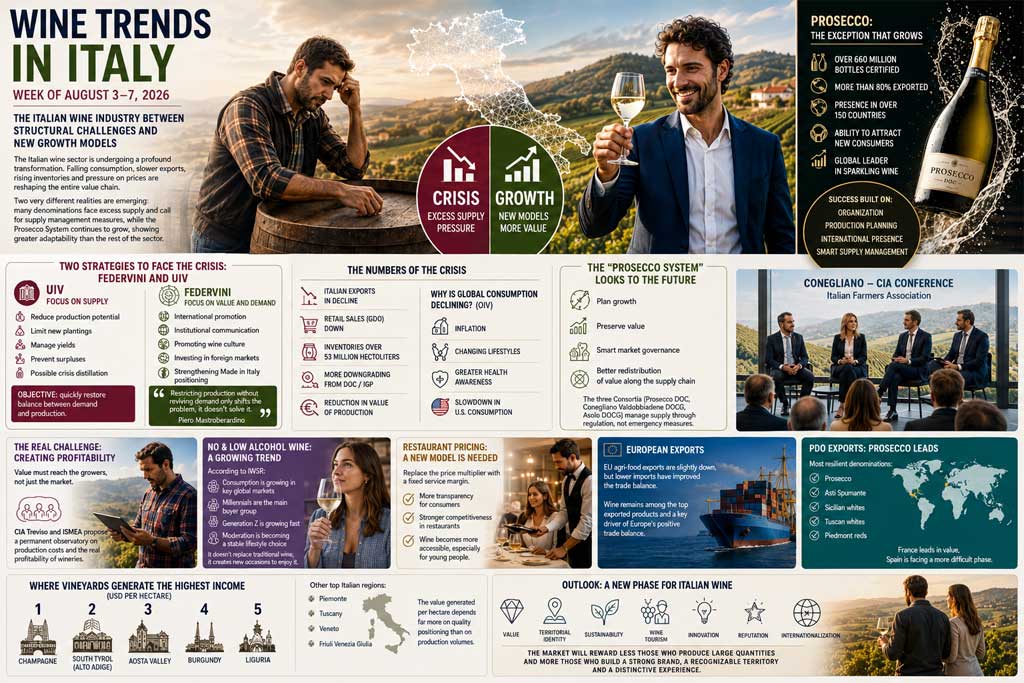
Wine Trends in Italy Week 3 – 7 August 2026

The Italian wine sector between structural crisis and new growth models.
Italian wine is undergoing a phase of profound transformation.

Declining global consumption, slowing exports, rising inventories, and price pressure are disrupting the entire supply chain.

However, within the sector, two very different realities emerge.

On the one hand, many denominations are facing overproduction and are demanding supply containment measures; on the other, the Prosecco System continues to grow, demonstrating a greater capacity for adaptation than the rest of the sector.

Federvini and UIV: Two strategies to address the crisis

The open discussion at the Ministry of Agriculture’s Supply Chain Table highlights two different approaches.

Italian Wine Union (UIV)

According to UIV, it is necessary to intervene mainly on the supply through:

reduction of production potential;
limitation of new installations;
yield management;
prevention of surpluses;
possible recourse to crisis distillation.

The goal is to quickly restore balance between demand and production.

Federvini

Federvini, on the other hand, proposes a different strategy.

According to President Piero Mastroberardino, future competitiveness will not depend so much on producing less, but on creating greater value through:

international promotion;
institutional communication;
promotion of wine culture;
investments in foreign markets;
strengthening the positioning of Made in Italy.

The philosophy is simple:

Limiting production without boosting demand risks shifting the problem without solving it.

The numbers of the crisis

The current scenario portrays a more difficult market than in previous years.

Among the main elements:

Italian exports decreasing;
sales in large-scale retail trade are declining;
over 53 million hectolitres of stocks;
increase in downgradings from DOC and IGP;
reduction in the economic value of production.

According to the OIV, world consumption continues to decline due to:

inflation;
lifestyle changes;
greater attention to health;
slowdown in consumption in the United States.

Prosecco is the exception

While most Italian denominations are experiencing a slowdown, the Prosecco System continues to show positive signs.

The main factors supporting this growth are:

over 660 million certified bottles;
over 80% destined for export;
strong presence in international markets;
ability to intercept new consumers;
world leadership in sparkling wines.

According to Franco Passador (Vi.VO Cantine), success comes from a balance built over the years between:

supply chain organization;
production planning;
international presence;
ability to manage supply.

The “Prosecco System” looks forward

During the conference organized by CIA Agricoltori Italiani in Conegliano, a very different vision emerged compared to the rest of the sector.

We are not talking about reducing production here, but about:

plan for growth;
maintain value;
manage the market intelligently;
better redistribute profitability along the supply chain.

The three Consortia (Prosecco DOC, Conegliano Valdobbiadene DOCG, and Asolo DOCG) share a management approach based on supply regulation rather than emergency interventions.

The real challenge will be to create profitability

One of the most important issues that emerged concerns the profitability of agricultural businesses.

According to CIA Treviso and ISMEA, creating commercial value is not enough.

This value must also reach winemakers.

For this reason, the creation of a permanent observatory on production costs and the real profitability of companies has been proposed.

No and Low Alcohol Wine Continues to Grow

Another trend destined to influence the market concerns the No and Low Alcohol segment.

According to IWSR:

consumption is growing in the main world markets;
Millennials represent today’s largest group of buyers;
the presence of Generation Z is also rapidly increasing;
moderation in consumption becomes a stable and no longer occasional choice.

The phenomenon does not replace traditional wine but expands consumption opportunities.

Restaurant prices: a new model is needed

Riccardo Ricci Curbastro proposes to overcome the traditional markup system.

The idea is to replace the multiplier on the price of the bottle with a fixed margin that remunerates the service.

According to this setting:

the consumer perceives greater transparency;
increases the competitiveness of the restaurant industry;
wine is becoming more accessible, especially to young people.

European export

European Commission data show a less negative picture than expected.

The European Union’s agri-food exports decreased slightly, but the reduction in imports improved the trade balance.

Wine remains among the main export products and continues to represent one of the major contributors to the European trade balance.

DOP Exports: Prosecco Remains the Leader

The Nomisma Wine Monitor report confirms a general slowdown in exports of Italian PDO wines.

Among the denominations that show the greatest resilience we find:

Prosecco;
Asti Sparkling Wine;
Sicilian whites;
Tuscan whites;
Piedmontese reds.

France continues to maintain its world leadership in value, while Spain is going through a more difficult phase.

Where the vineyard generates the most income

According to a study by the American Association of Wine Economists:

Champagne
South Tyrol
Aosta Valley
Burgundy
Liguria

The Italian regions also include:

Piedmont;
Tuscany;
Veneto;
Friuli Venezia Giulia.

The study confirms that the value produced by a hectare of vineyard depends much more on qualitative positioning than on volumes.

The prospects

The sector is entering a new phase.

The keywords will be:

value;
territorial identity;
sustainability;
wine tourism;
innovation;
reputation;
internationalization.

The market will increasingly reward those who produce large quantities less and increasingly those who can build a strong brand, a recognizable territory, and a distinctive experience.


Wine press review for Thursday August 6 -2026

Italian wineries, Italian wine producers, and current wine news.

Good morning,

Wine Idea presents a new summary of the main news from the wine sector

Italian and international.

ITALIAN WINERIES

Tramin inaugurates its new production cellar

The South Tyrolean cooperative has completed a €15 million investment in a new underground production facility, designed to increase quality, efficiency, and sustainability.

Ermes Cellars and Gotto d’Oro together

A multi-year agreement between the Sicilian and Lazio cooperatives is underway to strengthen the Gotto d’Oro brand, promote the Castelli Romani region, and develop markets.

Apollonio Vini

The historic Salento winery celebrates over 150 years of business, continuing to promote Negroamaro and Puglia’s winemaking heritage.

Cataldi Madonna presents “Mandrella”

A new Trebbiano d’Abruzzo Superiore is born, produced in just 1,000 bottles, symbolizing the generational transition of the Cataldi Madonna family.

Ruvo di Puglia Winery

It is among the 120 leading Italian wineries with a turnover of over 11 million euros and export growth of over 26%.

Sankt Pauls Winery

The Plötzner Pinot Bianco celebrates its fortyth anniversary, becoming one of the iconic wines of Alto Adige.

Carlo Hauner

The Aeolian Islands company continues to represent a global benchmark for Malvasia di Salina.

Ripani Hills

Launches the new line of dealcoholized wines “A Cuor Leggero”, obtained from Marche grape varieties using modern dealcoholization technologies.

Amorim Cork Italia

The Italian subsidiary of the world leader in cork stoppers records a turnover of 74 million euros and invests in innovation and sustainability.

ITALIAN WINE AND OENOLOGY

Federdoc requests new labeling instructions

Proposal to clearly distinguish naturally low-alcohol wines from dealcoholized ones, focusing on transparency for the consumer.

The “Low Nat” wine segment is growing

Increasing attention is being paid to naturally lower-alcohol wines obtained without dealcoholization, thanks to dedicated agronomic practices and cellar techniques.

Harvest 2026

The first harvests will begin around mid-August. The quality outlook is positive despite the heat and water shortage.

Heat and grape ripening

Winemakers recommend monitoring not only sugar levels but also acidity, aromas, and the health of the grapes to maintain qualitative balance.

Prosecco goes against the trend

While many denominations discuss reducing yields and limiting production, the Prosecco system continues to plan for growth.

Abruzzo reduces yields

The Region approves production containment measures for Montepulciano d’Abruzzo and Pecorino to support the value of the denominations.

Management of harvest declarations

The sector is calling for greater punctuality in the publication of official harvest and production data to better plan the market.

Elba DOC

Producers are calling for urgent action against wild boars, which are responsible for serious damage to the island’s vineyards.

Kalimera of Ischia

Pasquale Cenatiempo’s Biancolella receives new international recognition, confirming the value of Campania’s great white wines.

Clear Bubbles 2023

Il Borro presents the new organic Metodo Classico Blanc de Noirs obtained from Sangiovese.

Marsala restarts with young people

A new generation of producers is revitalizing the area through small, quality productions and new wineries.

Wine tourism on the rise

In the Mantua area, wine tourism represents up to 30% of the turnover of many wineries.

INTERNATIONAL

Health of American Wineries

According to the InnoVint report, only 42% of US companies currently consider their economic situation to be good. The main challenges are sales, costs, and a decline in visitors.

Ukraine

A bombing near Kiev destroyed the warehouse of the main Ukrainian importer of Bottega Spa, causing casualties and significant economic damage.

Spain

Spanish producers are also giving up on making forecasts for the 2026 harvest due to climate uncertainty.

Artificial Intelligence and wine

AI identifies climate change, new consumers, and sustainability as the industry’s main future challenges. Many manufacturers share these assessments.

WINE EVENTS

Vinitaly and the City

The event returns to Calabria with events in Reggio Calabria dedicated to promoting regional and national winemaking.

Goblets of Stars

From August 8th to 10th, one of Italy’s most important wine tourism events returns, featuring tastings, concerts, and stargazing in the cellars.

The Nights of Wine

Gradisca d’Isonzo hosts two days dedicated to the Collio, Isonzo, and Carso DOC wines, with tastings and meetings with producers.

Vinalia

The event dedicated to Sannio wines continues in Guardia Sanframondi with tastings, culture, food, and family activities.

Pitei ‘n Cantina

The event returns to the village of Pitelli with specific safety measures for the sale of drinks.

Da Vinci Goblets

The first edition of the wine competition dedicated to the excellence of Montalbano was a great success.

Novara Viticulture Day

September 8th marks forty years of integrated pest management and sustainability in the Novara Hills.

THE MOST RELEVANT NEWS OF THE DAY

Federdoc proposes new communication for naturally low-alcohol wines.
The market for “low nat” wines is growing rapidly.
The Prosecco system continues to invest in growth while other areas reduce production.
Tramin inaugurates the largest investment in its history.
Cantine Ermes and Gotto d’Oro sign a strategic partnership.
The 2026 harvest will start early with good quality prospects.
Wine tourism continues to be one of the main drivers of development for Italian wineries.

QUIDQUID – Wine Press Review A summary of the main news in the sector dedicated to entrepreneurs, wineries, investors and professionals in the supply chain.

Wine press review for Wednesday August 5 -2026

Italian wineries, Italian wine producers, and current wine news.

Good morning,

Wine Idea presents a new summary of the main news from the wine sector

Italian and international.

Italian wineries

Cantina Tramin (Alto Adige) inaugurates the most significant production expansion in its history, with new facilities designed to improve quality, sustainability, and enhance the value of individual terroirs.

Cantina Tollo Group is expanding its vineyard area by 133 hectares , reaching a total of 2,490 hectares, and strengthening its “Vigneto Avanzato” project to support winemakers.

Cantina di Ruvo di Puglia (Crifo) enters the top 120 Italian wineries, with exports growing by 26.4% .

Cantina Rauscedo celebrates 75 years by presenting its Sustainability Report and a new production and commercial relaunch plan.

Cantine Ermes begins the 2026 harvest with lower-than-average yields but good-quality grapes, after a season characterized by heavy phytosanitary pressure.

Moncaro launches the third auction for the sale of its remaining assets with discounts of up to 36% on base prices.

Cantine dell’Angelo presents Raggiere , the new Greco di Tufo 2024 produced in a limited edition.

Tenute Ballasanti (Etna) inaugurates a permanent art park that integrates contemporary art, landscape, and viticulture.

Paololeo develops “Mormora”, a classic Apulian method aged at sea with a new dedicated wine tourism experience.

Italian wine and oenology

Wine tourism exhibits a two-speed trend: stable but more selective demand, with results dependent on wineries’ ability to convert visits into direct sales.

The Conegliano Valdobbiadene Prosecco Superiore DOCG Consortium is offering a blind tasting to highlight the role of soil in the wine’s identity.

One of the first Italian plants dedicated to the production of 100% Made in Italy dealcoholized wines is being opened in Puglia .

Agrivoltaics in vineyards is confirmed as a promising solution for mitigating the effects of climate change and improving grape quality.

Attilio Scienza calls on the sector to profoundly rethink the naming system to address climate change.

In Abruzzo, yields of Montepulciano DOC are being reduced and storage measures are being introduced to rebalance the market.

Piedmont is aiming to transform unsold wine into vermouth, vinegar, and other derivatives to reduce cellar surpluses.

Viviana Corich (University of Padua) highlights how particular yeasts can naturally reduce the alcohol content of wine by up to 3%.

The debate on NoLo (No & Low Alcohol) wines continues: the Italian market is growing and companies’ interest in dealcoholization is increasing.

The 2026 harvest is starting early in many Italian regions due to high temperatures, with lower yields but generally positive quality.

 One of the highest vineyards in the province of Brescia is born in Valcamonica , at around 900 metres above sea level.

International scenario

Franciacorta strengthens its international positioning by becoming an official partner of the Emmy Awards , consolidating the brand’s visibility in foreign markets.

Dealcoholized Italian wines represent a new growth opportunity on international markets, following a trend already consolidated in Germany, the United Kingdom, and the United States.

Global interest in NoLo products is growing, creating new business opportunities for Italian wine.

Wine events

Registration is now open for the Tourist Harvest in the wineries of Friuli Venezia Giulia.

The Wine Nights continue in Friuli Venezia Giulia with tastings, music, and events for the public.

The Nights of Wine also come to Barolo with tastings, culture, and astronomical observations.

DiVino Etrusco celebrates its twentieth anniversary in Tarquinia with 53 wineries participating.

Kaid sotto le Stelle celebrates twenty years of wine tourism in Camporeale (Sicily).

Registration is now open for the Rome Wine Expo – Christmas Edition , scheduled for November 28-29, 2026 in Rome.

Calici di Stelle brings Barbarano to life on the night of San Lorenzo with tastings and shows.

Trekking among the palmenti (wine presses) returns to Ardauli (Sardinia) with the traditional grape pressing.

Featured today

More selective but still dynamic wine tourism.
They accelerate investments in innovation, sustainability and dealcoholization.
Harvest was early in much of Italy due to the heat.
The strategic importance of international markets and NoLo wines is growing.
August is packed with events dedicated to wine, the region, and wine tourism.

QUIDQUID – Wine Press Review A summary of the main news in the sector dedicated to entrepreneurs, wineries, investors and professionals in the supply chain.

Wine press review for Tuesday August 4 -2026

Italian wineries, Italian wine producers, and current wine news.

Good morning,

Wine Idea presents a new summary of the main news from the wine sector

Italian and international.

ITALIAN WINERIES

Compagnia del Gusto Holding continues its international expansion plan by acquiring Jascots Wine Merchants in the United Kingdom and strengthening the distribution of Italian wines in the British Horeca channel.
Cantina Tramin inaugurates its new production facility, the cooperative’s most significant investment, with facilities designed to improve quality, sustainability, and separate grape processing.
Colli Ripani enters the dealcoholized wine market with the A Cuor Leggero line, obtained from Pecorino, Sangiovese and Passerina.
Cantina di Ruvo di Puglia (Crifo) enters the top 120 Italian wineries with export growth of over 26%.
In Gallura , Roberto Albertini is investing in the development of Vermentino with a new sustainable winery and a major wine tourism project.
The Sol-Platar project was born in Val di Non : Chardonnay grown at 1,000 meters for a high-mountain sparkling wine.

ITALIAN WINE

The sector is going through a complex phase: declining consumption, slowing exports, high inventories and bulk prices under pressure.
Discussions continue between the Italian Wine Union and Federvini on strategies to revitalize the sector: controlling supply or increasing international promotion.
FIVI proposes:
temporary blocking of new plants;
real census of the Italian vineyard;
recovery of abandoned vineyards;
better production planning.
Confagricoltura emphasizes the need for innovation, promotion, and development of lower-alcohol wines.
The 2026 harvest will begin early in many Italian regions thanks to high temperatures, but with positive quality prospects.
One of the earliest harvests of recent years has already begun in the Langhe .
Prosecco DOC delle Venezie strengthens its collaboration with FAI to promote culture, territory, and tourism.
A blind tasting of Conegliano Valdobbiadene Prosecco Superiore DOCG highlights the crucial role different soils play in the wine’s identity.
Interest in investment wine is growing, with international collectors increasingly considering it an alternative asset.
According to international research, a winery’s profitability depends primarily on the quality of its management rather than its size or the renown of its territory.
Rosé continues to grow thanks to its gastronomic versatility and new consumption styles.

OENOLOGY AND VITICULTURE

AAWE study: the most economically profitable vineyards are those of Champagne , followed by Alto Adige and Valle d’Aosta .
New research shows that some yeasts can naturally reduce the alcohol content of wine by up to 3%, while maintaining aromas and quality.
One of the first Italian plants dedicated to the production of dealcoholized wines was founded in Puglia.
Technical focus on Flavescence dorée : early recognition of symptoms and mandatory management of the disease.
Further information on the management of Botrytis after hailstorms is also essential for insurance assessments.
Wine is increasingly being interpreted as a cultural, symbolic, and experiential product, as well as a food product.

INTERNATIONAL SCENARIO

Mosel Riesling is experiencing a sharp decline in exports, causing difficulties for many small German wineries.
In London, the consumption of wine by the glass is growing rapidly, a model that is also interesting for the Italian market.
In the United States, competition between Bacardi and Campari is increasing in the aperitif segment, with the growth of the Hugo cocktail.
The global market continues to increasingly reward premium wines, wine tourism and low-alcohol products.

EVENTS AND TERRITORY

The Women of the Vine launch the “Roots in the Landscape” photography competition, dedicated to Italian vineyard landscapes.
The traditional Calici di Stelle events are back in numerous Italian cities.
The Nights of Wine continue with events in Friuli Venezia Giulia and Barolo.
DiVino Etrusco celebrates its twentieth anniversary with 53 wineries taking center stage in Tarquinia.
The ONAV cultural course expands the training of sommeliers by introducing anthropology, neuroscience, and wine sociology.

TRENDS TO MONITOR

Consumption and export crisis.
Growth of dealcoholized wines.
Early harvests due to climate change.
Greater attention to company profitability.
Strengthening wine tourism.
Increased investment in innovation and sustainability.
The evolution of wine as a cultural experience and collectible.

QUIDQUID – Wine Press Review A summary of the main news in the sector dedicated to entrepreneurs, wineries, investors and professionals in the supply chain.

Error: Contact form not found.