All posts by admin

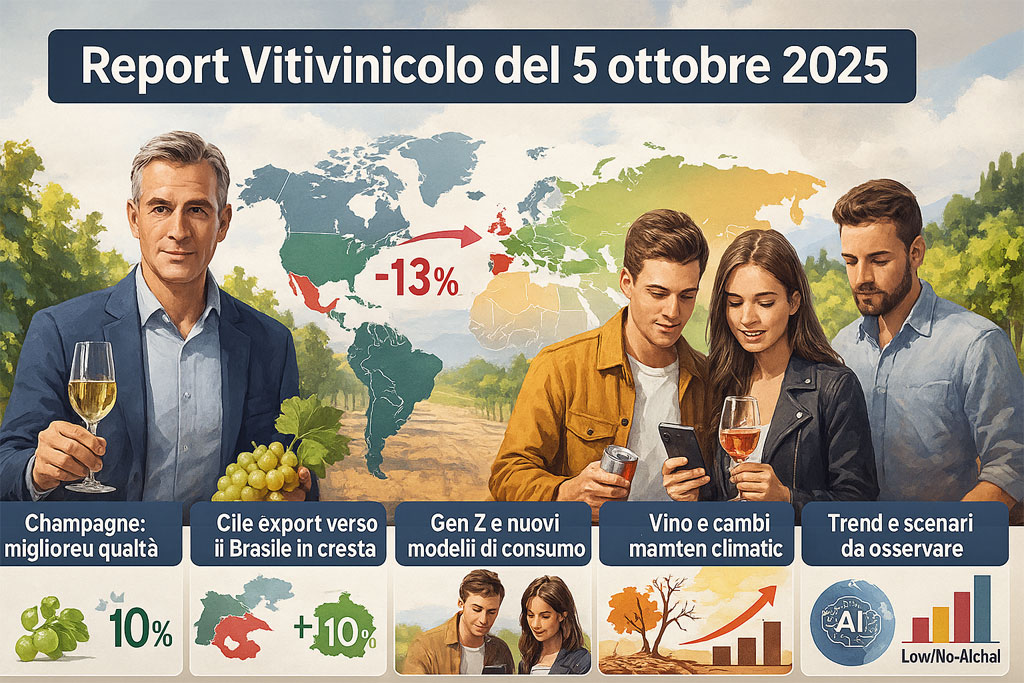
Wine Report of October 5, 2025

with the most relevant elements useful as a basis for a strategic post in the wine sector:

  1. Champagne: Improving quality, but reduced harvest Champagne producers report a 2025 harvest that is 10% smaller than average, but with improved grapes that fuel hopes of a revival in international demand.
  2. Chile shifts exports to Brazil due to US tariffs. Chilean wine exports to the United States decreased by 13% (in value) in the first seven months of 2025, due to the introduction of a 10% tariff. At the same time, sales to Brazil increased by 10%, making it the main market for Chilean wine.
  3. Young people (Gen Z) are rewriting wine consumption. Generation Z is showing growing interest in low-alcohol, natural, sustainable wines, and innovative formats (such as cans and spritzes). The “barrier-free” approach in wine culture is trumping the traditional idea of exclusivity.
  4. Wine and Climate Change: The Structural Challenge A recent article highlights how many historic regions (e.g., Spain) are already precariously exposed to climate stress and how the industry is responding with sustainable practices, resilient grape varieties, altitudinal shifts, circular design, and carbon capture.
  5. Global vineyard values are declining. Due to the decline in global consumption, vineyard values have fallen significantly (up to 30–33%). Areas like Marlborough (NZ) are experiencing the greatest losses, while premium regions like Champagne and some areas of England are better able to withstand the pressure.

Trends and scenarios to keep an eye on

  • AI, Big Data, and Sustainable Wine: A recent study (ArXiv) explores the adoption of Artificial Intelligence for viticulture management, wine production, and food and wine tourism, with impacts on water efficiency, predictive vineyard monitoring, and personalized customer experience. In parallel, another study shows how spectral analysis combined with machine learning models can profile wine origins with over 91% accuracy.
  • Vinitaly.USA / wine2wine in Chicago (5–6 October 2025) The second edition of the forum is held at Chicago’s Navy Pier: 250 Italian exhibiting companies, focus on strategies for the American market, duties, promotion and B2B networking.
  • Structural Weakness in the US Market and DTC Channels. The “State of the US Wine Industry 2025” report notes that consumption growth has stalled, with a combination of demographic factors (the decline of the Boomer generation) and social sensitivity to alcohol negatively impacting it. At the same time, direct-to-consumer (DTC) sales are showing signs of contraction, and US exports in value have fallen by 18% in some quarters.
  • Emerging trends: low- and no-alcohol wines and new markets. The low- and no-alcohol wine segment is expected to grow strongly (over 20% by 2029), and format innovation (ready-to-drink, alcohol-free sparkling wines) is gaining ground. Furthermore, new geographic markets (Asia, Latin America, Northern Europe) are perceived as key opportunities for export diversification, especially in the context of rising tariffs.
  • Alcohol Price Regulations: MUP vs. Volumetric Taxation A recent study models the impact of policies such as the minimum price per alcoholic unit (MUP) in France, finding that such policies would favor small and medium-sized wineries (39% profits), penalizing large producers without altering state revenues.
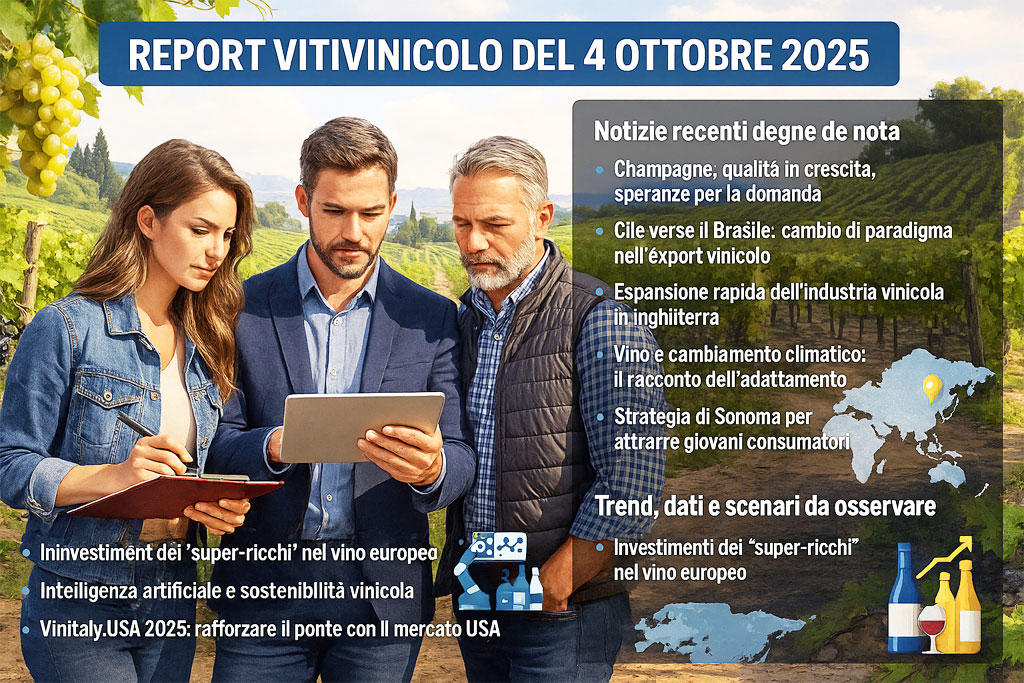

Wine Report of October 4, 2025

Recent news of note, Latest from the world of wine.

Champagne: quality on the rise, hopes for demand

Champagne producers are banking on improved grape quality in 2025, after a difficult season. Despite a 10% decline in the harvest, they are optimistic about the potential leverage effect on demand.

· Chile towards Brazil: paradigm shift in wine exports The new tariffs on Chilean wines destined for the United States have pushed wine exports towards Brazil, which has become the main market, with growth close to 10%.

· Rapid expansion of the English wine industry . Warmer forecasts and earlier ripening have spurred a surge in English vineyard acreage. Production for 2025 has already shown signs of strong dynamism, with more room for still wines in addition to sparkling wines.

· Wine and Climate Change: The Story of Adaptation A recent article explores how traditional regions are already feeling the effects of climate change (extreme temperatures, weather events) and how producers and researchers are responding with more resilient techniques.

Sonoma’s Strategy to Attract Young Consumers In California, some wineries are proposing a 1% tax on tastings and sales to fund marketing initiatives aimed at engaging younger generations. The idea has sparked debate.

In Napa, Heitz Cellar changes its grape sourcing strategy . After 60 years of exclusive contracts with grapes from Martha’s Vineyard, Heitz will open to outside suppliers for the 2025 harvest. This is a strong signal of the changing supply chain logic in the United States.

Trends, data and scenarios to watch

  • Super-rich investing in European wine A Knight Frank survey reports that 46% of the world’s top fortunes are considering moving to Europe with an interest in wine or olive oil properties—conceived as “hybrid” assets, halfway between lifestyle and income.
  • Artificial Intelligence and Wine Sustainability A recent study (preprint) shows how AI is entering the winery, with applications in precision viticulture, system monitoring, irrigation optimization, and personalized wine tourism experiences.
  • Vinitaly.USA 2025: Strengthening the Bridge with the US Market. Vinitaly.USA returns to Chicago on October 5–6, with approximately 250 companies and 1,500 buyers expected. The event will be accompanied by wine2wine, a business forum with thematic sessions on the future of the sector. Italian Exports Suffer / US Tariffs / Trump Duties. Trade tensions between the EU and the United States are impacting European wine: French and Italian companies are already feeling the effects of the tariffs and are seeking compensatory measures.
  • Emerging Phenomena: Wine-Producing Sweden Bucking the trend of many stagnant markets, Sweden is emerging as an “atypical” wine region, with growing investment in the supply chain and local production.
  • Regulatory Perspectives: Minimum Taxes and Minimum Tariffs An academic study assesses the impact of policies such as the introduction of a minimum price per alcoholic unit (MUP) compared to volumetric taxation, highlighting potential effects on the profits of wineries of different sizes.

Wine press review for Friday, October 3, 2025!

News on Italian wine and oenology.

Italian Wineries

  • Cantina di Venosa is investing in wine tourism. Starting in 2027, a new architectural and functional structure will increase visits, direct sales, and business meetings. A €3.4 million investment, including funding from the National Recovery and Resilience Plan (PNRR).
  • Cantina Segreta in Eboli (SA), a journey through flavors created by Andrea Nanna. A restaurant created from an ancient cellar, where tradition and creativity blend in the chef’s cuisine.
  • Castel de Paolis celebrates 40 years in the Castelli Romani area. Official celebrations with artwork and a calendar of events showcasing the Santarelli family’s winemaking excellence.
  • The La Torre winery turns 100. Since 1925, a journey of family and territory, now the fourth generation and certified organic. The heart of the production: the rare Groppello di Mocasina.
  • Cantina Valtidone, Tre Bicchieri 2026 for Arvange Metodo Classico Pas Dosé An internationally prestigious recognition for the pure Pinot Noir sparkling wine.
  • Celli Winery awarded by Gambero Rosso. The Sangiovese Riserva Bertinoro “Bron&Ruseval” wins the Tre Bicchieri 2026 award: a first for this wine and the only Bertinoro wine on the podium.

Italian Wine

  • Prosecco, a superstar in the US, is consolidating its overtaking of Champagne: $531 million, a 178% increase in seven years. It now represents 31% of the value of Italian wine consumption overseas.
  • Etna, a region looking to the future. The Etna Wine Consortium and leading companies are focusing on quality, great reds and new whites, with a strong push towards wine tourism.
  • Walking among the ungrafted vineyards of Carignano in Sulcis. A slow journey through the sea, mines, and ancestral identities of Sardinia, with Carignano del Sulcis as the protagonist.
  • Tre Bicchieri 2026, the best wines of Lombardy. 34 wines awarded by Gambero Rosso, with a section dedicated to rare wines, confirming Lombardy among the leading regions.
  • AGIVI’s voices: sustainability and new entrepreneurial visions. Young producers from North to South share an approach to wine that combines environmental and social impact with quality of life.
  • Argea: ecodesign and biosymbiosis. The group, founded in 2021, presents its 2024 sustainability report and aims to create a new wine industry model.

Italian Oenology

  • The glass makes the difference: Italesse launches the one for Amarone della Valpolicella. The result of the Senses Project, a glass designed with sommeliers, technicians, and oenologists to best enhance the characteristics of the great Veronese red wine.

International

  • Spain: Harvest down 10-15% According to the Spanish Wine Federation, 2025 will bring lower quantities but higher quality.
  • Giorgio Locatelli’s Locanda collection up for auction (London) Over 400 fine lots up for auction at Bonhams, including vertical tastings of Sassicaia and rare bottles of Barolo Monfortino.

Wine Events

  • “Colline ad Arte”: a contemporary art prize in the UNESCO hills of Conegliano and Valdobbiadene. A long-term project that will transform the landscape into an open-air collection.
  • “Vini ad Arte” 2025 in Faenza The Romagna wine region has overcome the consequences of the 2023 flood and is restarting with energy.
  • “Di…Vino, d’Olio e Dintorni” in Nocera Terinese (CZ) On November 8th, a food and wine trail in the ancient village with wines, oils and typical Calabrian dishes.
  • Centenary of the Marino Grape Festival (Rome) A special edition celebrating the 100th anniversary of the historic Castelli Romani festival, famous for its wine fountains.
  • “Between Villages and Cellars” in the province of Siena From October 16th to November 27th, six events in Monteriggioni, San Gimignano, Montepulciano, Montalcino and other Tuscan villages.
  • “Cantine e Trattorie in Cantina” in Romagna From October 21st to December 2nd, four evenings of local cuisine and wines, in “theatre season ticket” format.
  • Concours Mondial de Bruxelles 2025 – Sweet and Fortified Wines Session In Catania, Italy shines with 26 medals, dominated by Sicilian wineries: Ben Ryé 2022, Marsala Lombardo 2011, and Single Barrel di Pellegrino.

This was the wine news for October 3, 2025. We’ll talk to you again tomorrow, again with QUIDQUID – powered by WINEIDEA.IT .

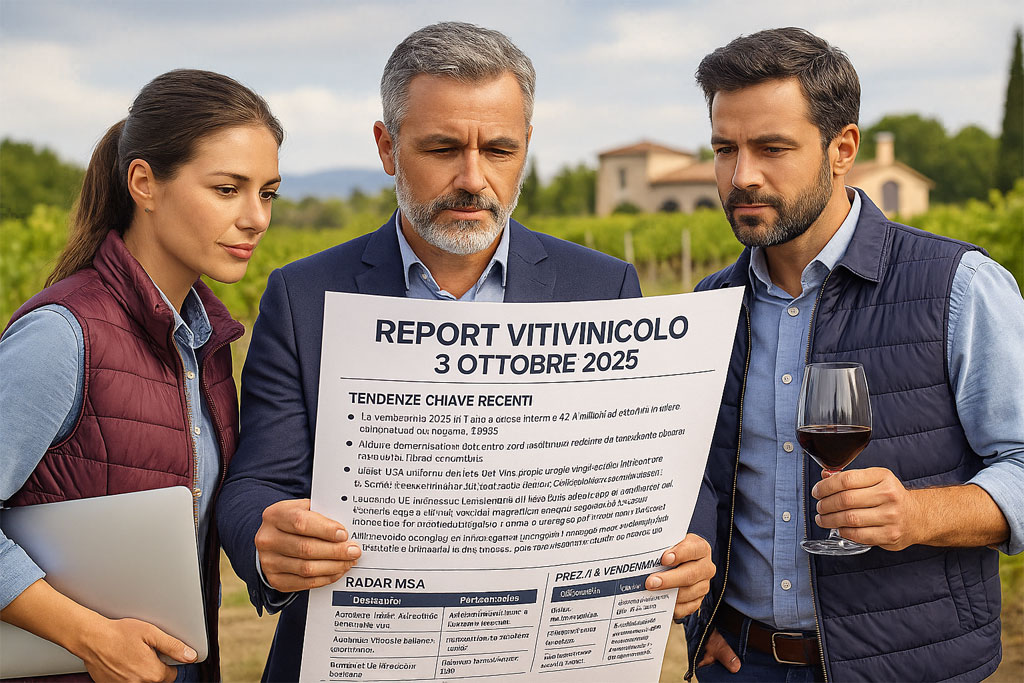
Wine Report of October 3, 2025

with updated useful insights as a basis for the wine/cellar sector:

Recent Key Trends (5–7 points)

  • The 2025 harvest in Italy is expected to be around 47.4 million hectoliters , up 8% compared to 2024, with quality judged to be “excellent / good” (Unione Italiana Vini)
  • Some denominations in central and northern Italy are reporting reduced yields (-10-20%) compared to the previous year, with the desired effect of rebalancing supply and demand.
  • On Italian domestic markets, sales in the large-scale retail channel show 0.7% in value but –2.5% in volume (August 2024-July 2025) — sparkling wines are holding up better than the rest (1.9% value, 2.5% volume)
  • In the first half of 2025, Italian wine exports recorded 1.5% in value but -3% in volume; the greatest difficulties are evident in the United States and Germany
  • The uniform US tariffs of 15% for European wines (which came into force in summer 2025) put strong pressure on the entry and medium segments, in the absence of specific exemptions (valuation of premium wines)
  • The EU-Mercosur agreement, now authorized by the European Commission (to be ratified by the Member States), provides for the progressive elimination of wine duties for Argentina, Brazil, Uruguay and Paraguay, with a potential strategic opening for Italian wine in Latin American markets.
  • Globally, the bulk wine market appears “sluggish”: grape prices are struggling to recover, while stocks are high and demand is weak, penalizing negotiations for bulk and blended wines (Ciatti report September 2025)
  • On the technological horizon, Artificial Intelligence is also gaining ground in sustainable viticulture and wineries, with applications in environmental monitoring, resource management and production process optimisation (study “Artificial Intelligence for Sustainable Wine Industry”, 2025)
  • M&A Radar
Operation / RumorParties involvedValue (if known)Geography / focusSource / date
Accolade Wines and Pernod Ricard Merger → VinarchyAccolade Wines & Pernod Ricardnot communicatedwide-ranging (Australia, New Zealand, South Africa, Spain)official announcement 2025
Italian wine operations in the Mediobanca reportvarious national wineries and operatorsnot available in the main casesItaly“M&A Strategies in Italian Wine: Mediobanca Report 2025”
(Rumor) Italian acquisitions in the US in 2025Italian wineries targeting the USunspecifiedUnited StatesKPMG article “The Italian Presence and M&A in the USA”

Prices & Harvest (mini-box)

Region / varietyGrape price / reported trendNotes on yield / performance vs last year
Italy (national average)Grape prices do not show general increases: the market is “calm” and prices are still uncertain (in September 2025)High cellar inventories: ~36 million hectoliters as of July 31, 2025 (potential drag on prices)
Tuscan denominations (Chianti, Langhe, Barbera)There are no recent public quotations for specific varieties, but some consortia have approved yield reductions to protect value (e.g. Chianti from 75 to 65 quintals/ha).In some areas (Morellino, Montecucco) yields are lower than initial estimates, with healthy grapes and good qualitative balances
International bulk marketBulk wine and grape market prices show weakness and a tendency to stabilize at a low level; general increases are expected only if demand picks up again.Oversupply and high inventories limit negotiations and the ability to obtain better prices.