A network portal of Wine Idea. Discover the world of Wine idea

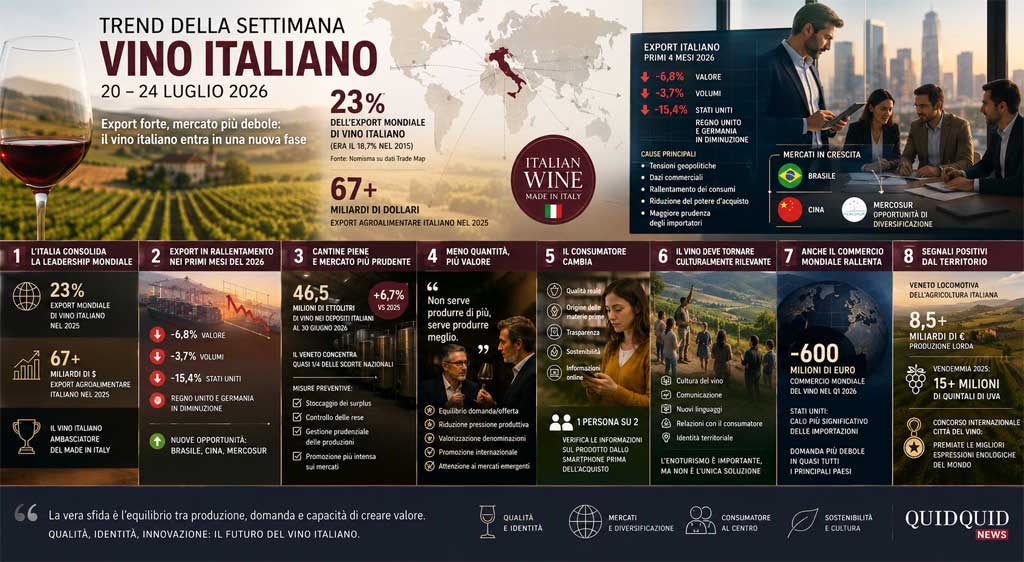
Wine Trends and Performance in Italy – Final Summary – Week 16 – March 20 – 2026

The Italian wine sector is currently undergoing a structural transformation that simultaneously affects production, consumption, international trade, and market models.

The data and analyses released during the week of March 16-20, 2026, confirm that the wine industry is not simply experiencing a cyclical phase, but rather a profound shift in the economic balance that has sustained the sector over the past few decades.

Exports down in 2025: the impact of tariffs and the global slowdown

2025 ended on a negative note for Italian wine exports. According to data from the Italian Wine Union Observatory based on Istat, exports reached 7.78 billion euros , a 3.7% decrease compared to 2024 , equal to approximately 300 million euros , while volumes fell 1.9% to approximately 21 million hectoliters .

The slowdown was primarily driven by tensions in non-EU markets, particularly the United States, the world’s leading market for Italian wine, where sales fell by 9.2% , resulting in a loss of approximately €178 million . In the second half of 2025, the decline was even more pronounced, with peaks approaching 23% and a significant reduction in average prices.

Overall, non-European markets recorded a contraction of -6.4% , while the European Union demonstrated greater stability, with growth of 0.5% driven by Germany, France and the Netherlands.

At a territorial level, the three major Italian wine regions remain dominant:

  • Veneto : 2.9 billion euros (-1.2%)
  • Tuscany : 1.17 billion (-2%)
  • Piedmont : 1.15 billion (-2.2%)

Together they represent over 66% of national exports , confirming the strong geographical concentration of the value of Italian wine in the world.

Global consumption and demand: the market is polarizing

The most significant change, however, concerns demand. Global wine consumption is not simply decreasing: its structure is changing .

The market is polarizing into three large segments:

  1. Large-scale distribution and accessible segment
    It remains relatively stable because it caters to more controlled and price-conscious domestic consumption. In a context of inflation and reduced spending outside the home, many consumers are protecting their daily purchases by choosing more affordable bottles.
  2. Super-premium segment
    Iconic wines with a strong territorial reputation demonstrate strong resilience. Here, wine is purchased as an experience, a gift, or a collectible. Consumption decreases in frequency but maintains its value.
  3. Mid-market range
    This is the segment most exposed to the crisis. Too expensive to be considered everyday consumption and not distinctive enough to be perceived as a premium choice, it is experiencing strong competitive pressure and margin compression.

This dynamic represents one of the main factors of the current overproduction , that is, production exceeding the market’s actual absorption capacity.

Overproduction: From an Agricultural Problem to a Strategic Problem

For many years, the excess wine was managed as a technical or agricultural problem, using tools such as emergency distillations or temporary storage. Today, it’s clear that these solutions are merely stopgap measures.

The key issue is strategic and industrial : part of the supply is no longer aligned with current demand. Continuing to produce large volumes of undistinguished wines aimed at the mid-range market represents one of the riskiest decisions for many companies today.

The market increasingly rewards:

  • territorial identity
  • stylistic recognisability
  • range coherence
  • clarity of positioning

The Prosecco case: bottling to slow down in 2026

Among the most evident signs of the new context is the slowdown of Prosecco DOC , one of the driving forces of Italian exports in recent years.

In the first two months of 2026 , bottling recorded:

  • -19% in January
  • -14% in February

The decline is partly linked to the rush to buy stocks that occurred in 2025 before the introduction of US tariffs, but even analyzing the average of the last four years, the figure remains negative ( -7% ). This signal highlights a phase of readjustment for one of the symbolic products of Italian wine.

International markets: new strategies and investments

In parallel with the slowdown in some emerging markets, such as China – where wine imports decreased by -14.6% in value and -26.7% in volume – some companies continue to invest in building international distribution platforms.

Operations such as Ethica Wines’ expansion into the Chinese market demonstrate how the sector is seeking to strengthen its presence in global markets through more structured and integrated distribution models.

New consumption models: drinkability, moderation and simplicity

The style of wines finding their way onto the market is also changing. Consumers are increasingly seeking:

  • drinkability and freshness
  • more moderate alcohol content
  • gastronomic versatility
  • immediacy of consumption

In a context where people drink less, the ease of returning to purchase becomes a decisive metric.

Young People and Wine: A Cultural Challenge

One of the central themes that emerged in the sector debate concerns the relationship between wine and new generations.

The decline in consumption among young people stems not only from economic factors but also from cultural distance. Wine is often perceived as too complex or elitist, while cocktails and spirits convey conviviality, simplicity, and immediacy.

The challenge for the sector is therefore to change its language and storytelling methods , maintaining the cultural depth of wine but making it more accessible, contemporary and inclusive.

Wine tourism: one of the drivers of growth

In contrast to the slowdown in traditional consumption, wine tourism continues to grow strongly.

In 2025:

  • visitors in structured cellars 16.8%
  • direct sales 21.4%
  • Average booking value: 39.4 euros per adult

More and more wineries consider wine tourism not as an ancillary activity but as a strategic business asset and relationship with the consumer .

Sustainability and regenerative viticulture

Another strategic direction concerns the adoption of more sustainable agricultural models. There is growing interest in regenerative viticulture , which aims not only to reduce environmental impact but also to improve soil fertility, biodiversity, and the resilience of vineyards to climate change through digital technologies and innovative agronomic practices.

Conclusion: a sector entering economic maturity

Italian wine remains a cornerstone of the European agri-food economy and a cultural symbol of Made in Italy. However, the sector is entering a phase of economic maturity similar to that experienced by other premium cultural and consumer goods.

The future will no longer depend on the quantity produced, but on the ability to create value.

In a world that consumes less wine, the producers and territories capable of making every bottle necessary, recognizable, and desirable will win. The challenge is not to fill the market, but to conquer a space within an increasingly aware and selective consumer base.

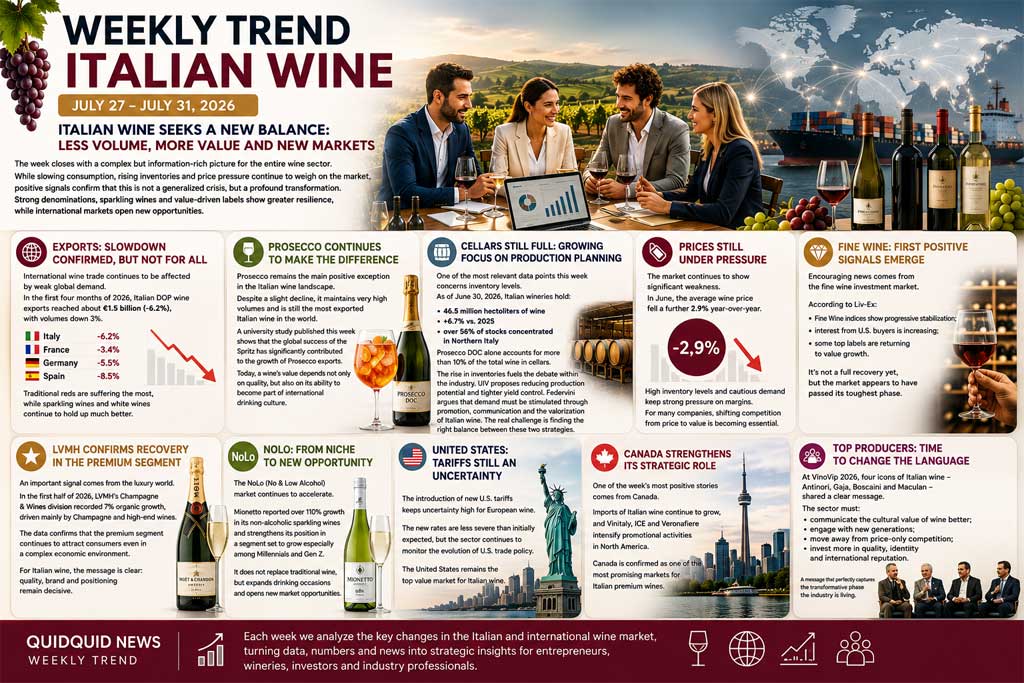
Wine Trends and Performance in Italy. Weekly Summary – March 9-13, 2026

The Italian winemaking system is experiencing a fragile equilibrium, characterized by still-full cellars, declining global consumption, and more unstable international markets.

The sector remains structurally solid, but is entering a new economic cycle in which production flexibility, market diversification, and business model innovation are becoming decisive factors.

Cellars full: the problem is not production but the speed of sales

According to the ICQRF’s Cantina Italia report, in February 2026, Italian cellars held approximately 58.6 million hectoliters of wine , in addition to 6 million hectoliters of must . Compared to 2025, stocks increased by 5.8% , confirming a trend that had already emerged in previous months.

This level of inventory is not due to a particularly abundant harvest: 2025 production stopped at around 44.3 million hectoliters , in line with the previous year. The real critical factor is therefore the slowdown in the rate at which wine is absorbed by the market .

The trend reflects a broader phenomenon: world consumption fell from 276 million hectoliters in 2019 to around 227 million in 2024 , signaling a structural shift in global demand.

Slower consumption and new consumer behaviors

In mature markets—Europe and North America—wine consumption is changing. Among the main factors are:

  • greater attention to moderation and health
  • growing competition from other beverages
  • new social models of consumption
  • generational changes in habits

In the Horeca channel, data from the CDA consortium show a stable but changing market: in 2025, out-of-home beverage sales grew slightly in value (0.66%) , but fell in volume (-0.92%) .

The consumer mix is shifting toward categories perceived as lighter or more experiential. The following are growing:

  • aperitifs and vermouth (9.39% value)
  • energy drink (9.17%)
  • short-term consumption formulas such as aperitifs and lunch breaks.

Traditional evening consumption, on the other hand, tends to lose its centrality.

Exports: the slowdown in the United States weighs on the sector

International trade in Italian wine remains strong but shows signs of slowing.

In 2025, Italian exports closed at 7.7 billion euros , with a decrease of -3.7% compared to 2024 and approximately 300 million euros less .

The main cause is the decline in the US market, the primary commercial outlet for Italian wine. In the United States:

  • overall wine imports decreased by approximately -12% in value
  • Italian exports lost approximately -13.2% , falling to 1.8 billion euros .

Several simultaneous factors were at play:

  • tariffs introduced by the Trump administration
  • devaluation of the dollar
  • reduction of internal consumption
  • process of clearing out stocks accumulated after the pandemic.

To keep prices competitive, many producers have absorbed part of the duties by reducing margins.

New markets and export geographies

The contraction of the United States is pushing Italian wine to seek new trade routes.

In 2025, the markets with the most dynamic signals are:

  • Brazil , the only major market growing in both volume and value
  • South Korea , with increasing wine imports
  • Eastern European countries such as Poland and the Czech Republic
  • emerging markets in Southeast Asia such as Vietnam and Thailand .

Despite these opportunities, many major global markets – China, Japan, the United Kingdom and Switzerland – still saw slowdowns in purchasing.

Strategies for managing surpluses

The issue of inventories brings the question of managing production potential back to the fore.

There are various tools available to the sector:

  • product storage pending better conditions
  • downgrading of wines from denomination to lower categories
  • distillation as an emergency tool
  • uprooting of vineyards to reduce production capacity.

Many consortia, however, underline that the drop in consumption is no longer a temporary phenomenon but a structural trend .

Wine tourism and direct sales: levers of value

In this context, models that bring the producer closer to the consumer become increasingly relevant.

Wine tourism represents one of the most important levers: according to Roberta Garibaldi’s report, for some Italian wineries the tourist experience can generate up to 60% of profits , while for approximately half of the companies it contributes up to 30%.

At the same time, interest in direct online sales (D2C) is growing. In the European market, this method can guarantee margins of up to 70% , compared to the 25–30% of traditional shelf sales.

A sector that needs to become more flexible

The debate currently raging in the wine world converges on one point: the production system must become more flexible.

In a global market characterized by geopolitical volatility, consumption fluctuations and cultural changes, the Italian wine sector will have to:

  • adapt production to demand more quickly
  • diversify markets and sales channels
  • develop integrated models between wine, tourism and experience
  • improve communication towards new consumers.

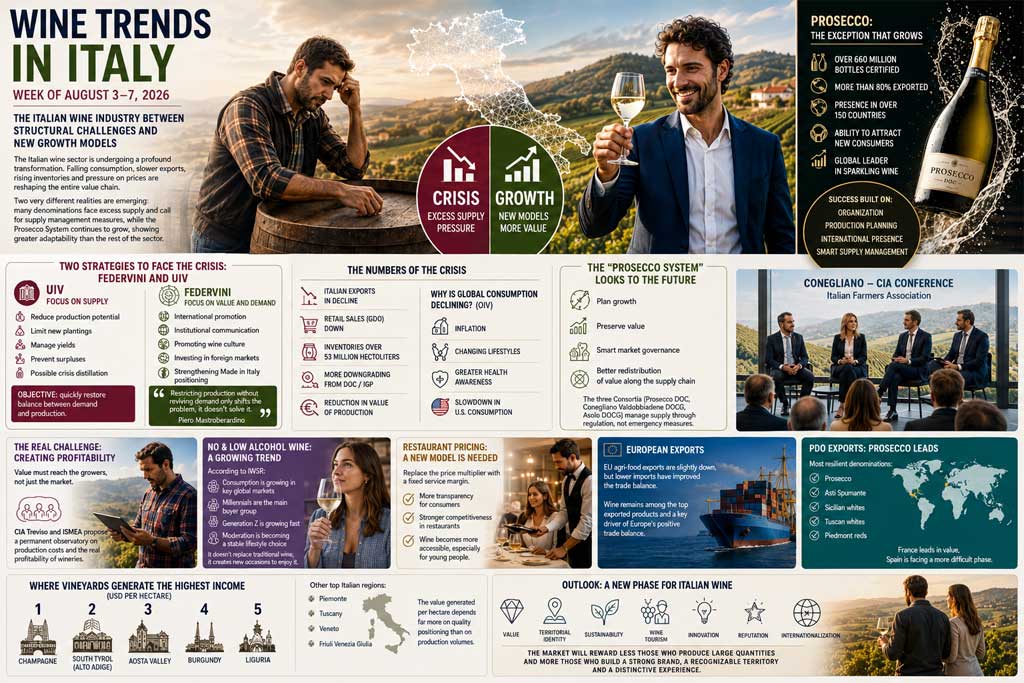
Wine Trends and Market Performance in Italy (Week of March 2–6, 2026)

The first full week of March 2026 portrays an Italian wine sector in a phase of “difficult resilience.” The industry is not collapsing, but it is moving in a fragile balance between structural declines in volumes, pressure on margins, geopolitical and trade uncertainty (tariffs and key export markets), and changing consumption patterns driven by new lifestyles and health awareness.

At the same time, some niches—particularly fine wines and top brands—are showing early signs of recovery, while price competition and consumer selectivity continue to increase.

1) 2025 Financial Results: More Stability Than Growth, Widespread but Limited Declines

Evidence from the sample of wineries analyzed (high-profile companies with aggregated revenues exceeding €2.5 billion) shows that 2025 closed as a complex year of consolidation.

  • 53% of companies: reported stable financial results.
  • Most of the remaining companies: recorded revenue declines mainly between -1% and -5%, with very few cases of slight growth.

However, the sector is coming from a high baseline:

  • 2024 was a record year for exports, reaching €8.1 billion, following several favorable post-Covid years.

The key issue is not only how much is being lost, but how companies are reacting. Many wineries are defending their results through tactical decisions involving:

  • pricing strategies
  • promotions
  • channel mix adjustments
  • tighter control over inventory and sales networks

2) Italy vs Export Markets: More Stability at Home, More Volatility Abroad

The gap between the domestic market and exports remains evident.

Domestic Italian Market

  • 58% report stability
  • 26% report decline
  • 16% report growth

Changes are generally limited (1–3 percentage points), but the signal is clear: the market is stable but lacks strong momentum, and growth remains a minority trend.

Export Markets

  • 42% report stability
  • 37% report decline (sometimes significant, from -3% to -15%)
  • 21% report growth (generally +1% to +3%)

Supporting data confirm a “cool” 2025 market environment:

  • Large-scale retail (GDO): -0.5% in value and -3.1% in volume
  • Exports (first 11 months of 2025): -3.6% in value and -2% in volume

In summary: the domestic market holds up better but does not accelerate, while exports remain more volatile, influenced by external shocks and shifting demand patterns.

3) Expectations for 2026: Operational Realism with Hopes for a Modest Recovery

Expectations for 2026 remain cautious but relatively stable.

  • 70% of companies expect stability or slight recovery
  • 30% fear a further (mild) decline

More specifically:

  • some expect results in line with 2025
  • some foresee a -3% to -5% decrease
  • others anticipate +2% to +4% growth — more a recovery than a boom

The strategic interpretation is clear: 2026 is not a year for inertia.
Performance will depend more than ever on:

  • commercial agility
  • channel management quality
  • price, packaging and format strategy
  • the ability to make brands clear, understandable and desirable

4) Investments: Communication Stable, Sales Strengthened

An important operational signal emerges from the sector: despite pressure on profitability, companies are not massively cutting the functions that drive sales.

  • Marketing & communication:
    • 79% expect stable budgets in 2026 compared with 2025
    • budget cuts exist but are not the norm (generally -5% to -20%)
  • Sales support:
    • no companies expect reductions
    • 37% plan to increase investments, typically around +5%, with peaks up to +10%

In other words, the industry message is clear:
“The market is tough, so we must strengthen our commercial engine and protect brand perception.”

5) Consumption and Drinking Culture: Less Automatic, More Selective (Gen Z and Beyond)

Changes in consumption are not simply a decline—they represent a shift in the grammar of drinking.

  • Overall consumption is decreasing across several countries.
  • Generation Z is not disappearing from the market — it is selecting more carefully.

Drinking is becoming:

  • more occasional
  • more aligned with personal wellbeing and identity
  • more sensitive to authenticity, sustainability and transparency

Interest is growing in:

  • sparkling wines
  • fresh white wines
  • lighter styles that are easier to drink

At the same time, low/no alcohol products are gaining attention, but there is no widespread belief that they will “save volumes.”

A notable divide emerges in the data:

  • 26% of wineries are investing or planning to invest in low/no alcohol products
  • 74% are not considering it (at least for now)

This reflects a sector split between those who see a strategic opportunity and those who fear brand dilution or low margins.

6) Pricing and Restaurants: The Challenge Is How Wine Is Sold

In the Ho.Re.Ca. channel, the challenge is not only fewer customers but also price perception and spending thresholds.

Wine lists become problematic when consumers are more cautious and psychological price limits decrease.

Signs of adaptation are emerging:

  • renewed interest in smaller formats (half bottles)
  • increased sensitivity to promotions and commercial formulas
  • experimentation with new packaging and formats

The strategic challenge here is critical:
transforming the wine list from a barrier into a lever, making it easier for consumers to choose—and easier for them to trade up without feeling overcharged.

7) International Markets: New Attractive Geographies and Trade Shocks

The international environment highlights two key messages.

  1. Increasing focus on intra-European markets

Markets perceived as more attractive in the short term include:

  • Germany
  • The Netherlands
  • Japan

The United States is dropping in priority, mainly due to tariff uncertainty and market volatility.

  1. Mercosur opportunities

The provisional implementation of the EU–Mercosur agreement is viewed positively, especially regarding Brazil, where tariffs historically have been very high:

  • up to 27% on still wines
  • up to 35% on sparkling wines

The operational idea:
today it remains a marginal market, but with growth potential if trade barriers decrease and structured promotion is implemented.

Another contextual signal:
Russia remains a market where Italy is the leading exporter, although volumes have declined compared to 2024, consistent with an overall contraction in imports.

8) Fine Wines: A Small Niche, But a Meaningful Signal

The secondary market for fine wines (Liv-Ex) shows moderately positive signals at the beginning of 2026:

  • main indices show slight growth
  • Italian labels are performing strongly in some top segments

This niche does not rescue the sector as a whole, but it indicates that:

  • brand equity and rarity remain resilient
  • the premium segment may recover earlier than the mainstream market
  • the premium strategy remains valid, provided it is supported by distribution, storytelling and coherent positioning

9) Strategic Implications for Italian Wineries

The picture emerging from the week of March 2–6, 2026 leads to a clear conclusion:
this is not a cycle to wait for—it is a cycle to manage.

Operational priorities emerging from sector data include:

  • Protect margins before volumes: pricing, promotions and formats must be managed as a strategic architecture, not reactive measures.
  • Strengthen sales networks and conversion capability: increased sales budgets highlight where 2026 will be won or lost.
  • Simplify value for consumers: clearer product ranges, consumption occasions, by-the-glass offerings, pairings and formats.
  • Reposition portfolios toward more demanded styles: whites, sparkling wines and freshness; reds more selective and better narrated.
  • Open alternative markets with real strategies: Germany, Northern Europe and urban Asia; Brazil as a strategic option if properly supported.
  • Low/no alcohol: a strategic decision, not a trend. For some wineries it may become an entry channel; for others it conflicts with identity. In both cases, the choice must be clear and deliberate.

Wine: With tariffs, war, and logistics in decline, is Italian wine at risk of default?

“The recently published Nomisma Wine Monitor analysis shows how, understandably, given everything that has happened and is happening in the world, the global wine market in 2025 has shown strong signs of slowing, with a drop of almost 12% in value and a market that has stabilized around 5.5 billion euros,” comments Diego Cusumano, one of the most recognized winemakers in Italy and abroad, and owner of the eponymous company with his brother Alberto.

Producers: “If exports don’t go well, there’s a risk of huge production surpluses.”

According to the report, the United States is at the center of this decline due to tariffs, with a 2.6% decrease in volume and 6.2% in value compared to the previous year. But even looking east, the situation isn’t improving, with China seeing a decline in value of Italian wine by over 15%, and Japan reducing purchases by 2.2% in volume and 1.7% in value. In Europe, the United Kingdom, Italy’s second-largest market, saw total imports decline by approximately 6% in both volume and value, and Switzerland also saw Italian exports decline by approximately 6% in value. Brazil, on the other hand, saw exports grow by 3.5% in volume and 1.9% in value, as did South Korea, where imports grew by 5.3%.

“This new war, which is spreading throughout the Middle East and beyond, represents a further aggravating factor not only for wine exports but for Made in Italy in general ,” explains winemaker Cusumano . ” If tariffs and price increases have caused a significant slowdown, now the threat is the interruption of supply chains, specifically in terms of logistics and transportation. International corridors, due to the war, are significantly narrowing, with the availability of operating carriers dramatically reduced to the real, even minimal, need, which will translate into transportation costs, where possible, much more expensive and therefore uneconomical. On the other hand, let’s also ask ourselves what we should do, already in 2026, with the harvest effectively upon us (end of August), with the probable surpluses due to the sharp slowdown not so much in foreign demand, which remains, but in the possibility of satisfying it logistically. And if we winemakers, for certain types of wine, are slightly lucky since It will age, I wonder what the impact will be on the entire Italian food and wine sector.”

Matteo Lunelli , CEO of the Lunelli group and CEO and president of Ferrari Trento, also agrees with Diego Cusumano . “The war,” the producer claims, ” will certainly have repercussions on the economy as well: it will cause problems in transportation because it compromises strategic routes, it undermines consumer confidence, it will raise energy costs and it will also affect the Middle East and the Emirates, which is a rapidly growing market and also important in general for Italian wine and Made in Italy products.”

Confirmation of the surplus also comes from Lamberto Frescobaldi , president of the Italian Wine Union, who already raised the alarm last July : “We have over 40 million hectoliters of wine in storage, and if the next harvest—or rather, the upcoming one, the UIV president explained—is average with around 50 million hectoliters, we will have approximately 90 million hectoliters of product available by the end of the year. A monstrous supply that risks depressing prices. There’s really nothing to celebrate.”

Style Selector
Select the layout
Choose the theme
Preset colors
No Preset
Select the pattern