A network portal of Wine Idea. Discover the world of Wine idea

Wine Trends in Italy — Week 6–10 October 2025

From the economic situation to operational steps: what’s really happening and how to proceed now.

Trend of Italian and world wines.

Snapshot of the week

  • US administrative stalemate : shutdown halts TTB on COLA and COLA Waivers → delays on labels and halts entry of samples for trade fairs/tastings. Real risk of export promotions being blocked in Italy’s top wine market.
  • Growing tourist demand for family-run wineries : interest from international visitors is booming, led by US Gen Z ; authenticity and a personal welcome are the real drivers.
  • Fine Wine is in a “reset” phase : after the 2020–2022 boom, markets are recovering and becoming more experience-oriented (drinking, not just investing). Italy 100 is more resilient than other regions.
  • Vinitaly.USA (Chicago, October 5–6) : Strong participation from North American companies/consortia and buyers; practical focus on tariffs, trade, and Millennial/GenZ engagement.
  • HNWI migration to the EU : 46% of the super-rich consider relocation and investments in vineyards/olive groves as “hybrid” assets (lifestyle value); Tuscany tops the list among non-urbanites.
  • Italy–USA economic relationship : Italian wine generates ~$19 billion in impact on the US economy (out of a total of $144.4 billion), with a 38% share of foreign wines consumed.
  • EU structural overproduction : 13% of consumption in 2024/25, in line with the 20-year average → pressure on inventories/prices.
  • European consumption : 71% of consumers are cutting back on alcohol; 25% of 25-35 year-olds don’t buy at all. Low-/no-alcohol, functional, and non-alcoholic beverages are on the rise.
  • Italy at a crossroads : US tariffs at 15% (devaluation), declining domestic consumption, and high inventories; structural measures and innovation (including AI ) are needed.

Key insights

1) US Shutdown: immediate impacts on exports and promotion

  • COLA standard : manageable impact (long-term planning).
  • COLA Waivers : high criticality → impossible to ship samples for fairs/masterclasses.
  • Ripple effect on consortia and companies with promotional activities scheduled in the USA.

2) Wine tourism: the (global) choice goes to the family

  • Winery visits: top experiences for the US/UK/DE; family-run wineries beat out brand-name ones.
  • Gen Z USA : 82% want to visit; authenticity and hospitality = competitive advantage.
  • Next step: digital, multichannel promotion, AI for visibility and CRM; the role of specialized wine tourism consultants (revenue, omnichannel sales) to scale without losing brand identity.

3) Fine Wine: From the Covid bubble to the return to the glass

  • World production in 2024 at its lowest since 1961; consumption down to 214 mhl .
  • Indices: Liv-ex 100 −4.9% YTD (Jun ’25); Fine Wine 50 −7.4% YTD; Burgundy 150 −30.2% in 2 years; Italy 100 −3.0% YTD but 12.2% at 5 years.
  • New focus: ready-to-drink, mature wines , and attention to storage costs. The focus shifts back to provenance, authenticity, and drinkability .

4) Vinitaly.USA Chicago: strategic presence

  • 250 exhibitors, a strong presence of consortia and top brands; >1,500 operators expected, with over 2,200 in the final estimates.
  • Program: masterclass, talks, and wine2wine Business Forum ; focus on tariffs, North America, and wine tourism .
  • Sentiment: Fewer tariff scares at meetings, greater openness of importers/distributors to sales programs and new projects.

5) Olive grove-vineyard capital: Europe attracts HNWIs

  • Push for premium agricultural assets (organic/terroir, integrated experiences).
  • Hot areas for Italy: Tuscany, Piedmont, Puglia (wine and oil).
  • “Hybrid” returns: lifestyle income and asset appreciation.

6) Italy–USA: economic symbiosis

  • Italian exports 2024: $2.2–2.3 billion ; US share ~ 24% of Italian wine export value.
  • Every $1 spent on EU/IT wine → $4.5 in value in the US economy.
  • 15% tariffs starting in August: pressure on prices and mix; economic diplomacy and channel strategies needed.

7) EU supply and falling demand: the structural issue

  • EU self-sufficiency 113.6% : chronic surplus → inventories and cash flow under stress.
  • In Europe, alcoholic beverages −1.8% vs. non-alcoholic beverages 5.1%; no/low-fat and functional beverages ~60% of the beverage category.

8) Italy: critical issues and levers of sectoral policy

  • 30,000 processing companies, 250,000 agricultural companies; €16 billion turnover; world’s leading producer.
  • Operational proposals (safeguard package):
    • Revision of the Consolidated Law : yields per hectare, alignment of yields with five-year data, management of surpluses, simplification of controls, labelling (ingredients & nutritional information).
    • Planting/replanting permits : suspension of fines for unused permits (pre-Jan 2025); validity extended to 8 years .
    • Anti-tariff measures : temporary compensation for sub-marginal profits; proposed reduced VAT on wine served with meals in restaurants to stimulate domestic demand.
    • Finance & Operations : Business unit lease; joint venture/newco for technologies and new markets (e.g., dealcoholized products); revolving lien on inventory for liquidity.
    • End-to-end Artificial Intelligence : vineyard (targeted dosages), winery (fermentations/blends), marketing (segmentation/CRM), sales (dynamic pricing), supply (demand forecasting).

What to do now (essential playbook for wineries and consortia)

  1. Mitigating the US Shutdown
    • Reschedule your export promotion calendar: move activities requiring COLA Waivers to alternative markets in the next 6–8 weeks.
    • Prepare a documentation pipeline ready for TTB reopening; maintain standard COLAs in progress (even if not reviewed).
    • Activate B2B digital tastings , domestic shipments via importers with stock already cleared through customs.
  2. Portfolio repositioning
    • Increase the white/sparkling/rosé mix (GenZ hookup & multi-cuisine pairing).
    • For reds, focus on ready- to-drink vintages ; storytelling on origin and sustainability .
    • Introduce a no/low test line on 1–2 SKUs in selective large-scale retail or DTC.
  3. Wine tourism as a marginal channel
    • Family-Hosted format with digital booking, dynamic ticketing, and add-ons (vertical, food pairing, olive grove tour).
    • CRM with lead magnets (photo tours, home recipes, playlists) and automations (welcome → cross-sell → wine club subscription).
  4. North American exports, beyond tariffs
    • Net Pricing : Protect top placements with value-adds (bundles, library releases, magnums).
    • Channels : Strengthens specialized e-retail, clubs, and premium Italian restaurants; serves as a buffer in Canada and Mexico .
  5. Finance and liquidity
    • Activates a revolving lien on slow-moving inventory; evaluates a joint venture for third-party dealcoholization/bottling plants.
    • Review delivery/yield contracts to align production with actual demand.
  6. AI & Operational Data
    • Vineyard: sensors/vision algorithms for targeted treatments (less input, higher quality).
    • Winery: Predictive fermentation models; blends assisted by a human validation panel.
    • Go-to-market: elastic pricing by market/segment; look-alike campaigns targeting GenZ/Millennial audiences.

Conclusion

2025 marks an active selection process : less dispersion, more focus on high-margin markets/channels and authentic experiences. Amid tariffs, shutdowns, and shifting demand , the winners are wineries capable of three key moves: diversifying , rethinking their portfolio (including low/no), and monetizing wine tourism with digital and AI. Italian wine leadership begins here: consistent quality, authentic storytelling, and financial discipline. The rest is just background noise.
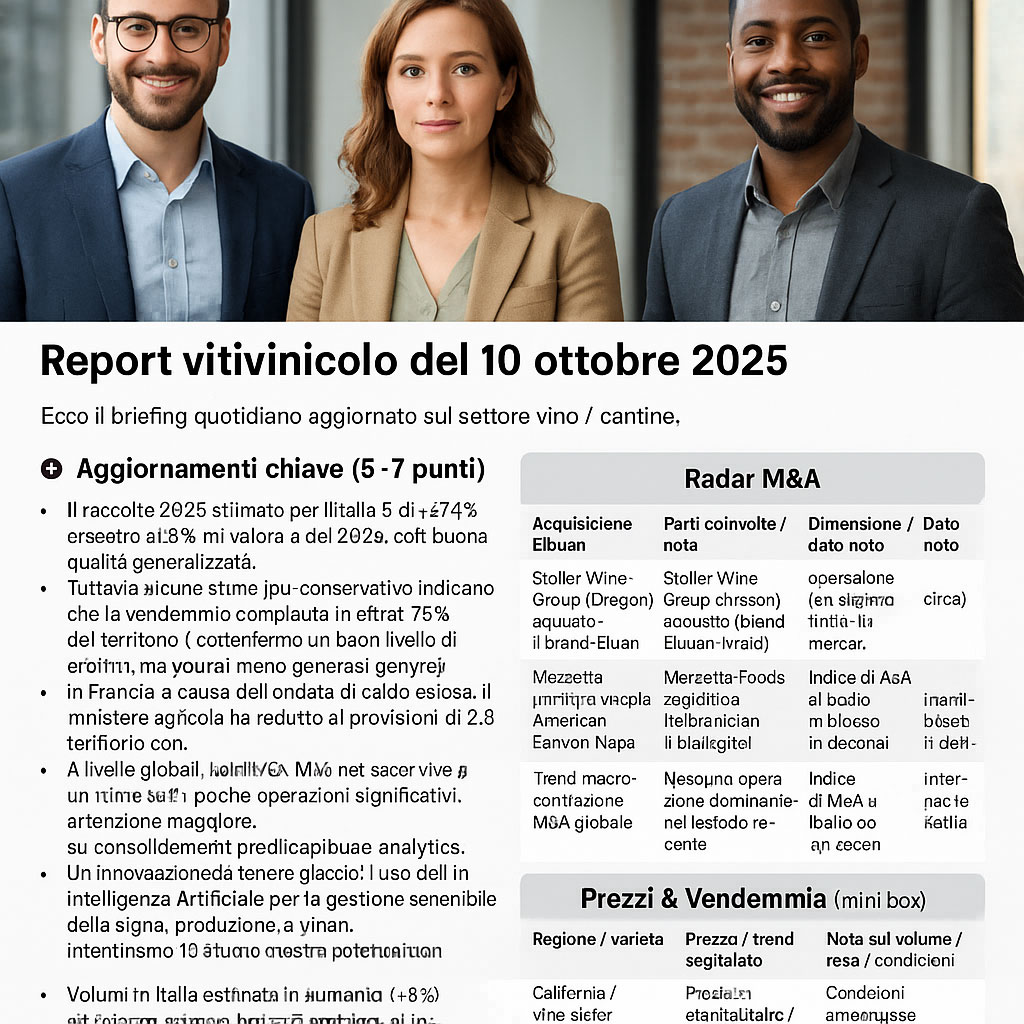
Wine Report of October 10, 2025

Here’s the updated daily briefing on the wine/winery sector, with recent data and strategic insights.

Key Updates (5–7 points)

  • The estimated 2025 harvest for Italy is ~47.4 million hectoliters, 8% compared to 2024, with good overall quality.
  • However, some more conservative estimates indicate that the harvest completed in over 75% of the territory (in progress) could bring in ~44 million hectolitres, confirming a good quality level but less generous volumes than expected.
  • In France, due to the summer heatwave, the Ministry of Agriculture has reduced its 2025 production forecast to ~36 million hectoliters, −1% year-on-year and well below the five-year average.
  • The California bulk wine market is reporting “flat/weak” prices due to slowing sales and competition between coastal and inland areas.
  • Italian wine exports grew in the first months of 2025: exports exceeded €2.8 billion in the period considered.
  • Globally, M&A activity in the wine sector is experiencing a “time out”: few significant transactions, greater focus on selective consolidations.
  • An innovation to watch: the use of Artificial Intelligence for sustainable vineyard management, production, and wine tourism. The study highlights potential in predictive analytics, irrigation optimization, and personalized customer experience.

M&A Radar

Deal / RumorParties involved / notesSize / Known dataGeography / focalitySource / date
Elouan Acquisition (Oregon Pinot Noir)Stoller Wine Group (Oregon) Acquires Elouan Brand from Copper Caneoperation in the finished segment, volume from a well-known brand in the US marketUSA / Oregon
Purchase of American Canyon Winery, NapaMezzetta Foods Acquires Winery from Cartlidge & Browne~116,000 ft² (approximately)California / USA
Macro Trend: Global M&A ContractionNo dominant operations in recent timesM&A index at lowest level in decadesInternational / wine & agribusiness sector

Prices & Harvest (mini box)

Region / varietyPrice / trend reportedNote on volume / yield / climatic conditions
California / bulk winePrices stagnant / weak compared to previous monthsCoastal competitors hold margin; interior suffers oversupply
Spain / generic white wines (ex-cellar)€0.45-€0.50/l approximately (stable price)The “must / sulphate must” market shows greater fluidity
Tuscany (Italy)Estimated reduction in regional production: from 2.7 to 2.4 million hl in 2025Favorable climate, balanced ripening, quality judged to be “excellent / very good”
Italy overallEstimated harvest 47.4 million hl (but revised to ~44 million)>75% harvest already picked, moderate night conditions support balanced acidity

Trend vs last year / careful notes:

  • Volumes in Italy estimated to increase (8%) on some estimates but with more cautious downward revisions.
  • In France, a physiological decline due to previous thermal stress and drought: some areas (Bordeaux, Languedoc) are in decline.
  • Summer weather conditions (heat and drought) continue to influence yields and quality in many European countries.
  • The bulk wine market is showing signs of price compression, especially in less distinctive regions.

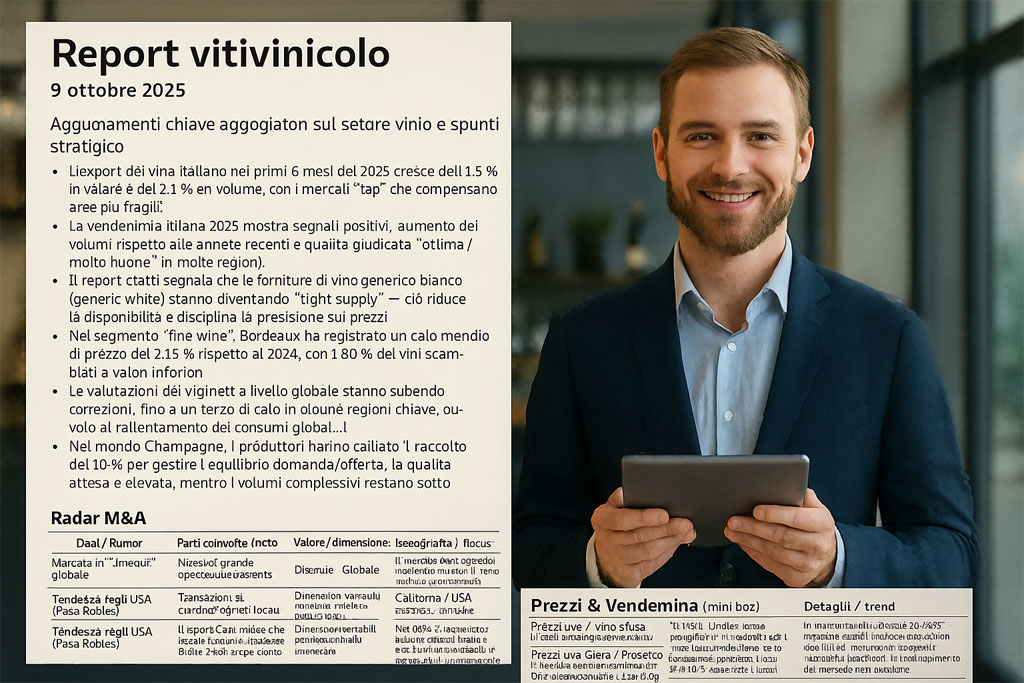
Wine Report of October 9, 2025

Here’s the updated daily briefing on the wine/winery sector, with recent data and strategic insights.

Key Updates (5-7 points)

  • In the first six months of 2025, Italian wine exports grew by 1.5% in value and 2.1% in volume , with top markets compensating for more fragile areas.
  • The 2025 Italian harvest shows positive signs: increased volumes compared to recent years and quality judged “excellent/very good” in many regions.
  • The Ciatti report notes that supplies of generic white wine are becoming “tight supply” — this reduces availability and regulates price pressure.
  • In the “fine wine” segment, Bordeaux recorded an average price drop of 7.15% compared to 2024, with 80% of wines trading at lower values.
  • Global vineyard valuations are undergoing corrections: up to a third lower in some key regions, due to the slowdown in global consumption.
  • In the Champagne world, producers have cut the harvest by 10% to manage the supply/demand balance: the expected quality is high, while overall volumes remain under pressure.
  • Innovation in Focus: A recent study analyzes the use of Artificial Intelligence in viticulture, production, and wine tourism to improve sustainability, efficiency, and experience personalization.

Prices & Harvest

ElementDetails / trends
Grape / bulk wine pricesIn Italy, the ISMEA Index reports an average 1% for wines produced in the 2024/25 campaign; divergent variations: table wines 4%, DOC‑DOCG reds –2%.
Glera/Prosecco grape pricesProsecco DOC certified Glera grapes are traded at ~€1.15/kg versus ~€0.40/kg for “generic” grapes — a substantial difference.
Availability / ScarcityThe Ciatti report indicates that generic whites, Sauvignon Blanc, Pinot Grigio are becoming “tight supply” — some suppliers are sold out by 2025.
Yields, times and climatic notesThe 2025 harvest started early in many Italian regions (according to AVITO) with accelerated ripening, but also with phytosanitary risks for sensitive varieties.
Stocks / saturationStocks at the 2024/25 closing date are stable year-on-year (Cantina Italia), but the new harvest will exert pressure if market absorption does not accelerate.

M&A Radar

Market in global “timeout”No major recent headline operations detectedGlobalThe agricultural/wine M&A market records the lowest number of announced deals in over 20 years.
Trend in the USA (Paso Robles)Local winery/vineyard transactionsVariable size, careful financial scrutinyCalifornia / USASales in Paso Robles are expected in 2025 with more selective buyers and financing constraints.


Wine press review for Wednesday, October 8, 2025!

News on Italian wine and oenology.

organized by thematic areas.


ITALIAN WINERIES

Pasqua Vini arrives in Pantelleria and acquires Carole Bouquet’s winery. Pasqua Vini, a historic Veronese company celebrating 100 years of business, has acquired 70% of the Sangue d’Oro winery, founded twenty years ago by French actress Carole Bouquet. This acquisition sheds new light on the island of Pantelleria, a UNESCO World Heritage site and the birthplace of the famous Zibibbo wine.

Mesa Winery: Gavino Sanna’s dream that has given a new voice to Carignano del Sulcis. A project born in 2004 to showcase Sardinia and Mediterranean conviviality. Gavino Sanna has made his “Mesa”—Sardinian for table—a symbol of hospitality and affordable yet high-quality wine.

Cinti Grassano: The Santoro Cave-Cellar Reopens. On Saturday, October 11th, the historic Santoro cellar-museum will open in Grassano (MT), restored and returned to the community. Professor Giuseppe Santoro’s original instruments will become an educational resource for the new generations.

Suavia: 2025 harvest marked by terroir, technique, and talent. A challenging yet consistent year for Suavia, an icon of Soave. The Tessari sisters describe a harvest of balance and authenticity, the fruit of the resilience of the hillside vineyards.

ITALIAN WINE AND NATIONAL OENOLOGY

Tre Bicchieri 2026 and Cinque Grappoli: Lazio surprises Eleven Gambero Rosso Tre Bicchieri and twenty-eight Bibenda Cinque Grappoli consecrate Lazio as the new frontier of Italian wine, with Malvasia del Lazio and Cesanese the absolute protagonists.

Wine tourism: Tuscany, the capital of wine lovers. With its experiential formats and strong territorial identity, Tuscany leads the national wine tourism scene. The model, launched 32 years ago by Donatella Cinelli Colombini, continues to generate value and beauty.

“SOS Marzemino”: Vallagarina defends its iconic grape. Trentino producers and institutions unite to promote Marzemino, the star of the “La Vigna Eccellente” (Excellent Vineyard) event. The grape remains an emblem of territorial identity and quality.

“Barolo en Primeur” 2025: 4,000 liters of Barolo up for auction for social causes. The international charity auction returns to Grinzane Cavour Castle on October 24th. Fourteen barrels of Gustava Barolo will be auctioned to support over 70 social and cultural projects.

Wine List Italia 2025: the “perfect” wine list. Presented at Milan Wine Week, the guide, authored by 100 sommeliers, showcases 1,000 iconic labels. Highlights include 842 Italian wineries and a palate-first view of fine dining.

Edoardo Freddi: “Tariffs shouldn’t scare us, we need to focus on quality and brand identity.” The CEO of Edoardo Freddi International urges us to view US tariffs as a temporary measure: Italian wine must respond by investing in value and distribution.

WINE AND INTERNATIONAL OENOLOGY

Italian wine is strategic for the US economy. Italy remains a key partner for the American market, with $2.2 billion in exports in 2024 and a total impact of $19 billion on the US wine industry. The topic of tariffs was a central theme at the “wine2wine Business Forum” in Chicago.

Vinitaly.USA 2025: Sardinia’s success in Chicago. The Sardinia Collective won over buyers and distributors at Navy Pier, with 18 wineries present and a climate of optimism for Italian wine overseas.

Castel-Vins Group Acquires Tannico from Campari and Moët Hennessy The Italian e-commerce platform joins the French giant Castel-Vins, which aims to strengthen its direct connection with consumers and consolidate its presence in Europe.

Putin and Luxury Wine: The Italian Winemaker Behind the Krinitsa Winery An investigation by The Insider reveals the financial backstory of the $330 million Russian presidential winery, run at a loss in the millions and led by an Italian winemaker.

US Shutdown: The American Wine Industry Stalled. The political battle over the federal budget is stalling key agencies for the wine industry. California, the driving force of American wine, is reporting the economic damage.

Wine overproduction in the EU: 13% in 2024/2025, in line with the historical average. According to the American Association of Wine Economists, Europe consistently produces more wine than it consumes. This structural phenomenon also affects Italy, France, and Spain.

VinNatur Paris 2025: Natural wines arrive in the City of Light. Ninety producers from seven countries and five technical masterclasses at 116 rue de Turenne. The Italian association’s Parisian debut marks an international breakthrough for natural wine.

WINE EVENTS

Hostaria Verona: Three Days of Wine and Culture From October 17th to 19th, the 11th edition transforms Verona into a grand collective toast with 350 wines and the theme “Where Wine and Culture Meet.”

The Harvest on Via Monte Napoleone: the Quadrilatero turns ruby red. From October 6th to 12th, Milan celebrates the synergy between wine, fashion, and haute cuisine. Boutiques, restaurants, and hotels host tastings and themed installations, including “La Tela del Mosto” by Vincenzo Dascanio.

Barolo en Primeur and the Truffle Auction: Charity Takes Center Stage in the Langhe. From Piedmont to Hong Kong, wine puts itself at the service of philanthropy in a double international event.

RULES AND TERRITORY

Agricultural land: no need to declare IMU changes. The Court of Cassation (ruling no. 26291/2025) establishes that the change in classification to building area is known to the Municipality and does not require a declaration by the taxpayer.

In closing: This is the wine press review for Wednesday, October 8, 2025, curated by QUIDQUID and brought to you by WineIdea.it . The vine continues to tell the world, one story at a time.

Style Selector
Select the layout
Choose the theme
Preset colors
No Preset
Select the pattern