A network portal of Wine Idea. Discover the world of Wine idea

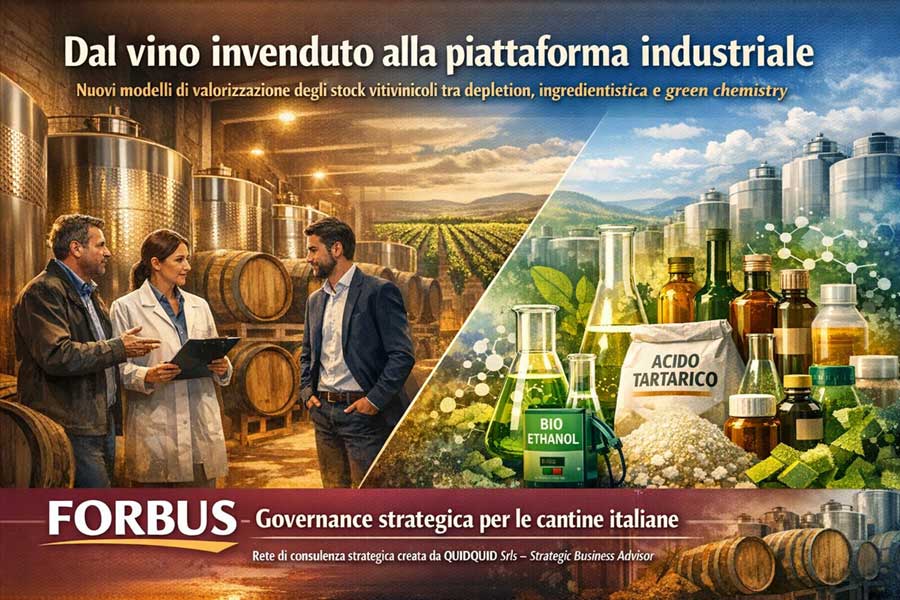
Strategic Analysis – From Unsold Wine to Industrial Platform (forbus)

New models for valorizing wine stocks: depletion, ingredients, and green chemistry.

From unsold wine to the industrial platform.

FORBUS – Strategic Governance for Italian Wineries
Strategic consulting network created by QUIDQUID Srls – Strategic Business Advisor

In wine there comes a point when stock stops being an asset and becomes pressure.
Ten million hectoliters sitting in the cellar aren’t a reserve: they’re a financial cost, a health risk, and a devaluation of assets.

But they can also be something else.

If managed with an industrial logic, those volumes become a platform of products, ingredients, and supply chains capable of generating value outside the traditional wine perimeter.

Because today the market no longer rewards “wine itself”.
It rewards specific functions: drinkability, serviceability, low alcohol content, sustainability, ingredients, industrial stability.
Wine is no longer just a bottle with a poetic label. It is an agricultural raw material with high chemical and functional content.

From this awareness a new strategy is born: managing wine as a noble biomass.

From wine to the product portfolio

Part of the stock can still be valorized by remaining in the beverage orbit, but with industrial logic.

The fastest solutions concern private label wines for large-scale European distribution, bag-in-boxes and lightweight formats, which allow for rapid rotation and immediate liquidity.

The bases for sparkling and semi-sparkling wines transform low-alcohol technical wines into cuvées for bubbles, one of the few segments still dynamic on international markets.

Dealcoholized and low-alcohol wines today represent the true “second life” of European wine. Demand is growing in Northern Europe, Canada, the United States, and Asia, while the supply of technical raw materials remains insufficient.

Finally, the RTD and mixology channel opens up to the world of industrial beverages: ready-to-drink spritzers, wine-based cocktails, and premium sangria. In this segment, what matters is not names or storytelling, but stability, alcohol content, color, and continuity of supply.

These solutions allow you to quickly reduce inventory.
But the real strategic leap occurs when we definitively exit the wine and spirits sector.

Wine as a “noble chemical broth”

Chemically, wine is an extraordinary mixture: structured water, alcohol, organic acids, polyphenols, residual sugars, aromas, mineral salts.

If we stop calling it wine and start calling it organic feedstock, a huge industrial ecosystem opens up: ingredients, cosmetics, nutraceuticals, pharmaceuticals, food processing, green chemistry.

There are at least seven main supply chains active today.

Tartaric acid and tartaric salts

Wine is the world’s leading natural source of tartaric acid.
Food additives, pharmaceuticals, fine chemicals, and green stabilizers represent a structural demand with stable prices and multi-year contracts.

Polyphenols and antioxidants

Resveratrol, flavonoids, and catechins are extracted from red wines for use in anti-aging cosmetics, supplements, and functional beverages.
Here the price is not per liter but per kilogram: one of the few cases in which an unsold wine becomes a premium ingredient.

Bioethanol and green chemistry

Renewable fuels, solvents, detergents, medical disinfectants.
Low unit margin, but the ability to absorb enormous volumes and guarantee constant flows.

Industrial vinegar and organic acids

Food processing, preserves, ready-to-eat products, and sauces.
Simple technology, stable market, massive uptake.

Natural flavors and aromatic waters

Premium soft drinks, iced teas, kombucha, natural perfumes.
The industry is moving away from synthetic flavors in favor of certified natural sources.

Fertilizers and biostimulants

Real circular economy: liquid fertilizers, fermented substrates, soil conditioners for intensive and organic agriculture.

Biomaterials and bioplastics

Natural resins, green solvents, additives for paper and fabrics.
Large European chemical groups enter here with multi-year agreements.

The industrial model: “empty warehouse, create business unit”

The real turning point isn’t choosing a product. It’s designing industrial architecture.

The most effective model today is the twin-engine one.

Engine 1 – Depletion (0–24 months)

Objective: drain volumes, generate cash, reduce risk.

Bioethanol and technical alcohol, industrial vinegar, fertilizers, and biogas allow for rapid inventory reduction, reduced health risks, and restored cash flows.

Here we are looking for speed, not margin.

Engine 2 – Valorization (12–60 months)

Objective: to create a new high-value industrial division.

The three strategic business units are:

  • antioxidant ingredients and polyphenols,
  • tartaric acid and tartaric salts,
  • natural aromas and flavours.

The winning model is the selective joint venture: the manufacturer supplies volumes and guarantees continuity, while the industrial partner invests in facilities, certifications, and customers.

The result is a radical transformation of the economic profile: no longer selling wine at a few cents a liter, but the creation of industrial participations.

From cellar to agricultural refinery

This isn’t a sales crisis. It’s a model crisis.

With ten million hectolitres there is no need to look for marginal alternative products.
We need to build a platform for the industrial valorization of wine, as already happens for sugar, corn and sugar cane.

Looking ahead, a “Bio-Ingredients & Green Chemistry” division could become worth more than the winery itself in just a few years.

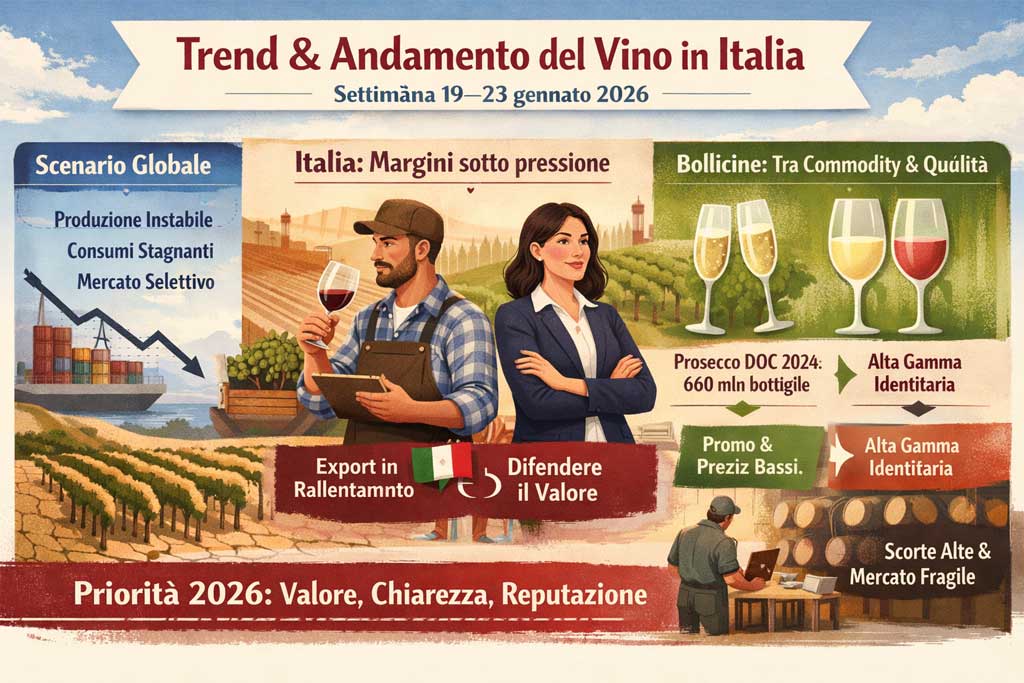
Wine Trends & Performance in Italy – Week 19–23 January 2026

2026 opens as a year of readjustment rather than growth: stagnant consumption, pressure on inventories.

agricultural volatility and a competition that is not won by “making more wine,” but by making more legible, more coherent, and more defensible wine in terms of price and reputation.

1) Global scenario: unstable production, stagnant consumption, selective market

After a phase marked by climate shocks and no longer expansive demand, the sector is entering a new “normality”:

  • 2024 world harvest : the lowest since 1961 (225.8 million hl worldwide).
  • 2025 : slight recovery, but without a return to historical averages.
  • Extreme weather becomes the new constant , with a structural effect: relative scarcity and production fluctuations as the hallmark of the next two years.
  • Consumption : IWRS data indicates zero growth in alcoholic beverages (volume and value) for 2026. Wine is part of this trend: the “tide” is no longer rising, so it’s not dragging everyone along.

Direct consequence: market share is not gained through industry inertia, but through commercial precision and a “clear” proposal to the consumer.

2) Italy: solid production base, but market fragility and margins to be protected

Italy remains strong in fundamentals, but growth is not automatic.

  • 2025 harvest Italy : ~ 47.4 million hl , with good quality level.
  • Exports: Italy maintains the world record in volume and one of the highest values (over 8 billion euros ), but with a less “easy” dynamic:
    • USA (first outlet) slowing down.
    • Germany and Canada are more regular in supporting flows.

Key message: in 2026, the priority is to defend margins and positioning , not to chase volumes at any price.

3) Bubbles: the engine that continues to push, but with a clear polarization

In the calm sea of global stagnation, bubbles remain the most dynamic segment, but the rules of the game are changing.

  • Prosecco DOC (2024) : 660 million bottles , estimated value 3.6 billion euros .
  • The category is polarized :
    1. Promotional offer (price pressure, commodity risk).
    2. Identity cuvées : parcels, maturation times, more precise agronomy, recognizable styles.

The most promising direction is the second: specificity and recognisability, i.e. sustainable value.

In parallel:

  • Franciacorta and Trentodoc consolidate their reputation thanks to a key driver: the demand for authenticity, transparency, and process (not just “brand”).

4) Contemporary whites and technical rosé: Italy has a natural competitive advantage

Outside the world of sparkling wine, two areas emerge where Italy “speaks the language” of the 2026 consumer:

“Contemporary” whites

Clear, saline, agile wines, with moderate alcohol content and fine textures: perfect for a more balanced and gastronomic drinking culture.
Examples cited: Verdicchio, Pinot Bianco, Fiano, Falanghina , Alto Adige and Friulian blends.

New generation Rosé

No longer “seasonal”, but gastronomic and long-lived , with an increasingly precise technical profile.
Examples: Chiaretto, Cerasuolo d’Abruzzo, Sicilian rosés .

In short: the winner is the one who produces usable , modern, coherent and easily described wines (even in international contexts).

5) Agricultural side: falling grape prices, high stocks, risk of discrepancies between denominations

Here the situation becomes more difficult and more strategic.

  • In 2025, grape prices are expected to plummet in many areas (up to 40% in some areas), with a knock-on effect on agricultural income and the perception of value.
  • A gap opens up:
    • Names capable of controlling the offer and valorising it (communication policies).
    • Areas most exposed to volatility and “volume alone”.

The lesson is brutal but true: volume without narration generates no value .

Stocks: the issue that weighs on everything

“Cantina Italia / ICQRF” data updated as of 12/31/2025 :

  • 59.5 million hl of wine in stock
  • 7.7 million hl of must
  • 2.8 million hl of new wine in fermentation
    In one year: wine 4.4% , must 16.8% , fermenting wine 32.3% .

The picture depicts a system that must dispose of and realign production and demand. Prosecco appears less worrisome in terms of sales potential; the situation is more critical for several “firm” denominations, where sales are not immediate.

6) Communication and “consumer culture”: the counter-offensive as a market lever

In this context, an industrial as well as cultural theme takes shape: how do we talk about wine in the health/sober era?

Sandro Veronesi (Oniverse/Signorvino/Oniwines) proposes a clear line:

  • wine is in a normal phase (supply > demand) and “now it needs to be sold”;
  • What is needed is joint work and communication that distinguishes moderate and convivial consumption, with scientific and cultural foundations, avoiding indiscriminate demonization.

This is a key point: in 2026, simply making a product well isn’t enough; we also need to legitimize its role (food, conviviality, Mediterranean style) in a credible and responsible way.

7) No/Low alcohol: from curiosity to laboratory (and opportunity)

No/low-alcohol is no longer a “trendy corner”: it is a laboratory where experiments are carried out to intercept new behaviors.

  • Forecast: Average annual growth 7–9% until 2026 .
  • Most favorable soil: aromatic and sparkling wines.
  • Real challenge: maintaining sensory integrity and texture, protecting the qualitative perception.

For many wineries it could become a parallel (not replacement) line to cover consumption opportunities that are currently “lost”.

8) Policies and finance: CMO Wine Investments 2026–2027 (AGEA)

On an operational level, this provides a concrete benchmark for those who want to invest in competitiveness and structure.

  • AGEA publishes instructions for the CMO Wine – Investment Intervention 2026/2027 .
  • Funds guaranteed until the 2027 financial year; for the 2026/2027 campaign, projects can only be annual .
  • Objective: improve overall performance (facilities, infrastructure, marketing, energy efficiency, sustainability).
  • Grants: up to 40% for micro, small, and medium-sized enterprises; lower percentages for medium-sized and large enterprises.
  • Application deadline : March 30, 2026 .

This is an important signal: in 2026, “defensible” investments are those that improve efficiency, sustainability, and commercial capacity, not those that simply increase volumes.

9) Abroad: USA, fine wines and Champagne show stress (and indicate a change of era)

United States (2025)

  • Value: -1.6% ($74.3 billion vs $75.5 billion)
  • Volume: -2% (329 million cases vs 335.9 million)
    Trend: Strengthening direct-to-consumer (DTC) sales as a driver of loyalty, not just a channel.

Fine wines as an investment

The Liv-ex Fine Wine 100 Index (referred to as the “Dow Jones” of fine wines) has lost approximately 11% in two years ; declines have been widespread, even across top regions. This signals a decline in wine’s status as an asset, with a return to more rational thinking.

Champagne

After the record 2022 (326 million bottles), in 2025 it will drop to 266 million (-2% on 2024): -60 million bottles in three years.
The tariffs/USA issue remains an unknown, with threats of very heavy tariffs.

Wine press review for Monday January 19 -2026

Wine news, cellars and Italian wine.

ITALIAN WINERIES

Terre d’Oltrepò, UIL’s fears over the sale. Unions are concerned about the possible acquisition by Collis Veneto Wines: guarantees regarding employment and territorial identity are needed to prevent a grape “shopping” that would distort the Oltrepò brand.

A winery at 2,000 meters above sea level: the Prié Blanc from Morgex La Cave Mont Blanc leads the promotion of heroic viticulture in the Aosta Valley, with Prié Blanc grown up to 1,200 meters as a symbol of extreme territory and Alpine identity.

From Cilento, Albamarina’s Valmezzana 2014. A portrait of longevity and slow living: a Campanian white that transcends time, evoking the value of patience and territorial expression.

Bio Cantina Sociale Orsogna welcomes the “winemakers of the future.” Eleven newborns in the families of its members: a symbolic gesture that speaks of community, generational continuity, and leadership in organic and biodynamic winemaking in Abruzzo.

A winery blending tradition and modernity in Frascati. From historic caves to a new, fully equipped cellar: a controlled supply chain and a production capacity of over 1,700 hl.

The excellence of Frascati DOC. Certified organic estate since 1996 in Montecompatri: 11.36 hectares in the heart of the Frascati DOC and DOCG regions, combining agricultural investment and cultural heritage.

ITALIAN WINE AND ITALIAN OENOLOGY

Wines to drink in 2026: six appellations to bet on. Eight Italian wines, including new ventures and rediscoveries: emerging appellations and wines penalized by changes in consumption.

EU Rural Development Funds: Italy Spends 99.43% of the Fund. Over €14 billion spent between 2014 and 2022: Spending capacity for the primary sector strengthened.

The horizons of the Veneto wine system. Harvest 2025: 1,000 hectares of vineyards, 104,397 hectares total, 75% white grapes. Veneto confirms its role as a national driving force.

Alcohol-free wine: why (for now) it’s not convincing. In Lazio, there’s little inclination to eliminate alcohol: high costs, regulatory limits for DOP and IGP products, and investments that are difficult to sustain.

Italian Wine – Key Trends | Week of January 12–16, 2026 2026 is a year of selection: lower volume, more commercial discipline, higher value per bottle.

FORBUS: when quality is no longer enough Strategic management as a true competitive factor: integrated management of viticulture, cellar, sales and branding.

INTERNATIONAL AND MARKETS

The myth of wine as an investment crumbles. The Liv-ex Fine Wine 100 Index has fallen 11% in two years. Bordeaux, Burgundy, California, and Italy are all down. Luxury wine is entering a phase of structural correction.

Garda DOC Consortium and the Euchronicles project: Four European PDOs come together to showcase their quality and origin: wine, cured meats, and cheeses as pillars of the EU agri-food model.

CULTURE, EDUCATION AND OENOLOGY

Monvigliero 2021 Barolo DOCG – Burlotto Portrait of a collectible Barolo: extreme finesse and territorial identity from Verduno.

How to Taste Wine with Quantum Physics. A thesis in Pollenzo: a philosophical-scientific approach to tasting, between consciousness and perception.

The Wine Gym Educational tasting for grape variety recognition: five single-varietal red wines to practice sensory analysis.

WINE EVENTS

Genoa – “All the Colors of White” Winter Edition January 19: tasting with wineries from 15 Italian regions, focusing on the biodiversity of white wines.

Valentine’s Day in the Cellar – Bortolomiol February 14th: Romantic candlelit visit with Prosecco DOCG and harp music.

Stories of the Langhe at the Cantina Comunale in La Morra, January 22: Theater and film on memory and emigration in the Langhe.

Native is born – Milan, January 22: Over 100 native grape varieties for tasting, closing of the national Go Wine tour.

Grandi Langhe 2026 – Turin, January 26–27: Over 2,000 accredited operators and 515 companies present at the OGR.

OPERATIONS AND STRATEGIC ASSETS

You’re not looking for a listing. You’re looking for a transaction. TenuteAgricole24 and RuralEstate24: reserved access to selected assets.

Strategic asset in Friuli Venezia Giulia: 74 hectares, 10,000 hl cellar, 70% exports: already an industrial platform, not a project to build.

If you like, in the next issue we can add a concluding editorial summary with 3–4 key messages for entrepreneurs and investors, useful for strengthening the strategic positioning of the review.

Wine press review for Thursday January 15 -2026

Novità enologiche, cantine e vini italiani.

Cantine italiane

Oltrepò Pavese: Pinot Nero “buono e accessibile” sotto i 15 euro (Valle Versa) Focus su una realtà storica della Valle Versa (culla del Pinot Nero oltrepadano): identità territoriale, suoli argilloso-calcarei, clima continentale “temperato” e crescita aziendale da realtà agricola a struttura consolidata.

Crisi Terre d’Oltrepò: non solo Collis, spunta anche l’interesse di Cantine Riunite Alla manifestazione d’interesse della cooperativa veneta Collis si aggiungono voci (non confermate) su Cantine Riunite. Nodo centrale: impegni di conferimento uve (si parla di obiettivo 250.000 quintali per la prossima vendemmia). Tema chiave: futuro industriale e tenuta della base agricola.

Monfort: 2025 di anniversari e investimenti (Trentino) 80 anni dalla fondazione (1945), 40 anni di Metodo Classico e lancio del Le Général Noir Riserva Trentodoc 2018. Direzione: investimenti su Trentodoc, sostenibilità e spinta estera (presenza in oltre 25 Paesi).

Cantine Levante: la viticoltura “verticale” ligure tra fatica e qualità Racconto identitario: vigneti difficili, paesaggi estremi, aziende che trasformano limiti fisici in unicità di prodotto e valore narrativo.

W1neShot: vino in lattina, consumo contemporaneo e “consapevole” Formato 200 ml, bianchi e rosé, 10°: proposta che affianca il rito classico (non lo sostituisce) con linguaggio più informale, sostenibile e immediato. Progetto guidato da un’enologa veronese (Elisa Di Stefano), con attenzione alle nuove generazioni.

Vino italiano ed enologia italiana

Ingredienti e QR code: vino rosso con mosto concentrato, è regolare? Dal tema etichettatura (ingredienti, valori energetici e tabella nutrizionale anche via QR) alla domanda pratica: presenza di mosto concentrato e origine “UE” generica. Un caso che riporta al centro trasparenza e percezione del consumatore.

Nasce un corso di Viticoltura ed Enologia nella terra del Verdicchio dei Castelli di Jesi Dal 2026–2027, all’IIS “Cuppari Salvati” (Villa Salvati di Pianello Vallesina, Monte Roberto): percorso tecnico per formare figure operative su gestione sostenibile del vigneto, vinificazione e biotecnologie della qualità. Segnale forte: territorio che investe su competenze, non solo su produzione.

Rifiuti agricoli: Rentri, esenzione dall’iscrizione per gli agricoltori (con tracciabilità sostanziale) La Legge di Bilancio 2026 (Legge 199/2025) modifica l’art. 188-bis del T.U. Ambiente: esenzione dall’iscrizione obbligatoria al RENTRI per imprenditori agricoli (resta possibile adesione volontaria). Meno burocrazia, ma attenzione: le regole sulla tracciabilità “di fatto” restano un punto da presidiare.

Innovazione in vigneto: progetto “InVigna” per sfidare il clima (Oltrepò Pavese e Lombardia) Dopo “Biodivigna”, il Distretto del vino di qualità torna capofila con un progetto integrato (prove in campo, collaudi, azioni dimostrative) con Università Cattolica, istituto agrario Gallini, partner tecnici e agronomici. Parola d’ordine: adattamento climatico con metodo, non slogan.

Cantina Italia (ICQRF): giacenze a 59,5 milioni di ettolitri a dicembre 2025 (+4,4% sul 2024) Dato “pesante” che fotografa un 2025 complicato: vendemmie più abbondanti (2024 e 2025) + consumi/vendite più lenti = stock che cresce. Segnale operativo per il 2026: disciplina commerciale, gestione prezzi, canali e rotazione.

No/Low Alcohol: “vino dealcolato” e “parzialmente dealcolato”, la nuova normalità Il no-alcol esce dalla nicchia: cresce la proposta e si consolidano le definizioni di etichetta (soglie e diciture). Tema identitario + tecnico: come preservare qualità, posizionamento e fiducia mentre cambia il prodotto.

Turismo: Colline del Prosecco UNESCO, crescita diffusa tra Core, Buffer e Commitment Zone Gen–nov 2025: +5,9% arrivi e +7,1% presenze; crescita estera +9%. Interessante la distribuzione dei flussi (non solo “core zone”): spinta dell’extralberghiero e domanda di soggiorni esperienziali, autentici, più lunghi.

Dibattito salute: Garattini vs Gardini, vino sì/no e questione “senza alcol” La discussione pubblica si polarizza: messaggi sanitari netti e contro-narrazioni dal mondo vino. Effetto collaterale: il consumatore chiede più chiarezza (e meno propaganda) su rischio, moderazione e alternative.

Internazionale

USA: i dazi frenano i valori ma non i volumi del vino importato (Nomisma, 10 mesi 2025) Import complessivo: -7,5% a valore, +0,1% a volume. Per l’Italia si nota una riduzione dei prezzi medi all’import (strategia difensiva per contenere i prezzi al consumo). Segnale: la competizione si gioca su prezzo/margine e posizionamento.

India: mercato ancora piccolo, ma potenziale in crescita per il vino italiano Import 2023 contenuto, ma trend di crescita sostenuto e prospettive positive sul valore al consumo fino al 2028. L’Italia è tra i principali fornitori con tassi di crescita interessanti: terreno da coltivare con pazienza, presidio e formazione.

Eventi enologici

Agenda weekend 16–18 gennaio 2026: festival, sagre ed eventi enogastronomici Selezione di appuntamenti in Italia tra degustazioni, format “bere consapevole”, esperienze outdoor e rassegne. Spicca il progetto “Dry January” in chiave gastronomica contemporanea e diffusa (tour tra locali del Nord Italia).

SuperVeneti (AIS Veneto): focus sui grandi rossi internazionali in chiave veneta Evento per degustatori ufficiali e gruppo servizi AIS: Cabernet Sauvignon, Merlot, Carmenère, Cabernet Franc in aree vocate tra Vicenza, Padova e Treviso. Lettura interessante: “altra faccia” del Veneto, spesso meno raccontata.

Memorie Mediterranee: masterclass Salice Salentino (31 gennaio 2026, ore 14:00) In collaborazione con il Consorzio: Negroamaro e denominazione in diverse interpretazioni (rosato, rosso, riserva). Formula con calice tecnico e accesso masterclass.

Dialoghi tra Vignaioli: dietro le quinte del Barolo (gennaio–marzo 2026) Tre appuntamenti della Strada del Barolo. Primo incontro: 21 gennaio, Mudet (Museo del Tartufo) di Alba, con focus su suolo, biodiversità e connessioni tra ecosistemi (tartufo, bosco, vigneto).

Torino Capitale del Vermouth: 240° anniversario (1786–2026), Salone del Vermouth 21–22 febbraio 2026 Terza edizione al Museo Nazionale del Risorgimento: oltre 30 produttori, taglio culturale ed esperienziale, dialogo tra storici e nuovi player.

Focus Politiche & regolazione (trasversale)

“Pacchetto Vino” UE: ok Commissione Agricoltura, attesa la plenaria di febbraio Via libera all’unanimità all’intesa: misure su gestione produzione/offerta, resilienza climatica (coperture fino all’80% dei costi ammissibili), etichettatura semplificata/armonizzata, enoturismo, definizioni per No/Lo, export e aromatizzati. Ora serve il voto finale dell’Eurocamera.

Reazioni Italia: Città del Vino e Coldiretti promuovono la direzione (meno burocrazia, più trasparenza, strumenti di crisi) Apprezzamento per semplificazione, misure di crisi e chiarimenti su terminologia dealcolati; richiesta implicita: risorse e applicazione efficace.

Fertilizzanti: annunciata sospensione dazi UE (nota politica) Tema costi di produzione agricola: se la misura resta e si traduce in prezzi, può alleggerire una voce di costo sensibile per molti vigneti (da verificare impatto reale lungo la filiera).

Grazie per l’ascolto: la rassegna stampa vino di oggi è stata offerta da WINEIDEA.IT. A risentirci domani.

Style Selector
Select the layout
Choose the theme
Preset colors
No Preset
Select the pattern