



This is no longer just a normal market fluctuation, but a structural shift involving consumption, exports, geopolitics, the social perception of wine, and the economic sustainability of the entire supply chain.
The Italian wine sector is going through one of the most complex phases of recent decades.
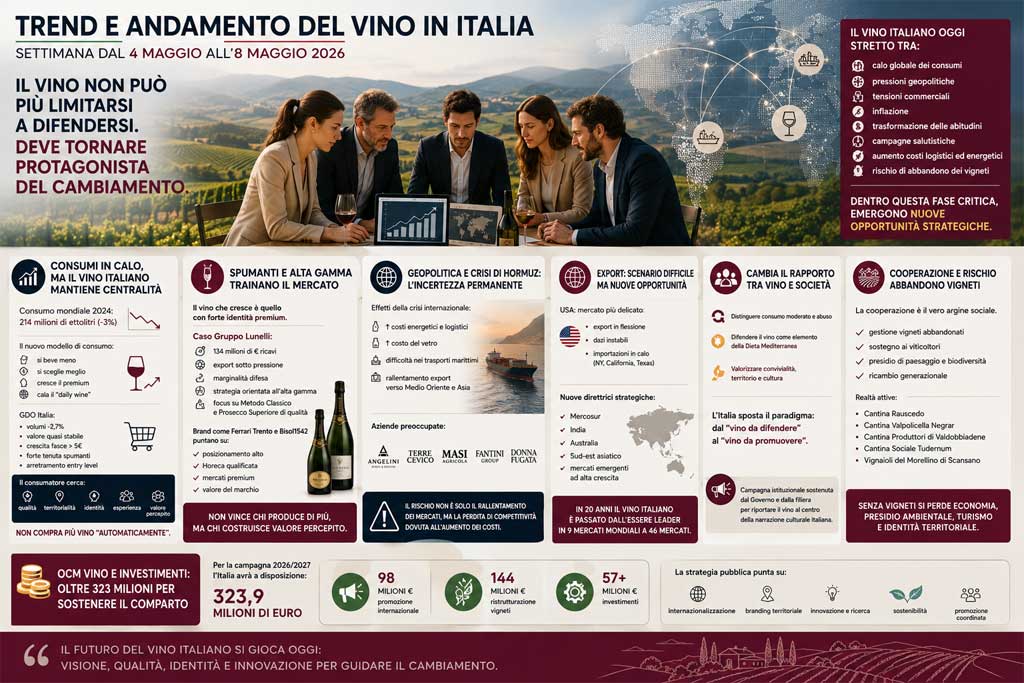
The message emerging forcefully this week from the Italian wine world is clear: wine can no longer simply defend itself. It must once again become a leader in change.
At the heart of the debate was Piero Mastroberardino’s speech at the inauguration of the Academic Year of the Academy of Vine and Wine, which lucidly captured the current state of the sector.
Italian wine today finds itself caught between:
global decline in consumption,
geopolitical pressures,
trade tensions,
inflation,
transformation of consumer habits,
increasingly aggressive health campaigns,
increasing logistics and energy costs,
risk of abandonment of the vineyards.
Yet, precisely within this critical phase, new strategic opportunities also emerge.
Global consumption is declining, but Italian wine remains central
According to OIV data recalled during the week, world wine consumption in 2024 fell to 214 million hectolitres (-3%).
The United States remains the world’s leading market in terms of overall consumption, but is showing signs of slowdown and significant instability related to tariffs and inflation. Italy, however, remains among the countries with the highest per capita consumption in the world and continues to play a central role in international wine culture.
The real transformation, however, concerns the consumption model:
we drink less,
you choose better,
the premium increases,
“daily wine” drops.
Italian large-scale retail trade confirms this trend:
volumes down (-2.7%),
almost stable value,
growth in the bands above 5 euros,
strong hold of sparkling wines,
decline in entry-level wines.
Today’s consumer is looking for:
quality,
territoriality,
identity,
experience,
perceived value.
He no longer buys wine “automatically”.
Sparkling wines and high-end wines drive the market
The week confirmed the consolidation of a very clear trend: the Italian wine that grows best is that with a strong premium identity.
The case of the Lunelli Group is a concrete example:
revenues of 134 million euros,
exports under pressure,
defended marginality,
high-end oriented strategy,
focus on quality Classic Method and Superior Prosecco.
Brands like:
Ferrari Trento
Bisol1542
they are increasingly focusing on:
high positioning,
Qualified Horeca,
premium markets,
brand value.
The message is clear: in the new global scenario, the winners are not those who produce more, but those who manage to build perceived value.
Geopolitics and the Hormuz Crisis: Wine Enters an Era of Permanent Uncertainty
One of the most pressing issues of the week concerns the effect of the international crisis on Italian wine.
Tension in the Hormuz area is generating:
increasing energy costs,
logistical increases,
rising cost of glass,
difficulties in maritime transport,
slowdown in exports to the Middle East and Asia.
Many large Italian companies are already registering:
orders suspended,
blocked containers,
increase in operating costs,
pressure on marginality.
Among the groups that have expressed concern:
Angelini Wines
Cevico Lands
Masi Agricola
Fantini Group
Donnafugata
The main risk today is not only the slowdown of the markets, but the loss of competitiveness caused by increasing costs along the entire supply chain.
Many operators also believe that increasing price lists could be a strategic mistake, because the international consumer is already under inflationary pressure.
Exports: a challenging scenario but new global opportunities
The United States remains the most sensitive market:
Italian exports in decline,
tariffs still unstable,
reducing imports in key states such as New York, California and Texas.
France is also suffering greatly:
sharp drop in average prices in the US,
reduction in exports,
difficulties on premium French wines.
But within this instability, new strategic directions emerge:
Mercosur,
India,
Australia,
Southeast Asia,
high-growth emerging markets.
Italy today appears better positioned than other competitors thanks to:
strong territorial diversification,
ability to cover different groups,
growth of the image of Made in Italy,
increase of Italian leadership in international markets.
In twenty years, Italian wine has gone from being the leader in 9 world markets to 46 markets.
The relationship between wine and society is changing
The cultural theme is now central.
Wine today is not just fighting a commercial battle, but also a narrative and identity battle.
Health campaigns, especially in Europe, are changing the perception of wine as a product, especially among young consumers.
The Italian supply chain, however, reacts with a very clear position:
distinguish between moderate consumption and abuse,
defend wine as an element of the Mediterranean Diet,
enhance conviviality, territory and culture.
Italy is trying to shift the paradigm:
from “wine to defend” to “wine to promote”.
Important in this regard is the institutional campaign supported by the Italian government together with the wine industry, with the aim of bringing wine back to the center of the Italian cultural narrative.
Cooperation and the risk of abandoning vineyards
Another strategic theme that emerged forcefully is the growing risk of vineyard abandonment.
The economic crisis in the sector is hitting hardest:
marginal areas,
heroic viticulture,
small producers,
historic hilly territories.
Italian wine cooperatives are becoming the true social bulwark of the system.
Cooperative wineries and consortia are taking action:
taking over abandoned vineyards,
by financially supporting winemakers,
preserving landscape and biodiversity,
promoting generational turnover.
Among the most active entities:
Rauscedo Winery
Valpolicella Negrar Winery
Valdobbiadene Producers’ Cellar
Tudernum Social Winery
Winemakers of Morellino di Scansano
The issue is not only agricultural:
Without vineyards, the economy, environmental protection, tourism, and territorial identity are lost.
CMO Wine and Investments: Over 323 Million to Support the Sector
Important signals are arriving on the support policy front.
For the 2026/2027 campaign, Italy will have at its disposal:
323.9 million euros CMO Wine,
of which:
98 million for international promotion,
144 million for vineyard renovation,
over 57 million in investments.
The Piedmont Region is also very active, having allocated over 7.6 million euros for international promotion, wine tourism, and territorial development.
The public strategy today focuses on:
internationalization,
territorial branding,
innovation,
research,
sustainability,
coordinated promotion.