A network portal of Wine Idea. Discover the world of Wine idea

Wine press review for Saturday February 7 -2026

Winery, Italian wine producers, and wine news.

Italian wineries

Oltrepò: Losito and Guarini remain in the running.

  • The Losito and Guarini company confirms its interest in acquiring the Terre d’Oltrepò cooperative.
  • After the complaint of “failure to respond”, a formal communication arrives (29 January 2026) from ministerial commissioner Luigi Zingone.
  • Position: “open to any possible formula” → the game is still open, with territorial and socio-economic implications.

Tedeschi (Valpolicella): transition to the new generation

  • Enrico Giacomelli Tedeschi (from January), the first of the seven cousins of the new generation, will take over the role.
  • Key message: family continuity as a structured project (not just symbolic), with legal and managerial skills.

Tenuta Santa Maria Valverde: Organic certification halted, transition to integrated pest management.

  • Producer Nicola Campagnola makes a clear choice: abandoning certified organic production.
  • Hot topic: costs/complexity/perceived effectiveness of certification vs. “integrated” agronomic management.
  • Market insight: be careful about reputational risk and communication (how you tell it matters as much as what you do).

Lungarotti and “Progetto 1962”: Heritage as a Strategic Lever

  • Story of a structured reality (foundation company), with a focus on sustainability, biodiversity, and continuity of vision.
  • Reading: the past not as nostalgia, but as a tool for positioning and industrial coherence.

Santa Maria La Palma Winery (Alghero): A cooperative as a “widespread value”

  • Declared numbers: over 300 members , 800 hectares , approximately €28 million turnover , 8 million bottles .
  • Over €30 million redistributed to members (2021–2025), €8 million in the last year.
  • Model: international growth without relocation, with measurable local economic impact.

Italian wine and Italian oenology

Large-scale retail trade: wine closes 2025 in the red (but holds up)

  • Large-scale retail trade sales (Circana): €2.3 billion value ( -0.5% ), 618 million liters ( -3.1% ).
  • Average price: €3.77/L ( 2.6% ).
  • 0.75 bottle: value 0.2% , volume -1.9% ; sparkling: value 3.6% , volume 3.1% .
  • Reading: volumes down, price up → promotional pressure and selective “trade-down” remain the themes.

Freisa: “Second Youth” in Piedmont

  • Focus on the origins, aromatic identity and contemporary rediscovery of the grape variety.
  • Undercurrent: return of natives with “character” when they manage to speak a modern language.

Prosecco “col fondo”: the ancestor that comes back to count

  • Cultural difference: “Easy” Prosecco vs. “straight” Prosecco, more gastronomic, less accommodating.
  • Market insight: identity niches that become credible (not artificial) storytelling.

Amarone: More elegance and drinkability (concrete signs)

  • The Verona preview revealed a stylistic evolution perceived as more realistic and less declarative.
  • Direction: “intelligent” lightening without losing identity.

Calabria on the Rise: Gambero Rosso’s Best Ciròs

  • Cirò as a symbol of a qualitative leap in the region and the consolidation of the native varieties.
  • Note: a new dynamic in events/national attention (festivals and local initiatives) is cited.

Palizzi (IGT): a territorial tale between the Ionian coast and Greek roots

  • Emphasis on cultural identity and soil and climate conditions (clay, sea breeze, altitude).
  • Theme: Micro-territories that work if they become experiences (not just labels).

Wine and the young: fewer slogans, more culture and people

  • Interventions by young winemakers (22–40 years): shifting the focus from technicalities to storytelling, values, and faces.
  • Implication: The question isn’t “do they drink,” but “what really hooks them.”

Institutional wine campaign: Coldiretti

  • Support for supply chain communication against “demonization”, with reference to the economic value of 14.5 billion .

Observatory: “Uncertainty is the new normal”

  • The “Wine Permanent Observer” report was presented in Alba: a complex scenario and declining exports.
  • Message: We need governance of change, not defense of vested interests.

International

Low/no alcohol drinks: yes, but maximum caution is required.

  • A young and growing market; a “Trojan horse” risk for bringing alcohol consumption back to sensitive targets.
  • Alerts and analyses recalled (WHO 2024 and expert summaries in scientific journal).

Dry January loses its grip (USA): fewer mocktails, more spirits

  • From American bars: January busier than expected, driven by corporate events.
  • Demand composition: fewer non-alcoholic drinks, more spirits → a signal to monitor for those investing in no/low alcohol.

UK: New alcohol excise duties (from February 1) and protests

  • Excise duty increase in line with the RPI index (3.66%); wine/beer sector disputes.
  • Topic: balance between revenue/health policy and competitiveness of the sector.

Australia: Wine Exports to Decline in 2025

  • Wine Australia data: -8% value (2.34 billion AUD), -6% volume (613 million litres).
  • Average value per litre decreasing → pressure on positioning and market mix.

Wine events

Wine Paris 2026: Sicily takes center stage with IRVO (41 wineries)

  • Project: “Sicily of Wine. Roots of the Future” (February 9–11, 2026, Paris Expo).
  • Format: beyond the fair, identity storytelling, training events and food and wine pairing (also in a hotel school context).

Wine Paris 2026: Consortium of Romagna Wines with 10 wineries

  • Presence at the fair (Hall 5.2 – Stand B130) and participation in the “Selection by VertdeVin” event (10 February).
  • Objective: label selection and international positioning.

Oltrepò Pavese: Buttafuoco Storico turns 30

  • Anniversary 1996–2026 with calendar of events: tradition, future, stricter DOC rules to protect identity.

“The Great Verticals of the Cities of Wine” (January–April 2026)

  • Format: vertical tastings (young vs. mature wine) and in 2026 a focus on wine and food pairing as a participatory experience.

Winery Event: Bagna Cauda at Francesco Rosso (February 21)

  • An experiential evening in Roero: local food and wine as a driver of direct connection.

Cross-cutting focus of the day (strategic reading)

The common thread is crystal clear: the market isn’t collapsing, but its grammar is changing .

  • Distribution : volumes down, prices up → margins to be protected with mix and identity.
  • Styles and products : drinkability (Amarone), authenticity (with sediment), native wines that “return” (Freisa, Cirò).
  • Policy & reputation : organic between new rules (national brand) and unconventional choices (exiting certification).
  • International : health, excise duties, and “hybrid” consumption make the picture more unstable but legible for those who govern data and positioning.

See you tomorrow.

Wine press review for Friday February 6 -2026

Wineries, Italian wine producers, and wine news.

Italian wineries

Cantina Tollo presents its “TO BE” line. Making their debut at Wine Paris are TO BE Fresh (a chilled red) and TO BE Light (a low-alcohol white). A concrete response to new international consumption trends and a younger audience, without alcohol-free wines but with targeted agronomic choices.

Cantina Santa Maria La Palma: a cooperative that creates value. A virtuous model with a €28 million turnover and 8 million bottles produced. Over 300 members, 800 hectares, and growth without losing value: the wealth remains local.

Sankt Pauls renews governance and vision The historic South Tyrolean cooperative (1907) presents its new production and managerial course in Rome: a more modern style, strong attention to sustainability and terroir.

Tinazzi is among the greenest wineries (EcoVadis Silver). It has become one of the top 15% of companies certified for sustainability worldwide. A path of concrete action regarding suppliers, the environment, and social responsibility.

Pizzolato Winery: lower turnover, solid 2025 margins at €24 million (-€2 million), EBITDA stable at 15%, exports at 93%. Long-term international strategy and strengthening of the HoReCa business in Italy.

Enio Ottaviani among the excellences of Milan-Cortina 2026 Selected for the American Winter House: wine as a tool for cultural relations and food and wine diplomacy.

Italian wine and Italian oenology

The wine market is sailing by sight. Record exports in 2024 (€8.1 billion), but a contraction in 2025 (-2.2% in value, -1% in volume). The message is clear: volume growth no longer guarantees value. “Uncertainty is the new normal.”

Institutional wine ads: Masaf launches a €105,000 campaign for a national communication campaign promoting Italian wine. This move is more symbolic than structural, amid pressure on margins.

Vitae Guide 2026 – Abruzzo takes center stage with 76 wineries reviewed, 45 excellent wines scoring above 90/100. Best Italian wine: Trebbiano d’Abruzzo 2021 Valentini (98.5/100).

Langhe: Reclaiming Vineyards to Save Villages In Rocca Cigliè, reclaiming uncultivated land is becoming a tool to combat depopulation and attract new winemaking investments.

Glera Piwi: the future of Prosecco . Seven new resistant varieties presented in Rauscedo. Fewer treatments, more sustainability, and the same territorial identity. A key step for the future competitiveness of DOC and DOCG wines.

Bag-in-box: the taboo that no longer scares. Still only 3.5% of global trade, but a strategic format for price, convenience, and sustainability. Even some DOCs are starting to explore its use.

Anima Aurea: wine refinement in gold and silver. A patented project that combines science and experimentation: chromatographic analyses show improvements in taste and aroma in structured reds.

International

US: Wine consumption declines for the fifth year, down 7% in value and 9% in volume. Italy holds up better than the market (down 3% in value), thanks to Chianti Classico, Prosecco, and Brunello.

US market saturated: not just tariffs. In 2025, Italy will lose 5.2% in volume. France and New Zealand are holding up better; Australia, Chile, and Argentina are struggling.

Australia: China continues to slow down exports in 2025 (-8% in value, -6% in volume). Beijing remains an unstable and highly risky market.

Ningxia, the new frontier of Chinese wine China’s leading wine-producing region, now enjoying strong international growth and a new destination for luxury wine tourism.

Edoardo Freddi International expects 6% growth in value and 9% in volume in 2025 , with 38 million bottles sold in 112 markets. Europe is at 45%, while the US remains stable (-1%).

Wine events

VinNatur Genoa (February 8–9) 90 winemakers from 17 regions, masterclasses, and training. Natural wine continues to develop as a cultural and commercial segment.

Wine Paris (9–11 February)

  • Valpolicella: 50 companies, 24% stand, focus on Amarone
  • Brunello di Montalcino: 77 wineries, 71% less than in 2025
  • Asolo Montello: first stage of the 2026 export plan

Slow Wine Fair – Bologna Over 1,000 wineries to reflect on “good, clean, and fair wine”: quality, ethics, environment, and supply chain.

Milan-Cortina 2026: the toast is Prosecco DOC. A major investment by the appellation as the Official Sparkling Wine. Over 3 billion viewers: an unprecedented territorial positioning operation.

WinePrime is born (Milan, January 2027) A new high-end B2B fair dedicated to dialogue between excellent international producers and qualified distribution.

QUIDQUID Strategic Note

This week’s common thread is clear: those who govern supply chains, markets, and industrial models are withstanding the pressure; those who remain stagnant are suffering. Wine isn’t experiencing an identity crisis, but rather a crisis of adaptation.

Thanks for listening. Today’s wine press review was brought to you by WINEIDEA.IT . See you tomorrow.

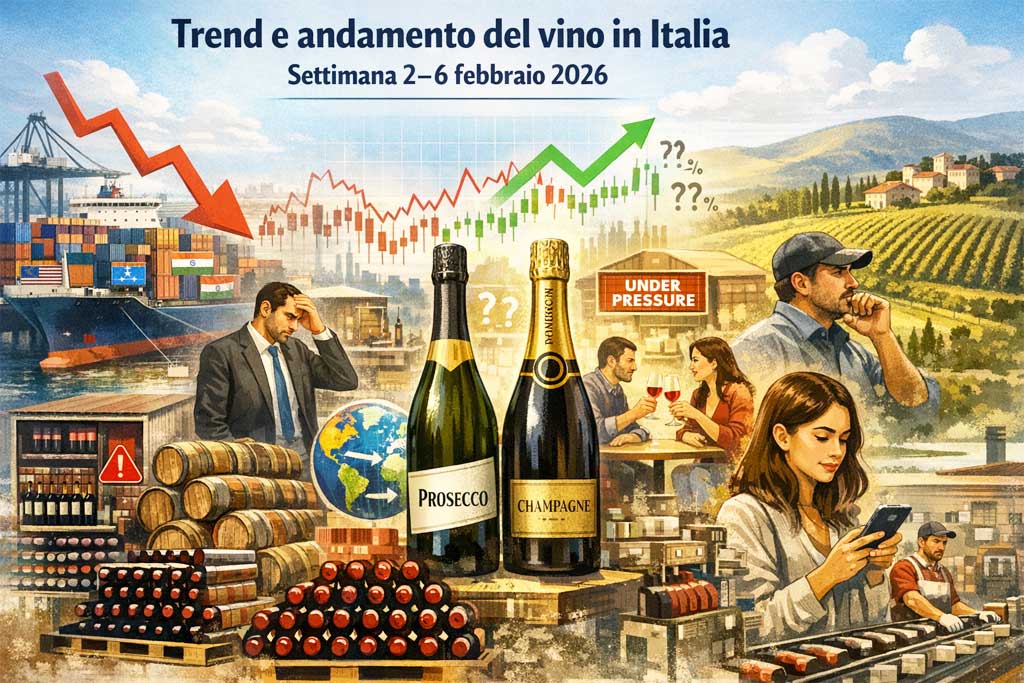
Wine trends and performance in Italy Week 2–6 February 2026

In 2026, Italian wine is entering a phase that is no longer cyclical but structural. The key is not the crisis itself, but rather the changing rules of the game.

As observers and leading international players have pointed out, “uncertainty is the new normal”: unstable markets, selective consumption, pressure on margins, and a growing gap between those who govern change and those who endure it.

Exports: record behind us, adjustment underway

2024 closed with an all-time high in Italian exports of €8.1 billion (up 5.5%) . However, 2025 saw a slowdown: -2.2% in value and -1% in volume , with a global scenario in which volume growth no longer guarantees value. Dependence on mature markets, primarily the US, exposes the economy to systemic risks (tariffs, inflation, and declining purchasing power). Hence the growing focus on new geographies: Mercosur and India are no longer theoretical options but mandatory trajectories, even if the implementation timelines remain long.

Prices and margins: the unresolved issue

Wine is suffering from an increasingly evident disconnect between price and perceived value. In key markets, particularly the United Kingdom and the United States, production, logistics, and bureaucratic costs are squeezing the trade’s profitability. The entry-level segment is shrinking, while the compression of margins is leading to reduced product assortments, lower investment, and job losses. Without a rethinking of business models, the “race for volume” risks turning into a systemic devaluation of the product.

US consumption: structural decline, Italy more resilient

In the United States—the world’s largest market by value—wine consumption is declining for the fifth consecutive year ( -8.8% in volume in 2025 ). Italy is holding up better than its competitors ( -5.2% in volume, -3% in value ), thanks primarily to sparkling wines. According to the Italian Wine Union , Prosecco remains the true driver, while denominations like Chianti Classico and Brunello maintain a defensive position. The structural trend is clear: in the US, people are drinking less wine, but they are seeking recognizable, consistent products that can justify their price.

Prosecco vs. Champagne: A Historic Watershed

2025 marks a symbolic and substantial leap forward: the Prosecco system surpasses Champagne in terms of market dynamics. While Champagne production has fallen to 266 million bottles, Prosecco approaches 800 million , embodying a model of “accessible luxury.” It’s not just a question of numbers: it’s a clash between two visions. On the one hand, defensive premiumization; on the other, the ability to interpret consumption, sociality, and immediacy. The market has chosen the latter.

Communication and the consumer: the real enabling factor

Wine isn’t rejected: it’s often poorly communicated. New generations are curious, but demand simpler language, immediate experiences, and authentic stories. The cultural and relational value of wine remains intact, but it needs to be revitalized with less self-referential communication and more connected to real life. In this sense, the new Italian institutional campaign on conscious consumption represents a significant political and cultural signal.

Overproduction and system under stress

The most critical data comes from the wineries: over 8 billion bottles in storage . This surplus fuels dumping, price pressures, and imbalances throughout the supply chain. The selection process has already begun: small, fragile producers, undercapitalized models, and confused positioning are at risk of being forced out of the market. This isn’t a collapse, but a fracture. And like any fracture, it redraws the perimeter of the survivors.

Strategic conclusion

Italian wine is not in decline, but in transformation. Those who manage inventory, margins, and positioning are the winners; those who invest even in difficult times; those who build value before even selling volume. 2026 will not reward inertia or nostalgia. It will reward industrial vision, product line clarity, market presence, and the ability to speak to today’s consumer. In an uncertain world, wine remains a powerful economic and cultural tool. Provided it is used wisely.

Wine press review for Thursday, February 5, 2026

Wineries, Italian wine producers, and wine news.

Italian wineries

  • Caviro Group relaunches Tavernello. A new national campaign featuring Nino Frassica for the iconic brand of the world’s best-selling Italian wine. Industry-standard numbers: 36,000 hectares, 11,500 winemakers, 150 million liters in 90 markets. This move reaffirms the role of cooperatives as a productive and commercial infrastructure.
  • Edoardo Freddi acquires a majority stake in Agriment. The company specializes in the export of over 60 wineries, closing 2025 with a 6% revenue share. Skepticism about alcohol-free wine as a structural market solution.
  • A collector opens a super wine shop in Milan. Fabio Cagnetti takes years of collecting and trading rare wines offline. A project focused on fine wines, a climate-controlled cellar, and an informal approach: experiential retail evolves.
  • Franchini and Amarone above a Roman villa. In Negrar, archaeology and viticulture intertwine: excavations funded by the company have revealed a 3rd-century Roman cellar. Cultural heritage becomes a lever for wine tourism and identity.
  • Cà du Ferrà, Liguria’s Resistance Heroic viticulture in Bonassola: reclaiming the terraces, slowness as a method, and landscape as an agricultural choice, not just a backdrop.
  • Vogadori Winery opens to bulk wines. A weekend dedicated to direct sales in Valpolicella: authenticity, direct contact with consumers, and a short supply chain as a concrete response to new consumer trends.
  • Cantina Pizzolato at Winter House Milan focuses on organic sparkling wines and non-alcoholic ready-to-drinks. In the US, the brand is #1 in organic sparkling wines, with triple-digit growth: a clear and consistent positioning.
  • Cantina Tollo presents the TO BE line: fresh, low-alcohol wines with a contemporary style to appeal to international markets and younger consumers. Preview at Wine Paris.
  • Ammura (Tommasi Family Estates) at Wine Paris Presentation of the new Etna Rosso and Bianco vintages and of Liuni Etna Rosso DOC: continuity in the valorization of a complex and highly recognizable terroir.

Italian wine and Italian oenology

  • Lollobrigida: “The decline in US exports is not a tragedy.” At the Masaf wine meeting, a joint discussion was held: dealcoholization has been shelved, and now the focus is on the CMO, CAP, and production containment. Caution regarding eradications, and the central role of agriculture in protecting the territory.
  • Valpolicella: not just styles, but identity rituals. From Amarone Opera Prima, a historical-cultural rereading of the denominations: communicating wine beyond technique, basing the story on coherence and historical truth.
  • Marchesini: The future lies between integrated production and the end of widespread drying. The SQNPI protocol is growing (47%), while organic production is declining (-9%) due to climate change. Practical sustainability is replacing ideological sustainability.
  • CMO Wine grants in Lombardy: €3.7 million to 139 companies for investments in wineries, hospitality, e-commerce, and innovation. Only one company in Como received funding: a marginal but confirmed presence.
  • Canned wine is growing (outside Italy). This alternative packaging is driven by convenience, informal consumption, and a lower environmental impact. It remains a niche market, but it appeals to young lifestyles.
  • Health and Red Wine: The debate on the cardiovascular benefits of moderate consumption is returning: a sensitive topic that requires balanced and scientifically responsible communication.

International

  • New resistant grape varieties: Agroscope’s “magnificent 7.” After 15 years of research, seven varieties resistant to downy mildew and powdery mildew have been identified. This is a strong signal for the future of European viticulture, including climate change.
  • Concours Mondial de Bruxelles rethinks communication Medals are no longer enough: we need understandable narratives, capable of speaking to young people and occasional consumers in a shrinking market.

Wine events

  • Milan–Cortina 2026: a global showcase for food and wine. Between the Olympics, fine dining, and luxury hospitality, Italian wine becomes a tool for cultural diplomacy and regional branding.
  • Amarone Opera Prima n.22 Verona at the center of the debate on Valpolicella between identity, communication, and production models.
  • Wine Paris 2026 Strong Italian presence: Brunello di Montalcino with 53 companies and a consortium wine bar, Ammura, Cantina Tollo and many other internationally oriented companies.
  • Wine tourism boom. The AITE–SRM report for FINE Wine Tourism Marketplace Italy confirms: less wine consumed, more value generated in the winery. Hospitality becomes a strategic asset.
  • Best Wine Hospitality Manager 2026 Hospitality professionals rewarded: people are back at the center of brand value.
  • Roero, wine and truffles From the Gathering of the Trifulau emerges a territorial model integrated between viticulture, gastronomy and local identity.
  • Fieragricola Verona Zaia reiterates: Veneto is Italy’s second-largest agricultural region, and first for wine. Agriculture is an identity, even before production.
  • DOC Sicilia: San Valentino and San Faustino Communication that combines ritual, conscious consumption, and the adaptability of wines to different moments in life.
  • UNESCO Prosecco Hills: Nearly €1 million for a visitor center and cultural projects: tourism, youth, and sustainability as long-term strategic axes.

Today’s wine press review was brought to you by WINEIDEA.IT . See you tomorrow.

Style Selector
Select the layout
Choose the theme
Preset colors
No Preset
Select the pattern