


A network portal of Wine Idea. Discover the world of Wine idea

Wine press review for Tuesday December 2 – 2025!

News on Italian wine and oenology.

ITALIAN WINERIES

Cantina La-Vis – “Portraits”: art, sustainability, and social responsibility in a single project. A new line of six wines illustrates the harmony between humanity and nature through the illustrations of artist Margherita Paoletti. The launch coincides with the International Day for the Elimination of Violence against Women, with a charity event in support of Telefono Rosa.

Le Colture – Cartizze: elegance for the holidays Le Colture’s Valdobbiadene DOCG Spumante Superiore di Cartizze confirms its status as a symbol of finesse: an extremely fine perlage, aromas of ripe fruit, and a perfectly recognizable story of the territory.

Torrevilla – AIS Lombardia Winemaker of the Year: Gabriele Picchi For the first time, AIS Lombardia has established the “Winemaker of the Year” award, awarding it to Gabriele Picchi for his work in selection, research, and quality improvement in Oltrepò Pavese.

Colterenzio Winery – New President: Franz Pardatscher. After 18 years as president of Niedermayr, Pardatscher, an oenologist and winemaker from Appiano, takes over the helm. This marks the beginning of a phase of consolidation and responsible renewal for the winery.

Cantina De Vigili – Mountain bubbles at 850 meters A vineyard located between 800 and 850 meters above sea level in the Spormaggiore area promises a sparkling wine with a distinctive “altitude” character, with the Brenta massif acting as a natural sentinel.

Enrico Serafino – Special Visit to the Canale Winery The winery welcomes guests of the “Il Girasole” day center: a simple and authentic experience that brings people closer to the culture of wine through firsthand experience and genuine curiosity.

Surprising Calabria – 56 wineries on display From November 29th to December 2nd, the press tour showcases a rapidly evolving region: Cosenza is the first stop on a journey involving producers, journalists, and international buyers.

Brescia’s Wineries Between Franciacorta and Garda – Top-Rated Wine Tourism. In Go Wine’s “Cantine d’Italia 2026” guide, Brescia takes center stage thanks to its quality hospitality and landscape. Bellavista is among the 25 wineries with “Tre Impronte” (Three Imprints).

La Sabbiona – Special Award for the Famous “VIP” Ravenna PGI The recovery of a historic aromatic grape variety becomes a virtuous case: the “Buono… non lo noto!” award celebrates a journey that began 18 years ago and is now recognized nationally.

MASI – New Wine Bar & Restaurant at Verona Airport The Masi Wine Bar & Restaurant opens in the renovated Catullo Airport, bringing the Veneto food and wine experience to the area’s main tourist hub.

ITALIAN WINE AND ITALIAN OENOLOGY

The Lost Classicism of Brunello: The Debate Continues. Winemaker Filippo Paoletti weighs in on the editorial criticizing the stylistic evolution of some Brunellos from Southern Montalcino. One firm point: going backwards would mean invasive techniques and results that are inconsistent with today’s terroir.

Circular Economy in the Winery – The Caviro Model Recovery, regeneration of by-products, and supply chain integration: Caviro presents an industrial model that transforms sustainability into an economic lever, not a mere slogan.

UIV relaunches “Enotria” – The wine magazine is back. The historic periodical founded in 1921 is relaunching after fourteen years: two annual issues, in print and digital, to give voice to wine culture and the memory of the sector.

The “Clinto” wine is on the way to European rehabilitation. The EU Agriculture Commission is open to the possibility of marketing “Clintòn,” a wine banned for nearly a century. Veneto celebrates, with historic festivals and studies on its oenological potential.

Vinci – Wine as a Territorial Network The Municipality of Vinci presents its agricultural and cultural development projects: a model that links landscape, events, and local products into a single narrative of identity.

Roma Vino 2025 – All the Award Winners Over 230 wines from Lazio compete, with a professional jury rewarding quality, innovation, and a strong connection to the region in the evocative setting of the Temple of Hadrian.

INTERNATIONAL

Romania – A Silent Giant of European Wine With 187,000 hectares and 3.6 million hectoliters (OIV data), Romania remains the world’s eighth-largest vineyard producer. Historical and cultural ties with Italy make this market increasingly attractive.

Italian exports under pressure – Extraordinary measures are needed. UIV raises the alarm: tariffs, an unfavorable exchange rate, and declining purchasing power risk curbing exports. The government is allocating €100 million annually (2026–2028) to promote exports abroad.

WINE EVENTS

Sparkle 2026 – A Roman success with 1,500 visitors. 92 labels awarded the “5 Spheres,” nearly 1,000 wines in the guide, and a growing audience: Italian sparkling wines continue to attract attention and curiosity.

Venicepromex – “Land of Wine Stars” with Chef Chiara Pavan. The initiative highlights wine as the defining language of the Veneto region. Chef Pavan shares her vision of sustainable cuisine and the connections between produce and landscape.

Advent Calendar – Day 1: Praeclarus Metodo Classico Since 1979, a symbol of Alto Adige sparkling wine: hand-picked grapes, rigorous classic method, and three versions available today that tell the story of a terroir that thrives on precision and freshness.

COLUMN – PEOPLE AND IDEAS

Piero Antinori – “I’m still searching for the perfect wine.” At 87, the Marchese recounts his never-ending quest: an ideal wine, capable of embodying an idea rather than a style. Among memories, Tignanello, and an unquenchable thought.

Thanks for listening. Today’s press review is brought to you by WINEIDEA.IT . Let’s follow the thread of these stories: each one reveals how the sector continues to evolve, even when no one notices.
Wine press review for Monday December 1 – 2025!

News on Italian wine and oenology.

Italian wineries

  • Borgo del Tiglio, a landmark winery hit by landslide and flood (Friuli). In Brazzano, on Mount Quarin, a landslide and flood devastated the historic Borgo del Tiglio winery: 17th-century buildings damaged, historic vineyards compromised, an archive of 10,000 bottles destroyed, and 60,000 bottles from the 2025 vintage trapped underground. The economic damage amounts to several million euros, and recovery times are long, due to the red zone and safety restrictions.
  • Oniwines (Oniverse) focuses on Trentodoc “mountain bubbles.” Federico Veronesi (Oniwines, Oniverse group – Calzedonia, Falconeri, Signorvino) describes a counter-current growth strategy in a shrinking market: six wineries in Lazio, Sardinia, Marche, Piedmont, and Veneto, and now the “Ert1050” project in Trentodoc, focusing on territorial identity and wine tourism.
  • “Cathedral” Trentodoc Altemasi: Cavit invests €26 million in Ravina. In response to the consumer crisis and competitive pressure, Cavit is investing €26 million in a new winery dedicated to Trentodoc Altemasi . This is a strong signal of the strategic role of mountain sparkling wines in the group’s future growth.
  • Rome Wine Award 2025: Lazio takes center stage with Famiglia Cotarella and Cantina Stefanoni. In the Hall of the Temple of Vibia Sabina and Adriano in Rome, the Rome Wine Award 2025 ceremony showcases Lazio’s finest wines. Recognition goes to the Viterbo-based wineries Famiglia Cotarella and Cantina Stefanoni , with the aim of supporting quality, exports, and new entrepreneurship (both young and female).
  • The Langhe is firmly established among the world’s elite of “fine wines.” In the 2025 international rankings of top wines and Europe’s best producers, the Langhe has firmly established itself among the world’s elite: among the names cited, Angelo Gaja (Barbaresco) and Giacomo Conterno appear alongside giants such as Egon Müller, Vega Sicilia, Krug, and Château Latour. Italy’s high-end winemaking is consolidating its global status.
  • Trevéz, three young people revitalizing old vineyards in Bologna. The Trevéz project was born from the meeting of three young winemakers and agronomists trained in Italy, Germany, New Zealand, Australia, and California. Their strategic choice: to lease very old, often abandoned, vineyards and enhance them with careful management. An example of a new urban entrepreneurship that reinterprets the land with technical expertise.

Italian wine and Italian oenology

  • Sondrio: €45 million for heroic agriculture and tourism. The Lombardy Region has approved the 2025 Territorial Development Framework Agreement for the province of Sondrio: over €45 million earmarked for projects that combine heroic agriculture, public water management, and tourism development in an entirely mountainous area. Key resources also for terraced vineyards.
  • “Lives of Langa and Roero”: Petrini and Tibaldi recount a peasant civilization. The book “Lives of Langa and Roero – Social Transformations of a Peasant Civilization” by Carlo Petrini and Paolo Tibaldi is being presented at the University of Gastronomic Sciences in Pollenzo. A journey that unites history, culture, wine, and collective identity, including Savoy courts, farms, the dignity of labor, climate change, sustainable tourism, and the future of local communities.
  • Budget and wine: between micro-regulations and the Wine Museum proposal. The package of amendments to the budget includes “micro-regulations” that also affect the sector: from strengthening the structure against blue crabs to the Wine Museum , including protection of the buffalo milk supply chain. These are signs of attention, but also regulatory fragmentation.
  • Primitivo “di Manduria” from a nonexistent winery: the K-Tipp case. An investigation by the Swiss monthly K-Tipp exposes the Primitivo di Manduria 1488 DOP “Fratelli Leporetti,” sold in Landi supermarkets: the producer in Puglia doesn’t exist. The label, designed to evoke authenticity and territory, is actually a fictitious one. The central theme: protecting denominations, transparency for consumers, and protecting the image of Italian wine abroad.
  • The Return of Autumn Wine: New Wine, Mulled Wine, and Rural Memories. Between San Martino and Christmas, the season of new wine , mulled wine , and cellar traditions returns: innkeepers and families once roamed Cellatica, Botticino, Garda, and Franciacorta to select the wine to keep at home year-round. A tale that intertwines rural memory, local tradition, and modern consumption.
  • Restaurants overwhelmed by storms: hospitality and resilience. From Tuscan restaurants like Osteria delle Terme in Massacciuccoli to chef Antonia Klugmann’s appeal in Friuli Venezia Giulia, the restaurant industry reports extensive damage but also impressive gestures of solidarity. Customers and communities shovel mud alongside restaurateurs: wine is once again a symbol of sociality, even in climate emergencies.
  • 2025 Harvest: Piedmontese Wine Cooperation Between Quality and Low Yields. The cooperative wineries belonging to Confcooperative Piemonte describe a high-quality 2025 vintage, but with low yields and a complex market. The cooperative model emerges as a tool for resilience: sharing expertise, supporting members, and the ability to transform challenges into opportunities for growth.
  • Varvaglione (UIV): More resources for promotion, exports must be protected. Marzia Varvaglione, vice president of the Italian Wine Union , welcomes the inclusion of €100 million per year for the three-year period 2026–2028 for promotion and internationalization activities. With tariffs, the falling dollar, and declining purchasing power, a significant portion of these resources is considered vital to protecting Italian wine exports.
  • Marsala nominated for UNESCO World Heritage status along with the wines of the “Sun Belt.” Marsala , a historic Sicilian wine, is nominated for UNESCO World Heritage status along with Jerez, Madeira, Porto, and Samos. The goal is to protect the landscapes, production practices, and traditions associated with the great fortified wines of the Mediterranean and Atlantic, strengthening the cultural and tourism positioning of these regions.

International

  • Global sparkling wine exports reach €8.5 billion, with Prosecco the global driving force. According to a Del Ray Analysts of Wine Markets analysis, global sparkling wine exports are worth €8.51 billion as of July 2025 (up 0.4% in volume, down 0.6% in value). The average price is €7.83/liter , the highest among all wine types, although slightly declining. Italy, France, and Spain account for 85% of the value and 75% of the volume; Prosecco is the sparkling wine that has grown the most in recent years, confirming its status as an international phenomenon.
  • The decline of the “American wine empire” (Napa and Sonoma) California viticulture is experiencing its most serious crisis since Prohibition: tariffs, excess inventory, changing consumer habits, and a recent, very generous harvest have saturated warehouses. Some Napa and Sonoma winemakers are even forced to uproot vineyards, raising profound questions about the business model of high-end American wine.
  • Swiss wine at 2.19 francs: the race to the bottom is crushing producers. At the meeting of the Swiss Farmers’ Union, the scandal erupted over bottles of Dôle and Chasselas selling for less than 3 francs (as low as 2.19). With such low margins, someone in the supply chain is footing the bill, and it’s not large-scale retail trade: producers are denouncing an unsustainable model, squeezed between rising costs and price pressure.

Wine events, culture and tourism

  • Alba: Presentation of “Vite di Langa e Roero” (December 10) At the Teatro Sociale G. Busca in Alba , on December 10th at 8:45 pm, Carlo Petrini and Paolo Tibaldi will present their book “Vite di Langa e Roero.” Free admission, an evening dedicated to rural memory and the relationship between history, wine, and community, in a region that is a symbol of Italian winemaking.
  • Orte in Cantina: a food and wine trail through the historic village. “Orte in Cantina” takes place between the last Sunday in November and the first in December: an itinerary featuring wine tastings, traditional products, and tours of the historic center. The event blends sensory experience and cultural discovery, transforming the village into a small, scattered wine city.
  • Christmas in the Cellar 2025 – Tuglie (Salento) In Tuglie , in the heart of the Ionian Salento area of Gallipoli, “Christmas in the Cellar 2025” kicks off at the Peparussu Winery – House of Traditions: music, food, crafts, solidarity, and popular memories until January 6th. On December 1st, the book “Da quando t’ho trovato” by Don Cosimo Schena will be presented, with a public discussion and free admission.
  • AIS Piemonte: 60 Years of the Italian Sommelier Association with Conferences and Tastings. To celebrate the 60th anniversary of the AIS, the Piedmontese group is organizing four days of events—until December 1st—including conferences, tastings, and training sessions. The key message: sommeliers are not a “caste,” but a cultural bridge between wine, the region, and the consumer.

Thanks for listening. Today’s wine press review was brought to you by WINEIDEA.IT .

See you tomorrow.

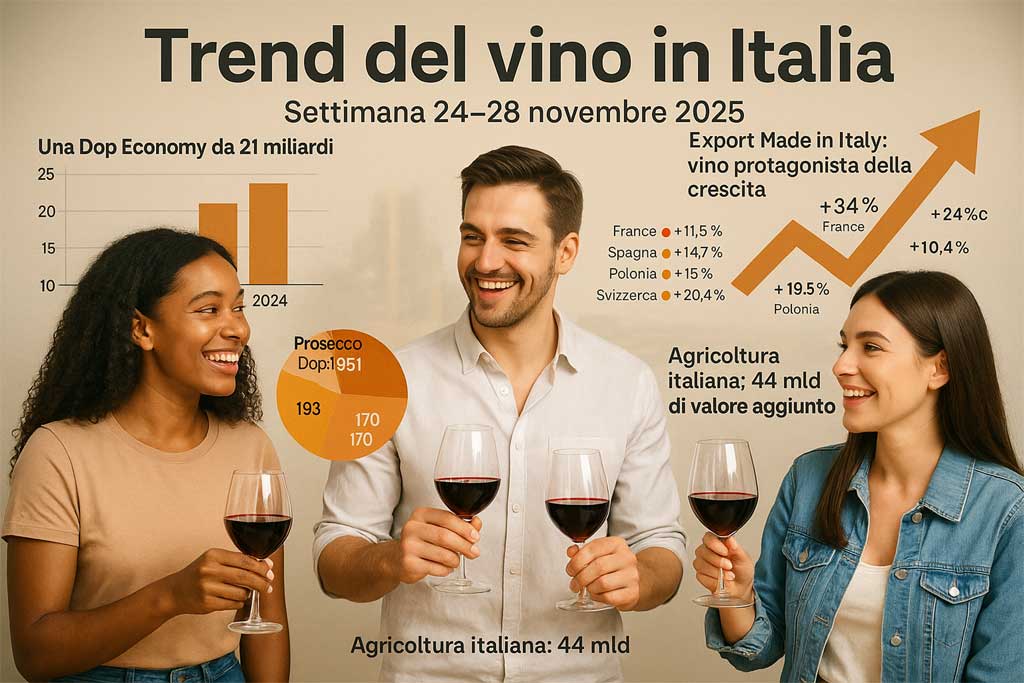
Wine Trends and Performance in Italy – Week of November 24-28 – 2025

The last week of November highlights a wine sector embedded in a rapidly growing national agricultural and agri-food landscape, driven by certified quality, dynamic exports, and a significant evolution in consumption.

The picture shows a solid Italian wine industry, increasingly premium and at the heart of high-value-added supply chains.

A €21 billion DOP economy: stable wine, accelerating exports

The XXIII Ismea–Qualivita Report confirms the strength of certified production: the PDO Economy will reach 20.7 billion euros in 2024 , 25% compared to 2020, with 328 Consortia , 184 thousand operators and an employment growth of 1.6%.
Bottled wine maintains a stable value of 11 billion , while overall PDO and PGI exports reach a new high: 12.3 billion euros (8.2%) , thanks to simultaneous records for food and wine.

The most dynamic areas are Lombardy (13%), Friuli Venezia Giulia (8%), and Puglia (12%). Veneto and Emilia-Romagna remain the epicenters of value, with a total of 8.9 billion .

Among the wines with the highest production value, the following stand out:

  • Prosecco Dop: 951 million (0.5%)
  • Delle Venezie Dop: 193 million (9%)
  • Conegliano Valdobbiadene-Prosecco DOP: 170 million (slightly down)

Made in Italy exports: wine leads growth

ISTAT data for September 2025 show foreign trade expanding: 10.5% in value , 7.9% in volume . Food and beverage grew by 6.9% in the month and 5% in the first nine months of the year, confirming its role as a cornerstone of the Italian trade balance.

Wine remains one of the most sought-after categories in premium markets, especially in non-EU countries. Exceptional performance:

  • United States: 34.7% , driven by wine and cheese
  • France: 19.5%
  • Spain: 14.7%
  • Poland: 15%
  • Switzerland: 10.4%
  • OPEC countries: 24.2%

Growth is based on certified quality, local identity, traceability, sustainable supply chains, and a structured presence on international markets.

Italian agriculture: €44 billion in added value

The Italian primary sector achieved a historic result: over €44 billion in added value , first in Europe. According to AGEA and INPS, government investments— €15 billion —have revitalized the sector, supporting:

  • recovery of 5 million hectares of abandoned land,
  • generational change,
  • increase in productivity and employment.

This agricultural solidity offers fertile ground for the entire wine industry, which benefits from policies geared towards production, legality, and the valorization of cultivated land.

Consumers, bubbles and new drinking cultures

The IULM analysis photographs a wine market in full transformation:

  • Italy is the third country in the world in terms of consumption by value .
  • Internal growth is driven by the pursuit of quality: less quantity, more value.
  • The sparkling segment continues to drive demand: 3.1 billion euros and 733 million litres in 2023 , with a clear premiumization dynamic.
  • Champagne sales are down (-8.4% globally), but Italian sparkling wines confirm their national and international leadership.
  • The low and no alcohol segments are increasing (5.9%) , especially among young consumers.

Gen Z is pushing for a different approach to wine: greater attention to sustainability, essential storytelling, light consumption opportunities, innovative formats, and greater health awareness.

Conclusion: a solid sector evolving towards quality, sustainability and premium positioning

Italian wine closes November 2025 with a strong structural picture: growing exports, certified production generating value, a national agriculture that invests, and a transforming domestic market.

The direction is clear:
Less volume, more value; less standardization, more identity; less tactics, more supply chain strategy .

This trend confirms the positioning of Italian wine as a crucial economic and cultural asset for Made in Italy and as a sector requiring informed industrial decisions, targeted investments, and a long-term strategic vision.

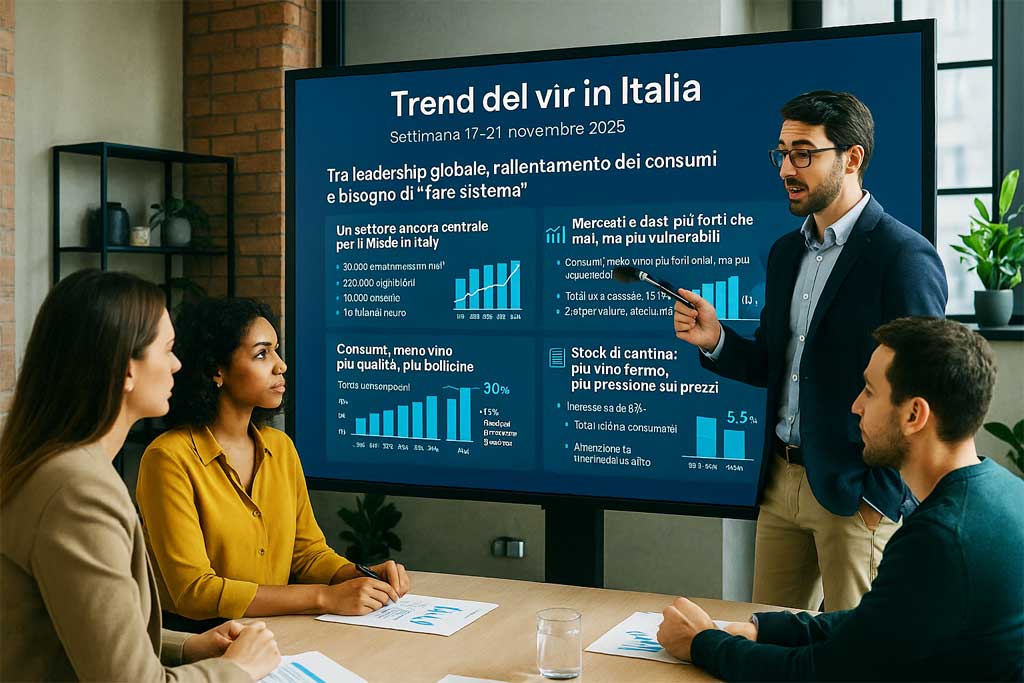
Wine Trends in Italy – Week 17-21 November 2025

Between global leadership, slowing consumption and the need to “work as a system”.

1. A sector still central to Made in Italy

In the week of November 17-21, 2025, the picture emerging from industry meetings, data from Nomisma, ICQRF, OIV, UIV, Confcooperative, and the 2024 financial statements reports is clear:

  • Wine remains one of the strategic assets of Made in Italy :
    • 30,000 processing companies
    • 240,000 agricultural companies
    • 74,000 employed
    • 16 billion euros in turnover , equal to 9% of the national food and beverage sector
  • Exports 2024 at 8.1 billion euros , 14% of agri-food exports:
    • Italy is the world’s leading exporter by volume
    • 2nd in value , behind France
  • From 2014 to 2024, exports went from less than 5 billion to 8.1: a doubling in ten years , despite crises, wars, inflation and the “health wave”.

In 2025, however, the wind has become more complex: in the first 7 months of the year, exports fell by 0.9% , in a context marked by new US duties (15%) , an unfavourable euro/dollar exchange rate and slowing consumption in all the main producing countries.

2. Markets and tariffs: stronger than ever, but more vulnerable

The picture on the markets is twofold: structural strength and cyclical vulnerability.

  • United States
    • First market for Italian wine: almost 2 billion euros in 2024 (10.2%)
    • From 2025 burdened by 15% duties on imports from the EU:
      • Actual effects postponed to 2026 price lists , because companies have brought forward shipments to build up stocks
      • Risk that the competitive advantage goes to local American producers
  • Diversification in progress :
    • Canada (15.3%) , Russia (40%) , South America, Eastern Europe, Asia are growing
    • Wine e-commerce is estimated to be worth $6.7 billion globally in 2025.
  • Geopolitics and global tariffs :
    • United States, Canada, China: strong volatility, with a collapse in exports for American producers and indirect impacts for Italy
    • The EU is working on a “Wine Package” and new agreements (Mercosur, India, Asia), with more funds for promotion (up to 80% co-financed)

The underlying message: the US market is irreplaceable, but no longer sufficient. 2026 will be a “year of review” for reorientation strategies.

3. Consumption: less wine, more quality, more bubbles

On the internal front the signs are structural:

  • Total consumption in long-term decline
    • From 1995 to today: -30% , to approximately 23 million hectolitres
    • Production, however, remains around 46–47 million hectolitres : half of the wine produced goes abroad.
  • Change the mix:
    • Sparkling wines account for 15.2% of consumption (almost doubled since 2010)
    • Whites remain at 39.6% (stable)
    • Rossi drops to 37.3% (from 43.9% in 2010)
  • The consumer changes:
    • Fewer “everyday consumers” (from 55% in 2008 to 40% in 2023)
    • More attention to quality, sustainability, moderation, freshness, lower alcohol content
    • No/low alcohol segment expected to grow strongly (20% expected by 2029)

In short: Italians drink less, but better , and this pushes companies towards higher positioning, but also towards new products.

4. Cellar stock: more still wine, more pressure on prices

The ICQRF report as of October 31, 2025, shows a system heavily loaded with products:

  • 44.5 million hectoliters of wine in stock
  • 14.3 million hectoliters of must
  • 14.3 million hectoliters of VNAIF (new wine still fermenting)
  • Compared to October 31, 2024:
    • Wine: 5.2%
    • Musts: 6.9%
    • VNAIF: 6.2%
  • 62.1% of the wine is from the North , primarily Veneto
  • Inventory structure:
    • 55.7% DOP
    • 25.3% PGI
    • 1.5% varietals
    • 17.6% other wines
  • Very high concentration : 20 denominations out of 526 make up 58.9% of the GI stocks

This backlog of inventories, while consumption slows, is one of the strongest pressures on prices and margins, especially for smaller companies.

5. 2024 Financial Statements: Turnover Grows, But Almost Half of Companies Lose Margins

The report by Studio Impresa – Management DiVino and Corriere Vinicolo (877 companies, revenues >1 million) offers a very clear economic x-ray:

  • Average result 2024
    • Revenues: 2% on 2023 (0.7% net of inflation)
    • Average EBITDA at 10.5% (7.4%)
  • But 415 out of 877 companies are losing profitability : the sector is growing, but not “for everyone”.

The key factor is the size of the company :

  • Big >50 million euros
    • Only 6.27% of the sample
    • They generate more than half of the 13.4 billion in revenues analyzed
    • Revenues in the three-year period 2022–2024: 8.4%
    • EBITDA growing (4.9%)
  • 20–50 million
    • Revenues: 4.5% in the three-year period
    • EBITDA: substantially stable (-1.2%)
  • 10–20 million
    • Revenues: -9.9% in the three-year period
    • EBITDA: 9.1% (those who were able to react restructured)
  • Under 10 million
    • 71% of the sample, but only 17% of the sector’s revenues
    • EBITDA in sharp decline:
      • <5 million: -16.4%
      • 5–10 million: -6.4%

Clear message: “Small is beautiful” can no longer withstand global competition . We need larger scale, managerial skills, efficiency, and aggregations .

At the regional level:

  • Veneto : first region for revenue volumes ( 4.35% in 2023 ), but only 13th for profitability (EBITDA 8.72%)
  • Tuscany, Lombardy, and Piedmont lead the generation of value:
    • Franciacorta (Brescia) EBITDA at 21.68%
    • Bolgheri (Livorno) even at 53.75%

6. Brand positioning, high-end and wine tourism

Despite the tensions, the “Italian wine” brand is holding up very well:

  • Top of the range
    • The “Italy 100” index remains slightly positive (0.6%)
    • Italy wins 138 medals and six “Best in Show” awards at the Decanter Awards.
    • 20 Italian wines enter the Wine Spectator 2025 Top 100 , with a strong presence from Tuscany (10 labels), Chianti Classico at the forefront and Barbaresco/Barolo consolidating the Piedmontese prestige
  • Champagne in Italy
    • Imports 1st half 2025: -10.5% in value , -10.3% in volume
    • Main reason: lower spending power and lower economic confidence among consumers
    • Potential space for Italian classic method and national sparkling wines with a better quality/price ratio
  • Wine tourism
    • 3 billion euros of expenditure
    • Over 15 million visitors (11%)
    • Very strong propensity to purchase directly from the cellar
    • Emerging areas are also growing (e.g. Badesi in Sardinia: 18% )
    • The winery experience is becoming increasingly immersive and digital , increasing the value of the brand-territory

7. Productive structure: wealth, fragmentation, dependencies

From a structural point of view:

  • Extremely high biodiversity
    • The top 10 grape varieties represent only 38% of the total , compared to 80% in Australia and 71% in France.
    • 409 DOP and 118 IGP products: a wealth of identity, but complex communication and marketing.
  • Entrepreneurial fragmentation
    • 124,000 agricultural companies in the supply chain
    • The top 100 companies cover between 46 and 55% of the turnover
  • Prosecco Addiction
    • Prosecco represents approximately a quarter of Italian bottled exports
    • Competitive advantage today, but also risk of concentration tomorrow

8. Major cross-cutting trends: climate, AI, regulation, young people

The structural challenges facing the sector:

  • Climate change
    • It impacts yields, harvest calendar, production geographies
    • It pushes towards new altitudes and territories, new styles (fresher, less alcoholic)
    • Increased disease and pest pressure; calls for investment in R&D and new molecules
  • Technological Innovation and Artificial Intelligence
    • Digital tools for:
      • vineyard management (drones, sensors, precision agriculture)
      • logistics efficiency and lightweight packaging
      • CRM, marketing and direct-to-consumer channels
  • European regulation and CAP
    • “Wine Package” in preparation, with more flexibility to rebalance production/market
    • Debate on uprooting vs. plant blocking
    • Risk of cuts to the CAP post-2027 and a “Single Fund” that renationalizes choices
  • Fiction about wine and health
    • Risk of demonization at international level
    • Push for campaigns on conscious consumption , on the cultural and territorial role of wine
  • Young consumers
    • Generation Z less tied to traditional consumption
    • They require authenticity, transparency, sustainability, less “courtly” languages and closer to their cultural codes

9. Strategic indications emerged during the week

From the various tables (Leonardo Committee, UIV, Confcooperative, Nomisma, institutions) some lines of direction converge:

  1. Making a system
    • Coordinate companies, consortia, cooperatives, institutions, ICE, SACE, SIMEST, and trade fairs (Vinitaly).
    • Using embassies and Italian restaurant networks around the world as brand multipliers
  2. Strengthen the structure of companies
    • Support aggregations, business networks, mergers and partnerships
    • Bringing managerial skills and data analysis to SMEs
    • Moving from “small is beautiful” to “small but connected, structured and integrated”
  3. Manage stock, value and product range
    • Manage inventories, avoiding price wars
    • Push for premiumization, DOP, experiences, wine tourism
    • Diversify beyond Prosecco, promoting classic method, local whites, distinctive reds, credible no/low alcohol wines
  4. Defending and relaunching the internal market
    • Less elitist, clearer communication, consistent with contemporary lifestyles
    • Educate towards moderate but qualified consumption
    • Bringing young people closer together with new languages, formats and consumption opportunities
  5. Supporting exports and emerging markets
    • Don’t give up on the USA, but open up South America, India, Southeast Asia, Eastern Europe
    • Making the most of the new EU co-financed promotion programmes

10. Final summary: a giant in transformation

Italian wine, in this week at the end of November 2025, presents itself as a giant in transition :

  • Stronger than ever in terms of reputation, biodiversity, market presence, and ability to create value in districts of excellence.
  • More exposed than ever to external shocks: tariffs, climate, currency dynamics, changing consumption, European policies.
  • More selective than ever within itself: large companies are running, small and medium-sized ones are struggling to maintain margins and competitiveness.

The common thread that unites data, conferences, and the positions of the protagonists is simple and challenging:
The future of Italian wine will depend on the ability to innovate without losing its identity, to grow in size and expertise, and to transform crises into opportunities to realign production, markets, and perceived value.

Style Selector
Select the layout
Choose the theme
Preset colors
No Preset
Select the pattern