A network portal of Wine Idea. Discover the world of Wine idea

Wine Trends and Performance in Italy – Week of November 24-28 – 2025

The last week of November highlights a wine sector embedded in a rapidly growing national agricultural and agri-food landscape, driven by certified quality, dynamic exports, and a significant evolution in consumption.

The picture shows a solid Italian wine industry, increasingly premium and at the heart of high-value-added supply chains.

A €21 billion DOP economy: stable wine, accelerating exports

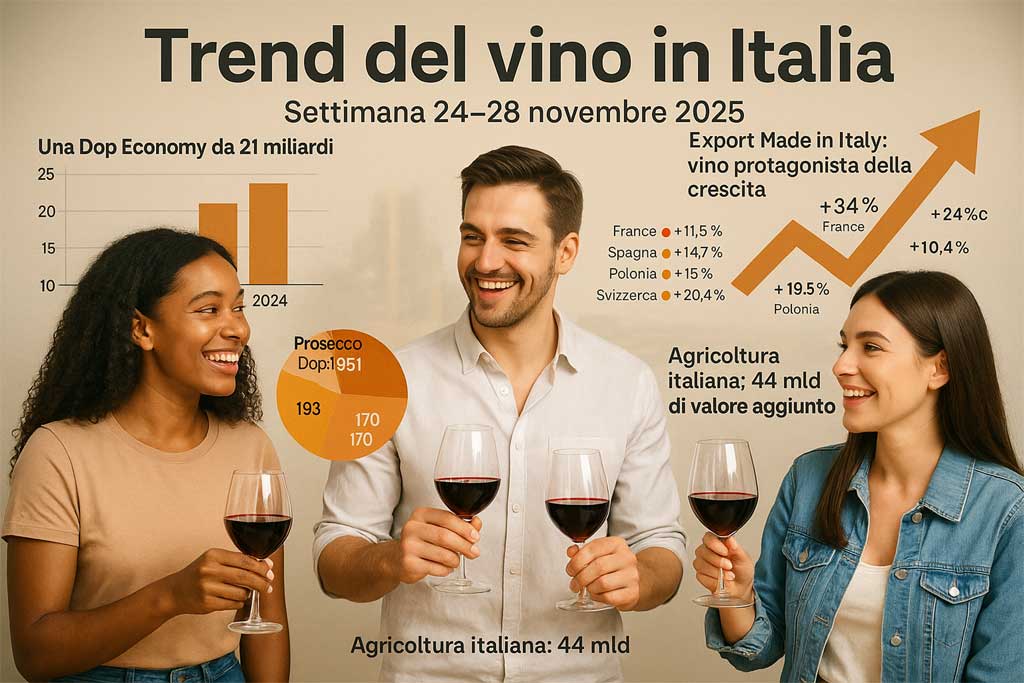
The XXIII Ismea–Qualivita Report confirms the strength of certified production: the PDO Economy will reach 20.7 billion euros in 2024 , 25% compared to 2020, with 328 Consortia , 184 thousand operators and an employment growth of 1.6%.
Bottled wine maintains a stable value of 11 billion , while overall PDO and PGI exports reach a new high: 12.3 billion euros (8.2%) , thanks to simultaneous records for food and wine.

The most dynamic areas are Lombardy (13%), Friuli Venezia Giulia (8%), and Puglia (12%). Veneto and Emilia-Romagna remain the epicenters of value, with a total of 8.9 billion .

Among the wines with the highest production value, the following stand out:

  • Prosecco Dop: 951 million (0.5%)
  • Delle Venezie Dop: 193 million (9%)
  • Conegliano Valdobbiadene-Prosecco DOP: 170 million (slightly down)

Made in Italy exports: wine leads growth

ISTAT data for September 2025 show foreign trade expanding: 10.5% in value , 7.9% in volume . Food and beverage grew by 6.9% in the month and 5% in the first nine months of the year, confirming its role as a cornerstone of the Italian trade balance.

Wine remains one of the most sought-after categories in premium markets, especially in non-EU countries. Exceptional performance:

  • United States: 34.7% , driven by wine and cheese
  • France: 19.5%
  • Spain: 14.7%
  • Poland: 15%
  • Switzerland: 10.4%
  • OPEC countries: 24.2%

Growth is based on certified quality, local identity, traceability, sustainable supply chains, and a structured presence on international markets.

Italian agriculture: €44 billion in added value

The Italian primary sector achieved a historic result: over €44 billion in added value , first in Europe. According to AGEA and INPS, government investments— €15 billion —have revitalized the sector, supporting:

  • recovery of 5 million hectares of abandoned land,
  • generational change,
  • increase in productivity and employment.

This agricultural solidity offers fertile ground for the entire wine industry, which benefits from policies geared towards production, legality, and the valorization of cultivated land.

Consumers, bubbles and new drinking cultures

The IULM analysis photographs a wine market in full transformation:

  • Italy is the third country in the world in terms of consumption by value .
  • Internal growth is driven by the pursuit of quality: less quantity, more value.
  • The sparkling segment continues to drive demand: 3.1 billion euros and 733 million litres in 2023 , with a clear premiumization dynamic.
  • Champagne sales are down (-8.4% globally), but Italian sparkling wines confirm their national and international leadership.
  • The low and no alcohol segments are increasing (5.9%) , especially among young consumers.

Gen Z is pushing for a different approach to wine: greater attention to sustainability, essential storytelling, light consumption opportunities, innovative formats, and greater health awareness.

Conclusion: a solid sector evolving towards quality, sustainability and premium positioning

Italian wine closes November 2025 with a strong structural picture: growing exports, certified production generating value, a national agriculture that invests, and a transforming domestic market.

The direction is clear:
Less volume, more value; less standardization, more identity; less tactics, more supply chain strategy .

This trend confirms the positioning of Italian wine as a crucial economic and cultural asset for Made in Italy and as a sector requiring informed industrial decisions, targeted investments, and a long-term strategic vision.

Wine Trends in Italy – Week 17-21 November 2025

Between global leadership, slowing consumption and the need to “work as a system”.

1. A sector still central to Made in Italy

In the week of November 17-21, 2025, the picture emerging from industry meetings, data from Nomisma, ICQRF, OIV, UIV, Confcooperative, and the 2024 financial statements reports is clear:

  • Wine remains one of the strategic assets of Made in Italy :
    • 30,000 processing companies
    • 240,000 agricultural companies
    • 74,000 employed
    • 16 billion euros in turnover , equal to 9% of the national food and beverage sector
  • Exports 2024 at 8.1 billion euros , 14% of agri-food exports:
    • Italy is the world’s leading exporter by volume
    • 2nd in value , behind France
  • From 2014 to 2024, exports went from less than 5 billion to 8.1: a doubling in ten years , despite crises, wars, inflation and the “health wave”.

In 2025, however, the wind has become more complex: in the first 7 months of the year, exports fell by 0.9% , in a context marked by new US duties (15%) , an unfavourable euro/dollar exchange rate and slowing consumption in all the main producing countries.

2. Markets and tariffs: stronger than ever, but more vulnerable

The picture on the markets is twofold: structural strength and cyclical vulnerability.

  • United States
    • First market for Italian wine: almost 2 billion euros in 2024 (10.2%)
    • From 2025 burdened by 15% duties on imports from the EU:
      • Actual effects postponed to 2026 price lists , because companies have brought forward shipments to build up stocks
      • Risk that the competitive advantage goes to local American producers
  • Diversification in progress :
    • Canada (15.3%) , Russia (40%) , South America, Eastern Europe, Asia are growing
    • Wine e-commerce is estimated to be worth $6.7 billion globally in 2025.
  • Geopolitics and global tariffs :
    • United States, Canada, China: strong volatility, with a collapse in exports for American producers and indirect impacts for Italy
    • The EU is working on a “Wine Package” and new agreements (Mercosur, India, Asia), with more funds for promotion (up to 80% co-financed)

The underlying message: the US market is irreplaceable, but no longer sufficient. 2026 will be a “year of review” for reorientation strategies.

3. Consumption: less wine, more quality, more bubbles

On the internal front the signs are structural:

  • Total consumption in long-term decline
    • From 1995 to today: -30% , to approximately 23 million hectolitres
    • Production, however, remains around 46–47 million hectolitres : half of the wine produced goes abroad.
  • Change the mix:
    • Sparkling wines account for 15.2% of consumption (almost doubled since 2010)
    • Whites remain at 39.6% (stable)
    • Rossi drops to 37.3% (from 43.9% in 2010)
  • The consumer changes:
    • Fewer “everyday consumers” (from 55% in 2008 to 40% in 2023)
    • More attention to quality, sustainability, moderation, freshness, lower alcohol content
    • No/low alcohol segment expected to grow strongly (20% expected by 2029)

In short: Italians drink less, but better , and this pushes companies towards higher positioning, but also towards new products.

4. Cellar stock: more still wine, more pressure on prices

The ICQRF report as of October 31, 2025, shows a system heavily loaded with products:

  • 44.5 million hectoliters of wine in stock
  • 14.3 million hectoliters of must
  • 14.3 million hectoliters of VNAIF (new wine still fermenting)
  • Compared to October 31, 2024:
    • Wine: 5.2%
    • Musts: 6.9%
    • VNAIF: 6.2%
  • 62.1% of the wine is from the North , primarily Veneto
  • Inventory structure:
    • 55.7% DOP
    • 25.3% PGI
    • 1.5% varietals
    • 17.6% other wines
  • Very high concentration : 20 denominations out of 526 make up 58.9% of the GI stocks

This backlog of inventories, while consumption slows, is one of the strongest pressures on prices and margins, especially for smaller companies.

5. 2024 Financial Statements: Turnover Grows, But Almost Half of Companies Lose Margins

The report by Studio Impresa – Management DiVino and Corriere Vinicolo (877 companies, revenues >1 million) offers a very clear economic x-ray:

  • Average result 2024
    • Revenues: 2% on 2023 (0.7% net of inflation)
    • Average EBITDA at 10.5% (7.4%)
  • But 415 out of 877 companies are losing profitability : the sector is growing, but not “for everyone”.

The key factor is the size of the company :

  • Big >50 million euros
    • Only 6.27% of the sample
    • They generate more than half of the 13.4 billion in revenues analyzed
    • Revenues in the three-year period 2022–2024: 8.4%
    • EBITDA growing (4.9%)
  • 20–50 million
    • Revenues: 4.5% in the three-year period
    • EBITDA: substantially stable (-1.2%)
  • 10–20 million
    • Revenues: -9.9% in the three-year period
    • EBITDA: 9.1% (those who were able to react restructured)
  • Under 10 million
    • 71% of the sample, but only 17% of the sector’s revenues
    • EBITDA in sharp decline:
      • <5 million: -16.4%
      • 5–10 million: -6.4%

Clear message: “Small is beautiful” can no longer withstand global competition . We need larger scale, managerial skills, efficiency, and aggregations .

At the regional level:

  • Veneto : first region for revenue volumes ( 4.35% in 2023 ), but only 13th for profitability (EBITDA 8.72%)
  • Tuscany, Lombardy, and Piedmont lead the generation of value:
    • Franciacorta (Brescia) EBITDA at 21.68%
    • Bolgheri (Livorno) even at 53.75%

6. Brand positioning, high-end and wine tourism

Despite the tensions, the “Italian wine” brand is holding up very well:

  • Top of the range
    • The “Italy 100” index remains slightly positive (0.6%)
    • Italy wins 138 medals and six “Best in Show” awards at the Decanter Awards.
    • 20 Italian wines enter the Wine Spectator 2025 Top 100 , with a strong presence from Tuscany (10 labels), Chianti Classico at the forefront and Barbaresco/Barolo consolidating the Piedmontese prestige
  • Champagne in Italy
    • Imports 1st half 2025: -10.5% in value , -10.3% in volume
    • Main reason: lower spending power and lower economic confidence among consumers
    • Potential space for Italian classic method and national sparkling wines with a better quality/price ratio
  • Wine tourism
    • 3 billion euros of expenditure
    • Over 15 million visitors (11%)
    • Very strong propensity to purchase directly from the cellar
    • Emerging areas are also growing (e.g. Badesi in Sardinia: 18% )
    • The winery experience is becoming increasingly immersive and digital , increasing the value of the brand-territory

7. Productive structure: wealth, fragmentation, dependencies

From a structural point of view:

  • Extremely high biodiversity
    • The top 10 grape varieties represent only 38% of the total , compared to 80% in Australia and 71% in France.
    • 409 DOP and 118 IGP products: a wealth of identity, but complex communication and marketing.
  • Entrepreneurial fragmentation
    • 124,000 agricultural companies in the supply chain
    • The top 100 companies cover between 46 and 55% of the turnover
  • Prosecco Addiction
    • Prosecco represents approximately a quarter of Italian bottled exports
    • Competitive advantage today, but also risk of concentration tomorrow

8. Major cross-cutting trends: climate, AI, regulation, young people

The structural challenges facing the sector:

  • Climate change
    • It impacts yields, harvest calendar, production geographies
    • It pushes towards new altitudes and territories, new styles (fresher, less alcoholic)
    • Increased disease and pest pressure; calls for investment in R&D and new molecules
  • Technological Innovation and Artificial Intelligence
    • Digital tools for:
      • vineyard management (drones, sensors, precision agriculture)
      • logistics efficiency and lightweight packaging
      • CRM, marketing and direct-to-consumer channels
  • European regulation and CAP
    • “Wine Package” in preparation, with more flexibility to rebalance production/market
    • Debate on uprooting vs. plant blocking
    • Risk of cuts to the CAP post-2027 and a “Single Fund” that renationalizes choices
  • Fiction about wine and health
    • Risk of demonization at international level
    • Push for campaigns on conscious consumption , on the cultural and territorial role of wine
  • Young consumers
    • Generation Z less tied to traditional consumption
    • They require authenticity, transparency, sustainability, less “courtly” languages and closer to their cultural codes

9. Strategic indications emerged during the week

From the various tables (Leonardo Committee, UIV, Confcooperative, Nomisma, institutions) some lines of direction converge:

  1. Making a system
    • Coordinate companies, consortia, cooperatives, institutions, ICE, SACE, SIMEST, and trade fairs (Vinitaly).
    • Using embassies and Italian restaurant networks around the world as brand multipliers
  2. Strengthen the structure of companies
    • Support aggregations, business networks, mergers and partnerships
    • Bringing managerial skills and data analysis to SMEs
    • Moving from “small is beautiful” to “small but connected, structured and integrated”
  3. Manage stock, value and product range
    • Manage inventories, avoiding price wars
    • Push for premiumization, DOP, experiences, wine tourism
    • Diversify beyond Prosecco, promoting classic method, local whites, distinctive reds, credible no/low alcohol wines
  4. Defending and relaunching the internal market
    • Less elitist, clearer communication, consistent with contemporary lifestyles
    • Educate towards moderate but qualified consumption
    • Bringing young people closer together with new languages, formats and consumption opportunities
  5. Supporting exports and emerging markets
    • Don’t give up on the USA, but open up South America, India, Southeast Asia, Eastern Europe
    • Making the most of the new EU co-financed promotion programmes

10. Final summary: a giant in transformation

Italian wine, in this week at the end of November 2025, presents itself as a giant in transition :

  • Stronger than ever in terms of reputation, biodiversity, market presence, and ability to create value in districts of excellence.
  • More exposed than ever to external shocks: tariffs, climate, currency dynamics, changing consumption, European policies.
  • More selective than ever within itself: large companies are running, small and medium-sized ones are struggling to maintain margins and competitiveness.

The common thread that unites data, conferences, and the positions of the protagonists is simple and challenging:
The future of Italian wine will depend on the ability to innovate without losing its identity, to grow in size and expertise, and to transform crises into opportunities to realign production, markets, and perceived value.

Harvest 2025: Italy on the Rise, Excellent Quality and a Market Seeking Balance

The 2025 harvest delivers a positive and, in many ways, encouraging production outlook for Italy. After a 2024 marked by climatic uncertainty and market tensions, the newly completed vintage brings the country back to the five-year average, with output estimated at 47.447 million hectolitres, equal to +8% year-on-year. But the real headline is quality: the grapes harvested stand out for their health, uniform ripening and very high oenological potential.

Harvest 2025: Italy on the Rise, Excellent Quality and a Market Seeking Balance

A mild spring and an early summer favoured a regular vegetative cycle and an overall earlier harvest, especially in the North. The result is a quality profile that promises fresh and long-lived wines in northern regions, balanced wines in central Italy, and structured, deep wines in the South.

Key Features of the Italian Vintage

Production on the rise
Total volume rebounds after two years of decline, realigning with historical standards. With over 47 million hectolitres, Italy confirms its position as the world’s leading wine producer, ahead of France, Spain and the United States.

High quality from North to South
Northern Italy: excellent ripening, intact grapes, pronounced aromatics. Early fermentations point to particularly clean and well-balanced white wines.
Central Italy: good day-night temperature variation and limited disease pressure favoured a uniform harvest.
Southern Italy: structured and highly expressive reds, with sugar levels well balanced by natural acidity.

Stable stocks
Despite higher production, wine stocks as of 30 September 2025 remain essentially stable. This signals an active—yet still fragile—market.

The hot topic: grape prices aren’t covering production costs

The 2025 harvest is generous in terms of quality, but the economic picture shows growing tension. The provincial president of Cia Cuneo, Claudio Conterno, raises an alarm echoed in many other Italian regions: “At this year’s average prices, it’s difficult to maintain vineyards.”

According to Conterno, a fair price for grapes should start at €1.20 per kilo, a figure that now coincides merely with production costs. Nevertheless, the season saw sharp fluctuations: almost no demand in July, followed by a sudden shortage of grapes during harvest.

Conterno also highlights another critical issue: the weight of industry players in price formation. In the Langhe, he notes, 70% of grapes are vinified directly by growers, 20% by cooperatives, and only a small share by industry. Yet the latter continues to significantly influence grape prices, even in territories where production costs—including land—are incomparable.

At the same time, the Cia president comments on wine’s public image: “Wine is often demonised, while other beverages with a much greater health impact are rarely questioned. When consumed in moderation, wine is part of our landscape, our culture and our work.”

The global picture: low production, but a more stable market

While Italy posts a positive season, the rest of the world remains in a delicate balance. According to the OIV report published in November 2025, global production is estimated at 232 million hectolitres—the third lowest ever recorded.

The figure represents only a timid recovery compared to 2024 (+3%), yet remains 7% below the five-year average.

Paradoxically, this is not necessarily bad news. Lower production is helping stabilise the global market, in a context marked by weak demand, high inventories and persistent trade tensions.

Main Producers in 2025
– Italy: 47.3 mln hl, +8%
– France: 35.9 mln hl, –1% (second-lowest harvest since 1957)
– Spain: 29.4 mln hl, –6%
– United States: 21.7 mln hl, +3%
– Australia: 11.6 mln hl, +11%
– Argentina: 10.7 mln hl, –1%

Europe: a mix of recovery and difficulty
Italy leads the continent, while France, Spain, Germany and Portugal continue to face unfavourable climatic conditions. Romania stands out in the opposite direction, growing by 30% and surpassing 4 million hectolitres.

Southern Hemisphere recovery
After three challenging harvests, the Southern Hemisphere shows a 7% increase. Australia, South Africa, New Zealand and Brazil all report positive trends thanks to more favourable weather conditions.

A harvest that encourages, a market that demands stability

The 2025 vintage confirms the solidity of Italian viticulture, both in quantity and quality. The challenge now is economic: ensuring profitability for producers, containing market fluctuations and enhancing a production that demonstrates resilience and adaptability year after year.

A country that continues to be a global leader cannot overlook the real value of grapes, vineyard labour and the cultural heritage embodied in every bottle. The 2025 harvest marks a fresh start; the future will depend on the sector’s ability to achieve a more stable and sustainable balance.

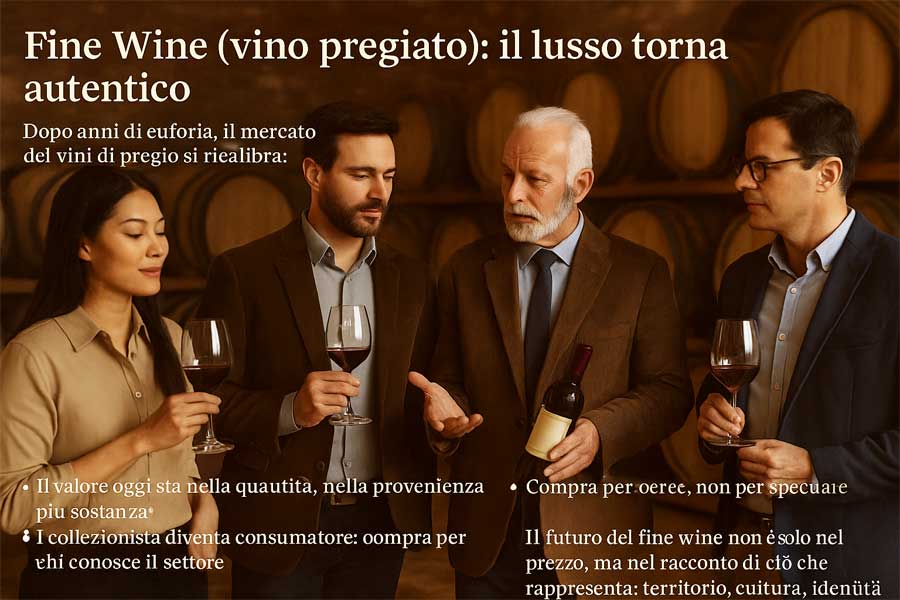
Fine Wine: The Market Changes Pace

From speculation to experience, the new paradigm for producers and investors.

The fine wine sector is entering a phase of maturity that is forcing operators and investors to review their strategies.

After the post-pandemic euphoria and the subsequent market “cooling,” fine wine is now moving between a physiological price correction and the rediscovery of its authentic value: quality, provenance, and ability to generate experience.

Fine wine is no longer just an alternative asset or a safe haven, but a segment that measures the strength of a brand, the reputation of a region, and the consistency of a corporate vision over time.

A changing economic cycle

The three-year period 2020–2022 represented a historic exception: the combination of high liquidity, global lockdowns, and near-zero interest rates fueled abnormal demand for fine wines, particularly from Champagne, Burgundy, and Bordeaux, with a positive impact on Italy’s great reds as well.

Since 2023, the curve has inverted. The withdrawal of liquidity, the normalization of the luxury market, and the decline in global consumption have pushed the market toward an inevitable downturn.
The indicators speak clearly: in 2025, the Liv-ex Fine Wine 100 is down 4.9% since the beginning of the year, while the Liv-ex 1000 , which summarizes over a thousand global labels, has lost over 24% in two years.

It’s not a collapse, but a structural reset . The market is eliminating speculative distortions and returning to reward the intrinsic value of bottles, the reputation of brands, and their ability to offer real and consistent consumer experiences.

New drivers: quality, authenticity and immediacy

Demand is changing. Investors and collectors are now showing a growing preference for mature, ready-to-drink wines that combine economic value and sensory gratification.

This is also reshaping market psychology: the bottle is no longer a financial asset, but an experiential asset . At the same time, the cost of long-term storage and price volatility are accelerating this transition.

For manufacturers, this paradigm shift opens a strategic window: brands capable of combining consistent quality, credible storytelling, and coherent pricing policies will be able to gain competitive ground, both in direct channels and on the secondary market.

Tactical opportunities and positioning

Paradoxically, the reduction in prices creates a favorable environment for new acquisitions or diversification operations .
Many iconic labels are now trading 30–50% below their 2022 highs, making it possible for savvy operators to enter premium segments with lower barriers to entry.

At the same time, the auction market confirms its structural resilience : Sotheby’s recorded over $114 million in sales across 61 auctions in 2024, a sign of continued robust but more selective demand. The focus is on established vintages, rare formats, and certified provenance—elements that reinforce the brand’s perception of reliability.

For investors, this means that value no longer arises from the expectation of automatic capital gains, but from the ability to choose with skill and vision .

Understanding who buys

Analyses by the Areni Global Institute show that the fine wine market, while remaining a niche, involves three well-defined price ranges:

  • affordable luxury ($50–$150),
  • experiential luxury ($200–$900),
  • the iconic and collectible luxury (over $1,000).

Demographically, these are increasingly younger consumers (under 44), culturally sophisticated, with a selective approach to spending and oriented towards perceived quality.
For wineries, this means that brand building —its recognizability, production transparency, and ability to convey cultural value—becomes the true competitive lever.

The new rules for producers

Entering or remaining in the fine wine segment today requires clear strategic governance :

  • consistency between positioning, price and communication;
  • rigorous quality control and traceability;
  • presence on the secondary market to consolidate reputation;
  • disciplined management of discount and mark-up policies, to avoid perceptual distortions;
  • building alliances along the supply chain (distributors, communicators, high-end marketplaces).

In a less euphoric but more rational market, the difference will be made by those who know how to combine the industrial dimension with the identity one , speaking to the global public with authenticity and coherence.

Outlook: From Financial Value to Cultural Value

The future of fine wine will be written by those who know how to interpret this moment as a phase of rebalancing and strategic repositioning .
The new generations don’t buy status, they buy meaning: they demand traceable, sustainable, and recognizable wines. This is an invitation to wineries and investors to rethink their role not as mere market operators, but as custodians of cultural value .

In this return to substance—terroir, authenticity, identity—fine wine rediscovers its original mission: to be a symbol of territory and a generator of real, economic, and reputational value .

Style Selector
Select the layout
Choose the theme
Preset colors
No Preset
Select the pattern