Today’s wine trend.
1. Quick summary (Italy & the world)
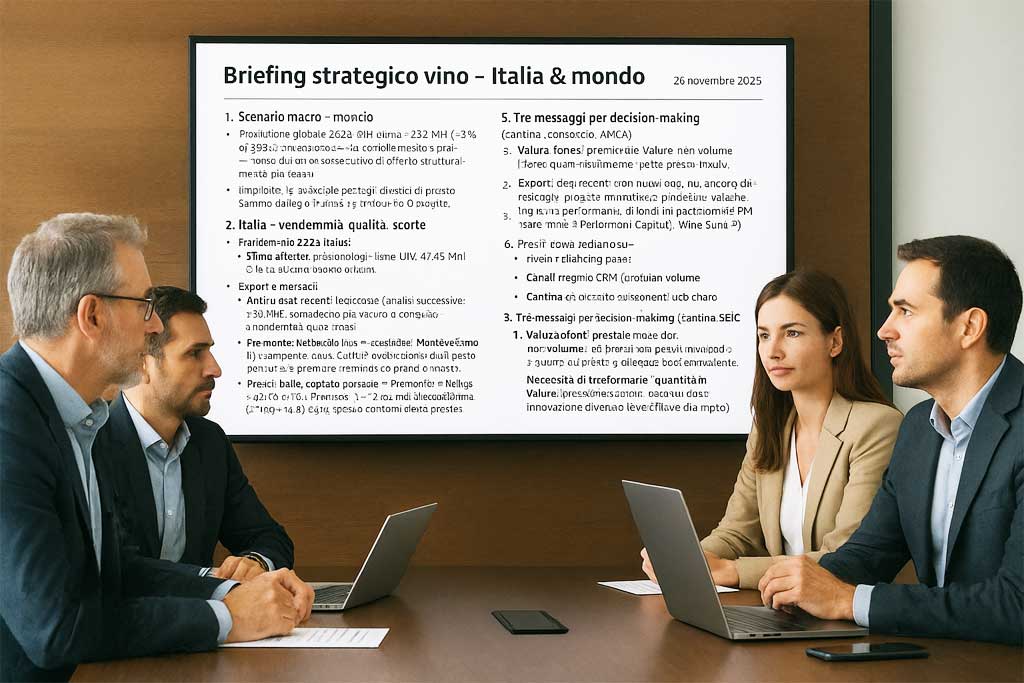
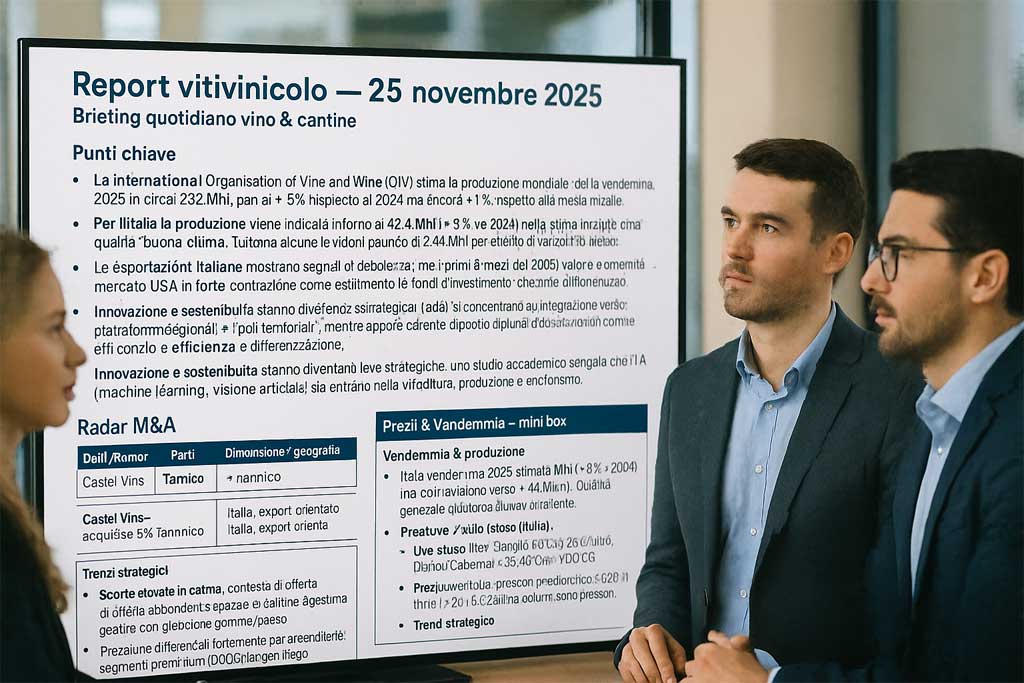
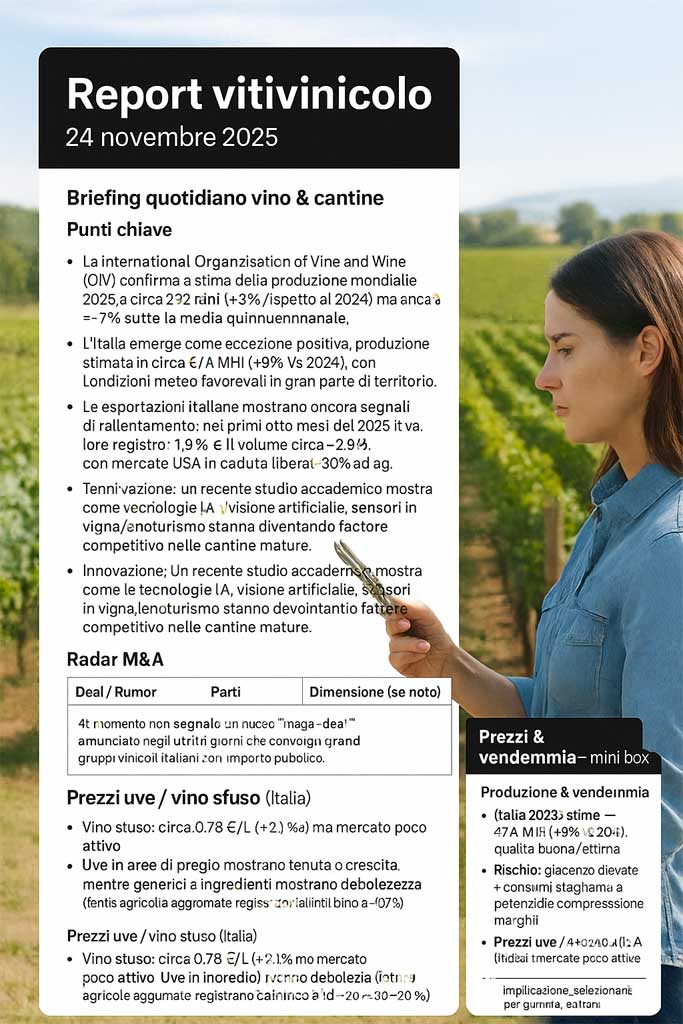
- World supply is still “short”, but recovering slightly: after the minimum production of the last 60 years in 2024, production in 2025 is estimated at around 232 mhl (3% compared to 2024, but below the five-year average) ; the dominant causes remain climatic extremes and a structurally weaker demand.
- Italy returns to “full” volumes: 2025 harvest estimated at 47.4 million hl (8% on 2024) , with good to excellent quality and fears of overproduction in various basins (North-East and some red PDOs).
- Italian exports are at a record high, but more competitive: in 2024, Italy exported 21.7 million hl for €8.1 billion (5.5%) , leading the world in volume and second in value. At the same time, pressure on prices and positioning is growing, with demand shifting toward whites, rosés, and sparkling wines , and strong growth in organic wines.
- Producer prices: slight 1%, but polarized: ISMEA index 2024/25 1% overall: common wines 4% (whites leading), DOC/DOCG -2% (reds weaker), IGT 1%. In November, many bulk wine prices were stable w/w but below year-ago levels .
- Selective but lively M&A: few buyers, many sellers; large groups only make targeted acquisitions (heritage brands, premium positions, strategic markets). Examples: the creation of Vinarchy from the Pernod Ricard Accolade wine portfolio, the acquisition of the historic Simi brand by WarRoom Cellars, and the integration of cooperative wineries in the Veneto region.
2. Export & demand
Italy
- 2024: 48 million hl produced (13% vs 2023) and domestic consumption stable at 22 million hl (~37.8 l per capita) .
- Exports 2024: €8.136 billion , with PDO at 68% of the exported value and sparkling wines at 29% (Prosecco DOC almost a quarter of the national PDO production).
- Consumption trends: structured, everyday reds are decreasing, while fresh whites, rosés and Charmat methods are increasing, in line with the positioning of many Italian PDOs.
- Markets: risk of tariffs on some key outlets (USA) pushes to diversify towards Canada, Asia and digital channels , with global wine e-commerce expected to grow strongly by 2025.
World
- OIV: Global production and consumption in 2024 at their lowest since the early 1960s; inflation, geopolitical instability, and changing habits (less alcohol, less daily drinking) are weighing on volumes, while premiumization remains the value driver.
Operational analysis: for an export-oriented Italian company, it becomes crucial to narrow its portfolio around 2–3 strong axes (e.g., sparkling wines, gourmet whites, iconic red wines) and build targeted plans for the USA/Canada, Northern Europe, and select Asian markets.
3. Prices & Harvest (Italy)
Box – “Prices & Harvest”
- Volumes & Quality 2025 (Italy)
- Assoenologi–Ismea–Uiv estimate: 47.4 million hl (8% vs 2024) , with quality ranging from “very good” to “excellent” in most areas; specific critical issues where late rains or extreme events have affected health.
- Signs of oversupply on some volume red varieties and on PDOs in already overexposed areas.
- Grape and wine prices (trend)
- 2024/25 campaign: producer price index 1% overall; common wines 4% (whites in particular), DOC/DOCG -2% (reds suffering), IGT 1% .
- Weekly Ismea data on wine (November 2025): in some reference markets, basic white and red wines are around €4.5–5.4/hectoliter , stable compared to the previous week but in several cases between -4% and -22% on an annual basis , a sign of a market that is slowly absorbing the increased production.
- Stocks & Inventory
- According to Federdoc, Italian stocks as of June 30, 2025 were 43.6 million hl , slightly above the previous year, despite the 2024 harvest being the lowest in the last 60 years: the system therefore enters the 2025 harvest with warehouses still full .
- Climate & yields
- The 2024/25 reports confirm the need to revise yields and specifications to align supply with new climatic conditions and actual demand, with proposals to reduce yields/ha and review “surplus” production.
Practical implication: today the real margin driver is not “producing more”, but managing volumes (yields, inventory management, outlets such as distillation/musts) and protecting the average value per bottle.
4. M&A Radar (last period)
(actual deals and strategic signals, Italy and the world)
- WarRoom Cellars – SIMI (California, USA)
- Type: acquisition of a historic brand
- Parties: WarRoom Cellars (California Central Coast) acquires the Simi brand from The Wine Group.
- Size: Undisclosed; Simi produces ~340,000 cases/year, mid-premium.
- Strategic message: focus on undervalued heritage brands to relaunch with a lean structure (production outsourcing, targeted marketing).
- Pernod Ricard → Vinarchy (Australia/Spain/New Zealand)
- Type: Portfolio transfer to create a new global group
- Shares: Pernod Ricard sells its international wine portfolio to Australian Wine Holdco (owner of Accolade Wines), creating Vinarchy as a new major pure wine player.
- Strategic message: concentration of assets in specialized vehicles , with strong pressure to rationalize brands and production sites.
- Vinarchy – Portfolio Streamlining
- Planned cut of approximately 40% of brands (over 60 labels) to focus investments on global brands (e.g. Jacob’s Creek, Hardys) and on new low-alcohol products, small formats, and RTDs designed for young people.
- Collis Veneto Wine Group – Monteforte d’Alpone Winery (Veneto, Italy)
- Type: incorporation of social winery
- Shares: Collis Veneto Wine Group integrates the Monteforte d’Alpone winery, strengthening its critical mass in the Veneto cooperative segment.
- Strategic message: In Italy, the movement toward aggregation among cooperatives/POs continues to increase bargaining power and investment capacity.
- Santa Margherita – Marsh Estate (Oregon, USA)
- Type: acquisition of a foreign company
- Shares: The Santa Margherita Group acquires the Marsh Estate in Oregon, continuing its expansion in the US after several previous transactions.
- Strategic message: confirmation of the ” short supply chain in the target market ” logic: physically presence in key countries with local production assets.
General context: The M&A market is experiencing a phase with a few selective buyers and many potential sellers , especially undercapitalized family businesses and cooperatives under price pressure.
5. Regulation & Policy
- EU Labelling – Ingredients & Nutritional Values
- From 8 December 2023, all wines in the EU must provide a list of ingredients and nutritional values; the use of e-labels via QR code is permitted, provided that the information area is separated from the marketing area.
- Italy – Revision of the Consolidated Wine Act (L. 238/2016)
- Federdoc and other organizations are calling for a thorough overhaul : reduced yields, updated specifications, management of redundancies, simplified controls, and reform of the denomination system (including the possibility of regional mergers).
- New tax stamps and traceability
- A new, more secure and legible tax stamp model has been under testing since July 28, 2025 , designed to integrate with digital systems (QR, RFID, NFC) and strengthen the fight against counterfeiting.
- Italian Parliament fact-finding inquiry into the wine sector (2025)
- The Agriculture Commission has launched a process of analyzing the sector’s prospects in 2025, signaling possible future interventions regarding profitability, competition, and crisis management tools.
Translated for companies: compliance is no longer just an “obligation”, but a competitive lever : those who structure data, traceability and digital communication well today will be able to stay ahead of the curve on markets, controls and premium channels tomorrow.
6. Innovation (vineyard, cellar, market)
- AI and robotics in the vineyard
- Projects like Astibot in Spain and other European initiatives on pruning and vineyard management robots aim to reduce labor requirements and improve quality and safety.
- International reports highlight the growing use of AI-powered tractors and sensors for precision irrigation, disease monitoring, and yield forecasting, with benefits in terms of costs and sustainability.
- Digital platforms & decision support
- Solutions like Scout (analytics for precision viticulture) and management software with integrated AI (e.g., Crafted and similar) are starting to provide insights into individual plots and for the integrated management of the vineyard, cellar, and warehouse.
- E‑label, blockchain and Digital Product Passport
- Several platforms (e.g. SwearIt, e‑label, WineOnChain) leverage QR codes and blockchain to create digital wine passports , combining EU compliance, brand storytelling, and anti-fraud traceability.
Key takeaway: It’s not necessary to immediately adopt “deep tech” solutions, but it’s a good idea to identify 1–2 pilot projects (e.g., e-labels for simple sensors in vineyards) that can deliver concrete data and benefits within 12–24 months.
7. Strategic reading for wineries, consortia, and M&A operations
- Excess supply = right time to reposition your portfolio
- With a plentiful 2025 harvest and high inventories, those who continue to chase volumes alone risk a permanent compression of margins.
- Priorities: redesign the mix (fewer “weak” labels, more focus on DOP/IGT with a clear value proposition), work on returns and inventory management, and negotiate industrial outlets to free up warehouses without damaging the main brands.
- Aggregation as a response to fragmentation
- The Collis Veneto–Monteforte d’Alpone case shows that the cooperative/aggregative approach is concrete: greater critical mass means greater strength in large-scale retail trade/export and more resources for marketing and innovation .
- For many small and medium-sized businesses, the choice is clear: seek an alliance/integration (horizontal or vertical) or strengthen their niche positioning with high margins and selective channels.
- M&A: From “Selling the Winery” to “Selling an Industrial Project”
- The big players are buying stories, brands, and market access , not just hectares and tanks. Preparing a transaction means clarifying the identity, margins per line, growth potential over 3–5 years, and realistic synergies for a potential buyer.
- In a context of few buyers, those who arrive with a well-constructed dossier have a better chance of closing and better defending the valorization .
- Compliance & data as an asset, not a cost
- Digital labels, new taxation, and demands for traceability and sustainability will push us to organize our vineyard, cellar, stock, and market data .
- A winery or consortium group that can accurately measure yields, costs per label, environmental impact, and performance per channel is in a strong position both with respect to distribution and in a potential M&A round.
- Innovation in steps, not in leaps
- Technology today allows you to start with targeted interventions (e.g., an AI pilot project for irrigation on a few hectares, or a serious CRM for top foreign clients) and scale them up only if they generate clear returns.
- The important thing is not to stand still : while large groups like Vinarchy are rethinking their portfolios and models, even family businesses and cooperatives can carve out space for themselves, if they move with determination and clarity.