
A network portal of Wine Idea. Discover the world of Wine idea

Wine press review for Friday February 20 – 2026

Wineries, Italian wine producers, and wine news.

ITALIAN WINERIES

The crisis is not just macroeconomic: it affects structures, territories, and production models.

  • Terre d’Oltrepò faces insolvency. The historic Pavia cooperative enters the decisive phase of its crisis: the liquidator is seeking a judicial declaration of insolvency. Banks are alarmed, the 2025 harvest is at risk, internal tensions and fragile governance are at the heart of the problem.
  • Piedmont, full cellars and plummeting grape prices. Barolo, Barbaresco, Barbera, Dolcetto, and Moscato are suffering from an unprecedented oversupply. Record stocks, domestic consumption at 20 liters per capita, and grape prices down as much as 30%. Consortia are denouncing a structural crisis in the Regional Council.
  • Passopisciaro, Etna according to Andrea Franchetti. The story of one of the volcano’s iconic wineries: districts, centuries-old vines, and an identity-driven vision that continues to inspire Etna DOC.
  • Baglio di Pianetto: A New Etna Path The Etna project is entering a mature phase: fresher and more elegant local wines, positioned at an accessible price, after five experimental vintages.
  • Corte Normanna (Sannio) Relaunch of historic labels and strong focus on Falanghina sparkling wines: Classic Method and Charmat become central to the production model.
  • Pisoni (Trentino) Since 1852, the winery-distillery has been valorizing grape pomace by transforming it into high-quality grappa: a concrete example of the circular economy applied to wine.
  • Castello di Spessa and Villa Russiz (Collio) Two iconic estates in the Gorizia Collio area: history, elegance, tourism, and a great tradition of white wines.
  • The vineyard by the sea (Maremma) A small organic farm in Capalbio, born from a lifestyle choice: quality, nature, and participation in the Slow Wine Fair.
  • Malabaila (Roero) 664 years of winemaking history: one of Piedmont’s oldest wineries showcases its region as a key identity and cultural embassy abroad.

ITALIAN WINE AND ITALIAN OENOLOGY

Regulations, internal market, sustainability and new trajectories.

  • Structural crisis in Italian wine. Piedmont is a case in point: falling grape prices, high inventories, and denominations under pressure.
  • Vineyard renewal: Lombardy allocates over 5 million EAAG funds for the 2026–2027 campaign, aiming to strengthen PDO and PGI products (which account for 90% of regional production).
  • Organic under scrutiny: FederBio. Abandoning organic is a strategic mistake. After growth, the sector is entering a phase of adjustment, but it remains crucial for climate and competitiveness.
  • Drones and Precision Agriculture : The Simplification Bill gives the green light to trials of pesticide treatments using drones. The Masaf implementing decree is expected by March.
  • Unsold Barbera and Dolcetto: Thousands of Piedmontese companies are struggling: declining trade, rising inventories, and falling yields and prices.
  • Chianti and Morellino di Scansano: Production is declining, but quality is high. Chianti is looking to new markets (Africa and India), while Morellino is growing domestically.
  • Rankings and territories The best Ligurian white wines near Sanremo according to Gambero Rosso: Vermentino and Pigato as identity flags.
  • Wine and health Nutrition and metabolism: the food context matters as much as the calories in wine.
  • Carlo Petrini: A New Regeneration for Wine. Forty years after the methanol scandal, wine needs a new ethical, cultural, and production pact.

INTERNATIONAL

Clear signals: overproduction, falling consumption, and financial tensions.

  • Jancis Robinson: “Too much wine.” Too much unsold wine around the world. Australia, France, and New Zealand are struggling with declining exports and production models that need rethinking.
  • EU exports in decline. Bottled PDO wines have lost €424 million in three years. An overall decline of 2.8% in value.
  • Treasury Wine Estate in crisis. The Australian giant closed the first half of the year with operating income down 39.6%, write-downs of over AUD 770 million, and a halt to dividends.

WINE EVENTS AND SYSTEM

Trade fairs, EU policies, and new promotional platforms.

  • The Best Italian Wines – Rome EUR 25th edition of the event hosted by Luca and Francesca Romana Maroni. The 2026 focus is on dealcohol-free and low-alcohol wines.
  • FuoriVinifera (Trentino) 100 Alpine winemakers among cellars, palaces, and vineyards: the event changes format and territory.
  • Cristina Mercuri, the first Italian Master of Wine. A historic milestone for education and equality in the wine world.
  • EU Wine Package approved. Green light from the European Parliament: new rules on dealcohol products, labeling, and market instruments.
  • Wine and Sicily Package: Concrete opportunities for one of Italy’s key wine regions: competitiveness, related industries, and employment.
  • Wines Experience: A new international platform for promoting Italian wine in the UK, Vietnam, and Mexico.

Thanks for listening. Today’s wine press review is brought to you by WINEIDEA.IT .

See you tomorrow.
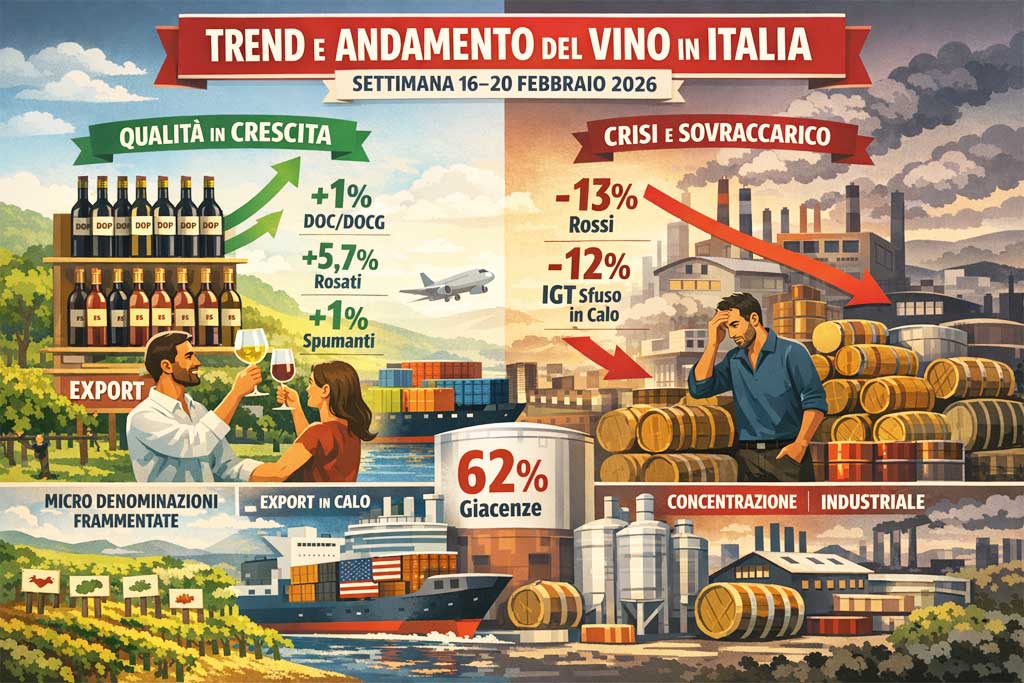
Wine Trends and Performance in Italy — Week 16–20 February 2026

The week of February 16–20, 2026, shows a sector that is holding steady in “certified” quality volumes, but experiencing growing industrial tension: weak global demand, slowing exports, bulk prices under pressure and inventories that continue to rise despite a “contained” 2025 harvest.

The result is a two-speed Italian wine industry: DOP, whites, and sparkling wines are more resilient, while reds and “generic/IGT” labels are suffering much more.

In the background, a structural theme emerges: fragmentation of denominations and, simultaneously, greater industrial concentration in certified volumes.

1) Bottling 2025: -2.1% overall, but the DOP range is growing

Valoritalia data (updated to December 31, 2025) indicates an overall decline of -2.1% compared to 2024 in certified bottling. However, the message is not a “collapse,” but rather a stabilization : volumes remain higher than pre-Covid , and the contraction is considered limited .

Inside that -2.1% is the most interesting part:

  • DOC/DOCG: 1% (on an annual basis and compared to the average of the last three years) → “organized” quality continues to act as a driving force, especially for exports.
  • IGT: -12% compared to 2024 (and -10% on the average of the previous three years) → net decline of the largest and often most “commodity” or least identifiable segment.

Strategic reading: the market is rewarding identity, recognisability and positioning , penalising what is perceived as “interchangeable”.

2) The demand is changing: whites, rosés, and sparkling wines are ahead; reds are slowing down significantly.

The typological divide is now structural and will become even more evident in 2025:

  • Sparkling wines: 1%
  • Rosé: 5.7%
  • Still whites: 2.7%
  • Rossi: over -13%

What it really means: It’s not just “trend.” It’s a shift in consumption (in Italy and around the world) toward fresher, less demanding wines , often more compatible with new drinking styles and a growing awareness of alcohol, lightness, and immediacy. Regions historically associated with full-bodied reds risk paying a double price: declining demand and stagnant inventory.

3) Micro-denominations: many acronyms, little critical mass (and more vulnerability)

The appellation breakdown by size is a key point this week. The micro-appellations (under 10,000 hl) are:

  • 70% of certified DOs , but
  • only 2% of bottled volumes , and in 2025 they will be -7.2% (worse than average).

The dynamics by size range show that critical mass matters :

  • 10–20,000 hl: 3%
  • 20–50,000 hl: -4.7%
  • 50–150,000 hl: 4%
  • over 150,000 hl: -2.7%

Diagnosis: Micro-DOs struggle to cope with market fluctuations, costs, and commercial complexity. Having a name isn’t enough: you need a strong structure (a strong consortium, planning, promotion, and channels).

4) Production structure: hyper-fragmented at the base, concentrated at the top

The numbers confirm a sector made up of many small operators and very few large ones:

  • over 75% of certified bottlers sell less than 65,000 bottles
  • only 171 companies (3.2%) exceed 1.3 million bottles
  • the first 5 operators bottle 18% of the total certified volumes, despite being 0.1% in number

Implication: competition is no longer just “product vs. product,” but increasingly an organized system vs. fragmented system . Small businesses must choose: either they become ultra-specialized and premium , or they merge (commercially or industrially).

5) The major industrial hub: stable production, but growing inventories

Here lies the “paradox” that is squeezing margins and financial serenity.

  • 2025 harvest: 44.38 million hl (approximately 0.7% compared to 2024)
  • Wine stocks: 61 million hl ( 6% per year)
  • Wine and must stocks: almost 68 million hl ( 7.5% )

According to UIV, after two campaigns of just over 44 million hl, even these volumes are no longer sustainable if demand is not absorbed.

Where the surplus is concentrated:

  • common/varietal wines: 11.3%
  • White IGT: 10.5%
  • DOP: 3.6% (more stable, but still increasing)

Immediate effect on the market:

  • Cellar sales: -20% compared to 2024 peaks
  • Bulk prices: weak, with common whites down over 10% in several areas

Brutal translation: more inventory = more idle capital = more pressure on prices and liquidity, especially for those operating in segments less protected by brands/names.

6) Exports and markets: relative stability, but the direction is still negative

The international picture remains complex. The aforementioned analyses (Nomisma Wine Monitor) report a 3% decline in the value of Italian exports , in a context where other competitors (Australia, Chile, France) are performing worse. It’s a “victory on points,” not a triumph.

On the US front and trade tensions, UIV reports:

  • US shipments 2025 estimated -9% in value
  • extra-EU around -6.5%
  • many companies have reduced their price lists by ~10% to defend their shares (margins under stress)

At the same time, in the US alcohol market, wine is declining (-3.5%) , while ready-to-drink products are growing strongly (16.4%), i.e. simpler, cheaper and “immediate” to enjoy.

The underlying message: simply “being present” in traditional markets isn’t enough. We need to reallocate our energies to third-party markets , trade agreements (Mercosur/India), and a more aggressive and continuous presence on the markets.

7) Data, control and planning: TESSA and the new reporting system for Consortia

An often underestimated but strategic point: data quality becomes a competitive lever.

Valoritalia is pushing the TESSA platform (developed with Microsoft) to process the movements of over 90,000 companies across 219 certified denominations , and is introducing monthly reporting for Consortia with indicators on:

  • sampling, bottling
  • bulk sales/transfers
  • downgrades/reclassifications
  • analytical parameters, stocks, volumes
  • socioeconomic indicators (members/non-members, concentration indices)

Why it matters: in 2026, those who know how to plan (supply, yields, inventories, channels) will win, not those who “suffer” the market.

What this week really tells us (in one sentence)

Italian wine enters 2026 with a supply chain that relies on organised quality , but must face an industrial challenge that cannot be postponed: too many inventories compared to demand , with the need for production flexibility, organisational consolidation and commercial repositioning .

Wine press review for Thursday February 19 -2026

Wineries, Italian wine producers, and wine news.

Italian wineries

Cantina Terre d’Oltrepò faces insolvency. The Oltrepò cooperative, already in compulsory administrative liquidation, now risks insolvency. The liquidator’s report highlights an irreversible financial crisis, exacerbated by the freeze on bank loans starting in early 2025. This case is emblematic of the structural weaknesses of some large cooperatives.

Cantine I Favati looks to the US West Coast. The Irpinia winery embarks on a strategic mission to the United States, with tastings and dinners in San Francisco for industry professionals. This positioning initiative focuses on authentic Italian wine regions, with the support of wine director Shelley Lindgren.

Moncalisse debuts on international markets with Trentodoc. An exclusive event in London marks the international launch of the new winery founded by Julia and Karoline Walch. Italian sparkling wines remain a key pillar of exports, with sparkling wines expected to generate between €1.6 and €1.7 billion in 2024 and 2025.

Leone de Castris joins “Les Hénokiens.” The historic Salento winery joins the international club of companies with over 200 years of history. This recognition reinforces the cultural, heritage, and industrial value of Italian wine worldwide.

Castello di Uviglie: Classic Method and Monferrato UNESCO. A winery that intertwines history, centuries-old crus, and territorial valorization. The vineyards, some documented since 1491, tell the story of a Monferrato where wine is an integral part of the cultural landscape.

Costa Arènte, Valpantèna in the spotlight Ten years after its acquisition by Genagricola, the winery celebrates its journey within the Le Tenute del Leone Alato project, which combines winemaking quality, territorial storytelling, and experience.

Manduria producers tasting in Brescia. Free tasting of Apulian wines and Primitivo di Manduria DOC and DOCG, with a focus on sustainability and biodiversity.

Vecchie Terre di Montefili presents two new Gran Selezione wines : the 2026 Chianti Classico Collection debuts Vinea Vecchia and Vinea Nel Bosco, two high-altitude Sangiovese wines that express an agronomic vision of precision and respect for natural rhythms.

Italian wine and Italian oenology

Italian exports 2025: 3.3% despite tariffs. Istat data confirms growth in exports and the trade surplus. Trade with the United States remains under close scrutiny, but the manufacturing system demonstrates resilience and internationalization.

Record-breaking Italian agri-food exports: €73 billion . In 2025, agri-food exports are expected to grow by 5%. Wine is slowing (-3.6% in the first 11 months), but it still represents 10% of the total, confirming its strategic position as a Made in Italy asset.

Langhe: from scandal to world leadership The story of the rebirth of Langhe viticulture after the adulterations, thanks to the DOC, the controls and a quality model that today is a global reference.

Too Much Unsold Wine: A Critical Analysis by Jancis Robinson The Master of Wine photographs a global crisis of overproduction and declining consumption: Australia, France, and New Zealand are grappling with full tanks and production models that need to be rethought.

EU wine exports are declining: PDO wines are the hardest hit. Over €460 million has been lost in three years. Bottled PDO wines are posting the worst performance, despite being the driving force of European exports.

Italian wine: exports stable at €8 billion. Despite international tensions, wine remains an ambassador of Italianness. Consolidation of traditional markets and expansion into Asia and India are levers for future growth.

Wine Export Labeling 2026: Focus on operating rules for the EU, USA, and Canada and training courses dedicated to regulatory compliance: the label as a key to market access.

The Ciravegna Case, 40 Years After the Methanol Affair A wound still open in the history of Italian wine: the families of the victims demand remembrance and justice.

Walks in Sardinia: the Carignano Trails in Sulcis. Slow wine tourism among centuries-old vineyards, abandoned mines, and archaeology, with stops at the Carignano del Sulcis wineries.

Molise, a new agriculture between the sea and the hills. The Molisìr project offers a structured vision of contemporary southern agriculture, including oil, wheat, and pasta.

Agricultural cohousing for seniors. Agricoltura Nuova’s CARE project proposes a replicable model of a residential agricultural community, combining social inclusion and the recovery of rural heritage.

International

No/low alcohol: the category to bet on. According to Circana, non-alcoholic beverages are experiencing double-digit growth in value and volume. The Be No area debuts at Wine Paris, signaling a structural convergence between alcoholic and non-alcoholic beverages.

European wine exports in difficulty Analysis of global markets: declining EU exports and the need to rethink production mixes and commercial strategies.

Wine events

The future of Monferrato begins with wine – March 3, Acqui Terme. Joint conference of the Consortia of Acqui, Barbera d’Asti, Monferrato, and Asti Spumante: an integrated vision of wine as an economic, social, and landscape lever.

Luca Maroni’s Best Italian Wines 2026 – Rome From February 20th to 22nd at the Salone delle Fontane: tastings, masterclasses, and meetings for the 25th edition of the event.

Wild Wines 2026 – Rome, March 7-9. An independent fair dedicated to natural wines and artisanal agriculture, a benchmark for a conscious drinking culture.

MareMMMa – Alberese, March 1-2, 2026 Two days dedicated to Maremma wines: wine lovers on Sunday, operators on Monday.

Umbria Tops at Slow Wine Fair 2026. Fourth consecutive participation with an ever-growing presence at the Bologna fair dedicated to good, clean, and fair wine.

The Other Tuscany teams up During the Preview Week, the “diffuse” Tuscany presents itself as a system, promoting lesser-known but strategic denominations and territories.

Wine Marketing: Stepping Out of Your Comfort Zone. Experts warn at Wine Paris: business models need to be rethought to address uncertainties and structural changes in the market.

Today’s press review is brought to you by WINEIDEA.IT . See you tomorrow.

Wine press review for Wednesday February 18 -2026

Wineries, Italian wine producers, and wine news.

Italian wineries

Trentino: Local Reds Under €15 Alongside the excellence of Trentodocs, the quality of still whites and reds is growing, particularly Teroldego della Piana Rotaliana: distinctive wines, profound yet easy to drink, the result of increasingly informed viticulture.

Nizza: the cooperative winery undergoes a makeover. The board of directors has been renewed, with Andrea Ghignone elected president. The stated goal is to revitalize the identity and role of cooperatives in a region that is a symbol of Barbera.

Tenuta di Castellaro (Aeolian Islands) The 2021 Nero Ossidiana showcases Corinto Nero and a winemaking project that combines landscape, native grape varieties, and organic and vegan protocols. A rare example of an “island wine” with the ambition of a great red.

Malenchini – Chianti Colli Fiorentini La Riserva Vigna di Lappeggi 2021: vineyard selection, maturation in large barrels, and an elegant profile. An example of how the Chianti subzones can express distinctive characteristics.

Cinque Maggio Winery (Torrecuso, Sannio) A family project that reclaims memory, territory, and identity, placing wine back at the center of an authentic agricultural narrative.

Masseria di Sessa (Falerno del Massico DOP) Organic farming, agritourism, and environmental protection: an integrated model where wine, oil, and hospitality become a single value system.

Italian wine and Italian oenology

2025 bottling: -2.1%, but DOC and DOCG hold up. Overall decline, but clear signals:

  • DOCG and DOC 1%
  • Whites 2.7%, rosés 5.7%, sparkling wines 1%
  • Red wines stagnate -13%. IGT wines suffer (-12%). The system holds up thanks to strong, export-oriented denominations.

Wine exports: slowdown confirmed. As of November 2025: €7.2 billion (-3.6%). The United States weighs negatively (-8% in value). Tariffs and the euro/dollar exchange rate have a structural impact.

Alcohol-free: The Lunelli Group enters the segment. With Tassoni, a non-alcoholic gin designed for mocktails is debuting. Not a fad, but an industrial response to new consumption styles.

Wooden barrels and fire prevention. Clarification from the Fire Brigade: the wood from barrels, as technical equipment, is not included in the quantities to be calculated for fire prevention purposes.

Agricultural cohousing for seniors. Agricoltura Nuova’s CARE project experiments with a replicable social model that brings agriculture back to the center of community life.

International and markets

Italian exports to the US: 7.2% in 2025 (net of duties) Made in Italy products grew by 3.3% overall, demonstrating resilience despite geopolitical tensions.

Trade Agreements: Mercosur and India at the Center. A clear message from the institutional and manufacturing world: without new agreements and protection of emerging markets, wine risks marginalization.

“Lumbarda” PDO: Italian opposition. Lombardy producers challenge the Croatian application for the risk of confusion with “Lombardia.” Geographical indications remain a strategic asset.

Tariffs and Politics The Italian Parliament has criticized the communication approach to this issue: operational strategies are needed, not propaganda.

Wine events and territory

UNESCO Prosecco Hills: Record Visitors in 2025: 7.3% Arrivals and 8.5% Visitors. Non-hotel and international “slow” tourism are growing: the region functions as an economic hub.

Chianti Classico Collection 2026: A record 223 wineries present. Two vintages compared:

  • 2024 fresher and more direct
  • 2023 (Riserva and Gran Selezione) richer and more enveloping Il Gallo Nero grows on markets and strengthens the message “Wine is culture”.

Slow Wine Fair: strong presence from the Marche region, 36 wineries, and a masterclass dedicated to Verdicchio Riserva DOCG: targeted promotion and continuity up to Vinitaly.

Anastasia Mancini confirmed as president of the Tuscany Wine Tourism Movement : wine tourism is a fundamental part of the agricultural enterprise.

Virtual Wine Museum – Castiglione di Sicilia A participatory project that combines memory, technology, and Etna identity, with Lauria Castle as its symbolic centerpiece.

Milan Cortina 2026 Italian wine takes center stage at Casa Italia: 26 labels as a tool for cultural diplomacy and positioning Made in Italy.

Wine Marketing: Stepping Out of Your Comfort Zone. Experts at Wine Paris warned: business models need to be rethought, adaptability as a new key skill.

Thanks for listening. Today’s wine press review is brought to you by WINEIDEA.IT . See you tomorrow.

Style Selector
Select the layout
Choose the theme
Preset colors
No Preset
Select the pattern