A network portal of Wine Idea. Discover the world of Wine idea

Wine press review for Saturday April 11 -2026

Italian wineries and Italian wine producers.

Italian wineries

Ornellaia entrusts “La Vitality” 2023 to Marina Abramovic. The new edition of Vendemmia d’Artista interprets the 2023 Ornellaia vintage through the visual language of Marina Abramovic. The project focuses on vitality as a transformative energy, with labels and large formats conceived as an artistic and sensorial experience.

Franciacorta at Vinitaly with 36 wineries and signs of solidity. The appellation will be present in Verona with 36 wineries. Observatory data shows stable volumes, a stable average price, and growing exports, confirming Franciacorta’s competitive strength in international markets.

Allegrini closes 2025 with growth and relaunches its integrated wine-hospitality model. The Allegrini family closed 2025 with revenue up 5.7% to €11.1 million. The strategy focuses on harmony between territories, hospitality, culture, and the promotion of three iconic wine regions: Valpolicella, Bolgheri, and Montalcino.

Pietrefitte Winery, a family-run business in Torrecuso. Founded from a small inherited vineyard, Pietrefitte has built a consistent winemaking philosophy over the years, focusing on native varieties such as Aglianico, Falanghina, Fiano, and Piedirosso. A family-run business that has transformed passion and local roots into a productive project.

Monchiero, a family tradition between Barolo and foreign markets. The Monchiero winery tells a story spanning generations in the Langhe, between La Morra and Castiglione Falletto. From the first bottling of Barolo in 1971 to its opening to international markets and wine tourism, its journey demonstrates continuity and the capacity for evolution.

New Poderi di Sisini awarded in Brussels The 2025 Fadas 100 % Syrah, Isola dei Nuraghi IGT, won the gold medal at the Concours Mondial de Bruxelles 2026. An important recognition for the Sardinian winery and for its international visibility.

Follador debuts in retail with “Prosecco by Follador.” At Vinitaly, the historic company launches a new line designed for the retail channel and a broader international audience. Accessible positioning, immediate style, and a strong connection to the Italian lifestyle are the project’s key elements.

Conte Collalto presents the new Ponte Rosso Extra Brut. The Susegana winery launches a new label of Conegliano Valdobbiadene Prosecco Superiore DOCG Rive di Colfosco Extra-Brut. The wine is born from the valorization of a specific parcel and focuses on mineral identity, flavor tension, and a contemporary style.

La Farra brings two new wines from the heart of the UNESCO hills. The family-run winery in Farra di Soligo presents two new interpretations of Valdobbiadene Prosecco Superiore DOCG at Vinitaly. With 25 hectares of directly cultivated land and certified production, La Farra continues to invest in quality, sustainability, and international markets.

Sabaini takes center stage in a local wine and food pairing. The Sabaini Winery, located between Valpolicella and Soave, shines in an event dedicated to the dialogue between food and wine. The company’s story unfolds through family ties, the younger generation, and the winery’s ability to interpret two key Veneto appellations.

Italian wine and Italian oenology

Is there an “Italian” way to drink wine? Vinitaly 2026 presents Italian wine as a symbol of good living, conviviality, and national identity. Wine is presented as an ambassador of Italian regions, culture, and cuisine, further reinforced by its UNESCO recognition.

Trentino wine exports down 17% in two years. Between 2023 and 2025, Trentino wine exports will lose approximately €75 million, with significant declines in the United States and Germany. Positive signs remain only in a few smaller markets, such as Colombia, which is showing significant growth.

At IULM, tasting is studied as an emotional experience. The Behavior and Brain Lab in Milan challenges traditional analytical tasting and studies reactions to wine using neuroscientific tools such as EEG, heart rate, and skin conductance. The goal is to understand the relationship between perception, emotion, and decision-making.

UIV brings figures on consumption, markets, and new trends to Vinitaly. Unione Italiana Vini presents analyses of consumers, exports, product mix, alcohol-free wines, and the new relationship between wine and restaurants. The focus aims to offer an anti-crisis analysis of the sector during a time of significant transformation.

Vinitaly 2026 recounts the transformations of Italian wine. On the eve of the fair, the industry emerges torn between fatigue and the will to react. Producers and experts are calling for a clear understanding of the decline in consumption, but also for a strategy capable of relaunching Italian wine with greater awareness.

Italy, world leader in production and second in exports. With 47.3 million hectoliters in 2025, Italy remains the world’s leading wine producer. The sector remains strong, but must address costs, climate, tariffs, and changing consumption dynamics, focusing on exports, premiumization, and sustainability.

Alcohol-Free Wine Segment Enters Strategic Radar Alcohol-free wine is becoming one of the hot topics at Vinitaly 2026. The global market is growing, and in Italy, the new regulatory framework is opening up concrete prospects for more structured and innovation-oriented producers.

Signature wineries as a lever for positioning. A journey through architecture, landscape, and design shows how Italy’s most iconic wineries become tools for territorial branding and wine tourism. From the Langhe to Barolo, the cellar’s aesthetics enhance the perceived value of wine.

The latest developments from exhibiting wineries reshape the Vinitaly narrative. With new whites from Timorasso, selections of Nizza DOCG, and limited editions, Vinitaly confirms its position as a showcase for the new stylistic trends in Italian wine. The message is clear: greater identity, precision, and the valorization of individual terroirs.

Farmers can exclude properties but not land. The legislation on facilitated exclusions confirms that agricultural land remains a capital asset and cannot be excluded from individual businesses. The measure only concerns instrumental properties and remains in effect until May 31, 2026.

International

OperaWine selects 150 labels to showcase Italian wine to the world. Wine Spectator’s preview confirms the international standing of Italian wine, with 150 labels and 45 debuts. The event remains one of the most prestigious platforms for the global promotion of Italian excellence.

Wine events

Vinitaly and the City brings wine to the heart of Verona and Valpolicella. Vinitaly’s pop-up off-site event transforms Verona into a grand experience featuring tastings, entertainment, and culture. Among the symbolic moments are the opening toast with Pinot Grigio DOC delle Venezie and the immersive show “Italy Is Inside.”

Emilia-Romagna at Vinitaly with 90 exhibitors and a systemic narrative. The region presents itself with growing numbers, a renovated pavilion, masterclasses, and food formats designed by Carlo Cracco. The goal is to showcase wine as part of a unique territorial ecosystem, connected to the food valley and tourism.

The Ministry of Agriculture’s large bottle becomes an immersive experience. At Vinitaly 2026, Masaf presents a large installation, 10 meters high and 30 meters long, dedicated to the story of Italian wine as a synthesis of nature, art, and culture. The installation also features Roman statues from the Uffizi and Palazzo Pitti.

Gambero Rosso and Andrea Gori recommend the must-see wines at the fair. The selections dedicated to the best tastings in the pavilions offer a useful compass for professionals and enthusiasts. Among the emerging trends, the potential strategic rediscovery of sweet wines is also worth noting.

IMT brings 79 Marche wineries to Verona. The Marche Wine Protection Institute (IMT) is coming to Vinitaly with a diverse presence, including a regional collective and independent stands. Tastings, masterclasses, and meetings with buyers support the Marche wine region’s positioning in Italy and abroad.

Calabria on the rise between Vinitaly and wine tourism. The region will be present with over 111 wineries, including wines, spirits, and liqueurs. Wine tourism data confirms a significant growth in demand for experiences at wineries, strengthening the role of wineries as destinations.

DOC Sicilia, Alessio Planeta appointed new president of the Consortium. The Consortium for the Protection of DOC Sicilian Wines has renewed its governance structure and appointed Alessio Planeta as president. This appointment comes at a strategic moment for the denomination, which is called upon to consolidate its influence, representation, and vision.

Thanks for listening. Today’s wine press review was brought to you by WINEIDEA.IT.

See you tomorrow.
If you wish, I can also transform it into your usual editorial format, even more ready for web publishing.

Wine press review for Friday April 10 -2026

Italian wineries, Italian wine producers, and current wine news.

Italian wineries

Cusumano debuts at Vinitaly with Alta Mora Arrigo Etna Bianco 2023. The Sicilian winery brings to Verona the new Carricante Cru from Contrada Arrigo, on Mount Etna, showcasing a volcanic terroir capable of expressing freshness, flavor, and a strong territorial identity.

Cantina del Taburno and La Fortezza take center stage at Vinitaly. The Rillo Group presents a calendar of tastings dedicated to Classic Method sparkling wines and the iconic wines of Sannio, with a focus on Falanghina and Aglianico del Taburno.

Cantina Nifo Sarrapocchiello tells the story of Sannio through its labels and its territory. The Ponte-based company stands out for its narrative of identity that combines graphic design, Samnite roots, and family continuity, enhancing the connection between wine and local culture.

Roberto Voerzio joins Sagna’s portfolio. The addition of the renowned Langhe producer strengthens Sagna’s distribution offering with a flagship brand of Barolo and the great crus of La Morra.

Tramin Winery: Epokale 2017 receives 100 points from Henris. Important international recognition for the Gewürztraminer aged in the Ridanna Monteneve mine, which confirms the positioning of excellence of the South Tyrolean cooperative.

Daniele Ricci transforms Timorasso into a food and wine experience. The Colli Tortonesi winemaker opens his agriturismo among the vineyards on Sundays, reinforcing the value of hospitality and the family’s agricultural identity.

Carlo Menale brings Asprinio di Aversa to Vinitaly. The Campania winery presents itself as an ambassador of a historic tradition, uniting wine, catering, and the valorization of local roots.

Colle Santa Mustiola relaunches a Sangiovese outside of the most celebrated territories. This small winery near Chiusi stands out for its rigorous interpretation of Sangiovese, with long refinements and a strong stylistic personality.

Suavia in Rome with a dinner dedicated to the volcanic wines of Soave The event on April 20th at Osteria Fernanda brings to the capital the story of a winery strongly linked to the basaltic soils and the tradition of Fittà.

La Farra consolidates the cultural project “Dialoghi a Col Brià”. The Conegliano Valdobbiadene winery continues to invest in a format that intertwines landscape, culture, and community, strengthening its territorial positioning.

Italian wine and Italian oenology

The global wine market will be worth $328.5 billion in 2026. According to Coherent Market Insights, the global sector will grow to $447 billion by 2033, with an overall increase of 36% and a CAGR of 4.5%.

Young people are once again central to the future of wine. The IWSR notes that those under 34 are showing greater curiosity, a willingness to spend on premium wines, and a focus on sustainability, low-alcohol consumption, and new consumer languages.

Wine e-commerce is growing strongly: sparkling wines account for 52% of searches. The Trovaprezzi.it analysis reports over 657,000 searches in the first three months of 2026, with an increase of nearly 10% over 2025 and a strong leadership position for sparkling wines.

No and low alcohol: restaurants must change their approach. According to FIPE, wine lists in Italian restaurants have room for improvement and will need to adapt to more moderate, informal consumers who are interested in light meals.

In Umbria, work is underway on indigenous yeasts for low-alcohol wines. The University of Perugia and Terre Margaritelli are launching a trial to naturally reduce alcohol content, without resorting to industrial dealcoholization.

The mini laboratory alcohol dispenser for small wineries and restaurants arrives. VasonGroup launches a compact and modular system that allows testing on small quantities of wine, opening up new experimental possibilities in the no- and low-alcohol segment.

Glera 2.0: at CREA in Susegana, a disease-resistant “super Prosecco” is born. Research uses CRISPR-Cas9 technology to develop a more resilient Glera, reducing dependence on chemicals without altering the grape variety’s profile.

Vineyard irrigation: more efficient and innovative management is needed. Amid climate crisis, rising costs, and water stress, Italian viticulture is being challenged to rethink its use of water and energy to ensure sustainability and profitability.

UIV opposes the return of health warnings on labels. The sector considers the new European draft of the BECA plan to be worrying, considering it punitive and inconsistent with the balance already achieved at Community level.

Heroic viticulture: productive protection and territorial value The Creafuturo focus highlights how mountain areas, despite demographic difficulties, can maintain economic vitality thanks to quality viticulture systems.

International

Global wine seeks growth amid premiumization and consumption moderation. Market projections confirm that, despite the slowdown in volumes, the sector can still grow thanks to premiums, young consumers, and new consumption styles.

Viva a Vicenza showcases over 70 European producers. The international exhibition of natural, organic, and sustainable wine strengthens the European dialogue around ethical and territorial production models.

Wine events

Vinitaly 2026: Verona returns as the wine capital. From April 12 to 15, the 58th edition brings together nearly 4,000 companies, over 1,000 top buyers, and more than 100 official events, confirming its position as a central platform for the internationalization of Italian wine.

The Wine and Flavor Routes of Trentino return to Vinitaly. Tastings, local storytelling, and profiled B2B meetings relaunch Trentino as an integrated destination for wine, typical products, and slow experiences.

GARDA DOC brings GARDA360 social tastings to Vinitaly. The Consortium focuses on immersive tastings that showcase the lake as an ecosystem balancing landscape, nature, and human activity.

Valpolicella expands its presence at Vinitaly. More companies, a new stand, and a program dedicated to appassimento as a distinctive lever, aiming to strengthen the denomination’s identity and positioning.

Abruzzo also debuts at Vinitaly and the City. For the first time, the region is combining its presence at the Fair with direct promotion in the historic center of Verona, bringing 97 companies and a broader visibility strategy.

The Vermouth di Torino Consortium showcases at Vinitaly. An institutional stand, dedicated cocktail party, and themed talks promote Vermouth di Torino PGI in the Piedmont region and within the tourism sector.

Piemonte Pairing Experience revitalizes the connection between Langa wines and gastronomy. Twelve events through September offer tastings paired with local products, strengthening the value of experiential wine tourism.

Viva – International Wine Show animates Vicenza On April 12th and 13th, the festival brings producers, masterclasses, and natural wine culture to the Basilica Palladiana in the heart of the city.

Strategic Conclusion The day confirms a wine sector undergoing transformation: on the one hand, pressures are emerging on consumption, regulation, and traditional models; on the other, innovation, premiumization, low-alcohol, digital, and wine tourism are gaining momentum. The focus is no longer simply on selling wine, but on building value around identity, experience, sustainability, and positioning.

Thanks for listening, we remind you that today’s wine press review was brought to you by WINEIDEA.IT .

See you tomorrow.

Wine trends and performance in Italy – week of April 6-10, 2026.

The picture that emerged this week confirms that Italian wine is in a complex, but far from static, phase.

The market is not standing still: its structure, languages, consumption opportunities, and competitive logic are changing.

On the one hand, pressures on consumption, prices, exports, and traditional channels remain evident; on the other, trends that can support the sector in the medium term are strengthening, such as premiumization, young consumers, wine tourism, product innovation, and greater commercial integration.

Internationally, wine continues to move within a scenario of potential growth. Estimates predict the global market will reach $328.5 billion in 2026, with the prospect of reaching over $447 billion by 2033, indicating that the sector is not in structural decline, but undergoing transformation. The strategic message is clear: wine will continue to generate value, but will do so by increasingly rewarding those who understand changing consumer behavior. Europe remains the dominant market share, thanks to tradition and wine tourism, while North America is identified as the most dynamic, driven by young people, direct sales, and a more everyday, accessible, and experiential wine culture.

For Italy, this means that wine can no longer be seen simply as an agricultural product or consumer good, but as an integrated system comprising the bottle, the region, hospitality, storytelling, and positioning. The most interesting signs come precisely from the sector’s ability to combine identity and adaptation. There is growing interest in premium, organic, biodynamic, low-alcohol, and no-alcohol wines, in products with sustainability credentials, and in easier-to-drink formulas that are more consistent with a lifestyle focused on well-being. This shift doesn’t eliminate traditional wine, but it does alter its competitive landscape.

One of the week’s most important developments concerns the relationship between wine and young people. International analyses reaffirm a finding that until recently seemed counterintuitive: younger generations aren’t necessarily distant from wine, but rather approach it in different ways. They’re more curious, more open to experimentation, more attentive to food, more responsive to advice and storytelling, more inclined to use digital channels, and more willing to spend when they recognize quality, experience, and brand consistency. Essentially, young consumers no longer seek wine simply as a habit, but as a cultural and identity-building choice. This opens up significant space for wineries capable of crafting contemporary languages without sacrificing authenticity.

On the domestic demand front, however, the picture remains selective. Out-of-home dining continues to show contradictory signals: the market is growing in value, but losing customers. This means people are spending more, but frequenting less. Aperitivo, for years a symbol of socializing and urban consumption, appears to be one of the hardest-hit occasions, with a marked decline in visits and the value generated by alcoholic beverages. This is an important sign, because it points not only to a difficult economic climate, but also to a shift in habits. Italian consumers are more cautious, more price-conscious, more sensitive to well-being, and less inclined to automatically consume alcohol. Regulatory pressure, the issue of driving, health, and changing attitudes toward alcohol are also contributing to reshaping the market.

In this scenario, wine is suffering especially in the segments most exposed to unspecified daily consumption. But not all are declining equally. Dinner remains the most economically powerful moment for eating out, tourism supports the sector with higher average receipts, and premium wine continues to hold up better than the lower end. This is one of the most compelling messages of the week: the market is not rewarding indistinct wines, but rather those that can justify their price, image, story, and perceived value. In other words, sales are lower where differentiation is lacking, while products that express identity, reputation, and a clear purchasing motivation hold up better.

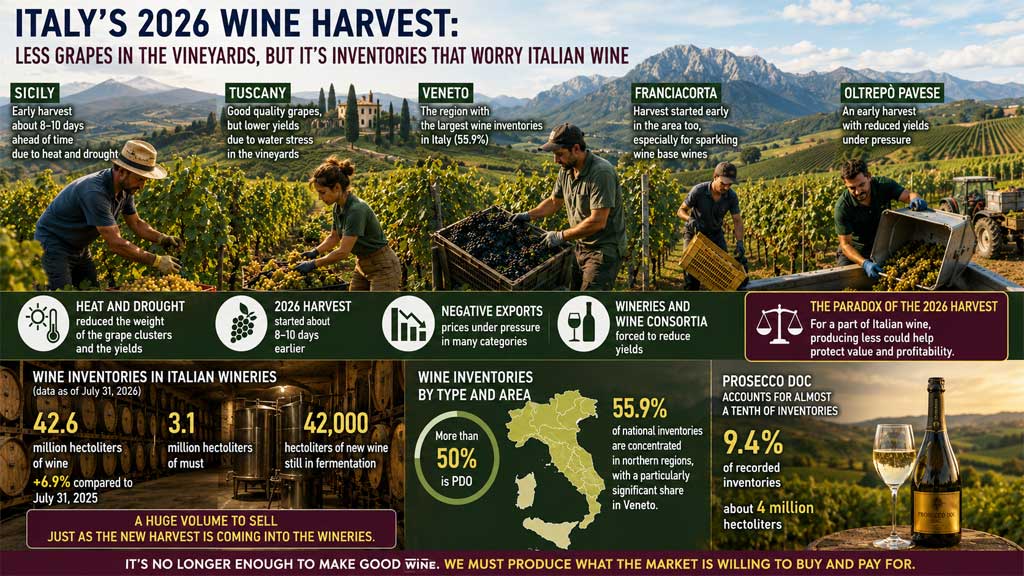
The case of Sicily is also highly relevant, capturing a national trend: declining domestic consumption, rising costs, and pressure on full cellars, but also strong competitiveness in terms of quality-price ratio and the preservation of territorial value. The Sicily brand continues to have great evocative power, supported by tourism, its international reputation, and highly attractive locations like Mount Etna. This teaches a clear lesson for Italian wine as a whole: strong, easily identifiable, and well-touted territories still have the power to attract, even in a challenging market environment. Where recognition exists, the product more easily maintains its market share. Where wine is perceived as a commodity, however, the difficulty increases.

At the same time, the sector is demonstrating a growing organizational capacity for responsiveness. The “Galassia – World Wine Network” project represents one of the most interesting signs of the week because it points to a concrete industrial and commercial direction: building synergies, sharing networks, combining expertise, increasing international coverage, and streamlining market presence without erasing the identity of individual brands. It’s a model that can have broader implications for Italian wine: in a time of compressed margins and complex markets, commercial efficiency and governance become as crucial as wine quality. Producing well is no longer enough; markets must be managed with structure, continuity, and vision.

Exports also remain a sensitive area, requiring close monitoring. The negative signals coming from both Italy to the United States and Spain in January 2026 suggest that the international wine trade is having a difficult start to the year, amid declining volumes, weakening demand, and broader economic tensions. For Italy, this does not mean a loss of centrality, but rather the need for greater strategic prudence: geographical diversification, strengthening less mature markets, maintaining premium status, and more targeted commercial investments are becoming essential. In a less linear international context, those who rely too heavily on a limited number of outlets are likely to suffer the most.

Financially and symbolically, the first quarter of 2026 for Liv-Ex offers encouraging signs. The recovery, though moderate and limited to fine wines, indicates that high-end Italian labels retain their appeal and confidence in the secondary market. Italy is performing well, especially in the more refined segments, with Barolo, Supertuscans, and other top labels showing significant recoveries. This figure doesn’t represent all Italian wines, but it is a useful indicator: the reputational value of top-of-the-line Italian wines remains solid and continues to strengthen the country’s international positioning.

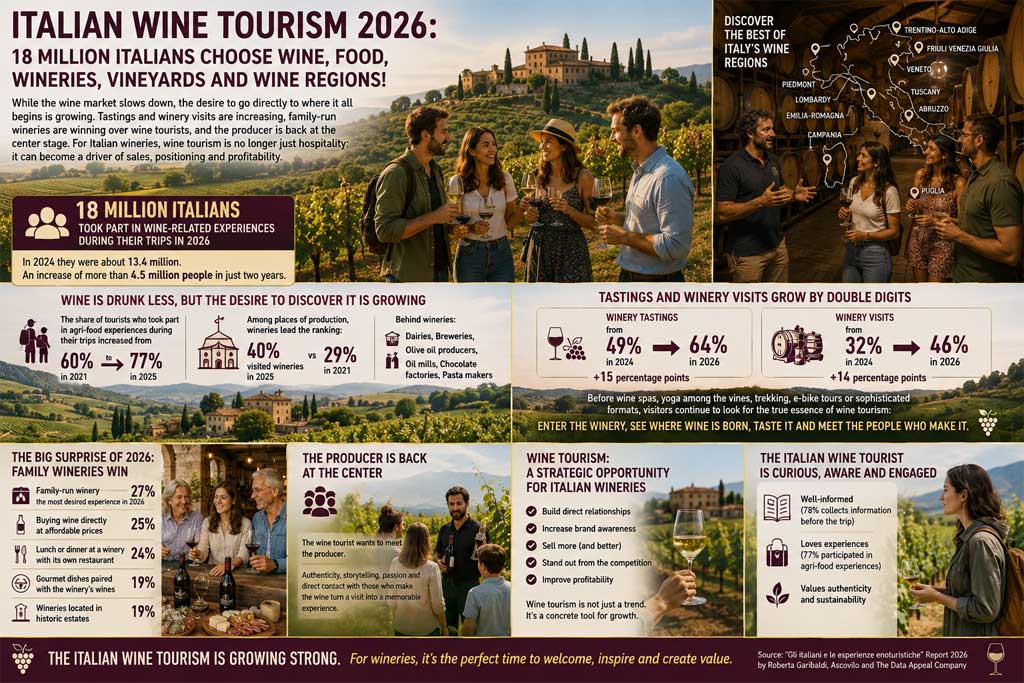
The most dynamic and perhaps most promising aspect, however, is wine tourism. This week’s data shows a clear acceleration: in 2026, an estimated 18 million Italians will be involved in wine-related experiences, a significant increase compared to 2024. But the real issue isn’t just quantitative. The way we experience the winery is changing. Visitors seek authenticity, human connections, winemaking families, landscapes, easy booking, diverse experiences, food and wine pairings, and quality hospitality. The winery is no longer just a place for tasting: it is becoming a commercial interface, a loyalty tool, a branding lever, and a direct sales and reputation channel. For many businesses, this means that wine tourism can no longer be an afterthought, but must become part of their business model.

Furthermore, the growth of wine tourism is intertwined with two key themes for the future: proximity and technology. On the one hand, it increases the potential of nearby destinations and local audiences; on the other, artificial intelligence is beginning to impact the customer journey, from research to inspiration to the personalization of the experience. This opens up a very interesting space for wineries that can combine authentic hospitality with digital tools. The risk, however, is thinking of monetizing experiences simply by raising prices without increasing their perceived value: the market clearly indicates that consumers are willing to spend, but demand consistency, quality, and a connection.

Overall, the week of April 6-10, 2026, therefore, depicts an Italian wine market that isn’t simply experiencing a slowdown, but rather a profound restructuring. Consumption is more cautious, eating out is less automatic, aperitifs are losing steam, costs remain a concern, and exports are off to a shaky start. But at the same time, signs of a new demand structure are growing: greater quality, greater identity, greater terroir, greater experience, greater sustainability, greater connections, and greater segmentation.

Wine press review for Thursday April 9 -2026

Italian wineries, Italian wine producers, and current wine news.

Italian wineries

Ornellaia, art and high-end at auction. Ornellaia brings “Vendemmia d’Artista 2023 – La Vitality,” signed by Marina Abramovic, to Bonhams with large formats and exclusive experiences. This move strengthens the brand’s luxury and international positioning, while also supporting philanthropic causes.

The journalist who chooses natural wine in the Matese area. Francesco Fossa, a television correspondent, is developing a micro-winery in the Caserta area, producing around 4,000 bottles annually. A small-scale, artisanal project with a distinctive identity and a distinctly unconventional feel, built with strong local roots.

Collis suspends Terre d’Oltrepò relaunch. The relaunch project promoted by Collis Veneto Wine Group for Terre d’Oltrepò has been put on hold, at least for now. The support received has proven insufficient to financially and operationally support the operation.

Pietramatta and Nove Lune at Vinitaly with amphorae and PIWI. The two Bergamo-based wineries of the Sala brothers will be presenting at Vinitaly in the “Amphora Revolution” area. The focus will be on cellar innovation, resistant grape varieties, the classic method, and experimentation with materials.

Terre Margaritelli is researching low-alcohol wines with the University of Perugia. The Umbrian winery is launching a scientific project using indigenous yeasts to produce wines with a low alcohol content without artificial intervention. This approach combines research, territorial identity, and new consumer trends.

Cantina del Taburno takes center stage at Vinitaly. The Rillo Group brings Cantina del Taburno and La Fortezza to Verona, with tastings focusing on Falanghina, Aglianico del Taburno, and Metodo Classico. This initiative aims to boost the visibility of the Sannio region.

Feudo Apiano, a new winery and territorial identity for Fiano di Avellino. Angelo Silano consolidates his project in Lapio with a new winery and a focus on the Fiano crus. This consistent growth enhances technical expertise, terroir, and niche positioning.

Monte Maletto and the mountain Carema. The spotlight is on the wines of Monte Maletto, a young winery already recognized for its stylistic precision. The Carema stands out as a mountain Nebbiolo, more slender, taut, and spicy, with a strong territorial personality.

Italian wine and Italian oenology

Restaurant wine and the markup issue. The gap between the new wine market and the old restaurant model is growing. Premiumization holds up on the value side, but the menu markup system risks penalizing consumption, rotation, and affordability.

Agriculture in Sicily, nearly €100 million for generational turnover. The Sicilian Region has published the provisional rankings for calls for applications for young and new farmers. This is an important measure to foster new entrepreneurship and innovation in agriculture.

Vineyard defense strategy: starting well makes all the difference. Early management of the growing cycle is considered a crucial tool for preventing downy mildew, powdery mildew, and botrytis. Early prevention remains key to yield, physiological balance, and final quality.

Altroconsumo’s best white wine under €10. Of the 48 wines tested, the Zavalloni Romagna Albana Secco DOCG 2024 stands out as the best buy. Among the organic wines, the Antonelli San Marco Montefalco Grechetto DOC 2024 stands out.

Italian wine can still innovate. According to Fabiola Sfodera, the Italian wine industry has already demonstrated its ability to respond to crises with innovation in quality, communication, and technology. In a more selective market, growth will come from quality consumption and value.

Wine e-commerce on the rise: more searches, greater attention to quality and affordability. In the first quarter of 2026, wine searches on Trovaprezzi.it increased by 10%. Sparkling wines dominate, followed by reds and whites, while interest in premium labels and more informed purchases is growing.

Agivi: dealcoholized products and AI should be integrated, not tolerated. Young wine entrepreneurs see dealcoholized products and artificial intelligence as tools to be carefully incorporated into business strategies. The key is not replacing traditional wine, but expanding the offering and improving efficiency.

2026 still complex, but premium and youth markets open up. Market analyses indicate a still challenging scenario, but with encouraging signs: premium segments holding up, interest from young people, growing attention for no/low alcohol and sustainability.

International

Bollinger opens its new cellar and begins its journey toward its 200th anniversary. Maison Bollinger inaugurates a new production facility in Aÿ, described as one of the most significant transformations since its founding. This investment combines prestige, architecture, and brand continuity.

Dom Pérignon relaunches three key vintages of its style. The new 2017 releases, Rosé 2010, and Plénitude 2 2008, showcase the maison’s dedication to maturation and stylistic coherence. This initiative reinforces the brand’s legacy and the value of time in the cellar.

The EU compromise on Australian Prosecco divides producers. The European agreement allows for a transitional use of the DOC and IGP labels in Australia, with a planned end in ten years. This delicate compromise leaves open tensions on identity and commercial levels.

From Lebanon, Sept Winery, blocked by the war, issues an appeal. The Lebanese biodynamic winery denounces its inability to travel, export, and attend international trade fairs due to the conflict. A powerful reminder of the need for productive survival in crisis-stricken areas.

Chiara Pepe from Abruzzo to Hermitage. Emidio Pepe’s winemaker will lead the viticulture and winemaking operations at Domaine de La Chapelle in Hermitage starting with the 2026 harvest. This represents an internationally recognized recognition of Italian expertise.

Spain opens 2026 with a decline in wine exports. In January 2026, Spanish exports fell 15.1% in value and 21.4% in volume. This figure confirms the fragility of the international wine trade at this stage.

Wine events

Natural wine: sustainability, wellness, and new audiences. With Summa, ViniVeri, and VinNatur Tasting, April remains a key month for natural wine events. The connection between sustainability, local culture, and engagement with discerning wine lovers is growing.

Vinitaly 2026: Sicily presents 164 wineries. The Sicilian group focuses on biodiversity, organic products, and native grape varieties with dedicated panels and masterclasses. The island’s presence in Verona confirms a high-intensity promotional strategy.

“Viva – International Wine Exhibition” in Vicenza On April 12th and 13th, Vicenza will host over 70 European producers, talks, masterclasses, and a food area. This event focuses on natural, organic, and sustainable wines, with strong urban and regional roots.

The 10 wines not to be missed at Vinitaly according to Giancarlo Gariglio. The classic selection of must-see wines at the fair returns. A useful tool for orienting professionals and enthusiasts among the pavilions, emerging labels, and trends to be identified.

Casa Toscana debuts at Vinitaly with an institutional stand. For the first time, the Tuscany Region will be present with its own official space. The strategy aims to unite large consortia, lesser-known territories, small producers, and heroic viticulture in a unified narrative.

Vinitaly: Verona nears a sell-out, ministers expected, and large attendance. The city is preparing for a major economic and media impact, with 4,000 exhibitors and 97,000 trade visitors expected. The event confirms its position as a key platform for Italian wine.

Vinitaly and the City lights up Verona from April 10th to 12th. The Fuorisalone will enliven the historic center with over 70 events including tastings, mixology, art, and wine regions. This increasingly strategic format expands audiences beyond the trade fair business.

The Valdobbiadene DOCG Show turns 70. The seventieth edition of a historic event for the Prosecco Superiore region opens in Col San Martino. Local involvement is strong, including among the younger generations.

Strategic Summary of the Day: Today’s review shows a sector that remains under pressure, but continues to respond with three specific levers: premiumization , production innovation , and experiential positioning . On the one hand, concrete critical issues emerge regarding exports, restaurant margins, and the sustainability of certain supply chain models; on the other, positive signs are emerging regarding low-alcohol products, scientific research, events, natural wines, and the ability of Italian regions to better present themselves to the markets.

Thanks for listening, we remind you that today’s wine press review was brought to you by WINEIDEA.IT .

See you tomorrow.

Style Selector
Select the layout
Choose the theme
Preset colors
No Preset
Select the pattern